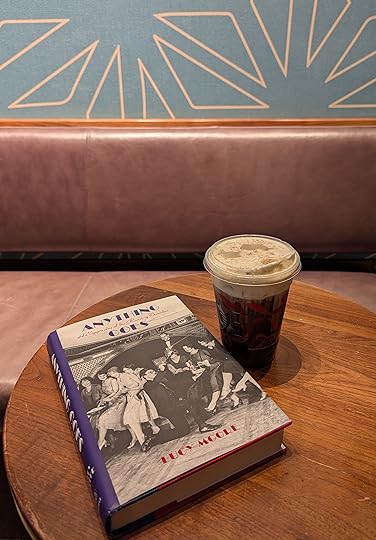
This is an exhilarating portrait of the era of invention, glamour and excess from one of the brightest young stars of mainstream history writing. Bracketed by the catastrophes of the Great War and the Wall Street Crash, the 1920s was a time of fear and hedonism. The decade glittered with seduction: jazz, flappers, wild all-night parties, the birth of Hollywood, and a glamorous gangster-led crime scene forced to flourish under prohibition. It was punctuated by terrifying events—the political show trials of Sacco and Vanzetti; the huge march down Washington DC's Pennsylvania Avenue by the Ku Klux Klan—and produced a glittering array of artists, musicians and film stars, from F. Scott Fitzgerald to Bessie Smith to Charlie Chaplin.
Here, Lucy Moore interweaves the most compelling stories of the people and events that characterized the decade to produce a gripping account of an often-overlooked period. In doing so, she demonstrates that the jazz age was far more than just 'between wars'; it was an epoch of passion and change—an age, she observes, that was not unlike our own. The world she evokes is one of effortless allure and terrifying drama: a world that was desperate to escape itself.
Librarian Note: There is more than one author by this name in the Goodreads database.
Lucy Moore was born in 1970 and educated in Britain and the United States before reading history at Edinburgh University. She is the editor of Con Men and Cutpurses: Scenes from the Hogarthian Underworld, and author of the critically acclaimed The Thieves Opera: The Remarkable Lives and Deaths of Jonathan Wild, Thief-Taker, and Jack Sheppard, House-Breaker (Viking 1996) as well as Amphibious Thing: the Life of a Georgian Rake (Viking 2000) and Maharanis: The Lives and Times of Three Generations of Indian Princesses (Viking 2004). Maharanis has been reprinted six times, was an Evening Standard bestseller, and the top selling non-fiction title in WH Smith on paperback publication in summer 2005.
Lucy is a regular book reviewer for the Observer and the Sunday Times. In April 2001, she was voted one of the 'Top Twenty Young Writers in Britain' by the Independent on Sunday and in the 'Writers' section of the New Statesman's 'Best of Young British' issue.
Television presenter work includes Nelson for Great Britons (BBC) and Kings in Waiting: Edward VII (BBC) plus a number of talking head appearances.
2.75 stars “a professor of sociology asserted that “the most dangerous weakness in a democracy is the uninformed and unthinking average man.” Lucy Moore is a writer of “popular histories” and this is no exception. She has produced a history of the US in the 1920s. A huge canvas. She manages it by the simple expedient of producing a chapter on a series of topics. The sweep is broad and there are chapters on: business, the Crash, Prohibition and organised crime, film, Jazz, Hollywood, the Ku Klux Klan, politics and particularly Harding, Lindbergh, sport (especially boxing and Jack Dempsey), the literary scene (an excess of Fitzgerald), immigration, labour unions, the rise of the motor car, evolution vs creationism and the infamous trial and much more crammed in between. It is readable and very anecdotal with very little that cannot be found elsewhere. It does feel like a first year university student’s attempt at it, following the adage “let’s cram everything in” (in terms of topics). As a result of there being so many areas covered, there is no real depth. Certain characters are focussed on: Al Capone, Charlie Chaplin, Mary Pickford, Jack Dempsey, Warren Harding, F. Scott and Zelda Fitzgerald, Charles Lindbergh and many others. There are occasional flashes of insight which raise it from the really dire: “So many aspects of the Jazz Age recall our own: political corruption and complacency; fear of outsiders; life-changing technologies; cults of youth, excess, consumerism and celebrity; profit as a new religion on the one hand and the easy availability of credit on the other; astonishing affluence and yet a huge section of society unable to move out of poverty.” However the very number of areas under consideration mean that nothing is covered in real depth. There are a few errors scattered around. But if you know nothing about the US in the 1920s you will learn a good deal.
Oh, the 1920s. One of the most famous decades in American history, known for flappers, expats, and excess, all ending in the hush of the financial crash. Anything Goes is Lucy Moore’s so-called “biography” of the decade, though it’s much more a collection of snapshots that together give a sense of the years (but I suppose the publisher found that to be far less sexy as a title). The topics range from Prohibition to literary figures, political scandal to the emergence of jazz. While the book does give the reader an overview of the era, taking on such a subject is quite a feat, and any resulting book was bound to feel at least a bit scattered, as this tome ultimately does.
And while Moore provides a perfectly serviceable prologue, the book lacks a true concluding chapter. Nonfiction that leaves me off on the final topic without any attempt at reflection is the worst kind of cliffhanger; if the author can’t quite summarize what they’ve spent so much effort assembling, it’s hard not to question whether my own time with the book was well spent.
The decade itself is endlessly fascinating. This book? Occasionally so. But it’s probably more rewarding to pick a specific facet of the '20s, find a book that zooms in on it, and read that instead.
I thought this would be more of a social history of everyday people, but basically it's a collection of short overviews of the things in the 1920s that everyone has already heard of anyway--Al Capone, Henry Ford, the movie industry, etc. At least I thought it would be a fun refresher course.
Then things started to be noticeably different from other, well-researched books I'd read. First it was a bit about Charlie Chaplin that sounded different than I remembered from the biography I read, but I just assumed that I remembered that wrong. Then the author went on to state that "trade [which should be labor if one is writing about the US] unions had all but disappeared" in the 1920s. I knew that sounded wrong--especially after reading a great book about the Pullman Porters and the establishment of the first black labor union--the Brotherhood of Sleeping Car Porters--in 1925. That sounds pretty visible to me. Then the author went on to talk about how much money everyone suddenly had. Sort of true and sort of not. Everyone had CREDIT and people were dabbling in the stock market on margin, but real wages had not risen as fast as profits and the prosperity was not universal. Trusts and monopolies operated to fix wages, and 40% of Americans were living below poverty line. Black farm workers lost jobs throughout the 1920s. Overall GDP rose, but--as has been so repeatedly paralleled with the 2008 crash--it was the top earnings that skyrocketed, not the overall earnings.
Not even being halfway through the book, I completely lost interest by the time I was 2 pages into her chapter on American business. She misses connections--like the farm slump being tied to farmers maintaining the production of the war years but without the war-time demand (with their plowing more and more prairie under for farming which would result in the Dust Bowl) rather than storage, and makes some leaps and huge generalizations that don't even make sense. I still can't figure out what she's trying to say about Rotary and Kiwanis, which is interesting as I was a Kiwanian for about 15 years. Even the most cursory of internet searches disproves the author's portrayal of Warren G. Harding, or at best makes it "highly suspect." The consensus seems to be that he had 4 affairs during his marriage--hardly the sex maniac that Moore makes him out to be. That disappoints me--I was thinking a lot of high school kids would start taking a MUCH bigger interest in American History than they currently do.
For what started out as a promising book, this turned out to be a badly-researched and deeply flawed book that ultimately had no point.
It was an enjoyable read. But I have to question my enjoyment since it did sit on my shelf for about 7 years. I was about 1/3 into it and I put it on the shelf, whether on purpose or by accident. Maybe there was just another "shiny" new book that attracted my attention.
Fairly informative, kind of gossipy.
Touches on most aspects of the '20s - Harlem Renaissance, white people slumming in Harlem (not appreciated by the residents), the revamp of the Ku Klux Klan (Indiana has a lot to answer for), the Scopes Trial (again, a book that draws heavily on Edward J. Larson's Summer for the Gods: The Scopes Trial and America's Continuing Debate Over Science and Religion, so again I shall have to delay picking that book a while more), the literary scene - including the Algonquin Round Table.
Interesting to find out that President Harding (who had so many things going against him) was in favor of a federal anti-lynching law but was turned by Southern lawmakers. (There were rumors for years that he had African-American blood in him. Don't believe this was ever confirmed yea or nay.)
And, of course, the Crash.
For those who have any interest in the Roaring Twenties, this may be a good book to start with. Includes a decent Bibliography.
Not the greatest work of history I've ever read. It's entertaining and readable enough, but that's more a result of the subject than the actual content. The Twenties was a decade that is hard to make boring.
Moore takes a thematic approach rather than chronological, organising her chapters by topics such as celebrities, movies, sport, architecture, literature, politics. I'm not sure the approach works - it makes it much more a superficial, 'potted' history rather than anything approaching any kind of depth, and there's very little analysis of why the Twenties were the way the way they were, whether it was a reaction to the horrors of WW1 or something else.
But as I said, it's not boring. The pages are full of characters like Babe Ruth, F. Scott Fitzgerald, Jack Dempsey, Charles Lindbergh, Al Capone: flappers and mobsters and heroes and villains. It's a light fizzy read with little substance to it. Much like the Twenties, I would imagine.
This book really was "just okay." It wasn't particularly cohesive--basically just a number of biographical essays on famous individuals from the '20s strung together without a coherent theme. It wasn't footnoted or well-researched, either. At one point in the bibliography the author notes that "as far as she knows" there is only one major work on Zelda Fitzgerald--as though she couldn't be bothered to check for sure. For a more well researched, better written, and generally more exciting read on the 1920s, I'd opt for Joshua Zeitz's "Flapper." Incidentally, that book also contains a cohesive central argument, which "Anything Goes" is pretty seriously lacking.
Long book. A fascinating glimpse at a bygone era, and an era whose echoes can instruct in our current time. It is chilling reading about the rise of the KKK and seeing in that account the dangers of the current right wing fanaticism.
Readable, well organized. Ms. Moore has presented an accessible history. It is a survey for the casual reader and hopefully a jumping off point for someone with deeper interests and curiosities.
If you’re looking for an overview of the 1920s that is both comprehensive and accessible, then Anything Goes has it all. Lucy Moore provides a solid overview of the decade’s major moments and trends, whether it be the arts (the Harlem Renaissance, Hollywood), business (the auto boom, the Wall Street crash), politics (the rise and fall of Warren G. Harding, William Jennings Bryan and the Scopes Trial), entertainment (boxing, Charlie Chaplin), literature (F. Scott Fitzgerald, The New Yorker), crime (the Vanzetti trial, Al Capone, the reemergence of the Klan), tech (radio, aviation) or other major culture topics (flappers, Prohibition). The Roaring Twenties was a time of unprecedented prosperity and social change, generating both excitement and anxiety as the country quickly urbanized and began to transition into the modern age. Preferring to look forward rather than dwell on the scars of the First World War, many Americans found themselves with more time and money than they had before, and the introduction of movie theaters, sports radio, and cars created mass cultural experiences that helped forge a unifying American culture. All this happened in tandem with vast demographic changes marked by postwar immigration and the Great Migration of African Americans from the rural south to the urban north and Midwest. Businessmen were regarded with the same reverence as tech titans were in the 2010s, and it was a good time to be young and ambitious, at least until the end of October 1929.
This is a popular history, so Moore doesn’t bother with footnotes, instead providing a bibliography and a section on recommended reading at the end of the book. For most readers, this will likely be a plus, but for anyone who is in the history field (or just likes details), it can be a bit frustrating. Moore cites many facts and figures that can’t be traced to a specific source, and unfortunately, based on what I found online, it looks like she got some of the dates wrong. (For whatever reason, she also writes dates in military format.) I enjoyed the way each chapter read like its own mini-history book about a specific topic—the rise of the mob, Charles Lindbergh’s cross-Atlantic flight, Teapot Dome—but there were a few parts that could have been trimmed and cut. Moore’s exploration of the Lost Generation’s hedonism enriches the cultural history at the heart of this book, but we didn’t need, for example, an entire chapter about Harry Crosby and the other disillusioned expats he kept company with who ultimately contributed very little to American culture or history.
This is compounded by the other topics Moore overlooks. As entertaining as the chapter about Hardings (the original Bill and Hillary ) and their dysfunctional marriage was, Calvin Coolidge was president for most of the 20s, but is only mentioned sparingly. For the amount of focus Moore allocates to demographic changes, she says very little about the Immigration Act of 1924, which severely restricted the flow of immigration into the country, and doesn’t mention the Indian Citizenship Act at all. America’s changing role in world—namely the decision to embrace isolationism in the wake of WWI—is never made explicit, despite how it contributed to the social climate and the future trajectory of the country. At the same time, I can’t fault the author for narrowing the scope a bit, given just how much content she managed to include. The critiques I have are all fairly minor when compared to the whole, which is a fluid and engrossing summation of a period in history that is both iconic and frequently overlooked.
Enjoyable analysis of American popular culture in the 20s. Crime, political corruption, the arts, the Ku Klux Klan, prohibition and the Wall Street Crash are all explored in a readable and accessible way and the Lucy Moore makes the parallels between their world and ours very clear. I will definitely read more by her.
The first half of this book is excellent. Moore has a knack for weaving historical detail into a coherent narrative, telling the story of the Roaring Twenties. Her portrayal of Zelda Fitzgerald--as a woman who turned to hedonism as an escape from inner despair--was especially poignant. I didn't know much about the Fitzgeralds before I read that chapter, but I do not hesitate to say that it was the first time I encountered them as people. Moore's sweeping portrait of the jazz scene--as one of rebellion and despair and joy all rolled into one--was also excellent. If I had to recommend this book, I would recommend reading the first half. What would be a good stopping point, you ask? Why, the chapter "Fear of the Foreign," in which she spends a considerable amount of time on the Sacco and Vanzetti case.
Now, I am no expert on that case. I know more than some, less than others, and not as much as I would like. It's a historical mystery, and a tragedy as well--one that resulted in the execution of two potentially innocent men. Note the first word: potentially. As in, their guilt or innocence has still not been determined over eighty years later. If I were handling this case, I would stick to the facts, incorporating views from both camps, and end the chapter with a note that while the case is still shrouded in doubt, it continues to be as divisive today as it was in 1927.
Moore does not do this. Instead, she takes the opportunity to add as much preaching to her narrative as she can muster. This is not a "failure of the justice system" case; it is not a "we don't know what happened and we may have erred on the wrong side" case; it is not a "Judge Thayer went against popular opinion, and in this case popular opinion may have been correct" case. In Moore's hands, it is a clear-cut case of good and evil. Everyone who allied with Sacco and Vanzetti were Good; everyone who allied against them is Evil. And Racist and Xenophobic and probably a Fat Cat Capitalist, too.
I can accept that Sacco and Vanzetti were good men. I can even accept that they were innocent. But in quoting heavily from their supporters--and from the men themselves, who earnestly proclaimed their innocence and their faith in their ideals--Moore glosses over the most important fact of all, which she states earlier in the chapter: The year 1919 saw many labor strikes, some of which became violent, as well as anarchist protests.
Like bombings.
As in, blowing up buildings.
That's the kind of thing that strikes fear into the hearts of....oh, every person who values their life. To a person in 1919 or 1920, it probably seemed as though anarchists were trying to take over the country--after destroying it, of course! What would YOU think if multiple buildings were bombed by people who claimed "Long live anarchy!" I'd be terrified. And since Sacco and Vanzetti were anarchists...well. That certainly puts a damper on Moore's claim that everyone who opposed Sacco and Vanzetti were unabashed racists, doesn't it? Add this to the fact that after their execution, many more protests took place, including bombings of American embassies in Rome, Paris and Lisbon. "People involved in their conviction--the brother of the garage owner who had informed on them, Governor Fuller who had refused them clemency, one of their jurors, the executioner, Judge Thayer himself--were the focus of specific violent attacks. Thayer's home was destroyed and he spent the rest of his life living under permanent guard at his club in Boston." (Pg. 182)
Those facts do not seem to support Moore's thesis that Sacco and Vanzetti were members of a good-hearted group working to free lower-class Americans from oppression; they support Thayer's implied thesis that they were members of a militant group that did not hesitate to use violence to support its ends, heedless of how many lives were lost or property destroyed along the way. Did Thayer deny evidence that could have exonerated them? Most likely, and there is no excusing that. Were the men of the jury who convicted Sacco and Vanzetti racist? I'm sure some of them were. But it seems more probable that Thayer and the men responsible for Sacco and Vanzetti's conviction were terrified of anarchy and the violence it seemed to embrace. So rather than releasing them because they were not guilty beyond a reasonable doubt, they convicted them--because there was considerable doubt as to their innocence. It was a failure of the American justice system, not a case of blatant racism. Had Sacco and Vanzetti been whiter-than-white descendants of Mayflower Pilgrims, I don't think the outcome would have been any different.
Moore doesn't even consider this idea. Instead, she brands everyone who opposed Sacco and Vanzetti an Evil Racist Pig, and labels everyone who supported them Intellectual and Enlightened and Compassionate Toward the Ninety-Nine Percent. Everyone in the middle becomes a Passive Supporter of an Unabashedly Racist Regime that killed Kindhearted Immigrants who Just Wanted to Spread Joyous Anarchy to the Little Children. Excuse me while I vomit.
In short, this book goes from fascinating to disgusting in the space of a single chapter. It's not disgusting because she sides with Sacco and Vanzetti, or even because her sympathies so clearly lie with the anarchists of the 1920s. It's disgusting because she deliberately twists facts to suit her worldview. It's disgusting because she takes a perfectly legitimate fear--the fear of being blown to smithereens by anarchists who were often from Italy--and turns it into "EVERY1 IN THE 1920S WAS SUPER UBER RACIST AND TAHT'S RONG!!!!!11!!!!!1!!! IF U DONT BELEEVE ME GO JOIN THE KKK!!!!!!" She doesn't consider other factors--factors that, if incorporated, would make for a much more balanced and honest history.
I listened to the audio book and it is very interesting. It is interesting for many reasons and one because it is 2024 when I chose to listen to the book, nearly half-way through the 20's decade of this century and this book is about the 20's decade of a century prior.
The history of the 1920's contains many things of which I was completely unfamiliar, like Martin Luther King, Jr. being born in 1929, the KKK was formed in this decade, Hollywood started in this decade and there were also many people who died from drug overdoses, mainly from opioids which we are still seeing, only more so now, 100 years later. Flying became popular in the 1920's and prohibition happened in the 1920's as did the rise, and fall, of Al Capone.
a fun and informative popular history of the 1920s; a good starting point for those interested in the era. i especially appreciated the smooth transitions between the topics/chapters.
This is the 1920s in America and I thought the book gave a good overview of the good and bad of the decade. Each chapter deals with a different topic such as: Chicago and its gangsters, music and dance (Charleston and the blues); religion and its impact on law and society; cars and the introduction of the modern factory (and labour laws) and the stock market and great crash to end the decade.
Much of this decade with its great changes in society and technology seems familiar even today. The financial excess and great divide between rich and poor in a society whose rich were decadent and self-destructive and proud of it.
This was an era when there was minimal government regulation and intervention in lives of employers and labour laws were virtually non-existant. If you want to see what your life would be like without the improvements unions have bought into our lives in the years since you only have to look at this decade.
While unions in many cases (where they became too powerful and rich) eventually caused their own destruction books like these make you realise how people who want to go back to a nirvna of "little government" have already had that and while it was great if you were at the top of the pile for everyone else it was a jungle-like environment. Overall, this was a worthwhile read I thought.
I can see lots of negative reviews but I wonder if they are down to the fact that the writer isn't actually American. Anyway, I enjoyed it. I love reading about America and I love reading about the 1920s. Plenty of the 'cast', I had read about before - the Fitzgeralds, Chaplin and the Lingberghs etc - but it was my first time to read about the likes of Al Capone and Jack Dempsey. I was surprised not to see screenwriter, director, writer Francis Marion's name in the chapter about her best friend Mary Pickford. In an case, this was a very accessible and easy read.
The Roaring Twenties seem like a long time ago (and literally they were a hundred years prior to our current moment), but also super close to our own time and relevant to the many times we've gone through extraordinary highs only to experience deeply unpleasant lows (to my way of thinking, the Nineties are defined by a sort of can-do exuberance undone by the shocking events of 9/11, in the same way that the Twenties ended with the stock-market collapse and the onset of the Great Depression). I've long had a fascination with aspects of the popular culture at the time, and so this book seemed like a natural for me to read.
"Anything Goes: A Biography of the Roaring Twenties" by Lucy Moore, is a sort of cheat-sheet history of some of the different aspects of the decade that saw America embrace hedonism and excess in ways that we'd never done before (and to some extent never would again). It's not a deep, exhaustive tome about the various social movements that defined that time, but that's okay. I have another book about the Twenties ("America In the Twenties") that I'm meaning to read asap, so I'll probably look to that to be more informative overall. But while "Anything Goes" isn't the deepest book on the subject, it's enjoyable in its own right.
Moore details some of the figures and moments that made the decade so memorable, from Al Capone and F. Scott Fitzgerald to Jack Dempsey and Charles Lindbergh. Her book mixes the high and the low, from the Scopes Monkey Trial to the scandals surrounding the Harding Administration. As I said, it's not a particularly deep book (and there's the glaring error of calling Memphis the capital of Tennessee when talking about the Scopes trial), but it's entertaining in the way that popular histories can be.
I was originally unsure if I'd finish this book because I found the opening chapter on Capone to be a bit too light and breezy (and because I'd looked at some of the reviews here for the book, which are mostly unfavorable). But I got sucked in and kept on reading, which means that this book is certainly entertaining. I paid a couple of bucks for it at the local library's used book sale, so I'm not out too much and I enjoyed it overall.
This was an entertaining overview of the 20s. Not in-depth, but a decent jumping off point to inspire further reading on the Jazz Age. All the parallels between then and now are especially interesting. This quote from the prologue addresses those similarities:
"So many aspects of the Jazz Age recall our own: political corruption and complacency; fear of outsiders; life-changing technologies; cults of youth, excess, consumerism and celebrity; profit as a new religion on the one hand and the easy availability of credit on the other; astonishing affluence and yet a huge section of society unable to move out of poverty. Perhaps we too are hurtling towards some sort of catastrophe, the effects of which will evoke those of the crash of 1929. After all, as history so often reminds us, there is nothing new under the sun."
Anything Goes was published in 2010. I'd like to think we've had our crash, and are in recovery.
An entertaining light history of the 1920s. Covers a lot of the same territory as Law’s excellent Only Yesterday, but with modern, accessible flair, focusing heavily on popular culture. Read this in concert with Only Yesterday and you’ll have a great, well-rounded overview of the era.
This was an interesting book that consisted of fourteen chapters, each one detailing an important person or event of the 1920s. The first chapter focused on Al Capone. The second explained the development of jazz music. The description of the Fitzgeralds, especially that of Zelda, helped me better understand the backdrop of The Great Gatsby. Movie theaters and their development are explained in chapter four. The next chapter explains President Harding and his impact on the country. Page 147 explains, “Many industries boomed in the 1920s, but one stands tall above the rest: the automotive business.” The next chapter is entitled “The Fear of the Foreign” and traces the arrival and eventual death of Bartolomeo Vanzetti. Chapter eight explains the rise of the Ku Klux Klan. Page 230 describes, “Harry Crosby was by no means the most talented writer of his generation, nor the most representative, but he encapsulates so many of the things that inspired his peers: the feeling of alienation, the desire for self-expression and freedom, the conflation of pleasure and happiness, the philosophy of living for the moment, the pagan worship of the body, the belief that by continuing to move one would find meaning.” With this in mind, the author explains the term the “lost generation” and puts so much into an understandable context. The next chapter focuses on the literature and development of magazines, with specific references to “The New Yorker.” The debate about Darwin’s theory of evolution and what should be taught in schools follows. Chapter twelve focuses on Charles Lindbergh and the development of air travel. Jack Dempsey and the money making appeal of boxing are the focus of chapter thirteen. The final chapter explains, “The greatest and last triumphs…..may well have been skyscrapers, the radiant symbols of energy, wealth and modernity for 1920s America (p. 317).” Specifically mentioned is The Chrysler Building in Manhattan, where the small space forced building up instead of out.
Overall, this was a fun and interesting book to read. I knew some of the material, but not all of it. The author did a good job of weaving separate important people and events into a coherent book about a much referenced decade. Reading this book in 2022, I did ask myself how much has changed, and how different would a book written about 2020 really would be. This was a good history book for someone like me, a person who wanted an enjoyable and not overwhelming book about the past to better understand the present.
Reading Lucy Moore's book made me realize that a lot of what we associate with America in the 1960s was present in the 1920s. Hedonism, openness to African-American culture, sexual experimentation, the glamour of intoxicants, the cult of celebrity, intellectual ferment, new technologies, political corruption, a sneaking fondness for violence, shell-shocked veterans, the desire to "drop out," and an almost suicidal cult of youth (Think of Roger Daltry singing "I hope I die before I get old" a few decades early). Also a feature of both decades: stubborn poverty amidst plenty, and a conservative backlash from old-boy elites and pious country folk alike, often more than a little tinged with racism. But the analogy isn't perfect: Missing from the 1920s were the idealistic political activism of the 1960s and, of course, the Vietnam War.
I didn't make the connection before now for two reasons. First, I associate the 1920s with my grandparents, who were very old when I knew them; they and their milieu seemed worlds apart from the 1960s, which was closer to my own time. But more importantly, I suspect that the memory of the lighthearted, high-flying 1920s is obscured by what came next: a global depression and a world war, much grimmer, unhappier times.
A word of warning before you begin this book: It's exclusively about the United States, with only a bit about some celebrity English expatriates and some Americans who temporarily sojourned in Europe. That's not a bad thing, particularly since the first half of the twentieth century is arguably when the United States reached a peak of power and influence. But if you want to read about, say, the Bloomsbury Group, the efflorescence of Weimar Germany, the origins of Italian fascism, developments in the newborn Soviet Union, or more than a few details about interwar Paris, you'll have to go elsewhere.
I was genuinely surprised by some of the “meh” or outright negative reviews of this book, which I thought was fresh and vivid and fun to read. It’s hard to condense a number of dense, complicated topics (e.g. jazz, the Scopes monkey trial, the Sacco Vanzetti case, the rise of skyscrapers) into succinct, readable chapters but this book did it unusually well for me. And I found the writing lively and entertaining. It kept me engaged even with topics that don’t usual interest me.
I wonder if some of the negative reviews are because of the broader objective of the book — to provide a broad overview of an entire decade in one book. If you want to go into depth (or have in the past gone into depth) on any of the topics covered, you’re likely to find the content here rather brief. But that’s what an overview book does. If you want to read a rich, fully complex history of the growth of movies in the 1920s, this isn’t your book. But if you want a nicely summarized account of the major issues involved with the growth of the movies in the 1920s — put in the context of other major events occurring in the U.S. at the same time — this is a great pick.
I can see this book being a wonderful intro to the decade for college students, or any general reader looking for a broad overview.
I have a long held fascination with 1920s America. I can’t pinpoint its origins, whether it was a movie I watched growing up (I’m a 2nd generation cinephile) or a book. Either way, Lucy Moore’s biography of the Roaring Twenties ticked all my boxes, and then some!
She took me from Al Capone’s home to the origins of jazz in Chicago nightlife, to the first waves of feminism, to the debauchery of Hollywood with words. I loved it!
She even managed to walk me through a whole chapter on the KKK, a topic I had been consciously avoiding because of its potential to trigger my sense of justice.
The book’s so good, I can’t pick a favourite chapter. A lot of the major ones came through with their bits of information about a time I can only wish to have been a direct observer of.
All in all, if you’re looking for a book that will somehow run you through the feelings of disgust, awe, excitement, fantasy through the lens of a defining time and place in modern world history, this is definitely up there in my list of recommendations.
As others have noted, the book starts off pretty good, but then just drops into almost unreadable, gossipy, poorly-researched rubbish. More often than not, it comes across as a self-published, glorified term paper. Some GLARING issues: teenagers in the 1920s borrowing the family car to visit friends(?); central figures whose names seemingly changed from paragraph to paragraph; and my favorite: constant reference to "Middletown," as if it is a legitimate U.S. city, with no explanation as to the origin of the concept.
There are countless books about the 1920s, and an equal number of biographies of the people who lived through the decade. I would recommend reading any number of those for a better, less biased, more educated look into a truly fascinating period in history.
This book had some great stories, but it all centered around Al Capone for most of them and I wanted something that really got into the history of the 20's which I didn't think this book did very well.
The best overview of the 1920's I've read. Thorough research into all the factors that made the 1920's such a pivotal time in history and you can see a lot of links with what happened in the first decade of the 21st century. It was like reading recent history in many ways. I highly recommend this book.
I received this from a friend, as I am interested in that period. Really fascinating accounts of crime in Chicago and good portrayal of Al Capone. My only criticism so far is that it is all set in the US. Still it got me playing some old Bessie Smith songs, which is a very good thing.