

What do you think?

Under-Earth
The inmates of an extensive underground prison struggle to build meaningful lives in a broken system, in the most ambitious graphic novel to date from rising indie star Chris Gooch (BOTTLED and DEEP BREATHS). Under-Earth takes place in a subterranean landfill, hollowed out to serve as a massive improvised prison. Sunken into the trash and debris of the past—Gameboys, iPhones, coffee cups, old cars—we follow two parallel stories. In the first, a new arrival struggles to adapt to the everyday violence, physical labor, and poverty of the prison city. Overwhelmed and alone, he finds a connection with a fellow inmate through an old, beat-up novel. While these two silent and uncommunicative men grow closer thanks to their book, the stress of their environment will test their new bond. Meanwhile, a pair of thieves pull off a risky job in exchange for the prisons’ schematics and the promise of escape—only to be betrayed by their employer. On the run with their hope for escape now gone, the two women set their minds to revenge. Yet as they lay their plans, their focus shifts from an obsession with the outside world to the life they have with each other. Equal parts sincerity and violence, Under-Earth explores humanity’s inextinguishable drive to find meaning, connection, and even family—and how fragile such constructions can be.
571 pages, Kindle Edition
First published November 10, 2020
About the author
Chris Gooch
21 books46 followersChris Gooch (b. 1993) is a cartoonist based out of Melbourne, Australia.
Ratings & Reviews
Friends & Following
Create a free account to discover what your friends think of this book!
Community Reviews
Displaying 1 - 30 of 106 reviews

February 7, 2021
In a hollowed-out landfill sits a horrific prison city teeming with prisoners and Stormtrooper-esque guards. The latest inmate, the hapless Reece, luckily stumbles across a friendly giant, Malcolm, and the two become friends - but will their friendship withstand the brutal prison culture? Elsewhere, a pair of thieves plan one last heist for a map out of this place in a desperate attempt at freedom.
Aussie cartoonist Chris Gooch’s third book, Under-Earth, is an ambitious, nearly 600-page comic that wasn’t as good as I’d hoped but was still pretty decent.
What’s surprising is that, given the length of the book, how underdeveloped the world is and how relatively simple the story is. Are all the buildings in the landfill already, or were they dropped in, or was the landfill simply a former city? How did they build that secret gladiatorial arena without the guards knowing or without machinery?
One of the set-pieces involves stealing a valuable plant from the deputy warden - but why would the villain say that the deputy warden would pay whatever they ask to have the stolen plant returned when the guards can so easily overpower the prisoners and they must know the villain is the kingpin of the prisoner populace and the only one with the resources to pull off something like this?
It wouldn’t bother me that much if there was a strong point to the story but there isn’t. Overpopulation/authoritarianism/environmental damage will turn us all into prisoners and hanging onto shreds of our humanity under extreme pressure is hard? I don’t know. The ending is underwhelming because nothing much has changed for our protagonists - life is still terrible for them. It’s very unsatisfying.
Still, it’s grimly fascinating and, though pointless, the characters’ stories were entertaining enough with plenty of exciting action - it’s never a boring read, just an unimpressive one. And I enjoyed Gooch’s artwork which was very expressive and brought his dark world to life well. The layouts are perfect too - he’s a terrific cartoonist who totally understands how to tell a story sequentially.
Though not as evocative as his debut Bottled, Under-Earth isn’t a bad comic and, besides fans of this cartoonist, might appeal to indie comics fans who enjoy dystopian sci-fi.
Aussie cartoonist Chris Gooch’s third book, Under-Earth, is an ambitious, nearly 600-page comic that wasn’t as good as I’d hoped but was still pretty decent.
What’s surprising is that, given the length of the book, how underdeveloped the world is and how relatively simple the story is. Are all the buildings in the landfill already, or were they dropped in, or was the landfill simply a former city? How did they build that secret gladiatorial arena without the guards knowing or without machinery?
One of the set-pieces involves stealing a valuable plant from the deputy warden - but why would the villain say that the deputy warden would pay whatever they ask to have the stolen plant returned when the guards can so easily overpower the prisoners and they must know the villain is the kingpin of the prisoner populace and the only one with the resources to pull off something like this?
It wouldn’t bother me that much if there was a strong point to the story but there isn’t. Overpopulation/authoritarianism/environmental damage will turn us all into prisoners and hanging onto shreds of our humanity under extreme pressure is hard? I don’t know. The ending is underwhelming because nothing much has changed for our protagonists - life is still terrible for them. It’s very unsatisfying.
Still, it’s grimly fascinating and, though pointless, the characters’ stories were entertaining enough with plenty of exciting action - it’s never a boring read, just an unimpressive one. And I enjoyed Gooch’s artwork which was very expressive and brought his dark world to life well. The layouts are perfect too - he’s a terrific cartoonist who totally understands how to tell a story sequentially.
Though not as evocative as his debut Bottled, Under-Earth isn’t a bad comic and, besides fans of this cartoonist, might appeal to indie comics fans who enjoy dystopian sci-fi.

December 7, 2020
A 580 page dystopian novel by the author of Bottled. The distinctive dimension of the project is the coloring, as Gooch chooses 3-4 colors, with an occasional red to highlight action. This approach is consistent with what he did on Bottled. The story is loooong, with that kind of page length, though there are many wordless pages, so it's not a slog, though I thought foe what we get as a story, it could have been edited way down.
The story takes place in some post-apocalypytic future, in what could be a totalitarian state (the police recall Farenheit 451 and 1984) in an underground prison named Delforge (which I thought might be a reference to cartoonist Michael DeForge?). The criminals there work as laborers. The prison was dug out of a landfill, so trash makes its ways into the story. There are two interwoven narratives; one is about Zoe and Ele, professional thieves and close friends, and the other features Malcolm, a tall, quiet man who collects garbage to sell; for much of the story Malcolm works for Mr. Optone, an inmate who seems to control Delforge.
There's a lot of cruelty and violence in this graphic novel, piles of bodies strewn everywhere, but I think the story is mainly about friendship, especially between Zoe and Ele. Tender moments that undermine the sense of horror and terror. Gooch is a fine cartoonist.
The story takes place in some post-apocalypytic future, in what could be a totalitarian state (the police recall Farenheit 451 and 1984) in an underground prison named Delforge (which I thought might be a reference to cartoonist Michael DeForge?). The criminals there work as laborers. The prison was dug out of a landfill, so trash makes its ways into the story. There are two interwoven narratives; one is about Zoe and Ele, professional thieves and close friends, and the other features Malcolm, a tall, quiet man who collects garbage to sell; for much of the story Malcolm works for Mr. Optone, an inmate who seems to control Delforge.
There's a lot of cruelty and violence in this graphic novel, piles of bodies strewn everywhere, but I think the story is mainly about friendship, especially between Zoe and Ele. Tender moments that undermine the sense of horror and terror. Gooch is a fine cartoonist.

March 13, 2021
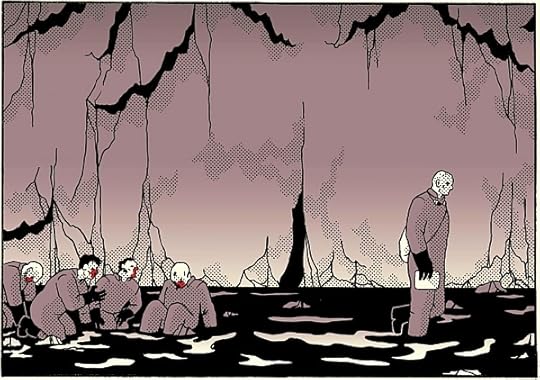
Under-Earth is a post-apocalyptic subterranean prison colony which supports itself by mining the landfill it occupies for repairable junk. The prisoners have organized themselves into a gritty, filthy society, overseen by a masked, heavily armed, brutal guard corps.
We follow four characters in this sunken hellhole: a new guy who's in for a rude awakening, a giant who just wants to read books, and two women who steal for an Under-Earth strongman.
This was a similar experience to reading the author's better known Bottled: both take a while to get going, both gather up the aimless meanderings of their characters in the back half of the book, and both draw to organic and satisfying conclusions. Each includes a moment of dramatic, unexpected restraint at a moment when most stories would take the obvious, much bloodier path; the deviation from form is a good thing.
Despite the chaos and violence running through all of his protagonists' lives, Gooch somehow delivers a sense of steadiness and peace. It's a neat achievement.
We follow four characters in this sunken hellhole: a new guy who's in for a rude awakening, a giant who just wants to read books, and two women who steal for an Under-Earth strongman.
This was a similar experience to reading the author's better known Bottled: both take a while to get going, both gather up the aimless meanderings of their characters in the back half of the book, and both draw to organic and satisfying conclusions. Each includes a moment of dramatic, unexpected restraint at a moment when most stories would take the obvious, much bloodier path; the deviation from form is a good thing.
Despite the chaos and violence running through all of his protagonists' lives, Gooch somehow delivers a sense of steadiness and peace. It's a neat achievement.

November 15, 2021
Another book I finished in a single sitting...
Chris Gooch is an author I just keep reading. Some of his stuff really strikes me, some of it utterly misses, but he always has merit. His style, likewise, is forever stroking.
"Under-Earth" is a strange book. In a dystopian future there's a prison that exists underground. There, the criminals create their own society while under the watchful eye of armed guards. Nobody ever escapes. How do you make such living bearable? Especially when none of the jobs down there really offer living wages and everyone is against you...
One strand of plot follows a pair of kids who specialize in breaking an entering. After they're set up, they decide to seek revenge against the man who betrayed them. The other strand of plot follows a newcomer who is befriended by a veritable giant of a man.... and the choices that he makes to make life more bearable. Both plots eventually meet for an intensely satisfying ending.
I love heist stories, and this was a satisfying one. The art flowed well and the stark narration was extremely fitting for the story that was told. This is probably my favorite of what I've read of Gooch, and I look forward to similarly great things in the future. The minimal use of color, the cleanness of the lines... It was just plainly good and reminiscent of ashcran press comics.
Would definitely recommend.
Chris Gooch is an author I just keep reading. Some of his stuff really strikes me, some of it utterly misses, but he always has merit. His style, likewise, is forever stroking.
"Under-Earth" is a strange book. In a dystopian future there's a prison that exists underground. There, the criminals create their own society while under the watchful eye of armed guards. Nobody ever escapes. How do you make such living bearable? Especially when none of the jobs down there really offer living wages and everyone is against you...
One strand of plot follows a pair of kids who specialize in breaking an entering. After they're set up, they decide to seek revenge against the man who betrayed them. The other strand of plot follows a newcomer who is befriended by a veritable giant of a man.... and the choices that he makes to make life more bearable. Both plots eventually meet for an intensely satisfying ending.
I love heist stories, and this was a satisfying one. The art flowed well and the stark narration was extremely fitting for the story that was told. This is probably my favorite of what I've read of Gooch, and I look forward to similarly great things in the future. The minimal use of color, the cleanness of the lines... It was just plainly good and reminiscent of ashcran press comics.
Would definitely recommend.

February 12, 2021
This is a totally unique book! Gooch is really forging quite a singular career in telling weird and creepy stories. The art is outstanding, reminiscent at times of Frank Miller, but still stands quite separate from Miller. Multiple story threads coming together. Lots to say about the throwaway world we live in. Totally recommend!

February 6, 2025
that was immersive as fuck

April 10, 2022
Het is geen vrolijke wereld. Het is een dystopische dystopie van formaat. Het doet soms denken aan (deze) Blokken, soms Is dit een mens, maar ook aan Fight Club.
En zou dit een knipoog naar Watchmen zijn? Nog wat vleugjes Fyodor Dostoevsky en het is iedereen duidelijk dat de wereld van Under-earth geen feest is, en geweld geen onbekend fenomeen. Toch, ondanks dat deze onderaardse wereld de vergelijking met de hel best aardig kan doorstaan, is het niet een troosteloos verhaal. Verre van zelfs... want zelfs hier, in deze - in beide betekenissen - uitzichtloze situatie zijn er mensen die samen alles doorstaan.

September 12, 2023
I went into Under-Earth with no expectations (typical for an indie comic) and came out pretty thoroughly jazzed. Without much preamble, Chris Gooch drops us into an underground prison city where the prisoners eke out a living in the toxic mines or completing odd jobs. It's basically a lawless land, minus the overseers who are essentially omnipotent.
We track two storylines: one features a weak new arrival and his sad tribulations, the other stars two long-time thieves who see a big score go sideways. At almost 600 pages, there's tons of room in the book for quiet world-building and slow conversations. Under-Earth seems odd and offputting at first, but it gets under your skin. The two storylines build and shift and, inevitably, merge in a dramatic conclusion.
Under-Earth isn't exactly a high-flying five-star shout-it-from-the-rooftops read. It's simply a really well-told story. I really, really dug it - and really, really did not expect to.
We track two storylines: one features a weak new arrival and his sad tribulations, the other stars two long-time thieves who see a big score go sideways. At almost 600 pages, there's tons of room in the book for quiet world-building and slow conversations. Under-Earth seems odd and offputting at first, but it gets under your skin. The two storylines build and shift and, inevitably, merge in a dramatic conclusion.
Under-Earth isn't exactly a high-flying five-star shout-it-from-the-rooftops read. It's simply a really well-told story. I really, really dug it - and really, really did not expect to.

Want to Read
December 4, 2020580 PAGES?! Do I dare? I found it on Hoopla but I would not be able to finish that many pages in 21 days, even if it was the only thing I read during that time. Why on earth is it so long? It's like 5 vols collected in 1😂
October 16, 2025
“Whether or not they choose to acknowledge it-there is no escape.”
With his delightful 80s retro vibe to the drawing, landing in some mysterious place between Lang’s “Metropolis” and Montellier’s "Social Fiction”, Gooch does a wonderful job of creating the mood of the story, giving a real atomised and claustrophobic feel to the sinister world.
This was great stuff, this moves incredibly fast with so much going to keep the action and intrigue churning along as we learn more about this dystopic underworld, making for a delightful take on late-stage capitalism.
With his delightful 80s retro vibe to the drawing, landing in some mysterious place between Lang’s “Metropolis” and Montellier’s "Social Fiction”, Gooch does a wonderful job of creating the mood of the story, giving a real atomised and claustrophobic feel to the sinister world.
This was great stuff, this moves incredibly fast with so much going to keep the action and intrigue churning along as we learn more about this dystopic underworld, making for a delightful take on late-stage capitalism.

October 14, 2021
An excellent story that doesn’t quite live up to its potential. “Under-Earth” is set in a prison constructed out of a landfill and follows two sets of prisoners, one male, one female, as they navigate the bonds of their subjugation and friendships. The author doesn’t delve very deeply into either, so we end up with a fairly typical dystopian prison narrative. He tells the story so well, though, that you won’t mind.

April 17, 2023
Didn't have much time to read today, but I've managed to squeeze this whole book in while doing chores, eating, and multitasking. That means this must have completely!! I'd recommend this book a million times over to literally any person. I loved the whole "world" and characters and their means of survival. I can't decide if I loved the story or the art more. This is definitely one of my favorites 😍 soooo happy I picked this one up !!!

January 8, 2021
Very interesting graphic novel. Even though this book is close to 600 pages long, it flew by. Even though we didn't get a lot of information on the characters, you could still understand their motivations.

September 6, 2024
This was a very interesting world, I like how we were placed inside of it and learned how this society operated. The way we follow two independ stories and eventually intertwine before once again going their own way....truly amazing! I would love to read more works by this author.

December 22, 2024
This book was so intense and crazy. It was too much too violent and dark for me. But I appreciated the little glimmer of hope.
Honestly I would give it a higher rating if it weren’t for how sad and dark the world is. It’s too hopeless and violent for me.
Honestly I would give it a higher rating if it weren’t for how sad and dark the world is. It’s too hopeless and violent for me.


January 23, 2022
The rough art style was a bit off putting to begin with but fit the world and story perfectly. Gooch's pacing is out of this world, each pane captures an exact point in time and I had to remind myself this was a book and not a movie. Would love to see him direct an animated feature film.

June 24, 2026
There is doomed (hopeful?) yaoi and yuri everywhere for those with eyes to see
But on a serious note this was a very heartwrenching yet heartwarming meditation on friendship, forgiveness, and perseverance in the face of an establishment that functions on despair and isolation
But on a serious note this was a very heartwrenching yet heartwarming meditation on friendship, forgiveness, and perseverance in the face of an establishment that functions on despair and isolation

December 8, 2022
One wild trip this has been.
An unhinged acid trip.
An unhinged acid trip.

November 12, 2021
8,5 Earlier this year I discovered some Youtube-channels talking about independent comics, and through them the wider world of comics opened up to me. That way I made the aquaintance of great graphic novels. I also found out that in this medium a lot of interesting sciencefictional tales are told, with a great level of depth and social realism. This one for example takes place in an underground prison, where inmates are dropped and left to fend for themselves, exploited not only by the guards and the economy, but also by their fellow prisoners. The metaphor is a bit on the nose. The prisoners dream of what they think is the only opening to the world above ground, but the reader discovers that it's a lie. Even the tower of the prison guards doesn't come that high up, so they might as well be part of the prison population themselves. It's a harsh world, left without hope. But, as is well put by another reviewer on Goodreads: 'Although there is a lot of violence and hopelessness in this world, the story is punctuated with wryly funny points and moments of true connection between the characters, suggesting the only way to push back against this system is by finding and cherishing those moments of pleasure and genuine connection.' The art here is raw, spare with lines and details, but still evocative. It conveys the dark nature of the surroundings and the despair of the characters. Their circumstances are not beautiful, which makes moment of real connection and friendship stand out that much more. Forgiveness, sacrifice and the joy of reading a book. The pacing was pretty slow, but I think it was done deliberately to make the reader get close to the characters, move through the panels with them and identify with their goals in life. The coloring is simple and makes it easy to see who you're following along with in the story. I was gripped, but don't expect a simple conclusion. Nobody gets to leave the prison, nobody gets to escape their fate, but still: being able to experience geuine connection is nothing to be snffed at, in my opinion

May 19, 2021
Actual rating: 2.5 stars
Under-Earth has sparse wording; the artwork conveyed most of the story. For a nearly 600-page graphic novel, I had hoped for more. I was intrigued by the underground prison world and found the characters fascinating. I just was left wanting more: more intersection of the two-character pairs’ stories, more detail on Malcolm & Reece’s friendship & the importance of the books, more explanation as to the formation of prison, more about the surveillance-eye-in-the-sky drone, more about the purpose of the mining and the payment system. It is one thing to leave a reader wanting a story to continue. It is another to leave a reader feeling like they never got enough to begin with.
Under-Earth has sparse wording; the artwork conveyed most of the story. For a nearly 600-page graphic novel, I had hoped for more. I was intrigued by the underground prison world and found the characters fascinating. I just was left wanting more: more intersection of the two-character pairs’ stories, more detail on Malcolm & Reece’s friendship & the importance of the books, more explanation as to the formation of prison, more about the surveillance-eye-in-the-sky drone, more about the purpose of the mining and the payment system. It is one thing to leave a reader wanting a story to continue. It is another to leave a reader feeling like they never got enough to begin with.

December 11, 2020
This graphic novel's illustrations are largely simple and sometimes difficult to follow, but the use of colors is interesting and leads to some contemplation. The two stories themselves are surprisingly appealing. What seems initially like a ho-hum story comes exciting by the midpoint. I liked the characters and the situations and world they found themselves in. The conclusion was perhaps a bit of a letdown--by that point, I expecting quite the punch--but it was respectable.

Read
May 20, 2021(A version of this review was published, in German, in the Swiss comics journal STRAPAZIN.)
Chris Gooch’s Under-Earth may not have been the best graphic novel published during the Global Pandemic (what would your nomination be?), but for my money it was a nearly perfect graphic novel for reading during the pandemic. As a tale set in a massive underground prison city where the only visible star is “rumoured to be a hole 600 meters up, just big enough to let in a glimmer of natural light … with no other purpose than to torment the populace,” Under-Earth embraces the reader in feelings of numbness, despair, anxiety, and even hope, in ways that resonated with so many of the ambivalent feelings we’ve all had over the last year.
Clocking in at nearly 600 pages, this book is a true graphic novel, though it actually reads more like a treatment for a film, and I mean that in a good way: I’d love to see what Tarkovsky or Kubrick could do with this source material. That said, Under-Earth works just beautifully as a comic book. Imagine Sammy Harkham, Gary Panter, and Katsuhiro Otomo sitting down to create a dystopian graphic novel and it might look something like Under-Earth. Though Gooch brings a particular degree of resolute empathy and hopefulness not seen often in those other cartoonists. Based on this book and his two prior (Bottled and Deep Breaths, neither of which is anything like Under-Earth), this young Australian is a talent to watch closely.
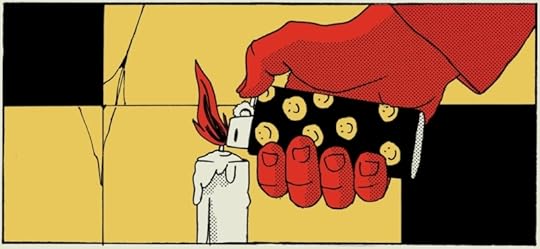
The story here is straightforward: a pair of female thieves (Ele and Zoe) and a mismatched pair of male prisoners living on the margins (Malcolm and Reece) struggle to survive in and take advantage of an oppressive and dehumanizing system that is definitively stacked against them. This simple story is deftly told via a series of interwoven parallel narratives and clever use of jump cuts and shifts in perspective, rendered in as engaging and skillful a drawing style as my Harkham-Panter-Otomo nod above suggests. The storytelling pulls the reader along quickly like the best Manga (many Western cartoonists in their 20’s seem to have internalized the grammar and syntax of Manga in an exciting and unselfconscious way) and the mostly monochromatic coloring (yellow, red, deep purple) powerfully conveys action, mood, and emotion.
While the main selling point of Under-Earth would seem to be its nightmare prison narrative (“Will they survive? Can they escape? What exists in the world outside this subterranean hell?”), what makes the book so special is its characterization. While the four main characters start off as “types”—the sullen loner; the nervous weakling; the tougher-than-you think ingénue; the surprisingly sentimental tough girl—we come to know each character relatively intimately, and at times their decisions and reactions surprise us. I read Under-Earth in one sitting, captivated by the plot; I read it again over the course of the next day, and the second time I came away with a real appreciation for Gooch’s storytelling skill and subtle sensitivity in character portrayal. I can’t wait to see what he does next.
Chris Gooch’s Under-Earth may not have been the best graphic novel published during the Global Pandemic (what would your nomination be?), but for my money it was a nearly perfect graphic novel for reading during the pandemic. As a tale set in a massive underground prison city where the only visible star is “rumoured to be a hole 600 meters up, just big enough to let in a glimmer of natural light … with no other purpose than to torment the populace,” Under-Earth embraces the reader in feelings of numbness, despair, anxiety, and even hope, in ways that resonated with so many of the ambivalent feelings we’ve all had over the last year.
Clocking in at nearly 600 pages, this book is a true graphic novel, though it actually reads more like a treatment for a film, and I mean that in a good way: I’d love to see what Tarkovsky or Kubrick could do with this source material. That said, Under-Earth works just beautifully as a comic book. Imagine Sammy Harkham, Gary Panter, and Katsuhiro Otomo sitting down to create a dystopian graphic novel and it might look something like Under-Earth. Though Gooch brings a particular degree of resolute empathy and hopefulness not seen often in those other cartoonists. Based on this book and his two prior (Bottled and Deep Breaths, neither of which is anything like Under-Earth), this young Australian is a talent to watch closely.
The story here is straightforward: a pair of female thieves (Ele and Zoe) and a mismatched pair of male prisoners living on the margins (Malcolm and Reece) struggle to survive in and take advantage of an oppressive and dehumanizing system that is definitively stacked against them. This simple story is deftly told via a series of interwoven parallel narratives and clever use of jump cuts and shifts in perspective, rendered in as engaging and skillful a drawing style as my Harkham-Panter-Otomo nod above suggests. The storytelling pulls the reader along quickly like the best Manga (many Western cartoonists in their 20’s seem to have internalized the grammar and syntax of Manga in an exciting and unselfconscious way) and the mostly monochromatic coloring (yellow, red, deep purple) powerfully conveys action, mood, and emotion.
While the main selling point of Under-Earth would seem to be its nightmare prison narrative (“Will they survive? Can they escape? What exists in the world outside this subterranean hell?”), what makes the book so special is its characterization. While the four main characters start off as “types”—the sullen loner; the nervous weakling; the tougher-than-you think ingénue; the surprisingly sentimental tough girl—we come to know each character relatively intimately, and at times their decisions and reactions surprise us. I read Under-Earth in one sitting, captivated by the plot; I read it again over the course of the next day, and the second time I came away with a real appreciation for Gooch’s storytelling skill and subtle sensitivity in character portrayal. I can’t wait to see what he does next.

November 21, 2021
Don't be intimidated by the size of this thick (560 pages) graphic novel by a promising indie creator from Australia. The art style is simplistic yet inventive, and the story is very fluid with sparse dialogue and never more than six panels per page. It didn't take long to pull me into the story and I finished it across two days.
The dystopian society of prisoners inhabiting a deep underground landfill that has been repurposed with streets and run-down buildings have no hope of ever escaping. The entry point is miles above them, where new inmates are lowered into this giant hollowed-out cell by helicopter.
The entire prison populace (except for the armed enforcement officers) have to pay for everything in their meager existence - - food, shelter, clothing and even entertainment (only card-playing, gambling, and betting on gladiator-like fights run by a corrupt and greedy warden). They earn dollars by scrounging through the giant landfill to salvage usable parts and items and then barter for money.
Writer/artist Chris Gooch leads us through this oppressive landscape by following two parallel stories. A new arrival, big and muscular yet quiet, is thrown into the gladiatorial games as a reluctant combatant and becomes the warden's favorite (although it earns him very few favors). He befriends another man and connects through a found beat-up novel (a diary by an unknown prisoner). The brutal environment, full of everyday violence, hard physical labor, and poverty challenges their stressful relationship which is tested one final time.
The other story centers on two female inmates in a relationship (the only females identified as such in the novel) with breaking-and-entering skills that become employed by a unreliable administrator who promises them a useless schematic of the prison to nurture their hopes of escape.
Both of these relationships are brought to a head in the final chapters, although the ending is anticlimactic, perhaps indicative of the hopelessness of this world/existence. I wasn't disappointed, although I would have appreciated a more positive resolution. Gooch employs just four colors in his art to get effect, with the occasional red helping to emphasize the violence.
I'm glad that Top Shelf brought this work to U.S. shores. Gooch has two other graphic novels, which I may seek out.
The dystopian society of prisoners inhabiting a deep underground landfill that has been repurposed with streets and run-down buildings have no hope of ever escaping. The entry point is miles above them, where new inmates are lowered into this giant hollowed-out cell by helicopter.
The entire prison populace (except for the armed enforcement officers) have to pay for everything in their meager existence - - food, shelter, clothing and even entertainment (only card-playing, gambling, and betting on gladiator-like fights run by a corrupt and greedy warden). They earn dollars by scrounging through the giant landfill to salvage usable parts and items and then barter for money.
Writer/artist Chris Gooch leads us through this oppressive landscape by following two parallel stories. A new arrival, big and muscular yet quiet, is thrown into the gladiatorial games as a reluctant combatant and becomes the warden's favorite (although it earns him very few favors). He befriends another man and connects through a found beat-up novel (a diary by an unknown prisoner). The brutal environment, full of everyday violence, hard physical labor, and poverty challenges their stressful relationship which is tested one final time.
The other story centers on two female inmates in a relationship (the only females identified as such in the novel) with breaking-and-entering skills that become employed by a unreliable administrator who promises them a useless schematic of the prison to nurture their hopes of escape.
Both of these relationships are brought to a head in the final chapters, although the ending is anticlimactic, perhaps indicative of the hopelessness of this world/existence. I wasn't disappointed, although I would have appreciated a more positive resolution. Gooch employs just four colors in his art to get effect, with the occasional red helping to emphasize the violence.
I'm glad that Top Shelf brought this work to U.S. shores. Gooch has two other graphic novels, which I may seek out.

June 25, 2021
Why I chose this book: I like dystopian narratives, and the artwork and concept appealed to me.
Brief summary: Under-Earth is set in a deep landfill/prison. The prisoners in this world have to pay for everything, from food to their own work gear. The first two protagonists of this story make money by finding useful trash, and the other two make money by stealing valuable items for a powerful inmate. There are two narratives here, with the finders and the thieves, that collide into one. The scarcity of money combined with the tyrannical guards and filthy living conditions create a harsh, dog-eat-dog environment that the protagonists must navigate through a series of difficult decisions.
What I don't like about this book: The illustrations do most of the heavy lifting for the worldbuilding, and while that had me immersed, some context about this world was lacking, as well as backstory of the characters. Both the world and the characters have such depths that couldn't be covered in the tight structure of this story; I feel like there could be fifteen more books in this world with these characters!
What I like about this book: In the Disney animated series Gravity Falls there's a line that keeps coming to mind while I reflect on this book, "morality is relative." The world in this book is unjust and corrupt, and the characters have to make no-win decisions just to survive to the next day; and yet, the reader is still in a position to understand and root for them. The questions that this book raises about morals and ethics in a corrupt system are plentiful. I always appreciate a book that leaves me with questions about the tension between good and evil.
Brief summary: Under-Earth is set in a deep landfill/prison. The prisoners in this world have to pay for everything, from food to their own work gear. The first two protagonists of this story make money by finding useful trash, and the other two make money by stealing valuable items for a powerful inmate. There are two narratives here, with the finders and the thieves, that collide into one. The scarcity of money combined with the tyrannical guards and filthy living conditions create a harsh, dog-eat-dog environment that the protagonists must navigate through a series of difficult decisions.
What I don't like about this book: The illustrations do most of the heavy lifting for the worldbuilding, and while that had me immersed, some context about this world was lacking, as well as backstory of the characters. Both the world and the characters have such depths that couldn't be covered in the tight structure of this story; I feel like there could be fifteen more books in this world with these characters!
What I like about this book: In the Disney animated series Gravity Falls there's a line that keeps coming to mind while I reflect on this book, "morality is relative." The world in this book is unjust and corrupt, and the characters have to make no-win decisions just to survive to the next day; and yet, the reader is still in a position to understand and root for them. The questions that this book raises about morals and ethics in a corrupt system are plentiful. I always appreciate a book that leaves me with questions about the tension between good and evil.

September 26, 2020
Under-Earth is super suffocating and creepy, just perfect! The story takes place in an underground prison system, where you have to work in order to eat. Hierarchy and bullying are the core and everyone is an inmate for reasons unknown. We actually hardly ever get to know about the reasons, which is interesting. There's a hole in the sky and the place is a dumpster basically. There are two story lines with the boxer and a loser who end up as some sort of friends and these two who want to steal and break the unfair system in order to survive. The whole thing is so faceless and hollow. We don't get to know why everything is how it is and somehow there doesn't seem to be any possibility to a change. This is almost like horror actually.
The art is simple and the colors are just black and white with yellow hues and whatnot. Under-Earth feels like a warning sign. This would be an awesome movie. Gooch is a master at creating an odd atmosphere that kicks the air out of you. Reminds me of Osamu Dazai in a way. I'm still baffled. A great comic indeed.
The art is simple and the colors are just black and white with yellow hues and whatnot. Under-Earth feels like a warning sign. This would be an awesome movie. Gooch is a master at creating an odd atmosphere that kicks the air out of you. Reminds me of Osamu Dazai in a way. I'm still baffled. A great comic indeed.

December 24, 2021
this was good. nothing too spectacular, but a pretty interesting read about what seems like a dystopian society, how it operates, and how different characters operate within it. i feel like there are quite a few aspects of the story/plot that i am left wanting more of: how they got to be in the situation that they are in, what happens next, etc., but maybe that was the author's purpose all along.
i really enjoyed gooch's use of colors to tell the multiple, intertwined stories, as well as how he refrained from using text boxes/bubbles for multiple panels. it was really interesting to read along with that, since it allowed me to focus more on what was going on in each of the drawings and make connections from panel to panel.
i am not a person that is entirely bothered by gore, but even in this story, there is a lot of it. be prepared for that.
word of the day: crevice - "a narrow opening or fissure, especially in a rock or wall." (also what took the vma theatre department by storm my freshman year)
i really enjoyed gooch's use of colors to tell the multiple, intertwined stories, as well as how he refrained from using text boxes/bubbles for multiple panels. it was really interesting to read along with that, since it allowed me to focus more on what was going on in each of the drawings and make connections from panel to panel.
i am not a person that is entirely bothered by gore, but even in this story, there is a lot of it. be prepared for that.
word of the day: crevice - "a narrow opening or fissure, especially in a rock or wall." (also what took the vma theatre department by storm my freshman year)

January 18, 2024
I really liked this!!
Despite the dystopian future setting, the book felt really Melbourne- which is a compliment. The characters feel like they’re emotionally Melbourne, even though they are living somewhere else. It’s kind of a feeling of people with sone kind of high morality and sentimentality, that is not homogeneous, but they’ll go to great lengths to preserve something of value to them, or to get something of great value to them, but there is a lot of shit to wade through in between. I really like the emotional palette of the two main relationships- Mason and Reece, and Ele and Zoe. Just that they would aim for maintaining the connection and bond, however limited the base, but just stick together somehow.
The colour palette is also similarly effective- black, white, yellow and occasional red, just keeps the pictoral language clear, stark, and a bit out of the normal. It means you go to the bodies and faces of the characters to pick up the meaning, as much as the action of the story- it gives nice focus and impact to the art.
Despite the dystopian future setting, the book felt really Melbourne- which is a compliment. The characters feel like they’re emotionally Melbourne, even though they are living somewhere else. It’s kind of a feeling of people with sone kind of high morality and sentimentality, that is not homogeneous, but they’ll go to great lengths to preserve something of value to them, or to get something of great value to them, but there is a lot of shit to wade through in between. I really like the emotional palette of the two main relationships- Mason and Reece, and Ele and Zoe. Just that they would aim for maintaining the connection and bond, however limited the base, but just stick together somehow.
The colour palette is also similarly effective- black, white, yellow and occasional red, just keeps the pictoral language clear, stark, and a bit out of the normal. It means you go to the bodies and faces of the characters to pick up the meaning, as much as the action of the story- it gives nice focus and impact to the art.
September 1, 2020
I absolutely loved Gooch's Bottled, and how he perfectly portrayed the raw and ugly emotions with both his writing and his gloomy palette. Well, that gloomy palette is back (with highlights of yellow), but the depth of emotion isn't there.
We follow two stories: a pair of thieves, desperate to hold on to each other and escape, because there's nothing else, and a giant of a prisoner, solitary and under-the-radar. They both run afoul of the bespectacled man who runs the prison, and eventually end up working together (kind of) to achieve his demise.
It's violent and unflinching about the horrors of living in an underground inescapable prison, without being too gratuitous, but the themes of friendship and family don't rise above. It's such a harsh environment, and those human emotions are necessary, but aside from one touching moment where one inmate betrays another, is in turn betrayed, and then they both forgive each other, it feels flat.
We follow two stories: a pair of thieves, desperate to hold on to each other and escape, because there's nothing else, and a giant of a prisoner, solitary and under-the-radar. They both run afoul of the bespectacled man who runs the prison, and eventually end up working together (kind of) to achieve his demise.
It's violent and unflinching about the horrors of living in an underground inescapable prison, without being too gratuitous, but the themes of friendship and family don't rise above. It's such a harsh environment, and those human emotions are necessary, but aside from one touching moment where one inmate betrays another, is in turn betrayed, and then they both forgive each other, it feels flat.
July 7, 2022
*read in 2022*
Under-Earth takes place in a subterranean landfill, hollowed out to serve as a massive improvised prison. Sunken into the trash and debris of the past—GameBoys, iPhones, coffee cups, old cars—we follow two parallel stories.
In the first, a new arrival struggles to adapt to the everyday violence, physical labour, and poverty of the prison city. Overwhelmed and alone, he finds a connection with a fellow inmate through an old, beat-up novel. While these two silent and uncommunicative men grow closer thanks to their book, the stress of their environment will test their new bond.
Meanwhile, a pair of thieves pull off a risky job in exchange for the prisons' schematics and the promise of escape—only to be betrayed by their employer. On the run with their hope for escape now gone, the two women set their minds to revenge. Yet as they lay their plans, their focus shifts from an obsession with the outside world to the life they have with each other.
Under-Earth takes place in a subterranean landfill, hollowed out to serve as a massive improvised prison. Sunken into the trash and debris of the past—GameBoys, iPhones, coffee cups, old cars—we follow two parallel stories.
In the first, a new arrival struggles to adapt to the everyday violence, physical labour, and poverty of the prison city. Overwhelmed and alone, he finds a connection with a fellow inmate through an old, beat-up novel. While these two silent and uncommunicative men grow closer thanks to their book, the stress of their environment will test their new bond.
Meanwhile, a pair of thieves pull off a risky job in exchange for the prisons' schematics and the promise of escape—only to be betrayed by their employer. On the run with their hope for escape now gone, the two women set their minds to revenge. Yet as they lay their plans, their focus shifts from an obsession with the outside world to the life they have with each other.
Displaying 1 - 30 of 106 reviews