

What do you think?

King Richard: an American tragedy
A riveting account — told from inside the White House — of the crucial days, hours, and moments when the Watergate conspiracy consumed and ultimately toppled a president.
In January 1973, Richard Nixon had just been inaugurated after winning re-election in a historic landslide. But by April 1973, his presidency had fallen apart as the Watergate scandal metastasized into what White House counsel John Dean called ‘a full-blown cancer’. King Richard is the intimate, utterly absorbing narrative of the tension-packed hundred days when the Watergate burglars and their handlers in the administration turned on one another, revealing their direct connection ties to the White House.
Drawing on thousands of hours of newly released taped recordings, Michael Dobbs takes us into the very heart of the conspiracy, recreating these dramatic events in unprecedentedly vivid detail. He captures the growing paranoia of the principal players and their desperate attempts to deflect blame as the noose tightened around them and the daily pressures became increasingly unbearable. At the centre of this spellbinding drama is Nixon himself, a man whose strengths — particularly his determination to win at all costs — were also his fatal flaws. Structured like a classical tragedy with a uniquely American twist, this is an epic and deeply human story of ambition, power, and betrayal.
In January 1973, Richard Nixon had just been inaugurated after winning re-election in a historic landslide. But by April 1973, his presidency had fallen apart as the Watergate scandal metastasized into what White House counsel John Dean called ‘a full-blown cancer’. King Richard is the intimate, utterly absorbing narrative of the tension-packed hundred days when the Watergate burglars and their handlers in the administration turned on one another, revealing their direct connection ties to the White House.
Drawing on thousands of hours of newly released taped recordings, Michael Dobbs takes us into the very heart of the conspiracy, recreating these dramatic events in unprecedentedly vivid detail. He captures the growing paranoia of the principal players and their desperate attempts to deflect blame as the noose tightened around them and the daily pressures became increasingly unbearable. At the centre of this spellbinding drama is Nixon himself, a man whose strengths — particularly his determination to win at all costs — were also his fatal flaws. Structured like a classical tragedy with a uniquely American twist, this is an epic and deeply human story of ambition, power, and betrayal.
416 pages, Paperback
First published May 25, 2021
About the author
Michael Dobbs
8 books223 followersTo distinguish myself from all the "presidential historians" out there, I have invented a new area of expertise: "presidential crisis historian." How a president confronts the gravest challenges of modern times, and how his decisions affect the rest of us, has been a recurring theme of my seven books.
One Minute to Midnight focused on possibly the gravest crisis ever, in October 1962, when John F. Kennedy stepped back from the nuclear brink at the last possible moment. The Unwanted looked at Franklin Roosevelt's handling of the Jewish refugee crisis that preceded the Holocaust. Six Months in 1945 examined how FDR and Truman negotiated the perilous transition from World War to Cold War. My latest book, King Richard: An American Tragedy, relates the Shakespearean tale of the self-made man who scrambled his way to the top only to see his dreams turn to nightmares because of tragic character flaws.
Before becoming an author, I was a journalist and foreign correspondent. After a stint in Rome as a correspondent for Reuters, and a tour of Africa, I lived in Yugoslavia during the twilight years of Marshal Tito. I moved to Poland for The Washington Post just in time to witness the extraordinary spectacle of workers rebelling against the "workers' state." I was the first western reporter to visit the Lenin shipyard in Gdansk in August 1980. As The Post's bureau chief in Moscow, I was standing in front of Boris Yeltsin in August 1991 when he climbed on a tank to face down Communist hardliners. In between these two events, I covered the imposition of martial law in Poland, the Chernobyl nuclear catastrophe, Gorbachev-Reagan summits, the Tiananmen uprising in China, and the 1989 revolution in Romania.
In addition to my work as a journalist and a historian, I have taught courses at the universities of Princeton, Michigan, and Georgetown, as well as American University. I also spent seven years at the United States Holocaust Memorial Museum where I organized conferences on the genocides in Rwanda and Bosnia, and researched and wrote The Unwanted. King Richard is my seventh book.
One Minute to Midnight focused on possibly the gravest crisis ever, in October 1962, when John F. Kennedy stepped back from the nuclear brink at the last possible moment. The Unwanted looked at Franklin Roosevelt's handling of the Jewish refugee crisis that preceded the Holocaust. Six Months in 1945 examined how FDR and Truman negotiated the perilous transition from World War to Cold War. My latest book, King Richard: An American Tragedy, relates the Shakespearean tale of the self-made man who scrambled his way to the top only to see his dreams turn to nightmares because of tragic character flaws.
Before becoming an author, I was a journalist and foreign correspondent. After a stint in Rome as a correspondent for Reuters, and a tour of Africa, I lived in Yugoslavia during the twilight years of Marshal Tito. I moved to Poland for The Washington Post just in time to witness the extraordinary spectacle of workers rebelling against the "workers' state." I was the first western reporter to visit the Lenin shipyard in Gdansk in August 1980. As The Post's bureau chief in Moscow, I was standing in front of Boris Yeltsin in August 1991 when he climbed on a tank to face down Communist hardliners. In between these two events, I covered the imposition of martial law in Poland, the Chernobyl nuclear catastrophe, Gorbachev-Reagan summits, the Tiananmen uprising in China, and the 1989 revolution in Romania.
In addition to my work as a journalist and a historian, I have taught courses at the universities of Princeton, Michigan, and Georgetown, as well as American University. I also spent seven years at the United States Holocaust Memorial Museum where I organized conferences on the genocides in Rwanda and Bosnia, and researched and wrote The Unwanted. King Richard is my seventh book.
Ratings & Reviews
Friends & Following
Create a free account to discover what your friends think of this book!
Community Reviews
Displaying 1 - 30 of 209 reviews

June 20, 2021
I would love to write a realllly looooong review explaining exactly how the whole Watergate thing began and how Mr Nixon didn’t know anything about it until after it happened and how Gordon Liddy unintentionally totally destroyed his presidency (One man! He did it!) but I can see your eyes glazing over already so I will reluctantly confine myself to a few remarks.
1) This book covers in great detail the period 20 January (Inauguration Day) to 17 July 1973. The collapse of Nixon is AWESOME – from the president who won the biggest landslide ever to the only president who had to resign and be pardoned for criminal activities. And it only took 18 months. Fantastic. So the focus is on the period when Watergate transformed from a cloud the size of a man’s hand way out on the horizon to a tropical typhoon demolishing all buildings above ground level. But because Michael Dobbs is an excellent narrator and guides us through vast complexities with the grace of a mountain goat I wanted MORE of this story: Nixon’s total paranoia in 1972 which led to the dirty tricks, plus the crash & burn of the rest of 1973 and 1974. So that was kinda frustrating. Not many times do I wish a book was twice the size.
2) 21st March 1973. This is just astonishing. Dean tells Nixon that the Watergate burglars are blackmailing their political bosses for hush money. Instead of saying “what in hell? That would be illegal! Don’t give them a cent! Are you crazy?” Nixon switches immediately into Don Richard Corleone mode :
”How much money do you need?”
“I would say these people are going to cost a million dollars over the next two years.” (That by the way was a wild guess.)
”You could get a million dollars. You could get it in cash. I know where it could be gotten.”
So you see RN’s criminality right there. He didn’t tell anyone to burglarize anybody but he was instantly on board with covering it up.
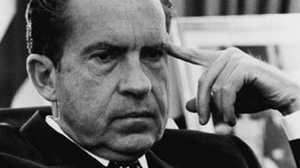
3) The most shocking quote in the whole book is on page 263. It is April 22 and Watergate is raining down hard upon RN and his two main men Haldeman and Ehrlichman. RN says
Just remember you’re doing the right thing. That’s what I used to think when I killed some innocent children in Hanoi.
This is so grotesque that I thought it had to be a made up quote. The notes say it comes from the detailed diary kept by Haldeman himself.
4) There are glints of humour in all the anguish. At one point somebody had to step up and listen to the tapes to see just how incriminating they were.
After several hours of listening to tapes in a locked room, Haldeman’s normally sharp mind had ceased to function clearly.
And later that same day :
By convincing each other that the president had said the opposite of what he had actually said, Nixon and Haldeman had finally come up with their best-case scenario.
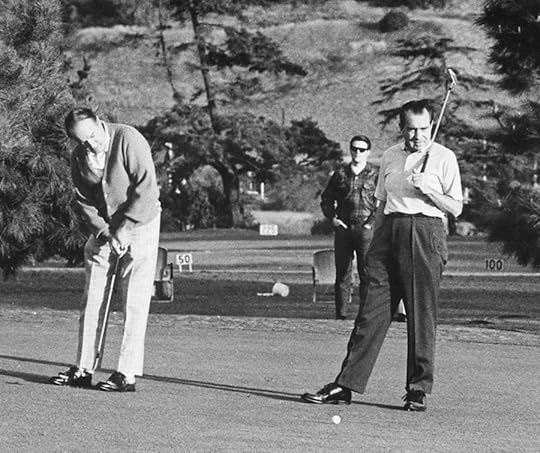
And as a side note I might say that when you read about the lives of rich American men you get the strong idea that what motivates these guys way way more than money or sex is golf and fishing. Man alive, do rich American men like to golf and fish.
1) This book covers in great detail the period 20 January (Inauguration Day) to 17 July 1973. The collapse of Nixon is AWESOME – from the president who won the biggest landslide ever to the only president who had to resign and be pardoned for criminal activities. And it only took 18 months. Fantastic. So the focus is on the period when Watergate transformed from a cloud the size of a man’s hand way out on the horizon to a tropical typhoon demolishing all buildings above ground level. But because Michael Dobbs is an excellent narrator and guides us through vast complexities with the grace of a mountain goat I wanted MORE of this story: Nixon’s total paranoia in 1972 which led to the dirty tricks, plus the crash & burn of the rest of 1973 and 1974. So that was kinda frustrating. Not many times do I wish a book was twice the size.
2) 21st March 1973. This is just astonishing. Dean tells Nixon that the Watergate burglars are blackmailing their political bosses for hush money. Instead of saying “what in hell? That would be illegal! Don’t give them a cent! Are you crazy?” Nixon switches immediately into Don Richard Corleone mode :
”How much money do you need?”
“I would say these people are going to cost a million dollars over the next two years.” (That by the way was a wild guess.)
”You could get a million dollars. You could get it in cash. I know where it could be gotten.”
So you see RN’s criminality right there. He didn’t tell anyone to burglarize anybody but he was instantly on board with covering it up.
3) The most shocking quote in the whole book is on page 263. It is April 22 and Watergate is raining down hard upon RN and his two main men Haldeman and Ehrlichman. RN says
Just remember you’re doing the right thing. That’s what I used to think when I killed some innocent children in Hanoi.
This is so grotesque that I thought it had to be a made up quote. The notes say it comes from the detailed diary kept by Haldeman himself.
4) There are glints of humour in all the anguish. At one point somebody had to step up and listen to the tapes to see just how incriminating they were.
After several hours of listening to tapes in a locked room, Haldeman’s normally sharp mind had ceased to function clearly.
And later that same day :
By convincing each other that the president had said the opposite of what he had actually said, Nixon and Haldeman had finally come up with their best-case scenario.
And as a side note I might say that when you read about the lives of rich American men you get the strong idea that what motivates these guys way way more than money or sex is golf and fishing. Man alive, do rich American men like to golf and fish.

May 27, 2021
Michael Dobbs' King Richard is the latest recapitulation of the Watergate scandal. The book focuses on the 100 days between Nixon's second inauguration, when Watergate seemed like background noise to his triumphant reelection, and April 30th, 1973 when Nixon fires aides Bob Haldeman and John Ehrlichman as the scandal snowballs beyond control. Thus the book is something like a prequel to Woodward and Bernstein's The Final Days, a fly-on-the-wall reconstruction focused on a "hinge point" (in Dobbs' words) when Nixon's administration went from wounded to irreparably damaged. We see Nixon thrashing about like King Lear: insecure, paranoid, prone to violent mood swings, vowing revenge, but ultimately unable to control his fate for all his nominal power. We also get side bars on Howard Hunt, Gordon Liddy and the other burglars as they face ruthless prosecutors and a harrowing prison term; Jeb Magruder, the unctuous CREEP official whose brazen perjury hastens Nixon's downfall; John Dean, elevated to the "desk officer of the cover up" only to find himself shaped as a scapegoat; FBI official Mark Felt, leaking investigation details to the press to undermine director Pat Gray's connivance in the cover-up; Haldeman, Ehrlichman, Chuck Colson and other Nixon aides scrambling for cover as the walls come crashing down. Little of this will be new to Watergate buffs, but Dobbs' ear for telling dialogue (using recently-declassified White House tapes, oral histories and interviews) and vivid storytelling eye makes it seem fresh and exciting, even as we know the endgame. We come away from the book wishing that Dobbs had tackled the whole scandal, but grateful that he provided this window into the turning point of Nixon's presidency.

May 29, 2021
Michael Dobb’s new book, “King Richard: Nixon and Watergate - An American Tragedy”, is one of the best political books I’ve ever read. Dobbs - who is the author of many other books based on British and American politics - takes a relatively short length of time - three months after his second Inauguration in January, 1973, and highlights the major events of that time span.
He begins the book with an overview of the times and characters involved in the Watergate mess. He brings in the Washington Post reporters as well as CIA and FBI agents and explains the connections with Nixon and his “men”. I hadn’t realised Mark Felt’s position in the FBI and how it led to his link to Bob Woodward. I didn’t remember how involved Nixon was in the coverup of the break-ins at the Watergate and Daniel Ellsberg’s psychiatrist in Los Angeles, among many other facts. And since so much of the conversations in the book are based on the infamous tapes recorded in the Oval Office, Dobbs includes actual excerpts to play in various chapters of the Audible version. (I switched from the Kindle version to the Audible halfway through the book.)
Dobbs doesn’t seem to miss much in his relatively short book - about 330 pages. He’s an incredibly concise writer and gives the reader a helpful “who’s who” at the beginning of the book. I liked this book so much I’ll probably use it when leading an adult education class.
I’m not writing a political review of the book, but reading it reminded me of recent politicians and their actions...and I’ll leave it at that.
He begins the book with an overview of the times and characters involved in the Watergate mess. He brings in the Washington Post reporters as well as CIA and FBI agents and explains the connections with Nixon and his “men”. I hadn’t realised Mark Felt’s position in the FBI and how it led to his link to Bob Woodward. I didn’t remember how involved Nixon was in the coverup of the break-ins at the Watergate and Daniel Ellsberg’s psychiatrist in Los Angeles, among many other facts. And since so much of the conversations in the book are based on the infamous tapes recorded in the Oval Office, Dobbs includes actual excerpts to play in various chapters of the Audible version. (I switched from the Kindle version to the Audible halfway through the book.)
Dobbs doesn’t seem to miss much in his relatively short book - about 330 pages. He’s an incredibly concise writer and gives the reader a helpful “who’s who” at the beginning of the book. I liked this book so much I’ll probably use it when leading an adult education class.
I’m not writing a political review of the book, but reading it reminded me of recent politicians and their actions...and I’ll leave it at that.

November 25, 2021
The good thing about this book is that I never really understood watergate and now I do. On top of that, I probably knew less about Nixon than any other recent president and now I know a lot more about him! Another good thing is that this book was based on hours and hours of actually audio tapes from the white house. Great documentation of history.
The bad thing about this book is that it’s entertainment value was about 0. I didn’t read the afterward thing bc by the time I got there I was so happy to be done.
The bad thing about this book is that it’s entertainment value was about 0. I didn’t read the afterward thing bc by the time I got there I was so happy to be done.
October 19, 2021
An extremely well written book, as all of Mr Dobbs’ books are. Others have described the book so I won’t rehash what’s already been done. My chief reactions: I despised Nixon when all of this was going on, but reading the book I found myself feeling quite sympathetic for how badly the onslaught of [well-deserved] attacks affected him. He was a damaged and vulnerable individual, far more needful of approval and validation that I’d ever have guessed. He really felt the blows even as he tried desperately to discredit them or put blame elsewhere. I guess what it boils down to is that he was more truly human than I believed at the time. The passage of many decades has done much to elevate Nixon’s standing, I think. The stains of Watergate, his frankly treasonous pre-election communications with North Vietnam, etc., have not been erased, of course, but his achievements were substantial. Can anyone today imagine a Republican administration being active in environmental protection or proposing something like a national health plan?
Second, there really was something rather Shakespearean about his political life. The experience of Dobbs’ presentation as it moves from person to person and time to time, feels very much like watching the flow of scenes in one of Shakespeare’s history plays or tragedies.
And finally, I put the book down utterly dismayed by the fact that the Watergate story would never play out today as it did then. Had the cultural and media universes then been anything like what they are now, a President Nixon would not have been profoundly upset at the prospect of impeachment, nor would his party been willing to put the welfare of the country and the integrity of the Presidency ahead of political gain. Compared to what we’ve seen over the past decade or so, the Nixon years might not feel like a Golden Age of American politics, but Bronze or Silver don’t feel so far-fetched. The Trump years have utterly changed how we think about the villains of our political past.
Second, there really was something rather Shakespearean about his political life. The experience of Dobbs’ presentation as it moves from person to person and time to time, feels very much like watching the flow of scenes in one of Shakespeare’s history plays or tragedies.
And finally, I put the book down utterly dismayed by the fact that the Watergate story would never play out today as it did then. Had the cultural and media universes then been anything like what they are now, a President Nixon would not have been profoundly upset at the prospect of impeachment, nor would his party been willing to put the welfare of the country and the integrity of the Presidency ahead of political gain. Compared to what we’ve seen over the past decade or so, the Nixon years might not feel like a Golden Age of American politics, but Bronze or Silver don’t feel so far-fetched. The Trump years have utterly changed how we think about the villains of our political past.

August 19, 2022
My 2021 New Year’s Resolution was to read some presidential biographies. As you can see from my Read list, since then I’ve ventured through Washington, Adams, FDR, TR, Taft, Truman, a book by one of Obama’s aides, and two volumes about Eleanor Roosevelt. Tricky Dick had been on my list for a while, but I could never find a text that wasn’t half a billion pages or didn’t deify the guy. I forget how I came across this, but it was a very good find.
It took until the final chapter to realize what Dobbs was trying to do: style this in the framework of a Greek tragedy. Hubris, Crisis, Catastrophe, Catharsis. Made me realize I’m not up on my classics, so I stuck The Oresteia on my TBR list. A very clever structure that worked well.
Apparently, this book came as a result of a trove of tapes released in 2013. But rather than merely transcribing the whole shebang, which would have been OK, I suppose, he really does create a good story from all those recordings.
Dobbs seems to paint a sympathetic picture of Nixon: a man on top of the world, did a great job with foreign policy, made some mistakes which did him in, and that’s too bad. There’s a point in the last chapter where he just about writes those very words. But within the bulk of the novel, he pulls few punches. We get a sense of Nixon’s part in the cover-up, of his seething anger against the media, the Democrats, the “Eastern Establishment.” He comes off as human but angry and vengeful, and much more emotional than I might have thought. We get just enough backstory to support our understanding of him.
But the crux here is this: I wanted to learn more about Watergate, and I got just about what I wanted. Perhaps this book is more about the aftermath, the time just after his second inauguration, than the sordid details of the break-in itself. That said, maybe the details of the break-in are just as simple as they were described here, and if that’s true, again I got what I wanted.
Mostly, this is a retelling through recordings, interviews, and notes of how the Nixon Administration and his “Plumbers” dealt with the swirling investigations of 1973. I felt I got to know all the players intimately, with hardly a single filter. No one emerges from this unscathed, and I suppose that was true of the time. As I said earlier, I felt like things were going in a circle, like I was coming back to the same story many times, but that, of course, was probably true of the situation. It did, indeed, feel tragic: every character flailed and panicked at covering himself before finally succumbing to his ultimate fate, just hoping the consequences would be easier than expected. No one comes off well, but they do come off all too human.
Many of you may have already read about Watergate, but if you haven’t, I’d recommend this one.
It took until the final chapter to realize what Dobbs was trying to do: style this in the framework of a Greek tragedy. Hubris, Crisis, Catastrophe, Catharsis. Made me realize I’m not up on my classics, so I stuck The Oresteia on my TBR list. A very clever structure that worked well.
Apparently, this book came as a result of a trove of tapes released in 2013. But rather than merely transcribing the whole shebang, which would have been OK, I suppose, he really does create a good story from all those recordings.
Dobbs seems to paint a sympathetic picture of Nixon: a man on top of the world, did a great job with foreign policy, made some mistakes which did him in, and that’s too bad. There’s a point in the last chapter where he just about writes those very words. But within the bulk of the novel, he pulls few punches. We get a sense of Nixon’s part in the cover-up, of his seething anger against the media, the Democrats, the “Eastern Establishment.” He comes off as human but angry and vengeful, and much more emotional than I might have thought. We get just enough backstory to support our understanding of him.
But the crux here is this: I wanted to learn more about Watergate, and I got just about what I wanted. Perhaps this book is more about the aftermath, the time just after his second inauguration, than the sordid details of the break-in itself. That said, maybe the details of the break-in are just as simple as they were described here, and if that’s true, again I got what I wanted.
Mostly, this is a retelling through recordings, interviews, and notes of how the Nixon Administration and his “Plumbers” dealt with the swirling investigations of 1973. I felt I got to know all the players intimately, with hardly a single filter. No one emerges from this unscathed, and I suppose that was true of the time. As I said earlier, I felt like things were going in a circle, like I was coming back to the same story many times, but that, of course, was probably true of the situation. It did, indeed, feel tragic: every character flailed and panicked at covering himself before finally succumbing to his ultimate fate, just hoping the consequences would be easier than expected. No one comes off well, but they do come off all too human.
Many of you may have already read about Watergate, but if you haven’t, I’d recommend this one.

March 15, 2022
For anyone that knows the watergate story well, no new ground is broken here. This is also not a biography in the strict sense, just a few paragraphs are focused on Nixon’s early life and rise.
It tells the tale of the scandal from the date of the second inaugural, Jan 20, 1973 to April 30, 1973. So if you want the full story of the scandal you’ll need to look elsewhere.
I suspect this is due to the fact that for all intents and purposes the presidency really ended on 4/30/73. This is the day after Nixon’s two closest aides, HR Haldeman and John Erlichman were forced to resign at Camp David due to their involvement in the scandal.
Without his two closest aides and confidents in good times and bad, Nixon was forced to endure 16 more months until finally sinking with his resignation on 8/9/74. I would’ve liked if more of that time period would’ve been told.
However what was presented was solid and fun to read.
A solid 4 stars.
It tells the tale of the scandal from the date of the second inaugural, Jan 20, 1973 to April 30, 1973. So if you want the full story of the scandal you’ll need to look elsewhere.
I suspect this is due to the fact that for all intents and purposes the presidency really ended on 4/30/73. This is the day after Nixon’s two closest aides, HR Haldeman and John Erlichman were forced to resign at Camp David due to their involvement in the scandal.
Without his two closest aides and confidents in good times and bad, Nixon was forced to endure 16 more months until finally sinking with his resignation on 8/9/74. I would’ve liked if more of that time period would’ve been told.
However what was presented was solid and fun to read.
A solid 4 stars.

June 23, 2021
Elegantly structured, propulsive, relatively brief account of about 100 key days from Nixon's beginning his second term (after a landslide victory) to his resignation in disgrace. I've read a lot of Nixon books, but this one really helped me understand not only the legal and political issues but also the personalities and characters of the people involved. Also it's interesting to hear a Briton's perspective of all this.
In theory I liked the idea that the audiobook included portions of the actual White House tapes, but in practice I ended up skipping most of them. They repeated the text, and the audio quality was poor.
The audiobook reader was superb. Normally I don't like it when a narrator attempts accents. But this narrator did a great job imitating Nixon and Henry Kissinger, both of whom had/have distinctive speaking styles that could easily have crossed the line into parody. Not only that, he also did a great job voicing Martha Mitchell, Julie Nixon Eisenhower, and King Timahoe.
In theory I liked the idea that the audiobook included portions of the actual White House tapes, but in practice I ended up skipping most of them. They repeated the text, and the audio quality was poor.
The audiobook reader was superb. Normally I don't like it when a narrator attempts accents. But this narrator did a great job imitating Nixon and Henry Kissinger, both of whom had/have distinctive speaking styles that could easily have crossed the line into parody. Not only that, he also did a great job voicing Martha Mitchell, Julie Nixon Eisenhower, and King Timahoe.

April 21, 2026
WOW what a great book. A while ago I thought, so what’s this Watergate thing really about? I should really pick up a book about it. And in came King Richard, a perfect introduction that strikes such a good balance between detail and readability.
The whole book is wonderfully crafted: the author Michael Dobbs creates this narrative structure that presents the events of Watergate through the frame of a classical tragedy, which is an interesting choice but one that works very well. A huge plus of the book is that it is so strongly researched and backed up: as Dobbs says himself, no pivotal moment in American history is as well documented as Watergate, both through primary and secondary sources, so wading through haystacks and haystacks of information to find the needle that will make for a good book is no joke. Dobbs does that very well, and more importantly he presents just enough to keep a good record of quotes, and his own narrative.
I did think the ending was somewhat rushed - the book doesn’t actually cover the final moments of Nixons presidency, especially what happened after the existence of the tapes was revealed, which could’ve added a lot I feel. However, my basic understanding and knowledge of Watergate is complete, and my goal of knowing what the scandal is about is very satisfyingly also complete. History is truly a fascinating collection of stories, and it feels so nice to stumble onto a period you don’t usually study and get exposed to a vast world of information, characters and lore.
I’ve got to say that the books portrait of Nixon is also one of its strongest points. I feel as though I truly know the man, because it seems that Dodds did too. While you can’t excuse what Nixon did, it’s also difficult not to feel sympathetic about the little boy from a dirt poor farm in California, that made to the top of the ladder through pure grit and hard work. Nixon has unexpectedly turned out to be such a unique character, that I’ll find it hard to forget him. Beneath the awkward and slightly combative façade is a man of deep feeling and intelligence.
Though a deeply flawed man desperate of approval, Nixon is in the end, only too human. Who can imagine a Republican administration erecting a substantial environmental protection bill, opening up to China, and wanting to be known as peacemakers? On the political side, this book doesn’t go far into explaining the victories of the Nixon administration, but it gives an inkling of the drive that animated these men, and even though you can’t agree with all of it, there’s a lot to credit them with.
I now can’t wait to immerse myself further in 20th century American history, and it’s all due to this book 😎.
The whole book is wonderfully crafted: the author Michael Dobbs creates this narrative structure that presents the events of Watergate through the frame of a classical tragedy, which is an interesting choice but one that works very well. A huge plus of the book is that it is so strongly researched and backed up: as Dobbs says himself, no pivotal moment in American history is as well documented as Watergate, both through primary and secondary sources, so wading through haystacks and haystacks of information to find the needle that will make for a good book is no joke. Dobbs does that very well, and more importantly he presents just enough to keep a good record of quotes, and his own narrative.
I did think the ending was somewhat rushed - the book doesn’t actually cover the final moments of Nixons presidency, especially what happened after the existence of the tapes was revealed, which could’ve added a lot I feel. However, my basic understanding and knowledge of Watergate is complete, and my goal of knowing what the scandal is about is very satisfyingly also complete. History is truly a fascinating collection of stories, and it feels so nice to stumble onto a period you don’t usually study and get exposed to a vast world of information, characters and lore.
I’ve got to say that the books portrait of Nixon is also one of its strongest points. I feel as though I truly know the man, because it seems that Dodds did too. While you can’t excuse what Nixon did, it’s also difficult not to feel sympathetic about the little boy from a dirt poor farm in California, that made to the top of the ladder through pure grit and hard work. Nixon has unexpectedly turned out to be such a unique character, that I’ll find it hard to forget him. Beneath the awkward and slightly combative façade is a man of deep feeling and intelligence.
Though a deeply flawed man desperate of approval, Nixon is in the end, only too human. Who can imagine a Republican administration erecting a substantial environmental protection bill, opening up to China, and wanting to be known as peacemakers? On the political side, this book doesn’t go far into explaining the victories of the Nixon administration, but it gives an inkling of the drive that animated these men, and even though you can’t agree with all of it, there’s a lot to credit them with.
I now can’t wait to immerse myself further in 20th century American history, and it’s all due to this book 😎.

May 27, 2021
Phenomenal analysis and recreation of the 100 days of Watergate.

July 6, 2021
I am a Watergate junkie and this book is one of the best. Dobbs brings to life President Nixon and his cadre of yes-men who all thought they were doing the right thing. It’s about the unraveling of the highest office in the country and a showcase of what happens when morals become even slightly dubious. I don’t envy those in public service and those tasked to make decisions for the whole. I especially liked the structure of the book in the different parts and the extensive use of the recordings. It reads like a thriller more than a historical non-fiction account.

July 18, 2025
reread 9/28/26: my nixonnnnnn
-
7/18/25: i’m going to throw up this is so good. everyone interested in nixon read this NOWWWWWW
-
7/18/25: i’m going to throw up this is so good. everyone interested in nixon read this NOWWWWWW
July 31, 2021
4.5 stars
Just fascinating! An incredibly readable book focused on the 100 days in 1973 when the Watergate scandal broke open and the White House imploded. Highly recommend.
Just fascinating! An incredibly readable book focused on the 100 days in 1973 when the Watergate scandal broke open and the White House imploded. Highly recommend.

May 30, 2021
An in-depth look at the 100 days following Nixon’s second term inauguration. An historic electoral victory, “peace with honor” in Vietnam, so many other foreign affairs accomplishments, a redefinition of the republican party’s base, all destroyed by Watergate. The fall is breathtaking. Nixon is hateful, spiteful, bigoted, yet aspires to greatness. His demons are evident. The tapes, something he wanted so that he could influence history in the manner in which he wanted, ultimately took him down. Per the author: given that Nixon ultimately redefined himself, this is not really a Greek tragedy but a truly American story.

January 4, 2022
On a recent trip I listened to this audiobook. The narrator, Mark Bramhall, was excellent with his voices of Nixon and Kissinger. I’m amazed at how Nixon’s bigotry existed throughout his presidency. I recommend listening to this book rather than reading it.

January 20, 2023
A very well written account, in intimate detail, of the hundred days that followed Nixon's second inaugural and the unraveling of his presidency. As Dobbs points out "it is a paradox that this most private and secretive of presidents should have left behind the most detailed and revealing of historical records" -- Nixon's secret taping system (Alexander Butterfield anyone?). Highly recommended.

June 12, 2021
We will never have presidential biographies that will equal the sheer data that is available about Nixon. Because of the tapes, we have a view that is unprecedented. If you have read other Nixon biographies, you are aware of how bright he was and how crazy he was. What jumps out in this well written book is his insecurity and his neediness. Even if you aren’t an audio book person, this is the book to make an exception with. The narration is interspersed with actual White House tapes; it’s quite extraordinary and rather jarring. This isn’t a full biography; it covers one year as the Watergate story begins to unravel. It’s absolutely riveting.

June 28, 2021
Highly recommend as an audiobook, since there are audio snippets from Nixon's recordings at the end of each chapter.
November 18, 2021
King Richard: Nixon and Watergate — an American Tragedy is a biography of Richard Nixon, the 37th President of the United States. Michael Dobbs, a British-American non-fiction author and journalist wrote this biography.
Richard Milhous Nixon was the 37th President of the United States, serving from 1969 to 1974. A member of the Republican Party, Nixon previously served as the 36th vice president from 1953 to 1961, having risen to national prominence as a representative and senator from California.
The unraveling of Richard Nixon's presidency plays out in intimate detail in this vivid recreation of a key period in the Watergate scandal. Drawing on recently released tapes from Nixon's secret White House recording system, historian Dobbs focuses on the six months between Nixon’s second inauguration, when he was riding high from his 1972 re-election landslide and peace treaty with North Vietnam, and July 17, 1973, when the press first reported on the existence of the recording devices, setting him on the path to resignation in August 1974.
It's a gripping story of decline under pressure as Nixon and his aides confront mounting extortion demands from the Watergate burglars. Nixon assures White House counsel John Dean in a discussion of hush-money procedures and grows increasingly desperate and fractious as investigators close in.
King Richard: Nixon and Watergate — an American Tragedy is written and researched extremely well – it is far from perfect, but it comes rather close. Dobbs skillfully quotes from the tapes to paint colorful, nuanced portraits of White House yes-men, a manipulative Henry Kissinger, and a Nixon who is vulnerable, melancholy, paranoid, and vengeful. The result is an indelible study of a political antihero.
All in all, King Richard: Nixon and Watergate — an American Tragedy is a riveting portrait of ambition, hubris, betrayal, and the downfall of an American president.
Richard Milhous Nixon was the 37th President of the United States, serving from 1969 to 1974. A member of the Republican Party, Nixon previously served as the 36th vice president from 1953 to 1961, having risen to national prominence as a representative and senator from California.
The unraveling of Richard Nixon's presidency plays out in intimate detail in this vivid recreation of a key period in the Watergate scandal. Drawing on recently released tapes from Nixon's secret White House recording system, historian Dobbs focuses on the six months between Nixon’s second inauguration, when he was riding high from his 1972 re-election landslide and peace treaty with North Vietnam, and July 17, 1973, when the press first reported on the existence of the recording devices, setting him on the path to resignation in August 1974.
It's a gripping story of decline under pressure as Nixon and his aides confront mounting extortion demands from the Watergate burglars. Nixon assures White House counsel John Dean in a discussion of hush-money procedures and grows increasingly desperate and fractious as investigators close in.
King Richard: Nixon and Watergate — an American Tragedy is written and researched extremely well – it is far from perfect, but it comes rather close. Dobbs skillfully quotes from the tapes to paint colorful, nuanced portraits of White House yes-men, a manipulative Henry Kissinger, and a Nixon who is vulnerable, melancholy, paranoid, and vengeful. The result is an indelible study of a political antihero.
All in all, King Richard: Nixon and Watergate — an American Tragedy is a riveting portrait of ambition, hubris, betrayal, and the downfall of an American president.

July 21, 2021
The Trump era made me a Watergate junkie. It’s as simple as that. If there’s a new book on Watergate, I’m reading it.
I’ve become fascinated with the twisted story of Nixon and his cronies, especially how power can imbue one with a sense of dignity and grace, at least in the public eye. Most of us need to go to bed at night assuming our leaders are competent adults who wouldn’t hurt a fly unless it was absolutely necessary and who have it all under control.
As we get older, wiser, we know this to be a farce. Our leaders are all too human as we are human. Part of the reason why we build personality cults around them is that we need to believe in the best of their humanity to get us through.
The Trump era, should have disabused us all of that notion. Our nation handed over to a gang of petty ante criminals, Stephen King villains, and shameless grifters who sucked the marrow out of all they could exploit before being mercifully booted in January.
Just don’t overlook the Nixon crew.
These guys were morons, completely in over their head. Michael Dobbs documents the six month decline from relative security to total chaos, showing that these guys had no idea what they were doing, protected only by the imprimatur of state legitimacy. The focus is not on the journalists, congress folk or public, but the powerbrokers and friends of Richard Nixon.
Using the three act play, Dobbs intends to cast the story as a drama. And it is. Perhaps it’s a cheap trick he uses. It’ll be familiar to the Watergate buff. But it’s still a fun way to tell it.
This book has been billed as a great starter to understanding Watergate. I actually disagree. It helps to know more about the break in, more about Liddy and Hunt and McCord. Start with All the President’s Men and/or Blind Ambition. But make your way here quickly. Don’t let this be the first or the last stop.
I’ve become fascinated with the twisted story of Nixon and his cronies, especially how power can imbue one with a sense of dignity and grace, at least in the public eye. Most of us need to go to bed at night assuming our leaders are competent adults who wouldn’t hurt a fly unless it was absolutely necessary and who have it all under control.
As we get older, wiser, we know this to be a farce. Our leaders are all too human as we are human. Part of the reason why we build personality cults around them is that we need to believe in the best of their humanity to get us through.
The Trump era, should have disabused us all of that notion. Our nation handed over to a gang of petty ante criminals, Stephen King villains, and shameless grifters who sucked the marrow out of all they could exploit before being mercifully booted in January.
Just don’t overlook the Nixon crew.
These guys were morons, completely in over their head. Michael Dobbs documents the six month decline from relative security to total chaos, showing that these guys had no idea what they were doing, protected only by the imprimatur of state legitimacy. The focus is not on the journalists, congress folk or public, but the powerbrokers and friends of Richard Nixon.
Using the three act play, Dobbs intends to cast the story as a drama. And it is. Perhaps it’s a cheap trick he uses. It’ll be familiar to the Watergate buff. But it’s still a fun way to tell it.
This book has been billed as a great starter to understanding Watergate. I actually disagree. It helps to know more about the break in, more about Liddy and Hunt and McCord. Start with All the President’s Men and/or Blind Ambition. But make your way here quickly. Don’t let this be the first or the last stop.

July 19, 2021
Armed with every recorded tape (and at this point, anything that went on in any of Richard Nixon's offices was taped), every published photo, and every West Wing memoir dealing with the hundred days after Nixon's second inauguration, Dobbs takes us inside the White House as the Watergate incident explodes from a sketchy burglary into an unprecedented scandal and a possible constitutional crisis. And by "takes us inside," I don't mean "describes." Instead, Dobbs uses the taped or reported conversations as dialog and the photos and descriptions as setting to give us an immersive, novelistic view into the inner workings of this White House at this historic time. Many "characters" whose names I knew from the nightly news as a child ("Now, Dasher! Now, Dancer! Now, Prancer and Vixen!
On, Haldeman! Ehrlichman! John Dean and Nixon!") become fleshed out here, and at times sympathetic; it doesn't excuse his crimes to know that even Nixon had his kind and vulnerable sides, and wept honest tears when he was forced by events to fire his two closest aides.
Dobbs is not a great prose stylist, but his approach is ingenious and effective. Recommended to any student of the period, or to people like me for whom Watergate was an early political awakening.
On, Haldeman! Ehrlichman! John Dean and Nixon!") become fleshed out here, and at times sympathetic; it doesn't excuse his crimes to know that even Nixon had his kind and vulnerable sides, and wept honest tears when he was forced by events to fire his two closest aides.
Dobbs is not a great prose stylist, but his approach is ingenious and effective. Recommended to any student of the period, or to people like me for whom Watergate was an early political awakening.

July 3, 2021
I sometimes wonder why I remain so fascinated by the events of Nixon's second term. Partly, I suppose, because I vividly remember the summer of 1974 and following the events in Washington as the Watergate affair stumbled to the eventual resignation of the President. And also because the existence of the taping system in effect during those years in the White House meant that ordinary citizens like me could eavesdrop on discussions of vast importance sullied by petty griping and the now infamous "expletives deleted."
Dobbs chronicles the months of January to July 1973, as events and disclosures began to pile upon each other, loyalties began to unravel, and formerly principled men began to come to terms with the tragic consequences of their various mistakes.
Drawing upon the many hours of taped conversations the author is able to reconstruct actual events in remarkable detail.
The book is very readable, almost compulsively enjoyable. If reading about such a miserable time could be enjoyed.
Dobbs chronicles the months of January to July 1973, as events and disclosures began to pile upon each other, loyalties began to unravel, and formerly principled men began to come to terms with the tragic consequences of their various mistakes.
Drawing upon the many hours of taped conversations the author is able to reconstruct actual events in remarkable detail.
The book is very readable, almost compulsively enjoyable. If reading about such a miserable time could be enjoyed.

May 31, 2022
This is an interesting book about Watergate. It isn’t the usual chronological recitation of the events from beginning to end. The author concentrates on the hundred days after Nixon’s inauguration in January,1073. The book is written like a play with the highlighted seen as an act in the totality of events.
The author details the characteristics of Nixon that led to Watergate. His paranoia, vindictiveness and and need to be remembered as a great president all led to his downfall. The days that are discussed each are pivotal in the widening scandal. The author describes the interactions of Nixon with his staff that led to the dirty tricks and subsequent coverup. As the investigation progresses the reader watches as relationships deteriorate they began to desert ship to look out for themselves.
The reader sees Nixon waver between thinking of resigning to the decision to fight it out. The book ends on July 17,1973 with the revaluation about the tapes and the subsequent legal battle over them.
The book was interesting look at the attempted coverup and how it all unraveled.
The author details the characteristics of Nixon that led to Watergate. His paranoia, vindictiveness and and need to be remembered as a great president all led to his downfall. The days that are discussed each are pivotal in the widening scandal. The author describes the interactions of Nixon with his staff that led to the dirty tricks and subsequent coverup. As the investigation progresses the reader watches as relationships deteriorate they began to desert ship to look out for themselves.
The reader sees Nixon waver between thinking of resigning to the decision to fight it out. The book ends on July 17,1973 with the revaluation about the tapes and the subsequent legal battle over them.
The book was interesting look at the attempted coverup and how it all unraveled.

June 23, 2021
It is important to know, upfront, that this book does not claim to expose any new Watergate information. The book will tell you this in the prologue, but still. What this does do is drive deeply and slowly into the 100 days after the Watergate break-in, detailing in slow burn the unraveling of the Nixon presidency. If you are looking for a complete overview of the scandal, this will end before episodes like the Saturday Night Massacre, etc. The 100-day mark is also just about when Haig destroys the White House taping system, which works out perfectly for this audiobook. If you are going to read this, I *highly* recommend the audiobook. It plays portions of the tapes and audio diaries that it quotes at the end of each chapter so that you can understand the conversations in context and then actually get to hear the principles speaking. That is what put this book over the top for me.

May 31, 2021
A good recap of the point at which Watergate really started to unravel the Nixon Presidency. It doesn’t go into much detail of the period beyond April 1973 when Haldeman, Ehrlichman and Dean leave the White House, but the Nixon Presidency was not the same after that point.
Written in a narrative style that’s easy to follow and provides good solid background on all the major points of interest in the complicated saga, as well as keeping the large number of individuals involved well-defined and sorted out.
There’s not much new here for serious students or Watergate, but it’s an entertaining read nonetheless. I’d definitely recommend it for anyone with a passing knowledge of the scandal looking to learn more.
Written in a narrative style that’s easy to follow and provides good solid background on all the major points of interest in the complicated saga, as well as keeping the large number of individuals involved well-defined and sorted out.
There’s not much new here for serious students or Watergate, but it’s an entertaining read nonetheless. I’d definitely recommend it for anyone with a passing knowledge of the scandal looking to learn more.

June 27, 2021
Mr. Dobbs chooses a fascinating angle and timeline for the biggest political scandal in US History, in which hundreds of books have been published about. His reads like a intriguing mystery, unfolding step-by-step, which ties altogether, in curious detail. This is an excellent read!

February 17, 2022
Great book and great insight about Watergate and its various players, particularly Nixon. The audiobook plays real audio from Nixon’s personal recordings, which amped up the drama and scandal. It helped during some of the drier parts of the book.

December 9, 2024
like reading a movie script, soooo good


July 13, 2021
I really could not put this book down. If you like history you will be fascinated.
Displaying 1 - 30 of 209 reviews