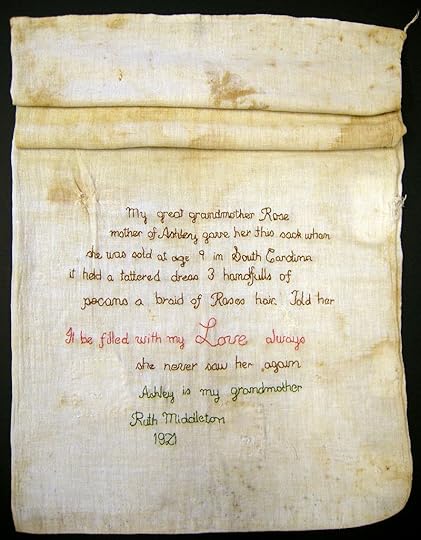
In a display case in the Smithsonian’s National Museum of African American History and Culture sits a rough cotton bag, called Ashley’s Sack, embroidered with just a handful of words that evoke a sweeping family story of loss and of love, passed down through generations.
In 1850s South Carolina, an enslaved woman named Rose gave this sack filled with a few precious items to her daughter, Ashley, as a token of love and to try to ensure Ashley’s survival as well. Soon after, the nine-year-old girl was separated from her mother and sold. Decades later, Ashley’s granddaughter Ruth embroidered this family history on the bag in spare yet haunting language—including Rose’s wish that “It be filled with my Love always.” Now, in this illuminating, deeply moving new book inspired by Rose’s gift to Ashley, historian Tiya Miles carefully unearths these women’s faint presence in archival records and draws on objects and art, to follow the paths of their lives—and the lives of so many women like them—in a singular and revelatory history of the experience of slavery, and the uncertain freedom afterward, in the United States.
All That She Carried is a poignant story of resilience and of love passed down through generations of women against steep odds. It honors the creativity and fierce resourcefulness of people who preserved family ties even when official systems refused to do so.
Tiya Miles is from Ohio, "the heart of it all," though now she spends summers in her husband's native Montana. She is the author of All That She Carried (which won a National Book Award for nonfiction and more), and of three prize-winning works of history on the intersections of African American and Native American experience. Her forthcoming book, Night Flyer: Harriet Tubman and the Faith Dreams of a Free People, will be out in June 2024, right on the heels of her short but sweet exploration of childhoods in nature: Wild Girls: How the Outdoors Shaped the Women Who Challenged a Nation (September 2024). Her debut dual time period (historical-contemporary) novel based on her early career research, The Cherokee Rose: A Novel of Gardens and Ghosts, was revised with new scenes and released as a paperback original by Random House in June 2023; check out the new version! She has also published a study of haunted plantations and manor homes in the South that reads like a travel narrative. (And she is as surprised as you are that two of her books focus on ghosts!) Her newest book, just out from W. W. Norton, is Wild Girls: How the Outdoors Shaped the Women Who Challenged a Nation. Tiya's favorite activities are reading good books while her three teenaged kids write stories together in the background, spending time in old houses, walking along forest trails, and drinking hot chocolate. She is currently working on a history, a novel, and essays about climate change and historic sites. Check out her Substack: Carrying Capacity, for news and updates! https://tiyamiles.substack.com/
Audiobook….read by Janina Edwards ….9 hours and 29 minutes
*National Book Award Winner*……[WELL DESERVED]
“LOVE and EMPATHY TOGETHER LEAD TO JUSTICE”
This is the most beautifully written book, (a unique-historical-personal-family story-a tribute to African-American women)…. and a gorgeous audio-listening companion! Huge applaud to Janina Edwards who made listening to Tiya Miles book…..”All That She Carried……The Journey of Ashley’s Sack, …a Black Family Keepsake” come alive with her deeply compassionate-warm-authentic-engaging voice!
There is so much to savor…..
If there was ever a book where Black Women from the past —who lived through physical cruelty, the Jim Crow era, sexual assault, mental splintering, daily suffering, (even death), as a result of so many women who were slaves — worth reading —THIS IS THAT BOOK!
From the minute I started listening to this audiobook….(having sent back several: AGAIN….back to the library)….I knew this was the audiobook I would be committed to from start to finish. I’ve been more picky lately with both my audiobook and ebook choices… If my own heart is not ‘fully’ in…..I’ve been dropping the ‘okay’ books more often …in search for a book that will WOW me …..(with interest and passion > heart inspiring and cerebral intrigue).
Personally…I don’t care what color a person’s skin is — their age- their sex - whom or how they enjoy their sex - (as long as it’s legal) - their class - their IQ- their body shape or size- THERE IS SOMETHING SO DARN INTERESTING TO ME WHEN ORDINARY PEOPLE …..share THEIR STORIES…THEIR TRUTHS…that fascinate me…. adding to my ‘learning’….deepening my understanding of history (without forced dry facts)…is better yet. YEP…I’m in love with this book. Ha…. I love people more than books….(but books can enhance and elevate my relationships with ordinary & extraordinary people from all walks of life)…. I’m a complete-‘hooker-people-loving-person’ —and this book is a magnet for people who love people, and their stories….. …..poignant history of ancestors linking the past to our present….and future.
Tiya Miles chronicles the story of three generations of Black Women through Ashley’s sack….(an embroidered cotton bag given to Ashley by her enslaved mother, Rose, before she was separated from her mother and sold during the period of slavery. NOTE: ….The sack can be seen in The Smithsonian National Museum of African American History and Culture.
Tiya traces the genealogy of three generations of women — offering a unique human-way to think about slavery in the south ……for Black Women.
We’ve learned the horrors before about slavery ….(but like the Holocaust- stories still need to be told — we don’t want to forget —as we never want to see it happen again)…. Of course by now, I knew thousands of African Americans were bought and sold — mothers who gave birth to their child - from rape — tried to protect their child—tried to avoid being ripped apart — But …. what I never really thought of — until this book — was how treasured textiles….(sewing, quilting, tapestries )…offered dignity—CONNECTING OUR PAST HISTORY….sooooo POWERFULLY! noble women sprung thread….and their cloth told stories ….stories passed down to distant kin. I have two friends who are exquisite quilters….I couldn’t help but think of them both —their amazing gifts -along with stories passed to children and friends.
African American quilting helped me understand aspects of slavery on a more personal level — not only the of physical and psychological trauma, but how material archives, treasures left behind (a dress, a hair clip, a lock of hair, a tote >> wrapped with stories)…. were much more meaningful—than I thought about.
What a fascinating way to explore history: tapestries stitched into our cultural memories.
We meet Rose, Ruth, and Ashley …. Their stories emerge…. sharing ways they were able to keep their children safe from slave owners.
Material objects— embroidered fabrics, sewing, and quilting help uncover history….and connect us together….(brings up beautiful thoughts in us)
There is a lot we can learn from this non-traditional historical book - inspire us — no matter what our race is —- It has a meditative quality …
I’m even left thinking about what’s worth keeping as Paul and I begin a major house remodeling in Jan. 2022. From books, dishes passed down from my grandmother, clothes, jewelry, paintings, other artwork, the inheritance of our seashell collection (we lost half during the 1989 earthquake), etc…. This book (on top of a dozen other things I took from it)….is having me seriously look at — what to send off to the thrift store —and what to keep.
I thought about and cared for the women in this book — their courage and humanity during a very inhuman time of history ….. I also thought about the treasures and trauma we inherit and carry.
Heartbreaking and heart endearing — “All That She Carried” would make a wonderful gift book to any woman or man you love…..(but read it or listen to it yourself first)….
A very interesting book about a grain/seed sack and three Black women who persevered in America. One of the challenges of Black history is that there are alot of things we do not know because of the lack of records. If only we had time machines. When records did not exist, Miles had to speculate what might have occurred between Rose and Ashley based on what we know about slavery from other historical records and studies. The sections of the book that I found most interesting was Miles's coverage of the items (dress, pecans, hair, and love) that Rose put in Ashley's sack and their possible significance based on what they meant to enslaved people. Overall good book, fans of Black history, genealogy, and family heirlooms will enjoy it.
Thanks to NetGalley, Random House, and Tiya Miles, for a free ARC copy in exchange for an honest review. This book will be released on June 8, 2021.
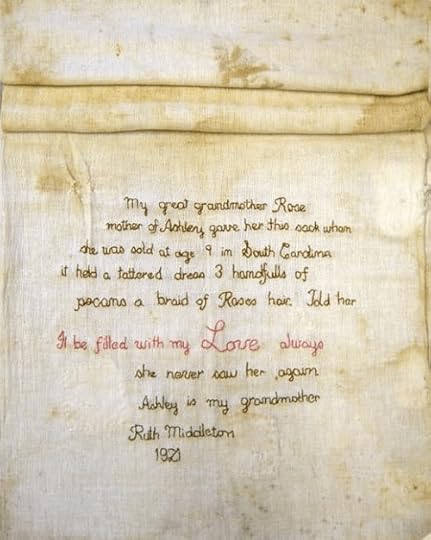
My great grandmother Rose mother of Ashley gave her this sack when she was sold at age 9 in South Carolina it held a tattered dress 3 handfulls of pecans a braid of Roses’s hair. Told her It be filled with my Love always she never saw her again Ashley is my grandmother
Ruth Middleton
1921
The above message is embroidered on a plain cotton sack from South Carolina in 1850, on exhibit at the Smithsonian Museum of African American History in Washington, D. C. In All That She Carried, Harvard historian Tiya Miles attempts to reconstruct the lives of great-grandmother Rose, Ashley, and her granddaughter Ruth and must confront the “conundrum of the archives.” How do you document the lives of individuals where written records are scarce? All That She Carries is a speculative history of these women’s lives and a fascinating description of the historical detective work, the methodology she used to reconstruct the past.
I found both aspects of the narrative engaging. Miles first had to scour records of South Carolina plantations to find one with a Rose and an Ashley listed as " property". She then visited the locale and researched aspects of life on plantations; the diets of enslaved people, permitted and forbidden food, types of clothing, roles women performed, the handicrafts they produced, and the significance of these crafts as family heirlooms. Miles also examines diaries of women from that period. For me, what was most moving was their descriptions of family separations, the pain of having a child sold, and never seeing the child again. In reconstructing the story of Ashley’s Sack, Tia Miles paints a vivid portrait of the lives of enslaved women and their ancestors. I highly recommend it.
So what I wanted from this book was not what was being offered. That is my fault and please accept my review and rating in that framework. I wanted the story of three women who were connected through a seemingly inconsequential piece of material. Instead, the sack is used as a framework to present the life of an enslaved person. Broad generalities were used and a lot of assumptions were made and I felt the view being portrayed became a bit romanticized. Not that Ms. Miles presented a life of wonder for these people, but by assigning significance and intent to certain actions, the reader gets what may be an inaccurate view. But again, this goes back to needing to make broad assumptions due to the lack of historical information regarding people who were brought here against their will and forced to support the economy of the privileged.
Thanks to Random House for a copy of the book. This review is my own opinion.
2. The story of Rose, Ashley and Ruth is heartbreaking. I couldn’t wait to read this book because I’d heard about the sack before and have never forgotten it.
3. I think she tried her best, but the author was not able to turn up much evidence on what became of Rose, Ashley and Ruth.
4. Because of number 3, there is a lot of filler in this book. A LOT. Almost to the point that the author really should not have bothered writing this. The book is well written but all over the place. The author tried to use general information to flesh out the scant records she could find on Rose, Ashley and Ruth and it just did not work. I found my eyes glazing over at the end and I was ready to move onto the next book.
Rose, Ashley and Ruth deserved better. Three stars.
Wow. I am literally blown away by the history collected in this text. I am familiar with the story of Ashley's Sack from a newspaper article a few years ago. I pre-ordered this from Kindle as soon as I read it was available but have hesitated to read it during the pandemic.
The newspaper story touched me so deeply I ugly cried. I have ancestors lost who were sold young and we do not know and can not find their people. So these stories hit me especially hard. Reading the book I discovered that many folks who encountered this lost history cried. When this was on display at Middleton Plantation Museum this exhibit includes a box of kleenex because few visitors left dry eyed. Now this exhibit is at the African American Museum in Washington DC and I would imagine the reaction is the same.
Yet this book covers so much more than Rose, Ashley & Ruth. This covers the history of chattel slavery in what becomes the Carolina's first and later South Carolina. From first Indigenous Peoples of the America's who were enslaved until it resolves into solely West Africans enslaved.
This covers foods, clothing, housing, slave markets/blocks/pens, to traditional chores/expectations of enslaved peoples, the crops they grew, etc.
The picture is so rich that it helps fill on the spaces of the lives of these remarkable and resilient Black women.
Beautifully and respectfully done. I'm gonna buy the audiobook as well because this is a book I'll return to.
Tiya Miles out did herself with this. I am so fucking grateful 😭💜🥰
I can definitely see why this one won the National Book Award. A touching, yet heartbreaking look at the history surrounding or in some way related to Ashley's sack, a gift from an enslaved mother to her young daughter upon their permanent parting.
Click here to hear more of my thoughts on this book over on my Booktube channel, abookolive.
Ashley's Sack is a simple bag originally made to house seeds. Constructed in, possibly, the 1840's, it has gained significance as a display in the Smithsonian's National Museum of African American History and Culture, a symbol of the lives of enslaved women, and the proof of a mother's love. Much of the history of the Sack is speculation in that Rose, Ashley's mother, cannot be personally identified due to the lack of records, but Rose represents millions of women who were not considered by their owners as other than property, thus being cruelly separated from their families. Ashley however held onto that Sack, and as a grandmother herself, inspiring Ruth, her granddaughter, to embroider the words that have set this article apart, noting that it was packed with a tattered dress, handful of pecans, braid of Rose's hair, and her mother's love. Much about history of slavery (hard to read throughout), the importance of pecans, needlework and even hair. Quite a few illustrations, some lovely, many disturbing. No matter how much I read about this subject, it never fails to shock, sadden, and anger me.
While I appreciate the intensive research that went into this book, I can't help but feel some of the conclusions drawn are based on scant evidence and cannot be presented as fact, which I felt to be the case on many of the pages in this book.
The issue of evidence--or lack thereof--is what does truly make Ashley's sack incredible. That it survived through generations of slavery, civil war, migration, and lifetimes is remarkable, miraculous even. However, and I recognize I have neither the credentials nor the expertise to make these claims with anything other than my own limited knowledge of Civil War era artifacts, I felt at times some of the parallels drawn were presumptuous. I suppose that it would be impossible to write an entire book about one remarkable artifact without some potentially erroneous conclusions, but for me personally, those attempts diminished the scholarly work.
After reading the essay on the writing of the book, I recognize that a grant was provided for this research, with the expectation that some sort of public work reaching a large audience would transpire. It makes sense then, that this book would attempt to draw conclusions when there is no evidence to do so and to try to find meaning when there is little context.
As a scholarly project, I was disappointed. As a narrative on the heartbreak of enslaved mothers and the desperation they must have felt for hundreds of years, I was reminded again of the horrors inflicted upon millions of people.
It's hard to know how to review a book such as this.
This remarkable book brings alive the meaning behind the embroidered words on a plain, fraying sack:
My great-grandmother Rose mother of Ashley, gave her this sack when she was sold at age 9 in South Carolina it had a tattered dress 3 handfuls of pecans a braid of Rose's hair. Told her
It be filled with my Love always
she never saw her again Ashley is my grandmother Ruth Middleton 1921
Both accessible and scholarly, Miles traces the journey of the sack and uses traditions and culture to illuminate the deep wounds, loves and losses of enslaved people.
Another book that got set aside for other reading for a couple of reasons. 1) it was much more academic than I had anticipated and thus required a lot of attention to the content, and I spent more time reflecting on what I had read, 2) I joined a real-life book club, so those books went to the top of my reading lists, and 3) my annual TBR summer challenge. Full RTC.
9/10/24: I am not sure I can do this book justice. First, I gave it 4 stars instead of five only because I got bogged down with minutia as Miles moved away from trying to reconstruct the story of Rose & Ashley into the significance of certain items. Miles herself stated that the book was a public history, and object history and a study of black women's lives. It was fascinating but slower reading for me.
1850's South Carolina, an enslaved woman faced the imminent sale of her 9 y/o daughter. She packed a cotton bag with a few precious items as a token of love and to try to ensure Ashley's survival. It passes through three generations; Ashley's granddaughter embroiders a spare family history on the bag.
My great grandmother Rose mother of Ashley gave her this sack when she was sold at 9 in South Carolina it held a tattered dress, 3 handfuls of pecans a braid of Roses's hair. Told her
It be filled with Love always She never saw her again Ashley is my grandmother
Ruth Middleton 1921
Ashley's sack is on display in D.C. at the Smithsonian's museum of African American History and Culture. A rare artifact that is tied to an enslaved woman.
Because of the dearth of records for and about the enslaved, Miles has tried to reconstruct the lives of Rose and Ashley and although this story may be speculative for these two women it is representative of the lives of enslaved women and has been heavily researched. There are 66 pages of n0tes and citation at the end.
It is a heartbreaking read of the cruelty of slavery but also life affirming as well. A testament to the resilience of black women from slavery through the Jim Crow era. How they tried to maintain their dignity and pass on their stories. ...story is about teh resourcefulness of women and girls, even the most marginalized of them. ...The story suggests how instructive memories of perseverance from the past can be, especially when fastened to things that serve as aids of recall and connections.
Things become the bearers of memory and information.
Ruth Middleton stood toward the end of a long line of women survivors. She used fabric, as women had for centuries, in a process of memorializing their families. I certainly look at quilts a lot differently now and think about my own precious items that are connected to memory. Many in my family says get rid of your stuff!!! I have been reluctant to do so, just as I was when going through my parents' items after their deaths. They aren't just things, they hold meaning. Ah, I digress from the book.
Everything about slavery is horrible, but so heart wrenching to be reminded about how families were torn apart, children ripped from their mothers. In the conclusion the author points out how outraged many in the country were when immigrant children were being separated from their parents. It highlights how society's sensibilities have changed except for the architects of those policies and those that cheered them on.
And just as an aside, there is another piece of slave life that is difficult to wrap my head around. If I were a slave owner that depended on slave labor to work the plantation and seen as a valuable commodity, why would I starve those workers? The idea that slaves were less than human and perhaps disposable to this day just is beyond my comprehension. It is sometimes hard to view history from our modern perspective and have true understanding. Just my humble opinion.
Anyway, I highly recommend this read. I borrowed this book from a friend but now have decided to order my own copy to read some sections again. I hope to convince my book club to read this, so much to discuss.
It breaks your heart, really. Even just the picture of it. Slightly bigger than a legal sized piece of paper, discolored enough to reveal experience and age. Found in that ultimate place of renouncement, of all things abandoned because of utter indifference and there but for a last hope to satisfy greedy avarice: a flea market. A pile of scraps held Ruth Middleton's sewn hope for recognition and remembrance. What was it my great-gran needled on so many things? Remember me. This humble bag, found tumbled amongst old scraps whispered Ruth Middleton's testimonial to whoever would hear. She'd needled love's genealogy in childish, very legible script bearing witness to the bag's chain of ownership, and its reason for being: a mother's desperate goodbye, promise of love never-ending and a tangible surrender to a system even a mother's love couldn't overcome.
My great grandmother Rose mother of Ashley gave her this sack when she was sold at age 9 in South Carolina it held a tattered dress 3 handfulls of pecans a braid of Roses hair. Told her It be filled with my Love always she never saw her again Ashley is my grandmother Ruth Middleton 1920
Tiya Miles' book is an education. Hard reading, yet compelling. Again, the world presents a reader with terrible truths, but necessary to know otherwise we again won't see it when it is happening. Again.
I received this book as part of a Goodreads giveaway. I give the book 3.5 stars but rounded up to 4 stars in my rating. My reasoning for not giving 4 or 5 stars is that in certain points of the book I thought the author was a bit repetitive and was almost rambling. That being said, Tiya Miles does an excellent job telling the story behind a historical object, successfully bringing not just Ashley’s sack to life but also the stories of thousands of enslaved people across the United States. In 21st century society we are so obsessed with “things” and owning physical items. To think this sack and the items inside were some of the only items an enslaved mother could pass on to her daughter is simultaneously heartbreaking and fascinating. Miles does an amazing job exploring who Ashley may have been, how her descendants might have lived post-Civil War, and how and why the objects in the sack are so important. Through researching and imagining Ashley’s story, Miles is able to tell a broader story about slavery as a whole that is both unique and profound.
Now the winner of the 2021 National Book Award for nonfiction, this accessible book shows a historian’s journey to draw out what can be known and surmised about a single historical artifact: a cloth sack embroidered with the passed-down story of an enslaved mother’s gift to her nine-year-old daughter when they were about to be separated. A moving and intriguing work that brings fresh insights and deeper empathy to our understanding of the lives of enslaved women, which makes it a sad and important read.
I could not finish this book. It was too tedious and repetitious. I liked the premise, but felt this could have been a short story with just as much impact.
Reading about slavery is a very tough assignment: one of the worst human atrocities committed on people, and for a long time, and in a country that prides itself on freedom. The cruelty, physical and mental degradation, beatings and back-breaking work made life unbearable. But the worst suffering black families endured was the separation of loved ones: children torn from mothers, husbands from wives, whenever enslavers sold people. (It is tough to even write ‘sold people’. How could you?)
Rose, Ashley’s mother, filled a sack with the necessities of life and a mother’s love for her child when Ashley was sold at age nine. She could not do much else for her - in fact it is remarkable she could even do that much. Three generations later, Ashley’s granddaughter, Ruth, embroidered the family legend onto the sack that has been passed down through the generations. With chainstich in red, she stitched the following story:
This object, and its text, more than anything, brings home the heartbreaking tragedy of losing a child, bringing tears to the eyes who see it. It is a rare artifact of enslaved people as not much of their possessions and few of their stories survive. It is also a testament to a mother’s love and caring, and to the resilience of black women, and their commitment to preserve the connection of the line of their mothers and family memory.
Tiya Miles is dazzled by this humble yet so affecting object - a sack, its contents, its story, and the women who created and carried it. She sets out to explore everything connected to it. Explores the dress, hair care, food, and spiritual beliefs of enslaved people; their daily lives, their tasks, what they did with their little free time (mostly grew food and made clothes). She places the emphasis on survival, resilience, maintaining dignity and loving connections.
The telling of the story has healing power for the women, and for the author herself as well. I appreciate her enthusiasm. At the same time this leads her to being overly effusive, repetitive and lengthy; sometimes jumping to unwarranted conclusions or even seeing things that are not there. For example, she sees “planters attitude” and parallels to slavery into a piece of writing about breeding pecans, because it contains words like “forcing” the plant and tree “limbs”. Hmm, sorry, Ms. Miles, those are just gardening terms. And I seriously doubt enslaved people were respecting pecan trees for their free attitude or because they are a very “democratic” tree. (I have the audio so I am paraphrasing.) I am pretty sure they liked them for the nuts.
A very valuable journey into the lives of enslaved women and their descendents through the Jim Crow era, however the author inserts herself and her analysis way too much into the story, leading to long sections where she belabors the same point over and over again. Despite that, this is a rare point of view emphasizing black women and their perspective, which makes this piece of history very personal.
This was such a poignant book. We live in a society where we give lots of importance to materialistic things, so it’s fascinating to explore how a single such item can convey the traumatic history of a whole group of people. While talking about how a single bag was passed down through generations, the author manages convey to us the horrors of enslavement, how the lives of enslaved women were for decades, and how difficult it was for them to even own something, let alone pass it down, when they themselves were considered property. Add to it the fact that families were separated very often, it’s truly a story of resilience that the author narrates to us here.
Very compelling and engaging read and I would definitely recommend to readers who would love to read books about African American history from different perspectives.
I really liked how this started with something so specific (a sack given to a daughter from her mother) and then zoomed out to look at other enslaved women before honing back in on the item and woman we originally were looking at. It created a thread between each story and they were all so important to learn.
I had to force myself to finish this book, and at that, I was skimming at times. I wanted to pay my respect to Rose, Ashley, and Ruth, the three women bound by DNA and their sack. But the author made it hard, sigh. There are no details about Rose and Ashley beyond their bare existence, so the author filled the void with a constant screed about life for enslaved African Americans. I am not making light of the slavery of this country, it was evil and the consequences remain with us still. But I don’t need to see the words”enslaved” and “unfree” half a dozen times on each page for 200+ pages (less frequently for the last third of the book). I do understand avoiding the word “slave”; it diminishes anyone unfortunate to be in such a condition and doesn’t put the onus on the ones who create and support the system of slavery. What I wanted, though, was less ranting and more about Rose and Ashley, which sadly wasn’t available.
The author also indulged in Victorian-style hyperbole about the meanings, hidden or otherwise, behind the choices Rose made in filling the sack, the use of textiles to tell a history, and other aspects of life for African Americans. Her speculations became very annoying, and her insistence that these were the sensibilities of African American women took no (or little) account that for millennia, women around the world also held the same values of family love and survival, that the creation of textiles have always been exquisitely important (both physical and metaphysical), or that women have always formed groups to push their agenda in a world dominated by men.
Ruth Middleton, Rose’s great-granddaughter and Ashley’s granddaughter, left more of a traceable history. And it was through her that Ashley’s sack came to light. My hat is off to all the ‘Roses’, ‘Ashleys’ and ‘Ruths’ who endured and survived, whose work is not yet done. Despite the literary challenges, this is what I take away from this book.
I borrowed this on a whim while browsing the audiobook selections from my library, and it did not disappoint. I was a little unsure about how much content there would be about a sack, even a historically important one, but on that point I was very wrong. This book is deeply researched and well-presented with every facet of the sack, the embroidery on it, the contents within it, and the hopes it represented, and the beliefs surrounding it.
I really enjoyed this, and definitely would recommend it highly.
In 1850s South Carolina, a nine-year-old enslaved girl, Ashley, is about to be sold away. Her mother, Rose, sends her away with a sack containing a tattered dress, three handfuls of pecans, a braid of Rose's hair and "all my love." Amazingly, the sack survives another seventy years, and Ashley's granddaughter embroiders the story on the sack in 1921. Even more amazingly, this artifact is now on display in the Smithsonian's Museum of African American History.
For some reason, I thought this book was going to be a novel, which I usually prefer to non-fiction. I like stories. But, the known story of the sack is thin. Researchers have tracked down the scanty record of women they believe to be Ashley and Rose, and the author relates the few sketchy details that are known. More is known of Ashely's granddaughter, Ruth Middleton, and the reader meets her in a later chapter.
But, mostly, the author uses the sack as a starting point to explore in depth what it meant to be an enslaved woman, and what it meant to be only partly liberated in the late 19th and early 20th centuries. We learn how slave records were kept. One chapter discusses what Rose put in the sack and why she would have chosen those items. There are chapters on the importance of fabric and needlework to Black women. All of the chapters are beautifully written and meticulously researched. The reader is spared none of the horror and heartbreak of slavery. But we are also inspired by the courage and fierce love of powerless mothers like Rose.
I enjoyed this book, but sometimes it felt bogged down by a little too much detail.
There is one quote in the introduction that I feel I must share, because it absolutely took my breath away. The author compares Ashley's sack to the Confederate monuments that are being re-evaluated and/or removed all over the country: "These memorials, erected to bury a nation's sin, were made to be larger than life to command a presence in national memory. At the same time, though, Confederate monuments undermined the aspirational principles of America's founding: freedom, equality, and democracy. Ashley's sack makes no such pretense to vainglory. It does not have to A quiet assertion of the right to life, liberty, and beauty even for those at the bottom, the sack stands in eloquent defense of the country's ideals by indicting its failures."
National Book Award for Nonfiction 2021. Ashley’s granddaughter Ruth embroidered the sack with the following inscription:
“My great grandmother Rose mother of Ashley gave her this sack when she was sold at age 9 in South Carolina it held a tattered dress 3 handfulls of pecans a braid of Roses hair. Told her It be filled with my Love always She never saw her again Ashley is my grandmother Ruth Middleton 1921”
The sack was on display at the Smithsonian’s National Museum of African American History and Culture after being rescued from a flea market in Nashville in 2007. Miles’ research efforts suggest the probability that the sack traces back to the estate of Robert Martin of South Carolina circa 1852. The professor at Harvard uses the sacks’ contents to explore the greater historical context of the period—the expanding cotton trade, the codifying of the clothes slaves were allowed to wear, the development of pecan farms, and the cultural habit of giving hair as a gesture of one’s love.
Miles efforts help to illuminate the lives of women slaves of the period.
I read this for a reading group. It was a struggle. More than half the group could not get through it. I did and I am not sorry.
The author is a professor of history and mostly she writes like a historian. Yet she mixes in a good deal of speculation and has a solid theme regarding the ways that Black women, both the enslaved and their descendants in America, pass on love and resilience down through the generations.
In building her case for that theme, Tiya Miles centers her book on a sack given by an enslaved mother to her daughter just before the daughter is to be sold away. In that rough cotton bag she placed a tattered dress, three handfuls of pecans and a braid of her hair.
By the time I finished the book I knew quite a bit about slavery in South Carolina, about pecans, about the significance of hair and textiles and crafts. I also finally got the point the author wanted to make.
I felt I had seen more into the personal lives of Black women during slavery, the terrible history of Reconstruction, the Great Migration, and the racism that accompanied it all to the present day. Thus, it was a good companion read to The 1619 Project I read earlier this year.
I had some realizations: One was why Black women are sometimes so intent on dressing well and doing their hair. The other was how objects carry history, especially when the actual records are scanty, which led me to focus more on objects in my own writing.
Despite my struggles during the reading, I decided it was worth having read this book, every page.
All That She Carried examines a sack given 9-year-old Ashley by her mother, Rose, when she was sold at auction: "it held a tattered dress three handfuls of // pecans a braid of Roses hair. Told her // it be filled with my Love always // she never saw her again" Ashley's granddaughter, Ruth, embroidered this charming, succinct, and heart-rending oral history on it.
Without this embroidery, Rose and Ashley would have been completely wiped from South Carolina's history. As Stephanie McCurry (1995) noted, "Historical visibility is everywhere related to social power."
Nonetheless, this sack had little provenance, and Tiya Miles was forced to engage in considerable speculation. Miles wandered through many rabbit holes, trying to understand who this Rose and Ashley were – Rose was a common name, but Ashley was uncommon in the middle of the 19th century, especially for a girl. Miles also explored the meaning of the sack, the implications of giving it to Ashley, and her choice of the dress, pecans, a braid of her hair, and even the colors of Ruth's embroidery floss.
I enjoyed Miles' questioning, an act making her speculation visible and engaging us with it:
How does a person treated like chattel express and enact a human ethic? What does an individual who is deeply devalued insist upon as her set of values? How does a woman demeaned and cowed face the abyss and still give love? (p. xiv)
I didn't like Miles' frequent use of adjectives (e.g., horrific, terrible, awful), however. I wanted the possibility of choosing adjectives to describe my dismay. I probably would have landed on horrific, terrible, and awful, but I wanted this to be my choice. As it was, my inner oppositional child initially resisted her labels – until my more grown-up mind stepped up and said, horrific, terrible, and awful. Would anyone reading this have arrived at another conclusion?
This was a Community read in Indianapolis, one that I was glad I joined.
This is one of those books that will stay with you, turning over in your mind, with bits and pieces resurfacing at unexpected times. The meditative approach makes this feel much less "academic" while maintaining scholarly rigor. Aka non-academics will like this too! It also contributes to this process of the book returning in fragments.
The introduction was a bit off-putting for me, but once the focus turned to the subject itself - a sack owned by an enslaved woman that once held a dress, pecans, and her mother's love - the meditative approach fit perfectly. Like many here, I learned a lot about pecans, and many other things. But I also put together knowledge that had been oddly separate in my head that these new pieces illuminated even more. For one example - Yes, I knew that enslaved people were given the worst cloth to use for their own clothes, and often not enough of it. Many used homespun that the enslaved people had to make themselves. I knew that cotton on plantations was for export, often to the North, and that then the finished cloth was sold in the South and elsewhere. How had I not considered the market forces in clothing the enslaved, the existence of a "negro cloth," and how that parallels with things like prison uniforms? If you dont have similar background knowledge, Miles effortlessly guides you, but there is still something here for those familiar with much of the material.
Academically speaking, in addition to those studying antebellum America, enslavement, etc, etc, this is great material for a discussion of history as memory and memory as history, a methods class, how to use methods from other fields as a historian (art history for a start), negative spaces in the record, gender history, and so many more.
Tiya Miles and I were baby grad students together in the early/mid 90s - I dropped out after a couple of years and chose a very different series of career paths, but she persevered, and so it's with pride as well as with awe that I get to connect with her again in these pages, one-sidedly, and witness her at the present height of her academic and writerly powers. It's a brilliant academic (yet at times deeply emotional and almost poetic) analysis of a singular artifact of enslavement. Ashley's sack is bottomless indeed. What beautiful and heartbreaking work.
A powerful and thought-provoking book in so many ways, but the execution of the history never quite hit its stride for me.
The central focus on Ashley’s sack is a brilliant way in to talking about the experiences of Black women as mothers, daughters, ancestors and descendants in the American South in the 19th and 20th centuries. As an emotional object it’s a classic starting point for Miles to work up a narrative through the sparse archival sources, using the tools of microhistory and critical fabulation. This works well when she takes an element of it - like the three handfuls of pecans Ashley’s mother loaded into the sack - and spins it into a chapter about Black and Indigenous food cultures, pecan cultivation and the harsh limitations of plantation diets. Throughout you can tell that Miles is a deeply read, methodological reflective scholar - the footnotes are legion and they are fascinating. But this is partly the problem - so much of the ideas, tools and techniques that underpin the book get siphoned into the tiny font of the notes (which are almost a quarter of the paperback edition), that the main text is strangely denuded. Without the scaffolding that justifies the constant return to the sack, the narrative becomes repetitive - I was frustrated that the same sentences, same assertions were made over and over at the front of the book, while the nuance of interpretation got parked at the back. It felt like an example of an academic text made accessible for a wider audience and losing something essential to its historical practice in the process.
Really thorough research about a terrible period in US history. Several sections explored little known facts about the lives of the enslaved African Americans. However there were so many instances of exaggerated symbolism and assumed motivations that I found it difficult to fully enjoy this book as a nonfiction tome.
As someone who has a PhD in the history of unfree labour and enslavement, I feel qualified to state: it just doesn't get better than this. This book is history, poetry, sorrow and beauty. I'll be talking about it for years.