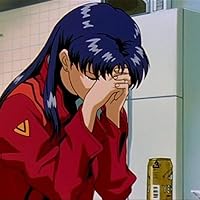
Une fois sa grand-mère partie, Yusake envisage de reprendre ses révisions pour les examens qui approchent. Pourtant, une nouvelle dispute avec Kyoko chamboule tous ses plans et l'envoie pour quelques semaines à l'hôpital ! Difficile dans ces conditions de réviser, ou plus important encore de marquer des points auprès de la femme qu'on aime...
Rumiko Takahashi (高橋留美子) was born in Niigata, Japan. She is not only one of the richest women in Japan but also one of the top paid manga artists. She is also the most successful female comic artist in history. She has been writing manga non-stop for 31 years.
Rumiko Takahashi is one of the wealthiest women in Japan. The manga she creates (and its anime adaptations) are very popular in the United States and Europe where they have been released as both manga and anime in English translation. Her works are relatively famous worldwide, and many of her series were some of the forerunners of early English language manga to be released in the nineties. Takahashi is also the best selling female comics artist in history; well over 100 million copies of her various works have been sold.
Though she was said to occasionally doodle in the margins of her papers while attending Niigata Chūō High School, Takahashi's interest in manga did not come until later. During her college years, she enrolled in Gekiga Sonjuku, a manga school founded by Kazuo Koike, mangaka of Crying Freeman and Lone Wolf and Cub. Under his guidance Rumiko Takahashi began to publish her first doujinshi creations in 1975, such as Bye-Bye Road and Star of Futile Dust. Kozue Koike often urged his students to create well-thought out, interesting characters, and this influence would greatly impact Rumiko Takahashi's works throughout her career.
Career and major works:
Takahashi's professional career began in 1978. Her first published story was Those Selfish Aliens, a comedic science fiction story. During the same year, she published Time Warp Trouble, Shake Your Buddha, and the Golden Gods of Poverty in Shōnen Sunday, which would remain the home to most of her major works for the next twenty years. Later that year, Rumiko attempted her first full-length series, Urusei Yatsura. Though it had a rocky start due to publishing difficulties, Urusei Yatsura would become one of the most beloved anime and manga comedies in Japan.
In 1980, Rumiko Takahashi found her niche and began to publish with regularity. At this time she started her second major series, Maison Ikkoku, in Big Comic Spirits. Written for an older audience, Maison Ikkoku is often considered to be one of the all-time best romance manga. Takahashi managed to work on Maison Ikkoku on and off simultaneously with Urusei Yatsura. She concluded both series in 1987, with Urusei Yatsura ending at 34 volumes, and Maison Ikkoku being 15.
During the 1980s, Takahashi became a prolific writer of short story manga, which is surprising considering the massive lengths of most of her works. Her stories The Laughing Target, Maris the Chojo, and Fire Tripper all were adapted into original video animations (OVAs). In 1984, after the end of Urusei Yatsura and Maison Ikkoku, Takahashi took a different approach to storytelling and began the dark, macabre Mermaid Saga. This series of short segments was published sporadically until 1994, with the final story being Mermaid's Mask. Many fans contend that this work remains unfinished by Takahashi, since the final story does not end on a conclusive note.
Another short work left untouched is One-Pound Gospel, which, like Mermaid Saga, was published erratically. The last story to be drawn was published in 2001, however just recently she wrote one final chapter concluding the series
Later in 1987, Takahashi began her third major series, Ranma ½. Following the late 80s and early 90s trend of shōnen martial arts manga, Ranma ½ features a gender-bending twist. The series continued for nearly a decade until 1996, when it ended at 38 volumes. Ranma ½ is one of Rumiko Takahashi's most popular series with the Western world.
During the later half of the 1990s, Rumiko Takahashi continued with short stories and her installments of Mermaid Saga and One-Pound Gospel until beginning her fourth major work, InuYasha. While Ran
The chapters that are good are great. The chapters that are bad are literal predatory creepy shit. This volume had two gross chapters, but it also had one of my favourites so far. I’m reluctantly invested in this series. Kyoko is the only reason this is worth the time.
In typical Takahashi fashion, this volume starts introducing a few more new characters to the cast and we say good bye (for now) to Godai's delightfully blunt and crafty grandmother as she finally goes home. The introduction of Goadai's cousin is a bit of a weird one—one needs to take the time period and culture into account on this one and just roll with the punches, which thankfully, even the cast admits is pretty effed up, and that is, frankly, what makes this type of humour funny. There is a nice balance of humour with the taboos, something that Takahashi always does well with her work, yes, it's a bit a pervy which may bother some readers, but I can't deny that it does make me laugh.
Highlights of this book include the introduction of Mr. Ichinose in physical form and its keeping with the long running joke of nobody having ever seen him. There is some peak pettiness between Godai and Coach Mitaka which I enjoyed beyond reason, and a good chunk of this book is devoted to these two in their battle of wills. The book is not all outrageous hijinks however, and dang if I didn't mist up as we come to the fourth year of Kyoko being a widow and how far she has come in her grieving process.
Least favourite? The introduction of the newest renter, 18 year old Nozomi. Another character infatuated with Kyoko and basically comes off as a poor man's version of both Godai and Mitaka.
I had a good time with this installment. Yet there were sad undercurrents and one scene that I wish I did not see.
Godai’s awesome grandma (who made the previous volume so much fun) went home. That chapter was hilarious!
What I found sad was seeing more of the Ichinose family: Mrs Ichinose is cool as an obnoxious neighbour; she is also a functioning alcoholic. Mr Ichinose is working so much that no one at Maison Ikkoku knows what he looks like. Their son saying that he cannot depend on his parents for anything broke my heart a bit.
How is it going for Kyoko and Godai, you ask? They are still unable to have an honest conversation with each other. Going around being clueless is a much more adult thing to do, right? I guess you can tell that I got very annoyed with both of them this time. Also, there was that one scene that aged extremely badly. Or rather, what Godai did isn’t ok in any century, but no one would put it into a manga today. I hope. However, in this volume Godai also broke a leg (twice, under ridiculous circumstances) and almost drowned (once). I’ll think of it as comeuppance.
Naturally, I want to know what happens next.
Quotes:
The neighbours are discussing whether asking Godai for a favour is a good idea: ”You sure he’s the best choice?” ”It’s fine. I knew he was a fool when I asked him.”
Après une énième dispute avec Kyoko, Yusaku se retrouve à l'hopital en voulant lui venir en aide. Avec une jambe cassé, il reste hospitalisé. Kyoko nourrit des sentiments assez ambivalents : la culpabilité mais en même temps une certaine fermeté dans la rancoeur. Lorsque la situation commence à dégénérer à l'hôpital avec les visites des colocataires, la jalousie de Shun le prof de tennis, ou les interventions de la pseudo petite amie, Yusaku ne sait plus comment faire pour attirer l'attention de Kyoko. Comme pour chaque tome, quiproquos et malentendus sont toujours de mises pour le grand plaisir des lecteurs.
I always enjoy reading this series! It’s like a funny little sitcom. I’m always laughing.
I do get annoyed by the back and forth with Kyoko and Godai but low and behold, in this volume, it seems like they are making some progress! Nothing concrete just yet … even though it’s been like 3-4 years LOL Honestly, I’m just glad that everyone has stopped ripping on Godai as much now. I was feeling so bad because everyone was always putting him down in the last 4 volumes…
Anyway, I’m excited for the next volume because a new tenant has arrived and I wonder how this is going to play out!!!
I absolutely adore this series and all its characters but isn't Kentaro's story sad. Like just the undercurrent of the poor family with the alcoholic mother/parents. It's all viewed through a slapstick comedy style, but it gives that feeling of sadness that kind of permeates through this series. Ver sad but also ver hilarious (the series, not our poor child star).
5 bands of tragic comedians out of 5 sweet sadnesses
“Maison Ikkoku” continues to be a well written, often poorly aged, interesting read. The romance develops a little bit this volume, not significantly, but at this point anything is something. Kyoko and Godai continue to get better as fully fleshed characters. The whole of Maison Ikkoku’s residents get some time this volume which is always nice. It’s exactly what I wanted and what I expected.
The deeper layers of the series are starting to show more and more with every chapter. Kyoko’s grief, Godai’s inferiority complex, the poverty of the apartment building and the characters within (for various reasons), the series is still very comedic but these undertones are worked in well by Takahashi.
Damn you, Takahashi, always tugging at the heartstrings in just the right ways. I do love watching these characters mature with time passing, and I think her handling of Kyoko's emotional journey as a young widow dealing with her evolving grief is really something.
When a manga has not only a "trip to the hot springs where the men peek at the women" story but also a "what if the protagonist's cousin is into him" angle and still gets four stars from me, you know it must be up to something special.
Like this series of manga rom com, between a student and the manager of his apartment building. It’s off the wall, ludicrous at times, repetitive, but brilliant, great characters. 5 books in and they’re still not together.
With interesting progress and endearing character arcs, this volume felt like a step forward, albeit a small one. I hope grander developments are in the works, can’t wait to see what comes next.
J'ai découvert la série avec Dorothée, sous le nom stupide de Juliette je t'aime. Version assez édulcorée, j'ai constaté que le manga a beaucoup plus d'allusions coquines... J'ai acheté le manga japonais, à l'époque où les traductions françaises brillaient par leur absence... Il y avait les gags visuels, et je complétais l'histoire avec ce que j'avais vu à la télé, même s'il y a avait des personnages omis dans la série. J'ai aussi encore quelques LD (laser disk, galettes taille 33 tours, ancêtres du DVD. Je n'ai plus de lecteur...) des OAV tirés de la série (en japonais non sous-titré).
Oui, je suis un fan de Rumiko Takahashi, de Urusei Yatsura (Lamu) à Ranma 1/2, mais je connais moins bien ses œuvres plus récente (Inu Yasha).
Et en lisant cette adaptation française, j'ai réalisé encore une fois pourquoi : la dame a un humour féroce, hilarant, n'excluant pas la tendresse, et la densité psychologique sous la loufoquerie des personnages. De plus, son dessin, un peu hésitant dans les premières pages, s'affine rapidement. La dame a un dessin efficace, sobre, avec peu d'effets, mais très expressif. Et, ma fois, souvent élégant, particulièrement quand elle dessine son héroïne en pied.
C'est rare que je m'esclaffe en lisant un livre ou une BD, c'est le cas de celle-là (et des livres de Douglas Adams et de Terry Pratchett). J'ai trouvé ces cinq volumes à ma bibliothèque, mais il faut vraiment que j'investisse dans la série (qui curieusement a moins de tomes que dans la VO, avec une pagination plus grande).
La traduction semble correcte, vivante et^drôle. C'est dommage que Tonkam ai manqué un peu de professionnalisme, laissant passer quelques fautes, altérant légèrement les noms des personnages. Passe pour les accents et trémas, utiles au grand public, mais quel besoin d'avoir abandonné les voyelles longues ? On lit Kyoko au lieu de Kyōko, Yusuke au lieu de Yūsuke. Pire encore, Mitaka appelle Kyōko Mme Otanashi pendant plusieurs chapitres, au lieu de Otonashi.
Mais ce ne sont que quelques détails, ce manga reste hautement recommandé.
PARTE 1 El andén del adiós PARTE 2 El señor Ichinose, en el paro PARTE 3 La carrera de los Ichinose PARTE 4 Alguien tiene que caer PARTE 5 Fiestas no, gracias PARTE 6 Se fugan los enamorados PARTE 7 El amor rompe huesos PARTE 8 Escrito en la nieve PARTE 9 La rehabilitación del amor PARTE 10 Ánimo, Godai PARTE 11 Sueños en el balneario PARTE 12 Recadero con traje y corbata PARTE 13 Retrato en la oscuridad PARTE 14 Monólogo en el cementerio PARTE 15 Vivamos juntos
Always walking the line between sweet and creepy, it's nice to see some development in the relationship even though it's still frustrating when these people could really help each other out by just talking things out. Still a fun series that I enjoy.