Jump to ratings and reviews
Rate this book

The Secret History

Rate this book
Having dutifully written the official war history of Justinian's reign, Procopius turned round and revealed in The Secret History the other faces of the leading men and women of Byzantium in the sixth century. Justinian, the great law-giver, appears as a hateful tyrant, wedded to an ex-prostitute, Theodora; and Belisarius, the brilliant general whose secretary Procopius had been, is seen as the pliable dupe of his wife Antonina, a woman as corrupt and scheming as Theodora herself.

205 pages, Paperback

First published January 1, 550

255 people are currently reading
5541 people want to read

About the author

Procopius

221 books81 followers
Procopius of Caesarea was born in the latter years of the fifth century at Caesarea in Palestine. He originated from the land-owning provincial upper class and, like Zosimus, became a civil servant. As early as A.D. 527, before the emperor Justin's death, Procopius became counsellor, assessor, and secretary to Belisarius, whose fortunes and campaigns he followed for the next twelve or fifteen years. Small wonder he became very knowledgeable of military affairs through this service. He has long been respected as a historian of the emperor Justinian’s wars, and is reckoned the greatest of the later Greek historians. Procopius was finally raised to the dignity of an illustrius, and died not earlier than A.D. 562.

Ratings & Reviews

What do you think?
Rate this book

Friends & Following

Create a free account to discover what your friends think of this book!

Community Reviews

5 stars
977 (28%)
4 stars
1,212 (35%)
3 stars
914 (26%)
2 stars
235 (6%)
1 star
52 (1%)
Displaying 1 - 30 of 373 reviews
Profile Image for Markus.
489 reviews1,960 followers
July 7, 2022
When some people fall out with their boss, they’ll write a post on Facebook about how much of a scumbag their boss is. Procopius wrote a book.

Once the official court historian of the emperor and an important member of the Byzantine Imperial court, Procopius wrote the History of the Wars of Justinian and worked on his great chronicles for decades. Then things changed...

The Secret History is his story of how things really were in the dark heart of the Byzantine Empire, meant to be published only after his death. The emperor Justinian was a power-hungry bastard who ”spoiled the beauty of the cities and plundered the poor”. His wife Theodora was a lying whore whose depravities knew no bounds. The great general Belisarius was a worthless idiot who was duped by everyone. And they were all ”fiends in human form” and, of course, created by the devil.

This book is filled to the brim with tales of the evil deeds of Justinian and his vile courtiers. You get to learn how the emperor was personally responsible for the deaths of one trillion people (Procopius provides a fully coherent argument where he arrives at this number), and much, much, more…

All in all, this might be the most entertaining medieval book ever.
February 19, 2021
Warning: this review is short. Because, YES, I can do short and almost-to-the-point when I really want to. It's just that I don't really want to very often.

You gotta give it to the Byzantines, these guys and gals really knew how to live: debauchery, greed, cruelty, a total lack of morals, corruption, duplicity, wickedness, mass slaughter, mean-spiritedness, spite, shrewdness...They really had the seven deadly sins more than covered. If you believe Procopius, that is. Considering he used to be Justinian's official court historian, and wrote The Secret History after he got the sack, you might not want to take everything he says here for granted. I mean, there is a slight possibility that his only reason for writing this book was good old retaliation.


Despite this probably being nothing more than a bunch of delicious lies meant to demolish Justinian (the most useless, vile, impulsive, treacherous, homicidal, corrupted emperor ever), his lovely wife Theodora (basically a crazy, bloodthirsty, capricious whore/slut/bitch), his first councilor Belisarius (the lamest, most pathetic, cuckolded Roman general ever), and Belisarius' wife Antonina (a sex-crazed, utterly depraved, calculating whore/slut/bitch), it is still lots of fun to read. And had Procopius not asked for this delightful piece of slightly biased literature to be published only after his death , I'm pretty sure Justinian would have gone all libel suit on his lovely derrière. I mean, this kind of ruins his image of saint of the Eastern Orthodox Church.


If some of you silly people are petrified and terrified at the thought of reading books like this one because it is History written by an Ancient Dude (insert sudden bouts of uncontrollable shuddering here), don't be. Petrified and terrified, I mean. This malicious bit of defamatory fun reads as easily as your average tabloid. So much so that even my 13-year-old niece could read it. Well, being my niece she is obviously superiorly intelligent and probably cleverer than most of you, but you know what I mean. Even total nitwits with half a grey cell should be able to understand what this book is about, so there's a good chance you will, too, my Little Barnacles!

And the moral of this non-review is: Ancient Historian Dudes cannot be trusted.
And the other moral of this non-review is: Justinian can't have been THAT bad. I mean, the guy even got a plague named after him, which obviously means he was super cool and extra awesome and stuff.
And the other, other moral of this non-review is: Procopius, you rock.
Profile Image for William2.
859 reviews4,046 followers
December 26, 2020
I read it for a second time because I had absolutely no memory of it. I do, however, vividly remember Robert Graves’s Count Belisarius, which used this text as a source. The avarice and rapacity of Emperor Justinian and his Empress Theodora, a former prostitute, are truly, I think, what Trump would be doing now if he could. Murdering on impulse, forging wills of the deceased that assigns themselves as heirs, paying tribute to the so-called barbarians.

“They were a pair of bloodthirsty demons and what poets call ‘plaguers of mortal men.’ For they plotted together to find the easiest and swiftest means of destroying all races of men and all their works, assumed human shape, became man-demons, and in this way convulsed the whole world.” (p. 58)

That’s right, it’s Procopius’s contention that Justinian was not a man but a demon. He based this assessment on two witnesses who independently saw Justinian’s head briefly vanish, so that his body continued to walk on headless for a time, before the head returned to its shoulders. Moreover, Justinian, like any demon, needed little to no sleep. Wild stuff, probably calumny, but outrageous and fun to read.
Profile Image for Paul Haspel.
725 reviews216 followers
March 3, 2025
The secrets of a state often remain secret – locked away in a dusty file somewhere, until the file itself crumbles into dust. But Procopius of Caesarea evidently had no intention of allowing what he considered the key state secrets of the Eastern Roman Empire to vanish thus. While writing official histories that glorified the achievements of the Byzantine Empire and its 6th-century emperor Justinian, Procopius was privately working on an unofficial history, a sort of minority report; and the Ἀπόκρυφη Ἱστορία, under its customary modern title of The Secret History, is one of the most challenging and ambiguous works of its time.

Procopius, whose classical education seems to have prepared him for a career in the law, became an advisor to Justinian’s top general, Belisarius, and accompanied Belisarius on a wide-ranging set of military campaigns through which Justinian hoped to recover the lands that had been lost to Rome when the Western Roman Empire fell in 476 A.D.

As a sort of aide-de-camp to Belisarius, Procopius became highly placed in the Byzantine court at Constantinople; and eventually, he was trusted with the tasks of writing the eight-volume History of the Wars of Byzantium, as well as a book called The Buildings that praised Justinian’s public-works projects like the Hagia Sophia cathedral, then the largest church in Christendom. Procopius’ fulsome praise of Justinian and his works in these two books is counterpointed by his bitter, scabrous criticism of Justinian, and of Justinian’s entire inner circle, in The Secret History.

But why the disconnect? Why is the emperor Justinian praised in such elaborate terms in Procopius’ other works, and denounced in such a harshly personal manner in The Secret History? Before we try to answer that question, we may want to address the image of Justinian that prevails in Western history – largely a positive one.

Justinian, who reigned as emperor from 527-565 A.D., is sometimes called “The Last Roman” -- and not just because he was the last Roman emperor, of East or West, to speak Latin (his Byzantine successors all spoke Greek). With Justinian, I still feel that I’m in an historical moment where the classical sensibility, at some level, lives on; it’s still the Eastern Roman Empire, and calling the people of the empire “Romans” doesn’t seem affected. After Justinian, by contrast, things seem thoroughly Byzantine – and completely, dishearteningly medieval.

Justinian certainly had the Caesarian taste for military conquest. Not one bit daunted by the fact that the Western empire had fallen 50 years before his accession to the throne, Justinian set himself the task of reconquering as much of the lost empire as he could – and was successful in recovering all of Italy, a long stretch of the North African coast from Libya to Morocco, and a decent-sized part of southern Spain.

Justinian was also an important legal reformer. Any practicing attorney, or student of the law, knows that Justinian’s Corpus Juris Civilis (Body of Civil Law), a radical rewriting of Roman law set down between 529 and 534 A.D., established an important precedent for how civil law would be organized in nations around the world, including modern democracies like Great Britain and the United States of America.

And any visitor to contemporary Istanbul will see the public-works projects with which Justinian transformed Constantinople – the Hagia Sophia cathedral, as mentioned above, but also the Basilica Cistern that shows Justinian’s determination to provide his people with a safe, stable supply of clean fresh water.

The impression that I had of Justinian, before reading this book, was of an active, energetic, effective, and successful monarch – much like his image in the mosaic that one can see on one’s way out of Hagia Sophia. The Virgin Mary and the Christ Child are at the center of the mosaic: on one side, the emperor Constantine offers them the city of Constantinople; on the other, the emperor Justinian offers them the cathedral of Hagia Sophia. The image of Justinian that emerges from The Secret History, by contrast, is utterly different.

How unfavourable is Procopius’ portrayal of Justinian in The Secret History? Well, for starters, the author claims that he can’t even be sure that Justinian is fully human: “It is said that Justinian’s own mother told some of her close friends that he was not the son of her husband Sabbatius, or of any man at all. For when she was about to conceive him, she was visited by a demon, who was invisible but who gave her the distinct impression that he was really there with her” (pp. 51-52).

The story that Procopius tells here is a kind of demonic inversion of the legends that sprang up about Alexander the Great, who was said to be truly a son of Zeus rather than of Philip of Macedon. And Procopius’ Justinian behaves exactly as would be expected of an Omen-style demon-son. “In a word,” Procopius writes, Justinian was “a great destroyer of well-established institutions”, and the author adds further that “it gave [Justinian] no satisfaction merely to ruin the Roman Empire: he insisted on making himself the master of Libya and Italy for the sole purpose of destroying their inhabitants along with those already subject to him” (pp. 26-27).

It is as far as one can get from the traditional picture of Justinian as an emperor who is busy conquering new territory for his people, and rewriting the legal code, and building cathedrals and cisterns. “While he ruled the Romans,” Procopius insists, “neither faith nor doctrine about God continued stable, no law had any permanence, no business dealing could be trusted, no contract meant anything” (p. 56).

Procopius leaves no travertine limestone unturned in his determination to depict Justinian as a corrupt and immoral ruler. A characteristic Procopian example of Justinian’s supposed corruption relates to Constantinople’s strategic position between the Bosphorus and the Dardanelles, the two straits that connect the Black Sea with the Mediterranean and Aegean seas. Procopius tells us that

Directly as Justinian took over the Empire he established official customs houses on both straits and regularly sent out two salaried officers. He arranged for the salaries to be paid to them, it is true, but he impressed on them that they must use every endeavour to see that he received as much money as possible from their operations. The officers, having no ambition than to convince him of the strength of their loyalty to him, forced the seamen to hand over the entire cash value of their cargoes. That was the course he followed at both straits. (pp. 101-02)

And this, Procopius tells us, is no isolated incident; rather, it is characteristic of Justinian’s rulership of the empire. After commenting extensively on Justinian’s cruelty and injustice, Procopius provides the following devastating overall assessment of Justinian’s reign:

Such were the disasters which in the time of this demon in human form befell the entire human race – disasters for which Justinian, as the reigning Emperor, provided the causes….For while this man administered Roman affairs, there was a continuous series of catastrophes, which as some maintained were due to the presence here of this wicked demon and to his machinations, though others argued that the Divinity, hating all that Justinian did and turning away from the Roman Empire, granted the avenging demons licence to effect such things in this manner. (p. 76)

And Justinian is hardly alone among those who suffer the jabs of Procopius’ poison pen. His wife, the empress Theodora, is in Procopius’ formulation a former sex worker and sexually insatiable wanton, constantly cheating on her imperial husband and forever seeking to gratify her increasingly kinky tastes (I won’t go into details, but Procopius does). Belisarius, the general who conquered all that territory for Justinian, emerges here as a weak-minded fool, easily manipulated by his money-hungry, power-starved, sex-crazed, and forever revenge-minded wife Antonina.

You get the idea. It can be heavy going, at times.

Procopius concludes The Secret History by looking ahead toward the death of Justinian, writing that “whenever Justinian, if he is a man, departs from this life, or, as the Chief of the Demons, sets this mortal life aside, then all those who have the fortune still to be alive will know the truth…” (p. 123) Clearly, Procopius wanted to keep The Secret History secret until after he died, or after Justinian died; and it stayed hidden much longer than that – until the early 1620’s, in fact, when a researcher found it in the archives of the Vatican Library.

So, why did Procopius write this strange and troubling little book? I have seen a couple of different possible explanations. One school of thought is that Procopius, loyal at first to the Emperor, became disillusioned over time and turned against Justinian, resulting in the broadside and jeremiad that is The Secret History. A second is that Procopius, knowing which side his imperial bread was buttered on, set down the official history for public consumption, and saved The Secret History as his private expression of what he really thought – to be published after his death as a sort of raised middle finger against Justinian and Theodora, once he was safely beyond their vengeful reach.

Yet if either of those possible explanations is true, then why didn’t Procopius arrange for the publication of The Secret History? How is it that the document disappeared for 1100 years, existing only as a rumour in the writings of others?

There are two other possible explanations, both of which I find more intriguing than the two mentioned above. One is that Procopius, seeing how uncertain the reign of even the mightiest emperor could be, may have written The Secret History as a sort of insurance policy, in case the day might come when Justinian and Theodora might be overthrown and deposed. In such an eventuality, Procopius, even though he had been Justinian’s court historian, could present The Secret History to the new rulers of Byzantium and say, “See? This is how I really felt about them!”

And the last possibility is even more intriguing. Translator Peter Sarris of Cambridge University, in a helpful introduction, points out that Procopius’ classical education would have exposed him to many prominent literary genres of classical times, including the psogos or invective. To anyone who might point out (correctly) that The Secret History does not seem fair or objective, Procopius might reply that the psogos was not supposed to be fair or objective; rather, the author was expected to demonstrate a sort of fierce ingenuity in launching unrelenting attacks on the man or woman unfortunate enough to be chosen as the subject for such an invective. Think Alexander Pope’s Dunciad (1728), only more so.

Did Procopius write The Secret History as a sort of private rhetorical challenge for himself? Having dutifully set forth Justinian’s military and architectural achievements in his other writings, did he want, for his own amusement, to "flip the script," with as much emphasis in denouncing Justinian as he had once utilized in praising him? Was it nothing more than a naughty little literary exercise, to be kept carefully under lock and key? It is an intriguing question – and is one of many troubling questions that are likely to flash across the modern reader’s mind as he or she reads The Secret History.
Profile Image for Sarah (Presto agitato).
124 reviews179 followers
March 11, 2013
I found this book after reading Bird Brian’s
terrific review
. First, though, I read Count Belisarius, a work of historical fiction by Robert Graves (author of I, Claudius) written about the same people - the Byzantine/Roman Emperor Justinian and Empress Theodora, and leading general Belisarius and his wife, Antonina. In Graves’s novel, Belisarius emerges as a sympathetic character. In Procopius’s contemporary history - not so much.

Procopius lived during the first half of the 6th century. He was secretary to Belisarius and is known for writing several sober histories of the period. In The Secret History, though, he lets it all out, attacking his subjects with a lurid fervor unmatched by any modern day tabloid. The narrator in Count Belisarius described the origins of The Secret History, saying, “Then Procopius in the bitterness of his heart wrote a book of libels not only upon Belisarius and my mistress Antonina but upon the Emperor himself and dead Theodora. Sometimes he told the truth, sometimes he distorted the facts, sometimes he lied - according to his vindictive purposes.”

That’s putting it mildly. In his section on “The Tyranny of Women,” Procopius makes sure that we are left with no doubt that Theodora and Antonina were wanton sluts who manipulated their husbands shamelessly and had no regard for the collateral damage wreaked on the Roman empire. The conservative Procopius was no fan of powerful women in general, and the Empress Theodora, demanding displays of servile obeisance from patricians as she pulled Justinian’s strings, made him apoplectic. But in her younger days, according to Procopius, the future Empress could sleep with more than 30 men at a single dinner party, and she had a trick involving nudity, barley grains, and geese that it’s best not to get into on a family website.

Procopius doesn’t spare Emperor Justinian or Belisarius, though. He tells us Justinian is worse than the bubonic plague (with the plague, “just as many people escaped as had the misfortune to succumb - either because they escaped the infection altogether, or because they got over it if they happened to be infected. But this man not a single person in the Roman Empire could escape.”)

Justinian may also, in fact, have been a demon. Justinian’s mother said she conceived him not with a man but with a demon (I wonder what Byzantine birthers had to say about that). Later on, a witness noticed the Emperor’s head disappearing from his body while he paced the floor, and then returning spontaneously to its usual location, a sure sign that something was up.

Procopius tell us that the greedy Justinian was the worst Emperor the Roman empire has seen, which is saying a lot: “So that if one chose to add up all the calamities which have befallen the Romans from the beginning and to weight them against those for which Justinian was responsible, I feel sure that he would find that a greater slaughter of human beings was brought about by this one man than took place in all the preceding centuries.” He also blames him for floods, earthquakes, and the plague, since he feels anyone that awful surely must have provoked divine retribution.

As history books go, this one may not be the most reliable, but it has to be the most entertaining. It makes The Twelve Caesars seem like a tame and sedate analysis. I’m not sure what exactly Justinian and Theodora did to Procopius to make him so mad, but he certainly has his revenge here. He tells us he writes for the “enlightenment of future generations,” and it turns out he gets the bonus of giving tabloid journalists something to aspire to.

byzantine_zpsc4cb6570

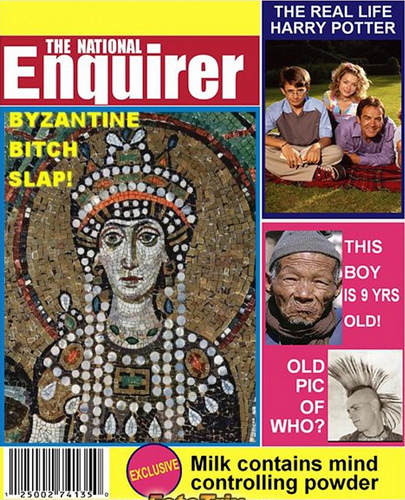
Empress Theodora, as depicted by Procopius
Profile Image for Yann.
1,412 reviews398 followers
December 4, 2016

Théodora

L’homme de main du fameux Bélisaire est, outre d'une histoire des guerres Byzantines, l’auteur de cet ouvrage qui contient de mordantes invectives contre l’empereur Justinien(483-565) et surtout contre l’impératrice Théodora (morte en 548). Leurs réformes furent en effet très mal reçues par la classe de possédant, et cette dent dure de Procope de Césarée (première moitié du VIeme siècle) est l’expression de l’exaspération que suscitèrent les impôts et expropriations rendues nécessaires par les nombreuses campagnes qui devaient rendre à l’empire sa grandeur.

Rien n’est épargné à Justinien, comparé à un antéchrist, affublé de toutes les tares et de tous les vices, inculte notoire, véritable génie du mal, ne ménageant pas sa peine pour inventer de nouveaux tourments, récompensant ceux qui se distinguaient dans le crime. Son épouse ne lui est pas inférieure en turpitudes, et l’auteur se complait dans la description de ses luxures les plus scandaleuses et les plus extravagantes. Bien sûr, une telle outrance dans la virulence fait naître des soupçons et requiert une certaine circonspection. Le commentaire érudit et pénétrant d’Ernest Renan qui accompagne l’ouvrage est particulièrement instructif.
Profile Image for Liz Janet.
583 reviews465 followers
January 21, 2016
This author is the definition of this meme, I am very pleased.

description
Profile Image for Lili Kyurkchiyska.
310 reviews110 followers
November 4, 2020
ВНИМАНИЕ!!!
Четете с фино настроено критично мислене и с кофа под ръка в случай, че решите да повърнете.
Още от ученическите ми години споменаването на "Тайната история" ме изпълваше с усещането, че съм докоснала нещо слузесто и гнусно. И когато стигнах до края й (след три неуспешни опита да я завърша), разбрах, че съм била права да се отвращавам. Защото "Тайната история" не е критика, ако и да има хора, които твърдят това. Една преподавателка я нарече "жълтата жроника на Средновековието", което намирам за доста по-точно. Това е труд, създаден чрез съзнателно изкривяване на реалните факти, стигащо до гротескни и ужасяващи образи, в които всеки със здрав разум би се усъмнил.
Не живея с идеята, че Юстиниан е съвършен. Той е бил свръхамбициозен, самомнителен, прекалено ревностен християнин за доброто на поданиците му. Но със сигурност не е "земното превъплъщение на царя на демоните" и не е вършел злини само защото му е харесвало да гледа как хората страдат. А каквото и да е вършила Теодора на младини, не е стигнала до императорския пурпур без да е притежавала остър ум и силен характер.
Мотивите на Прокопий за написването й са спорни. Като аристократ той навярно е бил недоволен от император, издигнал се от низините; а службата му в двора едва ли му е позволявала илюзии по отношение на императорската двойка. Може пък Хенинг Бьорм да се окаже прав и "Тайната история" да се окаже застраховката му в случай на дворцов преврат. Ако ли не, то той е бил просто професионален лицемер.
Profile Image for happy.
313 reviews108 followers
March 14, 2018
To sum this book up, this book is Peyton Place in Constantinople. The person who wrote this (if it was Procopius) really, really didn't like the royal family!!! He accuses the empress, Theodora, of all kinds of sexual misdeeds (before she married Justinian) and the translator says they are too deviant to translate for modern readers (this translation was first published in 1966, so it makes one wonder just what she was doing. He has already accused her of beastialty and taking on all comers in addition to being a high class courtesan.) After her marriage to the Justinian, the emperor (who had the laws changed to allow it) the author says she is fiercely faithful to him. She is portrayed as the power behind the throne. She is not above falsely accusing anyone who might threaten both her or the power of the emperor. About her only good quality is her absolute devotion to Justinian and more importantly the throne. During the Nikka Riots she is the one who insists they stay and ride it out.

Justinian does not fair any better. He is accused of being the devil's spawn and of gross corruption. According to the author he is dissolute and only caring for his worldly comforts and riches. He would falsely accuse almost any one to take there wealth. He also not above forging will for the same purpose. He is given no credit for the accomplishments of his reign - the codifying of the legal code, the great building projects - the Hagia Sophia is just one example, and lastly the reconquering of most of the Mediterranean basin for the empire.

About the person who comes out well is the general Belisarius. Even then he is painted as so besotted with his wife, who happens to be Theodora best friend, that when he catches her in bed with her stepson, he willing to disbelieve his own eyes and take no notice of it.

In some ways this reads like a novel, but doesn't flow well in spots. The transitions also are sometimes a little clunky.

All in all an eye opening look at royal life in 6th century Constantinople - 3 stars
Profile Image for Jonfaith.
2,145 reviews1,745 followers
February 24, 2018
My day to day involves routine investigations regarding incidents and accidents involving the significantly disabled. Most of the actual conversation is with caretakers. I go home often feeling drowned in bullshit, well maybe dunked with spittle-some baiting in between the submersions. I can handle tall tales, I could listen to Dylan spin a yarn about his upbringing amongst Chippewa carnies all night long. I just can’t handle the shit, the demonizing.

It shouldn’t be surprising then that this book wasn’t fun. No tales of trained geese pleasuring the nympho queen of Byzantium could lift this from being labor. The last forty percent of the account regards the rapine corruption of the regime. Measure upon measure robbing the populace and all without recourse. Somewhere Steven Pinker is saying, see I told you it was all improving.
Profile Image for Alp Turgut.
430 reviews141 followers
August 5, 2016
Bizans İmparatoru İustinianos ve karısı Theodora'nın ne kadar korkunç insanlar olduğunu oldukça akıcı bir dille anlatan "Bizans'ın Gizli Tarihi / The Secret History", Bizans hakkında harika bilgiler barındıran okunması gereken ders niteliğindeki tarih kitaplarından biri. Yazar Procopius / Prokopios'un dil ve anlatış bakımında Herodotus'tan çok Plutharkos'un izinden gittiği kitabı okurken Bizans İmparatorluğu'nun neden yıkıldığını daha iyi anlıyorsunuz. Bir liderin ne kadar korkunç olabileceğini Prokopios'un zaman zaman abartarak da olsa anlattığı kitabı okumak oldukça eğlenceli. Bu arada, kitapta bugünün Türkiye'siyle uyumlu bir sürü şey bulmak da mümkün ki bu durum bence kitabı Türk okuyucular için daha değerli kılıyor. Beklentim olmadan başladığım kitabın Plutharkhos tarzında okuması keyifli bir tarih eseri çıkması açıkçası beni çok mutlu etti.

05.08.2016
İstanbul, Türkiye

Alp Turgut

http://www.filmdoktoru.com/kitap-labo...
Profile Image for Darwin8u.
1,835 reviews9,034 followers
August 20, 2012
Doesn't quite rank with Herodotus, and definitely not close to Thucydides, etc. To be fair to Procopius, however, I probably should have read History of the Wars first. This book reminds me of a score-settling memoir Dick Morris/Rumsfiled would write if either was serving Belisarius. Anyway, it was interesting even if a bit uneven and biased. It is amazing what you can still glean about a culture and time from this type of history.

Profile Image for Aroosha Dehghan.
Author 3 books95 followers
April 8, 2024
حالا شاید همیشه این فاتحان نباشند که تاریخ را می‌نویسند اما همیشه یک روی دیگری از تاریخ هست که دیده نمی‌شود؛ یک رویی که خیلی از تاریخ‌نگارها رویشان نمی‌شود بنویسند یا جراتش را ندارند، رویی که می‌دانند دست‌کم تا ورق برنگردد قرار نیست خوانده شود و اگر خوانده شود وای به روزگارشان!
تعداد این تاریخ‌نگارها که جرات به خرج می‌دهند و از اسرار تاریخ و تاریخ سری می‌نویسند تا آن روی دیگر تاریخ را هم به تصویر بکشند به تعداد انگشتان دو دست هم نمی‌رسد و گل سر سبدشان جناب پروکوپیوس است!
پروکوپیوس، تاریخ‌نویس هم دوره‌ی یوستینیان بیزانسی و انوشیروان ساسانی در این کتاب از رازهای پشت پرده‌ی دربار بیزانس می‌گوید و کتابی به یادگار می‌گذارد که خودش هم می‌داند در زمان زندگی‌اش منتشر نخواهد شد. اینجا خبری از ستایش‌های کتاب «تواریخ» و چاپلوسی‌های بیش از اندازه‌ی «سازه‌ها» نیست. او از کثیف‌کاری‌های اشراف بیزانسی می‌گوید. از پشت‌پرده‌های روابط سیاسی و غیرسیاسی بزرگان پرده برمی‌دارد و خلاصه آن که برای یک بار هم که شده، روی دیگر تاریخ را به تصویر می‌کشد.
Profile Image for Raimondo Lagioia.
88 reviews23 followers
August 25, 2020
If this book is to be judged as a hatchet job, then it is a spectacular failure. History has been kind to the memory of the law-giver Justinian, establishing him as one of the greatest caesars of the Byzantine Empire. That glorious reign would have been curtailed if not for his feisty Empress Theodora, who famously stood up against the danger posed by the Nika Revolt with her immortal line about the imperial purple making for a fine shroud. And what about the popular General Belisarius, who has time and again managed to snatch a miraculous victory against the jaws of certain defeat? Really - who could argue against brilliance and success?

Maybe Procopius should have toned down the hyperbole. I mean, why paint the emperor as an actual, literal demon? Indeed, the Introduction states that if all he had written were the History of the Wars, he would have been regarded as a historian of the first water, to be ranked among the likes of Thucydides and Herodotus. The survival of this Anecdota may have been detrimental to his reputation. The things a person says or writes really does reflect more on his character than on the targets he tries to malign.

But if viewed as poisonous, pseudo-historic psogos then it blossoms into something quite exceptional. The fervid detailing of unspeakable crimes, sordid passions, murderous rapacity, incompetence, corruption, perfidy, chicanery, and all manner of brazen wickedness is nothing short of inspired. As a prose stylist, Procopius holds his own against other historians. He weaves a mesmerizing tale of ultimate power wedded to the purest evil, intent on fomenting calamities, misery and bloodshed. The latter sections of the second and the entire third part are admittedly rather dry though, dealing more with administrative, judicial, and fiscal skullduggery.

In the end: well, they do say that there's no smoke without fire. The question is: how much smoke was there, really? How much of these were lies, with a view to besmirching its subjects' names in the face of posterity? If only we can get ahold of a few Constantinopolitans of the 6th century AD and listen to the whispered gossip being bandied about in the markets, in the taverns . . .

7.5/10; 4 stars.
Profile Image for sologdin.
1,855 reviews873 followers
March 18, 2019
just fantastic, in both senses of the term. we know that we're in a reckless political polemic, which accounts veracity lightly, when justinian can be accused as follows:

"And that he was no human being, but, as has been suggested, some manner of demon in human form, one might infer by making an estimate of the magnitude of the ills which he inflicted upon mankind. For it is in the degree by which a man's deeds are surpassingly great that the power of the doer becomes evident. Now to state exactly the number of those who were destroyed by him would never be possible, I think, for anyone soever, or for God. For one might more quickly, I think, count all grains of sand than the vast number whom this Emperor destroyed. But making an approximate estimate of the extent of territory which has become to be destitute of inhabitants, I should say that a myriad myriad of myriads perished."

10,000 cubed is 1,000,000,000,000 human persons (1 trillion, aye?), which in my reckoning is more people than have existed throughout all history and prehistory up to the present moment. (anyone know how to count diachronic/serial population, rather than mere synchronic/parallel population, incidentally?)
Profile Image for Ray.
698 reviews152 followers
October 19, 2022
Justinian was one of the most prominent and important of the Emperors of the Eastern Roman Empire of Byzantium.

His brilliant general Belisarius led Byzantine armies to recapture Africa and Italy against overwhelming odds, and he patrolled the Eastern frontier against the old enemy Persia. Justinian was also a great builder, with the Hagia Sophia perhaps the pinnacle of his efforts.

Utlimately though Justinian drained the treasury through his building projects and he refused to give Belisarius enough backing to make his conquests permanent, so in a sense his reign was a failure.

As part of the setup around Belisarius Procopius was an insider who had also written a formal history of the period. The Secret History is his warts and all telling of what it was really like - secret because if it had got to Justinian it would mean execution. It is salacious and scabrous, and paints the Emperor and Belisarius as unprincipled charlatans in thrall to their wives.

It is an entertaining read but overdoes the condemnation, and loses something for that. It is not possible that Justinian caused a million million deaths in the Empire, and the tale about Empress Theodora and the geese was inventive but unlikely, just to give a couple of examples.

Read in the same spirit as you might read the Sun or the Daily Star - not for news but as titillation
Profile Image for فاطمة غانم الابراهيم.
233 reviews87 followers
Want to read
December 7, 2020
أوائل القرن الخامس الميلادي يسير الإمبراطور الروماني جوستنيان بخطى ثابته مستمعا لقائده العسكري بليزاريوس عن آخر حملة عسكرية شنها على الأراضي الشرقية ، ويتبعهما إمرأتهما ثيودورا وأنطونينا وهمس يعقبه ضحكة تنم عن الخبث ، وبروكوبيوس في مؤخرة السير يسترق السمع من ورائهما ، يهم ذلك الأخير بأداء عمله على أكمل وجه كأمين سر ومستشار قانوني ومناصب أخرى أعطيت له تكليفا أكثر من كونه تشريفا !

وحينما يحل الظلام يعود إلى حجرته وعلى أثر شمعته الوحيدة يدون بريشته " هنا تكمن الحقيقة !"


لطالما أشادت المصادر التأريخية بعظمة ذلك الإمبراطور وإمرأته ثيودورا كحامي الإمبراطورية والكنسية ، لكن هنالك مصادر أخرى تثبت العكس ، كهذا الكتاب على سبيل المثال ، فصاحبه - أي الكاتب بروكوبيوس - كان صديقا حميما لجوستنيان وبليزاريوس وكان على مقربة من تلك الأحداث وسرا يدونها يوما بيومه .


هذا الكتاب هو أقرب لأن يكون سيرة ذاتية لأربع شخصيات سياسية من أن يكون كتاب تأريخي ، كلا الشخصيات الأربع وإن اختلفت مناصبهم فالإنحلال الأخلاقي كان القاسم المشترك فيما بينهم فجوستنيان " بطبيعته خليطا نادرا من الحماقة والشرورية والتولع بالأذى" وإمرأته ثيودورا ذات منبت فاسد وتكرار عمليات الإجهاض خير دليل على ذلك !


أما أنطونينا فقد اتخذت من صديقتها ثيودروا مثلا يحتذى به ، فهى لم تعرف طريقا آخر سوى الرذيلة وهى التي لم تصاحب سوى السحره استطاعت أن تجعل من أعظم قادة الإمبراطورية عبدا لا يصدرا فعلا منه إلا بأمرها وهى التي تكبره بما يقارب العشرين سنه وربما أكثر ظل أسيرا بهواها حتى بعدما علم من قبل إحدى الجاريات بفعلها المشين مع ابنهما بالتبني بل رأى بأم عينيه لكن السحر كان أقوى من أن يثأر بخيانتها له ، كانت أنطونينا متعطشه للدماء لدرجة أنها قامت بقطع لسان خادمتها -التي فضحت أمرها - وتقطيع جسدها قطعا صغيرة ومن ثم رميها في البحر .


بقي أن أشير بأن الكتاب نشر بعد وفاة الإمبراطور وإمرأته وقائده لأنه كان على يقين بأن هلاكه سيكون قائما لا محاله ودون رحمه ، إلا أنه مخلص للعلم وكان من واجبه كتابة مايجب كتابته " فإن أسناني تصطك وأجد نفسي أتراجع أكبر قدر ممكن من المهمة "

على أية حال هذا الكتاب حافل بالدموية والسوداوية ولاشيء آخر يدعو للبهجة فهو أشبه بقصص الرعب !


ما أشار إليه بروكوبيوس في كتابه لايشوبه نفاق أو تلويث الحقائق هذا ما أكدته الدراسات الأخيرة بإعتباره مرجعا لايمكن التغاضي عنه !
Profile Image for Jenny.
97 reviews826 followers
June 9, 2021
Delightfully scandalous and gossipy! I do wish the Penguin edition came with more context for certain events Procopius alluded to because he would frequently make mention of something he expected the reader to know all about. If I had no prior knowledge of this period, I would have struggled with it because of that. In some cases, it's difficult to take what he says seriously but that's the fun of it--is he being serious or is it all a satire?
Profile Image for Smiley .
776 reviews18 followers
November 28, 2018
Second Review [May 31, 2014]

Having finished reading "Count Belisarius" (Penguin Books, 2006) by Robert Graves, I thought I should reread this book to make sure if I had had the right images of Belisarius, his wife Antonina, the Emperor Justinian and his wife Theodoara so that I would compare them to what Procopius has written to record their misdeeds. ...

First Review [August 27, 2011]

I think this book is all right for those interested in ancient history since it's a bit tough to follow what the author wanted to reveal textual traces of evidence for posterity. I've never heard/read Procopius before but I decided to read him after finishing reading "The Histories" by Herodotus. It's my idea to say something as an amateur reader in history, not as a professional historian so that, I hope, some of my like-minded Goodreads friends out there may become interested and tried to read any author he/she prefers.

First, be assured it takes time to read this obscure book and digest it as far as you can, don't worry too much if you can't remember all important years as indicated in important events/episodes. We need to read for its whole picture, not minor incidents here and there. In other words, the book has suggested such an empire pitifully, unimaginably corrupted by its emperor and empress.

Second, its title of course implies something done/hidden as 'secrets' along the developing reign of Justinian. While reading each chapter, I wondered who taught him and how. Maybe his parents or some of his teachers but, sadly, Procopius didn't mention anything about his schooling or effective ways of raising him as a good emperor worth respect, admiration and awe. Comparatively, I always admire Alexander the Great who had Aristotle, such a great formidable philosopher, as his teacher and I visualize he wisely listened to what his teacher said. Moreover, he took Homer (I'm not sure which book) to read in his various campaigns. Just imagine.

Lastly, I didn't enjoy reading this kind of biography. Sometime I asked myself if it was a waste of time, however, I kept going till the last chapter. One of the reasons is that all of those notorious secret deeds around 1,500 years ago as revealed should be applied in our daily lives so that they're definitely recorded in "the sand of time" (Longfellow). Therefore, we need to learn from the past so that we won't do anything senseless like some of our ancestors had done before.

I presume the original book was written in Greek, however, I found its Latin title [Historia Arcana] in the Wikipedia website and I wonder why the translator hasn't told his readers in the Introduction.
Profile Image for Elizabeth.
69 reviews
January 10, 2009
Think of this as the Byzantine equivalent to one of those trashy pop biographies of a celebrity that consists mainly of sexual rumors. Procopius apparently harbored a secret hatred of the Empress Theodora and everyone associated with her, and, secretly, wrote this vituperative companion to his other, public, more neutral works, apparently for the point of detailing the sexual excesses and blatant immoralities of the Justinian court. Examples of the Empress' behavior include: anointing her genitalia with barley, and then having geese loosed to peck at the seeds, while she was on stage; going on a picnic to cavort with ten young men, and after exhausting their stamina, taking on their thirty servants; having dozens of abortions; making the bastard son she didn't manage to abort in time "disappear"; arranging her bastard daughter's son's marriage to the very young daughter of a rich general and forcing them to have sex so that the marriage could not be undone and she would have claim to that wealth; and various other infamous behavior.

It amazes me that this narrative is taken as a relatively accurate history. The tone is so gleefully disappointed in the behaviors therein described, the events so repeatedly unbelievable, that it seems so biased as to deserve some skepticism.
Profile Image for Jan-Maat.
1,684 reviews2,490 followers
Read
January 30, 2013
I'm a bit puzzled by the allegation that the same Procopius of Caesarea wrote this as wrote History of the Wars because the tone is so different. The one gossipy and imprecise with millions of Ethiopians (ie inhabitants of North Africa) dying as a result of the reconquest of Vandal occupied North Africa the other careful and sober.

The Secret History is a dirt dishing account of the reign of Justinian. The validity of argument was for me undercut by its hyperbole, it's rather like reading The Lives of the Later Caesars. It has that same sense of something scurrilous that catered for the reader who loved their share of scandal. Very readable and entertaining though and your go to source for scurrilous stories about the Empress Theodora.
Profile Image for Yorgos.
110 reviews2 followers
March 28, 2022
Probably the best bang-for-your-buck introduction to practical historiography out there.

This book is batshit insane. Procopius is completely detached from reality. Rhetorically, the book is a mess. Structurally, it’s a disaster. It’s obviously unfinished. More importantly, there is absolutely no historical consensus on the historicity of any of this book. Maybe 1/5th of it is paralleled in either Procopius’ other works (i.e. we have one other source that mentions this name) or the Codex Julianus (i.e. Procopius is misreading the law on purpose). The rest is anecdote after insane anecdote.

Why does this matter? Think of it like this: there’s no editor in the world who can tell you definitely why ANY PART of this book was written or if there’s any truth in what is being said. It’s entirely in your hands. To read this book is to engage in historiography. If you are even remotely interested in the period, you have to choose how much of this book you’re going to take at face value. Is this accusation true? Is it a rumor? an invention? a joke? Does it reflect the attitudes of the senatorial class? of the common man? of Procopius alone?

But if you’re willing to do this, this book absolutely can help you understand the period: It’s biased; it’s hilarious; it’s probably how the senators talked about Justinian every day.

Procopius himself violently resist classification. He wrote three surviving works: a subversive panegyric, a biased classicizing history, and this pseudo-psogic-maybe-comic [something??]. He roughly conforms to the genre, but only to a point. Again, if you care about the period, you will not be able to avoid questions surrounding Procopius’ life, motives, and work. He is too important. In this way too, this book is a training course in practical historiography

I read the 2007 Penguin edition. It is a tour de force. The introduction frames the text in the best way possible: as an interesting historiographical puzzle. It offers no definitive answer to the questions surrounding the work while giving you all you need to approach them yourself. In general the editing is top notch: footnotes are neither too spare nor too dense and appear at the bottom of the page, citing parallel or referenced passages, clarifying obscurities in the text, explaining terminology, or pointing out trouble-spots in the translation. The map is helpful and the indexes (yes, plural) are complete. The editor gives a degree of structure to the work it badly needs, splitting it loosely into three sections. The translation is more on the close side, as far as I can tell, but even in a work as short as this (123 pages) you can feel Procopius’ style.

And let’s not forget that this really is a very funny and accessible book. You don't have much background to understand stuff like “[T]he Emperor was not a human being but, as stated, a demon in human guise[.] [...] To make any accurate estimate of the number of lives destroyed by this man would never, it seems to me, be within the power of any living being, or even of God. For sooner could one number all the sands than the hosts of men destroyed by this Emperor. But making a rough estimate, [...] I suggest ten thousand times ten thousand times ten thousand lost their lives.”

You buy this book. You think you're gonna laugh at the caricatures. You think you're gonna read it in a day or two. You think you're not gonna get invested because it's not even a finished book. Wrong. You don't give a shit about the funny anecdotes or the caricatures or the state of the book; you are now completely 100% all-in invested on the historiographical value of The Secret History.

a more funny historia augusta; 9/10
Profile Image for Cem Yüksel.
381 reviews66 followers
January 19, 2022
Prokopios o dönemin Filistin’inde , Caseria’da IS 500’lerde doğmuş bir tarihçi. Bu sene doğum yerini ziyaret ettikten sonra okuma listesine giren kitap, başında kendinin de belirttiği gibi korku ile yazılmış. Zira dönemin ünlü imparatoriçesi Theodora ve kocası İustinianos ile yine İtalya, Kuzey Afrika , Mezopotamya’da savaşlar kazanmış ordu komutanı Belisarios ve karısı Antonina’nın Bizans’a yaptıkları kötülükleri, insanlara eziyetlerini, entrikaları ve adaletsizlikleri anlatıyor. İmparatorluğun resmî tarihçisi olup Savaşlar Tarihi kitapları ile bilinen ciddi bir tarihçi olan Prokopios’ın bu özelliği olmasa , anlattıkları mübalağa olarak nitelenebilir. Özellikle İustinianos’un Ayasofya’nın yapımı , imparatorluğu restore etmek için yaptıkları ,hukuk külliyatını toparlaması , mimari hareketlenme ile tarihte “Büyük” lakabı ile anılması, hatta Ortodokslar için aziz olması , aynı şekilde dansçı ve Prokopios’a göre daha da ilginç bir geçmişi olan ve imparatorluğun yönetiminde Osmanlı’nın Hürrem’i gibi davranan ve sonunda azize ilan edilen Theodora dikkate alındığında. Görünen o ki , ihtişamın bedeli her zamanki gibi halka yüklenmiş. Anlatılanlardan bir çoğunda sadece isimleri değiştirmek , bugünün yönetim tarihlerini yazmak için kolay bir yöntem olurdu. Bizans tarihine meraklı olmayanlar için dahi , iktidar , toplum , tarih yazımı gibi konular için ilginç bir okuma. Bu arada Orhan Duru’nun başlangıçtaki kısa özeti , Bizans tarihinden uzak olanlar için kitaba iyi bir hazırlık sağlıyor. Bizans’ın imparatorlarının nasıl tahta gelebildiği , yetkinlikler vs konusunda da iyi bir kaynak. Neticede kadim İstanbul’un ilginç kadınlarından olup , Nika isyanında “İmparatorluğun mor rengi asil bir kefendir“ diye İustinianos’un tahttan çekilip kaçmasını engelleyen Theodora ve Ayasofya ile Ravenna’da mozaiklerde gözgöze gelindiğinde Iustinianos hakkında düşünmek için iyi bir kaynak.
Profile Image for Kyriakos Sorokkou.
Author 6 books213 followers
Read
March 13, 2024
Αρχαία Ελληνική Λογοτεχνία

1) Θεογονία / Έργα και Ημέραι / Ασπίς Ηρακλέους (750-650 π.Χ.)
2) Λυρική Ποίηση (630-570 π.Χ.)
3) Πέρσαι (472 π.Χ.)
4) Δύσκολος: Ή Μισάνθρωπος (317 π.Χ.)
5) Αργοναυτικά (283 - 221 π.Χ.)
6) Ερωτικά Παθήματα (52 - 26 π.Χ.)
7) Περί Της Κατά Μωυσέα Κοσμοποιίας (15/10 π.Χ. - 40 μ.Χ.)
8) Ικαρομένιππος / Αληθινή Ιστορία / Πλοίον ή Ευχαί (120 μ.Χ. - 192 μ.Χ.)
9) Δάφνις και Χλόη (170 μ.Χ. - 200 μ.Χ.)
10) Αιθιοπικά (370 μ.Χ.)
11) Τα καθ’ Ηρώ και Λέανδρον, Ελένης αρπαγή, Άλωσις Ιλίου, Αποσπάσματα (250 μ.Χ. - 518 μ.Χ.)

12) Ανέκδοτα ή απόκρυφη ιστορία (562 μ.Χ.)

χρόνος ανάγνωσης κριτικής: 1 λεπτό και 23 δευτερόλεπτα

Τελευταίο βιβλίο για τη 4η σεζόν του μεγαλεπήβολου αυτού πρότζεκτ: ελληνική λογοτεχνία.
Πρώτη σεζόν (2020: 20ος-21ος αιώνας)
Δεύτερη σεζόν (2021: 19ος αιώνας)
Τρίτη σεζόν (2022: 11ος-18ος αιώνας)
Τέταρτη σεζόν (2023: 8ος π.Χ.-6ος αιώνας μ.Χ.)
Η πέμπτη σεζόν (2024: 7ος μ.Χ-14ος αιώνας) αναβλήθηκε για φέτος διότι
λίγο το δίχρονο πρότζεκτ Καζαντζάκης (2021-2023) που ξεκίνησα αμέσως
μετά το τρίχρονο πρότζεκτ Κράιτον (2019-2021), μαζί με το τετράχρονο
πρότζεκτ Τόλκιν (2021-2024) που θα τελειώσει αισίως φέτος τα Χριστούγεννα,
έπαθα ένα οξύ κορεσμό με όλα αυτά τα πρότζεκτς και λέω νισάφι πια, σατσ̆ι
που λέμε και στην Κύπρο.

Είπα φέτος όχι άλλα πρότζεκτς.
Θα τελειώσω πρώτα τον Τόλκιν να φέρω τον Βενέζη στα μισά (6 βιβλία)
και του χρόνου βλέπουμε για πρότζεκτς.
Φέτος θα ξεκινούσα Ντίκενς και Κινγκ μαζί με τον Τόλκιν και την πέμπτη σεζόν
του ελληνικού πρότζεκτ αλλά όχι. Από του χρόνου πια.
Δε θα άντεχα να τρέχουν 4 πρότζεκτς ταυτόχρονα.

Στα του βιβλίου τώρα.
Αυτή η τέταρτη σεζόν του project ξεκίνησε με τον Ησίοδο που μπορεί να
ήταν και σύγχρονος του Ομήρου και φτάνουμε στον Προκόπιο που
ήταν σύγχρονος του Ιουστινιανού.
Άρα από την ομηρική εποχή έφτασα στην πρώιμη βυζαντινή εποχή.

Ο Προκόπιος έγραψε την Ιστορία του η οποία εκθειάζει σχεδόν σαν
προπαγάνδα όλο το έργο του Ιουστινιανού με το πως ξανάχτισε και
έκανε την αυτοκρατορία τρανή μετά από μια μεγάλη ύφεση.
Εκθείαζει αυτόν και τον Στρατηγό του τον Βελισσάριο και με άλλα λόγια
μιλάει υπέρ αυτών και των έργων τους. Και έρχεται τώρα ο Προκόπιος
να γράψει μία απόκρυφη ιστορία που παρουσιάζει τον Ιουστινιανό σαν
Αντίχριστο την Θεοδώρα την Αυτοκράτειρα σαν τη μεγαλύτερη δολοπλόκα καριόλα
που υπάρχει και τον Βελισσάριο σαν ένα πρόβατο που ακούει ό,τι του πει γυναίκα του.
με άλλα λόγια είναι ένας άβουλος άντρας όσο αφορά την οικογενειακή του ζωή.

Ουσιαστικά αυτός ο Προκόπιος έφτιαξε μετά από μία προπαγάνδα, έναν λίβελο
που με κάνει να σκεφτώ: πόσα από αυτά ισχύουν κι αν ισχύει κάτι από αυτά,
τι έμαθα στο τέλος εγώ για την βυζαντινή εποχή; Αν είναι όλα ψέμα έμαθα κάτι ή όχι;

Αλλά από τη στιγμή που αυτός ο άνθρωπος ίσως αφού έπεσε στη δησμένια
του Ιουστινιανου αποφασίζει κάπως να τον εκδικηθεί με αυτό το έργο,
είσαι κάπως αποτραβηγμένος, και κρατιέσαι σε μία απόσταση.
Δεν μετάνιωσα φυσικά που το διάβασα διότι ήταν ενδιαφέρον παρόλαυτα.
Profile Image for Lukas Sotola.
123 reviews99 followers
Read
January 21, 2025
A searing indictment of horrifyingly corrupt rulers. Procopius leaves no stone unturned in enumerating the abuses and excesses of Eastern Roman Emperor Justinian I, his wife Empress Theodora, Justinian’s top general Belisarius, and Belisarius’s own wife Antonina. From the tortures inflicted on individuals who displeased them to their sexual escapades to the lengths they go to to suck as much money from their officials and subjects as they can, these fabulously rich and powerful people’s horrible behavior has a certain voyeuristic attraction, I must confess. But more poignantly, while I wonder how much of this can be taken seriously as fact (I mean, Procopius does claim that Justinian is a literal demon), the important part—to me, at least—is that it is 100% believable that rulers could be just this corrupt and malicious and greedy. The rest of history before and after Procopius’s own time up to our present time—dare I say up to this very day?—bears that out. So although it remains open to question whether Justinian and those closest to him deserved such a brutal screed, it is not open to question that many powerful people throughout history have deserved something like a Secret History written about them. And with that in mind, I think this is a powerful read.
Profile Image for Comes.
49 reviews3 followers
Read
December 9, 2025
Justinian and Theodora in the eyes of Procopius are evil to no end. Largely, because of their hate for all good practices and officials and endless desire for more and more wealth which they set out to acquire at all costs. From closing public games, falsely charging officials, removing charity from the poor, selling justice and confiscating estates for the flimsiest of reasons. All of this done, as Procopius claims, to collect wealth which disappears into pointless construction projects, or nowhere at all.

The characters of Justinian and Theodora are made out to be despicable, to the point that Justinian becomes the Chief of Demons with a monk unwilling to even meet him because of his vision of Justinian's visage. Theodora is a shameless prostitute who seethes with hate at anybody who crosses her path. Belisarius turns from the hero depicted in the Wars to a gullible fool who is taken advantage of by his wife Antonia while ignoring all of her indiscretions.
Profile Image for Caspar "moved to storygraph" Bryant.
874 reviews55 followers
Read
June 9, 2023
this is a truly dated ! edition which describes the 'appalling vulgarity' of our girly Theodora, wife of Justinian .. (probably?) former prostitute, turned empress, nymphomaniac (according to Procopius), with a stage-show involving swan-sex, from what I can tell. it becomes clear that SHE is the reason this text is, she's , I think the centre. The stuffy intro concedes, petulantly, 'Perhaps the French can appreciate the lady better than we can'. more of her pls
Profile Image for Czarny Pies.
2,828 reviews1 follower
June 3, 2017
"The Secret History" is an appalling rant against Justinian the Great (Emperor of Rome from 527 to 565). Unlike most of the histories of the classical era (Tacitus, Suetonius, Julius Cesar) this document has virtually nothing to offer the modern reader. The majority of contemporary historians that have survived from the time of the Roman empire were subtle thinkers who presented balanced, trustworthy views of their topics. The pleasure to the modern reader is to detect the bias of the writer and to speculate on what omissions or distortions might have resulted from it. Unfortunately, Procopius in the "Secret History" writes with such a recounts so many highly improbable phenomena, the reader quickly concludes that nothing in the book can be revealed. The hysterical and bitter tone of the author make it highly unpleasant to read.

In "The Secret History" Procopius is not telling the story of an incompetent, tyrant who was quickly deposed. He is writing about an emperor who had many important accomplishments during his 28 year reign. Among other things, he reconquered the Western Empire, codified Roman laws and conducted a major building program at Constantinople that included the Hagia Sophia. The incompetent and sadistic buffoon described "The Secret History" would have been ousted by a coup within 12 months. It is no surprise that professional historians indicate that they have great difficulty in using this book.
Profile Image for Sean Chick.
Author 9 books1,106 followers
February 9, 2017
Procopius is what would happen if Suetonius offered analysis and not just gossip. The Secret History is most notorious for its depiction of scandalized sex and Justinian I's demonic powers. These are, for audiences today, the fun parts. Yet, more searing is the misgovernment and bad policies of Justinian and Theodora. One might say it is only Procopius' opinion, but he tellingly explains the matrix of high taxes, religious oppression, political corruption, and military adventurism that caused the empire to decline. Without Justinian and Theodora there would be no Muslim conquest.

The Secret History is also a warning. One could look at the military conquests of Justinian and his legal code and grand buildings and deduce that he was a great man. Procopius insists we look at the cost of these grand achievements. He is telling us, perhaps only tacitly, to never take power, position, and success at face value, that we must understand its arrogance and hypocrisy. It is a lesson we should all heed.
Displaying 1 - 30 of 373 reviews

Join the discussion

Can't find what you're looking for?

Get help and learn more about the design.