

What do you think?

John Keats
The life of Keats provides a unique opportunity for the study of literary greatness and of what permits or encourages its development. Its interest is deeply human and moral, in the most capacious sense of the words. In this authoritative biography--the first full-length life of Keats in almost forty years--the man and the poet are portrayed with rare insight and sympathy. In spite of a scarcity of factual data for his early years, the materials for Keats's life are nevertheless unusually full. Since most of his early poetry has survived, his artistic development can be observed more closely than is possible with most writers; and there are times during the period of his greatest creativity when his personal as well as his artistic life can be followed week by week.
The development of Keats's poetic craftsmanship proceeds simultaneously with the steady growth of qualities of mind and character. Mr. Bate has been concerned to show the organic relationship between the poet's art and his larger, more broadly humane development. Keats's great personal appeal--his spontaneity, vigor, playfulness, and affection--are movingly recreated; at the same time, his valiant attempt to solve the problem faced by all modern poets when they attempt to achieve originality and amplitude in the presence of their great artistic heritage is perceptively presented.
In discussing this matter, Mr. Bate says, "The pressure of this anxiety and the variety of reactions to it constitute one of the great unexplored factors in the history of the arts since 1750. And in no major poet, near the beginning of the modern era, is this problem met more directly than it is in Keats. The way in which Keats was somehow able, after the age of twenty-two, to confront this dilemma, and to transcend it, has fascinated every major poet who has used the English language since Keats's death and also every major critic since the Victorian era."
Mr. Bate has availed himself of all new biographical materials, published and unpublished, and has used them selectively and without ostentation, concentrating on the things that were meaningful to Keats. Similarly, his discussions of the poetry are not buried beneath the controversies of previous critics. He approaches the poems freshly and directly, showing their relation to Keats's experience and emotions, to premises and values already explored in the biographical narrative. The result is a book of many dimensions, not a restricted critical or biographical study but a fully integrated whole.,
The development of Keats's poetic craftsmanship proceeds simultaneously with the steady growth of qualities of mind and character. Mr. Bate has been concerned to show the organic relationship between the poet's art and his larger, more broadly humane development. Keats's great personal appeal--his spontaneity, vigor, playfulness, and affection--are movingly recreated; at the same time, his valiant attempt to solve the problem faced by all modern poets when they attempt to achieve originality and amplitude in the presence of their great artistic heritage is perceptively presented.
In discussing this matter, Mr. Bate says, "The pressure of this anxiety and the variety of reactions to it constitute one of the great unexplored factors in the history of the arts since 1750. And in no major poet, near the beginning of the modern era, is this problem met more directly than it is in Keats. The way in which Keats was somehow able, after the age of twenty-two, to confront this dilemma, and to transcend it, has fascinated every major poet who has used the English language since Keats's death and also every major critic since the Victorian era."
Mr. Bate has availed himself of all new biographical materials, published and unpublished, and has used them selectively and without ostentation, concentrating on the things that were meaningful to Keats. Similarly, his discussions of the poetry are not buried beneath the controversies of previous critics. He approaches the poems freshly and directly, showing their relation to Keats's experience and emotions, to premises and values already explored in the biographical narrative. The result is a book of many dimensions, not a restricted critical or biographical study but a fully integrated whole.,
732 pages, Hardcover
First published January 1, 1963
About the author
Walter Jackson Bate
44 books12 followersLiterary critic Walter Jackson Bate twice won the Pulitzer Prize for Biography, first for his work on the Romantic poet John Keats, and later for that on lexicographer Dr. Samuel Johnson.
Ratings & Reviews
Friends & Following
Create a free account to discover what your friends think of this book!
Community Reviews
Displaying 1 - 20 of 20 reviews

March 21, 2012
This is my second biographical read this summer, and as powerful as this book was, I think I will stick to fiction for a while. I don't avoid books with sad or dark themes; in fact, most of my favorite books include them. I guess I can handle the sadness better when it is a fictional story (gut-wrenching novels like A Fine Balance, which deal with real horrors of historical time and place, are a notable exception). The other nonfiction work I read recently (about J.M. Barrie) was disturbing, and Bate's incredibly vivid and thorough (700 page!) biography of Keats has left me deeply, deeply sad.
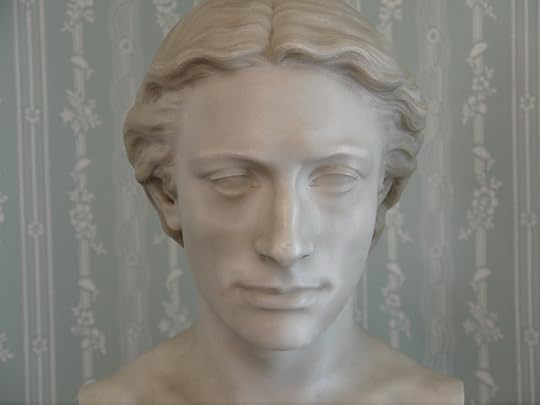
Ah, John Keats. I love Keats, always have, and the tragedy of his early death (and from a literary standpoint, the inevitable question of what more he could have achieved, had he lived past the age of 25) is always affecting. But he comes so vibrantly alive in this biography (and through his own letters and the words of friends and family Bate includes) as a person of "courage, sensitivity, and generosity" (17) that the suffering he faced in his last year is almost too terrible to read. His whole life reads like a tragic Victorian novel anyway-- orphaned young, kept poor and mistreated by a cruel appointed guardian, nursing a beloved brother on his deathbed, and in effect, contracting the disease himself. But strength of character led him to channel his own experiences into great empathy for others, which in turn helped him to write such powerful poetry. (One of my favorite quotes by Keats is: “Do you not see how necessary a world of pains and troubles is to school an intelligence and make it a soul?”) While nothing in Bate's biography seems romanticized at all, the simple facts of Keats' life and nature, related in the numerous accounts of those who knew him, make it hard not to fall a little in love with him. For example, as a boy he not only fiercely protected his little brothers but once fought two bigger boys to stop them from torturing a kitten, I mean COME ON. This kid ACTUALLY rescued kittens in his spare time:
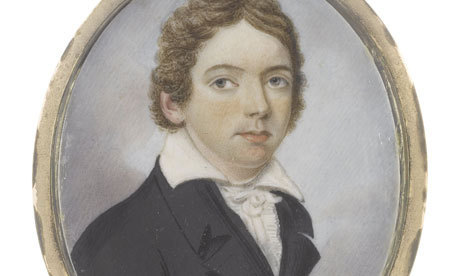
Who can resist that?
As well as his courage and kindness, Bate paints a powerful portrait of Keats' incredible passion for life--for writing, for travel, for the woman he loved and was unable to marry due to poverty and eventually illness. So reading about the final horrible months before Keats died of Tuberculosis (Bate spares none of the gruesome, horribly painful details) and how he had to accept the death of all his dreams and hopes, it's just utterly, indescribably sad.
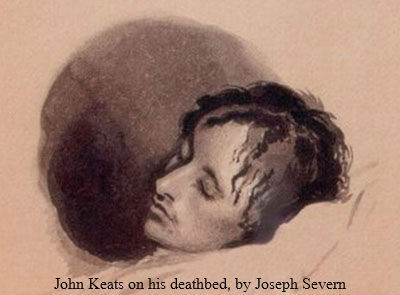
Ah, John Keats. I love Keats, always have, and the tragedy of his early death (and from a literary standpoint, the inevitable question of what more he could have achieved, had he lived past the age of 25) is always affecting. But he comes so vibrantly alive in this biography (and through his own letters and the words of friends and family Bate includes) as a person of "courage, sensitivity, and generosity" (17) that the suffering he faced in his last year is almost too terrible to read. His whole life reads like a tragic Victorian novel anyway-- orphaned young, kept poor and mistreated by a cruel appointed guardian, nursing a beloved brother on his deathbed, and in effect, contracting the disease himself. But strength of character led him to channel his own experiences into great empathy for others, which in turn helped him to write such powerful poetry. (One of my favorite quotes by Keats is: “Do you not see how necessary a world of pains and troubles is to school an intelligence and make it a soul?”) While nothing in Bate's biography seems romanticized at all, the simple facts of Keats' life and nature, related in the numerous accounts of those who knew him, make it hard not to fall a little in love with him. For example, as a boy he not only fiercely protected his little brothers but once fought two bigger boys to stop them from torturing a kitten, I mean COME ON. This kid ACTUALLY rescued kittens in his spare time:
Who can resist that?
As well as his courage and kindness, Bate paints a powerful portrait of Keats' incredible passion for life--for writing, for travel, for the woman he loved and was unable to marry due to poverty and eventually illness. So reading about the final horrible months before Keats died of Tuberculosis (Bate spares none of the gruesome, horribly painful details) and how he had to accept the death of all his dreams and hopes, it's just utterly, indescribably sad.

August 9, 2020
Read during my formative period a long time ago.

February 20, 2019
The best "classic" style biography free of political agenda and so compellingly readable that it won the Pulitzer Prize. Bate triumphs when he unpacks the poetry as well as taking us into Keats's mind.
Keats was an inherently tragic figure who never seemed to get anything going for him except with his self-confidence in his poetic powers. He never saw fame in his own lifetime. Yet, there is a compelling argument to be made that he was second only to Shakespeare in suppleness of his poetic structure as well as naturalness of expression. If you haven't read a bio of Keats, this is a great place to look.
Keats was an inherently tragic figure who never seemed to get anything going for him except with his self-confidence in his poetic powers. He never saw fame in his own lifetime. Yet, there is a compelling argument to be made that he was second only to Shakespeare in suppleness of his poetic structure as well as naturalness of expression. If you haven't read a bio of Keats, this is a great place to look.
November 29, 2013
The best Keats bio, says I. His bio of Johnson can't be the best, because Boswell got there first, but to have written the #1 and the #2 biographies of 2 great writers: that's some accomplishment.

December 28, 2023
An infinitely voluminous resource, researched with the finesse and detail that leaves the reader sweating. WJ Bate is enough to catch up on much of what Keats is. It's beyond an introduction, it's a summative work. It's not beyond reproach, but that's for academic haggling.
What an effort. I was not always thrilled with the anticipation in the way Bate tells the story and the constant repitions, but in some ways they are helpful to keep the reader close. A must read for any student of Romanticism, literary study and even anyone with a passing interest in critical biography.
What an effort. I was not always thrilled with the anticipation in the way Bate tells the story and the constant repitions, but in some ways they are helpful to keep the reader close. A must read for any student of Romanticism, literary study and even anyone with a passing interest in critical biography.

December 18, 2020
I have only read about ten percent of this biography and already I'm about to commit suicide. So far this is one of the driest biography's I've ever read. Sadly John Keats only lived to the age of 27 but it took 700 pages to tell his story. No offense to Mr. Keats but I'm glad he didn't live any longer otherwise who knows how long this biography would be. I have read the biographies of other poets (Louise Bogan and Robert Frost) and if this had been my first biography of a poet I would have never touched a poetic biography again. But what scares me the most is that Mr Bate has also written a biography of Samuel Johnson which I was going to read after I finished his biography of John Keats. I'm going to have to rethink that decision

September 22, 2011
i accidently spilled a large amount of pungent liquid laundry detergent on it. seemed to fit the prose.
July 16, 2020
walter jackson bate sure did deserve the pulitzer for this one—he is adept at balancing the emotion a fictional prose writer would employ w/ the careful distribution of facts a biographer does. also, i did cry several times

June 2, 2018
Best bio of Keats I've read.
March 8, 2020
What a sad life
May 6, 2022
Very dry, dull, even when it sweeps the story between Keats and Fanny Brawne. Helpful, when your interest concentrates on Keats coming of age as a poet, stylistically as well as linguistically.

August 1, 2022
Bate really gets you close up and personal with the "Young English Poet." Was crying profusely by the end of it.

June 19, 2019
An interesting collection of essays. It is clear that Keats was a victim of his own poetic abilities, but what a loss.

August 24, 2007
At seven-hundred pages, W. Jackson Bate’s biography of John Keats provides a thorough, if sometimes repetitive, account of the poet’s life and mind. For the repetition, the author apologizes in advance, offering by way of explanation that “Keats’s development naturally circles and eddies” (x). Thus, certain letters or poems that express key ideas continue to be relevant in each new context and need to be cited again and again as the chronology moves forward. While this explanation is reasonable enough, the need to offer it suggests what my own experience confirms: that the reading drags a bit from time to time. Readers looking for a brisker narrative of the events of Keats’s life might want to read Robert Gittings’ biography instead (Helen Vendler’s recommendation). Still, there is something to be said for taking the slow route: namely, that one has so much more time to let the important ideas sink in. After seven-hundred pages in Dr. Bate’s company, I am left with the sense of having taken a semester-long class with a professor whose thorough knowledge of the material leaves me confident that I’m walking away with something solid. Such professors seem always to have their quirks (Bate’s is a quaint need to insist, again and again, that Keats is a tougher, more “masculine” poet than his Victorian successors would have us believe), but these prove more charming than annoying. In the end, Bate is more of a scholar than a storyteller, better at mapping the shifts in Keats’s prosody than painting pretty pictures of Hampstead. But, speaking as one more interested in Keats the poet than Keats the posthumous celebrity, I would not have it otherwise; I am much happier to have the portrait of the man’s mind than that of his environs.
(There is a second paragraph to this review, but it exceeds the publishable limits of the Goodreads server. I've posted it as a comment on this review.)
(There is a second paragraph to this review, but it exceeds the publishable limits of the Goodreads server. I've posted it as a comment on this review.)

August 15, 2009
Stellar biography--and definitely the one to start with.

Want to Read
November 21, 2009Tabled for now-- hoping to come back to this and read alongside his letters (and his poems) in the fall.
February 20, 2010
Knowing more about the man helps me understand his poetry better. This was very helpful.

February 5, 2020
As always my favorite one !

June 24, 2007
I would give this a six if I could.

Read
February 27, 2019One of the most appealing aspects of this masterful work is the un repressed love and affection that Bate has for the poet. The humanistic readings might strike some as fusty and old-fashioned but no one who loves Keats' poetry will finish the book without having gained a profound insight into his life and work.
Displaying 1 - 20 of 20 reviews