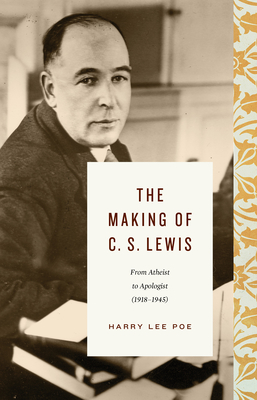
Experience C. S. Lewis’s Captivating Transformation from Atheist to Christian At the end of World War I, young C. S. Lewis was a devout atheist about to begin his studies at Oxford. In the three decades that followed, he would establish himself as one of the most influential writers and scholars of modern times, undergoing a radical conversion to Christianity that would transform his life and his work. Scholar Harry Lee Poe unfolds these watershed years in Lewis’s life, offering readers a unique perspective on his conversion, his friendships with well-known Christians such as J. R. R. Tolkien and Dorothy L. Sayers, and his development from an opponent of Christianity to one of its most ardent defenders.
Volume two of the trilogy is down. So much great material in the second volume. I found one of Poe's strengths to be the way he weaves Lewis' publication life into his personal life. It is one thing to know Lewis' many publications, it is so illuminating to know how the events of his life surrounded and led up to each publication. Onto volume three.
This one was much more fast paced and easier to read through, especially the war time portions that describe the intense work Lewis undertook. Poe is able to draw reader into 1940s Oxford in a unique way that paints a picture of how Lewis was understanding the world and how his past was colliding with his present during this time to form a brilliant Christian thinker.
I liked this much more than the first, perhaps because this volume features conversion. The first volume and the first half of this one features Lewis pre-Christ, and I was surprised at what a dislikable figure he was before his conversion. Poe’s in depth look at this often neglected period of Lewis’s life has certainly given me a richer appreciation for God’s work of transformation in his life. I still don’t love Poe’s writing style (he’s a little repetitive at points, and some of his portrayals of people seem harsh—for example, Tolkien is portrayed as very insecure and jealous of Lewis’s popularity. Perhaps this was true (?), but this is the first time I’ve read such a negative view of Tolkien’s relationship with Lewis). But all around, I was riveted; I blew through this one and am excited to pick up the final volume!
Volume 2 of the Life of C.S. Lewis (Covering the years 1918-1945).
Favorite Quotes/Themes:
"When he wrote to Warnie of Pasley's engagement, he condemned engagement as 'that fatal tomb of all lively and interesting men.'" (43)
C. S. Lewis liked a good draft cider. "As often as not, he chose cider over beer" (45).
I appreciate the image of C. S. Lewis playing ping-pong: "For someone who did not like games and complained not only of team sports but also of the sort of games played by the gentry to amuse themselves in Ireland, Jack took up games rather enthusiastically once he was under the same roof as Janie Moore, who appears to have enjoyed parlor games. They played a prodigious amount of bridge in the evenings, but also croquet in the afternoons. He even played ping-pong and badminton, but he drew the line at tennis, which he always managed to avoid" (63).
"Looking back on his first meeting with [Nevill] Coghill, Lewis recalled that their friendship occurred immediately, for Coghill was a man after his own heart... His old-fashioned sense of chivalry, honor, courage, freedom, and gentility all conspired to make Coghill a thoroughly admirable character. It made Jack wonder if the modern world had actually lost something along the way that Coghill, with all his Christianity and supernaturalism, had retained" (71).
"His success in the English School resulted primarily from already knowing all the material from his youthful years of pleasure reading" (78).
"A brute, material universe has no values, no ethics, no morality. It only has facts. How then do we account for ethics and morality?... Ethics and morality must come from outside the material world of chance, cause, and effect" (84).
Even C. S. Lewis had to bear a time of very few people attending his lectures: "When he resumed [his diary in Feb. 1925], he observed that his lectures had not been an overwhelming success. In Hilary term, only two people attended, and one of these was an old clergyman" (91).
"Lewis had also made peace with the fact that no one person could satisfy all the expectations of friendship for him" (109).
"In the preface to the third edition of The Pilgrim's Regress, Lewis described the progress of his intellectual journey as from 'popular realism' to Philosophical Idealism; from Idealism to Pantheism; from Pantheism to Theism; and from Theism to Christianity" (115).
Lewis had annual walking tours with friends (116).
"To have no philosophy is to have a bad philosophy" (124).
"As strained as relationship between father and son tended to be for the last fourteen years of his life, Albert Lewis continued to play an important part in Jack's life... [he] funded Jack's thirst for books and appears to have always been a dialogue partner about what Jack was reading until the end" (126).
Lewis' Definition of Myth: "it should have no taint of allegory to the maker and yet should suggest incipient allegories to the reader" (130).
"His other new walking and talking companion was an eighty-year-old retired coutnry parson named Foord-Kelcey, who shared none of his literary interests, but who had 'such tenderness of heart that one never feels bleak'" (132).
"In that moment, Lewis realized that Freud has gotten everything backward. Belief in God is not sublimated sex. Citing Plato's idea that the material world is an inferior copy of the spiritual world, he reasoned that the powerful experience of sex must be an inferior copy of something in the spiritual world. Sex is the sublimated experience of knowing IT [God]" (134).
"While Prudentius had depicted the struggle between good and evil as a war, Seneca had portrayed it as a journey" (157).
"In his letter to Warnie, Jack provided the earliest description of a get-together that would grow and blossom into a full fellowship of like-minded men in Oxford who eventually styled themselves the Inklings. They offered criticism of each other's writing and often drifted into discussions of theology or settled into bawdy and puns" (159).
"Though Lewis would gain international fame as an apologist, he did not think any proofs for the existence of God were convincing" (161).
"Pure reason in humans does not seem to be convinced by proofs" (161).
"He gained a new friend from among his pupils almost every year" (161).
"One of Lewis's main contentions was that ignorance of classical learning had contributed to the rise of atheism, thus John's encounter with Ignorantia [in The Pilgrim's Regress]" (166).
"[Minto] had also taken to relying on the opinion of Paxford, the yard man, who freely expressed his views on all topics without the encumbrance of information" (187).
"Most of Lewis's published essays began life as lectures. This pattern would continue throughout his career. He liked to try out his ideas with an audience before committing them to print" (204).
"[Christopher] Dawson concluded that without freedom, modern democracy and modern dictatorship are 'twin children of the Revolution' with their emphasis on the community or collective or state" (243).
"He told Arthur Greeves that he was so busy, he hardly had any time for reading. Then he mentioned five books he had just read" (250).
"He had developed the practice of having a smaller, follow-up meeting after his major address in order to converse with the more serious attendees" [Similar to Tim Keller's Q and A on Sunday mornings after the service] (279).
[About the Inklings]: "We meet on Friday evenings in my rooms: theoretically to talk about literature, but in fact nearly always to talk about something better. What I owe to them all is incalculable. Dyson and Tolkien were the immediate causes of my own conversion. Is any pleasure on earth as great as a circle of Christian friends by a good fire?" (309).
"Lewis was always railing against Aristotle, whom he called the philosopher of divisions" (322).
Definition of miracle: "an interference with Nature by supernatural power" (327).
"Quantum theory, with its observation of the indeterminate behavior of subatomic particles, demonstrates that the universe is not a closed, determinate system of cause and effect" (328).
"Human reason is the example of the interference with nature by a supernatural power" (329).
Additional Things to Read Mentioned in this Book:
Space, Time, and Deity by Samuel Alexander The Well at the World's End by William Morris Grace Abounding by John Bunyan Beyond Politics by Christopher Dawson
In Poe’s second book in the three-part biography, he masterfully tells of so many integral parts of the life of Lewis. What I found most fascinating and encouraging is how much and how little God changed Lewis in conversion. He changed little because he continued to love the things he loved before his conversion (fiction, walking tours, etc.). However, he changed a lot in how the Spirit was transforming the ungodly parts of him (grumbling, isolation, etc.). The new Lewis that became a follower of Jesus took the realities of what Christ accomplished and truly let them be put to work in every facet of his life. Great book!
Very good. I particularly appreciated the way that this volume traces the development of Lewis's thought through the life of his publications and relationships. This strikes me not only as a novel way of handling the subject of a biography, but particularly appropriate for Lewis, who a) tended to think less chronologically and more conceptually, and b) expressed his life through his pen. The result is presentation of Lewis that is far more full-figured then an arrangement of dates/events, but presents the critical development of the man as seen through his publications and associations. Excellent. Excited for the third volume.
I found myself very moved by this book and iteration of Lewis’s life. Particularly, the death of Charles Williams moved me. There is much to be learned by these people and how they regarded one another.
I was recently provided a review copy of The Making of C.S. Lewis by Crossway by Harry Lee Pope. Lewis is my favorite author for many reasons. I always will capitalize on an opportunity to read more about this man whose words have made such an impact on my life, so I was excited to read Pope's biographical sketch, focused on the years between 1918 and 1945.
However, because I have read many books about C.S. Lewis, and of course many of his own books and letters, I wasn't confident that The Making of C.S. Lewis would bring anything new to the table. I was pleasantly surprised that wasn't the case; in fact, this may be my new favorite Lewis biography.
Pope's attention to detail is extroidinary - it is obvious that he has done his homework thoroughly. His research of multiple credible sources is evident throughout the chapters. Pope also relied heavily on Lewis' letters, which has made me now want to go back and reread the three volume set that I have of Lewis' correspondance, that are presently gathering dust on my bookshelves.
But I think what I appreciated the most in The Making of C.S. Lewis is the woven tapestry Pope has created of drawing his readers to God in a very siimlar style as Lewis did through his apologetic, autobiographical writings and his stories. Pope's reseach and the way he presents it helps the reader to discover a natural flow as Pope leads us through the years that took Lewis from his Atheist state, to that of a Christ-follower. Thought-provoking and insightful work, indeed.
I also thoroughly enjoyed this book's examination of Lewis' friendships, particularly those of the Inklings. Intricate research was obviously required to truly trace not only those friendship connections, but the impact they had on Lewis and his journey to Christianity.
There are many books in the world, about C.S. Lewis - does the world need one more? I admit I did wonder that as I started to read the first chapter; but by the second or third, I was convinced that yes, there is room for one more - and Pope has filled that space beautifully.
I've been listening to the audio-book, great job done... The speaker has a gift for doing audio-books. Love it!!!
This is a trilogy which encompass the entire life of C. S. Lewis. Shedding much light on the Inklings (a literary circle) and Lewis's friends, family, and his Oxford environment.
If you love C. S. Lewis and his literary work like I do, then go for it my friend!!! A very good researched and meticulous done piece of work, a delight for every lover of Lewis books and life...
This follows my review of the first volume of Poe's biography, so I won't repeat (much) of that here. This, too, is somewhat repetetive, but better than the first volume. It draws heavily on useful sources like Warnie's diaries, as well as Lewis' own diary, which give a lot of valuable perspective that some other biographies lack. For that alone, it is worthwhile.
Once again, too, it's really helpful in drawing a picture of the secretive, manipulative and somewhat arrogant young man who would become the CS Lewis he would later be, and the long, slow road to faith that he embarked on. It reminds us of the constant pain of Lewis' war wounds. It shows the absolute misery of life with Janie as she got older and stranger and more demanding, including bizarre anecdotes like the farcical attempt to stake out a neighbour's gardens all night in order to 'help' her. Poe is not wrong to draw a line from Janie's selfishness to descriptions of vices in Screwtape, Mere Christianity, and the Great Divorce. And it shows the sheer strangeness of the way in which Lewis the literary scholar got sucked into becoming the great apologist during the war. The development of Lewis' thought is carefully traced through his books, and demonstrates how much his apologetics drew from his academic work very well indeed. All in all, I understand him much better after reading this book.
There are even newly-described sources, in particular the broadcast that Lewis recorded for the British Intelligence services to be played on Icelandic radio soon after the island was occupied - something Poe seems to have tracked down puersonally.
Once again, however, Poes' judgements here are lacking in thoughtfulness. Again his evaluation of the nature of the relationship with Janie is lacking, and, as we now know, completely wrong.
Poe often passes over the contentious points in Lewis' life with quick snap judgements, leaving points of utter triviality to be covered in meticulous detail. Why, for instance, is there a long, long discussion of whether Barfield was really a member of the Inklings or not? It would be enough to state how often he came to the meetings and leave it at that.
There's a certain carelessness at work here too. He caricatures Tolkien as having little knowledge of English literature after 1400; Ordway has since shown how wrong this is, but it should have been fairly obvious before she wrote that this was a caricature. Similarly, I think he also muddled at least one letter, confusing Lewis and his recipient, thus putting ideas into Lewis' mouth that he never held. And there are definitely misunderstandings of the way that Oxford functions, somewhat surprising that Poe seems to have been at least a visiting scholar there at some point.
It's not clear that Poe actually understands the Abolition of Man, seeming to think that the Tao> is about 'the idea... that some things are true and some things are false'. He seems to miss the whole natural-theology argument of shared values; considering that this underpins much of Lewis' work in other places in a less explicit way, it's a worrying misunderstanding. He clearly doesn't comprehend why Lewis reacted so strongly to arguments that aesthetic judgements are merely a matter of taste.
Indeed, the whole more technical side of Lewis' scholarship is elided. I'd have loved to see more of the influence of Oxford Philosophy on Lewis - Poe is not alone here in underplaying this, but Lewis was for a time among the 'Wee Teas', the group of young Philosophers who would later be so dominant in English speaking philosophy. The idea that Lewis was part of the group that included men like Ryle and Price and Mabbot and launched analytic philosophy on the world is astonishing, men who came up with the philosophical underpinnings for so much of modern moral relativism and rejection of the supernatural. There is a story to be written both of what he learned among them (I think his style of argument, definition, and analogy owes more to them than is at first apparent) and more importantly the way in which his apologetics directly answer many of their assertions as he came to believe them so utterly mistaken. But it's not clear Poe engages with the currents in Oxford Philosophy at the time at all.
In sum, there's a lot of excellent spadework here, though spoiled by occasional carelessness, and the book is worthwhile for that alone. It's far superior to the previous volume: I really discovered things about Lewis I would not have known otherwise. But Poe's judgements are not to be relied on, and he is better on the domestic details of Lewis' life than on details of scholarship, and poorest of all on anything technical in Lewis' writing.
Do you ever pick up a book expecting one thing and receiving another?
That definitely ended up being my experience with this book by Harry Lee Poe ... in a good way. Earlier this year, I read a disappointing tome on several of the Inklings that proved only to leave a bad taste in my mouth and chink the armor of one of my favorite authors. Now, that can have its place; we're all fallible humans. But, when the chinks result from seemingly shoddy research rather than basis in fact, that can mayhap make a reader gun-shy in trying again.
Blessedly, thankfully, Harry Lee Poe's latest release on CS Lewis restores my faith not only in Lewis, but in scholastic achievement. Impeccably researched and analyzed, 'The Making of CS Lewis' continues the journey readers started in volume 1 (Becoming CS Lewis) on through Lewis's adult academic journey, conversion, and beyond. It's readable, accessible by mortals like myself (lol), amusing at times (I think Lewis would approve!), educational, and simply everything I could want in a story of Lewis's life. I love how Poe really gets to deep-dive into every facet of Lewis's life; he and the publisher have joined efforts to create a definitive biography, not limiting themselves to just one tome but breaking it out into a trilogy.
I don't always re-read biographies, but this one absolutely earns a place on the bookshelf and subsequent reads.
I received an eARC of the book from the publisher via NetGalley. All opinions are my own.
Why is it that I never, ever get tired of C. S. Lewis biographies? Poe's second volume, focusing on Lewis's middle years (Conversion! Oxford! Inklings! Apologetics! WWII!), was uniformly pleasant and many times delightful. A focused and interesting deep dive into these years, this volume improved upon the slight rambling and repetitiveness of Becoming C. S. Lewis. Poe's summaries of Allegory of Love, The Great Divorce and Miracles were especially excellent, and his analysis of the friendships between the Inklings was probably the most thorough and nuanced of any book I've read that's not focused specifically on the group. Poe also traces intriguing patterns, like Lewis's sanctification or love of the journey motif, that I've not seen in other biographies. Some of his analysis of Lewis's life and thought was gold enough for me to take notes for future reference.
This book absolutely nails it because the epilogue summary was *exactly* my impression of the story Poe tells. In his early life, Lewis was actually a bit annoying and an ungrateful snob, which really surprised me. But following his conversion, you can actually observe him becoming a dutiful servant to others, a kind friend, and more thoughtful to the needs of others. This book tells that great story and demonstrates that progression, and in doing so highlights the value of biography as a genre. It makes me look forward to reading the last volume of the trilogy.
Another excellent installment on the life of C.S. Lewis. Poe does an great job of allowing the reader to learn of the motivation and changing perspective from which Lewis wrote. His writings and lectures were always couched in his life and circumstances. I wish I had read more of Lewis' books before reading this volume. I intend to read The Pilgrims Regress, The Great Divorce, Surprised by Joy, Miracles, and The Abolition of Man before I move on to the third and final.
Loved this artfully told story of C.S. Lewis’s conversion, hardships, and joys in the middle of his life! I started crying while reading the epilogue at how wonderful sanctification is and what beauty is seen through the Lord’s work in the life of a believer!
Fascinating and detailed insight into Lewis’s conversion to Christianity and his development as a author and speaker during the war years. Very well researched and dispels a number of myths that have arisen about who was an Inkling and who was not as well as his relationship with “Minto”. Builds well on the first volume and makes me eager to read the last!
This magnificent biography by Harry Lee Poe covers the middle years of C.S. Lewis's life. The Making of C. S. Lewis (1918–1945): From Atheist to Apologist is the second book in a planned trilogy, and it delves into Lewis's life with great detail, giving a sense of his personality, friendships and family relationships, spiritual search and conversion, academic work, popular writing and speaking, and experiences during World War II. I enjoyed this tremendously as a lifelong Lewis fan and a history major, and appreciate the excellent research that went into this. One of my pet peeves with biographies is when an author reads between the lines in someone's life, creating theories or imagining scenes that have no documented basis in reality. Poe entirely avoids that issue, and bases this entire book on clearly cited documentary evidence.
Poe writes about Lewis's conversion with careful nuance and understanding, drawing on multiple different sources to paint a complete picture of this often oversimplified story. He engages deeply with Lewis's philosophical transformation, and charts his journey to becoming a public apologist for the Christian faith while also doing significant academic work at Oxford. Unlike some biographies of well-known figures, this book does not select particular aspects of Lewis's life to focus on, but gives a sense of the whole. I really enjoyed this book, found it both educational and frequently inspiring, and appreciated the opportunity to sort my knowledge of Lewis into a clearer chronology, with additional context that I didn't have. Poe also does an excellent job of engaging with controversies about Lewis's life, such as the nature of his relationship with Mrs. Moore, the woman he shared a household with for years.
During World War I, Lewis and a friend pledged that if one of them died, the other would care for his fallen comrade's parent. Lewis kept his promise, lived with Mrs. Moore and her daughter for years, and cared for Mrs. Moore through declining health until her death. The biography conveys how sacrificial this was for Lewis, since Mrs. Moore was an extremely difficult person to live with, and Poe attributes common assumptions to poor scholarship and modern interpretations from after the sexual revolution, arguing that if Lewis and Mrs. Moore did have a sexual relationship, they couldn't have possibly kept it secret from her daughter, their maids, their frequent boarders, and all of the friends and relations that they kept an open door to in their home. Poe concludes that even though this was an unusual living arrangement, it reflects Lewis's sense of chivalry as Reepicheep, not as Lancelot.
The Making of C. S. Lewis is an excellent biography. Some people will find it far too detailed for their interest level, but it is a great resource for major Lewis fans, scholars, and people who enjoy in-depth biographies. I have already recommended this book to some of my friends, and am interested in reading the rest of the trilogy. This is one of the best biographies that I have ever read, and even though it took me a while to get through it, I enjoyed refreshing my memory of details about Lewis's life and learning so much more about so many different elements of his thoughts, experiences, and relationships. I would highly recommend this to people who share my interest in Lewis and in this period of history, and admire the careful work that went into the research, organization, and writing.
As an avid reader of C. S. Lewis, I was eager to receive this new biography about his early life. Harry Lee Poe has lectured for years on C. S. Lewis and has already written three previous books about him, including Becoming C. S. Lewis (1898-1918). Here, Poe deals with some of the lesser-known details of Lewis’s early life and traces his intellectual and religious progress. The book is chronologically arranged through periods in Lewis’s life and relies heavily on his correspondence, diary, and the commentary of others.
Most of Lewis’s popular works were written following his conversion, so many readers of this biography will be surprised to learn of Lewis’s small-mindedness as an unbeliever. His brilliant mind was not enough to keep him from becoming a self-centered reprobate who ruined many relationships. Only God’s divine hand could then lead him to conversion and to influential ministry as an apologist. Poe reveals the influence of Lewis’s friends at various points in his life, his struggles with family, and his personal temptations. We watch Lewis wrestle with faith and doubt, while experiencing intermittent bursts of unexpected Joy. Poe expertly weaves together the historical background of Lewis’s personal life and its influence on his thinking and prolific writing.
Lewis chose English over Philosophy when he accepted a fellowship at Magdalen College, but he never stopped thinking with the logic of a philosopher. The reader is then thrust into Lewis’s world of academic scholarship and shown the remarkable story of his gradual conversion to become a follower of Christ. Much of Poe’s biography traces Lewis’s growth as a thinker and writer in parallel with his progressive sanctification. Poe gives some analysis of Lewis’s life, but mainly lets the story speak for itself.
I found it particularly interesting to hear the back stories behind many of Lewis’s books. For example, he came up with the idea of Screwtape Letters while his mind wandered during a particularly boring Sunday sermon. Juicy tidbits such as this are sprinkled throughout the book, bringing C. S. Lewis to life for the reader who has only seen him on a bookshelf.
* Crossway has provided a media copy of this book for my honest review.
In this second volume of a three-part bio, Harry Lee Poe focused on Lewis’s life from 1918-1945, the impact of two world wars on Lewis’s life, his conversion, and the blossoming of his career as an educator, a writer, and a thought leader whose influence is still felt today.
I have read most of Lewis’s writing and a good amount of other people’s writing about Lewis, but even so, I was captivated by the way Poe presented Lewis’s personality and his world. For instance, one of Lewis’s quirks was his refusal to read newspapers, and he offered the excuse that “if anything important happens, someone will be sure to tell me.”
War shaped Lewis’s adult years, and he almost certainly suffered from PTSD as a result of his involvement in World War 1. In fact, the shoulder wound inflicted upon him troubled him for most of the remainder of his life and, it was the likely inspiration for Frodo’s shoulder wound in Tolkein’s Ring Trilogy. Lewis’s involvement in World War 2 (which he called his “war work”) consisted of BBC broadcast talks and in person lectures at RAF bases.
Lewis’s rapid movement from atheist to apologist was aided by his knowledge of the Bible as literature, long before he ever believed it was true. Poe goes into fascinating detail about how Christianity impacted Lewis’s writing and his relationships while giving equal time to his reputation and impact as a scholar. There’s another volume in the works to continue with the rest of C.S. Lewis’s life, and Poe brings this volume about a successful and satisfying career masterfully to a close with the hint that “perhaps he might even write some stories.” Many thanks to Crossway for providing a copy of this book to facilitate my review, which is, of course, offered freely and with honesty.
Harry Lee Poe delves into the period between the end of World War I and the beginning of Lewis's tenure at Oxford, painting a vivid picture of his journey from staunch atheism to becoming a powerful voice for Christianity. The book is praised for its fast-paced narrative, particularly during wartime, highlighting Lewis's intense work and the development of his spiritual and intellectual life.
Readers are transported to 1940s Oxford and given a front-row seat to the collision of Lewis's past and present, which forged his future as a brilliant Christian thinker. Poe's meticulous research and analysis offer a fresh perspective on Lewis's friendships with other notable Christians, such as J.R.R. Tolkien and Dorothy L. Sayers, and his gradual transformation from an opponent to a defender of the faith. This insightful account is not just a recounting of historical events; it's an invitation to understand the profound changes in Lewis's life and how they shaped his writing and apologetics. The book has garnered high praise and is recommended for anyone interested in C.S. Lewis's life, his writings, or the broader themes of skepticism and faith.
The Making of C. S. Lewis is Harry Lee Poe’s second volume in a forthcoming biographical trilogy on Lewis. His first volume Becoming C. S. Lewis (Crossway, 2019) sketches Lewis’ life from childhood until after WWI. This first volume was an important edition to Lewis scholarship, in that it focused on Lewis’ early life and formation. Most previous biographies skim over his early life and got straight to the “good stuff” concerning the events around his conversion and focus on his time as an apologist, etc. However, it is important to understand the experiences that shaped the man Lewis would become. If you have not already, I would encourage you to read the first volume in the series, as it sets the stage for the second volume.
The second volume covers the period of Lewis’ life from the time he returned to Oxford after serving in WWI until just after WWII in 1945. During that period Lewis went from being a student at Oxford to being on faculty as a fellow. More important, however, during that same period Lewis went from being an ardent atheist to being one of the most prominent public champions for the Christian faith. His atheism began as a youth still in his father’s house. It was nurtured as a pupil under the tutelage of W. T. Kirkpatrick, who prepared him for entry into Oxford. His ardent adherence began to wain, however, as he became friends with J. R. R. Tolkien and Hugo Dyson as a fellow. The three of them, among others, spent many an hour discussing literature and faith. This group of like minded writers would eventually become The Inklings. However, early into their friendship, they encouraged, Lewis as he went from atheist to theist, to believer.
Very helpful look at Lewis' middle years. Poe walks that fine line of describing well a man's written works without turning the whole book into literary criticism. We see Lewis come to faith, and the immediate repercussions that conversion has on his life. We see Lewis turn into a writing machine, putting pen to paper nearly every day of the week, while juggling a teaching schedule (with increased responsibilities during the war) as well as a very hectic home life. We see Lewis being invited by the BBC to address the nation and the RAF to address its airmen, with the trajectory of Christian apologetics changed forever.
Poe is a decent writer; workmanlike, I'd say. His biggest issue is exclamation works. A serious work of scholarship is allowed one exclamation mark per volume, but only if absolutely necessary. Poe uses them all the time; it's quite annoying. Nevertheless, I look forward to the book dealing with the last 17 years of Lewis' life, in which he stops living with a woman decades older and actually gets married; writes some children's novels in there too.
Every bit as superb as the first volume. Poe helps me not only to better understand Lewis himself, but his work and thought as well. In the early years after my own conversion, I devoured Lewis's work over and over again. At some point, though, I stopped reading apologetics in general, including his. And though I kept coming back to Surprised By Joy and The Discarded Image (and though Narnia is part of the warp and woof of my very being), it's been an awfully long time since I've read Lewis at any great length or depth. This biography is really prompting me to revisit that. I'm really hoping I won't have to wait another two years for the final volume.
(One unhappy revelation: Tolkien seems like a pretty huge jerk. I never got this impression from reading his own letters, but the material Poe collects makes a surprisingly strong case for this. It's something I'd like to investigate further on my own.)
I enjoyed this second volume in Poe's trilogy more than the first. I was confused for a bit at first since Poe ends the first volume with Lewis's stroll with Tolkien and subsequent conversion. I figured this volume would continue with where he left off in the last, but he actually goes back in time again and does not get to Lewis's conversion until about halfway through the book. However, I'm glad he covered more about Lewis's pre-Christian life, and I appreciate that he takes time to summarize the background and content of each significant book Lewis published. I also appreciate that Poe writes as a Christian, not being afraid to attribute changes in Lewis to the Holy Spirit. I've pretty much read all of Lewis's works and letters, and yet I still learned a lot. I've come away from this book admiring him even more.
I read this slowly along with some of Lewis’ writings from the same period as part of a reading group. Poe’s writing style is much better in this second volume than in the first, when he tended to be overt pedantic.
Best part of this book was the section near the end (pp 307-310) when he seriously questions whether Owen Barfield was an Inkling, which I have been troubled by for years. Nice to see someone make the case on paper. Barfield was a closer friend to Lewis than some of the Inklings, but for a number of reasons including his doubtful relationship with Christianity, he doesn’t seem to have been a member of this famous literary group.
Not as potent as the first installment but still highly readable. Some repetition throughout the prose, which contributed to lack of flow; however, Poe does a great service in filling in gaps where many Lewis biographies of this period of his life are silent — notably the staggering schedule that Lewis kept and his surreal productivity post-conversion. Looking forward to the penultimate volume (which I predict will be titled “The Joy of C.S. Lewis”).
At one point in the book, Poe talks about the difference between the oral tradition of Homer and the written tradition. In the oral, there is a lot of repetition (eg, "the wind-dark sea" instead of simply "the sea"), while there's less in the written. As I read this, I wished he'd remembered that this was part of that written tradition, that repeating facts and phrases frequently wasn't necessary.
Having said that, if you're a Lewis fan, this book provides insight into his development and movement both intellectually, religiously, and in his career. There are some claims made about his life with Minto that might anger some, but there's a lot about that relationship we will never know.