Eisner award-winning writer and artist BRANDON GRAHAM (KING CITY, PROPHET, MULTIPLE WARHEADS) presents a self-contained graphic novel of distant, far-future science fiction.
To rescue El, a young woman who has unknowingly entered a competition for immortality, supercriminal Brik Blok journeys to the palace-world of Skycradle. He disguises himself by mind-transferring into the body of a genetically engineered butler and begins making plans to steal an aristocrat's finger-keys
Meanwhile, the walking-cities on the desert-world of Crown Majesty are being picked off by an unseen force!
Brandon Graham (born 1976) is an American comic book creator.
Born in Oregon, Graham grew up in Seattle, Washington, where he was a graffiti artist. He wrote and illustrated comic books for Antarctic Press and Radio Comix, but got his start drawing pornographic comics like Pillow Fight and Multiple Warheads (Warheads would go on to become its own comic published by Oni Press in 2007). In 1997, he moved to New York City where he found work with NBM Publishing and became a founding member of comics collective Meathaus. His book Escalator was published by Alternative Comics in January 2005, when he returned to Seattle. His book King City was published by Tokyopop in 2007 and was nominated for an Eisner Award. In May 2009 Graham announced that King City would continue publication at Image Comics and his Oni Press title Multiple Warheads would resume publication after a delay, this time in color. Also at Image he is the writer on Prophet, the return of a 1990s series, with the rotating roster of artists Giannis Milonogiannis, Farel Dalrymple, Simon Roy, and himself.
Something is destroying walking cities - but what? Meanwhile, a super criminal attempts a daring rescue by breaking into an ultra-secure compound of the mega-rich.
Rain Like Hammers showcases Brandon Graham’s extraordinary imagination, as he takes readers on a sci-fi Alice in Wonderland-esque barney that nevertheless feels similar to our world. That high level of creation is also his weakness as it feels like he becomes so enamoured with the minutiae of his world-building that he forgets the story he’s meant to be telling.
He mentions in his afterword that this book was conceived as a short story collection but that somewhere along the way he decided to unify it all - and that’s probably partly why it doesn’t work. That entire final act is an incomprehensible mess as Graham tries to bring these disparate threads into a cogent narrative and completely fails. Characters duplicate so you don’t know who’s who, or why, there’s a giant space judge doing something and a golf-playing detective who practices erotic meditation saves the day somehow?! Gibberish.
That first issue is brilliant though. We follow the day-to-day life of Eugene, an office worker, and his life feels like a lot of people’s today: you go to work, push buttons, stare at screens, come back to your home, watch TV, repeat. It captures the loneliness and isolation of modern life beautifully as well as the experience of being in lockdown - uncannily too, given that this comic was created pre-pandemic. He also notes, quite profoundly, in his afterword that “depression looks a lot like lockdown” which is why this particular comic is so powerful, in its own quiet way.
I wish Graham had stuck to his initial idea of a series of short stories because I’d’ve loved an entire book of these zen sci-fi comics. Instead there’s the convoluted super villain/heist thing. Not that that part of the book was devoid of anything good - the super villain’s daughter, El, is having assassin training (or something - Graham’s not nearly as good a storyteller as he is an artist/designer), and the hotpot scene was exciting.
And I can’t say enough good things about the art and Graham’s world-building. I loved the strange architecture, the huge interior and exterior spaces contrasted with the intricately detailed cityscapes like Sky Cradle, the puzzling but oddly familiar jobs, the wonderful vending machines that deliver giant egg-shaped food packages that transform into miniature edible landscapes like curry formed into small mountains, the laundry box where you drop dirty clothes into the top and clean, neatly folded clothes plop out from the bottom a moment later, the small bugs the characters smoke - there’s so much here and it’s so imaginative. One character has a baby on a stick on fire as a weapon! The aesthetics are amazing.
But most of the second half of the book really bored me. The aristocracy stuff was dull, Brik Blok seemed to be treading water, the golf-playing detective and his sex robot servant car thing was too much, and the entire finale was garbled, underwhelming nonsense.
Going back to his afterword for the last time, Graham says that he started this comic as a way of working through his frustrated feelings of directionlessness which makes sense as that’s translated into a directionless book! Still, there is plenty to appreciate here thanks to his imagining of this remarkable sci-fi world and parts of the story are quite good too, even if they’re all found in the first half.
Not a must-read, but if you’re in the mood for some thoughtful and creative sci-fi, Rain Like Hammers is worth a look.
Brandon Graham has quite the imagination. Unfortunately, I always find his storytelling way too obtuse. His far off future, sci-fi worlds always give off a uniquely alien vibe. It's just that I typically find that vibe off-putting as the story is lost, meandering in minutia until I've quit paying attention. Then I need to backtrack and actually pay attention to writing I found uninteresting enough on the first pass. I think this will be the last book of Graham's I try out. His work just isn't appealing to me.
Rain Like Hammers is my fourth Brandon Graham work, and I have only two-or three-starred his books. This is between two and three stars for me. It's as usual interesting to look at, it has imaginative world-building, but the story, as usual, is just not something he seems to care very much about. It has some of the feel of European comics at times like Moebius or Jodorowsky, who are similarly imaginative. So Graham is an artist and not so much a storyteller, and I appreciate this distinction, and honor it, but on this occasion I just felt frustrated, never knowing what is going on. I liked it at the opening, then felt lost. Still, because it is visually interesting and the ideas are interesting, I'll go with three stars. But I can't say I am a particular fan.
I love this strange, silly, funny and witty book. It has a story, which sort of splatters all over the place, and then the splatters start dripping down and all the drips pool together again in the last chapter.
The story is okay, and the characters are great fun. But it is the worldbuilding that's king/queen here - all the funky little details Graham manages to stuff in.
This kind of worldbuilding can go two ways - it can become itty bitty and annoying, or it manages to come together. Here it comes together beautifully. (see also: earlier painfully extended splatter/drip metaphor).
And I just love Graham's art style, leaning on Moebius just the right amount to still be entirely its own Graham-y thing.
I also can completely see how this book could drive some to distraction.
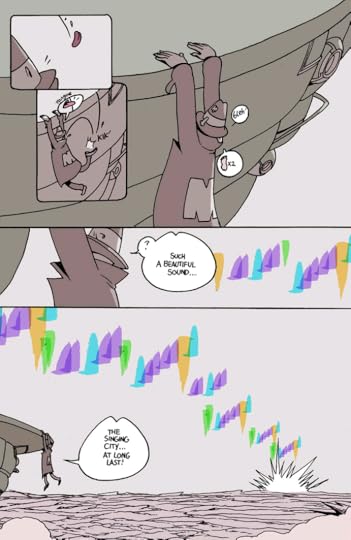
It'd be a strange reader indeed who went to Brandon Graham for a clear through-line or a plot-driven comic, but even so this opens in a particularly cocooned mood. If his earlier work often centred on dreams of leaving, this time we're with the guy who got out – only to find out the place he's ended up is duller and more constricted than where he started. Not that it's as litfic tedious as that might sound – the setting is a walking city traversing an alien planet, and Graham's art still confers that organic, intricate look on everything we see, not to mention an enviable sense of scale. And there are the little details too, like how to represent sounds on the page – "Tonight it sounds like a rhythmic climb upwards", next to a not-speech bubble filled with a staircase of pastel shapes – or the protagonist's favourite show, where the detective solves crimes with his detachable supernose, which sounds daft ("That is no ordinary awful death-fart!") but is if anything more sensible than the Russian show with a similar premise of which I once watched an episode on Netflix. The backmatter explains that this issue in particular came out of a depression which Graham admits had a lot in common with lockdown, and he talks about the influence of 'Iyashikei' or 'healing', a manga genre concentrating on small, tactile moments and intended to soothe, which sounds more than a little like a sort of ASMR on the page. Similarly, he suggests Rain Like Hammers was a kind of 'processing comic', which certainly gives a frame of reference – though one which becomes of increasingly questionable usefulness as the book continues. Before long we're switching protagonists (including two known as Vee and El, the second thing I've read this week where that was the case, and really, what are the odds?), a long way from those subdued opening pages, deep in a conspiracy spanning across the stars, all immortals, clones, body-jacking and finger-theft. And while it remains absolutely lovely to look at, it feels less and less like it has that devout interest in the textures of its strange worlds, not only compared to its opening chapter, but even compared to other Graham comics such as King City or Multiple Warheads. So in the end I can't really call it a satisfactory read, or a clear one – but it was inordinately pretty, and I hope it helped Graham work himself to a better place.
Now here's a comic I can compare to the likes of the Mother franchise in terms of unique experiences. The fact there is technology and concepts of a far future where anything is possible comes up constantly. Only there's a strong sense of isolation from every character. Their environments and decisions force them to confront different forms of it all, including what they value.
The reader definitely feels the sense of alienation thanks to the sound effects that need to accent actions. These people experience identity crises and a need to find purpose. Sometimes they just need a new perspective to get it all done, along with a proper translation to guide them. I'm definitely walking away with a new perspective on my life.
8.5/10 Outstanding. I am a lover of the medium with an unhealthy obsession with the form, a slow and analytical explorer of panels. Seriously, my motto could be: 'I do not read a lot of comics, but I read comics a lot'! So, it should come with no surprise that this book was one of my favourite reading in a long time, and its author one of my happy comic discovery of 2024. (I have been following him for a couple of years, I think since I saw him dissect Shirow's Appleseed on Youtube, but only now I have resolved myself to open one of his books.) This motherfucker Graham seems to know how to exploit inventively so many facets of the language: from the shape of a balloon to convey emotions to the representation of alien sounds through forms and colours, from integration of diagrammatic elements to original way to define directionality of reading. This comic book picked my brains so many times with a number of small sexy technicalities. It is, from this perspective, not exactly a work for the superficial reader. The art itself is a love letter to roundness, but with a counterintuitive allure: while usually roundness in cartooning conveys friendliness and warm, Graham softy line work kinda pushes the reader towards unsettling state of minds. Is it a compositional thing? Interesting, in any case. I also love unexplained sci-fi lores. Yes, please, plunge me into a world that I do not belong to, and make me feel like I do not belong. Alienate me. Great. I did not even realise until reading the afterword that the story itself is an exercise in social mourning process, as developed during a depressing period that the author had after an event of public humiliation by internet idiots. But let's not talk about that, let's talk about art. So yeah, to sum up: sexy formalism and storytelling, sexy art, sexy world-building, and even a dirty talking sexy little-helper robot of Barksian memory. This book has it.
Brandon Graham is one of the most imaginative comic book creators out there, each page is layered with details, both hidden and direct, and it’s through this that the story is really told. The narrative in ‘Rain Like Hammers’ is a little more open than some of Graham’s other works but it’s still about as much of a roiling carnal psychedelic sci-fi adventure as you could ask for.
I love Brandon Graham for his worldbuilding, his gorgeous artwork, and his weird and unique brand of eliptical storytelling, and Rain Like Hammers absolutely delivers. Muliple Warheads remain my favorite, but this one is almost as lovely. Beautiful stuff!
Hmmm... Just when you get used to the scruffy design aesthetic, and the fact the walking cities in the story here must all have been at the back of the queue when names were given out, that story completely gets dropped and swapped out by another so ungainly it took the blurb to tell me what was going on. When that got left behind, for the fact the intended target of that story was in a Danger Room that promised more than danger, I felt too left behind to continue. Like the design and the hand-lettering, this was a red hot mess.
I saw Rain Like Hammers at my local library and grabbed it because the art looked gorgeous. Here are my initial thoughts after finishing it. The story is difficult to get into since the book starts with a side story that seems out of place, but once the second chapter started it got much better. Main character Brik Blok's story is cool. For the most part I enjoyed the world that was built. I enjoyed the slice of life aspects. Some of the landscapes will sit in my mind for a while. Like I said, the art is gorgeous. I'm having trouble with how the (very few) female characters are written. The sex robot had more personality than every woman in this book, which is pretty disappointing to say the least.
Beautiful, free-flowing sci-fi art, but I couldn't make heads or tails of the story. A bounty hunter shifts his consciousness to a new body so he can find his daughter? Also, there's a guy doing menial labor on a moving city. I guess some of the sci-fi concepts are neat, but I buzzed through the last hundred pages or so because the dialogue had stopped making sense.
One of the best comics I’ve read in a long while. As the complex story comes together it’s both surprising and really emotionally effective, both of which (especially the latter) are rare in comics. Brandon Graham is a gift.
There is a Grand Guignol aspect to this, which feels like an unholy mashup of Moebius and Geof Darrow, but the combination is so discordant it defeats the qualities of its terrific constituent elements. Not unlike a peanut butter and onions sandwich. Alas.
I absolutely loved this. I didn’t read it so much as let it wash over me. It has a narrative that you sort of follow out of the corner of your eye, but really it’s a book to be felt more than read. It has a beautiful, clean sci-fi surrealism that reminds me of Moebius’s best work. Really just a wonderfully unique experience that I’m so grateful to have had.
Hiç bana göre bir okuma olmadı. Hikâyesini sevmedim, daha doğrusu ne anlatmaya çalışıyor anlamadım ki seveyim... Çok garip bir çizgi roman. İncelemelerini araştırıp görüşlerimi daha sabit bir hale getireceğim. Ondan sonra devam edip etmeme kararı alırım.
As with all of Brandon Graham’s creations, this was so good! There’s always so much to look at in his art of detailed, quirky alien worlds. A brilliant reading experience.
I was initially drawn to the art but found this a bit uneven. There are some great, epic land/cityscapes, but other times Graham is depicting some weird creature or obscure alien technology and his flat, intricate style makes it a bit difficult to understand what you are looking at. Eventually I got into the story. It takes a sharp left-turn after the first issue, with a number of new concepts and characters introduced, but it manages to all tie together in the end. Brendan Graham is full of great narrative and visual ideas but he comes across as a little unfocused here. I’m a fan of other works I've seen online and I should investigate these further as I think I would probably get into his stories if he was able to reign in his style a little bit more. 3 1/2
As with a lot of Brandon Graham's work, the pacing of this book is both relaxing and comforting. This is not a high-paced sci-fi action adventure (though it is very sci-fiy and has a lot of action), but rather a very carefully plotted story about people with plenty of puns to keep it light. As I was reading it, I felt myself calming and slowing down. It was very relaxing and pleasant. Also, Graham's pun game is top-notch and worth the price of admission.
I love the way Graham doesn't give us all the details. We see characters and ideas in action and don't get bogged down by the technicalities of how a light field is produced. Knowing too much of the background can leave me feeling oppressed, but Graham's stories give me so much space to imagine possibilities.
Prophet is a very important comic to me. It's difficult to explain. The combination of perplexing storylines, overly-detailed and innovative visions of the distant future, techno-body horror and a grand, cosmic scale that spread across lowly individuals and basically "Gods" shook me out of whatever a priori notions I had about what a comic could be.
So I opened Brandon Graham's Rain Like Hammers with a built-in affinity for some of his style and thinking. I accept that going into this.
Still - to me, at least, this is a five-star possible masterpiece. It is arresting, challenging, and nuanced. It's also extremely silly. There is a unique blend of slapstick and gravity that I don't think I've encountered anywhere else. It does, at times, capture some of the magic I felt reading Prophet, but the introduction of nonsensical, lowbrow comedy is the one thing I TRULY did not expect from this book - and wound up loving.
I want to shout out the first chapter in particular, which manages to capture the "lonely in a crowded room" feeling many people have in their 20s, discovering themselves, their purpose, and making their way through mundane jobs towards (we hope?) something a bit more fulfilling, stumbling over possible life paths as they go. I think I inhaled Chapter 1 in a single breath and was again thrown a curveball by Graham when I started Chapter 2 in a wildly different context.
A work like this should feel disconnected, disjointed, difficult to connect with (and reading through some of the 2 and 3 star reviews here, clearly some readers DID walk away with that feeling), but I had the opposite experience. Whatever this team was writing and drawing into this book, I was along for and eager to try and better understand.
In the end, there is a beautiful story here about how to evolve your life when you're already several stages in and think you know who you are. We're not talking about a tearjerker of a book, but I was moved by its conclusion.
I don't know - just stop reading this dumb review and go read the book as soon as you can. I loved it.
This was kind of a laid back story that meanders around a bit before coming together. The reader gets plopped down, with no explanation, into an unknown desert world with walking cities being attacked by some mysterious something, spend some time with an escaped convict trying to find the long lost daughter of an old friend, then some time with the daughter. These three storylines converge near the end, with a lot of weirdness. The story is interesting, with lots of moody moods, some intrigue, a bit of action, and a lot of what's going on here- basically, don't expect to fully know what happening, and be prepared to speculate (which can be quite fun). I enjoyed the fill in the blanks aspect, but YMMV. The art is the star here- it does the heavy labor, the world building. There is an incredible amount of detail in the illustration, and sometimes several pages will go by without any text and you don't notice, because the story is moved along so well by the art. The art is gorgeous, with qualities of Moebius and Windsor McCay while being unique, and really adds to the dreamlike quality of the story. Read this if you want a trippy escape from reality that you don't have to think about too hard; you can just let this wash over you, and get caught up in the flow.
I’ll preface my comments by saying I’ve been a fan of Brandon Graham’s work for a long time, so it should come as absolutely no surprise that I enjoyed “Rain Like Hammers” as much as I did. The art is what I’ve always come to expect, simultaneously marrying clean and simple colors with detailed and intricate compositions and unique design. The story is engrossing and immersive, and I’m especially happy to have a longform work from Graham to enjoy.
Graham’s art is reminiscent of Moebius, but it is in its way, unique and spellbinding. The story was interesting, but abstract and metaphor heavy. So if you are into clear plots with well defined resolutions this will not be for you. Graham states in the afterwards that part of the inspiration was his sense of alienation.
The story-line has two parts. We begin on a vast planet where we have giant moving cities striding across its surface. We then shift to a story involving clones, assassins, and a seemingly unaccountable ruling elite. In the final chapter, both stories converge and all the main characters are in one place for the final resolution.
It’s interesting to me (spoiler alert) that most Brandon Graham stories end so anticlimactically. He creates these detailed worlds, filled with puns, Mœbius-like vistas, imbibed with an eroticism and sense of invention, but they rarely go anywhere. I’m thinking of works of his like King City and Multiple Warheads and, yes, this. That’s not to say the ride isn’t pleasurable, or, in fact, that these excursions *need* to end decisively. But rather than, perhaps, the open-ended nature of some Mœbius stories, infused with his general spirituality, Graham’s stories feel like he finishes them up quickly to move on to another idea. At least, I guess, he finishes them: I’m still hoping James Stokoe will someday finish his Orc Stain. Regardless, this was fun to read and had moments of intoxicating vertigo due to the scope, both visually and with narrative world-building…I just wished the ending didn’t feel rushed and underwritten.
Brandon Graham is one of those creators who I always tend to lean towards, or at least give their books a shot. I really like his style and even more so, his imagination. The book is definitely all his style, which is alien, psychedelic, futuristic, and organic all at the same time. If you like Graham's work, this book will not disappointing in the slightest. From the locales, to the characters, to the objects, etc... it is all very strange, and I really liked that aspect of the story.
However, I think Graham is a stronger artist than he is a writer. This book was cool but I could not give a definite outline of what happened in the book, because it was kind of unclear and bizarre. I know the main characters, kind of, but their motivation and quest kind of got lost in the swirls and lines that so beautifully bring the world to life.
I think this one is more for direct fans of Graham's. However, if you like weird, sci -fi stories, this one might be right up your alley.
The mix of simple and complex line art, the coloring, the character design, the goofy multi-lingual puns—all of these made this book really enjoyable. I will say that the ‘immortals’ group of bad guys idea is kind of a weary trope already; and a few plot points didn’t make much sense to me. But overall I liked the universe and the characters and Brandon Graham inspired me with his art and creativity.
There's a weird, zen melancholy about this - it feels like the interstitial spaces in between loud moments. It's a quiet kind of comic. Even its big moments are quiet. Graham's art is gorgeous too, part of that quiet coming from the vastness of the landscapes he draws, and the small, small alien people things set against that, just living out their lives, going through existential crises, and more. Graham is my favorite comics artist for a reason.
I find Graham's work narratively tough to follow. Typically, I hate that kind of thing but he is a rare case where I will actually read through his work twice to fully appreciate it. I did so for Prophet and found it marvellously rewarding. This is one where I must have read to 3-4 times in parts. I finally realised that my stumblock was that he does lots of wide framed shots and my brain can't take it. But I wouldn't want it any other way.
this book is cool and i reallllly want to like it more than i did. the illustrations are so stunning and i love the way the pages were formatted (i’m a big nerd about this) but i had a hard time following the actual story. it felt too big and too far away to really grasp. too abstract for my liking, not very tangible? but still. giving it 3.5 stars for the visuals alone. i’ll reread it, i hope i pick up more of the story the second go around.