Oxford Author's series, General Editor Frank Kermode. Includes 'a comprehensive selection of Browning's poetry', selected letters from the 'courtship correspondence' with Elizabeth Barrett, and 'Other Selected Letters'.
Robert Browning (1812-1889) was a British poet and playwright whose mastery of dramatic verse, especially dramatic monologues, made him one of the foremost Victorian poets.
Browning began writing poetry at age 13. These poems were eventually collected, but were later destroyed by Browning himself. In 1833, Browning's "Pauline" was published and received a cool reception. Harold Bloom believes that John Stuart Mill's review of the poem pointed Browning in the direction of the dramatic monologue.
In 1845, Browning wrote a letter to the poet Elizabeth Barrett Browning, professing that he loved her poetry and her. In 1846, the couple eloped to Europe, eventually settling in Florence in 1847. They had a son Pen.
Upon Elizabeth Barrett Browning's death in 1861, Browning returned to London with his son. While in London, he published Dramatis Personae (1864) and The Ring and the Book (1869), both of which gained him critical priase and respect. His last book Asolando was published in 1889 when the poet was 77.
In 1889, Browning traveled to Italy to visit friends. He died in Venice on December 12 while visiting his sister.
Browning's poetry is not everybody's cup of tea. He alludes to the past, present and even future. His imagination (yes) helps him reach the places and times we cannot visit unless we imagine with him. His poetry may not sound entertaining and not seem exciting. And yet, those who understand poetry will have to appreciate his constant attempts and a few masterpieces.
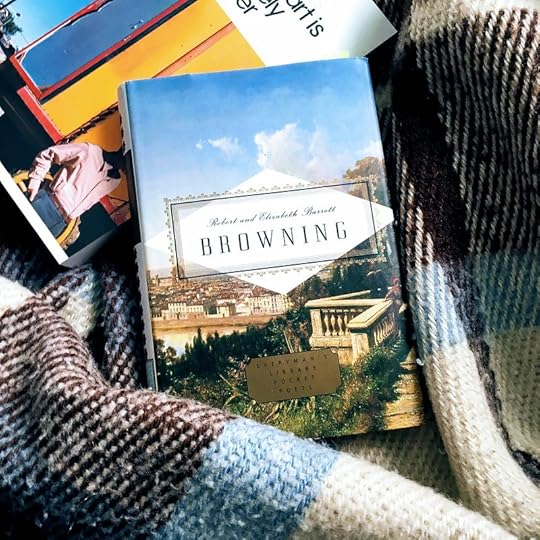
This is another pretty little book from Everyman's Library Pocket Poets series. I love this series and have over a dozen books from it. This particular book includes:
- 100 pages of Robert Browning's poems - 100 pages of Elizabeth Barret Browning's poems (including the whole of Sonnets from the Portuguese and an excerpt from Aurora Leigh) - 50 pages of letters they wrote to each other.
I knew Robert & Elizabeth Barret Browning were famous poets but didn't know the connection between them until reading Love Letters - an anthology of love letters written by famous writers and other prominent people. It's also part of Everyman's Library Pocket Poets series. That's how I found out about their extraordinary love story and became fascinated by it. My next (also accidental) encounter with them was in Flush by Virginia Woolf - a fictionalized biography of Elizabeth Barret Browning's dog, which of course shines a light on the life of the family.
At that point, I knew I had to get acquainted with their actual work. So I ordered this book. It's a great introduction to both of them - I'm really happy with this edition since it matched perfectly what I set out to do.
As to the actual writings contained here:
1) I found Robert Browning's poems a little too heavy in style for me. I had to stay very focused to follow them, so the experience wasn't as smooth and easy as I'd like it to be with poetry. So this portion of the book was 3* for me.
2) I really loved Elizabeth Barret Browning's poetry, especially Sonnets from the Portuguese. They were absolutely brilliant! The Aurora Leigh excerpt made me curious, so I ordered an edition of it to read it in full. It's a novel in verse. I guess this is testament enough to prove it was a 5-star experience for me.
3) The letters Robert and Elizabeth wrote prior to their first meeting, during their engagement and beyond were fascinating! I'm glad I knew the story well from reading Flush, so I had a better comprehension of them than I would have otherwise.
So, all in all, it was a delight. Totally recommend!
Pretty good lesser known poems. The letters between Robert and Elizabeth were pretty good too. The everymans pocket poets are a good way to get into poetry as well.
About: Poems by Robert and Elizabeth Barrett Browning is a collection of poetry by the Brownings who were famous for their marriage as well as their poetry in the 19th century. There are three sections in this book: the first is some of Robert’s poetry, the second some of Elizabeth’s poetry, and the third some of the letters they wrote to each other during their courtship.
Did I Like It?: Yes I did like this collection. I didn’t love this collection though and it took me awhile to get through it. There were poems I liked though, and poems that didn’t resonate. It was just a mix of both for me. For the most part I liked both Robert’s and Elizabeth’s poetry equally. It would be hard to pick a favorite. I also enjoyed their letters and thought it was a nice little addition to the collection at the end.
Favorite Poems: My favorite poems by Robert Browning were Inapprehensiveness, Summum Bonum, Meeting at Night/Parting at Morning, Now and Evelyn Hope. I also thought Porphyria’s Lover was good and creepy and Love in a Life and the excerpt from Pauline were relatively good too. My favorite poems by Elizabeth Barrett Browning were A Sea-Side Walk and the first book of Aurora Leigh ( I liked it so much I want to read the whole thing!). I also kind of liked The North and the South, The Best Thing in the World, Sonnets From the Portuguese, From Heine, Amy’s Cruelty, and A Man’s Requirements.
Do I Recommend It?: If you are interested in this collection then I think it’s worth picking up. If you have an interest in 19th century poetry in particular then this might resonate with you more.
A collection of poems by the most famous couple in poetry (until Sylvia Plath and Ted Hughes, at least) which also includes some of their courting correspondence and Elizabeth's famous Sonnets from the Portuguese, it's a pretty nifty and portable edition.
It's easy to make a little compare and contrast exercise between Robert and Elizabeth here, and while Robert seems to be clearly the more technically proficient poet, Elizabeth's poems speak a lot more to me, and to most people, because they are considerably more earnest. The two factors might in fact be connected, her lack of technicality allows for a freer expression of feeling, while Robert is always the more restrained writer.
Towards the end of the book you get their correspondence, which is pretty lovely as they are courting, only to be abruptly shut down as the letters jump some 20 years into the future and you get Robert's distraught letter describing Elizabeth's death. That's a bit of a downer to close on.
I cannot read the poetry of E. B.B. without coming to tears, especially knowing the story of her and Robert Brownings love. This sweet little volume was an excerpt of their talent, containing their shorter poems. The big bonus held in this tiny book is that it also contains some of their letters, including one written by R.B. to his sister, describing Elizabeth's death in his arms. A worthwhile read for lovers and lovers of words.
This is basically what it claims to be: a collection of the some of the best known poems by Robert Browning and Elizabeth Barrett Browning, and really, I have no complaints there. This is a good sampling of the works of the two poets. However, I do wish there were some changes made to the organization of the anthology. For one, I wish that the dates of the poems were printed along with them; I find that this helps show the progression of the poet's work and voice. Also, perhaps this is just on Goodreads, but for some reason, only Robert Browning is listed as author. This is odd and really especially so when Barrett Browning is generally considered the more famous and perhaps even more skilled of the two poets. That said, I did appreciate the inclusion of a sampling of the letters to one another at the end of the collection.
The poems in this volume that I understood I found to be fascinating and powerful. The poems I didn't understand I assume must be equally fascinating and powerful, but I lacked the patience to apply myself to studying them more closely. Browning was clearly a genius. I found philosophical depth here: authentic examination of profound ideas. I also found a compelling music. 'Caliban Upon Setebos' is especially strong rhymically. I need to revist some of these poems and I undoubtedly will.
The book actually has over 600 pages. I liked it more than the last book I read. I’m kinda on a classics flow as of right now. It was okay. Not the best classic I’ve ever read. But considering the time this was actually beautiful.
A great collection of their works. And their letters to each other are sweet and fun to read, although fun doesn't seem to be a right word to describe their skill with words and ideas even in casual correspondence. They give you a great picture of Robert's and Elizabeth's personalities.
My rating isn’t for the actual contents of the book, which are excellent, but for the compilation itself, which is lazy. Poems are separated by author which I feel defeats the purpose of putting these two in one source. Sonnets of the Portuguese isn’t numbered either. Things like this that make it feel sort of just thrown together. That said, it’s otherwise an excellent selection of two of my favourite poets’ work!
I love the poems collected here. It makes me want to get a more complete collection to explore.
And I especially love the collection of letters at the end: Elizabeth and Robert's letters to each other, then heartbreakingly capped off with a letter from Robert to his sister recapping the events leading to Elizabeth's death.
This entire review has been hidden because of spoilers.
"She had lived, we'll say, A harmless life, she called a virtuous life, A quiet life, which was not life at all (But then, she had not lived enough to know)"
But should you read it? If poetry is not your thing, but you feel you should at least be trying to access your civilization's heritage, than Browing is a fairly easy, accessible entry point for you. If you've acknowledged that not reading poetry marks you as a philistine and have taken up the hobby, Browning's works should definitely be on your list.
This is an engaging collection of love letters and poems between Robert and Elizabeth Browning. One thing that the collection demonstrates was what a command Elizabeth had of the sonnet. Critics love to focus on Shakespeare and Spencer (and Seamus Heaney among the modern practitioners) but Elizabeth was an excellent writer of sonnets. The "Sonnets from the Portuguese" are incredible.
I got this book from the library, but I am buying a copy for myself. The letters are unbelievably romantic and beautiful. It draws you into the poetry.