

What do you think?

Surveillance State: China's Quest to Launch a New Era of Social Control
Where is the line between digital utopia and digital police state?
Surveillance State tells the gripping, startling, and detailed story of how China’s Communist Party is building a new kind of political shaping the will of the people through the sophisticated―and often brutal―harnessing of data.
It is a story born in Silicon Valley and America’s “War on Terror,” and now playing out in alarming ways on China’s remote Central Asian frontier. As ethnic minorities in a border region strain against Party control, China’s leaders have built a dystopian police state that keeps millions under the constant gaze of security forces armed with AI. But across the country in the city of Hangzhou, the government is weaving a digital utopia, where technology helps optimize everything from traffic patterns to food safety to emergency response.
Award-winning journalists Josh Chin and Liza Lin take readers on a journey through the new world China is building within its borders, and beyond. Telling harrowing stories of the people and families affected by the Party’s ambitions, Surveillance State reveals a future that is already underway―a new society engineered around the power of digital surveillance.
Surveillance State tells the gripping, startling, and detailed story of how China’s Communist Party is building a new kind of political shaping the will of the people through the sophisticated―and often brutal―harnessing of data.
It is a story born in Silicon Valley and America’s “War on Terror,” and now playing out in alarming ways on China’s remote Central Asian frontier. As ethnic minorities in a border region strain against Party control, China’s leaders have built a dystopian police state that keeps millions under the constant gaze of security forces armed with AI. But across the country in the city of Hangzhou, the government is weaving a digital utopia, where technology helps optimize everything from traffic patterns to food safety to emergency response.
Award-winning journalists Josh Chin and Liza Lin take readers on a journey through the new world China is building within its borders, and beyond. Telling harrowing stories of the people and families affected by the Party’s ambitions, Surveillance State reveals a future that is already underway―a new society engineered around the power of digital surveillance.
310 pages, Hardcover
Published September 6, 2022
About the author
Josh Chin
4 books42 followersJosh Chin is Deputy Bureau Chief in China for The Wall Street Journal. He previously covered politics in China for the newspaper for more than a decade. He is a recipient of the Dan Bolles Medal, awarded to investigative journalists who have exhibited courage in standing up against intimidation, and led an investigative team that won the Gerald Loeb Award for international reporting in 2018. He has also been awarded two Human Rights Press Awards and an award for excellence in investigative reporting from the Society of Publishers in Asia.
Josh was named a National Fellow at New America in 2020. The following year, he was among the first of more than a dozen American reporters to be expelled from China. He currently splits his time between Seoul and Taipei.
Josh was named a National Fellow at New America in 2020. The following year, he was among the first of more than a dozen American reporters to be expelled from China. He currently splits his time between Seoul and Taipei.
Ratings & Reviews
Friends & Following
Create a free account to discover what your friends think of this book!
Community Reviews
Displaying 1 - 30 of 77 reviews

March 27, 2023

Image: Jeremy Bentham's Panopticon Prison. Source
In the 18th century, philosopher and social theorist Jeremy Bentham came up with the idea of the Panopticon Prison in which a single security guard could see every cell from their vantage point in a center tower.
The prisoners, forced to face the inside wall of their cells, would not know when or if they were being observed. Bentham theorized that because they couldn't know if they were being observed, they would act as if they were being observed, motivated to self-regulate and adhere to the rules.
The authors of Surveillance State compared the panopticon to China's increasing mass surveillance of her citizens. I am both fascinated by the Chinese government and abhorred by it.
The concept of knocking people into line and manipulating their behavior (and thoughts?) through mass surveillance has never been more possible than it is today, and nowhere is it happening as quickly as in China.
As soon as I saw this book, I knew I had to read it and I'm so glad I did. no matter how terrifying it is. The authors discuss the history of China's Communist government, culminating in the rise of Xi Jinping. They depict the various types of mass surveillance used by the Party to control its citizens.
Especially horrific is how they are using facial recognition technology to round up Uyghur Muslims for "re-education" in internment camps where they are often tortured into submission.
They interview Tahir, a Uyghur man, and his family who eventually escaped to the United States. Tahir relates how he and his wife were taken to a police station for biometric analysis and where they had multiple pictures taken, without any explanation of why.
"The government now had a collection of his biometric markers, none of which he could change. With the scan of his face on file, the surveillance cameras could recognize him from any angle. If this new system decided he was a threat to the social order, he wouldn’t have anywhere to hide."
There are cameras seemingly everywhere in Chinese cities, and ever more are being installed. Some of the uses are benign: to locate missing children and elderly people or to help alleviate traffic and assist first responders in arriving at a scene as quickly as possible.
As the authors state, "the same technologies the Party uses to terrorize and remold people who buck its authority can be deployed to coddle and reassure others who are willing to play along".
The West is not innocent when it comes to China's use of mass surveillance to commit human rights abuses. Indeed, China's technology originated in Silicon Valley, and just as "IBM helped automate the scheduling of trains that crisscrossed Europe, carrying supplies to German troops and Jews to concentration camps," so too did many American companies help China install systems of mass surveillance, eagerly testing technologies in ways that would be frowned upon or not allowed in the US or much of Europe.
Unfortunately for citizens in other countries, as the world's governments watch China, they are adopting some of its systems of surveillance. As the authors state, "With the exceptions of Australia and Antarctica, every continent now sees Chinese surveillance technology aiding its police forces."
This includes many police forces in the US now using facial recognition and photo editing software and even DNA from a blood sample to theoretically construct a suspect's face.
I would perhaps be ok with this if it was accurate, especially since human memory is fallible and the wrong people are often "identified" as having been the suspect.
However, while it is 95% accurate in good conditions, most CCTV cameras do not provide the kind of pictures that would warrant "good conditions''. Not only that, the algorithms are much less accurate at identifying darker skinned people, meaning many, especially Black and Brown people, are often wrongly identified as having been the criminal.
Additionally, police departments rarely admit to using this technology because they would have to prove its efficacy in court, something they are unable to do.
I am of two minds about much of the surveillance tactics discussed in this book. On one hand, they have the capacity to bring about a lot of good. On the other, they can be used to obliterate basic human rights.
The final part of the book looks at China's social system that rewards people for
Those who thwart the system, break the law, or don't pay their bills on time, might find themselves unable to purchase plane or high speed train tickets, or eat at a fancy restaurant.
I can see both good and bad in this system. Certainly I would like people to face consequences for antisocial behavior, such as disturbing the public (I'm looking at you, you assholes that blast music in the middle of the night when most people are trying to sleep). If you want to disturb your neighbors, fine. But you're not going to be able to eat at that new restaurant you've been dying to try.
Unfortunately, I think there is a lot more potential for abuse with such a system than there is for any good that could come of it. It's all such a slippery slope and I don't know where the line should be drawn when it comes to people's rights to privacy.
Do we allow cameras in public spaces to prevent crimes or catch criminals and if so, what constitutes a public space and who is allowed to view this data and for what reasons?
Should people be required to have cameras in their homes in order to prevent domestic and child abuse? (This gives me the creeps but I think it's a question that will eventually come up.)
Should corporations be allowed to use and sell our data? To whom and for what purposes?
Should we rely on algorithms to predict who might commit a crime, thus allowing us to bar that person from being able to commit it? And if so, how do we prevent them from committing this possible crime?
These are the sorts of questions I love to ponder and I'm glad this book gave me so much to think about.
I think citizens the world over need to be asking these questions now - before we find ourselves in a Panopticon of our own making, each cell built by apathy and lack of awareness.
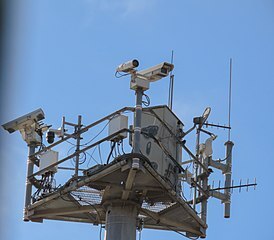
Image: A remote video surveillance system tower with multiple cameras on the California-Mexico border Source

October 10, 2022
If what the authors cover in this book doesn't chill you to your bones, you'd probably get along just fine in most Orwellian universes. When reading, remember, "Surveillance State" deals with surveillance tech in use today.
This is worth repeating, "Surveillance State" deals with surveillance tech in use today.
It's a book about the expanding Chinese surveillance state, about how China spreads its influence abroad by exporting social and political control, it's about pre-crime (with "crime" defined as anything those in power may deem it worth punishing people for - like, say, religious affiliation, or using your silverware incorrectly), it's about surveillance creep, and it's about how this is not a uniquely Chinese issue - how, in fact, it traces back to the west.
Honestly, I don't really know where to start here. I have too many highlighted sections and statements in this book to even begin to do the issues justice. Instead, I suggest you read this book. Yesterday.
The authors use anecdotes and individual perspectives to frame much larger issues. Perhaps chiefly among them how we, as populations, allow fearmongering and "safety" erode the freedoms and privileges that generations of humans have fought for. And as always, it's worse for those who already had/has it bad. Contrary to the naive idea of as little as 20-odd years ago that the internet would usher in an era of unprecedented freedoms and access, an crumbling of totalitarianism in the wake of newly informed and educated masses, this book is a story of near-enough the opposite... and much, much worse. It's the story of those in power leveraging technology to stay there, by any and all means necessary. It is the story of the creeping digital police state - in China, in Africa, in North America, and in Europe.
I like the book for the terrifying portrayal of the current state of the Chinese surveillance machine, how it ties in to a more global trend, and what this does to people - good and bad. I like it for the authors' efforts to specify what it isn't - yet - as well. But I especially like it for outlining how we're allowing this to happen, how - disturbingly - we're often even begging for it. I missed a few things relevant to the issue/s in the book, albeit that the book is taking on a huge issue and you have to limit yourself somewhere, but it's a fantastic journalistic effort. And it's a burning reminder to not treat a paper cut by amputating a limb, to cherish freedom, and to resist... while we can.
Finally, and again, this book is not about the future, it's not about a fearmongering prediction. It's about practices and tech deployments in use today. A terrifying must read in my mind, recommended.
This is worth repeating, "Surveillance State" deals with surveillance tech in use today.
It's a book about the expanding Chinese surveillance state, about how China spreads its influence abroad by exporting social and political control, it's about pre-crime (with "crime" defined as anything those in power may deem it worth punishing people for - like, say, religious affiliation, or using your silverware incorrectly), it's about surveillance creep, and it's about how this is not a uniquely Chinese issue - how, in fact, it traces back to the west.
Honestly, I don't really know where to start here. I have too many highlighted sections and statements in this book to even begin to do the issues justice. Instead, I suggest you read this book. Yesterday.
The authors use anecdotes and individual perspectives to frame much larger issues. Perhaps chiefly among them how we, as populations, allow fearmongering and "safety" erode the freedoms and privileges that generations of humans have fought for. And as always, it's worse for those who already had/has it bad. Contrary to the naive idea of as little as 20-odd years ago that the internet would usher in an era of unprecedented freedoms and access, an crumbling of totalitarianism in the wake of newly informed and educated masses, this book is a story of near-enough the opposite... and much, much worse. It's the story of those in power leveraging technology to stay there, by any and all means necessary. It is the story of the creeping digital police state - in China, in Africa, in North America, and in Europe.
I like the book for the terrifying portrayal of the current state of the Chinese surveillance machine, how it ties in to a more global trend, and what this does to people - good and bad. I like it for the authors' efforts to specify what it isn't - yet - as well. But I especially like it for outlining how we're allowing this to happen, how - disturbingly - we're often even begging for it. I missed a few things relevant to the issue/s in the book, albeit that the book is taking on a huge issue and you have to limit yourself somewhere, but it's a fantastic journalistic effort. And it's a burning reminder to not treat a paper cut by amputating a limb, to cherish freedom, and to resist... while we can.
Finally, and again, this book is not about the future, it's not about a fearmongering prediction. It's about practices and tech deployments in use today. A terrifying must read in my mind, recommended.

September 5, 2022
Most of this book comes from the authors' (very important) coverage of China's surveillance state in the Wall Street Journal, so it might be less informative for those who follow closely the development of the Xi administration. I'm glad that the authors return to the history of Chinese cyberneticists like Qian Xuesen and Song Jian, who laid the early theoretical groundwork (e.g. Qian's Open Complex Giant System 开放的复杂巨系统) for post-Mao China's technology-enabled social control. Chinese military cyberneticists have been an insufficiently examined source of influence in the history of Chinese technology and economic reforms.
The chapter could've benefitted from a global context of cybernetics: China wasn't the only country that was influenced by cybernetics in the second half of the 20th century, and authors like Eden Medina (Cybernetic Revolutionaries: Technology and Politics in Allende's Chile), Ben Peters (How Not to Network a Nation: The Uneasy History of the Soviet Internet), Ronald Kline (The Cybernetics Moment: Or Why We Call Our Age the Information Age), Fred Turner (From Counterculture to Cyberculture: Stewart Brand, the Whole Earth Network, and the Rise of Digital Utopianism), and others have discussed historical developments in Chile, the U.S., and the Soviet Union.
The authors make attempts to draw linkages between surveillance technologies in the U.S. and China -- that American corporations are complicit in Chinese digital authoritarianism, and that the U.S. government has adopted similar technologies in its wars on terror and crime at home. These are all valid points, and I wish there had been more structural critiques of global capitalism -- more specifically, the emerging transnational military-industrial complexes that integrate technology capitalists into American and Chinese authoritarian ambitions.
The chapter could've benefitted from a global context of cybernetics: China wasn't the only country that was influenced by cybernetics in the second half of the 20th century, and authors like Eden Medina (Cybernetic Revolutionaries: Technology and Politics in Allende's Chile), Ben Peters (How Not to Network a Nation: The Uneasy History of the Soviet Internet), Ronald Kline (The Cybernetics Moment: Or Why We Call Our Age the Information Age), Fred Turner (From Counterculture to Cyberculture: Stewart Brand, the Whole Earth Network, and the Rise of Digital Utopianism), and others have discussed historical developments in Chile, the U.S., and the Soviet Union.
The authors make attempts to draw linkages between surveillance technologies in the U.S. and China -- that American corporations are complicit in Chinese digital authoritarianism, and that the U.S. government has adopted similar technologies in its wars on terror and crime at home. These are all valid points, and I wish there had been more structural critiques of global capitalism -- more specifically, the emerging transnational military-industrial complexes that integrate technology capitalists into American and Chinese authoritarian ambitions.

June 1, 2023
This was absolutely terrifying. China has the surveillance that the Nazis would have KILLED for leading up to and during WWII. And China is using it pretty similarly to how the Nazis would have, using it to commit genocide on a religious minority within their borders. They just haven't expanded those borders...yet. And once they do, there are a LOT of those who they would also consider "other" they would use this technology on. In fact, I wouldn't doubt if they are using it on a LOT of people outside of their borders already.
Capitalism sucks, if only because those who worship it see money as being worth more than the people being hurt to get said money. Communism is only better on paper, case in point, looking at you China.
Don't read/listen to this if you are in a depressed/paranoid mood. It won't help. Though at this point, I'm not sure what will help this situation.
5, incredibly important to read/listen to, if depressing and scary, stars.
My thanks to libro.fm and Macmillan Audio for an ALC for me to listen to and review.
Capitalism sucks, if only because those who worship it see money as being worth more than the people being hurt to get said money. Communism is only better on paper, case in point, looking at you China.
Don't read/listen to this if you are in a depressed/paranoid mood. It won't help. Though at this point, I'm not sure what will help this situation.
5, incredibly important to read/listen to, if depressing and scary, stars.
My thanks to libro.fm and Macmillan Audio for an ALC for me to listen to and review.
This entire review has been hidden because of spoilers.

March 24, 2023
This is a book that goes into the different aspects of state surveillance of citizens focusing mainly on CCTV camera networks coupled with AI technology. Although the authors tried to cover a complete surveillance system that is supplemented by our behavioural data on other platforms (such as social media, e-commerce, etc), the coverage is disproportionately centred on CCTV, probably due to the lack of information on the inner workings of the state apparatus with regard to the other data which are much less conspicuous compared to CCTV cameras.
This is a very readable book but by no means enjoyable in the traditional sense. Not because it's badly written but because it awakens in us the realisation that we are probably under a high level of surveillance without even realising it. With today's technologies, the balance of power is not in the people's hands, whichever political system you are living under.
While this book is certainly informative, I'm not very sure exactly where it is positioning itself. The sub-text says "Inside China's quest to launch a new era of social control" but it jumps around too many areas to make it coherent. One chapter was dedicated to the US's application of a somewhat similar system post 9/11, seemingly trying to imply that surveillance is practised across politial systems. So what's the point? That China's not the one that launched it? Then there was a chapter on the mostly-American companies that are supplying the technologies to enable the surveillance system. This, while related to the topic, diffuses the focus of the book.
Then there was the focus on Mr Tahir Hamut, an Uyghur who experienced first hand the indignity of being hauled up seemingly at random by the state security forces and then being stalked as a "person of interest". He is a good example to embody the ill-treatment this community received but the story shifts focus to his escape from China and as an epilogue, detailed his life and struggles after settling in the US. I'm sure the plight of the Uyghurs are worth reporting but I would have read a book dedicated to that. In the end, I'm not exactly sure what the central focus of the book is. There seems to be too many ideas loosely tied around CCTV/AI surveillance and social control.
Yet, there are moments in the book when the authors take us on a journey of introspection and critical reflection. The chapter on surveillance system used during the Covid-19 pandemic is a case in point. Almost all countries employed some kind of movement tracking system during the pandemic, many of us submitted to the need, some even felt that it kept us safe. Beyond this, surveillance systems have also demonstrated their value in reducing crime. But when do we cross the line between the benefits into the zone of political control, between social good and intrusion of personal privacy? There are no easy answers and the authors would have done well leaving us with that question. Instead, they tried to paint the picture of Tahir seemingly escaping from surveillance hell to heaven having settled in the US. That? After giving parallels of surveillance hell between China and the US? I personally have little knowledge of the surveillance at the state level in either country so I'm not saying that either one is better or worse, but based on what the authors wrote about the US in the book, this seems to contradict what they said about the US. It gives me the feeling that they have preconceived ideas about the US versus China and that chapter critical of the US was included as an attempt "to be balanced".
The book is a bit dissonating but still worth reading for insights into surveillance at the state level and also how we are so unconscious of it. Most valuable of all, the invitation for us to ask ourselves the extent we would consent to the level of surveillance, giving up some of our privacy and freedom for the "greater good".
What I found ironic, and perhaps the authors didn't mean it that way, was how the Uyghurs who escaped China's project to assimilate them into the "greater China" culture by leaving the country would eventually lose their cultural heritage anyway. This comes out clearly in the epilogue epitomised by Tahir's elder daughter Asena. She left China at maybe thirteen to escape being "Han-ised" only to assimiate into the American culture in half that time. Still, I wish the family the best.
This is a very readable book but by no means enjoyable in the traditional sense. Not because it's badly written but because it awakens in us the realisation that we are probably under a high level of surveillance without even realising it. With today's technologies, the balance of power is not in the people's hands, whichever political system you are living under.
While this book is certainly informative, I'm not very sure exactly where it is positioning itself. The sub-text says "Inside China's quest to launch a new era of social control" but it jumps around too many areas to make it coherent. One chapter was dedicated to the US's application of a somewhat similar system post 9/11, seemingly trying to imply that surveillance is practised across politial systems. So what's the point? That China's not the one that launched it? Then there was a chapter on the mostly-American companies that are supplying the technologies to enable the surveillance system. This, while related to the topic, diffuses the focus of the book.
Then there was the focus on Mr Tahir Hamut, an Uyghur who experienced first hand the indignity of being hauled up seemingly at random by the state security forces and then being stalked as a "person of interest". He is a good example to embody the ill-treatment this community received but the story shifts focus to his escape from China and as an epilogue, detailed his life and struggles after settling in the US. I'm sure the plight of the Uyghurs are worth reporting but I would have read a book dedicated to that. In the end, I'm not exactly sure what the central focus of the book is. There seems to be too many ideas loosely tied around CCTV/AI surveillance and social control.
Yet, there are moments in the book when the authors take us on a journey of introspection and critical reflection. The chapter on surveillance system used during the Covid-19 pandemic is a case in point. Almost all countries employed some kind of movement tracking system during the pandemic, many of us submitted to the need, some even felt that it kept us safe. Beyond this, surveillance systems have also demonstrated their value in reducing crime. But when do we cross the line between the benefits into the zone of political control, between social good and intrusion of personal privacy? There are no easy answers and the authors would have done well leaving us with that question. Instead, they tried to paint the picture of Tahir seemingly escaping from surveillance hell to heaven having settled in the US. That? After giving parallels of surveillance hell between China and the US? I personally have little knowledge of the surveillance at the state level in either country so I'm not saying that either one is better or worse, but based on what the authors wrote about the US in the book, this seems to contradict what they said about the US. It gives me the feeling that they have preconceived ideas about the US versus China and that chapter critical of the US was included as an attempt "to be balanced".
The book is a bit dissonating but still worth reading for insights into surveillance at the state level and also how we are so unconscious of it. Most valuable of all, the invitation for us to ask ourselves the extent we would consent to the level of surveillance, giving up some of our privacy and freedom for the "greater good".
What I found ironic, and perhaps the authors didn't mean it that way, was how the Uyghurs who escaped China's project to assimilate them into the "greater China" culture by leaving the country would eventually lose their cultural heritage anyway. This comes out clearly in the epilogue epitomised by Tahir's elder daughter Asena. She left China at maybe thirteen to escape being "Han-ised" only to assimiate into the American culture in half that time. Still, I wish the family the best.

July 22, 2022
This is one of those books that you begin reading and immediately think, 'Everyone needs to know this.'
The amount of research that went into this book is incredible. The book touches on many topics regarding surveillance in China. However, one chapter that I was particularly fond of was when they contrasted surveillance attitudes in Western democracies with China's authoritarian regime. It really makes you think about privacy. What is it? Why do we value it so much?
Another point to remember, is that this isn't a book about predictions. It is what has been happening and in place NOW. If I survey some of the people I see everyday, I'm betting a small percentage, when asked if they are aware of the atrocities in this book, would actually be aware of them happening right now in China.
I will be continually recommending this book whenever these topics arise! Thank you NetGalley and the publisher for offering an ARC of this incredible book. These are 100% my thoughts.
The amount of research that went into this book is incredible. The book touches on many topics regarding surveillance in China. However, one chapter that I was particularly fond of was when they contrasted surveillance attitudes in Western democracies with China's authoritarian regime. It really makes you think about privacy. What is it? Why do we value it so much?
Another point to remember, is that this isn't a book about predictions. It is what has been happening and in place NOW. If I survey some of the people I see everyday, I'm betting a small percentage, when asked if they are aware of the atrocities in this book, would actually be aware of them happening right now in China.
I will be continually recommending this book whenever these topics arise! Thank you NetGalley and the publisher for offering an ARC of this incredible book. These are 100% my thoughts.

August 8, 2022
I recommended this to two people before I’d even finished the first chapter, and I felt even more strongly by the last chapter. “Relevant” is an overused descriptor in book reviews, but it is truly fitting in this case. Josh Chin’s and Lisa Lin’s reporting goes all the way up through the covid-19 pandemic, and threads through the Obama, Trump, and Biden presidencies.
Beyond being incredibly timely, this is a fascinating read. I learned a great deal about China, particularly the tech industry, and was able to put what I already knew into a broader context. If that’s all the book covered, it would’ve been worth reading, but it went beyond China. Surveillance State opens with the futuristic, invasive, and menacing state surveillance of Uyghurs in Xinjiang, then travels through recent Chinese history and politics, moving into Uganda (digital Silk Road) and the US (facial recognition, Silicon Valley, Ring cameras, BLM, contact tracing).
Surveillance State asks how democracies can balance privacy and protection, freedom and security; of course, it also examines how totalitarian regimes like China can use surveillance to further the goals of the state, and where the line might be drawn around privacy in a society that doesn’t value it.
The scope of this book is fairly large, yet it all fits perfectly into the book. I never felt that the focus wandered, or wished the book was shorter or longer. Chin and Lin are talented storytellers, because despite its density of facts and array of people mentioned, their meticulous reporting is engaging. I eagerly returned to this book until I finished it, and it has lingered with me ever since.
Thank you to the publisher for sending me an ARC through a Goodreads Giveaway; it has no bearing on this review, which is my honest opinion.
Beyond being incredibly timely, this is a fascinating read. I learned a great deal about China, particularly the tech industry, and was able to put what I already knew into a broader context. If that’s all the book covered, it would’ve been worth reading, but it went beyond China. Surveillance State opens with the futuristic, invasive, and menacing state surveillance of Uyghurs in Xinjiang, then travels through recent Chinese history and politics, moving into Uganda (digital Silk Road) and the US (facial recognition, Silicon Valley, Ring cameras, BLM, contact tracing).
Surveillance State asks how democracies can balance privacy and protection, freedom and security; of course, it also examines how totalitarian regimes like China can use surveillance to further the goals of the state, and where the line might be drawn around privacy in a society that doesn’t value it.
The scope of this book is fairly large, yet it all fits perfectly into the book. I never felt that the focus wandered, or wished the book was shorter or longer. Chin and Lin are talented storytellers, because despite its density of facts and array of people mentioned, their meticulous reporting is engaging. I eagerly returned to this book until I finished it, and it has lingered with me ever since.
Thank you to the publisher for sending me an ARC through a Goodreads Giveaway; it has no bearing on this review, which is my honest opinion.

December 26, 2022
This is an engaging and important book -- on the surface, it's an analysis of the efforts of the Chinese government to use surveillance and facial recognition / modeling to force assimilation of a Turkic minority, the Uyghurs, to the mainstream culture, thereby destroying their traditional culture and religion. Developments in Uganda and the US are also covered.
Most importantly - this book discusses how facial recognition technology and big data can be utilized to identify thought crimes and find "criminals" before they have committed some kind of crime. It also covers the use of AI as an aid in facial recognition for law enforcement to find "criminals" by seeding the search parameters with photos (ie, of celebrities who witnesses think look like the alleged perpetrator).
Overall - I think that the idea that AI can identify criminals before they commit crimes is very 1984 / Minority Report; and a topic that merits further exploration in the context of the technology and historical choices described in this book. I look forward to reading more on this subject from the authors.
I borrowed the audio version of this from the library -- it's a LONG recording, but I'm glad that I did since there were a lot of unfamiliar names and words (I don't speak Chinese). My only critique of the writing style is that it's a bit flowery - describing the appearances or mannerisms of some of the interview subjects in ways that don't contribute to the information being presented and just seem like padding. It reminds me a bit of Erik Larson's style - which can be annoying in non-fiction, so please stop doing that, Josh!
Most importantly - this book discusses how facial recognition technology and big data can be utilized to identify thought crimes and find "criminals" before they have committed some kind of crime. It also covers the use of AI as an aid in facial recognition for law enforcement to find "criminals" by seeding the search parameters with photos (ie, of celebrities who witnesses think look like the alleged perpetrator).
Overall - I think that the idea that AI can identify criminals before they commit crimes is very 1984 / Minority Report; and a topic that merits further exploration in the context of the technology and historical choices described in this book. I look forward to reading more on this subject from the authors.
I borrowed the audio version of this from the library -- it's a LONG recording, but I'm glad that I did since there were a lot of unfamiliar names and words (I don't speak Chinese). My only critique of the writing style is that it's a bit flowery - describing the appearances or mannerisms of some of the interview subjects in ways that don't contribute to the information being presented and just seem like padding. It reminds me a bit of Erik Larson's style - which can be annoying in non-fiction, so please stop doing that, Josh!

July 27, 2023
First note? The "salvific technologism" tag is fancy language, also used on my blog, for "technology as the cavalry riding over the hill to the rescue." The authors note that Chinese tech companies, as well as Silicon Valley here in the US, have no problem hyping and overtouting what they can do.
Second note? The sociology and culture tag. The authors show that Taiwan's response to COVID largely undercuts the "collective" mentality that Asian peoples have toward things like privacy. I had Asian-American friends make this claim during COVID.
China's surveillance state has big dreams, ever since Xi Jinping became Chinese Communist Party general secretary. And, a large part of that dream has been coupled with Xi's dream of more completely incorporating Xinjiang and its largely Uyghur population (it also has Kazakhs, Mongols and other non-Chinese peoples) into Beijing's control. Highly ramped-up surveillance of a people that has avidly adopted smartphones is part of this.
The authors note how Alibaba and Tencent have become the two biggest dogs in China's tech industry. They note the help of American tech companies, with Cisco even touting the infamous "engagement" idea to democratize China long after US governments of both duopoly parties had started moving away from that.
As part of how Xi's would-be Panopticon is less than perfect, they note that local governments still often can't talk well to Beijing because of computer incompatibility issues. (This issue wasn't discussed in their chapter on COVID; it would have been minor compared to things like Wuhan officials wanting to save face with Beijing, but it might have been something.)
All this is very good, in spite of horseshoe theory-type leftists on this issue, like Margaret Flowers, and the late Kevin Zeese, and their willing pupil, 2020 Green Party presidential nominee Howie Hawkins, being willing to cut Beijing blank checks. The same is true of pseudoleftists like Max Blumenthal and Aaron Maté, as noted here in general on both and here with Max on China. Hold on to that thought, though.
Hold on because this is NOT a 5-star book, for a mix of cumulative reasons.
First, beyond touting Taiwan, the rest of the chapter on COVID is bad, mainly for swallowing whole Xi's lies about how effective China had been in fighting COVID. In reality, more than a full year ago, China had almost certainly passed the 2 million dead mark. And, I wrote that before new lockdowns for all of Shanghai and other things. I'd venture they're past 2.5 million dead now; that might be 60 percent of the US death rate, which is good, but it's not like it's 20 percent.
Second, a variety of issues related to citations and blurbs, which may relate to them working for the WSJ, or may not. They cite the mainstream liberal BuzzFeed's writing on the Xinjiang camps, and once reference the International Consortium of Investigative Journalists, but have nothing from a leftist like Cory Doctorow.
The blurbs? Per a phrase on my blog, of the six, you've got a Nat-Sec Nutsack in Applebaum, a sort of fellow traveler in Slaughter, a Down Under sort of fellow traveler if not Nat-Sec Nutsack in McGregor, and a Canadian evangelical Christian sort of fellow traveler in Lyon (though older writings of his were blamed for being too soft on mass surveillance).
Second note? The sociology and culture tag. The authors show that Taiwan's response to COVID largely undercuts the "collective" mentality that Asian peoples have toward things like privacy. I had Asian-American friends make this claim during COVID.
China's surveillance state has big dreams, ever since Xi Jinping became Chinese Communist Party general secretary. And, a large part of that dream has been coupled with Xi's dream of more completely incorporating Xinjiang and its largely Uyghur population (it also has Kazakhs, Mongols and other non-Chinese peoples) into Beijing's control. Highly ramped-up surveillance of a people that has avidly adopted smartphones is part of this.
The authors note how Alibaba and Tencent have become the two biggest dogs in China's tech industry. They note the help of American tech companies, with Cisco even touting the infamous "engagement" idea to democratize China long after US governments of both duopoly parties had started moving away from that.
As part of how Xi's would-be Panopticon is less than perfect, they note that local governments still often can't talk well to Beijing because of computer incompatibility issues. (This issue wasn't discussed in their chapter on COVID; it would have been minor compared to things like Wuhan officials wanting to save face with Beijing, but it might have been something.)
All this is very good, in spite of horseshoe theory-type leftists on this issue, like Margaret Flowers, and the late Kevin Zeese, and their willing pupil, 2020 Green Party presidential nominee Howie Hawkins, being willing to cut Beijing blank checks. The same is true of pseudoleftists like Max Blumenthal and Aaron Maté, as noted here in general on both and here with Max on China. Hold on to that thought, though.
Hold on because this is NOT a 5-star book, for a mix of cumulative reasons.
First, beyond touting Taiwan, the rest of the chapter on COVID is bad, mainly for swallowing whole Xi's lies about how effective China had been in fighting COVID. In reality, more than a full year ago, China had almost certainly passed the 2 million dead mark. And, I wrote that before new lockdowns for all of Shanghai and other things. I'd venture they're past 2.5 million dead now; that might be 60 percent of the US death rate, which is good, but it's not like it's 20 percent.
Second, a variety of issues related to citations and blurbs, which may relate to them working for the WSJ, or may not. They cite the mainstream liberal BuzzFeed's writing on the Xinjiang camps, and once reference the International Consortium of Investigative Journalists, but have nothing from a leftist like Cory Doctorow.
The blurbs? Per a phrase on my blog, of the six, you've got a Nat-Sec Nutsack in Applebaum, a sort of fellow traveler in Slaughter, a Down Under sort of fellow traveler if not Nat-Sec Nutsack in McGregor, and a Canadian evangelical Christian sort of fellow traveler in Lyon (though older writings of his were blamed for being too soft on mass surveillance).

February 10, 2023
Excellent, even-handed overview of China's surveillance apparatus

October 16, 2022
Everything dystopian you think is happening -- in both China and the rest of the world including the US -- is happening. One of the many striking facts in this new book is that almost all of the companies involved in developing the apparatuses for digital control of people's lives in China were initially created in the US. American companies aggressively marketed their products and services to Chinese technology developers and police agencies, which the Chinese have now perfected. Cellphones and surveillance cameras (facial recognition) now control people's lives in China to an extent still unthinkable in the West, but I fear we're slowly moving in that direction. The only issue the authors neglect to discuss is the way China’s only social media app, WeChat, used exclusively by almost the entire population, has become a tool of the state, when it temporarily freezes or permanently blocks users who merely forward politically sensitive posts or news articles. This can seriously disrupt a person's life as the app is used for all sorts of communications, business and activities (the Alipay app can take over some of these but it's not a social media app used for communicating). WeChat repression has been going on for some years now so it’s unclear why the authors left it out. My guess is that they themselves rely on WeChat for their many China contacts and any direct criticism of the company might cause their own accounts to be blocked or shut down.

January 14, 2023
This is not just a book about China. This is a powerfully done, compelling look at our global society and at the role that surveillance technologies play in the survival of democracy, in governance generally, for civil rights, civil liberties and human rights more broadly. While the nominal focus of the book is China’s communist party, and the ways surveillance tech has been mobilized to control the Uyghur population (a form of social engineering), the role of the United States and American companies and the approach the US has taken to surveillance are discussed as well. The entire book deftly weaves an examination of these issues into an accounting of historical and recent events of global significance - inc. Nazi era surveillance, the Mao era, 9/11, the rise of the Chinese market, Xi Jinping’s leadership, the emergence of Alibaba, Hikvision, Tencent (WeChat) and similar companies, the covid pandemic and more.
Written by two reporters for the Wall Street Journal, the book is an engaging, accessible, thought-provoking read.
Written by two reporters for the Wall Street Journal, the book is an engaging, accessible, thought-provoking read.

July 5, 2022
Wow. Beyond alarming, what China and the modern day version of the Communist Party are up to at this moment. If you thought the origin of the coronavirus in Wuhan was sketchy, read this book and be further educated.

October 5, 2022
An interesting and informative read that keeps tech and big data concepts at a layman's level (a good thing, for this reader!) I especially enjoyed the description of how China's social control translates to the average Uighur resident of Xinjiang.
June 28, 2023
I have read and heard a lot of reports on China's surveillance system which has accelerated due to advances in AI. The authors package that reporting into one book. I read large chunks on a plane trip to Asia and back this spring. The stories are stunning (in a bad way) and the facts are concerning.

October 12, 2022
Surveillance State by Josh Chin and Liza Lin is an intense look behind the Great Firewall and the communist governments attempt to control its population and their access to information.
While it may be well known that China represses and tries to control its population I was amazed at the extent and thoroughness of the government and the links it goes to or as the description says" Where is the line between digital utopia and digital police state?
Surveillance State tells the gripping, startling, and detailed story of how China’s Communist Party is building a new kind of political control: shaping the will of the people through the sophisticated—and often brutal—harnessing of data.."
Thank you to #NetGalley, #StMartinsPress, and the authors for the ARC of this very informative book--#SurveillanceState.
While it may be well known that China represses and tries to control its population I was amazed at the extent and thoroughness of the government and the links it goes to or as the description says" Where is the line between digital utopia and digital police state?
Surveillance State tells the gripping, startling, and detailed story of how China’s Communist Party is building a new kind of political control: shaping the will of the people through the sophisticated—and often brutal—harnessing of data.."
Thank you to #NetGalley, #StMartinsPress, and the authors for the ARC of this very informative book--#SurveillanceState.

November 19, 2022
A State of Concern
This was an outstanding book on surveillance capitalism and how China's espionage efforts affect so many aspects of our daily life - and have the ability to affect more than that.
An excellent book at human rights and how North American companies are aiding China to, (by the author's words), dismantle democracy.
This book also detailed in great depth some plans for how to distance from companies like Huawei.
Some other great books to read as companion to this book:
The Age of Surveillance Capitalism: The Fight for a Human Future at the New Frontier of Power
4.8/5
This was an outstanding book on surveillance capitalism and how China's espionage efforts affect so many aspects of our daily life - and have the ability to affect more than that.
An excellent book at human rights and how North American companies are aiding China to, (by the author's words), dismantle democracy.
This book also detailed in great depth some plans for how to distance from companies like Huawei.
Some other great books to read as companion to this book:
The Age of Surveillance Capitalism: The Fight for a Human Future at the New Frontier of Power
4.8/5

February 9, 2024
This book is a journalistic investigation into the how China has been using a variety of technologies to control its country through surveillance technology, how the West (countries such as USA, Germany, and others) has not only participated in China’s politics of control, but profited from it, and even used similar techniques on its own people. It is eye-opening, and challenging: how dedicated is the West to democracy, and how important is individual privacy for Democracy?

March 5, 2023
I enjoyed this book but felt the direction was a bit discombobulated, and while the individual sections of the book were interesting in themselves, there was not much of a central thesis that brought them together.
November 29, 2022
Great cross section of different problems and attempted control methods

July 11, 2024
Well written book about the China’s efforts to control population using mass surveilance and its crowning achievement Uyghur genocide. Book gives a good description how surveilance is enhanced with collecting and analyzing massive amounts of data. Data analysis can be immensely helpful to make decisions, unfortunately as with many tools, it can do a very great damage when used by people with bad intentions. The book shows that how totalitarian regimes can use data to stay in power and it is very clear from the current evidence that they are very succesful at doing that. Unfortunately there is no easy cure for this, which does not bode well for this century.
This entire review has been hidden because of spoilers.

August 27, 2025
Accessible and informative background on state and corporate surveillance in China, including how newest generation technology is facilitating further-reaching versions of panopticon and allowing the Party to carry out atrocities and forced assimilation against Uyghurs, while realizing social utopia for others. Chin and Lin include history of surveillance tech/tactics invented in the US following 9/11, US companies’ role in surveillance in China, and challenge/debunk common tropes of Party motivations. I hope they write a second book

January 28, 2024
3.5 stars. Dragged in the middle, but fascinatingly riveting account of the use of facial recognition to track and impose sanctions on an entire population. It’s starting to be used subtly in the US. What the future holds scares me.

April 26, 2024
3.5 stars

March 2, 2025
Only thing I can really say is to reiterate the words I once heard from Kovi Duchesne. "The price for freedom is high, but that's a price I'm willing to pay"

May 21, 2026
I hate the surveillance state!
November 19, 2022
The panopticon in all its terror, majesty, and blind spots.

August 5, 2024
Realllly eyeopening.

January 1, 2023
This is a very readable book about an important topic that covers a lot of facets from a global perspective. Unfortunately the only facet that is covered in a depth that really does it justice is the use of surveillance as a tool of oppression against the Uighur people in China. While I appreciate that the other dimensions of our new reality of pervasive surveillance are mentioned, particularly that the same tools that are used to oppress the Uighurs can be used in ways that many people would consider beneficial to their quality of life, none of the other issues are addressed in enough detail to do them justice. I'd still recommend this book to anyone with a Ring doorbell, though.

July 22, 2023
Surveillance State is an investigation into governmental surveillance with a specific eye on China. In a global economy, the story naturally spills out to involve the activities of many nations, but China is particularly keen on collecting data on its citizens to control their behavior, sometimes even in a "predictive" way. The authors discuss how surveillance in China is a panopticon-- people aren't always being watched, but since the subjects can't know for sure, they assume they could be. Belief in the technology is more important than its actual functioning when it comes to self-regulating behavior. Whether through cameras and facial recognition in the real world or The Great Firewall limiting the digital one, a person's activities could conceivably be used against them at any time. American tech giants like Google, Amazon, and various social media platforms, etc. were driven out or mimicked by analogous, homegrown companies from the start to enable government data harvesting and streamlined censorship by the Communist Party.
Like anywhere else, surveillance in China is not a uniform process. Those viewed as inherently threatening to the Communist Party feel it the most. A particular group that has long been hounded is the Uyghur people in Xinjiang province. A fear of separatist movements among the Turkic Muslims has led to efforts to forcibly assimilate them into majority Han Chinese culture. Uyghurs are tracked in physical and digital spaces assiduously, and anyone viewed as difficult to control finds themself rounded up for reeducation in prison-like compounds that aim to replace religious devotion with loyalty to the state. American actions after 9/11 in the War on Terror provide a ready excuse: Muslims are categorized as susceptible to extremist or terrorist actions, therefore requiring active surveillance. In other parts of China, surveillance makes life easier and smoother... until someone ends up on a governmental blacklist meant to curtail untrustworthy actions. The book gives examples where misunderstandings, clerical errors, and unfair application of these blacklists can put people's lives on hold as they suffer travel bans, credit freezes, or an inability to find work depending on the agency in charge of the particular list.
The might of Chinese tech to carry out surveillance is not limited by its borders. Ambassadors are all too happy to connect other authoritarian governments with Chinese companies for business opportunities. The book specifically walks us through how Huawei's "safe city" in Uganda, a spin on the "smart city" concept, is used to surveil the movements of political enemies and prevent unrest. The authors are careful to deconstruct a line of thinking that frames these actions as a new era of the Cold War. Rather, China beats out Americans for contracts because they don't attempt to prevent digital authoritarianism. Instead, the companies take what has worked in China to advise others and to tailor their products to other nations' needs without imposing values of freedom and privacy. It makes them successful, but there's no attempt to spread communism through these contracts.
The United States is involved in the surveillance apparatus on multiple fronts. It's not as simple as setting up American companies as a foil touting truth, justice, and all that blahblahblah. The book offers multiple examples of "strategic corporate ignorance" as American tech industry giants supply China with components needed for their massive surveillance machine while supposedly not considering what their final application might be i.e. Intel chips that make video surveillance management possible by Chinese police. Partnerships with Chinese companies are lucrative and offer room for experimentation that would be prevented in the West. American investors also make Chinese research possible, including neural network research in machine learning and facial recognition research. And it's not just companies. Public universities and pension and retirement plans have provided funding through private equity firms.
On the back end, the United States has imported some of these surveillance products for its own use. Many states allow their driver's license photos to be collected in an FBI database with few citizens the wiser, and real-time facial recognition has been rolled out in some major cities. The authors introduce the concept of "mission creep" whereby some invasive technology is adopted for a narrow purpose like counterterrorism only to spread into other uses as police see their value. Surveillance tech is now used by ICE and to track protests, both outside the scope of a criminal investigation. Where China is proud of surveillance, U.S. law enforcement is secretive. This makes it hard to know where, how, and why it's being used and set limits on it.
As a final note, I appreciate how the authors address the fact that algorithms aren't objective because they reflect the biases of their creators. This means that the technology meant to improve lives and expected to be fairer than a person can actually just exacerbate inequalities like racial prejudice when built on "pale male datasets." This can happen without thought or be weaponized by governments, harming marginalized groups either way. This was a fascinating read. Thanks to St. Martin's Press for my copy to read and review!
Like anywhere else, surveillance in China is not a uniform process. Those viewed as inherently threatening to the Communist Party feel it the most. A particular group that has long been hounded is the Uyghur people in Xinjiang province. A fear of separatist movements among the Turkic Muslims has led to efforts to forcibly assimilate them into majority Han Chinese culture. Uyghurs are tracked in physical and digital spaces assiduously, and anyone viewed as difficult to control finds themself rounded up for reeducation in prison-like compounds that aim to replace religious devotion with loyalty to the state. American actions after 9/11 in the War on Terror provide a ready excuse: Muslims are categorized as susceptible to extremist or terrorist actions, therefore requiring active surveillance. In other parts of China, surveillance makes life easier and smoother... until someone ends up on a governmental blacklist meant to curtail untrustworthy actions. The book gives examples where misunderstandings, clerical errors, and unfair application of these blacklists can put people's lives on hold as they suffer travel bans, credit freezes, or an inability to find work depending on the agency in charge of the particular list.
The might of Chinese tech to carry out surveillance is not limited by its borders. Ambassadors are all too happy to connect other authoritarian governments with Chinese companies for business opportunities. The book specifically walks us through how Huawei's "safe city" in Uganda, a spin on the "smart city" concept, is used to surveil the movements of political enemies and prevent unrest. The authors are careful to deconstruct a line of thinking that frames these actions as a new era of the Cold War. Rather, China beats out Americans for contracts because they don't attempt to prevent digital authoritarianism. Instead, the companies take what has worked in China to advise others and to tailor their products to other nations' needs without imposing values of freedom and privacy. It makes them successful, but there's no attempt to spread communism through these contracts.
The United States is involved in the surveillance apparatus on multiple fronts. It's not as simple as setting up American companies as a foil touting truth, justice, and all that blahblahblah. The book offers multiple examples of "strategic corporate ignorance" as American tech industry giants supply China with components needed for their massive surveillance machine while supposedly not considering what their final application might be i.e. Intel chips that make video surveillance management possible by Chinese police. Partnerships with Chinese companies are lucrative and offer room for experimentation that would be prevented in the West. American investors also make Chinese research possible, including neural network research in machine learning and facial recognition research. And it's not just companies. Public universities and pension and retirement plans have provided funding through private equity firms.
On the back end, the United States has imported some of these surveillance products for its own use. Many states allow their driver's license photos to be collected in an FBI database with few citizens the wiser, and real-time facial recognition has been rolled out in some major cities. The authors introduce the concept of "mission creep" whereby some invasive technology is adopted for a narrow purpose like counterterrorism only to spread into other uses as police see their value. Surveillance tech is now used by ICE and to track protests, both outside the scope of a criminal investigation. Where China is proud of surveillance, U.S. law enforcement is secretive. This makes it hard to know where, how, and why it's being used and set limits on it.
As a final note, I appreciate how the authors address the fact that algorithms aren't objective because they reflect the biases of their creators. This means that the technology meant to improve lives and expected to be fairer than a person can actually just exacerbate inequalities like racial prejudice when built on "pale male datasets." This can happen without thought or be weaponized by governments, harming marginalized groups either way. This was a fascinating read. Thanks to St. Martin's Press for my copy to read and review!
Displaying 1 - 30 of 77 reviews