

What do you think?

The Gospels: A New Translation
An “electrifying [and] compulsively readable” new translation of the Gospels, destined to become a definitive edition of these canonical texts, from “one of our greatest living translators” (The Christian Science Monitor)“For anyone wanting to read the Gospels anew . . . a welcome and challenging companion.”—The New YorkerNAMED ONE OF THE BEST BOOKS OF THE YEAR BY PUBLISHERS WEEKLYSince nearly two millennia ago, the first four books of the New Testament have been formative texts for the modern world. The Gospels of Matthew, Mark, Luke, and John tell of the life and ministry of Jesus. These four separate versions of the same story show complex origins, intricate interweavings, and inherent contradictions. Faithfully pointing the reader back to the original Greek, this masterful new translation from the renowned scholar and acclaimed translator Sarah Ruden is the first to reconsider the Gospels as books to be read and understood on their own grounded in contemporary languages, literatures, and cultures, full of their own particular drama, humor, and reasoning, and free from later superimposed ideologies. The result is a striking and persuasive reappraisal of the accounts of these four authors, and presents a new appreciation of the ancient world as the foundation of our modern one. This robust and eminently readable translation is a welcoming ground on which a variety of readers can meet, and a resource for new debate, discussion, and inspiration for years to come.
386 pages, Kindle Edition
Published March 16, 2021
About the author
Sarah Ruden
28 books126 followersSarah Elizabeth Ruden is an American writer of poetry, essays, translations of Classic literature, and popularizations of Biblical philology, religious criticism and interpretation.
Ratings & Reviews
Friends & Following
Create a free account to discover what your friends think of this book!
Community Reviews
Displaying 1 - 30 of 62 reviews
April 6, 2021
February 14, 2023 Update Modern Library has today published the paperback edition of Sarah Ruden's 2021 translation of The Gospels.
Stunned almost beyond [the] capacity to be stunned
Review of the Modern Library hardcover edition (2021) translated from the Koine Greek of the Novum Testamentum Graece (Greek New Testament) (Nestle-Aland 28th edition 2012) based on the original manuscripts (70-110 CE) first published 382 CE
My lede is perhaps overly dramatic, but I couldn't resist adapting Sarah Ruden's new Mark 5:42 text to introduce this very readable new translation of the 4 Evangelist Gospels (Matthew, Mark, Luke and John) from the New Testament of the Bible. That verse was the first point* in the book where the language used definitely reinforced the idea that I was reading a 21st Century translation. For comparison:
Overall, I wouldn’t say that there was anything shocking about this translation, but very rarely some 21st century phrasing did make me sit up and pay close attention. This was especially so in John 19:5 and Matthew 22:50:
The use of "guy" and "pal", instead of the commonly known "man" and "friend", is explained by Ruden in her notes, which distinguish the levels of contempt or distance from a person in various Koine Greek phrasings.
Overall this was a fascinating reading experience and was especially user friendly compared to most Bible publications with their cramped two columns per page design. Ruden’s The Gospels is printed with regular one-column pages and with copious footnotes at the bottom of each, to avoid the annoyance of having to constantly flip to the back of the book.
I am looking forward to seeking out further translations by Sarah Ruden, of which there are several.
*Ruden's translation gives the Gospels in the order of their most likely historical date of writing, so it is Mark, Matthew, Luke and John (actually given here as Markos, Maththaios, Loukas and Iōannēs) rather than the conventional order of Matthew, Mark, Luke and John.
Trivia and Link
You can see the Novum Testamentum Graece (Nestle-Aland 28th edition 2012) online at Academic Bible. It is mostly not translatable by online translators due to the archaic nature of most of the Koine Greek words.
Stunned almost beyond [the] capacity to be stunned
Review of the Modern Library hardcover edition (2021) translated from the Koine Greek of the Novum Testamentum Graece (Greek New Testament) (Nestle-Aland 28th edition 2012) based on the original manuscripts (70-110 CE) first published 382 CE
My lede is perhaps overly dramatic, but I couldn't resist adapting Sarah Ruden's new Mark 5:42 text to introduce this very readable new translation of the 4 Evangelist Gospels (Matthew, Mark, Luke and John) from the New Testament of the Bible. That verse was the first point* in the book where the language used definitely reinforced the idea that I was reading a 21st Century translation. For comparison:
καὶ εὐθὺς ἀνέστη τὸ κοράσιον καὶ περιεπάτει· ἦν γὰρ ἐτῶν δώδεκα. καὶ ἐξέστησαν [εὐθὺς] ἐκστάσει μεγάλῃ. - Mark 5:42, Novum Testamentum Graece (NA28 - 2012)Ruden’s translation with its occasional 21st century vernacular has the curious effect of bringing us closer to the original text but at the same time making it newly strange and different. The ‘newly strange’ effect is from transliterating the Koine Greek, but not ‘translating’ the Aramaic, Greek and Roman personal and placenames, but rather leaving them as they are given. The occasional Aramaic word or phrase is also left as is (but explained in the generous footnotes). So you have to adapt to regularly seeing Iēsous for Jesus, Galilaia for Galilee, Pilatos for Pilate, etc. I’m only giving a few examples, but there are usually dozens on every page.
And straightway the damsel arose, and walked; for she was of the age of twelve years. And they were astonished with a great astonishment. - Mark 5:42 King James Version (1611)
Immediately the girl stood up and began to walk around (she was twelve years old). At this they were completely astonished. - Mark 5:42 New International Version (1978)
And right away the little girl stood up and walked around; she was twelve years old. Then [right away] they were stunned almost beyond their capacity to be stunned. - Mark 5:42 Sarah Ruden Version (2021)
Overall, I wouldn’t say that there was anything shocking about this translation, but very rarely some 21st century phrasing did make me sit up and pay close attention. This was especially so in John 19:5 and Matthew 22:50:
Then came Jesus forth, wearing the crown of thorns, and the purple robe. And Pilate saith unto them, Behold the man! - John 19:5, King James Version
When Jesus came out wearing the crown of thorns and the purple robe, Pilate said to them, "Here is the man!" - John 19:5, New International Version
So Iēsous came outside again, wearing the thorny garland and the purple robe. And Pilatos said to them, “Look at this guy.” - John 19:5, Sarah Ruden Version
And Jesus said unto him, Friend, wherefore art thou come? Then came they, and laid hands on Jesus and took him. - Matthew 26:50, King James Version
Jesus replied, "Do what you came for, friend." Then the men stepped forward, seized Jesus and arrested him. - Matthew 26:50, New International Version
But Iēsous said to him, “Do what you came for, pal.” Then they came up to Iēsous, laid hands on him, and took hold of him. - Matthew 26:50, Sarah Ruden Version
The use of "guy" and "pal", instead of the commonly known "man" and "friend", is explained by Ruden in her notes, which distinguish the levels of contempt or distance from a person in various Koine Greek phrasings.
Overall this was a fascinating reading experience and was especially user friendly compared to most Bible publications with their cramped two columns per page design. Ruden’s The Gospels is printed with regular one-column pages and with copious footnotes at the bottom of each, to avoid the annoyance of having to constantly flip to the back of the book.
I am looking forward to seeking out further translations by Sarah Ruden, of which there are several.
*Ruden's translation gives the Gospels in the order of their most likely historical date of writing, so it is Mark, Matthew, Luke and John (actually given here as Markos, Maththaios, Loukas and Iōannēs) rather than the conventional order of Matthew, Mark, Luke and John.
Trivia and Link
You can see the Novum Testamentum Graece (Nestle-Aland 28th edition 2012) online at Academic Bible. It is mostly not translatable by online translators due to the archaic nature of most of the Koine Greek words.

April 1, 2021
My friend asked for my thoughts when he saw I was reading this and was debating whether to get it himself, here's what I told him:
Part 1: I've read Mark so far. I preferred the Reynolds Price translation as a literary translation, but he only translated 2 and this one's all 4 and has more scholarly apparatus. She does some interesting things to try to recreate a first century mindset. She focuses more on trying to pin down specific sense of the words where other translations strive to translate the same word the way as much as possible, which I think I prefer. (I took Gibson's Bible as lit senior sem so I've got some baggage on this topic 😂!)
Part 2: Okay, I finished. All in all, I'd have to say I'd recommend the two translations in Reynolds Price's Three Gospels over this as a literary translation. (It's Mark and John and then his own apocryphal gospel, which is a choice. I haven't read all of his apocryphal but have read parts of it and there's some good literary stuff there.) I think Ruden kind of tries to have her cake and eat it too with being a literary translation but also getting hyper-finicky with her terms, and in general I find any benefit from the particularity outweighed by them cluttering the prose. There are some really great moments, but overall I found that the translations could be pretty awkward.
Part 1: I've read Mark so far. I preferred the Reynolds Price translation as a literary translation, but he only translated 2 and this one's all 4 and has more scholarly apparatus. She does some interesting things to try to recreate a first century mindset. She focuses more on trying to pin down specific sense of the words where other translations strive to translate the same word the way as much as possible, which I think I prefer. (I took Gibson's Bible as lit senior sem so I've got some baggage on this topic 😂!)
Part 2: Okay, I finished. All in all, I'd have to say I'd recommend the two translations in Reynolds Price's Three Gospels over this as a literary translation. (It's Mark and John and then his own apocryphal gospel, which is a choice. I haven't read all of his apocryphal but have read parts of it and there's some good literary stuff there.) I think Ruden kind of tries to have her cake and eat it too with being a literary translation but also getting hyper-finicky with her terms, and in general I find any benefit from the particularity outweighed by them cluttering the prose. There are some really great moments, but overall I found that the translations could be pretty awkward.

November 25, 2023
The review is for Ruden's translation, remarkable in its achievement of her goal to strip centuries of artifice from the text and instead to 'look first at [the] thing itself', and not for the spiritual nature of the content. This was a fascinating dive into these venerated and oft misunderstood Christian texts that was done with a reading club.
I am perhaps leaving with more questions than answers (as is so often and pleasurably the case with academic study!), but the references to contemporary myth and pagan practices as well as to Graeco-Roman literature (both epic and tragic) ground these works as very much of their time. The exercise of identifying the clearly unique themes from one gospel to the next makes this worth reading in itself. Ruden's translation provides a philosophically stimulating experience and a compelling study in ancient literature.
I am perhaps leaving with more questions than answers (as is so often and pleasurably the case with academic study!), but the references to contemporary myth and pagan practices as well as to Graeco-Roman literature (both epic and tragic) ground these works as very much of their time. The exercise of identifying the clearly unique themes from one gospel to the next makes this worth reading in itself. Ruden's translation provides a philosophically stimulating experience and a compelling study in ancient literature.
March 22, 2021
This is a brand new translation of the four gospels by a very well respected translator. Ruden has done acclaimed translations of many of the Greek and Latin classics.
She has written a radically new rendition of the Gospels. Rosen explains that she is trying to give us the feel and style of the original texts. They were written in late Greek with some Aramaic mixed in.
Roden argues that the Gospels were more informal and even slangy than what we find in English translations. Her Jesus calls people, "pal". At one point he says to his disciples, "let's get out of here". She also identifies jokes and word play that can't be appreciated in English.
Roden also claims that many of the words we are most familiar with in the Bible are mistranslations. She replaces 'crucify" with "hang on the stakes". "Heaven" becomes "the skies". "Sin" becomes "wrongdoing". The introduction does a good job of explaining her thought process for many of these decisions.
I obviously have no ability to second guess her scholarship but several of the translations seemed to serve no good purpose. For example, she replaces "spirit" with "life-breath" so we get "the Holy life-breath". I am not sure how that is progress.
Ruden also uses new version of almost every name. She says that these versions are closer to the Greek original. It adds a feeling of oddness. "Jesus" becomes "Iesous". "Noah" becomes "Noe". "Luke" becomes "Loukas".
The newness of the translation is a wonderful way of forcing a reader to read the Gospels as if for the first time. It is easy to glide over the translations we grew up with. I haven't read the Gospels in years. This new reading brought back the problems I have always had in reading the Bible.
-Jesus was wrong. He said that his Father would come and all would be judged before those then alive died. It didn't happen, and it was the central part of his teaching.
-The dogma that all three parts of the Trinity are equal, is wrong. Jesus prays to his father to spare him from being crucified. He repeatedly makes it clear that his Father is above him. When crucified he cries out, "Why have you abandoned me?". Jesus is the son. He is not equal to the father in the gospels.
-Do Christians really believe that Jesus drove demons out of a person into a herd of pigs and caused the pigs to run off a cliff?
-How many times does Jesus have to say that to be saved you should sell all your riches and come follow me? Jesus was not a fan of rich people.
-Jesus contradicts himself. "Honor your mother and father" and yet " I have come to divide a man from his father and a daughter from her mother.."
-Jesus says nothing about abortion, celibacy for priests, birth control, or homosexuality yet his followers are obscessed with these sexually related issues, often at the expense of worrying about the wrong doing of greed, selfishness and hatred, which he repeatedly and explicitly denounced.
This is an excellent way to reread the Gospels with new eyes.
She has written a radically new rendition of the Gospels. Rosen explains that she is trying to give us the feel and style of the original texts. They were written in late Greek with some Aramaic mixed in.
Roden argues that the Gospels were more informal and even slangy than what we find in English translations. Her Jesus calls people, "pal". At one point he says to his disciples, "let's get out of here". She also identifies jokes and word play that can't be appreciated in English.
Roden also claims that many of the words we are most familiar with in the Bible are mistranslations. She replaces 'crucify" with "hang on the stakes". "Heaven" becomes "the skies". "Sin" becomes "wrongdoing". The introduction does a good job of explaining her thought process for many of these decisions.
I obviously have no ability to second guess her scholarship but several of the translations seemed to serve no good purpose. For example, she replaces "spirit" with "life-breath" so we get "the Holy life-breath". I am not sure how that is progress.
Ruden also uses new version of almost every name. She says that these versions are closer to the Greek original. It adds a feeling of oddness. "Jesus" becomes "Iesous". "Noah" becomes "Noe". "Luke" becomes "Loukas".
The newness of the translation is a wonderful way of forcing a reader to read the Gospels as if for the first time. It is easy to glide over the translations we grew up with. I haven't read the Gospels in years. This new reading brought back the problems I have always had in reading the Bible.
-Jesus was wrong. He said that his Father would come and all would be judged before those then alive died. It didn't happen, and it was the central part of his teaching.
-The dogma that all three parts of the Trinity are equal, is wrong. Jesus prays to his father to spare him from being crucified. He repeatedly makes it clear that his Father is above him. When crucified he cries out, "Why have you abandoned me?". Jesus is the son. He is not equal to the father in the gospels.
-Do Christians really believe that Jesus drove demons out of a person into a herd of pigs and caused the pigs to run off a cliff?
-How many times does Jesus have to say that to be saved you should sell all your riches and come follow me? Jesus was not a fan of rich people.
-Jesus contradicts himself. "Honor your mother and father" and yet " I have come to divide a man from his father and a daughter from her mother.."
-Jesus says nothing about abortion, celibacy for priests, birth control, or homosexuality yet his followers are obscessed with these sexually related issues, often at the expense of worrying about the wrong doing of greed, selfishness and hatred, which he repeatedly and explicitly denounced.
This is an excellent way to reread the Gospels with new eyes.

April 29, 2021
Sarah Ruden's first book, Paul Among the People, was and remains so groundbreaking that I continue to recommend it. To have someone who was very knowledgeable with the language Paul was writing in and the society around him was revelatory.
Then came The Face of Water, or, as I call it, "Look, I'm learning to read Hebrew!" I failed to be impressed.
Unfortunately she has now translated the four canonical Gospels and the results are awful.
If anyone is interested in reading a basic, true to the original translation of Mark, it's hard to beat the version in the late Reynolds Price's Three Gospels, which rendered a stark yet mesmerizing take on Mark, very close to what must have been the shocking immediacy of the original. Ruden, on the other hand, sticking strictly to the original Greek, has come up with a version that's almost unreadable. She evidently forgets that what works in one language does not work in another without smoothing it out, and her use of the Greek names is a horrific distraction: there is no need not to translate the proper names of people and places, frankly, it adds nothing.
I'm always hoping to get closer to what Jesus said and meant, and this did not help.
Now, what's sad is that she could have had a great book if she'd written "A Translator's Take on the Gospels" - not a translation, but an informed commentary in the style of Paul Among the People. There's little in her notes I personally found startling, since I had the privilege for several years of listening to a very learned priest who was happy to share what he knew with the congregation, but many Christians would find such a book fascinating.
Tedious, dull, unreadable. Sad for an author who came out of the gate with such power.
Then came The Face of Water, or, as I call it, "Look, I'm learning to read Hebrew!" I failed to be impressed.
Unfortunately she has now translated the four canonical Gospels and the results are awful.
If anyone is interested in reading a basic, true to the original translation of Mark, it's hard to beat the version in the late Reynolds Price's Three Gospels, which rendered a stark yet mesmerizing take on Mark, very close to what must have been the shocking immediacy of the original. Ruden, on the other hand, sticking strictly to the original Greek, has come up with a version that's almost unreadable. She evidently forgets that what works in one language does not work in another without smoothing it out, and her use of the Greek names is a horrific distraction: there is no need not to translate the proper names of people and places, frankly, it adds nothing.
I'm always hoping to get closer to what Jesus said and meant, and this did not help.
Now, what's sad is that she could have had a great book if she'd written "A Translator's Take on the Gospels" - not a translation, but an informed commentary in the style of Paul Among the People. There's little in her notes I personally found startling, since I had the privilege for several years of listening to a very learned priest who was happy to share what he knew with the congregation, but many Christians would find such a book fascinating.
Tedious, dull, unreadable. Sad for an author who came out of the gate with such power.

May 25, 2021
People often forget how strange the Gospels are as literary works. They are translated out of Greek, telling stories about people who spoke Aramaic, with a message meant for people who were mostly not Jewish. The best thing about this translation is how it takes very familiar passages and renders them almost new. The picture that emerges feels less polished, more human, more accessible. There are little moments throughout the Gospels where small details, usually glossed over, emerge. As when Jesus says to Judas in the Garden, "Do what you came for, pal." By taking what's usually rendered "friend" and converting it to "pal," one sees a Jesus who is resigned, disappointed, and unwilling to countenance any misconceptions about what is happening. Instead of "Woe to you scribes and Pharisees, you hypocrites!" Ruden gives us "You have it coming, scholars and Farisaioi, play-actors!" which sounds more menacing. She also renders Jesus' grief at Lazarus' tomb in all of its pathos, and the gentle kidding of Jesus in the 21st Chapter of John when he asks the disciples from the seashore, "You don't have anything to nibble, youngsters?" My only quibble was with the footnotes, which occasionally seem unaware, or unwilling to mention, contextual research over the past two millennia into the meaning of some of the details behind Gospel episodes. But she gets so much right. “The Gospels are not about Jesus; they are Jesus... there is really only one figure, and only one voice...In the Gospels, no one is essential but Jesus.”

June 30, 2023
My husband and I own over a dozen translations of the Bible, but we were eager to add Ruden's translation of the four gospels to our collection. Why? Briefly put, we have dubbed her translation the "weirdo" translation.
Ruden strives to shock the reader into an unfamiliarity. This works for me, having primarily read the gospels in the KJV. She is not random in her choices. She looks at the root meaning of words and sticks close to that: heaven is sky, disciple is student, master is teacher, betray is hand over, etc.
I was prompted to see anew various passages because of her choices. She also strives to write out names and placenames in a style closer to the Aramaic and Greek instead of Anglicizing everything. This way I can "hear" a little more of the ancient voices while reading.
I am teaching a Sunday school class (to adult students), and I am still consulting Strong's Concordance (to look at the Greek) and Bible Hub (to check various translations); however, it's nice to read an entire chapter (that is in paragraph form with verse numbers for reference). I got more of a "flow" of a narrative as if I were listening to a witness to the events.
I highly recommend using Ruden's translation as a study tool.
Ruden strives to shock the reader into an unfamiliarity. This works for me, having primarily read the gospels in the KJV. She is not random in her choices. She looks at the root meaning of words and sticks close to that: heaven is sky, disciple is student, master is teacher, betray is hand over, etc.
I was prompted to see anew various passages because of her choices. She also strives to write out names and placenames in a style closer to the Aramaic and Greek instead of Anglicizing everything. This way I can "hear" a little more of the ancient voices while reading.
I am teaching a Sunday school class (to adult students), and I am still consulting Strong's Concordance (to look at the Greek) and Bible Hub (to check various translations); however, it's nice to read an entire chapter (that is in paragraph form with verse numbers for reference). I got more of a "flow" of a narrative as if I were listening to a witness to the events.
I highly recommend using Ruden's translation as a study tool.

January 20, 2021
I read and study from many different versions of the Bible, most recently the Complete Jewish Bible. This new translation of the gospels complements by personal study and offers even more insights into the life and times of the biblical world. I appreciate the scholarly approach to this translation. The extensive and detailed introduction explains what the gospels are and how they came to be a part of the book we now call the Bible. Also included are a glossary of unfamiliar words and transliterations of proper names. These resources are placed at the beginning of the book so that the reader has a firm foundation of the purpose and methodology of the translation before actually reading it. The Gospels will be a welcome resource on my Bible study shelf and I expect to return to it time and time again in the course of my studies of scripture.
Thanks to the publisher and NetGalley for the early copy to read and review. All opinions are my own.
Thanks to the publisher and NetGalley for the early copy to read and review. All opinions are my own.

October 24, 2021
Took me a while. I had not realized these are quite dull when read continuously. But it was useful to read through once in this manner.
Overall I would prefer to read the King James but it was interesting to read this version. Basically Ruden tried to strip away 2000 years of layers of Christian jargon and dogma and give you the Gospels, as a contemporaneous reader would have read them in Greek, translated into 21st century American.
The two good parts of the book were the glossary and the footnotes. The glossary explains deviations of her work from the other translations (eg “skies” instead of “heavens”, which I thought was pretty neat). The footnotes give a lot of great translator’s commentary re wordplay, etc, and historical commentary.
What I question (truly not knowing the answer) is whether the prose of the Original Greek is this flat and dull? If so, wow, King James was a great work of imagination. If not, I guess the problem is flat and dull contemporary American.
Overall I would prefer to read the King James but it was interesting to read this version. Basically Ruden tried to strip away 2000 years of layers of Christian jargon and dogma and give you the Gospels, as a contemporaneous reader would have read them in Greek, translated into 21st century American.
The two good parts of the book were the glossary and the footnotes. The glossary explains deviations of her work from the other translations (eg “skies” instead of “heavens”, which I thought was pretty neat). The footnotes give a lot of great translator’s commentary re wordplay, etc, and historical commentary.
What I question (truly not knowing the answer) is whether the prose of the Original Greek is this flat and dull? If so, wow, King James was a great work of imagination. If not, I guess the problem is flat and dull contemporary American.

July 27, 2023
I’m especially drawn to translations of the Bible that shed away the layers of accumulated cliche we’ve built around these texts. Sarah Ruden, a classicist who already translated the Aeneid and Augustine’s Confessions, is intent on doing exactly that in this translation. I often disagreed with her comments while simultaneously finding them really helpful. For me, this volume sits on the same shelf as Robert Altar’s translation of the Hebrew Bible and I expect I will be returning to it often. Here is hoping she’ll eventually translate the rest of the New Testament too.

April 20, 2021
I did like this, particularly Mark And Luke (which are the two I like anyway.) The only thing that threw me was the Greek names, that seemed overly formal, combined with the seemingly informal “pal” and/or “buddy.”

June 23, 2024
This new translation of the Gospels will make you re-think and refresh your perspective of the Gospels.
I would like to see this done as a Harmony.
I would like to see this done as a Harmony.
March 13, 2026
If there's going to be Christianity I'd like it to be Johannine and by way of Sarah Ruden...
[Deleuze: '...the same type of man could not have written [both] the gospel [of John] and the Apocalypse. It matters little that each of the two texts is complex or composite, and includes so many different things. The question does not concern two individuals or two authors, but two types of man, two regions of the soul, two completely different ensembles. The gospel [of John] is aristocratic, individual, soft, amorous, decadent, always rather cultivated. The Apocalypse is collective, popular, uncultivated, hateful, and savage...
Christ invented a religion of love (a practice, a way of living and not a belief)... In Nietzsche, there is the great opposition between Christ and Saint Paul: Christ, the softest, most amorous of the decadents, a kind of Buddha who frees us from the domination of priests and the ideas of fault, punishment, reward, judgment, death, and what follows death—
This bearer of glad tidings is doubled by Saint Paul, who keeps Christ on the cross, ceaselessly leading him back to it, making him rise from the dead, displacing the center of gravity toward eternal life, and inventing a new type of priest even more terrible than its predecessors. "Paul's invention, his means to priestly tyranny, to herd formation: the belief in immortality—that is, the doctrine of "judgment."' (Essays Critical and Clinical 36-7)]
Gospel of John 1.1-13 tr. Ruden
'At the inauguration was the true account, and this true account was with god, and god was the true account. He was, at the inauguration, with god. Everything came into being through him, and apart from him not even a single thing came into being. What came into being in him was life, and that life was the light of humankind. And the light appears, radiant in the darkness, and the darkness did not take hold of it.
There arose a man, sent by god, and his name was Iōannēs. He came to give testimony, to testify about the light, so that everyone could believe through him. But he was not the light; instead, he came to testify about the light.
It was the true light, which, as it comes into the universe, gives light to every human being. And he was in the universe, and the universe arose through him, but the universe didn't recognize him. He came into what belonged to him, but the people who belonged to him didn't accept them for themselves. But to all those who accepted him, he gave the power to become, to be born, children of god, if they trusted in his name. These are the people who have been engendered not in a blood relationship, and not from what the body wants, and not from what a husband wants, but from god.'
John 3.3-21
'"Amēn amēn I tell you: unless someone is born anew—taking it from the top—he can't see the kingdom of god.
...Amēn amēn I'm telling you: unless someone is born out of water and wind, breath, spirit, he can't enter the kingdom of god. What's born out of flesh and blood is flesh and blood, but what's born out of the life-breath is the life-breath.
Don't be bewildered when I say to you: all of you people must be born anew, taking it straight from the top. The wind winds, the breath breathes wherever it wants to, and you hear its sound, its voice, but you don't know where it comes from or where it's headed. That's the way everyone is who's born out of the life-breath...
Amēn amēn I tell you: what we know, we say, and we testify to what we've seen—but you people don't accept our testimony. If I've spoken to you about the things that are on this earth, yet you don't believe me, how will you believe if I speak to you about the things that are in the sky?
But no one has gone up to the sky unless he came down from the sky before, as the son of mankind. And just as Mōüsēs lifted up the snake in the wilderness, so must the son of mankind be lifted up, so that whoever trusts in him can have life for all time. This is in fact how much god loved the world: he gave the only son born to him, so that everyone who trusted in him wouldn't be annihilated, but would have life for all time.
God, you see, didn't send the son into the world to judge the world, but so the world could be rescued through him. Whoever trusts him isn't judged; but whoever doesn't trust in him has been judged already, because he didn't trust in the name of the only son born to god. The judgment is this: the light came into the world, but people loved darkness rather than light, as the things they did were contemptible. Everyone who does despicable things hates the light and doesn't come near the light, for fear that it's going to find him guilty of what he's done. But whoever acts on the truth comes to the light, so that the things he's done show brightly and clearly that they were done through the power of god."'
John 5.19-46
'"Amēn amēn I tell you, the son can't do anything on his own, but only what he sees the father doing: whatever he does, the son does likewise. The father loves the son specially and shows him everything he himself does, and will show him even greater work than this, so that you'll all be amazed.
In fact, just as the father awakens the dead and brings them back to life, the son as well brings back to life whoever he wants to. And the father, in fact, doesn't judge anyone, but has granted all judgment to the son, so that all people honor the son as they honor the father. Whoever doesn't honor the son doesn't honor the father who sent him.
Amēn amēn I tell you, the one hearing what I say and trusting in the one who sent me has life for all time and doesn't come under judgment, but instead has crossed over from death to life.
Amēn amēn I tell you, the time is coming, and it's here now, when the dead will hear the voice of god's son, and those who've heard it will live. Just as the father possesses life in himself, in fact, so he's granted his son as well life to possess in himself.
And he gave him the authority to pass judgment, because he's mankind's son. Don't be amazed at this, because the time is coming when all those in the tombs will hear his voice and make their way out: those who've done excellent things will be raised to their feet to live, and those who have done unworthy things will be raised to their feet to be judged. I can't do anything on my own. As I hear, I judged, and my judgment is lawful, because I'm not looking to do what I want, but rather what the one who sent me wants.
If I give testimony about myself, my testimony isn't true. There's someone else who testifies about me, and I know the testimony he gives about me is true... But I have testimony that's greater than that of Iōannēs. The work my father gave me to complete, the work itself that I do testifies on my behalf that my father sent me. And the father who sent me—he's testified on my behalf.
You've never heard his voice or seen his form, and you don't have what he's spoken remaining within you, because the one he sent is the one you don't trust. You search all the writings, because you think you possess in them life for all time; but it's these that testify on my behalf. But you don't want to come to me to have life.
I don't accept glory from human beings; no, I know you all, and that you don't have the love of god in you. I've come in the name of my father, but you don't accept me; if someone else comes in his own name, you'll accept him. How can you trust when you accept glory from each other but don't look for the glory that comes from god?
Don't think I'm going to indict you before the father. The one who's indicting you is Mōüsēs, on whom you've placed your hopes. If you trusted Mōüsēs, you would trust me: he in fact wrote about me. If you don't trust what he wrote, how ill you believe what I'm speaking about?'"
John 8:12-25
'"I'm the light of the universe: the one following after me doesn't walk around in darkness, but will have the light of life...
Even if I testify on my own behalf, my testimony is true, [contradicting J 5:31?] because I know where I come from and where I'm headed, but you don't know where I come from and where I'm headed. You make your judgment according to the body that dies, but I don't judge anyone. Even if I do judge, my judgment is true, because it's not me alone, but rather me and the father who sent me..." So they said to him, "Where is your father?" Iēsous answered, "You don't know either me or my father. If you knew me, you would know my father too...
"I'm headed off, and you'll look for me, but in your wrongdoing you'll die. Where I'm headed, you're not able to go... You belong to the things below, but I belong to the things above. You belong to this world, but I don't belong to this world... If in fact you don't believe that I am, you'll die in the things you've done wrong."
Then they said to him, "Who are you?" Iēsous said to them, "What have I been telling you from the start?"'
John 13:20-38
'"Amēn amēn I tell you, the one who takes in whoever I'm going to send takes me in, and the one who takes me in takes in the one who sent me."
After saying these things, Iēsous was agitated clear to his life-breath, and he testified by saying, "Amēn amēn I tell you, one of you is going to hand me over." The students looked at each other, at a dead end in guessing which one he meant.
There was one of his students, reclining in Iēsous' arms, whom Iēsous loved. Therefore Simōn Petros gestured to him to ask who it was Iēsous meant. So the man reclining against Iēsous' chest said to him, "Master, who is it?" Iēsous answered, "It's the man for whom I dip this piece of bread and give it to him." He then dipped the bread [took it] and gave it to Ioudas the son of Simōn Iskariōtēs. And then, after that piece of bread, satanas entered into him. Iēsous then said to him, "What you're about to do, do it quickly."
...[But] when he'd gone out, Iēsous said, "Now the son of mankind has been glorified, and god has been glorified in him. [If god has been glorified in him,] god will also glorify him in himself, and will glorify him right away.
"Little children, I'm with you for a little while longer. You'll look for me, and what I said to the Ioudaioi, I say to you as well now: where I'm headed, you can't go. I give you a new command: to love each other; just as I have loved you, you must love one another as well. By this, everyone will know that you're my students, if you show love for one another. "
Simōn Petros said to him, "Master, where are you headed?" Iēsous answered [him], "Where I'm headed, you can't follow me now, but you'll follow afterward." Petros said to him, "Master, why is it that I can't follow you right now? I'll lay down my life for you." Iēsous responded, "You'll lay down your life for me? Amēn amēn I tell you, the rooster definitely won't crow before you deny three times that you know me."'
[Deleuze: '...the same type of man could not have written [both] the gospel [of John] and the Apocalypse. It matters little that each of the two texts is complex or composite, and includes so many different things. The question does not concern two individuals or two authors, but two types of man, two regions of the soul, two completely different ensembles. The gospel [of John] is aristocratic, individual, soft, amorous, decadent, always rather cultivated. The Apocalypse is collective, popular, uncultivated, hateful, and savage...
Christ invented a religion of love (a practice, a way of living and not a belief)... In Nietzsche, there is the great opposition between Christ and Saint Paul: Christ, the softest, most amorous of the decadents, a kind of Buddha who frees us from the domination of priests and the ideas of fault, punishment, reward, judgment, death, and what follows death—
This bearer of glad tidings is doubled by Saint Paul, who keeps Christ on the cross, ceaselessly leading him back to it, making him rise from the dead, displacing the center of gravity toward eternal life, and inventing a new type of priest even more terrible than its predecessors. "Paul's invention, his means to priestly tyranny, to herd formation: the belief in immortality—that is, the doctrine of "judgment."' (Essays Critical and Clinical 36-7)]
Gospel of John 1.1-13 tr. Ruden
'At the inauguration was the true account, and this true account was with god, and god was the true account. He was, at the inauguration, with god. Everything came into being through him, and apart from him not even a single thing came into being. What came into being in him was life, and that life was the light of humankind. And the light appears, radiant in the darkness, and the darkness did not take hold of it.
There arose a man, sent by god, and his name was Iōannēs. He came to give testimony, to testify about the light, so that everyone could believe through him. But he was not the light; instead, he came to testify about the light.
It was the true light, which, as it comes into the universe, gives light to every human being. And he was in the universe, and the universe arose through him, but the universe didn't recognize him. He came into what belonged to him, but the people who belonged to him didn't accept them for themselves. But to all those who accepted him, he gave the power to become, to be born, children of god, if they trusted in his name. These are the people who have been engendered not in a blood relationship, and not from what the body wants, and not from what a husband wants, but from god.'
John 3.3-21
'"Amēn amēn I tell you: unless someone is born anew—taking it from the top—he can't see the kingdom of god.
...Amēn amēn I'm telling you: unless someone is born out of water and wind, breath, spirit, he can't enter the kingdom of god. What's born out of flesh and blood is flesh and blood, but what's born out of the life-breath is the life-breath.
Don't be bewildered when I say to you: all of you people must be born anew, taking it straight from the top. The wind winds, the breath breathes wherever it wants to, and you hear its sound, its voice, but you don't know where it comes from or where it's headed. That's the way everyone is who's born out of the life-breath...
Amēn amēn I tell you: what we know, we say, and we testify to what we've seen—but you people don't accept our testimony. If I've spoken to you about the things that are on this earth, yet you don't believe me, how will you believe if I speak to you about the things that are in the sky?
But no one has gone up to the sky unless he came down from the sky before, as the son of mankind. And just as Mōüsēs lifted up the snake in the wilderness, so must the son of mankind be lifted up, so that whoever trusts in him can have life for all time. This is in fact how much god loved the world: he gave the only son born to him, so that everyone who trusted in him wouldn't be annihilated, but would have life for all time.
God, you see, didn't send the son into the world to judge the world, but so the world could be rescued through him. Whoever trusts him isn't judged; but whoever doesn't trust in him has been judged already, because he didn't trust in the name of the only son born to god. The judgment is this: the light came into the world, but people loved darkness rather than light, as the things they did were contemptible. Everyone who does despicable things hates the light and doesn't come near the light, for fear that it's going to find him guilty of what he's done. But whoever acts on the truth comes to the light, so that the things he's done show brightly and clearly that they were done through the power of god."'
John 5.19-46
'"Amēn amēn I tell you, the son can't do anything on his own, but only what he sees the father doing: whatever he does, the son does likewise. The father loves the son specially and shows him everything he himself does, and will show him even greater work than this, so that you'll all be amazed.
In fact, just as the father awakens the dead and brings them back to life, the son as well brings back to life whoever he wants to. And the father, in fact, doesn't judge anyone, but has granted all judgment to the son, so that all people honor the son as they honor the father. Whoever doesn't honor the son doesn't honor the father who sent him.
Amēn amēn I tell you, the one hearing what I say and trusting in the one who sent me has life for all time and doesn't come under judgment, but instead has crossed over from death to life.
Amēn amēn I tell you, the time is coming, and it's here now, when the dead will hear the voice of god's son, and those who've heard it will live. Just as the father possesses life in himself, in fact, so he's granted his son as well life to possess in himself.
And he gave him the authority to pass judgment, because he's mankind's son. Don't be amazed at this, because the time is coming when all those in the tombs will hear his voice and make their way out: those who've done excellent things will be raised to their feet to live, and those who have done unworthy things will be raised to their feet to be judged. I can't do anything on my own. As I hear, I judged, and my judgment is lawful, because I'm not looking to do what I want, but rather what the one who sent me wants.
If I give testimony about myself, my testimony isn't true. There's someone else who testifies about me, and I know the testimony he gives about me is true... But I have testimony that's greater than that of Iōannēs. The work my father gave me to complete, the work itself that I do testifies on my behalf that my father sent me. And the father who sent me—he's testified on my behalf.
You've never heard his voice or seen his form, and you don't have what he's spoken remaining within you, because the one he sent is the one you don't trust. You search all the writings, because you think you possess in them life for all time; but it's these that testify on my behalf. But you don't want to come to me to have life.
I don't accept glory from human beings; no, I know you all, and that you don't have the love of god in you. I've come in the name of my father, but you don't accept me; if someone else comes in his own name, you'll accept him. How can you trust when you accept glory from each other but don't look for the glory that comes from god?
Don't think I'm going to indict you before the father. The one who's indicting you is Mōüsēs, on whom you've placed your hopes. If you trusted Mōüsēs, you would trust me: he in fact wrote about me. If you don't trust what he wrote, how ill you believe what I'm speaking about?'"
John 8:12-25
'"I'm the light of the universe: the one following after me doesn't walk around in darkness, but will have the light of life...
Even if I testify on my own behalf, my testimony is true, [contradicting J 5:31?] because I know where I come from and where I'm headed, but you don't know where I come from and where I'm headed. You make your judgment according to the body that dies, but I don't judge anyone. Even if I do judge, my judgment is true, because it's not me alone, but rather me and the father who sent me..." So they said to him, "Where is your father?" Iēsous answered, "You don't know either me or my father. If you knew me, you would know my father too...
"I'm headed off, and you'll look for me, but in your wrongdoing you'll die. Where I'm headed, you're not able to go... You belong to the things below, but I belong to the things above. You belong to this world, but I don't belong to this world... If in fact you don't believe that I am, you'll die in the things you've done wrong."
Then they said to him, "Who are you?" Iēsous said to them, "What have I been telling you from the start?"'
John 13:20-38
'"Amēn amēn I tell you, the one who takes in whoever I'm going to send takes me in, and the one who takes me in takes in the one who sent me."
After saying these things, Iēsous was agitated clear to his life-breath, and he testified by saying, "Amēn amēn I tell you, one of you is going to hand me over." The students looked at each other, at a dead end in guessing which one he meant.
There was one of his students, reclining in Iēsous' arms, whom Iēsous loved. Therefore Simōn Petros gestured to him to ask who it was Iēsous meant. So the man reclining against Iēsous' chest said to him, "Master, who is it?" Iēsous answered, "It's the man for whom I dip this piece of bread and give it to him." He then dipped the bread [took it] and gave it to Ioudas the son of Simōn Iskariōtēs. And then, after that piece of bread, satanas entered into him. Iēsous then said to him, "What you're about to do, do it quickly."
...[But] when he'd gone out, Iēsous said, "Now the son of mankind has been glorified, and god has been glorified in him. [If god has been glorified in him,] god will also glorify him in himself, and will glorify him right away.
"Little children, I'm with you for a little while longer. You'll look for me, and what I said to the Ioudaioi, I say to you as well now: where I'm headed, you can't go. I give you a new command: to love each other; just as I have loved you, you must love one another as well. By this, everyone will know that you're my students, if you show love for one another. "
Simōn Petros said to him, "Master, where are you headed?" Iēsous answered [him], "Where I'm headed, you can't follow me now, but you'll follow afterward." Petros said to him, "Master, why is it that I can't follow you right now? I'll lay down my life for you." Iēsous responded, "You'll lay down your life for me? Amēn amēn I tell you, the rooster definitely won't crow before you deny three times that you know me."'

January 19, 2023
There’s a useful critical apparatus here, and I understand and respect Ruden’s approach, but holy hell is the resulting product clunky to read. Also, what Ruden does with the poetry is just… painful to read.

April 10, 2022
After several months of reading this on and off, I finally finished Sarah Ruden's exciting, fresh, strange translation of the Gospels. Ruden succeeds in her mission of forcing the reader to put fresh eyes on the text and encouraging a more direct confrontation with the actual text of scripture.
The shock of her word decisions on the page for me had a way of burning a short circuit through all the layers of Catholic upbringing and immersions in Western society. It was bracing, and weird -- and refreshing! Impossible to forget that this is a work that has been repeatedly mistranslated and cobbled together over millennia in different languages, in different places, and for different purposes.
My issue with this agenda is that it causes her to be almost too zealous in finding a modern synonym for every ancient Greek or Aramaic term--as though she had a "find and replace" approach to updating the translation. It seems there was total refusal to use the received translation choice, no mater its merits. Words like "hell," "parable," and "sin" are all discarded in favor of lumpier more challenging terms.
But that's really only a halfhearted objection--and it's kind of the whole point! The terms that sounds oddest to modern ears ("pal" and "boss," and "slanderer" instead of "Satan") have an underlying logic that Ruden explains, and also have the effect of bringing the reader in closer historical contact with the narrative--as in, it requires you to imagine the words being spoken by actual people saying normal things in the world to a real being, not just the abstract Church Latin of the passages we all remember.
I confess (appropriately) that at a certain point it became somewhat repetitive reading the same stories four different times, so I did skim through parts of Luke and John (presented third and fourth here) with attention to her footnotes and the aspects of the story where they depart.
The shock of her word decisions on the page for me had a way of burning a short circuit through all the layers of Catholic upbringing and immersions in Western society. It was bracing, and weird -- and refreshing! Impossible to forget that this is a work that has been repeatedly mistranslated and cobbled together over millennia in different languages, in different places, and for different purposes.
My issue with this agenda is that it causes her to be almost too zealous in finding a modern synonym for every ancient Greek or Aramaic term--as though she had a "find and replace" approach to updating the translation. It seems there was total refusal to use the received translation choice, no mater its merits. Words like "hell," "parable," and "sin" are all discarded in favor of lumpier more challenging terms.
But that's really only a halfhearted objection--and it's kind of the whole point! The terms that sounds oddest to modern ears ("pal" and "boss," and "slanderer" instead of "Satan") have an underlying logic that Ruden explains, and also have the effect of bringing the reader in closer historical contact with the narrative--as in, it requires you to imagine the words being spoken by actual people saying normal things in the world to a real being, not just the abstract Church Latin of the passages we all remember.
I confess (appropriately) that at a certain point it became somewhat repetitive reading the same stories four different times, so I did skim through parts of Luke and John (presented third and fourth here) with attention to her footnotes and the aspects of the story where they depart.

January 24, 2022
With leaders in my country often discussing the need to bring Christianity more heavily into national politics and culture, I was inspired to re-read the foundational Christian texts. Out of the whole Bible, the four gospels are the only books that directly depict Jesus Christ and his teachings. Sarah Ruden’s 2021 translation takes us back to “the best restoration of” (p. xxvii) the ancient documents, providing the most literal English versions of the original Koinē Greek texts of Mark (Markos), Matthew (Maththaios), Luke (Loukas), and John (Iōannēs) widely available. She dispenses with many traditional English interpretations and misinterpretations of words, phrases, and stories, rightfully treating these books as individual works that were grounded in the cultures, languages, and literature of the eras they were written in. Each Gospel — the word euaggelion means “good news” — tells a different story of Jesus and has its own message. Ruden’s The Gospels: A New Translation is an important read for a basic understanding of Western culture, whether you are a believer or not.

[Image: Sarah Ruden]
Ruden herself is a Quaker. In the tradition of this oh-so-practical sect of Christianity, she has chosen to translate the Gospels much more “straightforwardly than is customary, to help people respond to the books on their own terms” (p. xiii). As such this book is less poetic than many other English versions. What it lacks in beauty is made up for in clarity, accuracy, and (surprisingly) humor:
Perhaps the most important part of reading all the Gospels is to get an understanding of what Jesus was actually like. Yes, even he had a sense of humor at times. Most Christians only get bits and pieces of his teachings and actions, with sermons usually providing a distinct interpretation of his parables. As Ruden puts it:
The Gospels: A New Translation makes clear just how strange these texts were and are. Jesus’ teachings were truly revolutionary during their day, a challenge to traditional Judaism and the Roman Empire that conquered most of the Western world. And it is a great mystery as to how and why these books were written in Koinē Greek in the first place. It was the most commonly used language in the massive empire, but Jesus and his core followers probably spoke Aramaic and had little education. Most of them were almost certainly illiterate. Yet “all the words attributed to them are…in a language they may never have voluntarily uttered, belonging to a cosmopolitan civilization they may well have despised” (p. xxii). Another mystery is why the Bible has four Gospels at all. Why not include only one for the sake of clarity? Or why stick to only four? Research indicates that there may have been more than fifty in the ancient world. We may never get these answers. But it is these mysteries that make the study of early Christianity so fascinating.
***************************************************************************
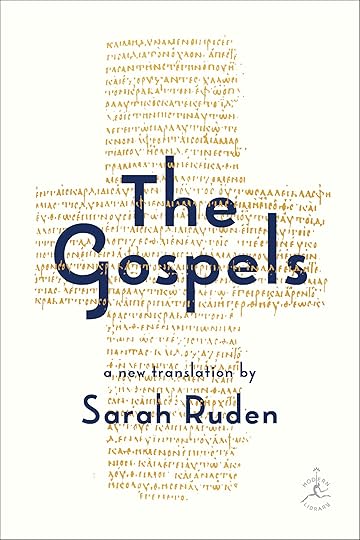
[Image: Book Cover]
Citation:
Ruden, S. (2021). The gospels: A new translation (eBook). Modern Library. https://sarahruden.com/the-gospels/
Ruden, S. (2021). The gospels: A new translation (audiobook). Tantor Audio. https://www.audible.com/pd/The-Gospel...
Title: The Gospels: A New Translation
Author(s): Sarah Ruden, translating the Koine Greek of the Novum Testamentum Graece (Greek New Testament) found in the Nestle-Aland 28th edition (2012), based on the original manuscripts (circa 70-110 AD), first published 382 AD
Year: 2021
Genre: Religion
Page count: 386 pages
Date(s) read: 1/27/25 - 2/1/25
Book 20 in 2025
***************************************************************************
[Image: Sarah Ruden]
Ruden herself is a Quaker. In the tradition of this oh-so-practical sect of Christianity, she has chosen to translate the Gospels much more “straightforwardly than is customary, to help people respond to the books on their own terms” (p. xiii). As such this book is less poetic than many other English versions. What it lacks in beauty is made up for in clarity, accuracy, and (surprisingly) humor:
“I have tried hard not to impose modern standards and styles on the Gospels, but to have respect for their original tones and shapes…I have found much more in the way of jokes, color, point, and cohesion in the Greek than in their standard English translations.” (p. xxxvii).
Perhaps the most important part of reading all the Gospels is to get an understanding of what Jesus was actually like. Yes, even he had a sense of humor at times. Most Christians only get bits and pieces of his teachings and actions, with sermons usually providing a distinct interpretation of his parables. As Ruden puts it:
“When Jesus introduces a story, analogy, or precept…he [often] sounds much more condescending or exasperated than, say, a Hebrew Bible prophet does in interlacing his poetic sermon with hinneh. But this difference suits who Jesus is. He is a ‘teacher,’ but often a short-tempered, contemptuous, and withholding one—not a prophet with a passion to persuade. Moreover, Jesus’ students seem to deserve this treatment, as they tend to be lazy, incurious, and distractible.” (p. xxxvi).
The Gospels: A New Translation makes clear just how strange these texts were and are. Jesus’ teachings were truly revolutionary during their day, a challenge to traditional Judaism and the Roman Empire that conquered most of the Western world. And it is a great mystery as to how and why these books were written in Koinē Greek in the first place. It was the most commonly used language in the massive empire, but Jesus and his core followers probably spoke Aramaic and had little education. Most of them were almost certainly illiterate. Yet “all the words attributed to them are…in a language they may never have voluntarily uttered, belonging to a cosmopolitan civilization they may well have despised” (p. xxii). Another mystery is why the Bible has four Gospels at all. Why not include only one for the sake of clarity? Or why stick to only four? Research indicates that there may have been more than fifty in the ancient world. We may never get these answers. But it is these mysteries that make the study of early Christianity so fascinating.
The Contents:
Epigraph (p. vi)
Introduction (p. ix)
A Discursive Glossary of Unfamiliar Word Choices (p. xl)
Unfamiliar Transliterations of Important Proper Names (p. lxiv)
The Good News According to Markos (p. lxix)
16 chapters
The Good News According to Maththaios (p. 65)
28 chapters
The Good News According to Loukas (p. 158)
24 chapters
The Good News According to Iōannēs (p. 258)
21 chapters
Dedication (p. 332)
***************************************************************************
[Image: Book Cover]
Citation:
Ruden, S. (2021). The gospels: A new translation (eBook). Modern Library. https://sarahruden.com/the-gospels/
Ruden, S. (2021). The gospels: A new translation (audiobook). Tantor Audio. https://www.audible.com/pd/The-Gospel...
Title: The Gospels: A New Translation
Author(s): Sarah Ruden, translating the Koine Greek of the Novum Testamentum Graece (Greek New Testament) found in the Nestle-Aland 28th edition (2012), based on the original manuscripts (circa 70-110 AD), first published 382 AD
Year: 2021
Genre: Religion
Page count: 386 pages
Date(s) read: 1/27/25 - 2/1/25
Book 20 in 2025
***************************************************************************

November 1, 2025
excellent translation, at least as far as I can tell with my sole comparator being the new oxford annotated. I also really liked the notes, but surely at some point any reader would get the point about the inclusive count of time.

June 5, 2021
Another way to read the gospels if you are so moved. Be sure to read the translator’s introduction. This will help you understand the approach she took. Having this understanding will also help in appreciating the work involved to translate.

October 4, 2021
Overview: A refreshing translation of the world’s most historic written Word; one which strives to capture through modern language the authentic impression and accessibility had by the original Greek texts on their contemporary audience.
Review:
“Many words are tainted by history. This makes it difficult to revive or change the concepts that correspond to those words. This seems not really fixable. Maybe a solution is to start from scratch: to create and use completely new languages.”*
I chanced upon this tweet during my reading of Ruden’s Gospels. Discarding the sardonic tone of futility attached to the quixotic recourse to “new languages”, I thought the sentiment touched aptly on that dilemma faced by translators the world and ages over; this dilemma is precisely that which qualifies Ruden's work as a necessary and stand-out edition to the copious list of translations of the world’s most translated, read, critiqued, and revered work; for in this case, the emphasis comes not so much in maintaining definition across languages, as maintaining connotation in language across the years.**
I find it ironic that these, my favorite literary stories of all time, are also among the most difficult for me to fluently read and comprehend at this stage of my life. Having read and encountered the Gospels repeatedly across numerous translations, languages, dialects, and underlying religious currents, it is a struggle to prevent the mind from wandering as it subconsciously finishes every chapter, parable, and verse within the same sequences of words encountered already millions of time. It is like walking through a familiar trail which no longer excites the senses like a novel environment, the likes of which conduce a familiar background letting your thoughts frolic inwardly. This is of course anathema to the intent of the religious Catholic turning to Scripture to renew his fount of passionate Grace.
The issue is made more complex for the cradle Christians who have grown up with copious exposure to a wealth of doctrinal Christian verbiage covering creeds, prayers, figures, proper names, and other nominal terms which denote parochial concepts whose definitions and usage are constrained to the authority of an established Church. These terms, picked up by the juvenile mind in a period of early Catechism, are henceforth stored within an ontological state of pre-consciousness; when invoked, such words and phrases as the Lord’s Prayer, the “Holy Spirit”, the figures of the Trinity, Feudal atavisms of “Lord” and “Servant”, proper English transliterations of Jesus, Mark, Luke, etc., all fail to register as novel, profound theological concepts, emotionally-connotative objects, or anything other than socio-cultural byproducts of a historical Christendom, utterly unrecognizable from the agricultural Judaic settlements inhabited by the Christ himself. In fact, most of us the aforementioned terms generally register no conscious significance whatsoever.
To think then, that the four Gospel book, which I and the Christian faithful value immeasurably as our spiritual fount, our portal to divinity, our authority on matters of faith, daily devotional, bed-side ritual and everlasting Good News; to think and admit that this same text, whose verses and imagery we can quote and invoke on command, are actually some of the most difficult translated texts to fluently comprehend - this is something we tend to oversee. It is unimaginable therefor to reconcile this notion with the fact that the Greek Gospel texts in themselves are of such accessibility that they universally are provided as beginner texts for students of secular Greek language courses.
Under the ineffable weight of the Bible’s vast importance, the Biblical translator, more than any other, heeds an obligation to produce the most “faithful translation.” Failure in this task means the risk of antagonizing ancient institutions and legions of their devout faithful. Ruden’s insight, however, intrepidly marks that this task need not be reduced to producing the most literally conservative transliteration, as is so often the case.
Under the yoke of strict, religious criticism, the dry, uninspired liturgical translations served up to the laiety, with their children of scholarly revisions and updated versions, have led us into the present age with: (1) antiquated and unintelligible texts repeating in rote the same exhausted phrases (stretched in modern tongue to near-meaningless), (2) recourse to conservative and meaningless transliterations of words and phrases (existing only as Sunday school jargon) , and (3) crafty digressions from the original text for doctrinal sake (at worst, choosing to gratuitously omit or make changes to words and verses to ensure adherence to some post-hoc theological position). A better way forward, as Ruden puts it, is to strive to convey the most faithful impression in those who read the Gospels as the simple Greek texts had on their original audience; for it is no small matter that these simple Greek texts were compelling and accessible enough in their content and literary style to ensure the prolific distribution and resulting establishment of the Gospels as the cornerstone of the World’s most historic and impactful institution.
I dare say that Ruden achieves this in my eyes, noting that this is the first version of the Gospels, and even the Bible, which I can sit down and read through as fluently and pleasantly as any ordinary book. At the same time, this is not some avant-garde literary revision of the original text, but an easement of the historic logos in modern tongue. To this end, Ruden displays no insignificant craft in stripping the text of overtly-liturgical post-hoc terms, culturally normative transliterations, proper noun capitalizations, verse segmentations, and pompous red-line augmentations - all anathemic to the content of the original Greek texts.
Likewise, Ruden brings the text to new life with a selection of novel and thought-provoking vocabulary (she provides context and justification for every significant change in word choice), which provide fresh perspective and considerably greater ease of access. These are dressed in a warm Serif font, syntactical outline, and publisher’s artistry which at first glance provides for a written work indistinguishable from that of an ordinary novel.
In spite of all these changes, the religious skeptic may yet hold their peace; for the good news is that one never loses sense of that familiar gravitas which inspires recognition and newfound love for the text in the understanding that this contribution is veritably another part of that most truth Account.
Time will only tell if Ruden’s work will be justified by its fruits; namely if reception of her Gospels will be able to strike a chord in our over-wrought, hyperanalytical, post-modern hearts, just as it did for the lost and weary diaspora on whom the texts of the Greek Logos descended as a life-changing Paraclete. Nonetheless, I can say merrily and with certainty that it had the not insignificant effect of bringing to new life that most treasured Good News that I cannot get enough of. I look forward to adding this English translation of the Gospels to the top of my list of personal Bibles, finding therein the cardinal virtues of faith, hope and love.
*tweet by @yeetgenstein
**the dilemma is thoroughly assayed in the book’s introduction, which is an interesting essay on biblical translation that stands on its own.
Review:
“Many words are tainted by history. This makes it difficult to revive or change the concepts that correspond to those words. This seems not really fixable. Maybe a solution is to start from scratch: to create and use completely new languages.”*
I chanced upon this tweet during my reading of Ruden’s Gospels. Discarding the sardonic tone of futility attached to the quixotic recourse to “new languages”, I thought the sentiment touched aptly on that dilemma faced by translators the world and ages over; this dilemma is precisely that which qualifies Ruden's work as a necessary and stand-out edition to the copious list of translations of the world’s most translated, read, critiqued, and revered work; for in this case, the emphasis comes not so much in maintaining definition across languages, as maintaining connotation in language across the years.**
I find it ironic that these, my favorite literary stories of all time, are also among the most difficult for me to fluently read and comprehend at this stage of my life. Having read and encountered the Gospels repeatedly across numerous translations, languages, dialects, and underlying religious currents, it is a struggle to prevent the mind from wandering as it subconsciously finishes every chapter, parable, and verse within the same sequences of words encountered already millions of time. It is like walking through a familiar trail which no longer excites the senses like a novel environment, the likes of which conduce a familiar background letting your thoughts frolic inwardly. This is of course anathema to the intent of the religious Catholic turning to Scripture to renew his fount of passionate Grace.
The issue is made more complex for the cradle Christians who have grown up with copious exposure to a wealth of doctrinal Christian verbiage covering creeds, prayers, figures, proper names, and other nominal terms which denote parochial concepts whose definitions and usage are constrained to the authority of an established Church. These terms, picked up by the juvenile mind in a period of early Catechism, are henceforth stored within an ontological state of pre-consciousness; when invoked, such words and phrases as the Lord’s Prayer, the “Holy Spirit”, the figures of the Trinity, Feudal atavisms of “Lord” and “Servant”, proper English transliterations of Jesus, Mark, Luke, etc., all fail to register as novel, profound theological concepts, emotionally-connotative objects, or anything other than socio-cultural byproducts of a historical Christendom, utterly unrecognizable from the agricultural Judaic settlements inhabited by the Christ himself. In fact, most of us the aforementioned terms generally register no conscious significance whatsoever.
To think then, that the four Gospel book, which I and the Christian faithful value immeasurably as our spiritual fount, our portal to divinity, our authority on matters of faith, daily devotional, bed-side ritual and everlasting Good News; to think and admit that this same text, whose verses and imagery we can quote and invoke on command, are actually some of the most difficult translated texts to fluently comprehend - this is something we tend to oversee. It is unimaginable therefor to reconcile this notion with the fact that the Greek Gospel texts in themselves are of such accessibility that they universally are provided as beginner texts for students of secular Greek language courses.
Under the ineffable weight of the Bible’s vast importance, the Biblical translator, more than any other, heeds an obligation to produce the most “faithful translation.” Failure in this task means the risk of antagonizing ancient institutions and legions of their devout faithful. Ruden’s insight, however, intrepidly marks that this task need not be reduced to producing the most literally conservative transliteration, as is so often the case.
Under the yoke of strict, religious criticism, the dry, uninspired liturgical translations served up to the laiety, with their children of scholarly revisions and updated versions, have led us into the present age with: (1) antiquated and unintelligible texts repeating in rote the same exhausted phrases (stretched in modern tongue to near-meaningless), (2) recourse to conservative and meaningless transliterations of words and phrases (existing only as Sunday school jargon) , and (3) crafty digressions from the original text for doctrinal sake (at worst, choosing to gratuitously omit or make changes to words and verses to ensure adherence to some post-hoc theological position). A better way forward, as Ruden puts it, is to strive to convey the most faithful impression in those who read the Gospels as the simple Greek texts had on their original audience; for it is no small matter that these simple Greek texts were compelling and accessible enough in their content and literary style to ensure the prolific distribution and resulting establishment of the Gospels as the cornerstone of the World’s most historic and impactful institution.
I dare say that Ruden achieves this in my eyes, noting that this is the first version of the Gospels, and even the Bible, which I can sit down and read through as fluently and pleasantly as any ordinary book. At the same time, this is not some avant-garde literary revision of the original text, but an easement of the historic logos in modern tongue. To this end, Ruden displays no insignificant craft in stripping the text of overtly-liturgical post-hoc terms, culturally normative transliterations, proper noun capitalizations, verse segmentations, and pompous red-line augmentations - all anathemic to the content of the original Greek texts.
Likewise, Ruden brings the text to new life with a selection of novel and thought-provoking vocabulary (she provides context and justification for every significant change in word choice), which provide fresh perspective and considerably greater ease of access. These are dressed in a warm Serif font, syntactical outline, and publisher’s artistry which at first glance provides for a written work indistinguishable from that of an ordinary novel.
In spite of all these changes, the religious skeptic may yet hold their peace; for the good news is that one never loses sense of that familiar gravitas which inspires recognition and newfound love for the text in the understanding that this contribution is veritably another part of that most truth Account.
Time will only tell if Ruden’s work will be justified by its fruits; namely if reception of her Gospels will be able to strike a chord in our over-wrought, hyperanalytical, post-modern hearts, just as it did for the lost and weary diaspora on whom the texts of the Greek Logos descended as a life-changing Paraclete. Nonetheless, I can say merrily and with certainty that it had the not insignificant effect of bringing to new life that most treasured Good News that I cannot get enough of. I look forward to adding this English translation of the Gospels to the top of my list of personal Bibles, finding therein the cardinal virtues of faith, hope and love.
*tweet by @yeetgenstein
**the dilemma is thoroughly assayed in the book’s introduction, which is an interesting essay on biblical translation that stands on its own.

March 25, 2024
While I would give the pristine and pure Gospels five glorious stars, I can only give this particular translation three stars out of five. While I respect the translation work of Classicist Sarah Ruden overall, especially her translation of Augustine of Hippo's Confessions, I found her translation of the Gospels to be awkward and even annoying. While she admits that she strove to make the translation unfamiliar—especially in regards to using the original Greek and non-Anglicized names, it just didn't work for me. I found the fact that the word "God" was always in lowercase whether it was referring to the One True God or a false god to be very off-putting. Sure, I get that the Greek letters in New Testament manuscripts don't have upper and lower case, but they also don't have a whole host of other grammatical features that the translator did, indeed, use throughout the text. So why focus on the one grammatical nuance that can come across as unbecoming and even be seen as irreverent? One wonders. On top of that, the notes at the bottom of each pages do not add much value and it some cases seemed to be rooted in the mindset of modern academia rather than firm faith. Being that these notes regularly contained undue speculation, even egregious skepticism, I didn't find their presence refreshing, much less beneficial or informative. All of this was, no doubt, a big turn off for me. Working through this translation was a long, hard slog and I'm happy that it is now over so that I can return to reading more faithful translations—and working and aspiring towards the day where I can read and understand the Gospels in their original Greek.

July 25, 2021
A fun translation of a familiar story. Some things caught my eye, while others raised my eyebrows.

July 7, 2021
This new hip translation of the Gospels is fascinating to read, though not very smooth or mellifluous. Be sure to read the very full introduction -- it reminds me of one of my favorite graduate courses "The Science of Linguistics & the Art of Translation". Indeed, translating the Gospels is certainly an art. This author has the credentials and scholarly reference points to back up her textual choices, and it certainly provides a Fresh look at these very old scrolls. It is exciting to feel that her translation more closely matches the sense of immediacy felt by the first readers/listeners. Her decision to keep the names in transliterated Greek is cute at first, but quickly bogs down the reading. After all, the first listeners did not have to mentally translate the names at each point, why should we?
I particularly liked the use of terms and notes referencing the politeness-levels of various pronouns or slang. This is a good study for anybody interested in the gospels.
I particularly liked the use of terms and notes referencing the politeness-levels of various pronouns or slang. This is a good study for anybody interested in the gospels.

July 12, 2024
this was totally worth it for the translator's note and glossary. I liked the explanations of word choices in modern English that reflected the relationship/context/tone of the original Koine Greek (eg "do what you came for, pal." and "look at this guy!" My only complaint is that the footnotes (of which there are legion) are kinda clunky on the kindle. A footnote would refer you back to a previous note, but no link to directly go there and you'd have to navigate the table of contents. But yet every. single. time. there was a mention of "three days" the note would spell out that, in the timekeeping customs of the day, it wasn't three literal full days. Yes, I got that the first time. But overall this was a great way to experience the Gospels in a new way, and I'd love to do a Bible study with this text in the future.

April 21, 2022
Quite a notable project—a translation of the gospels by someone who is more a scholar of ancient literature than theology, and one who wants to bring over into English a feeling for how the texts might have sounded to their earliest readers. Pilate says, for example, “Look at this guy!” instead of the stately “Behold the man!” and in a few places Jesus calls someone “pal”. If occasionally her acceptance of the historicity of parts of the text seem naive, in other places her commentary is quite pointed- the ludicrousness, for example, that Judas could have come to the garden of Gethsemane leading Roman soldiers.

January 8, 2023
Intrusive footnotes

October 21, 2024
The Gospels, like most of the Bible, are pretty mysterious. They are the primary source for understanding the life and ministry of Jesus Christ, but we don't really know who wrote any of them. I.e. they aren't written by Matthew, Mark, Luke, and John, but rather they are the "good news" according to Matthew, Mark, Luke, and John. It also isn't entirely clear who Matthew, Mark, Luke and John actually were, though we have some decent guesses. A lot of their accounts align but sometimes they don't. All of them appear to have been composed well after Christ's crucifixion -- Mark around 70 AD; John around 110 AD; and Matthew and Luke in the middle between 80 and 90 AD.
Sarah Ruden sails headfirst into all that ambiguity, and in this new translation, gives us "novelistic" Gospels that are both more readable and possibly more in tune with the original text. Rather than the lofty language of KJV, Ruden's translation gives us the inflection, wordplay, and even some humor, and plentiful little footnotes that give historical context and call out fun allusions to Old Testament texts. All the proper nouns are transliterated from the original Greek (e.g. Jesus is Iesous; Moses is Mouses; Elijah is Elias...) which takes you out of your usual head space and somehow draws you closer to that very foreign, distant world.
Mark (70 AD) is the oldest and probably the weirdest gospel. Jesus speaks mainly in allegory, is extremely protective of his identity and really does not want the word getting out about his miracle-making. Every chapter seems to conclude with Jesus giving a "stern warning" to not speak of him as son of God. There is not much reference back to the Old Testament texts that predict a Jewish messiah (e.g. Isaiah, various Psalms).
Contrast this with e.g. Matthew and Luke (80-90 AD) which really carefully match Jesus up with Jewish prophecy and take care to explain what parts of Jewish law are being overturned and why. Matthew has a scholarly flavor to it and is my favorite gospel personally. These later two add in some more explicit moral teaching as well, e.g. the Sermon on the Mount. This all seems more expressly oriented towards conversion and cementing Jesus as next in a line with the prophets Moses and Elijah.
Then contrast this with the muscular and even aggressive gospel of John (110 AD). Jesus is far more confrontational through the entire gospel with the Pharisees, frequently and outwardly claiming to be the son of God, and predicting the ruin of those who don't follow him. Perhaps this was an easier story to tell now that the Pharisaic leadership had, in fact, led Judea to utter ruin at the hands of the Romans (~73 AD) and the presumed audience had a few decades to feel its impact.
Seeing the gospels rendered as novel lays bare how discontinuous the storytelling is. There isn't a lot of rhyme or reason to the travels of Jesus and his apostles. People jump in and out of the narrative. It's goofy and leaves room for centuries of interpretation and interpolation.
----------
My favorite scene (that I hadn't noticed until reading this translation) is one that occurs only in Mark (14:51-52). When Jesus is being arrested, a young boy in a linen cloth clings to Jesus. When all the apostles have abandoned him and the Sanhedrin, armed thugs, etc draw near, the boy is Jesus's last friend. Finally, at the last moment, he scampers away naked, abandoning his linen cloth. Who is this streaker boy? What does this mean? Why did someone put this in the gospel? There's a lifetime of mystery in these ancient books.
Sarah Ruden sails headfirst into all that ambiguity, and in this new translation, gives us "novelistic" Gospels that are both more readable and possibly more in tune with the original text. Rather than the lofty language of KJV, Ruden's translation gives us the inflection, wordplay, and even some humor, and plentiful little footnotes that give historical context and call out fun allusions to Old Testament texts. All the proper nouns are transliterated from the original Greek (e.g. Jesus is Iesous; Moses is Mouses; Elijah is Elias...) which takes you out of your usual head space and somehow draws you closer to that very foreign, distant world.
Mark (70 AD) is the oldest and probably the weirdest gospel. Jesus speaks mainly in allegory, is extremely protective of his identity and really does not want the word getting out about his miracle-making. Every chapter seems to conclude with Jesus giving a "stern warning" to not speak of him as son of God. There is not much reference back to the Old Testament texts that predict a Jewish messiah (e.g. Isaiah, various Psalms).
Contrast this with e.g. Matthew and Luke (80-90 AD) which really carefully match Jesus up with Jewish prophecy and take care to explain what parts of Jewish law are being overturned and why. Matthew has a scholarly flavor to it and is my favorite gospel personally. These later two add in some more explicit moral teaching as well, e.g. the Sermon on the Mount. This all seems more expressly oriented towards conversion and cementing Jesus as next in a line with the prophets Moses and Elijah.
Then contrast this with the muscular and even aggressive gospel of John (110 AD). Jesus is far more confrontational through the entire gospel with the Pharisees, frequently and outwardly claiming to be the son of God, and predicting the ruin of those who don't follow him. Perhaps this was an easier story to tell now that the Pharisaic leadership had, in fact, led Judea to utter ruin at the hands of the Romans (~73 AD) and the presumed audience had a few decades to feel its impact.
Seeing the gospels rendered as novel lays bare how discontinuous the storytelling is. There isn't a lot of rhyme or reason to the travels of Jesus and his apostles. People jump in and out of the narrative. It's goofy and leaves room for centuries of interpretation and interpolation.
----------
My favorite scene (that I hadn't noticed until reading this translation) is one that occurs only in Mark (14:51-52). When Jesus is being arrested, a young boy in a linen cloth clings to Jesus. When all the apostles have abandoned him and the Sanhedrin, armed thugs, etc draw near, the boy is Jesus's last friend. Finally, at the last moment, he scampers away naked, abandoning his linen cloth. Who is this streaker boy? What does this mean? Why did someone put this in the gospel? There's a lifetime of mystery in these ancient books.

April 1, 2023
For this Lent, I resolved to read this new translations of the four canonical Gospels of Jesus of Nazareth as rendered by the Quaker scholar/translator of ancient languages, Ms. Sarah Ruden.
Although I am quite familiar with the Gospels, as one who has studied the daily lectionary texts for the Catholic eucharistic ceremony for 50 years, it has been rather rare for me to take the time to read any one of them all the way through at one sitting. Doing so reintroduces one to the "forest" rather than the individual "trees" of individual parables and teachings found in brief excerpts. I found this experience in itself quite interesting!
And I -- for the most part -- laud Ms. Ruden's translations as generally "freshening up" texts to which many of us have been accustomed and, therefore, perhaps less attentive than we were conscious of. In her very interesting introduction, she writes about how her intent was to render these old, albeit much-copied and, therefore, sometimes altered texts, in a way that would be as close as she could make it to the way they would have "sounded" to the people in Jesus' time.
For the most part, I think she has succeeded in this effort; the language is a tad plainer -- instead of using "behold," for example, she substitutes the simple but direct "look!" -- and possessed of the kind of speaking rhythm and artistry that someone hoping to hold the attention of a jostling crowd might use.
My only reservation is how she has chosen to render some personal and place names -- such as those for the evangelists and places like Judea and Jerusalem -- in altered forms that forced me to somewhat intrusively remember that "oh, here she means Jerusalem" or "according to Mark." Unlike altered words in parables and teachings that help to make more clear what Jesus might actually have been saying or referring to, these personal and place name alterations serve to, at least for me, get in the way of the flow.
This is a decidedly minor gripe, however, as she really does succeed in offering us fresh takes on texts that remain important and, with respect to desired as opposed to actual human behavior, jarring.
Although I am quite familiar with the Gospels, as one who has studied the daily lectionary texts for the Catholic eucharistic ceremony for 50 years, it has been rather rare for me to take the time to read any one of them all the way through at one sitting. Doing so reintroduces one to the "forest" rather than the individual "trees" of individual parables and teachings found in brief excerpts. I found this experience in itself quite interesting!
And I -- for the most part -- laud Ms. Ruden's translations as generally "freshening up" texts to which many of us have been accustomed and, therefore, perhaps less attentive than we were conscious of. In her very interesting introduction, she writes about how her intent was to render these old, albeit much-copied and, therefore, sometimes altered texts, in a way that would be as close as she could make it to the way they would have "sounded" to the people in Jesus' time.
For the most part, I think she has succeeded in this effort; the language is a tad plainer -- instead of using "behold," for example, she substitutes the simple but direct "look!" -- and possessed of the kind of speaking rhythm and artistry that someone hoping to hold the attention of a jostling crowd might use.
My only reservation is how she has chosen to render some personal and place names -- such as those for the evangelists and places like Judea and Jerusalem -- in altered forms that forced me to somewhat intrusively remember that "oh, here she means Jerusalem" or "according to Mark." Unlike altered words in parables and teachings that help to make more clear what Jesus might actually have been saying or referring to, these personal and place name alterations serve to, at least for me, get in the way of the flow.
This is a decidedly minor gripe, however, as she really does succeed in offering us fresh takes on texts that remain important and, with respect to desired as opposed to actual human behavior, jarring.

October 8, 2023
five stars for the translation - it seems pointless to assign a number rating to the gospels themselves, which contain whole universes of wisdom but are also intensely weird and fudged human documents and also four largely repeating and quite austere narrative) of the time a guy went around giving people unsolicited advice in the form of stories. this continues to mixed results until eventually the authorities arrange for him to be nailed to a tree and that's the end, until he walks out of his tomb and resumes giving advice (and in the gospel according to john he arranges for snacks to be distributed).
ruden's translation and the note apparatus. ruden is brave, in a real way, to take words that have been worn into fussiness by thousands of years of use and abuse and make them new and surprising. jesus uses the term "little doggies" and in general ruden shows you her work and when she can't quite nail something to her satisfaction she just tells you in the notes about the greek wordplay happening that her english can't bring across. despite my loving god and my loving jesus, i am not much for theology, so i'll leave the counting angels to yall and just say that this creased my wig a fair ways and i think i'll read more sarah ruden translations/writings now thank you
ruden's translation and the note apparatus. ruden is brave, in a real way, to take words that have been worn into fussiness by thousands of years of use and abuse and make them new and surprising. jesus uses the term "little doggies" and in general ruden shows you her work and when she can't quite nail something to her satisfaction she just tells you in the notes about the greek wordplay happening that her english can't bring across. despite my loving god and my loving jesus, i am not much for theology, so i'll leave the counting angels to yall and just say that this creased my wig a fair ways and i think i'll read more sarah ruden translations/writings now thank you

October 1, 2025
Stripped of two millennia of buffing and sanitizing and mythologizing, and translated directly from the Koine Greek in which they were originally committed to writing rather than from translations of translations of translations, the Gospels of Mark, Matthew, Luke, and John turn out to be a hell of a read. Ruben does an outstanding job of cutting to the heart of what these stories must’ve meant to their original readers nearly two thousand years ago, and her rendering captures the humor, the wordplay, and the rough poetry that’s been sanded off and censored out of Jesus’ story over the centuries. Even her choice to stick as closely as possible to the names of people and places, and the original meanings of Christian concepts, is a breath of fresh air - I much prefer Iesous and the life-breath to Jesus and the Holy Spirit. A must-read for anyone interested in why the story of Jesus of Nazareth ever got the traction to outlive other tales of other saviors of mankind.

January 13, 2022
Any time a translation causes me feel like I'm seeing for the first time something I've read a lot, I count that as a win. Ruden's translation intentionally almost never uses word choices that are theologically "loaded" -- this can lead to a little awkward-sounding language at times, but it really was like reading the gospels for the first time. The balance of colloquial language mixed with non-Anglicized names was jarring at times and took getting used to.
An example of all of this in one: Matthew 5:1-3
Seeing the crowds, Iēsous climbed up the mountain. Once he'd taken a seat there, his students came up to him, and he opened his mouth to speak and taught them, saying,
"Happy are those destitute in the life-breath,
because theirs is the kingdom of the skies."
The intro does a good job of explaining her methodology and some of the major translation/word choices she made.
An example of all of this in one: Matthew 5:1-3
Seeing the crowds, Iēsous climbed up the mountain. Once he'd taken a seat there, his students came up to him, and he opened his mouth to speak and taught them, saying,
"Happy are those destitute in the life-breath,
because theirs is the kingdom of the skies."
The intro does a good job of explaining her methodology and some of the major translation/word choices she made.
Displaying 1 - 30 of 62 reviews