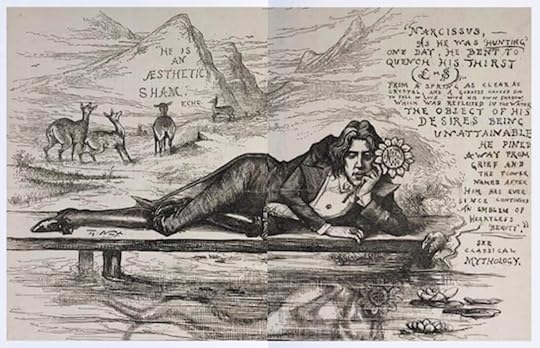
Oscar Fingal O'Fflahertie Wills Wilde was an Irish poet and playwright. After writing in different forms throughout the 1880s, he became one of the most popular playwrights in London in the early 1890s. He is best remembered for his epigrams and plays, his novel The Picture of Dorian Gray, and his criminal conviction for gross indecency for homosexual acts. Wilde's parents were Anglo-Irish intellectuals in Dublin. In his youth, Wilde learned to speak fluent French and German. At university, he read Greats; he demonstrated himself to be an exceptional classicist, first at Trinity College Dublin, then at Magdalen College, Oxford. He became associated with the emerging philosophy of aestheticism, led by two of his tutors, Walter Pater and John Ruskin. After university, Wilde moved to London into fashionable cultural and social circles. Wilde tried his hand at various literary activities: he wrote a play, published a book of poems, lectured in the United States and Canada on "The English Renaissance" in art and interior decoration, and then returned to London where he lectured on his American travels and wrote reviews for various periodicals. Known for his biting wit, flamboyant dress and glittering conversational skill, Wilde became one of the best-known personalities of his day. At the turn of the 1890s, he refined his ideas about the supremacy of art in a series of dialogues and essays, and incorporated themes of decadence, duplicity, and beauty into what would be his only novel, The Picture of Dorian Gray (1890). Wilde returned to drama, writing Salome (1891) in French while in Paris, but it was refused a licence for England due to an absolute prohibition on the portrayal of Biblical subjects on the English stage. Undiscouraged, Wilde produced four society comedies in the early 1890s, which made him one of the most successful playwrights of late-Victorian London. At the height of his fame and success, while An Ideal Husband (1895) and The Importance of Being Earnest (1895) were still being performed in London, Wilde issued a civil writ against John Sholto Douglas, the 9th Marquess of Queensberry for criminal libel. The Marquess was the father of Wilde's lover, Lord Alfred Douglas. The libel hearings unearthed evidence that caused Wilde to drop his charges and led to his own arrest and criminal prosecution for gross indecency with other males. The jury was unable to reach a verdict and so a retrial was ordered. In the second trial Wilde was convicted and sentenced to two years' hard labour, the maximum penalty, and was jailed from 1895 to 1897. During his last year in prison he wrote De Profundis (published posthumously in abridged form in 1905), a long letter that discusses his spiritual journey through his trials and is a dark counterpoint to his earlier philosophy of pleasure. On the day of his release, he caught the overnight steamer to France, never to return to Britain or Ireland. In France and Italy, he wrote his last work, The Ballad of Reading Gaol (1898), a long poem commemorating the harsh rhythms of prison life.
The Disciple is Wilde's clever poem told from the pool's point of view while Narcissus gazes lovingly at his reflection. It was published as a collection of six prose poems in 1894 in The Fortnightly Review.
The poem is short and clever and here how it goes
When Narcissus died the pool of his pleasure changed from a cup of sweet waters into a cup of salt tears, and the Oreads came weeping through the woodland that they might sing to the pool and give it comfort.
And when they saw that the pool had changed from a cup of sweet waters into a cup of salt tears, they loosened the green tresses of their hair and cried to the pool and said, `We do not wonder that you should mourn in this manner for Narcissus, so beautiful was he.'
`But was Narcissus beautiful?' said the pool.
`Who should know that better than you?' answered the Oreads. `Us did he ever pass by, but you he sought for, and would lie on your banks and look down at you, and in the mirror of your waters he would mirror his own beauty.'
And the pool answered, `But I loved Narcissus because, as he lay on my banks and looked down at me, in the mirror of his eyes I saw ever my own beauty mirrored.'
A very short story of the myth of Narcissus, but from the point of view of the pool that he looked into. I give it 3 stars because I think the idea is not developed to its full potential.
It could show more more the pool's point of view; what it feels like to be gazed into, the slow awakening of learning what your reflection is and realizing how beautiful it is, how the pool can only see it's reflection when Narcissus comes around. It could have been a story of emerging consciousness, when an inanimate object learns to be animate by observing Narcissus.
It could have had metaphorical weight, as metaphor for the realization that you are beautiful. I think as humans we know if we are attractive/beautiful/high status/powerful often not by looking directly at ourselves, but by looking at our effect on others, seeing how people respond to us, much like looking at a reflective surface tells us about us. None of this is implied in the story, these are my own ideas for what the story could have implied.
The process of the pool (the discipline) learning from Narcissus is summarized in a single sentence at end the story. It’s unfulfilling.
Honestly my favourite poem in prose by him. Loved that it was greek mythology and not christian (partially sorry). Also: The personification of the "mirror", how the action of Narcissus turned the pool into something mourning as a side effect + the turning point/ switching sides moment >>>>>>
10 lignes pour compléter mon reading challenge... 😬
And the pool answered, `But I loved Narcissus because, as he lay on my banks and looked down at me, in the mirror of his eyes I saw ever my own beauty mirrored.'
Me gusta, pero por qué me gusta la poesía, creo que es un poema clásico y que tiene mucha belleza en sus interior, me gusta, aunque me confundí un poco con lo de las copas pero ❤️
Summary: After Narcissus dies, the personified pool into which he often gazed at himself turns to a salt pool and makes a surprising revelation to some nymphs.
"But I loved Narcissus because, as he lay on my banks and looked down on me, in the mirror of his eyes I saw ever my own beauty mirrored." Oscar Wilde, The Disciple
I just read this for the first time a few weeks ago but couldn't find it on here at first. This is because it was under another name in a book of short stories.
I found it again because it is quoted in the beginning of "The Alchemist" which I'm reading now.
It's a very short poetic story of Echo and Narcissus.
Only it is told from the sparkling and melancholy perspective of the lake that Narcisssus gazed into.
So beautiful. Not to be missed, particularly if you adore Greek Mythology, as I do.