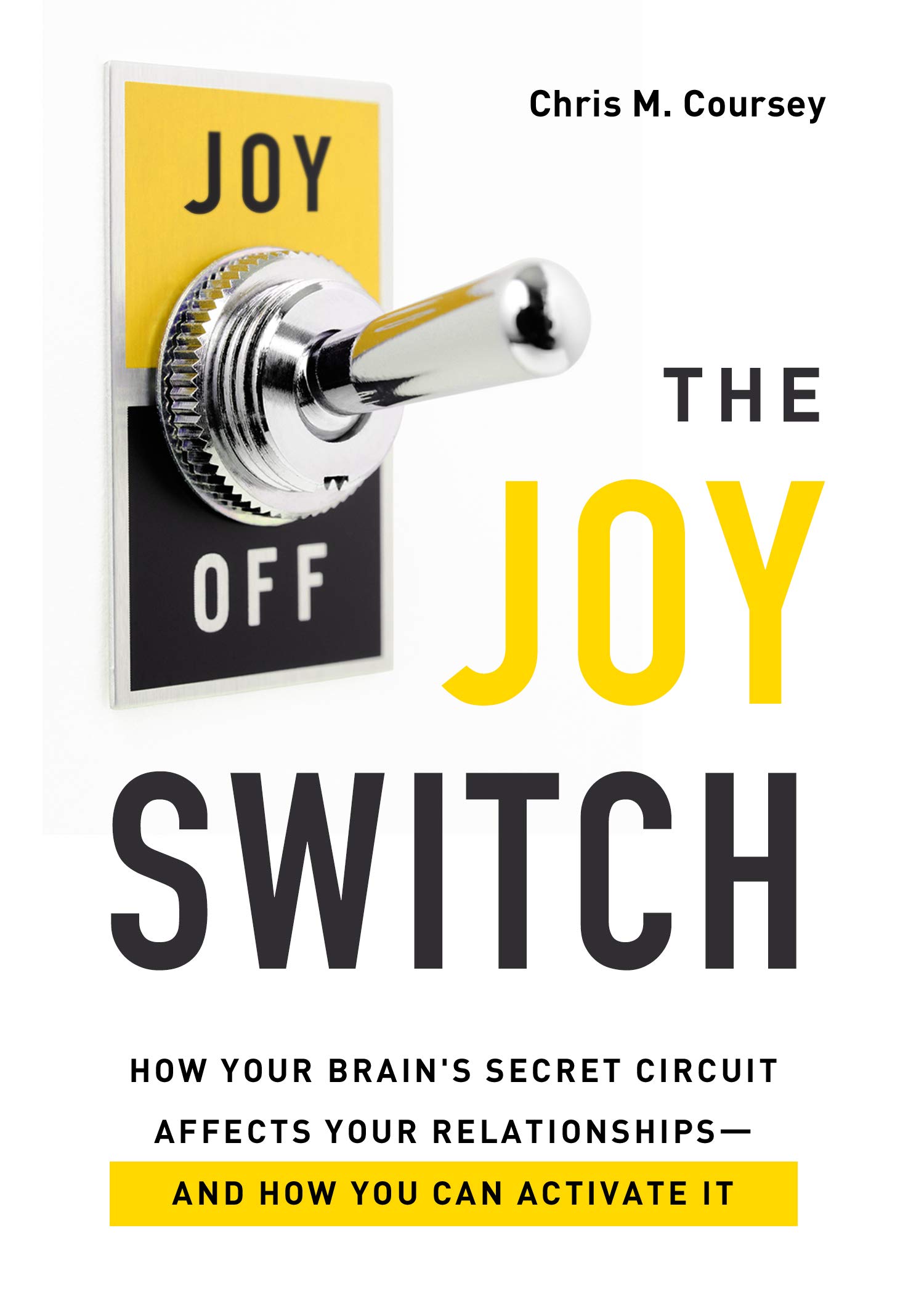
Why do we sometimes feel more connected in our relationships than at other times? Perhaps you sometimes find it easy and exciting to spend time with your loved ones—but sometimes, especially when things don’t go according to plan, you feel incapable of connecting in conversations. You then feel distant from those you love most. What if the answer to remaining connected in relationships has been right under your nose—or, rather, right inside your head all along?
Discover the simple switch in your brain that activates—or deactivates—what you most need for relational joy. In The Joy Switch, learn how the simple flip of this brain switch either enables you to remain present for those around you or causes you to become overwhelmed—and ultimately inhibited from being your best self—when problems arise. You’ll learn how to maximize your relational brain, how to recognize when your brain’s joy switch is flipped, and how to take steps to restore your relational sweet-spot. This book will help you love others and remain fully connected with yourself while being the best version of who you were made to be.
I plan to recommend this book to all my therapy clients.
I am always looking for resources for my clients to improve their outcomes in therapy. This is one of the best books I have read about what is going on in the brain and how that influences relational interactions. Even better, it goes beyond simply educating people. There are lots of anecdotal examples that clarify the information presented in the book. Unlike many books that inform and educate, this one includes practical application and specific exercises and activities that enable the reader to put this to work in their life immediately.
Anyone can take what they read and make substantial changes. Couples and apply this material to their relationships and see immediate improvement. Even young children can learn these principles and be empowered to make better choices. Everyone needs this book.
Finally, a book that explains exactly what happens when things go wrong relationally and what to do about it! Not only is Chris Coursey a masterful storyteller, but he weaves brain science, spiritual truth and practical reality together in such a craftful way, I found myself convicted, yet laughing at my own flaws and joyfully receiving truth around how to show up more relationally in all areas of my life. A leadership must! The Joy Switch is an essential read for anyone and everyone who wants live a more effective and emotionally connected life. The very simple and practical tools outlined in this book have the power to stop wars, end divorce, and trauma-proof our children! Thank you, Chris, for this incredible gift to the world!”
We read this book this fall in Bible study, which is why it took me so long to finish it. Honestly, I didn't love it and would have rated it 2/5 if it were not for the last chapter on God's peace, which was by far the best chapter. I thought Coursey had a half-developed idea that he never fully explained or supported with Scripture or scientific evidence. Reading the book felt like listening to someone selling me "magic beans" or a version of Christianity lite, if you will. He had some great points about life and how we respond emotionally to different situations, but the overall point he was making was weak. The acronyms felt condescending, and there were a few chapters that bothered me as an introvert.
I’ve been paying attention to what brings me joy and what drains me. The Joy Switch tells me what’s going on in both cases and, most important, how to get back to joy quickly. The author's storytelling provides relatable and memorable examples of how The Joy Switch works. I especially love the end of chapter exercises that offer ways to practice recognizing joy leakages and quickly repair them.
The concepts and practices make sense and give practical ways to be the person God created me to be. Knowing how to turn on my joy switch helps me remain more consistently relational, creative, and flexible. As a member of The Joy Switch launch team, I am grateful to have previewed the book. The concept of how ‘expecting joy’ turns on my joy switch has changed my anticipation of the coming year.
It’s an excellent, easy-to-read, self help book regarding joy in the life of a person. It can help the reader recognize poor habits, unmet needs, disordered thinking, to name a few. It gives wisdom and practical tools to develop new habits and thus become for joyful. (Hopefully)😉
It was an interesting read, and helpful. I feel like it could've been a bit shorter, and for the first couple of chapters it just kinda felt he was repeating himself, I kinda had deja vu, but I'm definitely glad I read it, and it was the right read at the right time
"No matter how good our intentions or how strong our willpower, we are no match for unregulated feelings. We all reach a tipping point. Our ability to manage what we feel sets the limits on our enjoyment of life and relationships" (11).
"We used to think transformation happens with more information, better communication, and good choices. We now know there are actual areas in our brain that respond to specific ingredients found only by interaction with other humans--joyful responses when someone is glad to see us, examples that show us how to handle hardship, a person who helps us rest, and more" (19).
"Joy is glad-to-be-togetherness, where we light up to see others and they light up to see us...This exchange is more of a reflex than a choice or decision of the will" (30).
"The goal is not to avoid a relational shutdown. Rather, we want to recognize, then repair the disruption of our brain's relational circuit" (39).
Four indicators of an engaged relational circuit (CAKE): Curiosity, Appreciation, Kindness, Eye Contact
Four habits to help us return to relational mode (CARS): Connection, Appreciation, Rest, Shalom My Body
"one of the greatest threats to a working relational circuit is feeling alone. We will inevitably feel alone when people try to fix our pain instead of listening, validating, and sharing our distress...People do not need us to fix their distress. Rather, people need to feel connected so they become relational" (81).
Roadblocks to staying relational: 1. Threats to self: things that cause us to fight, flee, or freeze 2. Unprocessed pain: "Overreactions in the present are often connected to past pain that keeps us in enemy mode" (95). 3. Loss: "Our relational circuit is more likely to stay on during distress when we have people who are glad to be with us" (97). 4. Physical needs: sometimes we just need a snack or a nap 5. Missing relational skills: i.e., "skills to keep relationships bigger than problems" (98).
"Remembering and feeling appreciation activates our relational circuit...Opening 'joy files' by thinking about the good stuff starts a chain reaction in our brain and body where we respond as though we are reliving the moment all over again. Our sadness turns to joy! The brain trained on appreciation and gratitude will search the environment for good things to enjoy, while the untrained brain will look for things to criticize and complain about" (101-2).
"Research shows when we have our phones close to us, even when we are not using the phone, our cognitive capacity is diminished" (117).
"Many parents make the classic mistake of using timeout or isolation in the bedroom as a punishment to modify behaviors...Instead, try relational rest" (119).
"Enemy mode is our brain's way of avoiding what causes pain. We rely on fear to get results" (129).
"Peace comes when we know we are not alone with our feelings and that how we feel makes sense for the situation we face" (130).
PEACE Check: Pay attention to my body Evaluate my breathing Attention and focus Calm or busy thoughts Easing muscle tension
"When we first seek God's peace from a relational place, we start our prayer times thinking about all that is good instead of starting with the focus on pain and problems" (141).
"Trying to force a moment with God only activates enemy mode because the pressure knocks us out of relational mode as fears pop up. If peace is God's signature, then fear is the weed that grows when peace is missing" (146).
I bought this book after attending a free Thrive webinar. What Coursey brings to the table is an easy to read explanation of how to keep all parts of our brain open when all it wants to do is to shut down in the midst of unhappiness, sadness, fear, anger, etc. Keeping that same metaphor or analogy, I was hoping the table was going to include the 19 relational skills (it does not; the reader will be pointed back to the Thrive website). The book does include practices (so some good healthy food at the table) of which I was hoping for a bit more. On this same table I wish I had Paul Hollywood and Mary Berry along to say that there were a lot of repeated elements in Coursey's showstopper. In other words, I felt an editor with a bit stronger editing pen could have deleted some of the repeated sentences.
The book feels rushed (dare I say that Coursey doesn't seem to have been given enough time to accomplish this showstopper), and, yet, I'm glad a friend passed along to me the link to the webinar, and I'm glad I bought the book. I plan on looking other researchers Coursey includes in the notes. Coursey keeps the specific scientific brain details to two pages which my family members like. I, on the other hand, like to read about brain research.
I would like to see in future editions the following: sentences not repeated, less exclamation marks (or sentences that feel like Coursey really wanted to have included an exclamation mark -- and this is coming from someone who does like to use exclamation marks so I understand the desire), more practices, and the inclusion of material which is mentioned (like the 19 relational skills). To mention something but then expect the reader to go to the website makes the reader feel like the book was written for commercial purposes. To keep my analogy: it feels as if the host says a really great Pavlova would be excellent with this meal. Go to such and such a bakery and buy it.
Eek. Please have your joy switch on, Chris Coursey, if you are reading this. I truly believe this is great material.
This book has many connections to Escaping Enemy Mode: How Our Brains Unite or Divide Us by Jim Wilder and Ray Woolridge. That's not surprising since it becomes clear Coursey and Wilder are friends. It is, however, interesting to note the differences in terminology and definitions: Wilder and Woolridge divide enemy mode into three categories - simple, stupid and intelligent. Coursey, on the other hand, divides enemy mode into two categories - simple and predatory. In his schema, stupid enemy mode is a sub-category of simple enemy mode.
"Narcissism is a lot like toxic mold flourishing in our basement, contaminating the air we breathe. Narcissism, the inability to shift out of enemy mode and process shame, robs joy and keeps people stuck in enemy mode." (p34)
"Any kind of correction without people s(p56)haring our experiences with us is not restorative. (p56)
Roadblocks to restoring relationship include threats to self, unprocessed pain, loss, physical needs, and missing relational skills.
When we are stuck in enemy mode, we are guided by fear. It is our brain's way of avoiding pain... we avoid speaking out because we fear the reaction. A narcissist cannot process shame. (p129)
The presence of peace is a good indicator our relational circuits are working. (p130)
Peace check: Pay attention to my body. Evaluate my breathing. Attention and focus. Calm or busy thoughts. Easing muscle tension.
CARS: Connection Appreciation Rest Shalom my body.
The Joy Switch How Your Brain's Secret Circuit Affects Your Relationships--And How You Can Activate It by Chris M. Coursey Moody Publishers Northfield Publishing Christian Pub Date 05 Jan 2021
I am reviewing a copy of Joy Switch through Moody Publishers/Northfield Publishing and Netgalley:
Life can be hard when you don’t feel like yourself.
Why is it that at times we feel more connected in our relationships, than we do at other times? There are times it is easy and even exciting to spend time with our loved ones. There are times though that especially when things don’t according to plan, you feel incapable of connecting in conversations. It is those times we often feel as if we are far and distant. What if staying connected to your relationships has been right inside your head all along?
The Joy Switch allows you to discover the simple switch in your brain that activates—or deactivates—what you most need for relational connectivity. This book helps the reader learn to flip this brain switch either and enables you to remain present for those around you or causes you to become overwhelmed—and ultimately inhibited from being your best self—when problems arise. You will learn how to maximize your relational brain and how to recognize when your brain’s joy switch is flipped, and how to take steps to restore your relational sweet-spot. In this book you will find help in learning how to stay connected with one another while being the best version of who you are meant to be.
I have been reading Chris Coursey’s books for years. His organization, ThriveToday, and its material on relational skills have always been the most practical and simplest information on the best brain science out there. So, when I get an email asking me to be part of the Launch Team for his latest book, Joy Switch, it was an easy “yes” for me to receive this book to in advance.
Joy Switch offers much-needed good news for us today. Chris introduces a relational switch, the joy switch, based on decades of neurological developmental research, as a set of “skills” that we can develop over time with practice. He does an excellent job reducing down mind-numbing neurological brain science into simple-to-understand language. The book premises that this relational switch is what helps us engage in meaningful and satisfying ways that leads to our own peace and relational joy. Don’t we all need more of this in our current day-and-age?
Throughout the book, Chris offers the why and how of turning on this relational switch. He provides concrete examples of what it looks like when this switch is off versus on. Chris pinpoints various factors that hinder our relational switch. At the end of each chapter, he offers many practical tools to turn on our relational switch. So, the good news: it’s not up to everyone else or circumstances around us to bring us peace; it’s “skills” we can learn and develop!
In Joy Switch, Chris Coursey does a fabulous job at making the concept of JOY- “glad-to-be-together” state very practical AND desirable. He explains in simple term some of the brain science behind JOY and the profound effects JOY or no JOY (relational circuits On or Off) have on ALL areas of life. This book is about relational circuits- what they are, what happens when they are off, how to get them back on and keep them on. I appreciate that this book is small, to the point and has good examples to demonstrate how to apply the concept as he explains in it.
I am excited about this book! It could not come at a better time for me and for others! I am noticing in me when I have anxiety and fear. Chris explains that fear means relational circuits are dim or off. I tried PEACE- one of the practices he teaches- which really helped me recapture my peace! I am incorporating this practice into my daily routine so that I can have more peace and be aware of when I lose my peace.
I would highly recommend this book IF, you want to get the most out of life, want to enjoy the journey of life, want to be the best version of yourself, want to be less triggered or bothered by what others do around you and if you want a deeper connection with God, yourself and other people. This book can easily be read in one to 4 sittings (if you’re a slower reader like me) and will have a powerful effect in your life even by applying one of the practices he gives at the end of each chapter.
This brief book is full of full of accessible information and exercises that are intended to open up my emotional response to enable building relationships with others close to me that will build trust and goodwill - what Coursey would describe as part of joy, the sense of being glad to be with another and they with me.
I found the exercises to be simple, useful and effective and these are probably the best value of the book, giving practical application exercises to immediately put into practice the concept just covered.
One of the distractions I found in the book is that it seems Coursey tries to cram too much into a short space. He introduces a number of acronyms - CAKE, CARE, BEEPS, PEACE - but the ideas in each are similar enought it is hard to use them as tools or keep straight when to use those tools. The same is true with many other concepts introduced.
The most useful acronym for me is CAKE, a series of check to determine if the relational circuits my brain are open to interacting with another. Curiosity, Appreciation, Kindness, Eye contact I have found I can use this as both a 'checklist' to check if I am open to another, as well as a roadmap to return to openness with another.
I am tempted to give a 4 because I am so supportive of the goal of the author, but overall I'll stick with a 3.
Chris Coursey's newest book, The Joy Switch, captured my interest with his easy-to-read style that incorporated well-documented teaching of what makes up the brain's relational circuitry, along with both practical stories and exercises, which I had the opportunity to glean as part of the launch team with an advance copy of the book.
As a teacher who likes practical ways to build a joyful community with students, the example Chris gave of how his family uses different names of fruit to alert each other when their relational circuits are dim to off, I noticed my own relational circuits lighting up like a bottle rocket for how I could use this creative idea with students. The practical exercises at the end of each chapter also afford ways to not only maintain my own relational circuits in 'on', but also to train my students' brains to stay relational. I will continue to use these exercises with my students so they may journey into the world with the ability to notice when they slip out of relational mode and take steps to quickly return. Very applicable book for teachers.
The Joy Switch by Chris Coursey provides insightful advice for recognizing your relational presence, transitioning from airplane (enemy) mode to relational mode, and for building an ability to be relational for longer periods of time. This book gave me the understanding of how to grow in my relational presence with family, colleagues, and friends. As a person of faith, I highly value joy and peace, but I did not recognize that when these qualities dim my relationships are affected. The Joy Switch provides concrete steps to identifying, building, and sustaining joy and peace. This book is one part of deep and wide array of training weaving relationships, spirituality, and physiology his wife Jen and he provide through their organization ThriveToday. It has been my joy to be part of the book release team and receive an advanced copy.
How many times have we beat up on ourselves after responding the wrong way or totally not acting like ourselves which resulted in a damaged relationship? Chris gives very practical steps to being our true selves in every situation while staying relational with others. I was a part of the Joy Switch launch team and after just a few pages of highlighting way too much I knew this was to be the next book study for my group as we pursue emotionally healthy spirituality. And after 40+ years of walking with the Lord I am thrilled to find these missing keys to living fully alive before God and others. I highly encourage you to grab a few friends and begin this journey together to richer and healthier relationships
The Joy Switch, is much more than a manual on relational skills and brain function. The insight I’ve gained, so far, has helped me to develop healthier relationships as well as restore distant or damaged ones.
Coursey’s explanations and examples about how to recognize when people are relationally “offline” and ways to help myself and others get back “online” are particularly helpful. I’m already using this new knowledge in my professional relationships with colleagues and students, personal relationships, and in my own life with positive results. I feel grateful to have been a member of the Launch team for this book and to have received an advanced copy! The Joy Switch is a tool for restored peace, greater understanding, and—more joy!
Implementing the concepts in this book has been life changing for me. I am on a journey of learning to connect with God and others, and joy is key! The book gives a clear definition of joy that makes sense from Scripture and science, gives practical steps about how to build joyful connections and how to intervene when our connections are disrupted. I liked the personal stories and the metaphors used to convey challenging concepts. The exercises given work when applied faithfully and patiently. I was part of the launch team assembled by the publisher because the material taught by Chris Coursey has changed my personal and professional relationships for the better and I wanted to be part of spreading this message.
In my own personal counseling, we talk a lot about the ideas and methods in this book (my counselor is friends with the author, which is how I heard about the book). I enjoyed the overview in the book and the ways it broke down what it meant to lose relational joy. But I struggled with feeling like a lot of the concepts were repetitive and that even though the book was short, it could have been shorter based on the content. I also didn't feel like there was sufficient depth within the different ideas to be helpful to me. As someone who struggles with getting stuck, I didn't find the exercises particularly helpful to return to joy. I even went to the video and tried out the exercises there. Perhaps this is just my experience, but I was hoping for more help than I got from reading this.
In his book, The Joy Switch, How Your Brain’s Secret Circuit Affects Your Relationships – and How You can Activate it, Chris Coursey clearly explains a switch in our brain that must be turned on for our lives to work relationally. When it goes off, things will go south quickly, so we ignore it at our own peril. This switch applies to all of life: our marriages, parenting, work relationships, and even our relationship with God. I recommend you read The Joy Switch and start noticing when it goes off and learn how to turn it back on quickly. Building an awareness of my joy switch has been a transformational practice for me personally. May you be as blessed as I am by this book!
I can not believe I have lived 60 years and never heard about how my brain function affects my emotional status and interactions with others! Chris presents proven study results in a layman’s language that MAKES SENSE!
He offers a life line for all to learn how to be in tune to our brain’s circuitry so that we can stay joyfully engaged with others around us.
I sure wish I would have had this book when I first married over 40 years ago! Also for raising our many children! But I have it now and I am HIGHLY recommending this book to one and all! It’s a game and life changer book!
While I felt the wording was clunky and challenging to read, the principles were fantastic. I had to get through what I felt was a cluttery layout, but it was worth it. I have been practicing CARS, and it is so true that even something as simple as connecting with eye contact can make all the difference! I highly recommend this book. (Though I think it would be better as a booklet or summarized workbook.)
You have to get over the “joy switch” gimmicky language to see that connection and gratitude are HUGE to relational joy.
I got a lot out of the book at the same time it was a review. I've been hearing about the importance of joy for a few years now. My first introduction was from some Jim Wilder books. What I remember is how we can touch a person's spirit just by smiling when we see them, letting them know that we are really happy to be with them.
I took some notes in my diary about the CARS plan. A big takeaway was again the importance of appreciation.
After trying to read “Escaping Enemy Mode” and finding that book to be very repetitive and poorly written, I felt that this book did a MUCH better job explaining enemy mode and healthy ways to retrain our brains. As someone who feels woefully inadequate in helping her children (and also herself) identify and regulate emotions, this book was helpful.
Highly recommend. An understanding of what happens in the brain when we feel agitated and out of sorts. Practical ways to bring us back to joy and relationship. I was a little concerned about some things, but the last chapter brought it back to God, and that really made up for it.
A good tool on how to use our emotions rather than allowing them to rule us.
I think every single person needs to read this book in order to know how as human beings we can get in different modes that create either healthy relationships or toxic ones. I need to read this often. Here's to training.
I found some parts of this book interesting, but overall, I was hoping for a bit more. The constantly used anology didn't really interest me and the writing was a bit tedious to get through. I really liked the idea, it just wasn't quite what I was expecting.
I heard about this on a podcast but the podcast was much more interesting than the book. I got to the 70% mark and gave up. It’s a short book so it kind of says a lot that I didn’t finish it.
Honestly, this book was a little simplistic, and I was glad I used a free credit on audible to listen to it. Nonetheless, I did find it helpful and it sparked some good ideas for self-regulating and also helping others to self-regulate.