

What do you think?

Landreisen - Reisen ohne Ziel
Nach Marokko reiste Richard einmal unabsichtlich ganz ohne Geld, einfach, weil er sich komplett planlos auf den Weg machte. Es veränderte ihn, aber vor allem die Art, wie er danach reiste. In seinen Erzählungen und Überlegungen zeichnet der Autor eine Vision, wie wir alle klimaschonend und komfortabel Urlaub machen können. Und dafür müssen wir uns noch nicht einmal sonderlich viel Zeit nehmen oder besonders weit weg: Denn die schönsten Orte finden wir auf dem Landweg. Wir verpassen sie sonst nur, wenn wir über sie hinwegfliegen.
- GenresTravelNonfiction
224 pages, Paperback
First published December 1, 2020
Ratings & Reviews
Friends & Following
Create a free account to discover what your friends think of this book!
Community Reviews
Displaying 1 - 11 of 11 reviews

July 10, 2022
Wishlist | Blog | Facebook | Twitter | Instagram | Ko-fi

Reading Overland was an adventure in itself for me, because of multiple reasons, which I will explore in more detail below. Reading Overland in the way I did made me experience this book in the most adventurous way and understand the points it makes so much better.
I am so glad the author, Richard Kaufmann, agreed to send me a copy of this book. The first bit I loved about it was the design. The book cover looks amazing, as well as the pictures inside the book, that give life to the places and characters in the stories. But aside from this, the book also comes with a big map and a postcard, both also looking gorgeous. The map shows the travel lines between major cities and more information about the journeys too.
“One does not travel in order to arrive, but for the sake of the journey itself.” - Johann Wolfgang von Goethe
When I started the book, I was preparing for a holiday. A 2-week road trip to Skopje, Macedonia in a car. According to Google, it takes 26 hours of driving (in one way). I was planning to finish Overland and write the review before we head off. And then the first paragraph of this book changed my plans. If I am about to travel so many hours, Overland would surely be the best choice of book to bring with me.
I am so glad I made that choice, and although this delayed my reading process and review (so sorry, Richard), I will forever cherish the connection this book now has with my road trip. What was supposed to be a “drive to get there” because a road trip in its fullest. My boyfriend and I decided to drive and stop in a lot of places throughout Europe, and explore a little bit of each country before we reach our destination.
Overland focuses on travelling slowly, mostly using the train as a transport mode.
Richard begins his story by talking about his adventures and why he fell in love with travelling. Going to Morocco with one plan and ending up with a ton of memories, new friendships and stories to tell. Then travelling to Iran via train and meeting Anna, who will later on become his wife. I loved how well described the places and people are in this book. I can feel the culture, I can almost smell the cities. Everytime I read about an adventure, I want to travel and experience that too.
A very important message that is shared in this book is about how holidays are perceived today by the majority of people. People book a flight, and then wait until they reach the destination for their holiday to start.
“I think that we should free ourselves of the idea that the holiday doesn’t start till we reach our destination, and that the happiness we find there ends with our departure.”
Through the stories in Overland, we can see there is more to travel than the actual destination. Travelling to a certain destination is an adventure in itself. I know my road trip with a car can’t compare with train or bus travels, but I saw so much more out my window than I would have if I was inside a plane. If I was on a plane, I would never have driven past Frankfurt, and seen a bridge above the motorway that happens to be a runway, and actually see a plane taking off right in front of me whilst I was driving.
The book also explores travelling without a plan, and travelling with as little planning as you can manage. Usually, we are very quick to moan if something we’ve been expecting from our holiday is not there. But what if we don’t have any expectations? What if we just have our destination in mind, and then take things as they come? Imagine all the places you can see, all the new interesting people you may meet. How many adventures have we missed by sticking to our holiday plans?
I am a very organised person, and having no plans would stress me out immensely. But after reading Richard’s stories, I know it’s possible to plan little to be able to relax, but also leave a lot of free space for memories to just create themselves on their own accord. And that’s where the real fun is.
Honestly, I can’t recommend Overland enough, if you love to travel!
And even if you don’t, it will prompt you to book your next holiday. It has so many amazing stories that feature slow travel. A lot of tips about the locations, organisation, planning, budgeting, culture, etc. It has amazing quotes, mentions of books, movies, and music. It even has a little bit of petry included, that I quite enjoyed!
Reading Overland was an adventure in itself for me, because of multiple reasons, which I will explore in more detail below. Reading Overland in the way I did made me experience this book in the most adventurous way and understand the points it makes so much better.
I am so glad the author, Richard Kaufmann, agreed to send me a copy of this book. The first bit I loved about it was the design. The book cover looks amazing, as well as the pictures inside the book, that give life to the places and characters in the stories. But aside from this, the book also comes with a big map and a postcard, both also looking gorgeous. The map shows the travel lines between major cities and more information about the journeys too.
“One does not travel in order to arrive, but for the sake of the journey itself.” - Johann Wolfgang von Goethe
When I started the book, I was preparing for a holiday. A 2-week road trip to Skopje, Macedonia in a car. According to Google, it takes 26 hours of driving (in one way). I was planning to finish Overland and write the review before we head off. And then the first paragraph of this book changed my plans. If I am about to travel so many hours, Overland would surely be the best choice of book to bring with me.
I am so glad I made that choice, and although this delayed my reading process and review (so sorry, Richard), I will forever cherish the connection this book now has with my road trip. What was supposed to be a “drive to get there” because a road trip in its fullest. My boyfriend and I decided to drive and stop in a lot of places throughout Europe, and explore a little bit of each country before we reach our destination.
Overland focuses on travelling slowly, mostly using the train as a transport mode.
Richard begins his story by talking about his adventures and why he fell in love with travelling. Going to Morocco with one plan and ending up with a ton of memories, new friendships and stories to tell. Then travelling to Iran via train and meeting Anna, who will later on become his wife. I loved how well described the places and people are in this book. I can feel the culture, I can almost smell the cities. Everytime I read about an adventure, I want to travel and experience that too.
A very important message that is shared in this book is about how holidays are perceived today by the majority of people. People book a flight, and then wait until they reach the destination for their holiday to start.
“I think that we should free ourselves of the idea that the holiday doesn’t start till we reach our destination, and that the happiness we find there ends with our departure.”
Through the stories in Overland, we can see there is more to travel than the actual destination. Travelling to a certain destination is an adventure in itself. I know my road trip with a car can’t compare with train or bus travels, but I saw so much more out my window than I would have if I was inside a plane. If I was on a plane, I would never have driven past Frankfurt, and seen a bridge above the motorway that happens to be a runway, and actually see a plane taking off right in front of me whilst I was driving.
The book also explores travelling without a plan, and travelling with as little planning as you can manage. Usually, we are very quick to moan if something we’ve been expecting from our holiday is not there. But what if we don’t have any expectations? What if we just have our destination in mind, and then take things as they come? Imagine all the places you can see, all the new interesting people you may meet. How many adventures have we missed by sticking to our holiday plans?
I am a very organised person, and having no plans would stress me out immensely. But after reading Richard’s stories, I know it’s possible to plan little to be able to relax, but also leave a lot of free space for memories to just create themselves on their own accord. And that’s where the real fun is.
Honestly, I can’t recommend Overland enough, if you love to travel!
And even if you don’t, it will prompt you to book your next holiday. It has so many amazing stories that feature slow travel. A lot of tips about the locations, organisation, planning, budgeting, culture, etc. It has amazing quotes, mentions of books, movies, and music. It even has a little bit of petry included, that I quite enjoyed!

May 14, 2022
Overland is a non-fiction travelogue. First written in German, it has now been successfully translated into English.
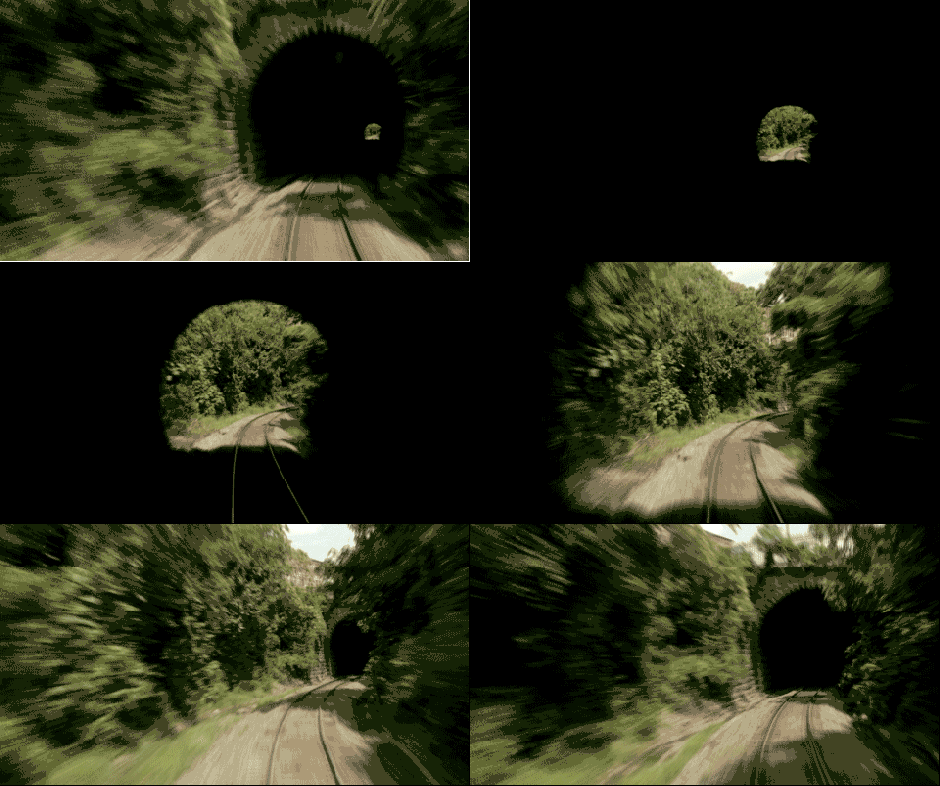
Set out in easy to read chapters with some wonderful colour illustrations, the book begins by questioning our human need for travel: what it means to be a tourist versus a traveller. The author poses a theory about a holiday being a search for some peace; a place to unwind from life’s stresses. He then considers how that peace is obtained. Is it the final destination? Or is it the complete journey with all its experiences? It’s easy to buy into the travel agent’s image of a destination and its promises, but how many of us are disappointed when our perfectly imagined holiday lets us down? Could we look at travel in a different light?
These musings are interspersed with author Richard Kaufmann’s travels, mainly via train, around Europe and parts of Asia. I really liked the author’s arguments against excessive air travel and how those carbon footprints add up, while his observations about people, culture and places were insightful. He certainly opened my eyes to make me look at my own methods of travel in the past and how I might change them in the future.
There’s also a map which lists popular and lesser-known destinations in Europe. It starts in Brussels, the author explaining that it is a good starting point for many Europeans. The map shows distances and train travel times, with some suggested prices. Some of those prices were surprisingly cheap (I know prices fluctuate) but it gives the train a new appeal.

If you are thinking of travelling again but want to do things differently, then think about the train and let it take the strain (as they say!).
Set out in easy to read chapters with some wonderful colour illustrations, the book begins by questioning our human need for travel: what it means to be a tourist versus a traveller. The author poses a theory about a holiday being a search for some peace; a place to unwind from life’s stresses. He then considers how that peace is obtained. Is it the final destination? Or is it the complete journey with all its experiences? It’s easy to buy into the travel agent’s image of a destination and its promises, but how many of us are disappointed when our perfectly imagined holiday lets us down? Could we look at travel in a different light?
These musings are interspersed with author Richard Kaufmann’s travels, mainly via train, around Europe and parts of Asia. I really liked the author’s arguments against excessive air travel and how those carbon footprints add up, while his observations about people, culture and places were insightful. He certainly opened my eyes to make me look at my own methods of travel in the past and how I might change them in the future.
There’s also a map which lists popular and lesser-known destinations in Europe. It starts in Brussels, the author explaining that it is a good starting point for many Europeans. The map shows distances and train travel times, with some suggested prices. Some of those prices were surprisingly cheap (I know prices fluctuate) but it gives the train a new appeal.
If you are thinking of travelling again but want to do things differently, then think about the train and let it take the strain (as they say!).
January 1, 2021
„Landreisen“ bringt alles mit, was ein Buch mitbringen muss: Humor, Unterhaltung, Liebe, ein bisschen Spannung und vor allem eine Menge Inspiration. Ich habe das Buch an einem Stück durchgelesen und bin vollends begeistert!
Der Autor erzählt von seinen erlebten Reisen mit dem Zug und was es heißt, mit fremden Kulturen und seinen eigenen Vorurteilen konfrontiert zu werden und warum es manchmal genau das Richtige ist, langsam zu reisen. Das Buch hat mich mitgenommen auf eine wundervolle Reise durch Europa. Am liebsten würde ich sofort in den nächsten Zug steigen. Vor allem aber hat Kaufmann mich motiviert, mich intensiver mit dem Zug als Langstrecken-Option zu beschäftigen. Das Zugfahren fantastisch ist und mir endlich mal Zeit zum Nichtstun gibt, weiß ich schon lange, finde es aber super, dass das endlich mal jemand runter schreibt :)
Das Cover und dessen Qualität ist ein absoluter Traum!
Von mir gibt es eine uneingeschränkte Leseempfehlung und einen Sonderplatz im Regal!
Der Autor erzählt von seinen erlebten Reisen mit dem Zug und was es heißt, mit fremden Kulturen und seinen eigenen Vorurteilen konfrontiert zu werden und warum es manchmal genau das Richtige ist, langsam zu reisen. Das Buch hat mich mitgenommen auf eine wundervolle Reise durch Europa. Am liebsten würde ich sofort in den nächsten Zug steigen. Vor allem aber hat Kaufmann mich motiviert, mich intensiver mit dem Zug als Langstrecken-Option zu beschäftigen. Das Zugfahren fantastisch ist und mir endlich mal Zeit zum Nichtstun gibt, weiß ich schon lange, finde es aber super, dass das endlich mal jemand runter schreibt :)
Das Cover und dessen Qualität ist ein absoluter Traum!
Von mir gibt es eine uneingeschränkte Leseempfehlung und einen Sonderplatz im Regal!

June 21, 2022
Don't be fooled by the intriguing train compartment ads on Facebook, this is a terrible book! I'm sure the experiences Kaufmann had were life changing for him, but he utterly fails to communicate any of it in his book. Its just bad writing and bad editing.
The book is made up of stories about his trips, and a few philosophical chapters. The travel writing leaves a lot to be desired. It doesn't give any inspiration for visiting the places described, it's just a weird mix of facts and simple, private thoughts. I was often very surprised by some of the twists and turns of a paragraph, in a "where did that come from" kind of way. There are a lot of anecdotes throughout, but there doesn't seem to be a point to any of them. Maybe showcasing that he makes friends easily and drinks a lot? I'm glad he included the afterword were he acknowledged that he was often racist, sexist etc, though I'm not convinced by the writing that he has changed that much.
The philosophy bit is poorly structured and he just comes across as extremely arrogant. The later section on working on a train is also very prejudiced and weird. At the end he attempts some discovery of self stuff, but it just makes him look quite dim. I hope I never meet this person.
The translation is pretty bad, the language still seems German in some places. I actually thought he had written in English himself.
The book is made up of stories about his trips, and a few philosophical chapters. The travel writing leaves a lot to be desired. It doesn't give any inspiration for visiting the places described, it's just a weird mix of facts and simple, private thoughts. I was often very surprised by some of the twists and turns of a paragraph, in a "where did that come from" kind of way. There are a lot of anecdotes throughout, but there doesn't seem to be a point to any of them. Maybe showcasing that he makes friends easily and drinks a lot? I'm glad he included the afterword were he acknowledged that he was often racist, sexist etc, though I'm not convinced by the writing that he has changed that much.
The philosophy bit is poorly structured and he just comes across as extremely arrogant. The later section on working on a train is also very prejudiced and weird. At the end he attempts some discovery of self stuff, but it just makes him look quite dim. I hope I never meet this person.
The translation is pretty bad, the language still seems German in some places. I actually thought he had written in English himself.

April 23, 2021
Ein schönes Büchlein über die Kunst des langsamen Reisens!
Der Autor erzählt sehr lebendig von den schönen, überraschenden und manchmal auch weniger schönen Momenten seiner Reisen. Die Szenen werden dabei richtig lebendig und man kann sich gut in die Lage versetzen, selbst an den beschriebenen Erlebnissen teilzuhaben. Sehr schön finde ich auch die Reisephilosophie des Autors: Es geht nicht um die perfekte und komplett durchgeplante Reise, sondern darum, neue Erlebnisse zu machen, sich auf die Reise und die Menschen, die man unterwegs trifft, einzustellen und vor allem um eine Geisteshaltung: offen zu sein, spontan zu sein, und das Schöne auch im Alltäglichen zu entdecken und wertzuschätzen.
Der Autor erzählt sehr lebendig von den schönen, überraschenden und manchmal auch weniger schönen Momenten seiner Reisen. Die Szenen werden dabei richtig lebendig und man kann sich gut in die Lage versetzen, selbst an den beschriebenen Erlebnissen teilzuhaben. Sehr schön finde ich auch die Reisephilosophie des Autors: Es geht nicht um die perfekte und komplett durchgeplante Reise, sondern darum, neue Erlebnisse zu machen, sich auf die Reise und die Menschen, die man unterwegs trifft, einzustellen und vor allem um eine Geisteshaltung: offen zu sein, spontan zu sein, und das Schöne auch im Alltäglichen zu entdecken und wertzuschätzen.
May 15, 2021
Da ich die Art von Reisen (die Anreise ist schon ein Erlebnis) schätze und bislang immer sehr gute Erfahrungen damit gemacht habe, hat mich dieses Buch noch einmal bestätigt. Niemals den Urlaub durchplanen, sondern viele Dinge spontan auf sich zukommen lassen. Meist braucht man nicht einmal einen Reiseführer vor Ort, weil die nette Besitzerin der Pension beim Check-In tolle Tipps parat hat.
Das Buch bietet für dieses Vorhaben weitere Anreize und daher empfehle ich es sehr weiter.
Das Buch bietet für dieses Vorhaben weitere Anreize und daher empfehle ich es sehr weiter.

November 17, 2021
WOW! Unglaublich inspirierend, gleichzeitig humorvoll und spannend. Es regt zum Denken an und verändert die Sicht darauf, warum wir reisen wie wir reisen. Es ist wohl eines der einzigen Bücher mit anhaltender Wirkung bei mir, da es mein Reisen bereits verändern konnte. Lest es und probiert es selbst aus - es lohnt sich!
November 20, 2021
Schade, ich hatte mehr von dem Buch erhofft. Das Cover ist wunderschön, und die Hauptaussage, per Zug zu reisen, sehr unterstutzenswert. Die Umsetzung des Buches ist aber leider nicht so gut. Für mich zu viel Alkohol, zu wenig Einsicht, dass es nicht für alle Menschen so einfach ist, überall hin sicher zu reisen (nicht-cis, nicht-hetero, nicht-weiß, nicht-männlich, behindert,...). Und auch die Beschreibungen lassen mit den Kapiteln nach.
March 4, 2024
Unfortunately I didn't really warm to the author, and the journeys didn't inspire or grip me. (Much preferred Zero Altitude.) There seemed to be quite a few contradictory statements/opinions, and too many errors.
Istanbul is not the capital of Turkey.
Istanbul is not the capital of Turkey.

April 2, 2023
Eine Liebeserklärung ans Bahnfahren und ein Plädoyer für achtsames Reisen. Feinfühlig philosophiert der Autor über seine zahlreichen kurzen und langen Abenteuer in und abseits des Waggons.
September 30, 2024
A beautiful book that motivates you to continue or to start give up flying and reconnect with the notion or “travelling”. Must read.
Displaying 1 - 11 of 11 reviews