In a delightfully different account of art and politics during the Second Empire, Friedrich sketches a landscape that encompasses Napoleon III, Flaubert, Wagner, Proust, Degas, Zola, Monet, Hugo, Manet, and many others, both famous and infamous. Photographs.
Otto Friedrich was born in Boston and graduated from Harvard, where his father was a political science professor. He took a while to find his literary stride. His career took him from the copy desk at Stars and Stripes to a top writing job at Time, with stops in between with the United Press in London and Paris and with The Daily News and Newsweek in New York.
But it was the seven years he spent with The Saturday Evening Post, including four as its last managing editor, that established Mr. Friedrich as a writer to be reckoned with.
When the venerable magazine folded in 1969, Mr. Friedrich, who had seen the end coming and kept meticulous notes, delineated its demise in a book, 'Decline and Fall," which was published by Harper & Row the next year. Widely hailed as both an engaging and definitive account of corporate myopia, the book, which won a George Polk Memorial Award, is still used as a textbook by both journalism and business schools, his daughter said.
From then on, Mr. Friedrich, who had tried his hand as a novelist in the 1950's and 60's and written a series of children's books with his wife, Priscilla Broughton, wrote nonfiction, turning out an average of one book every two years.
They include "Clover: A Love Story," a 1979 biography of Mrs. Henry Adams; "City of Nets: Hollywood in the 1940's" (1986); "Glenn Gould: A Life and Variations," (1989); "Olympia: Paris in the Age of Manet," (1992), and "Blood and Iron," a study of the Von Moltke family of Germany that is being published this fall.
He wrote his books, as well as reams of freelance articles and book reviews, while holding down a full-time job with Time that required him to write in a distinct style far different from the one he used at home.
Mr. Friedrich, who joined Time as a senior editor in 1971 and retired in 1990 after a decade as a senior writer, wrote 40 major cover stories, the magazine said yesterday, as well as hundreds of shorter pieces, all of them produced on an old-fashioned Royal typewriter that he was given special dispensation to continue using long after the magazine converted to computers.
Mrs. Lucas, portraying her father as a New England moralist whose life and literary interests reflected his disenchantment with much of 20th-century culture, noted that his aptitude for anachronism did not end with typewriters. "We have five rotary telephones in this house," she said.
In addition to pursuing his eclectic interests into print, Mr. Friedrich also had a knack for turning his own life into art. When he tried to grow roses, the record of his failure became a book, "The Rose Garden" (1972). When relatives were stricken with schizophrenia, his frustration drove him to produce an exhaustive study of insanity, "Going Crazy" (1976).
With Manet's famous painting as a starting point, the accomplished writer Otto Friedrich takes readers on a time travel into the Second Empire of the 19thC. Parisians loved paintings of Madonnas, nymphs and goddesses, but Manet (1832-1883) offered a demimondaine, or simply a modern Venus, coolly appraising you with casual indifference. Here's her "story," along w what happened to the model. Part of Manet's modernity was his subject matter: contemporary Parisian life that revealed the newly triumphant (but very insecure) bourgeoisie. Il faut etre de son temps, he believed. (One must belong to one's time.) The author puts you in Manet's time. Social intrigues, war, poverty, the celebration of great art, including Haussmann's redesign of Paris, are captured w excerpts from letters and diaries. Some of the players are Flaubert, the Goncourt Bros, Degas, Saint-Saens, Berlioz, Meyerbeer, Zola, Wagner and Rossini.
"Why do you say Degas has trouble having an erection?" asked Van Gogh to a poet friend. J.K. Huysmans believed that Degas had a "disdain for the flesh." Degas admired the plain Mary Cassatt. "I would have married her," he once said, "but I could never have made love to her." ~~A moralist, Zola was faithful to his wife for many years and then set up a mistress nearby who gave him two children. He loved his mistress, but needed his wife. Both women clung to him. ~~ A lengthy section is devoted to Wagner whose entree was helped by Meyerbeer, yet Wagner accused him of bribing music critics. Then, as today, critics were often snobs, social climbers, ignorant and incompetent. ~~ The most important music critic in Paris, and also painfully honest: Hector Berlioz. Wagner blamed a hostile Berlioz crit on his 2d wife, Marie. "A malignant woman can ruin a brilliant man." The Paris opening of "Tannhauser" is vividly described. Act 2 revisions: it had to open with a big ballet. Members of the trendy Jockey Club liked to swagger in after dinner to eye the female dancers they might date later. The opera itself was of no interest. Even Verdi had to open the 2d act of "Il Trovatore" with gypsies dancing around a campfire. The Jockey Club allowed no deviations. (I think of many Bwy musicals that open the 2d act w a major dance or "dream ballet." Filler material). Meantime, a poor German immigrant named Offenbach, the son of a cantor, conveyed the carefree spirit of the Second Empire in his comic operettas.
Syphilis was the disease killer. Flaubert, Jules Goncourt, Van Gogh, Baudelaire, Oscar Wilde, Maupassant, Lautrec, Manet are just a few who succumbed. Though Manet lived w his mother all his life, no one knows for sure when he was infected or by whom. Many scholars believe it happened on a youthful naval trip, age 16, he took to Rio de Janiero. Manet married a plump Dutch piano teacher in 1863 and adopted her illegitimate son, but no one knows the natural father. The true love of his life was painter Berthe Morisot of whom he did 11 portraits. He died painfully, age 51.
Author Friedrich, an editor and writer, knows how to select material, condense, and, most importantly, write. His books on the rise of Hitler and Hollywood in the 1940s are other examples. He can interweave characters, jump around in time, capsulize world events with a generous and silken narrative. "Olympia" and other Manet paintings are now exhibited in Paris at the Musee d'Orsay.
They were remarkably different people, these young Impressionists – Monet the passionate visionary, Renoir the carefree hedonist, Pissarro the idealistic socialist, Berthe Morisot the acerbic aristocrat – and yet they were bound together by their deep beliefs in a series of radical propositions. One was the conviction commonly held by ambitious young artists, that the gates of the establishment must be broken open... Another, more important, was that the tradition of historical painting must give way to scenes of contemporary life, la vie modern. And that the tradition of studio composition must give way to a new process of painting out of doors, en plein air. And that a painting need not be “finished”, in the sense that every detail must be fully shown by nearly invisible brushwork.
From page 259 (an Impressionist exhibition in 1876)
Wolff of Le Figaro returned ferociously to the attack. “At Durand-Ruel’s there has just opened an exhibition of so-called painting... Five or six lunatics – among them a woman – a group of unfortunate creatures stricken with the mania of ambition have met there to exhibit their works. Some people burst out laughing in front of these things – my heart is oppressed by them. Those self-styled artists give themselves the title of non-compromisers, impressionists; they take up canvas, paint, and brush, throw on a few tones haphazardly and sign the whole thing...It is a frightening spectacle of human vanity gone astray to the point of madness.”
This book is history with a personal face. It covers France from the 1840’s to the 1880’s. And it is just not Manet, and not just his paintings and the Impressionists. Its’ about Paris and France with fine depictions of some of the people who lived in that very dynamic era. We are presented with the lives of artists - Manet, Degas, Renoir, Monet; of writers – Gustave Flaubert and Emile Zola; of politicians like Napoleon III and their significant spouses (Empress Eugenie) and mistresses. It is a lively history and entertaining. We are never presented with long dry analyses of paintings or writings. This is history with passion.
The author does wax on about the beauty of the “Olympia” painting (I much prefer Renoir and Monet). But there is no doubting the controversy that to this day surrounds “Dejeuner Sur L’herbe” (1863) – its’ odd, striking, flamboyant – so French!
There is so much else pressed into this book besides art – Napoleon III, France’s defeat to Germany in 1872 (thing of the historical repersussions of that) and then the Paris Commune. This last one was basically a Civil War within Paris and to some extent instigated by a woman – Louise Michel. Other topics are poverty, prostitution and Baron Haussmann complete redesign of Paris.
Initially the Impressionists bonded together as a group, but as usual, with their strong artistic individualism, disputes arose and their association disbanded over time. Degas was a rather peculiar fellow. Manet never really joined them and was independently wealthy. Monet, by contrast, was very poor and constantly borrowing.
This book introduced me to a female Impressionist painter I had been unaware of – Berthe Morisot. She probably would have married Eduard Manet (the painter) but he was already married, even so they became friends for life. She married his brother, Eugene. Berthe Morisot painted her entire life.
Highly recommended for those interested in French history and art.
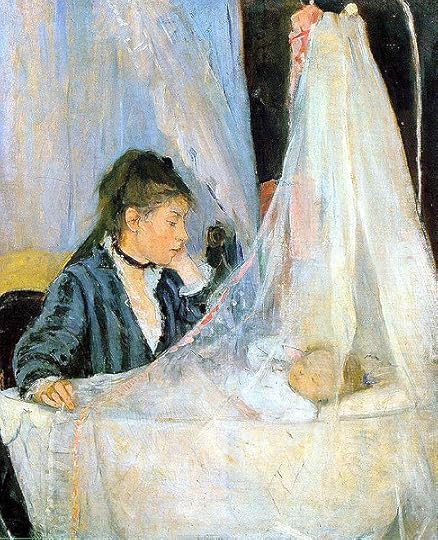
The Cradle by Berthe Morisot 1873 (National Gallery of Art, Washington D.C.)
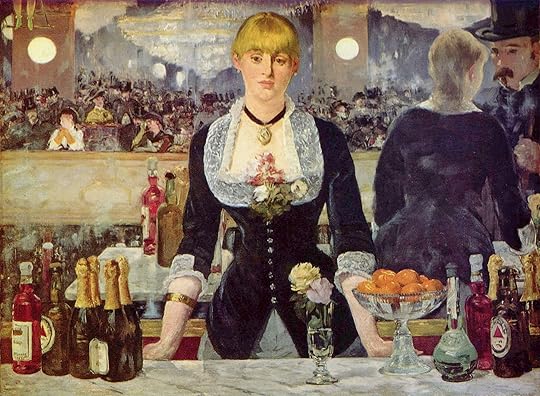
A Bar at the Folies-Bergere, 1881 (the Courtauld Gallery, London) one of Eduard Manet's last paintings
Otto Friedrich's tour of Paris in the Impressionist age is fabulous, meticulous, intimate and illuminating, as was his City of Nets of Hollywood in the 1940s.
Painters! Prussians! Prostitutes! All this and plenty more in Friedrich's exploration of the paradox of Paris during second half of the 19th century-- the time of Édouard Manet. If you know me well then you know that Manet is my favorite French artist; if you know me very well, then you know that if I could time travel to any era, it would be to this time in Paris. Friedrich's social history, which uses different paintings by Manet as springboards to different issues of the times, cautions me about such a desire. If I were to live during that time, my best bet would be to exist as a bourgeoisie male, preferably with inherited wealth and status. As such, I would have complete reign over my life and Paris; the complete total ability of making my own decisions. There are some drawbacks, however. I might be a slave to the tastes of the Paris Salon and its committee who determined what is and what is not good art. I might be blind to the talents of the Impressionists and attend the Salon de Refuseés to laugh and jeer at their work, whose modern themes, bright colors, lack of line, and thick brushstrokes differ wildly from the master of the time: Ernest Meissonier. I would see Meissonier as a "real" artist with his realistic historical scenes rendered near photographic quality with his undetectable brushstrokes. Manet, most likely, would not be my favorite artist.
In fact, when I first lay my eyes upon his "Olympia"-- the contemporary nude of Victorine Meurent who stares frankly at the viewer while her servant brings in flowers from a suitor? client?-- I might be shocked and refuse to acknowledge the truth she presents about modern Paris: that regardless of my moralistic, bourgeoisie tastes, I exist in a society of excess, where prostitution, debauchery, parodies, extreme wealth and poverty, and a corrupt government hold sway. While I may look like a respectable man with a wife and children, I might have a kept woman in a nearby apartment or visit a "maison du tolerance" for a hour's pleasure. As a result, I might be one of the 20% of the population who slowly begins to suffer from syphilis and begin a mercury treatment that hastens my death. I might even support the Second Empire and Emperor Napoleon III and Empress Eugénie. I might even support the killing of thousands of my countrymen during the repression of the Paris Commune after the Franco-Prussian War.
The second best bet would be to live as an unmarried bourgeoisie woman. As such, I would be taken care of and have the ability to pursue my ambitions, like artist Berthe Morisot for much of her life. I would have to endure the handwringing of my family who prefer that I marry, but it is a much better option than the majority of women face during this time. Most women were kept in abject poverty, and women of respectable professions, such as schoolteachers and seamstresses, made less money than prostitutes. Prostitutes, for a long time, were considered idle and lazy women who had no greater ambitions and as social necessities as men could take out their desires on them, hence preventing them from assaulting innocent women. No one wanted to explore how denying women rights and equality gave them little option than relying on their bodies.
But I am me, living in 2018 America, reading this book, dreaming of the past. Paris during this time appeals to me because it is when the future and the past meet head-on as the Impressionists, reluctantly lead by Manet, strive so hard to have their modern view of the world excepted by those mired in tradition and conservatism. Napoleon III had the old city torn down and ordered Baron Haussmann to build one anew, which is the city that we see today. There is nation-building as Prussia tries to unify into Germany, and it and France engage in the Franco-Prussian War using new weapons, a harbinger to the real cataclysm almost 50 years later. Paris also appeals to me because I love Paris as it is now; what I love about it now emerged during this time.
I enjoyed reading this book. Friedrich's approach is unique and informative. His style is breezy, gossipy, and informative. Sometimes it is a little too breezy as he refers to Meissonier as a "hack", which is unfair. Meissonier went to great lengths to recreate historical scenes so he could depict them as accurately as possible and he was a highly skilled painter who was wildly popular and well paid during his time. He is Paris's version of Thomas Kinkade; popularity doesn't promise legacy, and we do not flock to the Louvre or the Museé d'Orsay to see Meissonier. This small detail made me wonder where else Friedrich might have been unfair. I also wonder what Friedrich might have to say about the Impressionists today. He published this book in 1992, and when he went to see "Olympia" at the d'Orsay, it was showcased in a basement corner. Today the Impressionists occupy the museum's open and airy top floor where one can look out of its clock face to see the cityscape and the heights of Sacre-Couer in the distance. "Olympia" herself, displayed alone on a single panel, welcomes visitors to the space.
To be fair, I never got the Impressionists… no matter how adored they are. And so it seems perhaps strange that I started a book using Manet as a starting point. But it’s Otto Friedrich, one of the most underrated writers of nonfiction, a man who effortlessly finds the secret currents that run through history. I didn’t dig it as much as City of Nets or Before the Deluge… but those are stone-cold masterpieces. Olympia is still better than most creative nonfiction journeys.
What a wonderful look at the artistic (and political) world of Paris in the late 19th century. Taking Manet's masterpiece Olympia as the starting (and end) point, Friedrich tells about Manet, Cezanne, Renoir, Degas, Morrisot, and all the other painters of the time. He also tells about writers, musicians, actors, the Emperor, the Empress ... a brilliant way to learn history.
Manet and the impressionists did not live in a vacuum. This book tells of the people, places, and events that swirled around them during the last half of the 19th century. If you crave a fuller understanding of these people without reading scholarly tomes, this is the book for you.
This was an excellent read, and I was tempted to give it 5 stars, but...well...I don't know. It just didn't quite hit that mark for me. Part of it was Friedrich's tendency to go into detail where detail didn't matter--like in the courtship of Napoleon III and Eugenie. I was much more interested in how exactly Louis Napoleon was able to make his wife regent while he was otherwise engaged. How did that work exactly? Did all the generals and politicians in France just accept that like it was no big deal? My biggest issue was that I had a hard time really getting a feel for the personalities of Manet and the other artists Friedrich discusses. I respect him for not jumping to conclusions (as he points out that other historians have done vis a vis Manet's love life) but his hesitancy to speculate leaves the characters ciphers to a certain extent. I took this for a work of "popular history" so I expected a little more psychologizing than I would in a strictly academic work. Anyway, there is a lot of detail of the good sort in this book, a broad selection of topics that goes far beyond art, and all in all the reader gets a real sense of the culture and people of the period. So it is well worth reading.
As an artist and someone who studied art history, primarily 19th century American art, I loved this book. Friedrich is a wonderful writer and if you love Paris and have the slightest interest in 19th century French art and literature, with a dollop of history you will enjoy this book. Reading about how Manet's masterpiece, Olympia was attacked and reviled by critics and the public is revealing. Manet's constant rejection from the the Salons and his attempts to show his work is comforting to artists as we struggle to incite interest in what we are creating. After one rejection from the Salon exhibit, Manet spent a great deal of money to rent a space and show 57 of his paintings. Few people came and no one bought anything. Imagine all of those beautiful paintings and people only went to laugh at his work?
My only criticism is that there are not enough color plates of the paintings Friedrich writes about so I spent a lot of time on Google looking at them. Well worth it however, since seeing these incredible paintings again is a pleasure. I particularly enjoyed seeing more work by Berthe Morisot and now will buy picture books on both Manet and Morisot to feast on.
This covers some of the same ground as "The Judgement of Paris" but much less of it. It tends to leap from subject to subject. First is Manet and his painting Olympia, then we veer over to Napoleon III and Empress Eugenie then to Berthe Morisot then Jacques Offenbach then to a doctor who treated prostitutes, back to Manet, back to the Empress although that chapter is mostly about someone else....there is a "lack of cohesion" as they say on Project Runway. But it's easy to read and there is a lot of interesting information here. Not for scholars, but it was entertaining enough.
The way this book jumps around different periods and people is one of the most pleasurable aspects of it. You come out feeling as fascinated by Napoleon III and Empress Eugenie almost as much as you do Morisot and Manet. But compared to similar books I’ve read on the topic, such as Ross King’s Judgment of Paris, it just isn’t as fascinating a read. It’s still a good book, and certainly places you mentally in 1860s-70s Paris, which is always a welcome headspace.
I enjoyed this book as much as any that I’ve read recently. As evidenced by the notes at the end it is extremely well sourced. But most importantly it is not a dry history. Friedrich weaves together engaging stories of a number of important figures in the age of Manet that bring the period to life.
Loved 5his book for its historical perspective and the true hardships of artists who break the norms. As an artist, I was inspired to continue my work with faith and a positive outlook. So many historical facts about women that I admire women artists even more. Entertaining, informative, and inspiring read.
Read four of the eight chapters, Olympia, Olympia (II), Berthe Morisot, Berthe Morisot (II), and stopped there for now as those were most interesting subjects to me and the book is overdue at SPL.
Published in 1992, the author’s attitudes are decidedly chauvinistic.
Giving it a high rating because he spins a readable, if unreliable, take on personalities and episodes.
This study is so filled with fascinating tidbits about the life and art of Edouard Manet and his many contemporaries who made the era of France’s Second Empire so intriguing that I am tempted to write one of my typical ridiculously long reviews so I can share as much for the book’s information as possible.
However, I will try to hit the high points as I inspire others to delve into this information-packed and fascinating study. The title refers to Manet’s painting Olympia, which features a nude, lounging portrait of model Victorine Meursent (the subject of several of his other paintings as well). The painting is also featured on the book’s cover.) Today, “Olympia” hangs in the Musée d’Orsay and is considered priceless. But in 1865, art critics savaged the work, and for a while, it had to hang near the ceiling in a different museum “to keep it safe from flailing umbrellas and thrown objects” (24). And this, says the author, was in a “age of the can-can, and the imperial demi-monde of Madame Bovary and Nana.”
Two years earlier, Manet’s famous painting “The Bath” (1863), now called “Le déjenuer sur l’herbe,” was also rejected by jurors as unworthy of public exhibition. But that same year, the École des Beaux Art’s undisputed authority ended and the avant garde was born. Manet was subsequently called the first modern painter.
Although he was a generation earlier than the Impressionist movement, Manet rubbed shoulders with Monet, Renoir, Cézanne, Dégas, and others, and became a sort of mentor and honorary member of their school. Manet did not exhibit his paintings with these other artists, but after Monet importuned him, he paid them the compliment of painting side-by-side with them in the outdoors, experimenting with smaller brush strokes and brighter colors. This study weaves the events of Manet’s life and works through its chapters, including descriptions of his personal life. For example, Berthe Morisot, one of few female painters of the Impressionist movement, was the “love of his life” and the model in many of his paintings. But when the two met, Manet was already married, so before and after Berthe married his brother, Eugène, their relationship remained chaste and professional. “They were fascinated with each other’s work” (85).
Equally interesting in Friedrich’s study is the background on Emperor Napoléon III and Empress Eugénie (both colorful, if not particularly admirable, characters), anecdotes about authors Charles Baudelaire, Gustave Flaubert, and Emile Zola, composers Jacques Offenbach and Giacomo Meyerbeer, and the exile from France of Victor Hugo (who hated Napoleon III).
The author also discusses the transformation of the face and underground of urban Paris under the direction of Baron George Eugène Haussmann. Friedrich includes a description of Napoléon III’s ill-fated campaign in Mexico (also the subject of a Manet painting), and the Second Empire’s downfall during and after the Franco-Prussian war including the horrors of the siege of Paris, and the ensuing violence of the Commune. Some less elegant parts of the history include details on the history of prostitution in Paris and the ravages of syphilis before the advent of antibiotics.
I have never studied art, but have gone to several art museums and knew enough to appreciate this book, though I could not comprehend all of it. I learned some about history from the late 19th century and that too is an era that I am not that familiar with. So this book made me stretch some, but I still appreciated it. The sad thing was that Manet was never well supported for his work and he never was able to marry the person he loved. The curse of syphillis and the sad lot of the women was pitiful. Most women were forced into prostitution if they were from the lower class and even if single and of the lower middle class. Life in this era and place was for the rich a time of wanton pleasure. War was frequent and the loss of many lives and suffering for the living. Hedonistic living seemed to be thrust upon people because of the terribly poor prospects for the future.
fascinating subject. Written in a confusing way. a little too much of the author present to make it straight history but a little too dry to read like a work of historical fiction. He seemed to spin fictional probable scenarios and then add "of course we cant know". The non chronological set-up and flights of fancy made for easy reading but discredited it as a serious work of history. However, the dry disclaimers ruined it as a work of fiction. I guess the best description would be that it was a non-scholarly work of "history".
Sometimes boring but lots of good antidotes on artists and their life. Too much stuff about Napoleon and Wagner. The book is commendable in how it depicts the life of women in Paris models as well as Berthe Morisot and Victorine Muerant.