Jump to ratings and reviews
Rate this book

Born Knowing: Imprinting and the Origins of Knowledge

Rate this book
An expert on the brain argues that the mind is not a blank slate and that much early behavior is biologically predisposed rather than learned.

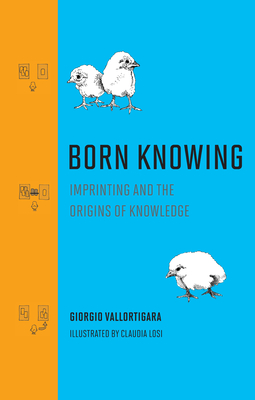
Why do newborns show a preference for a face (or something that resembles a face) over a nonface-like object? Why do baby chicks prefer a moving object to an inanimate one? Neither baby human nor baby chick has had time to learn to like faces or movement. In Born Knowing , neuroscientist Giorgio Vallortigara argues that the mind is not a blank slate. Early behavior is biologically predisposed rather than learned, and this instinctive or innate behavior, Vallortigara says, is key to understanding the origins of knowledge.

Drawing on research carried out in his own laboratory over several decades, Vallortigara explores what the imprinting process in young chicks, paralleled by the cognitive feats of human newborns, reveals about minds at the onset of life. He explains that a preference for faces or representations of something face-like and animate objects--predispositions he calls "life detectors"--streamlines learning, allowing minds to avoid a confusing multiplicity of objects in the environment, and he considers the possibility that autism spectrum disorders might be linked to a deficit in the preference for the animate. He also demonstrates that animals do not need language to think, and that addition and subtraction can be performed without numbers. The origin of knowledge, Vallortigara argues, is the wisdom that humans and animals possess as basic brain equipment, the product of natural history rather than individual development.

192 pages, Hardcover

Published September 28, 2021

8 people are currently reading
95 people want to read

About the author

Giorgio Vallortigara

30 books18 followers
È professore ordinario di neuroscienze del Center for Mind/Brain Sciences dell'Università di Trento. È anche Adjunct Professor presso la School of Biological, Biomedical and Molecular Sciences dell'Università del New England, in Australia. È autore di più di 170 articoli scientifici su riviste internazionali (con oltre 3000 citazioni) e di alcuni libri a carattere divulgativo.
È nell'editorial board delle riviste scientifiche internazionali.
Nel 2011 ha ottenuto uno dei prestigiosi ERC Advanced Research Grant della Comunità Europea, e poi di nuovo un secondo nel 2019. Nel 2016 ha ottenuto il Premio internazionale Geoffroy Saint Hilaire per l’etologia e una laurea honoris causa dall’Università della Ruhr, in Germania.
È socio dell’Istituto Veneto di Scienze Lettere ed Arti e Fellow della Royal Society of Biology. Oltre alla ricerca scientifica svolge un’intensa attività di divulgazione, collaborando con le pagine culturali di varie testate giornalistiche e riviste, quali il Sole 24 Ore e Le Scienze.

Ratings & Reviews

What do you think?
Rate this book

Friends & Following

Create a free account to discover what your friends think of this book!

Community Reviews

5 stars
6 (13%)
4 stars
20 (45%)
3 stars
15 (34%)
2 stars
3 (6%)
1 star
0 (0%)
Displaying 1 - 2 of 2 reviews
Profile Image for Fyrrea.
482 reviews28 followers
March 15, 2023
Bardzo dla nerdek, nerdów i innych osób nerdowskich. Trochę podstaw z biologii i psychologii trzeba mieć, ale bardzo warto - można się dowiedzieć kilku ciekawostek, którymi potem będziemy zanudzać znajomych :)
Aaaa, no i ryciny piękne!
Profile Image for Litttle._.clownn.
133 reviews
April 19, 2023
The mere comparison of a chick to a newborn sparked my interest in this book.
Despite the sometimes specialized language, the book was interesting and clear. The drawings also helped to imagine specific experiences or to help visualize a specific example.🙂
Displaying 1 - 2 of 2 reviews

Can't find what you're looking for?

Get help and learn more about the design.