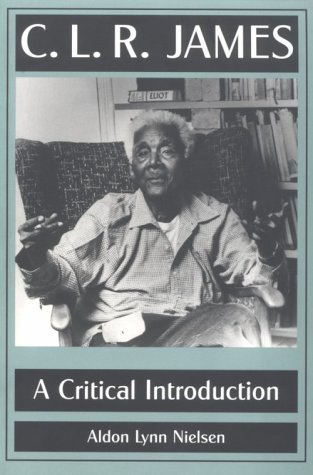
This study of C. L. R. James's writings is the first to look at them as literature and not as theory. This sustained analysis of his major published works places them in the context of his less well-known writings and offers an encompassing critique of one of the African diaspora's most significant thinkers and writers. Here the author of Black Jacobins , World Revolution , A History of Pan-African Revolt , , Beyond a Boundary , and the lyric novel Minty Alley is seen not only as among the great political philosophers but also as the literary artist that he remained, from his first writings in his native Trinidad through his underground years in America, to his final essays and speeches in London. The writings of James have inspired revolutionaries on three continents. They have altered the course of historiography, shown that way toward independent black political struggles, and established a base for much of today's study of culture. This study evaluates them as powerful works of literature.
Aldon Lynn Nielsen (born 1950) is an American poet, and literary critic who taught at Howard University, San Jose State University, UCLA, Loyola Marymount University, and Pennsylvania State University.
He wrote in the Introduction to this 1997 book, “The critical reception of the works of C.L.R. James in the United States, and in other countries as well, has been hobbled by the fact that there has never been a time… since the publication of his third book, that all of his writings were in print in easily available editions simultaneously. Many of James’s texts were fugitive publications or private printings, and others were internal documents circulated within small political organizations… Still, with books such as ‘The Black Jacobins’ remaining in print for long periods of time, each year new readers have discovered James’s thought and begun the search for the rest of his works… [This book] is not meant as a summary of James’s life and books, but it is intended to offer readers a critical study of his major writings illuminated by careful considerations of some of the more difficult to locate publications.” (Pg. xxiii)
Nielsen notes James’s reaction to the TV broadcast of the miniseries based on Alex’s Haley’s ‘Roots,’ that “James had certain qualms about Alex Haley’s work, but, as he told his students at Federal City College, nobody should underestimate the historical importance of the fact that millions of white Americans were attending, however shallow that attention, to an epic narrative of the lives of black Americans.” (Pg. 36)
He explains, “C.L.R. James has described himself as one who arrived in England with a set of abstract Labor and Socialist ideals clustered around a firm commitment to the goal of self-government for the peoples of Trinidad…. James met frequently with working-class radicals and leftist intellectuals who challenged his still somewhat vague politics.” (Pg. 53)
He observes, “With midcentury approaching, James saw African-American intellectuals who searched for histories with greater explanatory power in analyzing America’s racial present as caught between two alternatives: the Communist approach, practiced most effectively by Herbert Aptheker, and the liberal idealism represented by the work Gunnar Myrdal and his associates accomplished in producing their book, ‘An American Dilemma.’” (Pg. 57) He adds, “James finds that Herbert Aptheker’s works… fail to recognize the extent to which the actions of free blacks and insurrectionary slaves were the driving force behind nineteenth-century abolitionism.” (Pg. 59)
He notes, “In [Walter] Rodney’s case, in contrast, James felt that the younger revolutionary had attempted to move ahead of and without the masses. James knew that the greatest of errors was for those who thought they could lead the masses to take for granted that they would be followed.” (Pg. 84)
He points out that “James’s ‘Revolution of the Minority’ includes a remark that might have surprised more moderate proponents of civil rights and racial integration. ‘To the degree that the Negroes are more integrated into industry and unions… their consciousness of racial oppression and their resentment against it become greater, not less.’” (Pg. 137)
He says, “His study of political history converges with his study of the history of cricket in his discovery that the public that so eagerly wanted sports and games and the public that so eagerly sought after popular democracy ‘were stirred at the same time.’” (Pg. 177)
This book will be of great interest to anyone interested in James’ works.