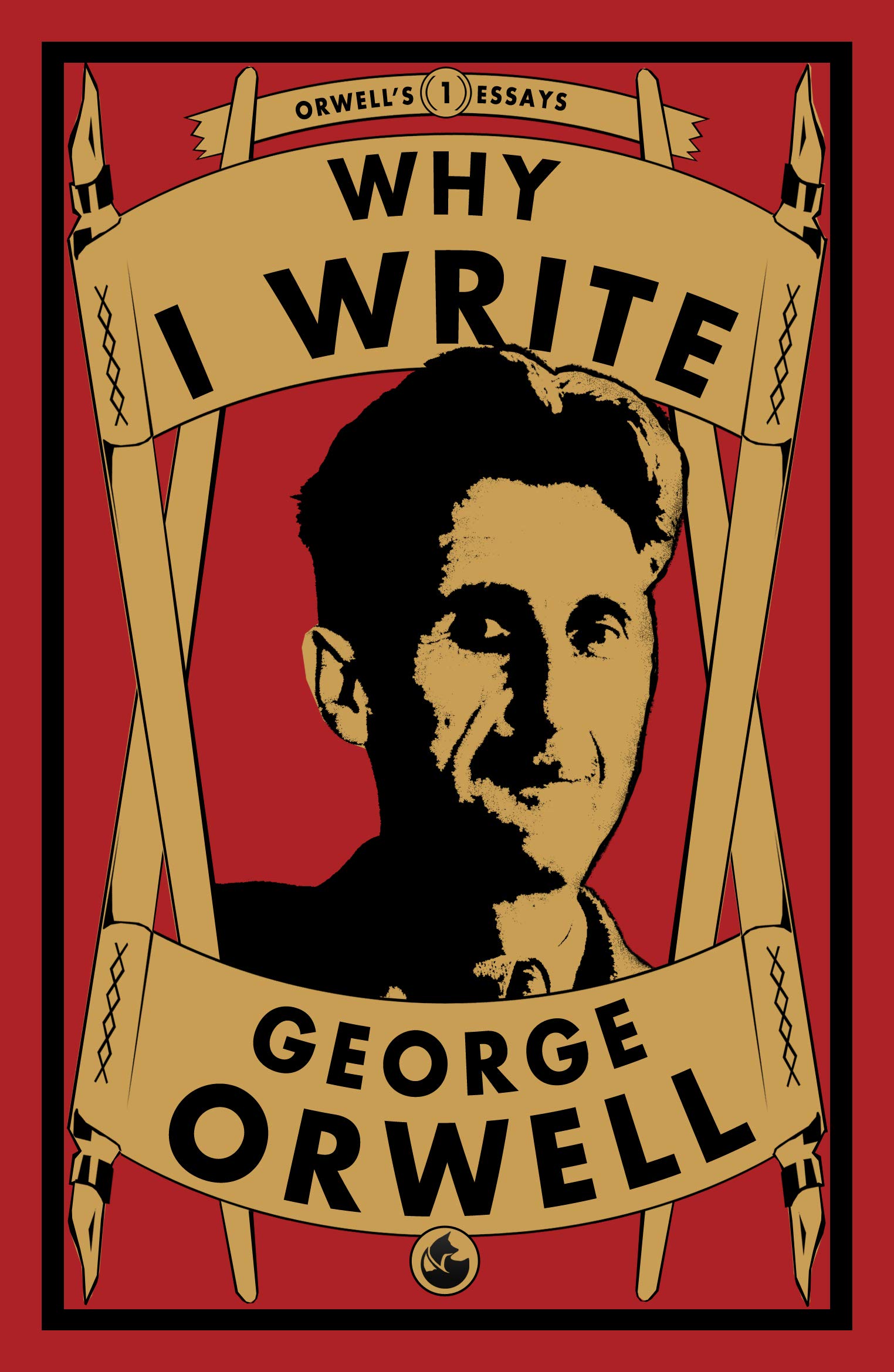
George Orwell set out ‘to make political writing into an art’, and to a wide extent this aim shaped the future of English literature – his descriptions of authoritarian regimes helped to form a new vocabulary that is fundamental to understanding totalitarianism. While 1984 and Animal Farm are amongst the most popular classic novels in the English language, this new series of Orwell’s essays seeks to bring a wider selection of his writing on politics and literature to a new readership.
In Why I Write, the first in the Orwell’s Essays series, Orwell describes his journey to becoming a writer, and his movement from writing poems to short stories to the essays, fiction and non-fiction we remember him for. He also discusses what he sees as the ‘four great motives for writing’ – ‘sheer egoism’, ‘aesthetic enthusiasm’, ‘historical impulse’ and ‘political purpose’ – and considers the importance of keeping these in balance. Why I Write is a unique opportunity to look into Orwell’s mind, and it grants the reader an entirely different vantage point from which to consider the rest of the great writer’s oeuvre.
Eric Arthur Blair was an English novelist, poet, essayist, journalist and critic who wrote under the pen name of George Orwell. His work is characterised by lucid prose, social criticism, opposition to all totalitarianism (both fascism and stalinism), and support of democratic socialism.
Orwell is best known for his allegorical novella Animal Farm (1945) and the dystopian novel Nineteen Eighty-Four (1949), although his works also encompass literary criticism, poetry, fiction and polemical journalism. His non-fiction works, including The Road to Wigan Pier (1937), documenting his experience of working-class life in the industrial north of England, and Homage to Catalonia (1938), an account of his experiences soldiering for the Republican faction of the Spanish Civil War (1936–1939), are as critically respected as his essays on politics, literature, language and culture.
Orwell's work remains influential in popular culture and in political culture, and the adjective "Orwellian"—describing totalitarian and authoritarian social practices—is part of the English language, like many of his neologisms, such as "Big Brother", "Thought Police", "Room 101", "Newspeak", "memory hole", "doublethink", and "thoughtcrime". In 2008, The Times named Orwell the second-greatest British writer since 1945.
What do they know of Orwell who only Animal Farm and Nineteen Eighty-Four know? -Irving Howe
Why do one write? What is the urgency to write or what is the need to write anything at all? Does one actually have control what one is writing or there is some profound force which influences one’s consciousness or sub-consciousness to do so. Perhaps one writes to get rid of tribulations of life going in his/ her head. For, there must be some way to disburse these anxious ordeals; and what better way it could be than to write. We may say, arguably though, that an author, or any one for that matter, writes to express, to get away from the insanity which might take one over if one does not decide to flush out the thoughts boiling up in the head; one expresses the turmoil one feels in consciousness, though he may choose different ways to do it- sometimes words are simply used to render the tumult and turbulence he might be going through while sometimes words are deftly used to concoct an escapade which may indirectly covey his thoughts. Writing a book is a horrible, exhausting struggle, like a long bout of some painful illness. One would never undertake such a thing if one were not driven on by some demon whom one can neither resist nor understand. For all one knows that demon is simply the same instinct that makes a baby squall for attention. Are there any innate values which shape up an author’s writing method? And what is the role of one’s upbringing, ideals hold in childhood, belief system, in motivating one to be an author. It may be said, though arguably again, that writing is a self-driven and ever evolving personal engagement but development of language is influenced and shaped by other authors one would have followed during early years; it stems from personal experience and the innate connection one bore to literature from early age.
Orwell’s essay- Why do I write- is a peculiar but reasonably specific form of writing, it’s an essay which may be quite content to raise an issue, force it on a reader’s attention, but then to ruminate and speculate, neither to orate nor pontificate; above all it will seem personal not objective, will give a sense of listening to an extended conversation by an odd but interesting individual. Orwell’s wish ‘to make political writing into an art’ led to a bold but carefully phrased claim for the originality of his essay. He proposed that everyone who writes has some form of political bias, and the more one is conscious of one’ s political bias, the more chance one has of acting politically without sacrificing one’s aesthetic and intellectual integrity. He said that one can not assess a writer’s motives without knowing something of his/ her early development. The subject matter of an author will be determined by the age he lives in, his childhood; the kind of stories authors imagine in their childhood have reflected in their styles which they adopted over the years.
Orwell proposed that there are four main motives for writing, at any rate for writing prose- egoism, aesthetic enthusiasm, historical impulse and political purpose, though degree of these motives may vary from one author to another and even in one author their proportions may vary from time to time. The desire to be talked about, to be remembered after death- which satisfies our ego- are quintessential to writers. Orwell said that serious writers are on the whole more vain and self- centered, though less interested in money. So, if not money then what they entices them- is fame not a manifestation of ego? Desire to share an experience which one feels is valuable but aesthetic motive is, what Orwell felt, very feeble in a lot of writers; perception of beauty in words and their arrangements is one of the prime motives to write. The other motive he talked about is historical importance – desire to see things as they are, to find out facts and store them up for the use of posterity. The role of history and historian has changed over the years, as philosopher and historian Foucault sought to critically examine the seemingly straight forward questions and the responses they had inspired. He directed his most sustained skepticism toward those responses—among them, race, the unity of reason or the psyche, progress, and liberation—He directed his most sustained skepticism toward those responses—among them, race, the unity of reason or the psyche, progress, and liberation. But those were ages of imperialism that probably that has affected the thought process of the intellectuals then. Orwell maintained that no book is genuinely free from political bias, the opinion that art should have nothing to do with politics is itself a political attitude.
The great mass of human beings are not acutely selfish. After the age of about thirty they abandon individual ambition- in many cases, indeed, they almost abandon the sense of being individuals at all- and live chiefly for others, or are simply smothered under drudgery. But there is also the minority of gifted, willful people who are determined to live their own lives to the end, and writers belong in this class.
There is another problem, perhaps subtler, which is of language and it may take too long to discuss; Orwell said that of later years he tried to write less picturesquely and more exactly. By the time one perfected any style of writing one has always outgrown it. Orwell developed language of satire as he progressed through his career; he was fully conscious of what he was doing during writing Animal Farm, to fuse political purpose and artistic purpose into one whole. Satire- laughter of free man- is like meditation wherein stories are written without any reference to any political power, it is an imaginative satire for the targets to become wider over time. A good cap fits many heads or can be made to do so with only a little stretching. He deliberately chose to write in the plain style for the very reason that he thought it the best way to reach the common reader and to convey truths. As he felt that the common man was the best hope for civilization, rather than proletarian man or aristocracies or elites of any kind.
Orwell’s great skill lies in using the essay as a mode of expression are part of his cult of the ordinary, his faith in common sense and common man. His plain style also reveals an metaphysical intensity about the value of ordinary things, a kind of secular pietism.
Part 56 in the "Another autobiographical review that nobody asked for!"-series.
Why I Review
It was already very late in my boyhood, at thirty years old, when I considered writing book reviews. Being the man of action that I am, which is to say a lazy bum, it was almost to my own surprise that this innocent consideration promptly turned itself into virulent spasms across the keyboard, with my first contributions on Goodreads as the very unfortunate result. Thankfully my friends list at the time only consisted of some imported Facebook contacts who had last been active 5 years prior to my sudden burst of literary enthusiasm and who had gotten too busy climbing up corporate ladders to even remember ever having registered to a website about books, let alone notice what I was doing. Maybe it was this anonymity that allowed me to stay here, because as my own ineptitude was gradually becoming clearer to me as I was reading through others' reviews, I still persisted in forcing myself upon this community and fiendishly sent out friend requests in hopes of learning but mainly in hopes of belonging in this hall of learned ladies and gentlemen. I didn't stop to ponder on these hopes, on my true intentions, my real motivations. I just went with that "big bang" moment that seemed to come out of nowhere and I took it from there. I never stopped to ask: Why?
George Orwell and his essay on why he writes made me revisit those early days of reviewing and the months (years?) that have transpired since then. I found his considerations relevant to why I am doing what I do, and the structure he employed quite helpful for the organisation of my own scrambled thoughts. Also, it's a very good essay and I rated it five stars, in case you were here for just the review. If you find yourself even remotely interested in reading further through my recollections then I can wholeheartedly recommend George Orwell's original text.
Employing Orwell's essay structure, I should start with an understanding of my true nature and with a return to my childhood. Many of you already know that I was a happy, skinny, bespectacled and introverted child with no brothers or sisters and with a wonderful dog. I will not elaborate on that childhood too much since I already did that in other reviews, but these traits do explain a tendency to keep busy with solitary activities. As a child or teenager these activities strangely enough barely entailed reading or writing, aside from comic books and what was required for school. I found reading to be very boring. It felt like watching a movie with subtitles, only without the movie, and much slower. And with the advent of video games I truly had everything my solitary heart desired. The few books I had at that time turned yellow, collected dust and eventually got sold for twenty francs.
Fast forward to the internet, with its chat rooms and forums devoted to games and the dominance of the English language in those settings. At a certain point I spent more time on the Internet discussing game strategies rather than playing the games themselves, as I also started commenting on the personal stories and the societal comments people invariably shared on these things. It is now, also through remembering some emails and letters I sent, I realise that it was mainly the writing in itself that I enjoyed, especially in English. All I needed was something worthwhile to write about.
Another fast forward to much later to when I finally started reading, also in English. Murakami's "The Wind-Up Bird Chronicle" proved to be the perfect present and as I read and finished that one I couldn't wait to start another book and then another and then another. Forget about slow. Forget about "where are the pictures?". Finally the movies I always wanted were playing in my mind as I sped through the pages. But after a couple of books a sad realisation gripped me as I asked myself: "What was the Murakami book about again? Something about a well and melanoma?". Clearly I had forgotten. I've always been someone who got through life more on the basis of an understanding in the moment rather than a remembering of the past. There are a lot of things to be said for traveling light and taking nothing with you on your travels, but I figured I preferred to try and collect some souvenirs at least. Hence the idea to write reviews.
So that's the narrative. But Orwell also comes up with a list of motives, especially when it comes to writing in order to be read, which clearly apply to my case:
Sheer egoism "The desire to seem clever." Check! The immediate feedback-system on Goodreads coupled with its exceedingly generous community makes this motive a potentially overpowering one.
Aesthetic enthusiasm "The desire to share an experience which one feels is valuable and ought not to be missed." Check! Hope you got John McNee's books in your libraries! I think I stressed that enough by now. In the case of reviewing it can also be the opposite of aesthetic enthusiasm, for cases where you would like to dissuade people from ever getting near a certain book. Having seen some negative reviews, those can be pretty enthusiastic as well.
Historical impulse "The desire to see things as they are, to find out true facts and store them up for use of posterity." On the one hand I can't say Check! here because I'm dealing in opinions rather than facts, but on the other hand, as is the case with "classics", some general opinions turn into facts and it's nice to either try and debunk them or wholeheartedly defend their status. In essence to see for yourself what all the fuss is about and reach your own conclusions. Moreover the discussions on books and society that often ensue on this website are often very enriching to me and teach me in much the same way a history teacher would, so what the hell: Check!
Political purpose "The desire to push the world in a certain direction, to alter people's idea of the kind of society they should strive after." Dump Trump!, uhh, I mean Check!
So there we have it. A "why" that has been answered, if not fully, at least partially. A reason for writing that Orwell shortly touched upon as well is "for a living". But I think only very few here get compensation in financial terms, not counting gifted books in return for reviews. Unless you guys know something that I don't. In any case, in the end the most important reason lies in the amalgam of all those reasons enumerated above, an amalgam that I can only describe as: I love being here.
Just kidding, that's not a reason, that's circular reasoning. But I almost made you tear up, didn't I?
Where the writer Orwell commands admiration with his fantastic novels, here it is the committed and uncompromising man who commands respect, with the added pleasure of hearing and feeling an extraordinary personality on these pages. Through this compilation of five texts, we discover the author in so many admirable facets: that he witnesses state lies during the Spanish War, of media or literary mediocrity, that he denounces the sordid condition of indigent patients in a Parisian hospital with practices barely healthier than in the 19th century, the role of the writer or even that he reveals the artistic journey taken to construct his work. Orwell reveals himself as a man driven by a rare requirement, both on political and creative levels, with a broad and lucid vision of totalitarianism, engaged courageously in the distraught times he lived through.
هذا الكتاب المترجم عن الإنجليزية يجمع بين دفتيه مجموعة من المقالات الثقافية/النقدية للصحفي والروائي الإنجليزي جوروج أورويل، ولضيق المساحة في هذا المكان سأتحدث –فقط- عن المقال الذي حمل الكتاب اسمه "لماذا أكتب؟".
ورغم أن السؤال يتكون من كلمتين لا غير إلا أنه يحتمل مئات إن لم يكن آلاف الإجابات. إجابات قد تكون تافهة وقد تكون سطحية وقد تكون ساذجة وقد تكون عميقة إلا أنها لا يمكن أن تكون خاطئة. فمبررات الكتابة تختلف من شخص إلى آخر، بل إنها أقرب ما تكون إلى بصمات الأصابع التي يستحيل أن تتطابق. فغابرييل ماركيز –مثلاً- يكتب "لكي ينال المزيد من حب أصدقائه"، وتوفيق الحكيم يكتب لهدف واحد .. هو "إثارة القارئ لكي يفكر"، أما محمود درويش فهو يكتب لأنه "بلا هوية ولا حب ولا وطن ولا حرية".
ولكن لماذا يكتب جوروج أورويل؟
يعتقد أورويل أن هناك أربعة دوافع للكتابة توجد بدرجات متفاوتة -حسب الجو العام- لدى كل كاتب. وأول هذه الدوافع هي "حب الذات الصرف" أو بمعنى آخر "الرغبة في أن تبدو ذكيا.. أن يتم الحديث عنك.. أن تذكر بعد الموت.. أن تنتقم من الكبار الذين وبخوك في طفولتك... الخ. من الهراء التظاهر بأن هذا ليس بدافع بل دافع قوي"، أمّا الدّافع الثاني فهو عند أورويل "الحماس الجمالي: إدراك الجمال في العالم الخارجي أو من ناحية أخرى في الكلمات وترتيبها الصحيح.. البهجة من أثر صوت واحد على الآخر.. في تماسك النثر الجيد أو إيقاع قصة جيد.. الرغبة في مشاركة تجربة يشعر المرء أنها قيّمة ويتعين عدم تفويتها". الدافع الثالث أسماه أورويل "الحافز التاريخي: الرغبة في رؤية الأشياء كما هي لاكتشاف حقائق صحيحة وحفظها من أجل إستخدام الأجيال القادمة" أما الدافع الرابع فهو "الهدف السياسي" وهو يعني بذلك "الرغية في دفع العالم في اتجاه معين: لتغيير أفكار الآخرين حول نوع المجتمع الذي ينبغي عليهم السعي نحوه"
بعد أن ينتهي أورويل من سرد الدوافع الأربعة يؤكد بأنه لا يوجد كتاب يخلو من التحيز السياسي، وأن الرأي القائل بضرورة عدم ارتباط الفن بالسياسة هو بحد ذاته موقف سياسي.
ويسرد أورويل تجربته مع الكتابة فيقول بأنه في البداية كان شخصا "ترجح فيه كفة الدوافع الثلاثة الأولى على كفة الرابع" أي "الدافع السياسي" لكنه بعد أن مرّ بالفقر وبالشعور بالفشل أدى ذلك الى تعاظم كراهيته للسلطوية وجعله واعيا للمرة الأولى بوجود الطبقات العاملة، لكن هذه التجارب لم تكن كافية لمنحه توجها سياسيا دقيقا. بعدها جاء هتلر والحرب الاسبانية الأهلية التي أدارت كفة الميزان، ومنذئذ عرف أين يقف. فكل سطر –بحسب أورويل - من العمل الجاد الذي كتبه منذ 1937 قد كتبه بشكل مباشر أو غير مباشر ضد الشمولية ومن أجل الديمقراطية الاشتراكية كما يفهمها. ينهي أورويل سرد تجربته بقوله "أن أكثر ما رغبت به طوال السنوات العشر الماضية هو أن أجعل من الكتابة السياسية فنًا!"
وربما هذا ما جعل من جورج أورويل واحداً من أعظم كتّاب المقالات في العالم
“Why do you write?” must have been a question George Orwell was asked countless times in his short life. Indeed, anyone who has seriously tried to write must ask themselves this now and then. It is usually a stressful, solitary and for the most part thankless task, yet for some the drive is constant and impossible to ignore; it always has been and always will be. As George Orwell said:
“I seemed to be making this descriptive effort almost against my will, under a kind of compulsion from outside.”
In the summer of 1946, the now defunct London literary magazine “Gangrel” decided to ask a selection of writers to explain why they write. Perhaps for the first time George Orwell addressed the question in public, giving as always a frank and honest assessment. He looked back over his whole oeuvre of work so far. The essay has become more significant than he might have supposed, because poignantly, George Orwell was to die less than four years later, at the age of 46.
Why I Write therefore reads as a sort of extremely short autobiography of George Orwell, and why he became a writer. He describes a childhood probably familiar to many, with childish attempts to write poems about a tiger, or other aspects of nature. He remembers one “ghastly” short story, and some comic verse, as well as what he was required to write for school. But what interested me about this part of his life, was his description of carrying on a continuous “story” about himself in his head. He maintained that this was like a rather humdrum running commentary of what he was doing, rather than anything creative.
In part this reminded me of an obsessive relative I knew, who would routinely comment on what she was doing (“Now I’m putting the carrots on to boil” kind of thing), but also, I noted with surprise, of myself. For as long as I can remember, if I have needed to speak to a large group of people, I have gone over and over what I would say in my head beforehand, rehearsing and improving it. Perhaps this is not unusual, but I also tend to prepare whatever I am going to write in my head beforehand too. This includes both formal letters, and also long chatty ones to friends, or journals, and so on. I mentioned this once to my husband, who is a writer, but my own “inner running commentary” baffled him. Obviously then, I haven’t hitherto shared it more widely, anticipating a slightly embarrassed hasty retreat from friends and neighbours. Nowadays, it tends to be my reviews for Goodreads which are written in my head, before they find their way to the keyboard. It does though make me wonder whether many of us have a version of George Orwell’s inner monologue, and if it does not have a routine outlet, whether in some this becomes the irresistible urge to write.
Perhaps it also sometimes stems from a tendency to be introverted. George Orwell tells us that he was a lonely child who would make up stories and hold conversations with imaginary people. His own desire to write seems to be linked to his feeling of being as he says “isolated and undervalued”. During the First World War, when he was still a child, George Orwell had two poems published in the local newspaper, and that was the beginning of his publishing career.
George Orwell concludes that by this, he knew he would be a writer from a very young age. Although he tried to abandon the idea in early adulthood, as many do, he knew it was his true calling and that he would eventually “settle down and write books”. When he was in his twenties, he had ambitions of writing as he says:
“enormous naturalistic novels with unhappy endings, full of detailed descriptions and arresting similes, and also full of purple passages in which words were used partly for the sake of their sound”.
We might dispute that George Orwell ever wrote “purple passages”, but he maintains that his first novel, “Burmese Days” (1934), was this kind of book.
He then goes in to identify what he sees as four chief motives for anyone becoming a writer. The first, he frankly admits, is egoism: the desire to be thought clever, to be talked about when alive and remembered after death—even perhaps to get your own back on anyone who might have snubbed your early efforts and aspirations. Any writer who disputes this, he roundly remarks is talking “humbug”. But then George Orwell always speaks his mind, as in:
“Serious writers, I should say, are on the whole more vain and self-centered than journalists, though less interested in money.”
The second is aesthetic enthusiasm: the perception of beauty in the world around the writer, as well as the beauty of language itself: its words and forms. George Orwell maintains that there are very few examples of writing which are entirely free from these aesthetic considerations.
The third is an historical impulse: a desire to see things as they are, to discover the truth, and present it faithfully as a record for the future.
George Orwell’s fourth reason is perhaps the one which has been the most misunderstood. It is that of political purpose—although he immediately qualifies this statement with the words:
“using the word ‘political’ in the widest possible sense.”
By this time, George Orwell had come to realise that his best writing was when he felt passionately about a particular cause. Earlier in this essay, he had identified the Spanish Civil War as the defining event which had shaped the political slant of his writing. Here he asserts that all writers have a desire to push the world in a certain direction, and to change what people believe about society. He goes further:
“No book is genuinely free from political bias. The opinion that art should have nothing to do with politics is itself a political attitude.”
These are very particular and specific assertions. George Orwell’s style is minimal and precise. Earlier in 1946, he had written an essay called “Politics and the English Language” in which he heavily criticised the deliberate use of misleading language in politics. He loathed the skewed language of party politics, and had given many examples of meaningless slogans and bombastic rhetoric. Of any writer, he says:
“His subject-matter will be determined by the age he lives in—at least this is true in tumultuous, revolutionary ages like our own—but before he ever begins to write he will have acquired an emotional attitude from which he will never completely escape.”
By this we can see that although George Orwell identified the Spanish Civil War as his personal breakthrough, it is his moral principles and ethical beliefs which underpin any and all of his political affiliations. Even though he was English, and was not involved in Spanish life and culture, he felt so passionately about individuals’ rights and freedoms that he travelled to Spain to fight for the Republicans against Franco’s Nationalists. Yet he had waited 10 years to write this essay, so this is a carefully considered retrospective opinion, looking back over all his life up to that point.
Indeed, throughout his life, George Orwell went through several different political affiliations. He had worked for the British colonial government in Burma and India, but also for a Communist newspaper. He had once described himself as a “Tory-anarchist”, but more often as a democratic socialist. George Orwell liked to provoke arguments by challenging the status quo, but was also very English in his love of traditional values. His political views were extremely complex, but by the time of this essay he states:
“Every line of serious work that I have written since 1936 has been written, directly or indirectly, against totalitarianism and for democratic socialism, as I understand it.”
At the time of the Spanish Civil War, George Orwell had been strongly influenced by the Trotskyist and anarchist critiques of the Soviet regime, and after Spain by the anarchists’ emphasis on individual freedom. One of the key insights in Why I Write is the link he makes between his own efforts to become a successful writer and the broader political scene at the time. The Spanish Civil War, and the rise of Nazism, fascism, and Stalinism, all gave him a clear sense of what he should write about. He returned from Catalonia a staunch anti-Stalinist, and joined the British Independent Labour Party in June 1938.
By the time of this essay, George Orwell’s conception of socialism was of a traditionally planned economy, alongside democracy. His emphasis on “democracy” places a strong emphasis on civil liberties within a socialist economy. To create memes from the observational gems in this essay, quoting them out of context and superimposing a simplistic idea of his political affiliations, is to travesty what George Orwell was trying to do. Both extremes of political persuasions have adopted his phrases in this essay, to support their own jingoism. George Orwell must be turning in his grave.
The year before this essay, his near-perfect satire, the novel “Animal Farm” had been published, resulting in both critical and commercial literary success. Of it he says:
“Animal Farm was the first book in which I tried, with full consciousness of what I was doing, to fuse political purpose and artistic purpose into one whole. I have not written a novel for seven years, but I hope to write another fairly soon. It is bound to be a failure, every book is a failure, but I do know with some clarity what kind of book I want to write.”.
By now he was seriously ill and desperate to get away from London to the island of Jura, Scotland, in order to start work on it. In the event his words proved to be poignant and ironic, since his next book was to be his final one, the hugely influential masterpiece “Nineteen Eighty-Four”. These two novels, often the only ones readers now remember, exemplify what he claims in this essay:
“What I have most wanted to do … is to make political writing into an art.”
George Orwell, the lonely introverted child, admits that for him personally, the first three motives would naturally far outweigh the fourth; that he felt “forced” into political writing, because of the age he lived in. It is difficult to think of anyone less devious and manipulative in his writing than George Orwell. He deplored the hyperbole of political language, and how all its propaganda debased language, promulgating inaccuracies. With his lucid prose and keen eye, the political world of slippery ethics, pamphleteering and broken promises seems a world away.
Whatever your own political persuasion, it is impossible to deny that George Orwell acted on his underlying principles throughout his life. The political scene helped him to sharpen and hone his own writing. He wrote with a purpose, and describes that as a “political purpose”, but it is clearly very different from how we colloquially use that phrase in the 21st century. The cause, or party may have differed for George Orwell according to the time, country or context, but his sense of injustice remained constant. Remember his words:
“My starting point is always a feeling of partisanship, a sense of injustice. When I sit down to write a book, I do not say to myself, ‘I am going to produce a work of art’. I write it because there is some lie that I want to expose, some fact to which I want to draw attention, and my initial concern is to get a hearing.”
These are not the words a politician would say (or only in rare cases). They are the words of a highly principled, honourable person with an overpowering urge to write. It is surprising that George Orwell is principally known for “political” writing, when his passion is clearly to right wrongs, and tailor his writing to his ethical and social principles. Truth and a sense of justice are essential. After all:
“Writing a book is a horrible, exhausting struggle, like a long bout of some painful illness. One would never undertake such a thing if one were not driven on by some demon whom one can neither resist or understand.”
Many who aspire to write will read this essay out of curiosity—and find it really rings a bell for them. The political causes or parties George Orwell joined, or even quite literally fought for, were therefore an outward expression of his inner principles. That is what he means by “political purpose”. His life was cruelly cut short. This essay is typically frank, and forthright, seeming to address each reader personally.
We cannot know how George Orwell would feel had he lived for 40 or so more years, and which political cause he would have embraced. But we can be sure that he would always feel passionately committed to writing with a social or “political” purpose, and would never produce what he called “lifeless” prose.
***
“And the more one is conscious of one’s political bias, the more chance one has of acting politically without sacrificing one’s aesthetic and intellectual integrity.”
This was an interesting book outlining George Orwell's raison d'être for writing. Part social commentary and part leftist tirade, Why I Write elegantly captures Orwell's sociopolitical stance as a writer. He argues quite convincingly that every writer intrinsically has a political purpose in addition to other motivations related to egoism, aesthetics and historical impulse. In his case Orwell clearly has strong leftist (i.e., pro-communist) sentiments. Understandably, this was at a time when many Soviet bloc countries were performing well economically and were therefore the darlings of many western socialists and communists. Towards the end of this work, he also veers off on a slight tangent, perhaps his hobbyhorse at the time, in which he is quite critical about the degradation in the quality of writing in Western media. Despite this, I found Why I Write to be a very thought-provoking book, that I would recommend to others.
This is a varied group of essays of equally fascinating proportions. Contrary to what the title led me to believe, not all of these centre around writing and this, instead, was only the title of the first essay in this collection of four.
The first and last essays, Why I Write and Politics and the English Language (of which I have a full review here) were both my particular favourites and the ones that dealt with purely the art of writing. I felt I learned a lot from both of these and are must-reads for any aspiring author.
The second essay, The Unicorn and the Lion, was the most politically concerned and took the largest segment of space, in this anthology. This dealt with Orwell's contemporary political climate but much of what he wrote could be adapted to our modern day society. His projections for the future were eerily accurate and made for a fascinating read.
The third essay, A Hanging, dealt with what the title suggests. This seemed the most random, and morbid, of the four essays collected here but on closer inspection was just as politically inclined as its neighbours. The hanging in question took place during wartime and it discusses the reactions of those witnessing the death, and many others before it.
Despite not being entirely the read I had anticipated, I found this a fascinating and worthy addition to my bookshelves, and have fallen in love with the minimalist beauty of the entire Penguin Great Ideas collection.
Sometimes it would be nice to get a little closer to the author of your favourite books. See things a little more from their perspective and, you know, really get inside their heads. There are various approaches which can be taken in order to achieve this. Isabelle Arundell was quite a big fan of the work produced by writer, explorer and all round fantasy-adventurer Richard Burton. She achieved closeness by monitoring his globe trotting adventures, hanging out in part of London which he frequented, reading all his books and eventually all this hard work paid off and she married him. Score! Of course this process took approximately ten years so unless you have a large savings account and the patience of a saint then this approach may not be for you.
There's also the Anne Wilkes in Misery approach. The eponymous film (and yes, I know it was a book first and foremost, before anyone comments!) starring James Caan showcased the best and most psychopathic way of bagging your own literary super star. Admittedly a lot of this relied purely on chance... Wilkes simply lucked out when author Paul Sheldon drunkenly "parks" his car in a giant snowdrift and she's the only one around to help. However, lopping off the limbs of your favourite writers is probably not the best way to ingratiate yourself or secure a starring role in their next book. Particularly if you're fond of chopping off their typing fingers.
Option number three is to get hold of an authors essays- in this case, George Orwell's "Why I write". If you're a fan of all things Orwellian then this is great little book which provides a framework for his literary life; experiences and ideas that Orwell used to create some of his literary masterpieces including 1984, Animal Farm and The Road to Wigan Pier. The four essays contained within this book (Why I write, The Lion and the Unicorn, A Hanging and Politics and the English Language) provide intriguing insights into Orwell's life experiences including the development of his political ideology in the 1930s and 1940s, his time in Burma and a short and personal discussion on the decrepitude of the English Language (if only he'd lived to see how much more bloody the butchering of the English Language has become). Short, informative and excellent.
However, if none of the above appeal to you and you're not prepared to read essays or simply wait for your favourite author to conveniently drop into your lap then perhaps hanging around outside Waterstones with a sack, some duct tape and hopeful look on your face is a better route.
عنوان مخادع نوعاً ما، فهو يوهمك أنك مقبل على كتاب يتحدث فيه أورويل وباستفاضة عن كتاباته، تخيلت وأنا أشتري الكتاب – بلا تصفح ما دام لأورويل – كل الحديث الذي سيدور عن (1984) و(مزرعة الحيوان) و(متشرداً في باريس ولندن) و(الطريق إلى رصيف ويغان) و(الحنين إلى كاتالونيا) و(ابنة القس)، تخيلت تلك اللحظات الحميمة عندما يعطف كتاب عملاق على قرائه فيمسك بأيديهم ويقودهم إلى الشوارع الخلفية لحياته، كيف تحولت مواقف ما وشخصيات ما إلى كتب مذهلة، ولكن القراءة الأولية أصابتني بخيبة أمل، فالكتاب ليس كما حلمت، وإنما هو مجموعة مقالات مختلفة لأورويل أحدها بعنوان (لماذا أكتب؟)، هذه الخيبة تبددت سريعاً، حالما اكتشفت الوجه الآخر لأورويل، كاتب المقالات الممتع والجميل، هكذا قنعت بما بين يدي وصرت أتنقل بين (واقعة شنق) شهدها أورويل في بورما، وقصة صيده لفيل، والذكريات الممتعة لعمله في محل لبيع الكتب، واعترافاته كمراجع كتب، ورؤيته حول الكتب الجيدة الرديئة، ومشاهداته المؤلمة في مراكش، مقالات عن هتلر والحرب العالمية الثانية، عن القنبلة النووية، غاندي، مارك توين، الشاي، جريمة القتل الإنجليزية، رحلات جيلفر، وهجوم تولستوي على شكسبير، ولكن أهم مقالين برأيي هما أطول مقالين، حيث الأول عن الأدب الإنجليزي بعنوان (داخل الحوت) والثاني (لماذا أكتب؟) عن دوافع أورويل الكتابية.
There are a few essays in this book, most of them I read before. However, a rereading was welcome, because there was only one essay that I had remembered quite well - Politics And the English Language. I read that one ages ago, when I was still a student. I must admit that Politics And the English Language is still one of my favourite essays by Orwell. It is simply brilliant. If there was a way to do it, I would force everyone to read it. Anyway, today I will review only one essay and that will be- Why I Write. The other essays in this book I will review when I review the editions I had originally read them in.
Why I Write was more personal in tone than I expected it to be. Not that I'm complaining. I consider Orwell to be one of the best essayists in the English language, if not the best. As much as I love the directness of his famous essay about the politics and the English language, I'm always interested in learning more about him, so this essay proved to be a wonderful read. In other words, I was only glad to read about Orwell's relationship with writing from a more personal point of view. Take a look at this, the opening sentence to this essay: "From a very early age, perhaps the age of five or six, I knew that when I grew up I should be a writer. Between the ages of about seventeen and twenty-four I tried to abandon this idea, but I did so with the consciousness that I was outraging my true nature and that sooner or later I should have to settle down and write books." Now, that's pretty personal, isn't it?
Orwell's words made me think of other writers I admire and sure enough they also wrote about writing being essential to them, about feeling that it is a part of their nature. Is the need for writing something we are born with? Is it nurture or nature? I can't help noticing that a lot of writers, great writers, were rather sickly (or isolated/lonely) as children. For many great writers to be, childhood was a challenging time at best. I remember what Kazuo Ishiguro said about writing, how it is important to start writing young and not to wait for mature years, how you can write just as well and in some cases even better as young. How young is too young or is there such a a thing? Is it a coincidence that a lot of great writers had the habit of escaping into dream worlds as kids?
I read a few books of Orwell's collected essays so I remember reading about his unhappy and lonely childhood before. Still, I couldn't help being touched when I read this: " I had the lonely child's habit of making up stories and holding conversations with imaginary persons, and I think from the very start my literary ambitions were mixed up with the feeling of being isolated and undervalued." In addition, that sentence made me think about how much does childhood affects a writer. Is it perhaps the crucial time in a life of a writer, something one always comes back to, or is a place from where the inspiration comes, from where the feelings are born, both the good and the bad ones?
Orwell seems to be aware of all the complex influences on the writer and about this important subject he says the following: "I give all this background information because I do not think one can assess a writer's motives without knowing something of his early development. His subject matter will be determined by the age he lives in — at least this is true in tumultuous, revolutionary ages like our own — but before he ever begins to write he will have acquired an emotional attitude from which he will never completely escape. It is his job, no doubt, to discipline his temperament and avoid getting stuck at some immature stage, in some perverse mood; but if he escapes from his early influences altogether, he will have killed his impulse to write. Putting aside the need to earn a living, I think there are four great motives for writing, at any rate for writing prose. They exist in different degrees in every writer, and in any one writer the proportions will vary from time to time, according to the atmosphere in which he is living."
Orwell goes on to explain how there are four main reasons why any writer writes: Sheer egoism, Aesthetic enthusiasm, Historical impulse and Political purpose. He explains it rather well, as you can imagine. I honestly think that any reader (and writer) for that matter will find that part of the essay extremely interesting. From there, Orwell continues to write a bit more about his own writing path, about historical events that influenced him and so on. Orwell says that by the end of 1935, he still didn't reach a solid decision about whether to be a writer or not. Orwell even included a little poem that he wrote as a result of his dilemma- to be or not to be a writer? I rather liked it, so I'll post it bellow:
A happy vicar I might have been Two hundred years ago To preach upon eternal doom And watch my walnuts grow; But born, alas, in an evil time, I missed that pleasant haven, For the hair has grown on my upper lip And the clergy are all clean-shaven. And later still the times were good, We were so easy to please, We rocked our troubled thoughts to sleep On the bosoms of the trees. All ignorant we dared to own The joys we now dissemble; The greenfinch on the apple bough Could make my enemies tremble. But girl's bellies and apricots, Roach in a shaded stream, Horses, ducks in flight at dawn, All these are a dream. It is forbidden to dream again; We maim our joys or hide them: Horses are made of chromium steel And little fat men shall ride them. I am the worm who never turned, The eunuch without a harem; Between the priest and the commissar I walk like Eugene Aram; And the commissar is telling my fortune While the radio plays, But the priest has promised an Austin Seven, For Duggie always pays. I dreamt I dwelt in marble halls, And woke to find it true; I wasn't born for an age like this; Was Smith? Was Jones? Were you?
After sharing this poem, Orwell talks a bit more about political writing, explain what it means and shows what its challenges are. At the conclusion of this essay, he gets a bit softer and opens up again. He talks about the process of writing with a refreshing honestly. There is one sentence that really stayed with me and I must share it - "Writing a book is a horrible, exhausting struggle, like a long bout of some painful illness. "
يعتقد أورويل حين يريد الكتابة و القيام بتأليف كتاب أو حتى نشر مقالة أنه ثمة كذبة ما يريد فضحها، ومن هذا الإعتقاد النبيل والإيمان العميق انبثق لنا هذا الكتاب، فهو عبارة عن عدة مقالات كُتبت في مراحل متباعدة من حياته، استعرض فيها أفكاره النقدية الرصينة حول الكتب والكتابة والكتاب ( بتشديد التاء).
مقالات اعجبتني : كتب جديدة رديئة اعترافات مراجع كتب لير، تولستوي، والبهلول
"أكثر ما رغبت به طوال السنوات العشر الماضية هو أن أجعل من الكتابة السياسية فناً."
عندما قرأت روايات: 1984، مزرعة الحيوان ومتشرداً في باريس ولندن، أنبهرت بالعقل الخارق والأفكار التنبؤية لجورج أورويل، وودت لو اقرأ جميع أعماله وبعدها اقرأ هذا الكتاب الذي اعتقدت بإنه يفسّر للقرّاء السبب الذي دفعه لإنتاج روائعه، لكن الوقت لم يسعفني.
يحتوي الكتاب على مجموعة من المقالات التي كتبها أورويل خلال وبعد الحرب العالمية الثانية، بعض من هذه المقالات سياسية؛ انتقد فيها الاستعمار والاستبداد ويتنبأ بما سيكون عليه العالم مستقبلاً في ظل تغيّر موازين القوى العالمية لتصبح بيد دولتين -أو عالمين مختلفين: الاتحاد السوفييتي والولايات المتحدة الأمريكية- وظهور القنابل النووية. والبعض من هذه المقالات أدبية انتقد فيها بعض الأعمال الأدبية والكُتّاب والشعراء في فترة العشرينات والثلاثينات وفترة الحرب وحال الأدب وتأثيره في التوجه السياسي.. استمتعت جداً بمقالة ذكريات محل بيع الكتب، كتب جيدة رديئة، كوب لطيف من الشاي، بعض الأفكار عن العلجوم الشائع وهكذا كانت المسرّات. أما في مقالة لماذا أكتب فقد أحببت أورويل كثيراً وأحببت تقسيمه لأسباب الكتابة وهذا يزيد حماسي بأن اقرأ جميع أعماله
لا أنكر مدى الصعوبة التي واجهتني في قراءة المقالات النقدية الأدبية كوني لم اقرأ الكثير من الأعمال الأدبية والقصائد التي انتقدها أورويل كما في مقالة داخل الحوت!. وينطبق علي المثل الذي يقول (مثل الأطرش بالزّفة).. شعرت بأن أورويل -زوّد العيار شوي- في رده على نقد تولستوي لشيكسبير في مقالة لير، تولستوي والبهلول، لا أعرف لكن هذه المواضيع النقدية تستعصي على فهمي ومستواي الإدراكي. ولم أفهم أيضاً انتقاده للمهاتما غاندي وسياسته وبداية حياته! - ما ترك حدا من شرّه- ! لكن هذا لا ينفي مدى إعجابي بأورويل الناقد والصحفي الذكي صاحب هذا الأسلوب النقدي المُبهر .وأيضاً الترجمة لم تكن جيدة جداً فبعض الجمل تحتاج إلى إعادة قرائتها لتفهم ما هو المقصود. لكن ككل استمتعت بهذا الكتاب وزاد إعجابي وحُبّي لأورويل.. نعم نعم السيد جورج أورويل عبقري بلا شك ومن أعظم من كتب المقالات.
----- في مقالتين أو ثلاثة ربما شعرت بأنني مثل المرحوم يونس شلبي في مسرحية العيال كبرت:
A opinião de que a arte nada deve ter a ver com a política é em si uma atitude política.
A escrever do outro lado do Canal da Mancha sensivelmente na mesma época, Orwell mostra outra faceta da icónica frase de Simone de Beauvoir: “O pessoal é político.” E dos quatro motivos apresentados parece ser o propósito político aquele que levava a primazia quando decidia escrever. Dado ao prelo um ano após o término da Segunda Guerra Mundial e a publicação de “Animal Farm”, o seu célebre libelo contra o estalinismo, como poderia o autor não ter, antes de mais, um olhar político sobre o que o rodeava?
Numa época pacífica poderia ter escrito livros ornamentais ou meramente descritivos, e poderia ter ficado quase sem ter consciência das minhas convicções políticas. Mas fui forçado a tornar-me uma espécie de panfletário.
Orwell conta como o facto de ser uma criança solitária lhe estimulou a veia de escritor que, embora tenha tentado reprimir durante parte da juventude, ganhou força com a sua experiência na Polícia Imperial Indiana, nos tempos de penúria em Londres e Paris e na experiência de combatente voluntário na Guerra Civil Espanhola ao lado dos Republicanos.
O meu ponto de partida é sempre um sentimento de militantismo, um sentido de injustiça. Quando me sento para escrever um livro, não digo a mim mesmo: “Vou produzir uma obra de arte”. Escrevo porque há uma mentira qualquer que quero denunciar, um facto qualquer para que quero chamar a atenção.
Não obstante a preponderância da sua consciência social, Orwell afirmava escrever também por puro egoísmo, por impulso histórico e por entusiasmo estético, o qual me parece ser ainda um chamamento muito forte na sua obra.
Não sou capaz de abandonar completamente, nem quero, a mundividência que adquiri na juventude. Enquanto estiver vivo e de boa saúde continuarei a ter fortes sentimentos quanto ao estilo de prosa, amar a superfície de Terra e a retirar prazer de objectos concretos e de pedaços de informação inútil.
Que pena ter tido apenas 47 anos para pôr em prática esse programa de vida tão decente.
تعرفت على أورويل الأكثر حدة، المتهكم بمرارة، الملتزم سياسيا وأخلاقيا تجاه الإنسان، والذي يقدس إنسانيته إلى درجة المطالبة باقتراف الأخطاء ومحاربة مبدأ القدسية .. سرد رصين ولغة متحفظة ومع ذلك هي قديرة إلى حد بعيد.
Each one of us has to decide what we want to do with the days that unfold, way too quickly. Orwell's penmanship cuts through the wordiness that only a man that knows what he wanted, where he was at, and where he wanted to go could achieve.
As a writer myself, I am on a journey where I also knew with a lighting-bolt shift in consciousness at 31 years of age that I was to write. And so my eyes still in a soft thrill, when I find a writer that I can learn from, to understand me, my craft, and life better. Orwell, accomplishes this on so many levels, and why? Honesty, experience, and reflection.
He raises the four great motives for why writer's write, at any rate for writing prose, which are the backbone, the keystone, of why he, and other writer's write: sheer egoism, aesthetic enthusiasm, historical impulse, and political purpose.
As kids we ask why, why, why. And this is a great way to learn for them, to understand, to relate to, and as it is here, by asking why, we become better writers. We start to lose our self-consciousness, and gain self-respect, and the most important trait...self-confidence. And as a result gain a deep-seeded respect for the craft of writing. Our mentors, which we all have, have tussled and hustled their way through the red-tape of their minds, their life, to breakthrough as a writer worthy of being a mentor.
Refining the style to become more exact rather than picturesque was his pursuit. To expose a lie. To be true to himself. To share with the world the truth according to George Orwell.
My, my, how invigorating it is to see a writer love words in this way, and as he states, "Good prose is like a windowpane." This to the end is also my pursuit.
I loved it, and he is definitely one of my mentors.
To understand why this book means to me as much as it does, it is important to do what Orwell does in the beginning of this book - go back to my childhood. When I was eleven years old, and people asked me what I wanted to be when I grew up, I had one answer: "I don't know what I want to do, but I know I'll never work in politics." Oh, how wrong I was!
A combination of having to closely follow elections because my grandfather did, and watching Aaron Sorkin shows, primarily, however, piqued my interest in said field, the field I had refused to wade in. Indeed, there are a myriad of reasons why I study politics. There are, however, exactly two reasons for why I want to write about politics, and George Orwell is one of them. The other is Stephen Kinzer.
Orwell, throughout his book emphasises on one main fact: that all writing is political. And while that has not shaped my world view or what I write, I believe that it is the cardinal rule we need to accept before we write. Even if, unlike me, you don't write about why we should redefine human trafficking or something equally depressing. General fiction, plays, even thrillers and romance novels, are political. The politics of the writer has a way of seeping into the writing, and that's only a fact of nature.
The primary reason I think everyone should read this book is because Orwell practises what he preaches. The key to good writing, he explains is to keep it simple and stick to the point, and that is what he does. Why I Write is but a hundred pages long. Whereas other books on writing, written by other authors I admire, are at least 3 times the length. Why I Write is indeed the antithesis to all the political writing we see today.
Of course, I'm going to end my review here. It would be a disservice to the man if I waxed poetic about this book, when the crux of his advice is to do exactly the opposite.
The power of a pen and a mind unapologetically free.
It had been long since I read something by Orwell and I somehow craved for an honest prose.
Such an encounter with Orwell was like sitting with him face to face and letting him describe all he thought while writing his masterpieces. A much needed confrontation with a writer as raw as him.
“When I sit down to write a book, I do not say to myself, 'I am going to produce a work of art.' I write it because there is some lie that I want to expose, some fact to which I want to draw attention, and my initial concern is to get a hearing.”
In this book Why I Write, Orwell doesn't discuss the creation of his brilliant works like 1984 & Animal Farm but rather the soul of the works - the 4 main motives for writing. He analyzes 4 motives: sheer egoism, aesthetic enthusiasm, historical impulse, and political purpose.
So, he says: ”I write a book because I have a lie to expose, a fact to draw attention to, my initial concern is to have a chance to talk to people. But if this is not also an aesthetic experience, I wouldn't write a book, nor even a long magazine article." Perhaps it is this requirement that led him to write his immortal works 1984 and Animal Farm, which inspired Haruki Murakami to pay tribute to him with a book like 1Q84.
Reading this book, savoring his childhood at Eton, his various experiences of war, displacement, and death threats, and following him into his writing career, you will find the embodiment of the 4 main writing motives he analyzed. Then, when he begins to defend novels, you will see his research in literary theory, understand his analysis of the complex relationship between literature, art, and politics, see his love for books, literature, and art, and feel more deeply his pursuit of truth and desire for honesty. You will marvel at his brilliant way of expressing his thoughts - the highly imaginative 1984 and the fairy-tale-like Animal Farm. As Simon Leys wrote in Orwell,: “He began his literary career as a craftsman of insight and integrity, and ended as one of the great prophets of our century.
And of course reading Why I Write is easier than reading 1984 and Animal Farm, because Orwell straightforwardly reveals his heart without a hint of sarcasm or obscurity. However, the mood is equally heavy due to his unjust treatment at Eton, his various ordeals in the military, during World War II, and the Spanish Civil War. Finally, you understand why he consistently opposed totalitarianism, just as he said - ”I cannot, and will not, completely abandon the worldview formed during my childhood." Since then, he had already been forced into the meat grinder of totalitarianism, and he experienced deep pain long before any of us felt anything.
Through this book, you will also discover that Orwell was not only a political prophet, novelist, literary critic, and book reviewer but also a stylistic critic. He held many roles, closely related to his life experiences. His experiences allowed him to see dangers that most people could not. ”Looking back through my work, I see that when I lack a political purpose, my work invariably becomes lifeless, resulting in hollow, pretentious articles filled with meaningless sentences and phrases, and entire pieces of nonsense."This is precisely what Simon Leys mentioned: ”Ultimately, his exceptional achievement was not due to his literary talents but rather his courage, dedication, and clear - sightedness, enabling him to see and denounce the unprecedented threat of totalitarianism to humanity." Indeed, many famous writers of his time also experienced the Spanish Civil War, such as the eminent Hemingway and Gide.a But today, Orwell’s name resonates more loudly among English writers, undeniably due to his courage, dedication, and clear vision.
After closing the book, I’m quite compelled to reread 1984 and Animal Farm because Why I Write reveals how they were conceived. As usual, after understanding the hen that laid the egg, we continue to enjoy the egg.
في مصافحتي الاولى لأورويل أصبت بالدهشة ، كنت أعتقد أن مجال اورويل هو السياسه فقط وذلك بحكم شهرته عن روايته 1984 ومزرعة الحيوان ، لكن ما أتضح لي أنه بارع وجدا في مجالات عده ويملك قلم مبدع
لماذا أكتب هو عبارة عن مجموعة مقالات متنوعه كتبها اورويل تتباين في جماليتها ولا اقول انه يوجد نص سيء فيها الا أنني لم استطع فهم ما يقصد دائما خصوصا اذا مل تكلم عن كتاب لم استطع القراءة لهم او العثور على معلومات بعد بحثي في الانترنت لكنني دائما ما انتهي بجمله انه على حق
لا ابالغ اذا ما قلت بأنني قرأت النص الاول لغاية اربع مرات مقدار السحر فيه أكثر من رائع وهو بعنوان واقعه شنق يوصف فيها اورويل مدى قوة الحياة حتى حين محاولة انهاءها وذلك اثناء تنفيذ حكم الاعدام في بورما كيفية اقتياد المحكوم عليه واثناء مناجاته بل انه لم يغفل تنحية عن بركه موحله رغم انه في طريقه للفناء
اسفار جيلفار ايضا من النصوص الجميلة في الكتاب وفيها يحلل اورويل نص سويفت الذي يشرح مدى الانحطاط الانساني وكيفيه قدرة المؤلف في بناء صفات لدولة فاضلة يحلم بها هذا النص جعل كتاب اسفار جليفار ضمن قائمتي حتما
في نص لماذا أكتب وهو المقتبس عنه عنوان الكتاب يتحدث فيها اورويل عن دوافعه في الكتابه وقد لخصها في اربعة اسباب لن اطلعكم عليها بالطبع لا يمكن الحصول على كل شي بسهوله.هناك العديد من النصوص الرائعه مثل نص صيد فيل هكذا كانت المسرات ولا انسى النص الرقيق لكوب لطيف من الشاي ،بالطبع لن تكون مصافحتي الاخيرة لهذا العظيم
This is a short little book containing a few of Orwell's writings. These are as follows: A Hanging (1931), The Lion and the Unicorn (1940), Politics and the English Language (1946), and Why I write (1946).
The Lion and the Unicorn is the longest essay by quite some distance, and deals with wartime Britain and how Orwell perceives the British "family," its politics, its weaknesses, flaws, and what the state of the nation is in itself, and what role Britain plays in the war. It begins, "As I write, highly civilized human beings are flying overhead, trying to kill me."
He writes that
"England is not the jewelled isle of Shakespeare's much-quoted message, nor the inferno depicted by Dr Goebbels. More than either it resembles a family, a rather stuffy victorian family, with not so many black sheep in it but with all its cupboards bursting with skeletons. It has rich relations who have to be kow-towed to and poor relations who are horribly sat upon, and there is a deep conspiracy of silence about the source of the family income. It is a family in which the young are generally thwarted and most of the power is in the hands of irresponsible uncles and bedridden aunts. Still, it is a family. [..] A family with the wrong members in control - that, perhaps, is as near as one can come to describing England in a phrase."
In general this is an interesting essay, especially for those interested in history, but it also outlines some ideas and thoughts that would be further developed in 1984 and Animal Farm and is well worth a read for that alone.
The remaining essays are also very interesting, and if it weren't for my laziness I would write more about those too. Just take my word for it: they are pretty short and very enjoyable to read, and they are all well worth your time. A Hanging is so short you can basically read it right now in 5 or 10 minutes, so go for it! Here's a link: http://www.online-literature.com/orwe...
I'd like to rephrase a quote by Pyotr Kroptkin to say something about Orwell. Kropotkin, talking about a poetry-loving friend wrote, “Sometimes he would advise me to read poetry, and would send me in his letters quantities of verses and whole poems, which he wrote from memory. 'Read poetry,' he wrote: 'poetry makes men better.' How often, in my later life, I realized the truth of this remark of his! Read poetry: it makes men better."
Orwell talks about his writing and the reasons writers write. Interesting insight into his definition of ‘political’ writing. “And looking back through my work, I see that it is invariably where I lacked a political purpose that I wrote lifeless books and was betrayed into purple passages, sentences without meaning, decorative adjectives and humbug generally.”
ওরয়েল সাহেবের ' কেন লিখি ' নামক পুস্তিকায় নাম প্রবন্ধটি বাদেও আরো কয়েকটি অতি বিখ্যাত রচনা আছে। বিশেষ করে 'রাজনীতির ভাষা' নিয়ে প্রবন্ধটি অতি মনোহর ও আশ্চর্যজনকভাবে ভীষণ প্রাসঙ্গিক ; এতোটাই প্রাসঙ্গিক ও আধুনিক যে মনে হয় সদ্য লেখা হয়েছে! বইটিতে ' ফাঁসি' নিয়ে একটা স্কেচধর্মী কিন্তু স্মৃতিকথাটা পড়ে বিমূঢ় হয়ে বসে থাকতে হয়েছে। বলতে গেলে সচেতন ওরয়েল-পাঠ শুরু হলো এটি দিয়ে। ' এনিম্যাল ফার্ম ' পড়েছিলাম সেই কবে আদিকালে তা গোনায় ধরা যায়না! ওরয়েলের ইংরাজি গদ্য বেশ লেগেছে আমার কাছে। ওস্তাদের সাথে যাত্রা অবশেষে শুরু করতে পেরে আনন্দিত।
এ গ্রন্থের একটা প্রবন্ধ "Politics and the English Language" -এ লেখক আলোচনা করেছেন রাজনৈতিক প্রবন্ধের ভাষার অবনতি নিয়ে। লেখকেরা অপ্রচলিত বা কম প্রচলিত শব্দ, সুস্পষ্ট অর্থ প্রকাশ পায় না এমন শব্দ, ভাব নেওয়ার জন্য দুর্বোধ্য শব্দ ব্যবহার করে রাজনৈতিক লেখালেখির মূল উদ্দেশ্য থেকে বিচ্যুত হচ্ছেন। শুধু শব্দ না, বাক্যও দুর্বোধ্য করছেন। রাজনীতির ভাষাকে অস্পষ্ট করে আমজনতাকে ভুলভাল বুঝ দিতে ভূমিকা রাখছেন। অরওয়েল শব্দের লিস্ট দিয়ে দিয়েছেন কোন কোন শব্দগুলো অর্থহীন, কোন শব্দগুলো ব্যাকডেটেড হয়ে গেছে, সহজ ইংরেজি শব্দ থাকা সত্ত্বেও কোন লাতিন বা ফ্রেঞ্চ ফ্রেজগুলো লেখা হচ্ছে। যদিও লেখক ইংরেজি ভাষার অবনমন নিয়ে লিখেছেন, তারপরও পৃথিবীর সব ভাষার রাজনৈতিক লেখালেখির ক্ষেত্রেই এসব কথা প্রযোজ্য। ভাষাতে দ্ব্যর্থকতা যোগ করে পাঠকদের ধোঁকা দেওয়া তাদের কাছে একটা আর্ট। ১৯৪৬ সালের এই লেখাটা জনসমাবেশে রাজনৈতিক নেতাদের বক্তব্যের জন্যও প্রাসঙ্গিক। প্রবন্ধ থেকে উদ্ধৃত: "Political language... is designed to make lies sound truthful and murder respectable, and to give an appearance of solidity to pure wind."
একইসাথে রচনার অস্পষ্টতা এড়াতে কিছু পরামর্শ দিয়েছেন লেখক, যেমন অপ্রয়োজনে একটা শব্দও না লেখা, অ্যাকটিভ ভয়েস ব্যবহার করা, জারগন বা বিদেশি ফ্রেজ ব্যবহার না করে সবচেয়ে পরিচিত শব্দটা ব্যবহার করা।
"Why I write" (1946) প্রবন্ধ প্রসঙ্গে:
অরওয়েল বলছেন, একজন লেখক প্রধানত চারটি কারণে লেখালেখি করেন। ১. খ্যাতির জন্য, সবাইকে দেখিয়ে দেওয়ার জন্য।
"কেন লিখি" প্রবন্ধে মানিক বন্দ্যোপাধ্যায় বলেছেন, তিনি জীবনে যা জেনেছেন সেটা পাঠককে উপলব্ধি করান। "আমার লেখাকে আশ্রয় করে সে কতকগুলি মানসিক অভিজ্ঞতা লাভ করে– আমি লিখে পাইয়ে না দিলে বেচারি যা কোনোদিন পেত না।"
২. ভালোবেসে লেখেন, ভাষার সৌন্দর্যের প্রতি টান অনুভব করেন।
Dead poets society (1989) মুভি থেকে একটা কোটেশন দেওয়া যায়:
"We read and write poetry because we are members of the human race. And the human race is filled with passion. And medicine, law, business, engineering, these are noble pursuits and necessary to sustain life. But poetry, beauty, romance, love, these are what we stay alive for."
৩. ভবিষ্যতের জন্য প্রয়োজনীয় জ্ঞান রেখে যাওয়ার দায়বদ্ধতা থেকে লেখেন।
৪. রাজনৈতিক উদ্দেশ্য হাসিলের জন্য লেখেন। ব্যাপারটা ইতিবাচক এবং নেতিবাচক, দুই রকমই হতে পারে।
অরওয়েল প্রধানত রাজনৈতিক কারণেই লিখতেন। প্রবন্ধ থেকে উদ্ধৃতি: "Every line of serious work that I have written since 1936 has been written, directly or indirectly, against totalitarianism and for democratic Socialism, as I understand it."
যারা রাজনৈতিক কারণে লেখালেখি করেন, তাদেরকে নির্দেশনা দেওয়ার মত, ও অনুপ্রাণিত করার মত কিছু কথা এই প্রবন্ধে আছে।
প্রবন্ধের শেষদিকে একটা সুসংবাদ দিয়েছেন অরওয়েল। তাঁর মুখ থেকেই শুনুন: "I have not written a novel for seven years, but I hope to write another fairly soon. It is bound to be a failure, every book is a failure, but I know with some clarity what kind of book I want to write."
মাথার মধ্যে নতুন উপন্যাসের প্লট সাজিয়ে ফেলেছেন অরওয়েল। কি মনে হয়? বইটা কতটুকু ব্যর্থ হবে?
تبدو هذه المقالات كقصص قصيرة تارة ووقائع حقيقية تارةً أخرى .. قرأت هذا فى المقدمة بقلم "برنارد كريك" وتأكدت منها طوال مقالات الكتاب .. يبدو لى هنا أورويل كاتب المقالات كشخصية مختلفة جداً عما عرفناه ككاتب روايتى 1984 ومزرعة الحيوان .. هل هو فعلاً من يتمتع بإحساس القتل بدم بارد كما فعل فى "واقعة شنق" و "صيد فيل" ؟! .. أو تشبيه الزنوج بقطيع من الماشية فى "مراكش" ؟! ولكن أورويل يعود بقوة كناقد أدبي محترف فى مقالاته: ( داخل الحوت - ويلز وهتلر ودولة العالم - مارك توين: المضحك المرخص) ويجذب انتباهي لعدة أدباء من عشرينيات وثلاثينيات القرن الماضي كهنرى ميللر -الذى لم أقرأ له قبلا - ورواياته: (مدار السرطان - مدار الجدى - ربيع أسود) ، وجيمس جويس (عوليس) ،وبالطبع ه .ج. ويلز، مارك توين ، تحليله لرحلات جليفر لجوناثان سويفت وأخيرا وصفه لنقد تولستوي لشكسبير .. بعض المقالات قرأتها قبلاً فى (تراجع جريمة القتل الإنجليزية ) والتى برز فيها أورويل كصحفى يومي .. (لماذا أكتب؟) المقالة الرئيسية التي حمل اسمها عنوان هذه المقالات جاءت كسرد ذاتي لتاريخ حياة أورويل .. كيف بدأ الكتابة والدوافع العامة لمعظم الكتاب -على الأقل لكتابة النثر - [حب الذات الصرف ، الحماس الجمالي، الحافز التاريخي ، الهدف السياسي ].
حقيقةً بعد قراءتي لتحليلات أورويل أجد أنه عمل شائك جداً أن تحترف النقد الأدبى .. بل حتى كتابة مراجعة (ريفيو ) لكتاب كهذا تتطلب الكثير من الثقافة والجرأة ايضاً ! استمتعت بالإقتراب من أورويل بهذا الشكل .. وان استغربت عدم ذكره لروايته الأشهر 1984 على الرغم من ذكره لمعظم أعماله الأخرى ( مزرعة الحيوان - الخروج إلى الهواء الطلق - أيام بورما - تحية الى كاتالونيا) ..
“Darağacına daha kırk metre kadar vardı. Mahkumun çıplak kahverengi sırtının önümde hareket edişini izledim. Bağlı kollarıyla beceriksizce ama Hintlilerin dizlerini hiç düzleştirmeden yukarı aşağı sallanan yürüyüşleriyle durmadan ilerliyordu. Kasları her adımda mükemmel bir şekilde oynuyor, saçının bukleleri yukarı aşağı dans ediyor, ayakları ıslak çakıl zeminde iz bırakıyordu. Ver her iki omzunu da tutan adamlara rağmen, önüne çıkan bir çamur birikintisinden sakınmak için bir kere hafifçe kenara çekildi.
İlginçtir, sağlıklı ve bilinçli bir insanı ortadan kaldırmanın ne anlama geldiğini o ana kadar kavrayamamıştım. Mahkumun çamur birikintisinden sakınmak için kenara çekildiğini gördüğümde, akıp giden hayatı birdenbire sonlandırmanın gizemini, kelimelerle söze dökülemeyecek yanlışlığını gördüm.”(s.94)
Published in 1946, Why I Write is one of Orwell's better known essays. It's really a mini-biography because he talks about his motivations and thought processes relating to his writing at the various stages of his life. He lists political motivation as the most important aspect of writing a novel, for him anyway. He believes that all novels are somewhat political in nature. Also sheer egoism is motivational, the need to be successful, to be remembered. That's just part of it. It's provides an insight, a window into the creative mind of a very interesting man, and a great writer.
I was hoping for an inspirational writing advice book, but this wasn't it. The only essay about writing was the first one, and it was only 10 pages long.
من می نویسم چون دروغ هایی وجود دارند که در پی افشای آن ها هستم حقایقی هستند که می خواهم توجه همه را به آن ها جلب کنم ...و دغدغه اولیه ام این است که گوشی شنوا یابم