

What do you think?

The Spire
Dean Jocelin has a vision: that God has chosen him to erect a great spire on his cathedral. His mason anxiously advises against it, for the old cathedral was built without foundations. Nevertheless, the spire rises octagon upon octagon, pinnacle by pinnacle, until the stone pillars shriek and the ground beneath it swims. Its shadow falls ever darker on the world below, and on Dean Jocelin in particular.
The Spire is a dark and powerful portrait of one man's will, and the folly that he creates.
The Spire is a dark and powerful portrait of one man's will, and the folly that he creates.
223 pages, Paperback
First published January 1, 1964
About the author
William Golding
158 books4,830 followersSir William Gerald Golding was an Engish novelist, playwright, and poet. Best known for his debut novel Lord of the Flies (1954), he published another twelve volumes of fiction in his lifetime. In 1980, he was awarded the Booker Prize for Rites of Passage, the first novel in what became his sea trilogy, To the Ends of the Earth. He was awarded the 1983 Nobel Prize in Literature.
As a result of his contributions to literature, Golding was knighted in 1988. He was a fellow of the Royal Society of Literature. In 2008, The Times ranked Golding third on its list of "The 50 greatest British writers since 1945".
As a result of his contributions to literature, Golding was knighted in 1988. He was a fellow of the Royal Society of Literature. In 2008, The Times ranked Golding third on its list of "The 50 greatest British writers since 1945".
Ratings & Reviews
Friends & Following
Create a free account to discover what your friends think of this book!
Community Reviews
Displaying 1 - 30 of 504 reviews

November 26, 2022
Isn’t pride the first deadly sin?
Thus the erection of The Spire commences… And, similar to Isaiah, he sees the guarding angel by his side…
“Above it stood the seraphims: each one had six wings; with twain he covered his face, and with twain he covered his feet, and with twain he did fly.” Isaiah 6:2
And in spite of all the troubles and hindrances the construction of the spire continues… But the process of building is taking its toll corrupting minds and souls… And immense fear grows around…
Is it the fallen angel of hubris that actually stands by his side?
Every time man attempts to build the Tower of Babel, it sooner or later crashes down upon his head.
Courage. Glory be. It is a final beginning. It was one thing to let him dig a pit there at the crossways like a grave for some notable. This is different. Now I lay a hand on the very body of my church. Like a surgeon, I take my knife to the stomach drugged with poppy.
Thus the erection of The Spire commences… And, similar to Isaiah, he sees the guarding angel by his side…
“Above it stood the seraphims: each one had six wings; with twain he covered his face, and with twain he covered his feet, and with twain he did fly.” Isaiah 6:2
And in spite of all the troubles and hindrances the construction of the spire continues… But the process of building is taking its toll corrupting minds and souls… And immense fear grows around…
Is it the fallen angel of hubris that actually stands by his side?
But he reached the top at last and squatted there among the ravens. While the sun sank in great stillness he sat there, and all the spire was in his head.
Every time man attempts to build the Tower of Babel, it sooner or later crashes down upon his head.

July 18, 2019
"Work! Work! Work!"
As the spire of the cathedral rises, the state of Jocelin, its Dean, declines - a sort of inverse Dorian Grey. Jocelin is the spire, absorbed by it into its stone and timber. As the spire is supported by four pillars of stone, so Jocelin is supported by the Master Builder, the Verger and their wives. Jocelin finds more of himself in each higher level, as the pillars and his supports deteriorate below him. He is insane. And his insanity is contagious.
A vision is a dangerous thing. Combined with religious faith, a vision can be lethal. And not just for the visionary; a religious visionary with authority is a civil menace. The visionary must repress everything not relevant to achieving his vision - family, friends, workmates, intimacy and contentment of any kind, and, especially, the idea of reality. The visionary causes organisational chaos and political discord, and is proud of it. The visionary knows only work, effort to achieve. Like the spire, he is otherwise empty, and acutely vulnerable to the world’s ‘weather.’ Vision demands the ultimate sacrifice of oneself as a prayer.
Work - ambition, career, advancement, achievement - is the modern form of religion. Faith in work is what drives capitalist culture. Where would we be if we didn’t work? If no one worked? It’s what we were placed here to do. Work is our calling, our vocation. Work protects. Work justifies our inadequacies (despite the warnings of St. Paul), and the injustice of our position. A vision is what we work towards, our teleological spur. Without vision we are without purpose. We have no meaning.
And working to find meaning drives us mad. As Jocelin discovers, “There is no innocent work.”
As the spire of the cathedral rises, the state of Jocelin, its Dean, declines - a sort of inverse Dorian Grey. Jocelin is the spire, absorbed by it into its stone and timber. As the spire is supported by four pillars of stone, so Jocelin is supported by the Master Builder, the Verger and their wives. Jocelin finds more of himself in each higher level, as the pillars and his supports deteriorate below him. He is insane. And his insanity is contagious.
A vision is a dangerous thing. Combined with religious faith, a vision can be lethal. And not just for the visionary; a religious visionary with authority is a civil menace. The visionary must repress everything not relevant to achieving his vision - family, friends, workmates, intimacy and contentment of any kind, and, especially, the idea of reality. The visionary causes organisational chaos and political discord, and is proud of it. The visionary knows only work, effort to achieve. Like the spire, he is otherwise empty, and acutely vulnerable to the world’s ‘weather.’ Vision demands the ultimate sacrifice of oneself as a prayer.
Work - ambition, career, advancement, achievement - is the modern form of religion. Faith in work is what drives capitalist culture. Where would we be if we didn’t work? If no one worked? It’s what we were placed here to do. Work is our calling, our vocation. Work protects. Work justifies our inadequacies (despite the warnings of St. Paul), and the injustice of our position. A vision is what we work towards, our teleological spur. Without vision we are without purpose. We have no meaning.
And working to find meaning drives us mad. As Jocelin discovers, “There is no innocent work.”

June 12, 2016

A BALANCING ACT
Second readings are dangerous enterprises. Anything can happen. When I first read this novel, I thought the Spire, that gives the name to the title, stood defiantly by the end of the book. My attention was focused on the descriptions of how architects and builders managed to pull up the complex architectural structures that miraculously were built during the Middle Ages. I did not pay too much attention to the writing. At the time, my English did not have strong foundations, and it was as much a guess-work as the art & craft of the medieval masons.
In my second reading and with a with a sounder linguistic knowledge I could expect that my understanding would be as firm as blocks of stone. The result is that the former ending collapsed in my mind. Nonetheless, Golding has used a dream of a language as elusive and as ambiguous as the afternoon sun filtering through glass stained in a variety of hues, which led me to conclude that certainty is after all a Balancing Act.
As Golding lived in Salisbury for several years, the reader easily thinks of Salisbury Spire being in the author’s mind when he worked on the scaffolding of his book. But any Spire would do. One can also forget about spires since any other building, or enterprise, could play the role. For what this novel does is edify the process through which a fixation can absorb one’s mind. Firm obsessions can dissolve uneasily as perceptions shift and flounder. And Golding’s equivocal language captures splendidly the way a fleeting chimera can take over one’s life and one’s will until it can either triumph or destroy.
Your pick.

Read
January 22, 2012This might be the finest historical fiction that I have read to date - partly because it works through atmosphere rather than detail.
The book is short and the story simple. Set in medieval England during the reign of Henry II it concerns a new Dean who seeks to have a spire built on his cathedral against advice to the contrary and what results from this.
The transformation of a cathedral into a medieval building site may not sound terribly exciting but it works through atmosphere and the confusion of motivations.
Throughout the Dean's language is centred on glorifying the cathedral, but as the novel progresses it is clear that his motivations are more confused and complex. At one moment the Dean has a vision of his spire reaching up into the heavens casting an ever longer shadow across the countryside. Visible from further and further afield more distant travellers and traders turn their feet towards his cathedral. He sees the routes and roads shift to centre on to his town as the new spire becomes a major landmark.
As the book ends there is a properly medieval reveal which clarifies the Dean's drive and the opposition to him.
The book is short and the story simple. Set in medieval England during the reign of Henry II it concerns a new Dean who seeks to have a spire built on his cathedral against advice to the contrary and what results from this.
The transformation of a cathedral into a medieval building site may not sound terribly exciting but it works through atmosphere and the confusion of motivations.
Throughout the Dean's language is centred on glorifying the cathedral, but as the novel progresses it is clear that his motivations are more confused and complex. At one moment the Dean has a vision of his spire reaching up into the heavens casting an ever longer shadow across the countryside. Visible from further and further afield more distant travellers and traders turn their feet towards his cathedral. He sees the routes and roads shift to centre on to his town as the new spire becomes a major landmark.
As the book ends there is a properly medieval reveal which clarifies the Dean's drive and the opposition to him.

August 13, 2019
William Golding's excellent but challenging novel, The Spire is not so much a tale of the building of a spire to further accentuate an existing cathedral, modeled after the one at Salisbury in Wiltshire but rather a kind of personal referendum on the human condition.
The novel represents a commentary that is both perplexing & dispiriting at times, while also being a structurally fascinating work that attempts to illuminate the fine line between divine inspiration & human obsession on the part of the main character Jocelin, the cathedral's dean & driving force to erect a spire that would stand for all time as "a prayer in stone".

In addition to cost overruns that can't be justified by Jocelin's grand "vision", a fractious master builder named Roger Mason & other characters who are not in sync with the plan to erect the spire, one that would be seen as the epicenter of the town & visible by neighboring towns as well, Jocelin is visited by competing forces of both an angel and the devil.
Jocelin envisions the cathedral as "the only refuge from evil, a stone ship, an ark to contain all these people & now fitted with a mast." At the same time, the cathedral is seen by others as more of a pagan temple than a Godly space.
However, as the spire is gradually erected, a hole is dug that seems to point to the fragility of the cathedral's underpinnings, an insufficiency of the original beams, also revealing an array of crawling specimens below ground that make the place resemble a painting by Hieronymus Bosch. The author's verbal imagery is often stunning and the interplay between good & evil is quite reminiscent of The Lord of the Flies, Golding's best-known work.
The Spire is distinctly allegorical and there are many references to how the grand medieval cathedral resembles a human body both in structure & function. Workers curse & chant bawdy songs, oblivious to the building's continuing function as a place of worship & one even conducts a sexual liaison within the walls. Another places the model for the spire between his legs to taunt Pangall, the much-beleaguered caretaker of the cathedral, someone whose red-haired wife Goody, becomes the object of continuing lust on the part of the master builder, while also infecting the mind & dreams of Dean Jocelin.
For every foot a spire goes up above the church, an increased support system must be put in place below ground. And for every hope that the raising of a monumental steeple will glorify God by reaching toward heaven, there is corresponding, antithetical human depravity occurring below.
Oddly perhaps, there is little sense of ongoing religious services within the church amidst scaffolding, dust & building materials during the endeavor to raise the spire; in fact the cathedral seems spiritually bereft as construction proceeds. Jocelin continues to see the cathedral as "a diagram in prayer & our spire will be a diagram of the highest prayer of all."
Meanwhile, Roger Mason, the master builder has become a kind of prisoner of Jocelin, proceeding against his better judgment & envisions the 4 columns opening apart & "everything--wood, stone, iron, glass & men on the scaffolds sliding down into the church, like the fall of a mountain." With it all, he views the spire as a "dunces cap." The master builder pointedly asks Jocelin: "Are you the devil?"
The concept of a cathedral spire piercing the sky as a spiritual as well an architectural statement is a metaphor of longstanding. I thought of the line from Robert Browning's poem, "A man's reach should extend his grasp, or what is a heaven for?" With William Golding's The Spire, there seems irretrievable space between the reach & the grasp, an obsessive descent rather than an uplifted "prayer in stone".
That said, the telling of this tale is at times magical but almost always frustratingly dark & cheerless. I grasp why a few reviewers found the novel disappointing & even confounding to read but there is also ample reward for the reader's perseverance with this & other Golding novels.

In 1969 I visited the Salisbury Cathedral, not long after my initial reading of The Spire, the great cathedral seeming as bewilderingly bleak as Dean Jocelin's character, with homeless people using the space as a refuge and a not unfaint odor of urine throughout. On another visit some years later & after a thorough renovation of the cathedral, it seemed reborn, a far more sanitary if not spotless space & a newly inaugurated site for concerts if not frequently for serious prayer.
Such places, even if not always viewed as religious temples stand as spiritual repositories for many, as with the case of the incinerated Cathedral of Notre Dame in Paris & the immediate longing for its rebirth, even by many who seldom if ever attend mass there. Such religious edifices do cause us to look skyward, to dream & even to pray, each of us, regardless of our personal stance on the
concept of a supreme being, perhaps rekindling our own individual quest or hope for the future.
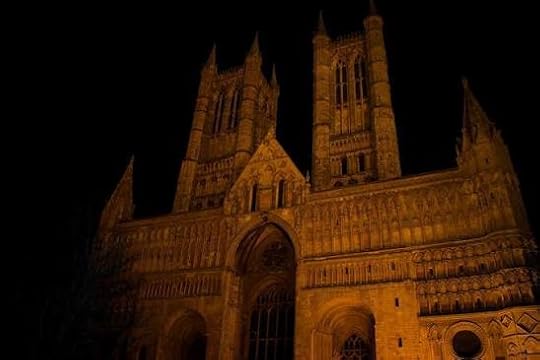
*Within my review are the images of author William Golding & that of the Salisbury Cathedral in Wiltshire at sunset.
The novel represents a commentary that is both perplexing & dispiriting at times, while also being a structurally fascinating work that attempts to illuminate the fine line between divine inspiration & human obsession on the part of the main character Jocelin, the cathedral's dean & driving force to erect a spire that would stand for all time as "a prayer in stone".
In addition to cost overruns that can't be justified by Jocelin's grand "vision", a fractious master builder named Roger Mason & other characters who are not in sync with the plan to erect the spire, one that would be seen as the epicenter of the town & visible by neighboring towns as well, Jocelin is visited by competing forces of both an angel and the devil.
Jocelin envisions the cathedral as "the only refuge from evil, a stone ship, an ark to contain all these people & now fitted with a mast." At the same time, the cathedral is seen by others as more of a pagan temple than a Godly space.
However, as the spire is gradually erected, a hole is dug that seems to point to the fragility of the cathedral's underpinnings, an insufficiency of the original beams, also revealing an array of crawling specimens below ground that make the place resemble a painting by Hieronymus Bosch. The author's verbal imagery is often stunning and the interplay between good & evil is quite reminiscent of The Lord of the Flies, Golding's best-known work.
The Spire is distinctly allegorical and there are many references to how the grand medieval cathedral resembles a human body both in structure & function. Workers curse & chant bawdy songs, oblivious to the building's continuing function as a place of worship & one even conducts a sexual liaison within the walls. Another places the model for the spire between his legs to taunt Pangall, the much-beleaguered caretaker of the cathedral, someone whose red-haired wife Goody, becomes the object of continuing lust on the part of the master builder, while also infecting the mind & dreams of Dean Jocelin.
For every foot a spire goes up above the church, an increased support system must be put in place below ground. And for every hope that the raising of a monumental steeple will glorify God by reaching toward heaven, there is corresponding, antithetical human depravity occurring below.
Day & night, acts of worship went on in the stink & the half dark, where the candles illuminated nothing but close halos of vapor; and the voices rose, in fear of age & death, in fear of weight & dimension, in fear of darkness & a universe without hope. "Lord, let our cry come unto thee!" There was a rumor of plague in the city. The number of faces--the strained, silent, shining eyed faces before the light that betoken the Host--increased to a crowd.The steeple venture has become "Jocelin's Folly" and at one point as he heard "the distant jeering of workmen, he understood what an alehouse joke it must seem to see the dean himself in the midst of the model for the spire." Jocelin suddenly realizes that "renewing life of the world was a filthy thing, a rising tide of muck, so that he gasped for air." Even some of the gargoyles "seemed diseased as they yelled their soundless blasphemies & derisions into the wind."
But Jocelin never joined them, since his own angel sometimes came to comfort, warm & sustain him. But like a good general, he saw that they needed help; for even to him, his instruments, these people he had to use, seemed little more than apes now that clambered about the building.
He had the model of the cathedral brought to the crossways & stood against a pillar, spire & all to encourage them. The model seemed the only clean thing in the building, though a finger that touched it, came away wet."
Oddly perhaps, there is little sense of ongoing religious services within the church amidst scaffolding, dust & building materials during the endeavor to raise the spire; in fact the cathedral seems spiritually bereft as construction proceeds. Jocelin continues to see the cathedral as "a diagram in prayer & our spire will be a diagram of the highest prayer of all."
Meanwhile, Roger Mason, the master builder has become a kind of prisoner of Jocelin, proceeding against his better judgment & envisions the 4 columns opening apart & "everything--wood, stone, iron, glass & men on the scaffolds sliding down into the church, like the fall of a mountain." With it all, he views the spire as a "dunces cap." The master builder pointedly asks Jocelin: "Are you the devil?"
The concept of a cathedral spire piercing the sky as a spiritual as well an architectural statement is a metaphor of longstanding. I thought of the line from Robert Browning's poem, "A man's reach should extend his grasp, or what is a heaven for?" With William Golding's The Spire, there seems irretrievable space between the reach & the grasp, an obsessive descent rather than an uplifted "prayer in stone".
That said, the telling of this tale is at times magical but almost always frustratingly dark & cheerless. I grasp why a few reviewers found the novel disappointing & even confounding to read but there is also ample reward for the reader's perseverance with this & other Golding novels.
In 1969 I visited the Salisbury Cathedral, not long after my initial reading of The Spire, the great cathedral seeming as bewilderingly bleak as Dean Jocelin's character, with homeless people using the space as a refuge and a not unfaint odor of urine throughout. On another visit some years later & after a thorough renovation of the cathedral, it seemed reborn, a far more sanitary if not spotless space & a newly inaugurated site for concerts if not frequently for serious prayer.
Such places, even if not always viewed as religious temples stand as spiritual repositories for many, as with the case of the incinerated Cathedral of Notre Dame in Paris & the immediate longing for its rebirth, even by many who seldom if ever attend mass there. Such religious edifices do cause us to look skyward, to dream & even to pray, each of us, regardless of our personal stance on the
concept of a supreme being, perhaps rekindling our own individual quest or hope for the future.
*Within my review are the images of author William Golding & that of the Salisbury Cathedral in Wiltshire at sunset.

April 21, 2020
I bought my copy of this last year at the Waterstones in Salisbury, after touring the cathedral and walking past Bishop Wordsworth's School, where Golding taught from 1945 to 1962.
Like Lord of the Flies, the only other of Golding's novels I've read, this is an intense study of extreme behavior, in this case of Dean Jocelin's obsession to build a spire atop the medieval cathedral over which he presides, that already is too heavy for its fragile and shifting foundation. Convinced that he has been chosen by God to lead this project, Jocelin sacrifices everything and everyone around him in his quest to complete the work before a growing array of opposing forces can stop it.
Although there are occasional passages of exquisite description, a great deal of the story takes place in Jocelin's head. Because of this, and because of the ever-building sense of foreboding, I was surprised to find myself feeling claustrophobic at times during my reading.
I didn't really enjoy the experience of the book, but I found it interesting.
The Spire
Like Lord of the Flies, the only other of Golding's novels I've read, this is an intense study of extreme behavior, in this case of Dean Jocelin's obsession to build a spire atop the medieval cathedral over which he presides, that already is too heavy for its fragile and shifting foundation. Convinced that he has been chosen by God to lead this project, Jocelin sacrifices everything and everyone around him in his quest to complete the work before a growing array of opposing forces can stop it.
Although there are occasional passages of exquisite description, a great deal of the story takes place in Jocelin's head. Because of this, and because of the ever-building sense of foreboding, I was surprised to find myself feeling claustrophobic at times during my reading.
I didn't really enjoy the experience of the book, but I found it interesting.
The Spire

October 7, 2024
سودای برپاداشتن برجی که به حریم آسمان راه یابد، در تاریخ و ادبیات، پیشینهای کهنه دارد. از برج بابل گرفته تا نمایشنامهی برند اثر ایبسن و نیز نمایشنامهی صخره اثر الیوت که معتقد بود استفاده و تکرار اسطوره در ادبیات، دستاویزی جهت ضبط تداوم حالات و احساسات و تجارب انسانی در ادوار مختلف است.
جاسلین، کشیش عالیرتبهای است که طبق قولی که به پدران و اجداد خود داده و موظف به عمل کردن به آن است، برجی را بسازد که به اراده خدا قرار است ساخته شود و حتی در این راه از دادن قربانی هم باکی ندارد. چون پایههای کلیسای جامع چندان مقاوم نیستند و ممکن است تحمل بار اضافه برای ساختن برج را نداشته باشند. ولی او دیگران را بدعتگذار نامیده و واقعیت را مطابق انچه که خود میداند، نشان میدهد.
جاسلین، کشیش عالیرتبهای است که طبق قولی که به پدران و اجداد خود داده و موظف به عمل کردن به آن است، برجی را بسازد که به اراده خدا قرار است ساخته شود و حتی در این راه از دادن قربانی هم باکی ندارد. چون پایههای کلیسای جامع چندان مقاوم نیستند و ممکن است تحمل بار اضافه برای ساختن برج را نداشته باشند. ولی او دیگران را بدعتگذار نامیده و واقعیت را مطابق انچه که خود میداند، نشان میدهد.

August 9, 2015
I have loved Lord of the Flies since we read it in English Literature class at school and have read it again a couple of times since. It occurred to me a few days ago that, despite my love of Lord of the Flies it has never even entered my head to try any other William Golding books. With this in mind, I bought Golding’s fifth novel The Spire.
Set in the twelfth century A.D. (or C.E. or whatever you want to call it), this fantastic novel tells the story of Dean Jocelin of a cathedral that I’m pretty sure is supposed to be Salisbury Cathedral and his single-minded obsession with adding a 400 foot spire to the building. The trouble with this is that this is physically impossible, as the master builder he has hired to do the work keeps trying to tell him, due to the foundations of the cathedral not being deep enough to support the extra load.
Unfortunately for virtually everybody involved, Jocelin believes he has been chosen by God to build this spire and refutes every logical argument and explanation by the master builder with the classic ‘it will stand because God wills it so’. The master builder’s problem, of course, is that he can’t refute this without being burned as a heretic (or whatever the punishment was for being a heretic in twelfth century England… I could look it up but sod it).
There are a number of other elements introduced into this plot and various twists and developments, but I can’t go into these without giving away spoilers, so I won’t. The crux of the novel is Jocelin’s descent into madness, which is extremely harrowing. Golding writes this in such a way that the reader is carried downward into the deepening pit of Jocelin’s insanity and, I have to say, there were a few times when I had to put the book down and go and reflect on what I’d just read and/or just take a huge lungful of sanity before I immersed myself in the book once more. I actually went back and re-read chapters a couple of times to make sure I’d actually understood what was going on, both plot-wise and symbolically.
I really can’t emphasise enough how visceral this experience is. Maybe it’s just me but I was completely swept up in Golding’s amazing writing. I don’t want to give the ending away, but those of you who only want to read books with happy endings should probably avoid this one.
P.S. – The Audible audiobook version of this book is read by Benedict Cumberbatch and his performance is absolutely incredible. I can honestly say that I have never read an audiobook with a better performance than this. If you’re a fan of audiobooks or Mr. Cumberbatch, you really are missing out if you don’t get hold of this audiobook.
Set in the twelfth century A.D. (or C.E. or whatever you want to call it), this fantastic novel tells the story of Dean Jocelin of a cathedral that I’m pretty sure is supposed to be Salisbury Cathedral and his single-minded obsession with adding a 400 foot spire to the building. The trouble with this is that this is physically impossible, as the master builder he has hired to do the work keeps trying to tell him, due to the foundations of the cathedral not being deep enough to support the extra load.
Unfortunately for virtually everybody involved, Jocelin believes he has been chosen by God to build this spire and refutes every logical argument and explanation by the master builder with the classic ‘it will stand because God wills it so’. The master builder’s problem, of course, is that he can’t refute this without being burned as a heretic (or whatever the punishment was for being a heretic in twelfth century England… I could look it up but sod it).
There are a number of other elements introduced into this plot and various twists and developments, but I can’t go into these without giving away spoilers, so I won’t. The crux of the novel is Jocelin’s descent into madness, which is extremely harrowing. Golding writes this in such a way that the reader is carried downward into the deepening pit of Jocelin’s insanity and, I have to say, there were a few times when I had to put the book down and go and reflect on what I’d just read and/or just take a huge lungful of sanity before I immersed myself in the book once more. I actually went back and re-read chapters a couple of times to make sure I’d actually understood what was going on, both plot-wise and symbolically.
I really can’t emphasise enough how visceral this experience is. Maybe it’s just me but I was completely swept up in Golding’s amazing writing. I don’t want to give the ending away, but those of you who only want to read books with happy endings should probably avoid this one.
P.S. – The Audible audiobook version of this book is read by Benedict Cumberbatch and his performance is absolutely incredible. I can honestly say that I have never read an audiobook with a better performance than this. If you’re a fan of audiobooks or Mr. Cumberbatch, you really are missing out if you don’t get hold of this audiobook.

March 1, 2015
What you can notice immediately about a novel like this is that it has nothing to do with today's shabby 'historical fiction' trend. Such books merely transpose today's sensationalism to a remote timeperiod; but deliver nothing more than the same tawdry pot-boiler melodramas we're familiar with from cable-TV.
'The Spire' is, in fact, literature; in that Golding exposes a forgotten way of life which heretofore has had little light shed upon it. He makes his scenario as authentic as possible, and (most important) he uses whatever rigor (in language) is called for. He doesn't toss off convenient, easy reading for modern audiences. He won't hold your hand; he cleaves very tightly to his history and his historical characters.
Golding respects the way medieval individuals actually might have thought, felt, or spoken in their world --not in ours. He 'keeps faith' with them; even though this renders them awkward and unfamiliar to our eyes and ears. It is difficult material; but Golding conquered it in the writing and you must conquer it in the reading. That is the arrangement here. You keep up with him, rather than him pandering to you. It's refreshing in that respect.
Now. All that being acknowledged, what else can be said about Golding's storytelling, his technical manner of prose? What is the sum worth of reading this particular book? After all, he has numerous others. Why choose this one? What does it have to offer the modern reader?
First, you can quickly see (when you read a few pages of any of Golding's books) that he exercises a very unbridled, powerful, 'coursing' style of prose. Its a cataract. A dense, choppy, churning, frothing river of words; running together in a mass. It gives the reader a 'pummeling' sensation because the flow is hardly ever relieved by any pauses, beats, or changes-in-tempo. It can be overwhelming--this, even when the content is engaging and the characters likeable.
Mark ye well: this 'coarse' style did not prevent Golding from winning numerous international literary prizes. Golding enjoys one of the finest reputations in English letters. Besides his audacious ideas, (their variety, their execution) his prose is considered one of his many strengths even taken at blank, face-value. His 'forceful' and 'torrential' style of text has won him many fans. Lots of readers enjoy his narrative voice, no matter what type-of-scene Golding happens to be describing. But will everyone appreciate it? No.
Some readers today may find it daunting; especially here in this strange 'religious novel' which has a lot of content which isn't particularly appealing. Muscular prose was adequate to Golding's purpose in, 'The Inheritors' (that tale describes neanderthals). It was adroit in 'Lord of the Flies' (a band of boys reverting to primitivism). Both these stories deal with 'extreme' situations and rough-hewn prose didn't hinder Golding at all in his exploration of either of his themes there. Both are still enjoyable readings experiences.
But unfortunately, 'The Spire' is much less savory. It really has no appealing characters at all. Every character in the story is rather slimy and vile. There's just no one to really admire in this tale. It's a struggle to 'care deeply about' these figures. Therefore, Golding's unforgiving, 'brutalist' narration, doesn't help matters any.
Next: the synopses on the rear-cover of 'The Spire' are misleading in several respects. Sure--as we know from Ken Follett's 'Pillars of the Earth'-- interest in medieval architecture can be awakened very keenly in readers today. But the cathedral-building in 'Spire' is just a backdrop to a story of medieval mindsets in general. Furthermore, the purported "battle-of-wills" between the clergyman and the 'architect' in this story is much less than what is promised.
Instead, what you get is a rather sticky, treacly, hysterical interregnum of complicated clerical relationships (issues betwixt priest & priest, priest & angels, priest & visions, priest & midwives, priest & benefactor, priest & cardinals). Furthermore--since this is the "Dark Ages"--whenever there's a quarrel, everyone is constantly bowing, genuflecting, begging forgiveness-for-an-unkind-thought; asking for pardon; poised on the verge of tears, or worrying about the purity of their faith.
It's kind of a feverish, high-strung litany, dwelling--at painful length-- on a rather sickly mishmash of personal tribulations and angsts. Although Golding doesn't falter anywhere in his exploration of medievalism, it is still not a very pleasant book to read. It is not a yarn I wager anyone would wish to read twice. It's just not an enjoyable tale; and I'm at a loss to explain how no less than Anthony Burgess marked it down as one of the top novels of the century.
This is one of those very odd cases where a first-rate author has penned a book which is highly-estimable; but just not very likable.
'The Spire' is, in fact, literature; in that Golding exposes a forgotten way of life which heretofore has had little light shed upon it. He makes his scenario as authentic as possible, and (most important) he uses whatever rigor (in language) is called for. He doesn't toss off convenient, easy reading for modern audiences. He won't hold your hand; he cleaves very tightly to his history and his historical characters.
Golding respects the way medieval individuals actually might have thought, felt, or spoken in their world --not in ours. He 'keeps faith' with them; even though this renders them awkward and unfamiliar to our eyes and ears. It is difficult material; but Golding conquered it in the writing and you must conquer it in the reading. That is the arrangement here. You keep up with him, rather than him pandering to you. It's refreshing in that respect.
Now. All that being acknowledged, what else can be said about Golding's storytelling, his technical manner of prose? What is the sum worth of reading this particular book? After all, he has numerous others. Why choose this one? What does it have to offer the modern reader?
First, you can quickly see (when you read a few pages of any of Golding's books) that he exercises a very unbridled, powerful, 'coursing' style of prose. Its a cataract. A dense, choppy, churning, frothing river of words; running together in a mass. It gives the reader a 'pummeling' sensation because the flow is hardly ever relieved by any pauses, beats, or changes-in-tempo. It can be overwhelming--this, even when the content is engaging and the characters likeable.
Mark ye well: this 'coarse' style did not prevent Golding from winning numerous international literary prizes. Golding enjoys one of the finest reputations in English letters. Besides his audacious ideas, (their variety, their execution) his prose is considered one of his many strengths even taken at blank, face-value. His 'forceful' and 'torrential' style of text has won him many fans. Lots of readers enjoy his narrative voice, no matter what type-of-scene Golding happens to be describing. But will everyone appreciate it? No.
Some readers today may find it daunting; especially here in this strange 'religious novel' which has a lot of content which isn't particularly appealing. Muscular prose was adequate to Golding's purpose in, 'The Inheritors' (that tale describes neanderthals). It was adroit in 'Lord of the Flies' (a band of boys reverting to primitivism). Both these stories deal with 'extreme' situations and rough-hewn prose didn't hinder Golding at all in his exploration of either of his themes there. Both are still enjoyable readings experiences.
But unfortunately, 'The Spire' is much less savory. It really has no appealing characters at all. Every character in the story is rather slimy and vile. There's just no one to really admire in this tale. It's a struggle to 'care deeply about' these figures. Therefore, Golding's unforgiving, 'brutalist' narration, doesn't help matters any.
Next: the synopses on the rear-cover of 'The Spire' are misleading in several respects. Sure--as we know from Ken Follett's 'Pillars of the Earth'-- interest in medieval architecture can be awakened very keenly in readers today. But the cathedral-building in 'Spire' is just a backdrop to a story of medieval mindsets in general. Furthermore, the purported "battle-of-wills" between the clergyman and the 'architect' in this story is much less than what is promised.
Instead, what you get is a rather sticky, treacly, hysterical interregnum of complicated clerical relationships (issues betwixt priest & priest, priest & angels, priest & visions, priest & midwives, priest & benefactor, priest & cardinals). Furthermore--since this is the "Dark Ages"--whenever there's a quarrel, everyone is constantly bowing, genuflecting, begging forgiveness-for-an-unkind-thought; asking for pardon; poised on the verge of tears, or worrying about the purity of their faith.
It's kind of a feverish, high-strung litany, dwelling--at painful length-- on a rather sickly mishmash of personal tribulations and angsts. Although Golding doesn't falter anywhere in his exploration of medievalism, it is still not a very pleasant book to read. It is not a yarn I wager anyone would wish to read twice. It's just not an enjoyable tale; and I'm at a loss to explain how no less than Anthony Burgess marked it down as one of the top novels of the century.
This is one of those very odd cases where a first-rate author has penned a book which is highly-estimable; but just not very likable.
May 25, 2025
I read the Goodreads review by Quo and instantly bought this book online. As a charity shop delver this was out of character. But the review was detailed and evocative and I am glad I bought it. The only previous work by the author I had read was many moons ago - The Lord of the Flies.
The Spire tells the story of Jocelyn, a Cathedral Dean, who wants to build a tower. The issue being that the Cathedral has little in the way of foundations. The addition of the tower will likely cause it to fall. Even Roger Mason the builder has his doubts on the success of the venture.
I had read Pillars of the Earth by Ken Follett about the building of an entire Cathedral which was more detailed on the actual build. The Spire is not like the Follett work. This is more a focus on Jocelyn. A man driven by his dream. With demons of his own driving him. Enjoyed the book immensely and managed to get another Golding…at a Charity shop.
Ps if you want to read a decent review search out that by Quo😉👍
The Spire tells the story of Jocelyn, a Cathedral Dean, who wants to build a tower. The issue being that the Cathedral has little in the way of foundations. The addition of the tower will likely cause it to fall. Even Roger Mason the builder has his doubts on the success of the venture.
I had read Pillars of the Earth by Ken Follett about the building of an entire Cathedral which was more detailed on the actual build. The Spire is not like the Follett work. This is more a focus on Jocelyn. A man driven by his dream. With demons of his own driving him. Enjoyed the book immensely and managed to get another Golding…at a Charity shop.
Ps if you want to read a decent review search out that by Quo😉👍

November 28, 2020
This novel of 1964 by the inestimable William Golding (of Lord of the Flies fame) tackles a familiar pillar of modern life by showcasing it from 800 years ago.
The themes? Religion and madness.
Indeed, this is quite a novel of our age. First, build a barely adequate church with a minimal foundation and then try to make it rise to the heavens like a ghetto retelling of the Tower of Babel.
When people tell you it can't be done but you hold all the cards and can have them burned as heretics for denying your will, you MAY or MAY NOT descend into madness while trying to twist yourself into knots trying to make reality conform to your will.
It sounds VERY modern, doesn't it?
I like the idea. I really do. But honestly, I kept trying to read this as a wonderfully biting satire and it really didn't QUITE go in that direction. A finger rising toward the sky, to me, sounded like a *middle* finger. All the wonderfully strange descriptions of these people as they do relatively normal things truly delighted me, too, but then the rest of the novel became something of a sermon.
In other words, it was kind of a mixed bag for me. If I read it like a classic novel in its own right, I'd still be trying to compare it to the better Pillars of Earth or even a bit of Thornbirds, but in the end, it just felt like a criticism of the *many* people who rationalize their way into making everyone's lives a living hell.
Good, but not ALL that great. And I've read a lot of other books that do it just as well or better. So. Alas...
The themes? Religion and madness.
Indeed, this is quite a novel of our age. First, build a barely adequate church with a minimal foundation and then try to make it rise to the heavens like a ghetto retelling of the Tower of Babel.
When people tell you it can't be done but you hold all the cards and can have them burned as heretics for denying your will, you MAY or MAY NOT descend into madness while trying to twist yourself into knots trying to make reality conform to your will.
It sounds VERY modern, doesn't it?
I like the idea. I really do. But honestly, I kept trying to read this as a wonderfully biting satire and it really didn't QUITE go in that direction. A finger rising toward the sky, to me, sounded like a *middle* finger. All the wonderfully strange descriptions of these people as they do relatively normal things truly delighted me, too, but then the rest of the novel became something of a sermon.
In other words, it was kind of a mixed bag for me. If I read it like a classic novel in its own right, I'd still be trying to compare it to the better Pillars of Earth or even a bit of Thornbirds, but in the end, it just felt like a criticism of the *many* people who rationalize their way into making everyone's lives a living hell.
Good, but not ALL that great. And I've read a lot of other books that do it just as well or better. So. Alas...

November 10, 2017
Pretty good book. I would probably listen to it again just so I can hear Benedict Cumberbatch whisper in my ear. Yum!
This is the story of a clergyman who thinks he was given a divine message to build a spire on his church even though the builder warns against it. Soon the clergyman thinks he also hears the devil talking to him, too.
As he slips further into madness and the spire grows, we see how the actions of his congregation change without his guidance and how that effects him.
This is the story of a clergyman who thinks he was given a divine message to build a spire on his church even though the builder warns against it. Soon the clergyman thinks he also hears the devil talking to him, too.
As he slips further into madness and the spire grows, we see how the actions of his congregation change without his guidance and how that effects him.

October 22, 2011
A priest builds a spire on a cathedral according to a spiritual vision, believing it to be the calling of God and dependant upon his will and faith to bring it to completion, destroying his congregation, vocation and sanity in the process.
The prose is dense and disorientated, flashing between coherent thought, delirium, reality, reverie and nightmare. Certain themes and motifs are repeated throughout some of which hints at an understated, repressed sexuality. There is often reference in the narrative to previous scenes and conversations that were either only partially, or just inadequately depicted in the first instance, meaning that at times the story loses coherency, even descending into abject nonsense. This may be an attempt to portray the thin line between revelation and delusion existentially?
I realised half way through that I wasn't 'tuning in' or 'getting it', so I twice backtracked and reread whole chapters but it still left me frustrated, scratching my head and wondering what was going on!
Maybe I'm not that clever.
Maybe this requires a re-read and more effort to get into it.
I'll be doing neither.
One of the worse novels that I've read to date!

May 31, 2012
For some reason, four years ago when I originally wrote this review (or one like it), I chose to attach it to The Spire, not Darkness Visible or Pincher Martin or The Inheritors, all equally fine books whose influence on me was no less profound. The review, you see, was really of Golding, not of any single one of his books. It also included an ornery and unfair assessment of British writers in general, prefaced by a genteel insult of British writing by Raymond Chandler and a brief, confused argument as to why Golding was somehow different from the run-of-the-mill of bloated, hubristic Brits. Having jetissoned that useless baggage, I’ll try to focus on what it is that makes Golding great, despite his detractors (most if not all of them angry primarily because he won the Nobel Prize), and despite its having been years since I read more than a page or two of his prose.
As a high school student, I studied Lord of the Flies, then chose to make Golding’s other novels the focus of further study. What appealed to me most, I think, in Golding was his ability to write a kind of perceptual counterpoint – to have his protagonist consciously experience one thing while unconsciously experiencing another, yet to make the reader (or the canny reader) privy to both levels of perception. (The most famous example is probably the child visionary Simon’s witnessing the monster atop the hill in Lord of the Flies, a monster which the reader correctly identifies as a corpse tangled in a parachute. But this dual perception is everywhere in Golding, from the egotist priest Jocelyn’s “angel” astride his back to the shipwrecked sailor Pincher Martin’s entire “island” in the Atlantic.) This technique, I thought, could surely only work so well in prose; it helped me to see how a literal rendering of story (which film, the staple of my childhood, so often is) could lack in dimensions, dimensions which prose, a collaboration between writer and reader, could more fully explore. But if this were all Golding offered, maybe he would justly be maligned. (And the truth is, at times – in Pincher Martin, for example – he writes a kind of detective story, a build-up to the Big Reveal, which limits his scope.) These days, when I think back on Golding, I see a creator of myths, not creation myths but dark destruction myths. A vague word to use, I guess, but suited to his peculiar near-timeless semi-allegorical tales, which so often pit helpless humans (or pre-humans, in The Inheritors) against cosmic-seeming forces which turn out, often as not, to be intrinsic to humankind. And suited, too, to the sense that these tales, in their essential forms (ie: not so much as written but when called up later from memory), are like polished stones, the simplest parables which, maybe, should never have been extended into novels at all. (The novella, I suspect, would be the perfect vehicle for Pincher Martin, and would let that shocking, hellish, stark vision truly shine from its igneous core.)
Golding wrote (so he tells us) each of his early novels in a matter of weeks, after a long internal gestation period, and I think it shows. It’s both their greatest asset and their biggest fault, but it’s part of what makes them so different from the dominant strand (among major literary prizewinners) of intellectual writing. Golding, to me, is a primitive. Whether he knew this himself I don’t know, and his writing gives no clues (it’s far from self-conscious, opting instead for an immersive quality both old-fashioned – in its insistent naturalism – and modern – in its immediacy, like cinema imbibed via all the senses), but it’s part of what makes his novels seem elemental. Golding – and this is a surprise when you consider his novels from afar, since in synopsis they seem so conceptual – is a sensualist. Or maybe not, if a sensualist enjoys the physical. No, Golding does not revel in the physical, but he inhabits it, relentlessly. Lok’s feet grope and grip the ground just as Pincher Martin’s entire body grasps the rock; even Jocelyn the priest is held to earth by the pains in his deteriorating spine; and the kids in the jungle in Lord of the Flies are always and undoubtedly in the jungle. Golding is in many ways a philosophical writer, but his philosophy emerges from the action; the two are inseparable. Of course he’s limited, like all so-called primitives. Critics have noted how one-dimensional his style can seem when he ventures into certain areas (relationships between the sexes, social realism, contemporary settings), and despite his key novels (Lord of the Flies, The Inheritors, Pincher Martin, The Spire – all of them written in quick succession early in his career) being so far-removed from each other in terms of subject matter, there is a sense in which (like Stanley Kubrick) he seems to be mapping out various parts of the same, very Golding-esque universe.
But what do I care if he’s limited? Poe (the master) was limited. Borges, Kafka, Clarice Lispector. If the aim of a writer is mastery in all fields, Golding is a failure. If the aim is to focus, with singleminded intensity, on whatever haunts, fascinates or inspires, he’s a success. In the realm of language, too, he has his moments, when a previously-uncharted (or less-charted) realm of the sayable suddenly presents itself to his vision. (The opening of Pincher Martin is one such moment: “He was struggling in every direction, he was the centre of the writhing and kicking knot of his own body. There was no up or down, no light and no air. He felt his mouth open of itself and the shrieked word burst out.” Rarely have we been so in a protagonist during an action scene, thanks to physical, declarative prose.) Golding, like all great writers, is one of a kind. That he’s able to communicate his vision to the young, I think, is a key part of his talent; there were few experiences so mind-expansive to me as reading these books as a teenager (reading Hermann Hesse was another), and he did much to broaden my conception of what could be said in literature. I recommend The Spire because it caught my young man’s imagination, though I can’t guarantee it would retain its power over me now. The plot (unlike the plots of many – even most – novels) remains with me quite clearly, and the whole of it appears a kind of medieval tapestry when I think back on it, stylised and not quite real-seeming but alive with light. As an adult I read Darkness Visible and though I thought it suffered from stylistic defects (again, particularly in its contemporary realist setting) I felt the pulsing of something true and rarely uncovered in its depths. The other novels listed above are all well worth reading for anyone who saw value in Lord of the Flies, and even the patchy Free Fall and the blander late-period Rites of Passage left meaningful impressions on me. An idiosyncratic master.
As a high school student, I studied Lord of the Flies, then chose to make Golding’s other novels the focus of further study. What appealed to me most, I think, in Golding was his ability to write a kind of perceptual counterpoint – to have his protagonist consciously experience one thing while unconsciously experiencing another, yet to make the reader (or the canny reader) privy to both levels of perception. (The most famous example is probably the child visionary Simon’s witnessing the monster atop the hill in Lord of the Flies, a monster which the reader correctly identifies as a corpse tangled in a parachute. But this dual perception is everywhere in Golding, from the egotist priest Jocelyn’s “angel” astride his back to the shipwrecked sailor Pincher Martin’s entire “island” in the Atlantic.) This technique, I thought, could surely only work so well in prose; it helped me to see how a literal rendering of story (which film, the staple of my childhood, so often is) could lack in dimensions, dimensions which prose, a collaboration between writer and reader, could more fully explore. But if this were all Golding offered, maybe he would justly be maligned. (And the truth is, at times – in Pincher Martin, for example – he writes a kind of detective story, a build-up to the Big Reveal, which limits his scope.) These days, when I think back on Golding, I see a creator of myths, not creation myths but dark destruction myths. A vague word to use, I guess, but suited to his peculiar near-timeless semi-allegorical tales, which so often pit helpless humans (or pre-humans, in The Inheritors) against cosmic-seeming forces which turn out, often as not, to be intrinsic to humankind. And suited, too, to the sense that these tales, in their essential forms (ie: not so much as written but when called up later from memory), are like polished stones, the simplest parables which, maybe, should never have been extended into novels at all. (The novella, I suspect, would be the perfect vehicle for Pincher Martin, and would let that shocking, hellish, stark vision truly shine from its igneous core.)
Golding wrote (so he tells us) each of his early novels in a matter of weeks, after a long internal gestation period, and I think it shows. It’s both their greatest asset and their biggest fault, but it’s part of what makes them so different from the dominant strand (among major literary prizewinners) of intellectual writing. Golding, to me, is a primitive. Whether he knew this himself I don’t know, and his writing gives no clues (it’s far from self-conscious, opting instead for an immersive quality both old-fashioned – in its insistent naturalism – and modern – in its immediacy, like cinema imbibed via all the senses), but it’s part of what makes his novels seem elemental. Golding – and this is a surprise when you consider his novels from afar, since in synopsis they seem so conceptual – is a sensualist. Or maybe not, if a sensualist enjoys the physical. No, Golding does not revel in the physical, but he inhabits it, relentlessly. Lok’s feet grope and grip the ground just as Pincher Martin’s entire body grasps the rock; even Jocelyn the priest is held to earth by the pains in his deteriorating spine; and the kids in the jungle in Lord of the Flies are always and undoubtedly in the jungle. Golding is in many ways a philosophical writer, but his philosophy emerges from the action; the two are inseparable. Of course he’s limited, like all so-called primitives. Critics have noted how one-dimensional his style can seem when he ventures into certain areas (relationships between the sexes, social realism, contemporary settings), and despite his key novels (Lord of the Flies, The Inheritors, Pincher Martin, The Spire – all of them written in quick succession early in his career) being so far-removed from each other in terms of subject matter, there is a sense in which (like Stanley Kubrick) he seems to be mapping out various parts of the same, very Golding-esque universe.
But what do I care if he’s limited? Poe (the master) was limited. Borges, Kafka, Clarice Lispector. If the aim of a writer is mastery in all fields, Golding is a failure. If the aim is to focus, with singleminded intensity, on whatever haunts, fascinates or inspires, he’s a success. In the realm of language, too, he has his moments, when a previously-uncharted (or less-charted) realm of the sayable suddenly presents itself to his vision. (The opening of Pincher Martin is one such moment: “He was struggling in every direction, he was the centre of the writhing and kicking knot of his own body. There was no up or down, no light and no air. He felt his mouth open of itself and the shrieked word burst out.” Rarely have we been so in a protagonist during an action scene, thanks to physical, declarative prose.) Golding, like all great writers, is one of a kind. That he’s able to communicate his vision to the young, I think, is a key part of his talent; there were few experiences so mind-expansive to me as reading these books as a teenager (reading Hermann Hesse was another), and he did much to broaden my conception of what could be said in literature. I recommend The Spire because it caught my young man’s imagination, though I can’t guarantee it would retain its power over me now. The plot (unlike the plots of many – even most – novels) remains with me quite clearly, and the whole of it appears a kind of medieval tapestry when I think back on it, stylised and not quite real-seeming but alive with light. As an adult I read Darkness Visible and though I thought it suffered from stylistic defects (again, particularly in its contemporary realist setting) I felt the pulsing of something true and rarely uncovered in its depths. The other novels listed above are all well worth reading for anyone who saw value in Lord of the Flies, and even the patchy Free Fall and the blander late-period Rites of Passage left meaningful impressions on me. An idiosyncratic master.

July 20, 2015
May be three and half stars.
On the surface, the plot looks very simple. Nepotism plays a main role in placing a less qualified person as a Dean of a Cathedral. The Dean considers it as his Call. Later as a Dean he has a vision and wants to transform the vision into a reality by building a spire to the cathedral. This is an impossible undertaking for the Cathedral is on a marshy land and does not have the foundation necessary to hold a spire of 400 feet. Everyone is against. The Deans considers it his Call and goes ahead. This foolish attempt is always referred to as Dean's Folly.
The plot looks very simple. But the difference is in the language which is laced with much symbolism. That played villain to me. I love symbolic language and subtle allusions. But here I found it a bit too much. I was caught between the plot and the symbols. Many times I found myself losing track - either I followed up an image or ended up following the plot. Thus resulting in lot of confusions. May be, the folly was mine.
For instance, I found allusions to Life of Christ; Life of Faith; Prayer; Life as a Building; etc.
A re-read of the novel, may be, after few more years might help me better.
On the surface, the plot looks very simple. Nepotism plays a main role in placing a less qualified person as a Dean of a Cathedral. The Dean considers it as his Call. Later as a Dean he has a vision and wants to transform the vision into a reality by building a spire to the cathedral. This is an impossible undertaking for the Cathedral is on a marshy land and does not have the foundation necessary to hold a spire of 400 feet. Everyone is against. The Deans considers it his Call and goes ahead. This foolish attempt is always referred to as Dean's Folly.
The plot looks very simple. But the difference is in the language which is laced with much symbolism. That played villain to me. I love symbolic language and subtle allusions. But here I found it a bit too much. I was caught between the plot and the symbols. Many times I found myself losing track - either I followed up an image or ended up following the plot. Thus resulting in lot of confusions. May be, the folly was mine.
For instance, I found allusions to Life of Christ; Life of Faith; Prayer; Life as a Building; etc.
A re-read of the novel, may be, after few more years might help me better.

January 18, 2026
Mese az emberi hübriszről, arról, hogy milyen, amikor valakit saját "akarata húz karóba". Jocelin, a Miasszonyunk Székesegyház dékánja mer nagyot álmodni: elhatározza, hogy megépíti az akkori világ legmagasabb katedrálisát, amelynek négyszáz láb magas csúcsa majd a Jóisten köldökéig ér. Természetesen egy ember sem akad széles e vidéken, aki hinni tudna a sikerben, hisz hiányzik a megfelelő alapozás, a pillérek pedig minden emberi számítás szerint összeroskadnak majd a súly alatt. De Jocelin jobban tudja, neki konkrétan a Magasságos küld üzenetet, úgyhogy minden észszerű ellenvetést visszadob azzal, hogy: "Csekély a hited, barátom. De azért szeretlek." A jó szándék vezérli, ez világos, a végtelen hit, hogy az Úr nevében cselekszik, de ez a végtelen hit vakká teszi. Következésképp még egy micimackói kvalitásokkal rendelkező olvasó is érzi már a harmincadik oldalon, hogy ennek nem lesz jó vége, a templom alighanem apokaliptikus körülmények közt hull darabokra. Ám Golding ettől függetlenül írja tovább a fejezeteket, egyre mélyíti Jocelin válságát, szaporodó konfliktusait a világ többi részével. Ilyen értelemben kicsit maga is Jocelinre emlékeztet, csak az ő katedrálisa az irodalmi szöveg, magjában a morális tanmesével, azt építené az égig.
Abszolút jogos a felvetés, hogy meglehetősen körülményes regény ez, ami újra és újra kifejt olyan tételeket, amelyeket lényegében már tudunk, legfeljebb új színeket kever hozzá. De ezzel együtt azért figyelemreméltó szöveg, főleg mert lenyűgözőek ezek a költői, helyenként látomásos prózában megírt fejezetek, amelyekben a szerző egyre mélyebbre toszogtatja Jocelint privát zsákutcájába, ahonnan aztán nem lehet kifarolni. Nem könnyen olvasható, az igaz, de jó sok nyelvi erő van benne.

November 12, 2016
Golding’s The Spire is an extraordinary novel—though uneven, I felt, in the same way as his Rites of Passage. The first two thirds or three quarters, while the spire is thrusting its improbable way to the heavens, is startlingly good: a poem of a novel, almost Blake-like in its fierce, odd, visionary, lyric language. The ending, for me, came untuned rather, but in a way that helped illustrate what a remarkable balancing act Golding pulls off in that great, prolonged opening sequence.
Golding taught for years (1945-61) at Bishop Wordsworth’s School, in the shadow of Salisbury Cathedral, and the tale of the building of the spire, strange and dream-like though it is in the telling, has historical roots. I was surprised to learn that some of the most dramatic and alarming elements in the fictional cathedral’s physical geography, such as the shallowness and marshiness of its foundations—brilliantly exploited by Golding at a literal and metaphorical level—are factually true of Salisbury Cathedral. The lunatic venture of piling up the second-highest spire in Europe on such a precarious base was one that Salisbury’s anonymous masons did actually undertake, in the early fourteenth century. The swaying, creaking, leaning pillar-crushing monstrosity that Golding portrays as the result of his fictional Dean Jocelin’s madness is the serenely beautiful landmark we know from Constable’s paintings. Christopher Wren, brought in for restoration in the 1680s, found the spire leaning almost 30 inches from the vertical and slowly crushing the ancient pillars on which it stood.
The Spire is told in third person, but focalized strictly, stream of consciousness-style, through the remarkable, unhinged mind of Jocelin: a psychological twin for the murky, marshy depths uncovered beneath the cathedral floor. (Golding likes his Freud; not for nothing is this a novel about a spire.) A spare selection of characters are ranged around Jocelin’s wounded, flailing, ecstatic consciousness, and they complement him well, especially the brilliant, tormented architect Roger Mason and his shrewish wife Rachel (shrewish in Jocelin’s perspective, at least; Golding is too adept at maintaining his focalizing character’s point of view for us to have any confidence that Jocelin’s vision of these characters would bear any resemblance to how we might see them ourselves.)
I was intrigued to see that Franck Kermode had reviewed The Spire for the New York Review of Books when it first came out in 1964. I looked it up, and it’s a great review, especially perceptive on the power of Golding’s language and the violence of his vision. Here’s the close of the review, expressing sentiments I shared exactly: “It is remote from the mainstream, potent, severe, even forbidding. And in its way it is, quite simply, a marvel.”
Golding taught for years (1945-61) at Bishop Wordsworth’s School, in the shadow of Salisbury Cathedral, and the tale of the building of the spire, strange and dream-like though it is in the telling, has historical roots. I was surprised to learn that some of the most dramatic and alarming elements in the fictional cathedral’s physical geography, such as the shallowness and marshiness of its foundations—brilliantly exploited by Golding at a literal and metaphorical level—are factually true of Salisbury Cathedral. The lunatic venture of piling up the second-highest spire in Europe on such a precarious base was one that Salisbury’s anonymous masons did actually undertake, in the early fourteenth century. The swaying, creaking, leaning pillar-crushing monstrosity that Golding portrays as the result of his fictional Dean Jocelin’s madness is the serenely beautiful landmark we know from Constable’s paintings. Christopher Wren, brought in for restoration in the 1680s, found the spire leaning almost 30 inches from the vertical and slowly crushing the ancient pillars on which it stood.
The Spire is told in third person, but focalized strictly, stream of consciousness-style, through the remarkable, unhinged mind of Jocelin: a psychological twin for the murky, marshy depths uncovered beneath the cathedral floor. (Golding likes his Freud; not for nothing is this a novel about a spire.) A spare selection of characters are ranged around Jocelin’s wounded, flailing, ecstatic consciousness, and they complement him well, especially the brilliant, tormented architect Roger Mason and his shrewish wife Rachel (shrewish in Jocelin’s perspective, at least; Golding is too adept at maintaining his focalizing character’s point of view for us to have any confidence that Jocelin’s vision of these characters would bear any resemblance to how we might see them ourselves.)
I was intrigued to see that Franck Kermode had reviewed The Spire for the New York Review of Books when it first came out in 1964. I looked it up, and it’s a great review, especially perceptive on the power of Golding’s language and the violence of his vision. Here’s the close of the review, expressing sentiments I shared exactly: “It is remote from the mainstream, potent, severe, even forbidding. And in its way it is, quite simply, a marvel.”

November 30, 2013
I think it's possible to measure (to some extent) a great piece of writing by how large it looms in your psyche. This book and the religious hubris of its main character seemed to take up residence in my dreams from the moment I started reading it. It is a book packed with metaphor, and although written in the third person, it is fully inhabited by the main character Jocelyn's mental landscape. He is a man obsessed by a vison and a charge, which he is convinced has been placed on him by God, to erect a huge spire atop an already existing cathedral. This building lacks the necessary foundations that might be considered sufficient for such a vast undertaking, and against the advice of Roger Mason (the master builder in charge of the project), wisdom and sanity, Jocelyn forces through what he believes to be God's will. He is a man who feels as if he's supported by an angel, yet at the same time is tormented by demons. The book, although written in linear time, has a nightmarish quality, and an out of sync feel about it - just as the main character's clarity of purpose is unbalanced by obsession.
Serious stuff, superb writing.
Serious stuff, superb writing.

November 21, 2021
This is a story about a mans obsession destroys him. Dean Jocelyn is driven insane by his vision of building a 400 foot tall tower above his church. Apparently based on Salisbury Cathedral. He bankrupts his church, alienates his brethren and persuades the master builder to continue his folly.
The tower for the spire is also constructed on a unstable foundation. To add to the mix Jocelyn sees an angel instructing him to build the spire for God. Yet, the Dean knows about the murder of Pangall as a form of sacrifice by the builders to ensure the Tower will not collapse. He convinces himself he did not see the murder and this also contributes to his madness.
The novel is full of symbolism and powerful in the metaphor of the cathedral as a person. In the end the dust Jocelyn sees on his deathbed is symbolic of where we all return too as will the Cathedral one day.
The tower for the spire is also constructed on a unstable foundation. To add to the mix Jocelyn sees an angel instructing him to build the spire for God. Yet, the Dean knows about the murder of Pangall as a form of sacrifice by the builders to ensure the Tower will not collapse. He convinces himself he did not see the murder and this also contributes to his madness.
The novel is full of symbolism and powerful in the metaphor of the cathedral as a person. In the end the dust Jocelyn sees on his deathbed is symbolic of where we all return too as will the Cathedral one day.
This entire review has been hidden because of spoilers.

December 19, 2022
من این کتاب رو خیلی دوست داشتم چون همیشه تقابل عقل و ایمان برام جذاب بوده...
داستان کتاب درباره کشیشیست که تصمیم میگیره برجی به طبقه کلیسا اضافه کند. ✝️
او تصور میکند که این تصمیم را به اراده خداوند گرفته است، او بنده برگزیده خداست و هرطور شده باید این برج را هر چند خلاف عقل و منطق بشری است، بسازد. حتی از دادن قربانی و بروز فاجعه بیم ندارد و باور دارد که این تاوانیست که باید برای فرمانبرداری از دستور خداوند بپردازد.
داستان کتاب درباره کشیشیست که تصمیم میگیره برجی به طبقه کلیسا اضافه کند. ✝️
او تصور میکند که این تصمیم را به اراده خداوند گرفته است، او بنده برگزیده خداست و هرطور شده باید این برج را هر چند خلاف عقل و منطق بشری است، بسازد. حتی از دادن قربانی و بروز فاجعه بیم ندارد و باور دارد که این تاوانیست که باید برای فرمانبرداری از دستور خداوند بپردازد.

May 28, 2009
The worst! I challenge everybody out there to read it and find something to like about it!

June 14, 2015
Day and night, acts of worship went on in the stink and half dark, where the candles illuminated nothing but close haloes of vapour; and the voices rose, in fear of age and death, in fear of weight and dimension, in fear of darkness and a universe without hope. (50)
I first read The Spire in my sophomore year of college. The course was ENGL 200 - "The Literary Experience" - in which we were to read a sampling of fiction, nonfiction, poetry, and drama. The Spire was our example of a novel. The professor told us up front what the major metaphor/motif was: the church spire Dean Jocelin struggles to raise is a phallic symbol. It's a penis. We all giggled.
This was my first dedicated close read, and the class inspired me to change my major—out of Math, realm of predictable symmetry and the elegant proof, and into English, with all its accompanying mess of human life and emotion. For the first time I understood symbolism more deeply than "Piggy's glasses = civilization" and "the spire = a penis." In all my classes before, I had been taught that symbolism in literature followed a simple this-for-that substitution and could be boiled down nicely for multiple choice exams. But The Spire was different. Felt different. In this story of misguided ambition and sublimated desire, poetically written and shot through with evocative imagery, I felt moved, powerfully, by Golding's prose. For the first time, I really connected with a passionate expression of the human condition. As I grow older, I appreciate more and more Golding and his hoary old cynical persona. I've read Lord of the Flies a half-dozen times, and marked up the margins with notes and connections and asterisks and exclamation points. Golding has a way, for me, of moving beyond plot and into the murky depths of theme. And though I've revisited The Spire far less often, it only gains meaning as I grow older and experience for myself the passing of time, the loss of youthful virility, the frustration of childhood goals not attained.
5 stars out of 5. Perhaps it is not the most engaging story, but for me it marks my very first exposure to true literary art and the seed from which my pretentious reading habit grew.

August 18, 2016
William Golding deyince insanın aklına hemen "Sineklerin Tanrısı" geliyor. Hadi en iyi ihtimalle "Piramit" gelsin. Ama "Kule" gelmez. Herkes Sineklerin Tanrısı 'na tapar. Amanda efenim ne de güzel kitaptır o değil mi? Şimdiden klasikleşmiştir. İşte ben Golding olsam Sineklerin Tanrısı'ndan nefret ederdim. Böyle bir şaheserle çıkmak piyasaya ve sonrasında da ömrün boyunca sadece bir kerecik tadabildiğin başarıyı yakalamaya çalışmak.... Dünyanın en zor işi. O kadar roman yaz, hepside birbirinden güzel olsun, ama hepsi de zamanında yazdığın bir romanın gölgesinde kalsın.
Neyse efendim, biz romanımıza dönelim.
Kule; evet bir Sineklerin Tanrısı değil. Ancak şu takıntıdan kurtulalım artık. Bu başka bir roman. (Nasıl da kendi takıntımı sizlere mal ettim ama:)
Bu kez bir manastırdayız. Bir baş rahibimiz var. Adı Jocelin. Şahsi yorumumu şimdiden söyleyeyim. Bence bu adam delinin teki. Yaşlandıkça ve Hıristyanlık aleminde yükseldikçe kafayı yemiş. Bir meleği var. (Kim bilir hangi psikolojik rahatsızlıktan muzdarip. Yazık la kimin çocuğuysa...) Meleği sürekli sırtında. Ondan hiç ayrılmıyor. Konuşmuyor da. Sadece peşinde dolanıyor, sırtında ağırlık yapıyor hepsi bu. Dolayısıyla bizim başrahip "ben seçilmiş kişiyim" diye dolanıyor ortalıkta.
Derken bir gün bir rüya görüyor. Rüya da tarihi manastırımızın kulesi var çatısında. Hoopp bizimki sabah ilk iş Usta Robert Mason 'ı buluyor. Ve kule inşaatına başlıyorlar. Çok kısa bir zaman sonra usta buraya 120m uzunluğunda bir kule yapmanın imkansız olduğunu çok isterse küçük, göstermelik bir kule yapılabileceğini söylüyor. Ama bizim Jocelin takmış kafayı. Eee ne de olsa seçilmiş kişi. Sırtında melek taşıyor. E rüyasında da gördü. Olmaz diyor. "Yapılacak o kule"
Usta yıkılır dayanmaz dese de yapılacak sen merak etme diyor.
"Yahu zemin müsait değil" dese de usta, "Sen merak etme ben biliyorum, tanrı böyle buyurdu, o kule yapılacak"
Ustayı delirtiyor. Usta ne kadar bırakıp gitmek istese de manyak rahip izin vermiyor. Adamın başka işler bulup gitmesini engelliyor. Kimse ustaya iş vermiyor ve dolayısıyla usta da bırakıp gidemiyor. Gizemli bir teyzesi var rahibin, ondan da para geliyor. Böylece kule inşaatı aylarca devam ediyor. Zavallı ustacık çaresizce bilimsel açıklamalar yapıyor. (Mukavemet analizi, zemin etüdü falan işte...) Ama yok. Manyak rahip o dili konuşmuyor ki. O tanrıdan alıyor emirleri. Senin fizik kurallarını koyan adamla konuşuyor rahip. Sen kimsin fakir usta!
Derken inşaat sırasında bir gün toprak kayması oluyor. 120m 'lik bir kule için kazılması gereken çoook derin temel kuyusuna birde çok yağmurlu bir kaç günün ardından su da dolunca toprak kayıveriyor. Kimseye birşey olmuyor. Tabi usta hemen rahibi getiriyor ve toprak kaymasının nedenlerini anlatıyor. Ama yok. (Sıkar gırtlağını gebertirsin yaaa) Manyak rahip gene ikna olmuyor. İnşaat devam edecek.
Derken yine bir akşam bir fırtınada inşaat yüzündan her yer harap oluyor, azıcık yükselmiş olan kulede eğiliyor bükülüyor rüzgardan. Yıkılmakla kalmayacak neredeyse tarihi manastırı da yıkacak. Hatta fırtına da rahibin kendiside yaralanıyor. Ama yok. İnşaat gene de devam edecek. Usta işi bırakıyor işsiz kalma pahasına en sonunda. Hatta bir ayyaş oluyor. Kendini içkiye vuruyor. Rahip gidip başkasını buluyor. O inşaat devam edecek arkadaş. Tanrı öyle istedi.
Kitabın sonuna doğru rahibin ustayı sıkıştırmaktan başka neler neler yaptığını da öğreniyoruz. Ama o da okuyanlara kalsın. Tabi Kulemizin akıbeti ne oldu? O da sürpriz.
Ancak şunu söyleyeyim. Bir gün bilimle dinin çatıştığını görürseniz, siz ne me lazım, yine de bilimden yana oluverin.
Neyse efendim, biz romanımıza dönelim.
Kule; evet bir Sineklerin Tanrısı değil. Ancak şu takıntıdan kurtulalım artık. Bu başka bir roman. (Nasıl da kendi takıntımı sizlere mal ettim ama:)
Bu kez bir manastırdayız. Bir baş rahibimiz var. Adı Jocelin. Şahsi yorumumu şimdiden söyleyeyim. Bence bu adam delinin teki. Yaşlandıkça ve Hıristyanlık aleminde yükseldikçe kafayı yemiş. Bir meleği var. (Kim bilir hangi psikolojik rahatsızlıktan muzdarip. Yazık la kimin çocuğuysa...) Meleği sürekli sırtında. Ondan hiç ayrılmıyor. Konuşmuyor da. Sadece peşinde dolanıyor, sırtında ağırlık yapıyor hepsi bu. Dolayısıyla bizim başrahip "ben seçilmiş kişiyim" diye dolanıyor ortalıkta.
Derken bir gün bir rüya görüyor. Rüya da tarihi manastırımızın kulesi var çatısında. Hoopp bizimki sabah ilk iş Usta Robert Mason 'ı buluyor. Ve kule inşaatına başlıyorlar. Çok kısa bir zaman sonra usta buraya 120m uzunluğunda bir kule yapmanın imkansız olduğunu çok isterse küçük, göstermelik bir kule yapılabileceğini söylüyor. Ama bizim Jocelin takmış kafayı. Eee ne de olsa seçilmiş kişi. Sırtında melek taşıyor. E rüyasında da gördü. Olmaz diyor. "Yapılacak o kule"
Usta yıkılır dayanmaz dese de yapılacak sen merak etme diyor.
"Yahu zemin müsait değil" dese de usta, "Sen merak etme ben biliyorum, tanrı böyle buyurdu, o kule yapılacak"
Ustayı delirtiyor. Usta ne kadar bırakıp gitmek istese de manyak rahip izin vermiyor. Adamın başka işler bulup gitmesini engelliyor. Kimse ustaya iş vermiyor ve dolayısıyla usta da bırakıp gidemiyor. Gizemli bir teyzesi var rahibin, ondan da para geliyor. Böylece kule inşaatı aylarca devam ediyor. Zavallı ustacık çaresizce bilimsel açıklamalar yapıyor. (Mukavemet analizi, zemin etüdü falan işte...) Ama yok. Manyak rahip o dili konuşmuyor ki. O tanrıdan alıyor emirleri. Senin fizik kurallarını koyan adamla konuşuyor rahip. Sen kimsin fakir usta!
Derken inşaat sırasında bir gün toprak kayması oluyor. 120m 'lik bir kule için kazılması gereken çoook derin temel kuyusuna birde çok yağmurlu bir kaç günün ardından su da dolunca toprak kayıveriyor. Kimseye birşey olmuyor. Tabi usta hemen rahibi getiriyor ve toprak kaymasının nedenlerini anlatıyor. Ama yok. (Sıkar gırtlağını gebertirsin yaaa) Manyak rahip gene ikna olmuyor. İnşaat devam edecek.
Derken yine bir akşam bir fırtınada inşaat yüzündan her yer harap oluyor, azıcık yükselmiş olan kulede eğiliyor bükülüyor rüzgardan. Yıkılmakla kalmayacak neredeyse tarihi manastırı da yıkacak. Hatta fırtına da rahibin kendiside yaralanıyor. Ama yok. İnşaat gene de devam edecek. Usta işi bırakıyor işsiz kalma pahasına en sonunda. Hatta bir ayyaş oluyor. Kendini içkiye vuruyor. Rahip gidip başkasını buluyor. O inşaat devam edecek arkadaş. Tanrı öyle istedi.
Kitabın sonuna doğru rahibin ustayı sıkıştırmaktan başka neler neler yaptığını da öğreniyoruz. Ama o da okuyanlara kalsın. Tabi Kulemizin akıbeti ne oldu? O da sürpriz.
Ancak şunu söyleyeyim. Bir gün bilimle dinin çatıştığını görürseniz, siz ne me lazım, yine de bilimden yana oluverin.

July 13, 2024
William Golding - O Pináculo
Uma obra literária maravilhosa. A descrição da curta distância entre a alucinação, a loucura e a fé inabalável no impossível.
É um texto em torno de Jocelin, que na qualidade de “Dean” da catedral da sua cidade (perto de Winchester) pretendia construir um pináculo de 122 metros como sinal aproximação dos homens a Deus.
Este foi o plano no qual William Golding construiu um texto todo ele repleto de metáforas que assinalavam a obsessão e ambição de Jocelin na construção de uma torre apesar dos avisos e dificuldades e de que forma esta obstinação influenciava a vida das pessoas em seu redor. Mas é também um texto em que o autor nos mostra a luta entre a fé e as dúvidas, e de que forma ambas têm impacto na vida do nosso personagem e em todos o que o rodeiam.
Todo o texto construído por Golding é repleto de simbologia. O pináculo representa a hubris humana, um símbolo das tentativas humanas em alcançar o divino e transcender a condição de mortais, esforços quase sempre condenados ao fracasso e ao insucesso. Insucesso e fracasso que no texto se devia às fracas fundações em que a estrutura assentava, sendo estas uma metáfora para as fracas bases em que muitos destes desejos e alucinações assentam. A debilidade das fundações é sem dúvida um tema central deste texto. As visões e sonhos representam a luta interna e os conflitos entre a fé, a loucura e os aspectos práticos da vida
Escrito em 1964 e reportando-se a história à Idade Média, Sec. XIV, o autor utiliza o cenário histórico da construção de uma catedral (o Pináculo) para conjugar fé com ambição pessoal, competição entre cidades na ostentação de feitos, condições de higiene e salubridade da época, a peste, a relação entre pessoas e as dificuldades técnicas e humanas na construção dessas estruturas. Tudo isto podemos encontrar num texto que nunca sendo explicito, consegue intrometer-se no imaginário do leitor levando-o a construir tudo o que não é apresentado explicitamente.
O texto reflete o conflito entre uma fé cega e uma realidade que nos aconselha por outros caminhos. Jocelin centrou-se numa fé que o cegava para os aspectos práticos da vida e desta incapacidade em ser sensível aos sinais resultou o fracasso da sua demanda e a critica final assumida pelos seus superiores na hierarquia da igreja que o acusaram de ser demasiado literal na interpretação das metáforas que alimentaram a sua demanda e de por essa via ter causado a desgraça a todos quantos o acompanharam.
Ao ler esta obra de William Golding recordei-me da “Escavação” de Andrei Platonov. Ambas as obras abordam os alicerces da sociedade e de que forma ela cria as fundações onde vão alicerçar-se as fundações da nova sociedade a construir. Enquanto na obra de Platonov a sociedade perde-se na construção das fundações de uma nova sociedade que nunca chega a construir, na de Golding, uma sociedade impreparada e impetuosa imprime mudanças para as quais não está estruturada.
Ambas as obras mostram-nos como os grandes projetos e ideais podem falhar quando carecem de bases sólidas e realistas.
Uma obra literária maravilhosa. A descrição da curta distância entre a alucinação, a loucura e a fé inabalável no impossível.
É um texto em torno de Jocelin, que na qualidade de “Dean” da catedral da sua cidade (perto de Winchester) pretendia construir um pináculo de 122 metros como sinal aproximação dos homens a Deus.
Este foi o plano no qual William Golding construiu um texto todo ele repleto de metáforas que assinalavam a obsessão e ambição de Jocelin na construção de uma torre apesar dos avisos e dificuldades e de que forma esta obstinação influenciava a vida das pessoas em seu redor. Mas é também um texto em que o autor nos mostra a luta entre a fé e as dúvidas, e de que forma ambas têm impacto na vida do nosso personagem e em todos o que o rodeiam.
Todo o texto construído por Golding é repleto de simbologia. O pináculo representa a hubris humana, um símbolo das tentativas humanas em alcançar o divino e transcender a condição de mortais, esforços quase sempre condenados ao fracasso e ao insucesso. Insucesso e fracasso que no texto se devia às fracas fundações em que a estrutura assentava, sendo estas uma metáfora para as fracas bases em que muitos destes desejos e alucinações assentam. A debilidade das fundações é sem dúvida um tema central deste texto. As visões e sonhos representam a luta interna e os conflitos entre a fé, a loucura e os aspectos práticos da vida
Escrito em 1964 e reportando-se a história à Idade Média, Sec. XIV, o autor utiliza o cenário histórico da construção de uma catedral (o Pináculo) para conjugar fé com ambição pessoal, competição entre cidades na ostentação de feitos, condições de higiene e salubridade da época, a peste, a relação entre pessoas e as dificuldades técnicas e humanas na construção dessas estruturas. Tudo isto podemos encontrar num texto que nunca sendo explicito, consegue intrometer-se no imaginário do leitor levando-o a construir tudo o que não é apresentado explicitamente.
O texto reflete o conflito entre uma fé cega e uma realidade que nos aconselha por outros caminhos. Jocelin centrou-se numa fé que o cegava para os aspectos práticos da vida e desta incapacidade em ser sensível aos sinais resultou o fracasso da sua demanda e a critica final assumida pelos seus superiores na hierarquia da igreja que o acusaram de ser demasiado literal na interpretação das metáforas que alimentaram a sua demanda e de por essa via ter causado a desgraça a todos quantos o acompanharam.
Ao ler esta obra de William Golding recordei-me da “Escavação” de Andrei Platonov. Ambas as obras abordam os alicerces da sociedade e de que forma ela cria as fundações onde vão alicerçar-se as fundações da nova sociedade a construir. Enquanto na obra de Platonov a sociedade perde-se na construção das fundações de uma nova sociedade que nunca chega a construir, na de Golding, uma sociedade impreparada e impetuosa imprime mudanças para as quais não está estruturada.
Ambas as obras mostram-nos como os grandes projetos e ideais podem falhar quando carecem de bases sólidas e realistas.

November 13, 2012
Golding's "The Spire" concerns Dean Jocelin's attempt to crown his parish's cathedral with a vast spire, despite the cathedral not having the foundations to support its weight and length. He is opposed my many, learned man and layman alike, who claim that such attempt is a folly that will only end in disaster. Jocelyn’s will remains unshaken however, for he firmly believes that he is doing God's work, resorting to coercion and manipulation to force the unwilling collaboration of others in order to fulfil his vision. As the spire rises, tensions do so as well to a boiling point.
This is a very demanding novel due to its narration style (it is written in the style of stream of conscience, but solely from Jocelyn's perspective) as well as its heavy symbolism and imagery. However, it is immensely rewarding due to the immersive prose. The apocalyptic, maddening and at times horrific imagery is conveyed perfectly through Golding's excellent narration skills, the dialogue between Jocelyn and his contenders riveting and the symbolism comes across crystal clear.
So, even if the narration is somewhat difficult at times, ultimately it is a very addictive and immersive read.
I had only read his most famed novel "Lord of the Flies" (which I adored) and since him his primarily known for that work, I feared his other novels might not be as engaging. However, after reading "The Spire" there is hardly a doubt in my mind that his other works are worth seeking out.
This is a very demanding novel due to its narration style (it is written in the style of stream of conscience, but solely from Jocelyn's perspective) as well as its heavy symbolism and imagery. However, it is immensely rewarding due to the immersive prose. The apocalyptic, maddening and at times horrific imagery is conveyed perfectly through Golding's excellent narration skills, the dialogue between Jocelyn and his contenders riveting and the symbolism comes across crystal clear.
So, even if the narration is somewhat difficult at times, ultimately it is a very addictive and immersive read.
I had only read his most famed novel "Lord of the Flies" (which I adored) and since him his primarily known for that work, I feared his other novels might not be as engaging. However, after reading "The Spire" there is hardly a doubt in my mind that his other works are worth seeking out.

July 6, 2012
After going to see Salisbury Cathedral and learning that Golding lived just down the street from it, near St. Anne's Gate, I was compelled to read this book in which Golding imagines the creation of the enormous spire atop the cathedral. In it, he has created is a brilliant, densely woven, intensely introspective study of obsession and faith, which pushes everyone around him to the very edge of endurance.
Golding did a brilliant job showing us as the readers how the gigantic phallic spire in the sky is not just an individual obsession but linked inextricably to his own illness and growing madness, which is in turn linked to the main character's own grinding sexual frustration. (Pay attention to the model of the spire, the images of the apple tree, the names of the characters, etc.) Nonetheless, the protagonist through whose eyes we see the work, is at pains to understand these things himself. Golding's ability to reveal information carefully in stages within his densely clouded and coded text, show a writer at the height of his imaginative and expressive powers.
Golding did a brilliant job showing us as the readers how the gigantic phallic spire in the sky is not just an individual obsession but linked inextricably to his own illness and growing madness, which is in turn linked to the main character's own grinding sexual frustration. (Pay attention to the model of the spire, the images of the apple tree, the names of the characters, etc.) Nonetheless, the protagonist through whose eyes we see the work, is at pains to understand these things himself. Golding's ability to reveal information carefully in stages within his densely clouded and coded text, show a writer at the height of his imaginative and expressive powers.

April 18, 2016
Nothing William Golding wrote about is what Golding wrote about—he was a master of metaphor, and his 1964 novel The Spire is a good example (as was his masterful Lord of the Flies, still on many reading lists).
This is not an easy book, and reviews are all over the place. It is stream-of-consciousness filtered through the mind of its main character, a style filled with ambiguation. And it is an allegory, speaking of things unspoken. On its surface, The Spire is about a medieval cathedral in an unnamed English town (Golding lived in Salisbury, near its famous cathedral). In (only) this sense is it like Ken Follett's Pillars of the Earth, with which its often compared.
The Spire is really a story of overweening pride, megalomania, and the downfall that must follow. And, we wonder, just whose pride and downfall are we really talking about? My money is on Western civilization—at the time of its writing the world had recently completed a decade of Depression followed by a World War, the Vietnam was near on the horizon, and the cloud of Cold War hung over us all. Or … maybe its just about cathedral construction! It's beauty is that each of us will find something different.
Dean Jocelin wants to add a 150-foot spire to his cathedral. This is his tribute to God and, more importantly, to himself (as evidenced by the four masks of his likeness that will grace the spire’s four sides). The Dean has none of the human malady called humility, nor, we find, is he immune to venal sin called lust. In fact, as the story develops we find that what he is, really, is just plain crazy, a condition complete with cackling laughter. To build the spire he is willing to sacrifice the essence of what is the cathedral—its place as a center of social stability, of hope, and of worship.
The cathedral's priests vigorously oppose the project, a revolt led by Jocelin’s longtime "friend" Father Anselm; the staff—represented by the maintenance man Pangall and his wife Goody Pangall—are upset by the dust and noise of construction, and by the building materials lying about in their faces. To top it off, the Master Builder, Robert Mason (what a great name!), is more than skeptical about the spire’s feasibility—the foundation, he argues, cannot support the spire’s weight and its addition will lead to collapse. To add to Jocelin’s peevishness, his aunt—whose influence was essential to his appointment and to financing the spire—wonders why he still pays no attention to her. Will no one rid him of these meddlesome people?
But Jocelin will not countenance any impediments. Jocelin gets his comfort from two sources. First, the cathedral is often bathed in gorgeous light, light that lifts up his spirit and causes him to shout “Rejoice, O daughters of Jerusalem!" Second, he is certain that he has an angel protecting both him and his project; he can sense the angel pressing warmly against his back. Still, some darkness intervenes in the form of Jocelin’s physically obvious lust for the good Goody Pangall, leading to his resentment of the obvious relationship developing between Roger Mason and the Goody. And there is an extended period of rain that soaks the ground and threatens the cathedral even before the spire is begun.
As the spire rises into the heaven, the spirits of those below fall dark: Mason’s infidelity is discovered by his wife Rachel, who puts an iron necklace (literal or figurative?) on him to control his whereabouts; Goody Pagnall dies in the birth of Mason’s child; Mason turns to drink; the workmen decamp as the cathedral begins to sing and moan from its developing stresses; the townspeople refuse to come to church services for fear of collapse; and the Dean’s angel turns out to be, well … not angelic. To top that off, Auntie comes to pay a visit.
Wait, Wait! There’s more!
This is a marvelous book, beautifully written and filled with mystery. I regret having waited fifty years to read it. I understand (I think) why some readers pan it, but that might reflect disappointed expectations rather than the novel itself. This is far far away from the genre of historical fiction in general, and from Pillars of the Earth in particular.
Five stars!
RATING SYSTEM:
5 = I would certainly read another work by this author
4 = I would probably read another work by this author
3 = I might read another work by this author
2 = I probably would NOT read another work by this author
1 = Never! Never! Never!
This is not an easy book, and reviews are all over the place. It is stream-of-consciousness filtered through the mind of its main character, a style filled with ambiguation. And it is an allegory, speaking of things unspoken. On its surface, The Spire is about a medieval cathedral in an unnamed English town (Golding lived in Salisbury, near its famous cathedral). In (only) this sense is it like Ken Follett's Pillars of the Earth, with which its often compared.
The Spire is really a story of overweening pride, megalomania, and the downfall that must follow. And, we wonder, just whose pride and downfall are we really talking about? My money is on Western civilization—at the time of its writing the world had recently completed a decade of Depression followed by a World War, the Vietnam was near on the horizon, and the cloud of Cold War hung over us all. Or … maybe its just about cathedral construction! It's beauty is that each of us will find something different.
Dean Jocelin wants to add a 150-foot spire to his cathedral. This is his tribute to God and, more importantly, to himself (as evidenced by the four masks of his likeness that will grace the spire’s four sides). The Dean has none of the human malady called humility, nor, we find, is he immune to venal sin called lust. In fact, as the story develops we find that what he is, really, is just plain crazy, a condition complete with cackling laughter. To build the spire he is willing to sacrifice the essence of what is the cathedral—its place as a center of social stability, of hope, and of worship.
The cathedral's priests vigorously oppose the project, a revolt led by Jocelin’s longtime "friend" Father Anselm; the staff—represented by the maintenance man Pangall and his wife Goody Pangall—are upset by the dust and noise of construction, and by the building materials lying about in their faces. To top it off, the Master Builder, Robert Mason (what a great name!), is more than skeptical about the spire’s feasibility—the foundation, he argues, cannot support the spire’s weight and its addition will lead to collapse. To add to Jocelin’s peevishness, his aunt—whose influence was essential to his appointment and to financing the spire—wonders why he still pays no attention to her. Will no one rid him of these meddlesome people?
But Jocelin will not countenance any impediments. Jocelin gets his comfort from two sources. First, the cathedral is often bathed in gorgeous light, light that lifts up his spirit and causes him to shout “Rejoice, O daughters of Jerusalem!" Second, he is certain that he has an angel protecting both him and his project; he can sense the angel pressing warmly against his back. Still, some darkness intervenes in the form of Jocelin’s physically obvious lust for the good Goody Pangall, leading to his resentment of the obvious relationship developing between Roger Mason and the Goody. And there is an extended period of rain that soaks the ground and threatens the cathedral even before the spire is begun.
As the spire rises into the heaven, the spirits of those below fall dark: Mason’s infidelity is discovered by his wife Rachel, who puts an iron necklace (literal or figurative?) on him to control his whereabouts; Goody Pagnall dies in the birth of Mason’s child; Mason turns to drink; the workmen decamp as the cathedral begins to sing and moan from its developing stresses; the townspeople refuse to come to church services for fear of collapse; and the Dean’s angel turns out to be, well … not angelic. To top that off, Auntie comes to pay a visit.
Wait, Wait! There’s more!
This is a marvelous book, beautifully written and filled with mystery. I regret having waited fifty years to read it. I understand (I think) why some readers pan it, but that might reflect disappointed expectations rather than the novel itself. This is far far away from the genre of historical fiction in general, and from Pillars of the Earth in particular.
Five stars!
RATING SYSTEM:
5 = I would certainly read another work by this author
4 = I would probably read another work by this author
3 = I might read another work by this author
2 = I probably would NOT read another work by this author
1 = Never! Never! Never!

June 24, 2022
An interesting, very well written historical fiction novel, set in medieval England. The story is about unlikeable protagonist Dean Jocelyn’s vision and ambition of building a 400 foot spire above his church. The spire is to be constructed on an unstable foundation. Jocelyn talks of being guided by God. His vision becomes an obsession. Jocelyn will not heed advice and warnings from Father Anselm and Roger Mason, the master builder.
Here are some examples of the author’s writing:
“Joy fell on the words like sunlight. They took fire.”
“At the moment of vision, the eyes see nothing.”
“I am here; and here is nowhere in particular.”
“There ought to be some mode of life where all love is good, where one love can’t compete with another but adds to it.”
This book was first published in 1964.
Here are some examples of the author’s writing:
“Joy fell on the words like sunlight. They took fire.”
“At the moment of vision, the eyes see nothing.”
“I am here; and here is nowhere in particular.”
“There ought to be some mode of life where all love is good, where one love can’t compete with another but adds to it.”
This book was first published in 1964.

June 15, 2018
Sonunda bitirebildim. Konunun içeriği de anlatış biçimi de gerçekten çok yorucu. Hristiyanlık kültürü ile doğrudan alakalı. Eser sembolik anlatımlar ve hristiyan mitleri ile dolu. Bu da kültüre yabancı birisi için ızdırap verici oluyor.

Did Not Finish
January 5, 2019I read a quarter of this and couldn’t connect at all with the story or, especially, the prose. I found myself having to re-read almost every sentence. I didn’t like the writing at all, despite loving The Lord Of the Flies.
Displaying 1 - 30 of 504 reviews