

What do you think?

No lo abras jamás
Una caja que jamás debe abrirse; una misteriosa mujer que no puede ser vista mientras teje; un tarro que contiene un veneno o quizá la más dulce de las mieles... Hay algo que sucede en el mismo momento en el que algo se prohíbe, y los protagonistas de las historias que componen 'No lo abras jamás', de Ken Niimura, se enfrentarán con todas sus fuerzas al irresistible deseo de caer en la tentación. Japón tiene un extenso repertorio de leyendas tradicionales agrupadas bajo el nombre de 'Mukashi Banashi', algunas de más de mil años de antigüedad. Estas historias van de lo épico a lo cómico, y han sido apreciadas por muchas generaciones. “Son también algunas de las historias que mis padres me leían cuando era pequeño”, recuerda Ken Niimura, historietista español de ascendencia hispano-japonesa. En 'No lo abras jamás', Ken Niimura toma como premisa las leyendas de “Urashima Taro”, “Ikkyu-san” y “La gratitud de la grulla”, y las reinterpreta dándoles una conclusión diferente al original. Una obra sobre la atracción de lo prohibido y las contradicciones de la naturaleza humana.
408 pages, Paperback
First published October 26, 2021
About the author
J.M. Ken Niimura
51 books48 followersJ.M. Ken Niimura is a Spanish-Japanese cartoonist and illustrator. He has produced work within the Spanish, North American and Japanese comic book markets.
Niimura was born and grew up in Madrid, Spain. He graduated in Fine Arts at the Complutense University of Madrid.
Niimura started his career in the early 2000's within the Spanish self-publishing comic scene. His major professional debut however happened in the US in 2009, when he illustrated the series I Kill Giants (Image comics), written by Joe Kelly and adapted into a live-action movie in 2018.
The success of I Kill Giants led Niimura to collaborate with various magazines around the world, such as 'Black' (Italy), 'Mandala' (Japan), 'Popgun' (USA), 'C'est Bon Anthology' (Sweden), 'Spera' (USA) and 'Fluide Glamour' (France). The resulting short stories were collected in the anthology Traveling (2014).
In 2013 Niimura moved to Japan, to work in the manga industry. He serialised the semi-autobiographical diary manga Henshin (2013) in the magazine 'Monthly Ikki' from publisher Shogakukan.
His next major project was the webcomic Umami (2019), about two cooks in a fantastic world. The work won the 2019 Eisner Award for Best Digital Comic.
Niimura was born and grew up in Madrid, Spain. He graduated in Fine Arts at the Complutense University of Madrid.
Niimura started his career in the early 2000's within the Spanish self-publishing comic scene. His major professional debut however happened in the US in 2009, when he illustrated the series I Kill Giants (Image comics), written by Joe Kelly and adapted into a live-action movie in 2018.
The success of I Kill Giants led Niimura to collaborate with various magazines around the world, such as 'Black' (Italy), 'Mandala' (Japan), 'Popgun' (USA), 'C'est Bon Anthology' (Sweden), 'Spera' (USA) and 'Fluide Glamour' (France). The resulting short stories were collected in the anthology Traveling (2014).
In 2013 Niimura moved to Japan, to work in the manga industry. He serialised the semi-autobiographical diary manga Henshin (2013) in the magazine 'Monthly Ikki' from publisher Shogakukan.
His next major project was the webcomic Umami (2019), about two cooks in a fantastic world. The work won the 2019 Eisner Award for Best Digital Comic.
Ratings & Reviews
Friends & Following
Create a free account to discover what your friends think of this book!
Community Reviews
Displaying 1 - 30 of 167 reviews

December 25, 2021
A collection of three stories reimagined from Japanese folklore. And that's probably why the plots unfold in abrupt and nonsensical ways.
None of the stories really pleased me, with the story of the monks and the pot of poison -- based on "Ikkyu-san" -- being the worst of the bunch. The retelling of "The Crane Wife" almost worked with all its romance and sacrifice. The first story, from the legend of Urashima Taro, is just a weird Japanese parallel to Rip Van Winkle. I might have been more impressed overall if the art weren't so loose and roughly sketched.
None of the stories really pleased me, with the story of the monks and the pot of poison -- based on "Ikkyu-san" -- being the worst of the bunch. The retelling of "The Crane Wife" almost worked with all its romance and sacrifice. The first story, from the legend of Urashima Taro, is just a weird Japanese parallel to Rip Van Winkle. I might have been more impressed overall if the art weren't so loose and roughly sketched.

June 30, 2023
This book gives you the best advice in the title. I hated this book and by the end I was speed reading just to be done and I had only been reading for a little less than an hour. Because the art is so choppy, poorly executed and confusing from the start, I was hoping that the stories would be very strong. Nope, definitely not very strong or even vaguely good. The art made it so hard to differentiate what was happening that it made the dialogue feel like an afterthought. I love a good book of chaos and unexpected story telling through art, but this was not it chief. J.M. Ken Niimura apparently also cocreated I Kill Giants, which I also hated.

April 6, 2022
Гледали ли сте някога филм на хартия? Точно такова е усещането от епичното произведение на Кен Ниимура „Никога не го отваряй“ (изд. „Locus Publishing“). А това е комикс, който просто трябва да отворите! Своеобразната тематична антология, събираща три експресивни рисувани истории от прочутия художник на „Аз убивам гиганти“, събужда куп чувства у читателя – но и тъгата, и смеха винаги са съпроводени с дълбоко възхищение към майстора-разказвач. В този том от над 400 страници откриваме „Никога не го отваряй“, „Нищо“ и „Обещанието“ – три сюжета, вдъхновени от древната японска култура, изграждащи „Забранената трилогия“. Родното издание е с превод и художествена адаптация на Емил Марков и съдържа предговор от самия Кен Ниимура, написан специално за българските читатели. Прочетете ревюто на „Книжни Криле“: https://knijnikrile.wordpress.com/202...

July 29, 2022
Tre storie che mettono in scena il fantastico rispetto all'infrazione di un divieto. Una biblica punizione non manca mai. Lo stile contemporaneo mi convince meno di quello di altri autori "giapponesi storici" e l'elemento del colore rosso in mezzo al bianco e nero mi pare una trovata un po' fine a se stessa. Così così.

October 12, 2025
Una preciosidad de novela gráfica. Dentro nos encontramos con 3 historias que tienen algo el común: la prohibición. El ser humano es curioso por naturaleza y, parece que por más que le prohíban algo, más curiosidad y ganas tiene de hacerlo.
Esta novela, dentro de la simplicidad, me ha gustado bastante. Sólo tiene cuatro colores y, uno de ellos (el rojo), sólo aparece en momentos clave de la historia.
Sin duda, volveré a leer al autor.
Esta novela, dentro de la simplicidad, me ha gustado bastante. Sólo tiene cuatro colores y, uno de ellos (el rojo), sólo aparece en momentos clave de la historia.
Sin duda, volveré a leer al autor.

May 16, 2022
• Никога не го отваряй - 3☆
• Нищо - 4☆
• Обещанието - 4☆
• Нищо - 4☆
• Обещанието - 4☆

June 1, 2023
While the artwork was stunning , I wasn’t familiar with the origins of the folklore which made elements of this adaptation even more challenging to follow.

December 31, 2021
Gorgeous and fluid illustration style paired with these three reimaginings of classic Japanese folk tales. It reminded me a lot of Ghibli’s “The Tale of Princess Kaguya”. I saw some reviews that had issue with the art style but I think it really lent itself to the emotional and comedic beats of the retellings. I also felt that the illustration style kind of helps with letting the emotions of each story shine through without a heavy focus on some intricately drawn style.
It’s a quick read and fun retellings of some well known Japanese folk tales.
It’s a quick read and fun retellings of some well known Japanese folk tales.

August 24, 2022
These work better if you know the original stories on which they are based. I didn't and therefore was confused a lot. The art didn't help; occasionally perfect, with bare sketches showing pure emotion, but often confusing in action sequences, and not always used to advantage in telling the stories. If you know the original stories or are willing to look them up, then perhaps this is the book for you.

December 23, 2021
Traditional Japanese folklore gets a new twist in this graphic collection. I appreciated some of the characters, especially the young woman who helped and befriended "The Crane Wife." The illustration style is scribbly and I'll admit, I couldn't always follow the action very well if there were no speech bubbles to clue me in.

October 9, 2022
Lo reconozco, tengo una fuerte debilidad por las cosas en negro/blanco/gris con rojo. Me chiflan.
October 12, 2025
No me esperaba nada y me he llevado una sorpresa chuli

October 29, 2021
A beautiful retelling of three Japanese fables, one of which being my all time favorite, the crane maiden. A small color pallet gives blood a big oomph, and the chacters are so realistic and lovely. Absolutely gorgeous and worth a read!

September 21, 2021
(Full disclosure: I received a free e-ARC for review through Edelweiss.)
In NEVER OPEN IT: THE TABOO TRILOGY, Spanish-Japanese artist Ken Niimura adapts three Japanese folk tales into the graphic novel format: "Urashima Taro" ("Never Open It), "Ikkyu-san" ("Empty") and "The Crane Wife" ("The Promise"). Each of these stories involves a taboo of some sort: a box which should not be opened until needed; a pot that contains a delicious - yet allegedly deadly - substance; a door separating a lovely yet mysterious weaver from the man who's enamored with her.

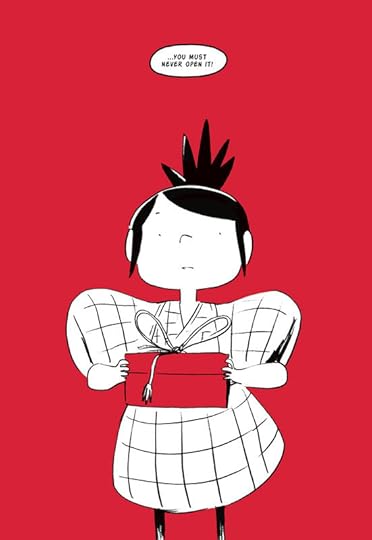
With a minimum of dialogue, NEVER OPEN IT leans heavily on the artwork to convey these stories. And while Niimura's illustrations certainly are striking - with a color palate of just black, white, and the occasional red - I wasn't always entirely sure what was going on. Many of the action-packed panels, for example, left me scratching my head.
For some reason - the ominous title? princess Otohime's floating hair? - I expected this to be a horror book, and I was more than a little disappointed by its relatively tame and non-spooky subject matter.
Even so, if you dig fairy tale retellings, NEVER OPEN IT might just be for you.
In NEVER OPEN IT: THE TABOO TRILOGY, Spanish-Japanese artist Ken Niimura adapts three Japanese folk tales into the graphic novel format: "Urashima Taro" ("Never Open It), "Ikkyu-san" ("Empty") and "The Crane Wife" ("The Promise"). Each of these stories involves a taboo of some sort: a box which should not be opened until needed; a pot that contains a delicious - yet allegedly deadly - substance; a door separating a lovely yet mysterious weaver from the man who's enamored with her.
With a minimum of dialogue, NEVER OPEN IT leans heavily on the artwork to convey these stories. And while Niimura's illustrations certainly are striking - with a color palate of just black, white, and the occasional red - I wasn't always entirely sure what was going on. Many of the action-packed panels, for example, left me scratching my head.
For some reason - the ominous title? princess Otohime's floating hair? - I expected this to be a horror book, and I was more than a little disappointed by its relatively tame and non-spooky subject matter.
Even so, if you dig fairy tale retellings, NEVER OPEN IT might just be for you.

February 2, 2021
El autor de este manga, José María Ken Niimura, conocido como Ken Niimura, es español con ascendencia hispano-japonesa. El estilo de ilustración es atractivo, me gusta como introduce toques de rojo dentro de la ilustración en blanco y negro, para dar dramatismo y resaltar algún aspecto de la escena. El trazo es rápido y en muchas ocasiones llegando a ser casi más un boceto, lo que le da también fuerza a la historia. Respecto al contenido, esta novela gráfica estilo manga incluye 3 relatos que son una reinterpretación de leyendas tradicionales japonesas (conocidas como Mukashi Banashi), a las que Niimura les da un interesante y diferente giro final. La primera historia, que da nombre al volumen "No lo abras jamás" es "Urashima Taro" (leyenda que yo ya conocía). Las otras dos no conozco la leyenda original. "Nada" es Ikkyu-san y "La promesa" es La gratitud de la grulla. Tendré que indagar los originales para saber qué aspectos de la historia han cambiado exactamente. El cambio introducido en Urashima Taro me ha gustado mucho y me ha parecido original. Las tres historias tienen en común la atracción por lo prohibido.

November 11, 2022
I'm going to keep this short and simple. I liked the book. My favorite story was the last one. I just also felt like it was middling something. Like a bridge to some scenes that could've been done better and made it flow nicer. However, I still enjoyed it, so it's a 2.75-3 stars from me.

March 14, 2022
Japanese folklore retellings done in sketched graphic novel form! 👌

December 13, 2021
3.5 Stars
Thank you to Edelweiss for the review copy.
I flew through Never Open It in one sitting and enjoyed myself throughout. Never Open It is a collection of three Japanese folk tales, I was familiar with the first story and the third, which is The Crane Wife.
Each story has the “never open it” moment, be it a box, a jar or door and the repercussions if you do. I liked the third story the best. Using red as the only colour and only in a few panels was very effective, especially in the last story of this collection.
Thank you to Edelweiss for the review copy.
I flew through Never Open It in one sitting and enjoyed myself throughout. Never Open It is a collection of three Japanese folk tales, I was familiar with the first story and the third, which is The Crane Wife.
Each story has the “never open it” moment, be it a box, a jar or door and the repercussions if you do. I liked the third story the best. Using red as the only colour and only in a few panels was very effective, especially in the last story of this collection.

June 1, 2022
3.5
Tre racconti del folklore giapponese rivisitati da Niimura, tutti incentrati sulle tentazioni del proibito. Volume un po’ affossato dal secondo racconto (abbastanza impalpabile), molto carini invece il primo e il terzo. Ho letto pareri contrastanti sullo stile, ma a me sono piaciuti sia l’uso del colore che il tratto.
Tre racconti del folklore giapponese rivisitati da Niimura, tutti incentrati sulle tentazioni del proibito. Volume un po’ affossato dal secondo racconto (abbastanza impalpabile), molto carini invece il primo e il terzo. Ho letto pareri contrastanti sullo stile, ma a me sono piaciuti sia l’uso del colore che il tratto.

September 29, 2022
An interesting trio of Japanese folktales, whose ill-fated characters definitely don’t live “happily ever after.” Some of the panels were a little confusing, I had a little trouble following the action, but I still enjoyed learning more about Japanese culture through the retelling of these tales.

October 13, 2022
It was fine??
I don't think the stories really worked together as a collection. Some of the endings of them didn't make sense, or even feel like endings. There was nothing that really hooked me and made me like any of the characters or plot lines or anything, but it was fine.
I don't think the stories really worked together as a collection. Some of the endings of them didn't make sense, or even feel like endings. There was nothing that really hooked me and made me like any of the characters or plot lines or anything, but it was fine.

December 23, 2022
2/3 ⭐
Una raccolta di tre storie incentrate sul folklore giapponese, in particolare sulla tentazione. Carini, ma niente di più in realtà. L'ultimo è quello che mi è piaciuto maggiormente, dove ho trovato anche di più l'autore sia nel tratto e nei colori.
Una raccolta di tre storie incentrate sul folklore giapponese, in particolare sulla tentazione. Carini, ma niente di più in realtà. L'ultimo è quello che mi è piaciuto maggiormente, dove ho trovato anche di più l'autore sia nel tratto e nei colori.

November 28, 2021
See what happens when you do not heed the warning “Never Open It.” In three retellings of Japanese folklore, characters are warned to not open a box, a jar, and a door. Of course, each is opened and leads to the dramatic endings. Empty left me feeling a bit empty but Never Open It and The Promise were quite dizzyingly beautiful.

July 24, 2022
Non è proprio la mia "cup of tea", sia per lo stile del disegno che per il tipo di narrazione..
December 23, 2023
I HAVE READ THIS BOOK ALMOST 5 TIMES AND ITS STILL THE BEST BOOK IVE READ EACH TIME OMG.

April 18, 2024
Una graphic novel sul non rispettare un divieto.
Tre storie con un bel po di fantasia.
La più carina è l’ultima.
Tre storie con un bel po di fantasia.
La più carina è l’ultima.

August 24, 2024
I liked the use of colors in the three stories

November 12, 2024
Person who has only read green velvet band: “I mean do I even need to say it”
August 21, 2025
Este cómic ilustra algunas de las leyendas japonesas más conocidas. El estilo de dibujo me ha gustado mucho y es muy ligero. 🥰

October 5, 2025
Me ha gustado más de lo que esperaba.
Creo que sobre todo la de "Nada". Muy contenta.
Creo que sobre todo la de "Nada". Muy contenta.
Displaying 1 - 30 of 167 reviews