Jump to ratings and reviews
Rate this book

Blue Postcards

Rate this book
Once there was a street in Paris and it was called the Street of Tailors. This was years back, in the blue mists of memory. Now it’s the 1950s and Henri is the last tailor on the street. With meticulous precision he takes the measurements of men and notes them down in his leather-bound ledger. He draws on the cloth with a blue chalk, cuts the pieces and sews them together. When the suit is done, Henri adds a finishing a blue Tekhelet thread hidden in the trousers somewhere, for luck. One day, the renowned French artist Yves Klein walks into the shop, and orders a suit. Set in Paris, this atmospheric tale delicately intertwines three connected narratives and timelines, interspersed with observations of the colour blue. It is a meditation on truth and lies, memory and time and thought. It is a leap of the imagination, a leap into the void.

160 pages, Paperback

First published October 1, 2021

11 people are currently reading
419 people want to read

About the author

Douglas Bruton

15 books19 followers
Douglas Bruton is a Scottish author. He has published in Northwards Now, and in Umbrellas of Edinburgh and Landfill, an anthology of new writing frm the Federation of Writers (Scotland).

Ratings & Reviews

What do you think?
Rate this book

Friends & Following

Create a free account to discover what your friends think of this book!

Community Reviews

5 stars
62 (38%)
4 stars
50 (31%)
3 stars
36 (22%)
2 stars
9 (5%)
1 star
2 (1%)
Displaying 1 - 30 of 43 reviews
Profile Image for Ilse.
555 reviews4,499 followers
July 31, 2024
The elusiveness of colour, memory, swallows and kisses

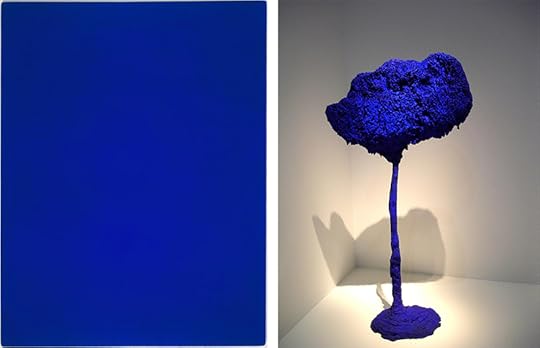
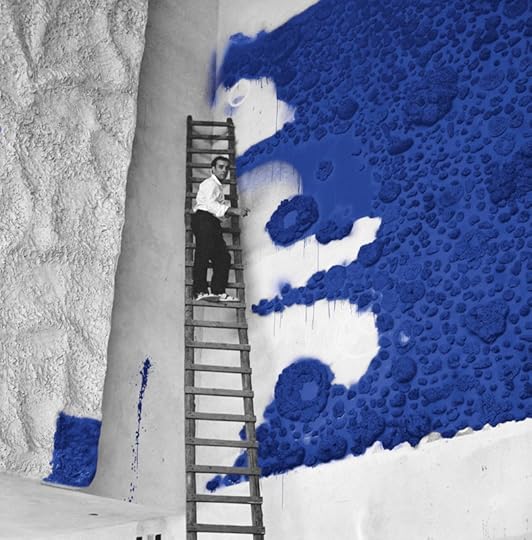
Blue Postcards set mostly in Paris in the late 1950ies, laces three interlocking narratives together, which gravitate around the short life and ground-breaking work of the French artist Yves Klein (1928-1962 ), famous for his monochrome blue paintings and for patenting International Klein Blue in 1957 – not the colour, but the chemical fixation process that made the colour hold its intensity and lustre – work that however encompassed much more than that, anticipating minimal art, performance, conceptual art and body-art.

Blue is obscurity become visible, a space of indeterminate reverie.

As the quintessential artist of blue, Bruton draws on the artist’s biography, from his love for the blue sky in Nice, portraying his wit and playfulness, not glossing over his mercantile spirit and mythomaniac quirks (selling the same paintings for different prices, the illusionism of his ‘Leap into the Void’). Just like Yves Klein, the narrator is unreliable and enigmatic, blurring memory, lies and truth, as are the two other characters bearing along the other two narratives, the narrator’s dream girl Michelle and the Jewish tailor Henri.

0029

Blue is a flame, blue is a painted vault.

Bruton’s novella has a remarkable structure which reminded me greatly of Maggie Nelson’s Bluets as there are quite a few striking parallels in their composition – both evolve around a fascination for blue, both break down in numbered paragraphs (500 in Blue Postcards and 240 in Bluets), in both the narrator collects and surrounds himself/herself with things that are blue.

c51005e6-e837-11ea-a0cd-c1a0a18cbab6

This novella and Nelson’s essay are however quite different in tone and gravity, Blue postcards feels a feather-light story with fairy tale traits in comparison to the more heavy-handed reflections on pain, illness, art and the disintegration of a relationship in the long personal essay of Nelson – not that Douglas Bruton takes the easy way of rounding up his three storylines with a saccharine ending – some darker notes bring balance.

Blue is a feeling ad a time and a memory. Blue is distance and nearness and touch.

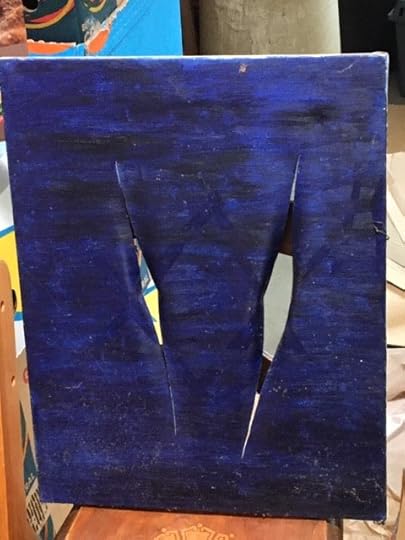
Now, the blue! Blue, apparently ‘the world’s favourite colour’, features in each and every one of the postcard-sized paragraphs. And as an aficionada of blue, enamoured with the deep cobalt blue by Yves Klein, how could I not be charmed by this lavish opulence of blue as well as by the discovery that Yves Klein is at the centre of this novella? Meeting his blue in the centre Pompidou in 1993 was love at first sight which a few years later winded up in decorating the house with a self-made assembly painting of Klein and Lucio Fontana, who was a friend of Klein (a lot of fun, the paint took weeks to dry so swishing along it in that tiny house wasn’t without risk).

fontana

Despite the brilliance, breadth and intensity of Maggie Nelson’s Bluets which I had been looking forward to read for years, her fragmentary, philosophical musings only partly spoke to me, while reading this novella, lacking Nelsons’s profundity and even containing a few pet peeves of mine (a rather facile use of Paris as a setting; a slight inclination to over-explicitism in the Holocaust narrative, subtly balanced however bringing in the theme of survival guilt) was a pure delight.

Bruton’s elegant novella bathes in a dreamy atmosphere comparable to Le Fabuleux Destin d’Amélie Poulain soaked in a melancholy which is gracefully colourful instead of worn-out sepia.

My thanks to the author and Fairlight Books for an ARC via NetGalley.
Profile Image for Esther.
442 reviews107 followers
October 9, 2021
This is not my usual genre, a little too modern for my taste. There is no plot or even much development of a story and the narrative has a gentle dreamy quality, not quite in touch with reality.

The narrative is divided into short paragraphs which alternate between a modern first person account, a historical third person point of view and an impersonal retelling of the chronology of the real life of artist Yves Klein.
Yves Klein, his IKB International Klein Blue and the blue tekhelet thread is the thread that connects these separate narratives along with a reoccurring motif of swallows.

I am still not quite sure what the author was trying to telling me but I enjoyed trying to find out.

3.5 stars

I received this book from Net Galley, in exchange for an honest review.
Profile Image for Sofia.
1,352 reviews300 followers
September 15, 2021
I have blue on my mind, totally. Recently I read When We Cease to Understand the World and now this one. So yes, surrounded by blue and loving it.

Bruton weaves a blue thread through his people and their stories, dipping in different spaces and different times so we do not have a linear still life, but rather a box where we meet his people at different times, doing different things but the blue thread joins it all. Well sometimes it breaks but then we get another blue thread and continue.

We meet Yves Klein, who really, really liked blue. We meet careful, lonely Henri and his angel, the narrator and his Michelle and the swallows of course and also we meet blue, the colour, the mood, the feeling.......

Quietly written but the feelings come out strong because they do not need bravado, they just need to show a little here and a little there and as Bruton says the perspective than changes, the story changes and as it changes in the book, it does in our reality, a missed word here and an extra one there changes the story completely.

Salvador Dali - The motionless swallow - study

An ARC gently provided by the author/publisher via Netgalley in return for a review
Profile Image for Morgan .
925 reviews246 followers
July 6, 2022
A study in blue set in Paris. No particular plot, but somehow mesmerizing.

Five sections, 100 chapters each, 151 pages weaving three narratives together.

Our unnamed narrator meets a young woman, Michelle, selling books, postcards and CDs from her Peugeot 4DA van, circa 1952 from whom he buys a blue postcard with a blue stamp. He collects things that are blue. Later he returns and they enter into a relationship. Or maybe not. Is her name even really Michelle?

Henri, the Jewish tailor secretly weaves a Tekhelet thread into every suit he makes for good luck for his customers.

Yves Klein, artist famous for painting monochrome blue painting will have a blue suit made by Henri.

The unnamed narrator advises us that not everything is as it is written, there are blue lies and white lies and sometimes things are just misremembered.

However, “Blue is a feeling and a time and a memory.” (Pg.88 / #282)
Profile Image for Janelle.
1,655 reviews347 followers
July 3, 2021
The colour blue is the central theme of this short novel, and is mentioned in every one of the 500 numbered paragraphs(the book is didvided into 5 chapters). It’s a meditation on memory, ageing, history, the passing of time, art, nature(particularly swallows) and I loved it! Somehow it works beautifully.
There are three interwoven narratives, the work and life of Yves Klein, a French artist; a tailor in Paris, Henri who makes a suit for Klein; and the narrators story, an old man (this storyline is contemporary) who finds a blue postcard of Klein in a stall under the Eiffel Tower. The flow between the three threads is dreamlike and even the narrators story may be just a dream. A beautiful little book.
Profile Image for Katie Lumsden.
Author 3 books3,805 followers
March 13, 2022
Maybe 3.5. This was a very different, experimental read, but I rather enjoyed it.
Profile Image for Ends of the Word.
550 reviews144 followers
February 9, 2022
“Fairlight Moderns”, Fairlight Books’ series of “new short modern fictions from around the world” is putting the novella on the map of contemporary literature. The previous sets of titles in the series, published in 2018 and 2019, were ample proof that this literary form could fit a variety of genres and settings, and could also leave room for experimentation in subject and form. Amongst several crackers which debuted as Fairlight Moderns one could mention Bottled Goods by Sophie van Llewyn, a magical-realist “novella-in-flash” set in 1970s Communist Romania which went on to be longlisted for The Women’s Prize for Fiction, The Republic of Consciousness Prize and The People’s Book Prize and which was eventually reissued in the US by HarperCollins to further critical acclaim.

Another clutch of Fairlight Modern titles is being published in 2021. Of these, I have just read Blue Postcards by Douglas Bruton and I am pleased to report that, if this novella is anything to go by, the forthcoming set of Moderns is as exciting as what has come before. Blue Postcards combines literary experimentation with good old storytelling and shows that innovative fiction can also be entertaining.

In a slim volume, Bruton weaves together three different storylines. The main narrative is, intriguingly, a mostly non-fictional account of the career of Yves Klein. Klein was an avant-garde artist fixated with the colour blue, who startled the art world with his all-blue paintings and “performance art” events (including the use of “human paintbrushes” - female models daubed in blue creating art… in blue). Although not primarily known as a musician or composer, Klein also created the John-Cage-like “Monotone Symphony”, in which musicians play one note continuously for forty minutes. As far as the Klein segments are concerned, Bruton adopts a Sebaldian approach, relying heavily on factual, historical events with a sprinkle of authorial imagination. This seems to be the in-thing at the moment. One thinks, for instance, of Labatut’s When We Cease to Understand the World which, incidentally, also features the colour “blue”.

The second strand in the novella is the tale of a tailor (whose clients include Yves Klein) and the tailor’s experiences of antisemitism in the years leading to the Second World War. What brings everything together is what might be considered the “frame story”. This is set in contemporary France and its protagonist is the narrator of the novella, who discovers love whilst seeking Yves Klein memorabilia. In a postmodern move, the narrator himself suggests that this sentimental tale in the shadows of the Tour Eiffel is a product of his imagination, leading us to question the truth of all that we have read. The thin line between reality and make-believe was, after all, one of the themes of Yves Klein’s output. This is exemplified, for instance, in the series of photomontages known as “Leap into the Void” (referenced in Bruton’s novella), which cleverly show Klein in gravity-defying flight.

If this all sounds rather convoluted, just wait until I tell you that Bruton’s novella is made of exactly 500 numbered paragraphs, all of which contain at least one mention of the word “blue”.

On paper all this might appear rather dry and contrived. But fear not – it works, and brilliantly. Blue Postcards is a novella which is structurally original and ambitious and, at the same time, a heart-warming read.

https://endsoftheword.blogspot.com/20...
Profile Image for Sîvan Sardar.
140 reviews1,526 followers
January 24, 2025
what an odd little novel, it felt surreal at times and too quiet in others but it remained intriguing throughout. the colour blue written in a way where it has the ability to hold memories and conjure new ones felt remarkable, and yet never repetitive despite the word being in every single one of the 500 small passages.

i thoroughly loved this, the last 10 pages were particularly enjoyable and i really think this is a read everyone will enjoy regardless of niche/preferred genre. what a great way to start the year!!
Profile Image for Bill on GR Sabbatical.
289 reviews89 followers
June 29, 2023
I do not think a stone can be said to belong to a person. I tell her about the stone and how I picked it up out of a river and it was blue until it dried and then it was blue only in possibility. I tell her that I like that most especially, that blue can be something that adheres in a thing and at the same time can be something hidden. I do not tell her that I think love is something the same.

In five chapters, each consisting of 100 numbered paragraphs, each paragraph including a reference to blue, Bruton weaves together three stories, in a fascinating reverie touching on art, love, memory, truth, fiction, and the Holocaust. One story is of the unnamed narrator and Michelle, the woman from whom he buys a postcard at her stand under the Eiffel Tower. Another is of the French artist Yves Klein's career in post-war Paris. The third concerns Henri, the last of the tailors left on a Parisian street that was full of them before the war. The stories are linked by the blue postcards that Klein sent out to publicize his May 1957 exhibition of blue monochrome paintings.
Profile Image for Tumblyhome (Caroline).
228 reviews18 followers
June 27, 2024
I just took a brief interlude into contemporary fiction, the first for a while. When @bobsphere recommends a book as highly as this one I know I will love it too. And I did. I sat up into the night to finish it. Unputdownable, good job it is short, I am an early bird and don’t survive late nights.

This is a short novella written in 500 postcard sized sections. There isn’t a linear timeframe but three stories unfold.
One is about the art of Yves Klein, who I really didn’t know much about but the more I read the more I loved. It is well worth reading about his life alongside this book. I guess the whole book is an ekphrasis, art in words, so you see and feel the pictures that are recreated in the book. Every short section features the word ‘blue’. Sometimes it feels squeezed in, other times you don’t even notice it, but it is there.

The other storylines are strange and beautiful reflections on time, love, loss and the many meanings of the colour blue, but not in a straightforward clinical way…oh and swallows duck and dive throughout the pages. I particularly loved the postcard no.d 345.. do you believe ideas are in the air and all we have to do is breathe them in? I do!

This book is a beautiful little sapphire. It is a forget me not…I could see elements of a few other novellas I love, Address Unknown (Kressman), The Employees (Ravn) and Silk (Baricco). Blue Postcards will be joining those treasured novellas on my favourites shelf.
Profile Image for Cathy.
1,463 reviews350 followers
November 26, 2024
The book has an unusual structure: 500 numbered paragraphs each including the word 'blue'. Sometimes the word blue describes the colour of an object - a glass, a dress, a tie - or an element of nature - the sea or sky. At other times, it's a phrase such as 'out of the blue' or 'feeling blue'. Along the way, we also get historical detail about use of the colour blue such as the significance of its use in religious art.

Intertwined with this meditation on the colour blue are three interconnected stories. The first starts with the narrator's purchase of an old blue postcard from a young woman named Michelle and goes on to describe their subsequent relationship (real or imagined). The second depicts events in the life of Yves Klein, the artist who originally created the postcard. The third is the story of Henri, a Jewish tailor, who makes a suit for Klein, a suit the latter considers lucky and associates with his increasing success in the art world.

Although Henri's story is set in the 1950s, other events do not necessarily unfold in linear time, as the narrator himself admits. Some might not even have happened at all. Memory is a theme that runs throughout the book whether that's the unreliability of memory, such as remembering things that never happened but you wish had happened, the pain caused by reliving certain memories or the memories evoked by an object - a sugar bowl, for example - or a place.

When it came to the story of Yves Klein, it wasn't until I read a review of the book by another reader that I discovered he was a real person and that the seemingly outrageous works of art described in the book really existed and were not a satirical comment on the art world by the author. I'm not sure whether knowing Klein was a real person would have changed my view of the book's inventiveness. I suspect it might have.

There's a lot of humour in the book, in particular some of the means by which the author inserts the colour blue into certain paragraphs. Having said that, there is a degree of repetition.

I can see why Blue Postcards, with its imaginative structure, made it on to the Walter Scott Prize longlist, but I can also understand why it didn't make the shortlist. Personally, I would have liked more of Henri's story and why he takes the action he does in the final pages.
Profile Image for Robert.
2,320 reviews263 followers
April 14, 2025
Blue is a feeling and a time and a memory

Blue is distance and nearness and touch

This two of the numbered 500 small paragraphs which are found in Douglas Bruton’s Blue Postcards.

The book starts with the narrator finding a blue postcard from a seller near the Eiffel Tower, which may have been designed by the artist Yves Klein.

From there, using bite sized paragraphs, the author goes into Yves Klein’s life, a tailor, swallows and his own life. The linking theme is the colour blue.

In this novella blue means sadness, lost love but also ambition – like the blue belt in Judo, something Klein did as a hobby. Even success as Klein created blue monochromatic paintings, with a particular shade of blue named after him, blue is secretive, such as the lucky thread the tailor, who makes Klein’s suits, inserts in his creations. Unfortunately blue also means death as it was the fumes from that particular blue which might have lead to his heart attack in 1962.

In the tradition of Luis Sagasti and Benjamin Labatut, Douglas Bruton manages to mix fact and fiction, with a meta twist as the narrator starts building up an imaginary relationship with the postcard seller, which has deeper implications. There are three timelines within the novel and they are all tied together excellently.

Blue Postcards is a brilliant read ; intelligent, playful and informative, this book tests the boundaries of fiction, and yet, is highly readable and pure enjoyment from paragraph 1 to 500.
Profile Image for janne Boswell.
121 reviews
July 1, 2021
LOVED it! What a delightful surprise. I am a purveyer of blue, so I was delightfully surprised to find a book to support my habit. In 500 vignettes, the Author tells the story from 3 connected perspectives, although intertwined based on a single blue thread and a postcard.
There are many quiet, endearing passages in this book.
I enjoyed all of the stories, Michelle, the Tailor, Henri, and the Author, "although the story may not be true."
I particularly enjoyed the historical perspective on Yves Klein. I googled the Artist immediately after reading the book.
I was unaware of the Fairlight Moderns series, before reading this book. I look forward to reading the other books.
Its rare to find, a nuanced, quirky, unusual novella such as this that is truly 'different' and engaging.

Thank you to the Author, NetGalley and Fairlight Books for the opportunity to read and review this intriguing book.

jb/https://seniorbooklounge.blogspot.com/
Profile Image for Natalia.
410 reviews51 followers
June 7, 2022
Loved the book, but can't explain why:)
First of all, Yves Klein is one of my favourite artists, he belongs to a small number of artists who had shaped the direction and form of the art in the XX century. In my view, key features of his art and his personality are vulnerability, beauty and sensuousness.
Bringing Yves Klein to a novel as one of the main characters is quite an audacious step. It confines a writer to a certain emotional level of narration that would correspond to YK's sensuous art. In my view, the author managed to weave emotions with words and produce an enchanting story about love, creativity, grief and hope.
The plot switches between three stories and what unites them into a one narration is the artist and his art - divine blue and the leap into the void.
However, this novel is not about the plot, it's about senses, emotions, beauty and magic.
Author 1 book11 followers
July 9, 2021
Out 8/7!
This is a little gem! A charming and elegant novella in 500 numbered paragraphs, each mentioning the word blue and featuring a blue object. Set in post WW2 Paris and not properly a historical novel, it comments on historical events related to the Nazi occupation and their aftermath. Blue is a thread that runs through the text, weaving a story that connects three narrative strands in a meaningful way.

We find a well-researched fictionalised account of Yves Klein’s career, his fascination with blue as the colour of spirituality and transcendence, his attempts to attain a stable, permanent blue that would not degrade (the famous Yves Klein Blue). The concern with permanence is also in the legendary 1960 Leap In The Void photos (in reality there was someone holding a tent). Klein is described as someone who made a work of art out of his life, a “mythomane… who made up the stories of his life and changed them at will”. This is a fascinating subplot, where Bruton shows Klein the man, the glamour, the gossip, and the white noise of life.

There are those with little agency such as Henri, a Jewish tailor who counted Klein among his customers. His family was a victim of the “night of broken windows” and Nazi persecution. He also holds on to a blue thread, the Tekhelet from Jewish culture associated with holiness. The two stories run eerily parallel, from their artistry to key moments in their life, till the leap in the void. The correspondences make for an engaging, stimulating read that constantly generates new insights.

The third protagonist is the storyteller, a collector of discarded objects with “a feeling and a time and a memory” who see meandering through Paris second-hand markets. He is a metafictional narrator who offers interesting insights into his writing process and the writing of history: how we choose specific events over others, we memorialise beautiful lies and rewrite the past, the problem being that at times we choose to erase tragic histories and truths that should be remembered. And this is a timely issue.

A beautiful novella about memory, permanence, trauma, erasure and history. The surreal resurfacing of threads and objects throughout the text is delightfully fascinating. Experimental but not difficult or convoluted, and the division in short alternating paragraphs makes for a propulsive read. Well crafted and accomplished.


My thanks to Netgalley and the publisher for an ARC of this book
Profile Image for Debbi Voisey.
Author 4 books9 followers
September 18, 2021
"What else is fiction but a manufactured lie even when it holds truth?"

I confess to not knowing what to think about Blue Postcards when I first started to read it. It caused a lot of conflicting emotions in me. I loved the format (little postcard-sized flash fictions which built up the story) and the language used is beautiful (I made so many notes on my kindle of phrases I want to keep forever – like “Blue is a feeling and a time and a memory. Blue is distance and nearness and touch. Blue is an experience and is more than light…” - be still my heart!!!), but also, I wasn’t sure if I was reading truth or fiction. I have never heard of Yves Klein, the man around whom this novella is woven. I later learned it is a mixture of the two, and so read it again, and immersed myself into the romance of it. The emotion, the passion, the fear, the love and loss as this imagining of a real life unfolds.

Starting with the narrator finding a blue postcard in a market in Paris, Bruton weaves three parallel tales and, along the way via the 500 beautifully crafted postcards, tells us all kinds of things about the colour, and also about life and love, and that each hold exquisite risks to your heart and soul.

I will read this wonderful novella many times.
Profile Image for Bogi Takács.
Author 64 books661 followers
Read
January 20, 2025
DNF. Fascinating theme and structure. However, for a book focusing in large measure on Judaism, everything Jewish seems to come from a superficial reading of Wikipedia and is full of misunderstandings about Jewish practice. Honestly bizarre, and not in a good way.

I also had different misgivings about one of the other threads, but the way this book treated its Jewish themes was enough for me to set it aside.

Find me elsewhere: My Patreon | My Bluesky account
_____
Source of the book: Bought with own money (actually RB bought it)
Profile Image for Laith Alobaidi.
27 reviews1 follower
August 9, 2021
Set in Paris, Bruton’s novella delicately intertwines three connected narratives and timelines, with the heart of the story occurring in the 1950’s, as recalled by a narrator who exists much closer to the modern day. The common link is the artist Yves Klein, whose association with the colour blue serves as the lens through which we observe the unfolding stories and ultimately derive meaning. Reflecting upon Klein’s famous photograph: Saut dans le vide (Leap into the void), as readers we are held in a suspense of blue, as Bruton exercises the colour as a meditation on truth and lies, memory and time and thought.

What I find most interesting about this novella is its structure. Not only are we presented with three interconnected narratives, but the book is split into five chapters, consisting of 500 numbered paragraphs, all of which contain at least one mention of the word “blue”. It’s an ambitious work but Bruton appears to have pulled it off with relative ease, echoing the famous misdirection of Klein’s leap. I’ve read few other texts like this, and whilst there is an air of simple beauty to Bruton’s prose, (perhaps indicative of Klein’s solid blue canvases), it draws parallels to Max Porter’s “The Death of Francis Bacon” in its attempt to be literature as painting.

Overall it’s a skilfully constructed, intriguing little book, with the colour blue proving to translate well onto the page as a mechanism to explore the diverse spectrum of the human spirit. Despite its minimalism, there’s plenty to muse over here, just as you may ponder the blue expanses of Klein’s most famous paintings.
Profile Image for Shannon A.
420 reviews22 followers
July 24, 2023
A meditation on blue that is fiction and truth.
Blue lies, white lies, hidden threads throughout both the story and the book; memory plus time woven into an absolute gem of a book… sewn together in a word:
Perfection.
Profile Image for Mandy.
3,633 reviews335 followers
October 15, 2021
Inventive, original and beautifully written, this touching and powerful novella interweaves three narratives – all connected by a the colour blue. Composed in 500 paragraphs, it’s a gem of a tale about memory, art, craft and love. The narrator’s own story starts when he buys a blue Yves Klein postcard from a young woman at a stall by the Eiffel Tower. Then we meet Henri, a Jewish tailor from the now renamed Street of the Tailors, the last survivor of a once bustling community. And finally the artist Yves Klein himself and his own obsession with the colour blue, leading to his invention of International Klein Blue. The storylines merge and interconnect via the motif of the blue thread that Henri sews into all the garments he makes. It’s nuanced and immersive tale, sensitively written without a wasted word, and one which I found quite haunting. Highly recommended.
Profile Image for iina.
471 reviews141 followers
August 9, 2021
This was a cute little novella about the colour blue and art and history, a little confusing but I did enjoy reading it.

Thank you to Fairlight Books for sending me a copy.
Profile Image for amy.
32 reviews
January 14, 2024
I genuinely didn’t expect this to move me as much as it did
Profile Image for The Reader Ignites.
134 reviews3 followers
September 2, 2021
This is my second novella of the #fairlightmoderns series to read this summer and I really enjoyed it. Douglas Bruton writes lovely prose and the structure of the writing was so interesting. Laid out in numbered paragraph form, it tells three different narratives which are intermingled and interconnected. I also love when a book introduces me to something new and it definitely did that here as I learnt about the artist Yves Klein and his artwork using the colour blue. The other two stories tell of a tailor, who having survived the Holocaust, creates a suit for Klein and an ageing man who comes upon a blue postcard and reflects on life and love for a girl with blue eyes.

Bruton creates a longing in his writing here - of summers gone by, of loves lost but also of dreams coming true and I finished this novella feeling that I had read it at just the right time coming into Autumn. Would definitely recommend.
Profile Image for Loree.
Author 1 book15 followers
July 31, 2021
Leafing through a box of postcards at a Parisian market stall, the narrator of Douglas Bruton’s exquisite novella finds a distinctive blue postcard which he recognises at once. The colour is International Klein Blue (IKB), created by the avant-garde artist Yves Klein, and the postcard is an invitation to a 1957 exhibition of his monochrome paintings. Such a seemingly simple postcard, but within it is a marvellously intricate meditation about the way memory reshapes itself over time and how truth is often found in fiction.

Written in 500 numbered paragraphs, Blue Postcards is a bravely experimental and engaging novella with more than a postmodern twist. Bruton juggles multiple stories, each with its own trajectory, and somehow manages to keep them all in flight until the very end. This book is clever, sensitive and thoughtful – a true piece of artistry, indeed.
Profile Image for Fiona Scott-Barrett.
Author 20 books6 followers
March 15, 2022
Three stories, flipping from past to present, run like threads through this novella. They are interspersed with metaphysical musings on truth and lies, memory, the passage of time, love, death and, of course, the colour blue in many different manifestations. Every so often, the author himself intervenes to remind the reader that time is not linear or that his own narrative in the book is also a story, not a factual rendering of past events.
Told in 500 numbered paragraphs, this book operates on many different levels and mixes and matches its various themes in an elegantly kaleidoscopic manner. Read it and be amazed!
Profile Image for Marcus Hobson.
736 reviews116 followers
July 15, 2025
There are four sections and each paragraph is numbered, starting from one at the beginning of the first section and ending at 500 at the end of the fourth section. Each section has exactly one hundred paragraphs. That sounds very ordered, but it doesn’t feel like that when you are reading.

There are a number of stories underway throughout. It took me a while to notice that one is being told in the first person and the others in the third by the omniscient narrator. There are four main characters; the narrator meets a girl called Michelle who runs a little stall selling books, CDs, and postcards near to the Eiffel Tower in Paris. Then we have the story of Henri a tailor who makes suits in the little shop where his father and grandfather have made suits before him. Lastly we have Yves Klein, who begins the story as the most opaque of the characters. He studies Judo and travels to Japan to learn more. At the same time he paints. On his return to France he begins to paint canvasses of a single colour, a blue called International Klein Blue (IKB) which he invented himself. Slowly he starts to stage exhibitions. Not everyone gets twelve identical blocks of colour or what they mean, but some “experts” hail him as a genius.

The paintings are all blue. The suits Henri makes are blue, and the postcard that the narrator buys from Michelle’s stall at the Eiffel Tower, is also blue.

Off we go into the gently unfolding stories of these four people. It takes a little while to fully understand that the time lines are not all joined. Henri and Yves Klein are running in the 1950s and ‘60s. The love story between narrator and Michelle is much more contemporary.
What endeared this book most to me were the small observations by the narrator. Here is an example:
15. It is a fact that colour perception deteriorates with age, particularly in the area of the spectrum that covers blue, blue-greens and yellows. I worry about this in a way that I never worry about the deterioration of hearing - there are high pitched sounds that adolescents hear and that are beyond the reach of adults after around the age of twenty-five. Some security firms use this high pitch in alarms fitted to buildings where teenagers and anti-social behaviour are a problem. It never worried me that I could not hear the high mosquito-whine of these alarms; but I worry that one day blue might not be blue when I look at it. Maybe that is why I collect things that are blue and surround myself with them.
16 One of my favourite paintings is Van Gogh’s Wheatfield with Crows. It is one of his last paintings. The yellow of the cornfield is aflame and the blue of the sky is a dark and brooding glory. I saw it hanging in the Van Gogh Museum in Amsterdam; it took my breath away and I wanted to step into the painting. It would be an unimaginable loss not to see that blue or that yellow in the way I see it now. It would be a loss comparable to the loss of words and thoughts.

Much later the narrator begins to reflect on himself as a writer, introducing another element to the story:
303 Maybe Michelle is a memory. The one that got away, for we all have those stories, except a writer can rewrite his story and maybe this time she does not get away but stays on the page, fixed in blue ink. (I know that if you are reading this it will be printed in black ink, but I’m writing this with a pen in a notebook with lined pages, so it is as I write something fixed in blue.)

As the story unfolds we soon realise that Henri the tailor is a Jew and that his family are persecuted by the Germans during the war. There is a wonderful comment that the yellow stars his family were forced to wear were the finest tailored you would ever see. And then comes this paragraph:
319 On 22 June 1940, Marshal Philippe Petain signed an armistice with Germany. He spoke on the radio to the nation about a new spirit of collaboration. As part of that collaboration Petain agreed to hand over the country’s ‘undesirables’. This included homosexuals and immigrants, traveller communities and, of course, Jews. You can’t just paint over that with International Klein Blue (IKB) and think people will forget - no matter how splendid the blue.


One paragraph puzzles me. It is in inverted commas and seems to have a first person narrator who is not the one we have been following throughout. There are some possible explanations, but none of them is an ideal fit, so I am left with a piece of the puzzle that, enigmatically, seems to belong somewhere else.:
329 ‘There was sunlight on glass today, blinding like gold, flashing like a hand waving. His hand. I stopped what I was doing and paid attention to what He wanted me to notice. There was a child, a small boy, and he had fallen in the street and his knee was grazed. I knelt down beside the boy and told him it would be all right. I tore a strip from my petticoat and bound up his knee. You see, I thought I was helping him but when I looked into the boy’s blue eyes I could see that he was helping me.’

I really enjoyed this book, I loved the many threads that are woven through the stories, just like the secret thread, the Tekhelet thread, that Henri the tailor sews into the cuffs and waistbands of blue suits that he makes for Yves Klein. Part of the joy is the simplicity of telling and the other the complexity of the many messages that lie just beneath the surface.
Profile Image for Ann.
266 reviews5 followers
July 3, 2021
Blue Postcards was my first book in the Fairlight Books genre. Although I am optimistic that I will enjoy some of the novellas in this series, I am not a fan of Blue Postcards. I found the format a little too busy for my taste, and I did not enjoy the constant need to incorporate the word blue. I understand what the author was trying to do, it just left me a bit underwhelmed and unable to follow the theme and main idea of the book.
Profile Image for Taliarochminska.
312 reviews14 followers
March 3, 2024
Poetical, visual experience bringing us closer to the world of blue


I often think about this book
Profile Image for Sarah Davies.
Author 6 books4 followers
July 20, 2022
Absolutely loved this novella. Three stories woven through 500 paragraphs. Left me breathless and I didn't want to put it down.
Displaying 1 - 30 of 43 reviews

Can't find what you're looking for?

Get help and learn more about the design.