Jump to ratings and reviews
Rate this book

The Man on a Donkey: A Powerful Novel of England in the Reign of Henry VIII

Rate this book
A powerful novel of England during the reign of Henry VIII. When the King's men despoil the monasteries and divide the wealth among the royal favorites, rebellion begins to brew in the north--and for a few weeks, the leader held the fate of a nation in his hands.

849 pages, Paperback

First published January 1, 1952

110 people are currently reading
1122 people want to read

About the author

H.F.M. Prescott

22 books21 followers
Hilda Francis Margaret Prescott, MA, MA, D.Litt, FRSL was born in Cheshire, the daughter of Rev. James Mulleneux Prescott and his wife Margaret (née Warburton).

She was educated at Wallasey High School and subsequently read Modern History at Lady Margaret Hall, University of Oxford where she received her first MA. Later, she studied Medieval and Modern History at Manchester University, from which she earned a second MA. She was awarded an honorary D.Litt. by the University of Durham. In 1958, she was elected Jubilee Research Fellow at Royal Holloway College in the University of London where she researched the life of Cardinal Thomas Wolsey.

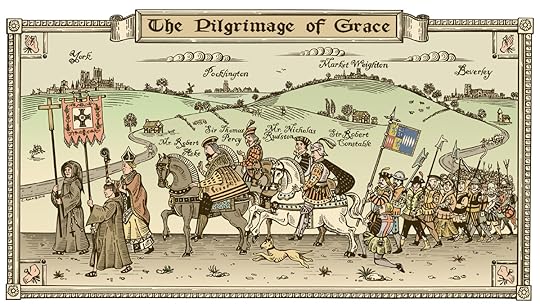
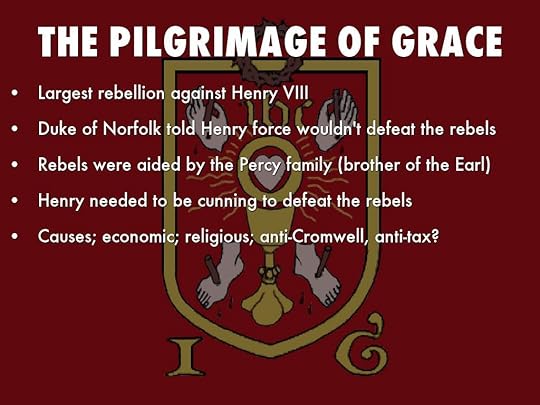
She is perhaps best known for her historical novel 'The Man on a Donkey;' written in the form of a chronicle, it tells the story of the Pilgrimage of Grace, a popular rising in protest at the Dissolution of the Monasteries by King Henry VIII.

Her biography of Queen Mary I of England, 'Mary Tudor' (originally titled 'Spanish Tudor'), won the James Tait Black Prize in 1941 and remains a well-respected biography.

Prescott wrote one thriller, 'Dead and Not Buried,' and this was adapted in 1954 for CBS's Climax! television series under the title 'Bury Me Later.'

Her interests included travel and a love of the English countryside and she lived for many years in Charlbury, Oxfordshire.

Ratings & Reviews

What do you think?
Rate this book

Friends & Following

Create a free account to discover what your friends think of this book!

Community Reviews

5 stars
143 (45%)
4 stars
111 (35%)
3 stars
43 (13%)
2 stars
15 (4%)
1 star
5 (1%)
Displaying 1 - 30 of 68 reviews
Profile Image for Fiona.
982 reviews526 followers
June 8, 2020
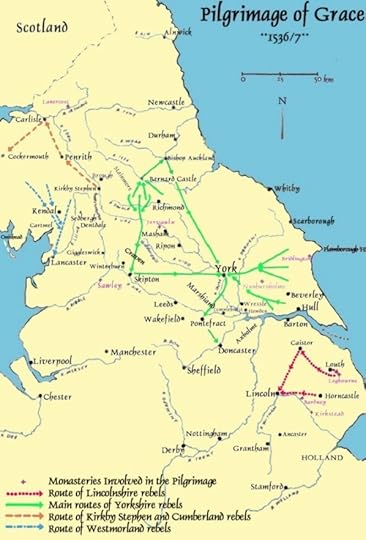
This marvellous book covers the same period as Hilary Mantel’s Wolf Hall trilogy. Written in the form of a chronicle, it tells the story of the Pilgrimage of Grace, an uprising in the North of England against the dissolution of the monasteries and the establishment of the Church of England. A swathe of characters appear from Henry VIII, the hated Thomas Cromwell, three Queens (Katherine of Aragon, Anne Boleyn, Jane Seymour), to the leaders of the uprising, primarily Robert Aske, Lord Darcy and Robert Constable, and those directly affected such as the nuns of Marrick Priory in Swaledale, Yorkshire.

It is a sweeping, historical chronicle that builds slowly (631 pages) but is written with intelligence and in such scrupulous detail that it is a joy to read and savour. The chronicle format works so well and the author explains at the outset why she chose this structure.

This form, which requires space to develop itself, has been used in an attempt to introduce the reader into a world, rather than at first to present him with a narrative. In that world he must for a while move like a stranger, as in real life picking up, from seemingly trifling episodes, understanding of those about him, and learning to know them without knowing that he learns. Only later, when the characters should by this means have become familiar, does the theme of the whole book emerge, as the different stories which it contains run together and are swallowed up in the tragic history of the Pilgrimage of Grace.
I don’t grudge a minute of the two weeks or so that it has taken me to read this book. I have lockdown to thank for giving me the time. For me, this is an almost perfect historical novel. It’s beautifully written, based on well researched historical detail (although World War II prevented the author from accessing primary sources), I learned a great deal and it gave me a new perspective on this period. I accept that it won’t be everyone’s cup of tea but it’s easily a 5 star read for me and has made it on to my list of all time favourite books.
Profile Image for Bettie.
9,977 reviews5 followers
April 1, 2015
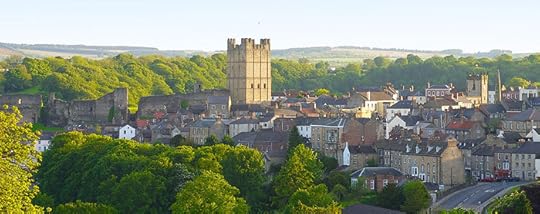
Richmond, North Yorkshire

Description: A powerful novel of England during the reign of Henry VIII. When the King's men despoil the monasteries and divide the wealth among the royal favorites, rebellion begins to brew in the north--and for a few weeks, the leader held the fate of a nation in his hands.

Opening: SIR JOHN UVEDALE had business at Coverham Abbey in Wensleydale, lately suppressed, so he sent his people on before him to Marrick, to make ready for him, and to take over possession of the Priory of St. Andrew from the Nuns, who should an be gone by noon or thereabouts. Sir John's steward had been there for a week already, making sure that the Ladies carried away nothing but what was their own, and having the best of the silver and gold ornaments of the Church packed up in canvas, then in barrels, ready to be sent to the King. The lesser stuff was pushed, all anyhow, into big wicker baskets; since it would be melted down, scratches and dints did not matter.


Cited by Mantel as her fav Tudor novel. The symbolism is not lost on me that I am reading about a man on a donkey in the Christian Church's Holy Week and this coincidence tickles like a Swedish Palm Sunday feather.

I loved the writing, erudite yet in no way stuffy, and although there were a few typos, they enhanced rather than detracted from my enjoyment:
If this was not an accusation
it was as like one as pea to pea in the cod.

The characters were fully realised, each displaying human frailties, so altogether a great read and fully recommended.


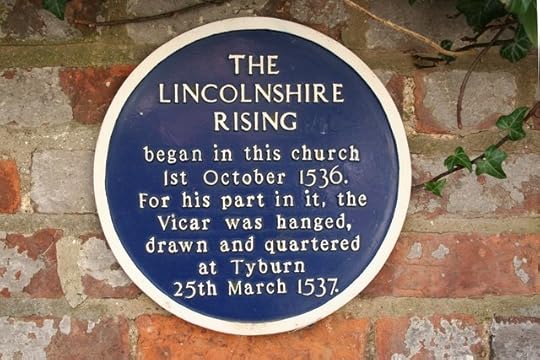
Plaque on St James Church, Louth, Lincolnshire


F drive - pdf
Profile Image for DoctorM.
842 reviews2 followers
July 5, 2015
Fascinating historical novel about the Pilgrimage of Grace and the Dissolution of the Monasteries under Henry VIII and Thos. Cromwell. H.F.M. Prescott was an author of historical novels who's been allowed to fall into obscurity...why? Excellent writing style, a use of period language that doesn't grate on the ear, and a way of foregrounding her characters' lives so that the great events of the day wash around them without requiring paragraphs of exposition.

"Man on a Donkey" follows the lives of dozens of characters--- nuns and barristers, rebels and functionaries, failed priests and bastard children, runaway wives and holy visionaries ---across a couple of decades of the mid-1500s. Somewhere in the background, King Henry is having a marriage annulled and a queen beheaded, and his minister Thos. Cromwell is eyeing England's monasteries as a source of wealth the crown can seize. Somewhere out there the Reformation in England is taking shape. And in the main story, a nun from a petty noble family takes charge of an obscure convent and tries to stave off dissolution and a brooding young barrister rides into Yorkshire to become leader of a movement that may become rebellion against the king. Prescott's characters meet, part, argue, and try to grasp events happening far away in London and Rome--- to try to hang on to a world they've known while royal power waits to crush them.

Well-written, sad, true to its times--- "Man on a Donkey" is one of those lost novels that was always worth tracking down, and is now back in print in a two-volume edition. Very much worth reading.
Profile Image for Melanie.
560 reviews276 followers
March 27, 2019
Brilliance in book form. Written in the 50ies, this book is everything one could wish of a historical fiction.
2,203 reviews
February 7, 2015
I first read A Man on a Donkey a little over 50 years ago and thought it was wonderful. Much more recently, I read Wolf Hall, which I admired immensely, both for the writing and the history. So, time to revisit Prescott and see how her book holds up over time. And it does. It is still an incredibly vivid chronicle of horrible events around the Pilgrimage of Grace, when the nobles and commons of northern England rose up to protest Henry VIII’s suppression of the monasteries.

It was not intended to be a revolution against the king, but an attempt to get his attention to redress the wrongs being done in his name and by his people. The religious and political strife was intense, deadly and omnipresent. Protestants and Catholics hated and feared each other, as did country and town folk, rich and poor, learned and ignorant.

The writing of the book has the feel of a chronicle of the time. Prescott uses many of the original documents from the time and does not soften the language to accommodate contemporary readers. She is not pedantic in the least, but her level of immersion in the period puts us there too as we read the book. Her descriptions of life in the villages, monasteries and palaces are filled with details about the clothes, the furnishings, the food, the occupations, books and opinions of the times. I have seldom read a book which recreates a distant era with such a sense of immediacy.

In addition, as a chronicle of events, the book does not attempt to psychoanalyze the motivations or causes of the people and events. We are there, we observe, we learn. It is remarkable and exceptionally effective.

The characters are three dimensional and flawed but understandable. Robert Aske is an idealist but blind to the motivations and emotions of others. Christabel Cowper, the Prioress of Marrick, is clever and acquisitive, a shrewd bargainer, but not an evil person. Gilbert Dawes, the failed priest, is filled with a toxic combination self-loathing and righteousness which leads him to abuse his son and act hatefully towards all. Julian Savage, the plain, illegitimate daughter of the Duke of Buckingham, is so besotted with love for Aske that she overlooks the loving kindness of her husband. Malle, the simple minded woman who has visions which neither she nor anyone can understand, but which cause widespread fear and cruelty, is a puzzle. Thomas Cromwell is the ultimate Machiavellian, Lord Darcy a doomed idealist. Julian‘s sister, Margaret Bulmer, is a beautiful seductress, much like Anne Boleyn, and similarly fated. Julian, Malle and Dawes are fictional characters. The rest are historical figures. All are unforgettable.

Many better educated, more articulate and informed people than I have written at length about this book. The links below will give a sampling.

http://supremacyandsurvival.blogspot....


http://www.telegraph.co.uk/culture/bo...

http://www.openlettersmonthly.com/ove...

http://www.nybooks.com/articles/archi...


485 reviews155 followers
July 28, 2013
What a GREAT novel this is.

I read it in 1966, a thick heavy blue hardback, just the thing for wiling away my life in the monastery reading about the dissolution of the same!!!!

And the prioress of Marrick was just one of the many colourful characters who were about to become victims of Henry VIII's machinations. Boy, I met lots of that type of self-interested religious superior.
And more of that type after I'd leapt over the monastic wall and gone into teaching. Human nature is pretty constant over time and place!!!!

The story is sieved through five characters who represent different aspects of Tudor Society. Christabel Cowper, Prioress, is the first, and we are given her history before this dramatic life-changing Dissolution of the Monasteries arrives on her very doorstep.. Hilary Mantel covers the same territory revealing that a clean sweep was long overdue.No one imagined it would be so final.There are also represented a Lord, a Gentlewoman, a Squire and a Priest.But there is also Malle, the Serving Woman and a mystic.
And the familiar historic players in the court - queens, courtiers and politicians all...and an Absolutist King.

Rebellion in the North against the King, the Pilgrimage of Grace...we also had rebellion in the monastery and the school system both...and Henry crushing it with wiles and deceit and bloody murder.If you like the Tudors and/or English history and/or a well told tale give this one a go.


Profile Image for BookAddict.
1,200 reviews4 followers
July 25, 2015
This is not a breezy read. It's big and dense with rich detail. I was expecting something more difficult given it was written in the 50s but while there is a lot to take in and it's not an easy read nor is it impossible, although I did have to re-read quite a bit. I have always wanted more about The Pilgrimmage of Grace and this is so thoroughly researched it does not disappoint. I would imagine this is one of the gold standards that all novelists of English or Tudor history should aspire to. Rich in character and detail it's quite astounding.
387 reviews14 followers
August 7, 2024
The subject of this historical novel is the Pilgrimage of Grace that took place in the north of England from 1536-1537. The story begins almost 30 years before and is told in the form of chronicles of various participants, both actual and fictional, in these events. There is Christabel Cowper, the last prioress of Marrick Priory in Yorkshire. Adherence to The Rule? Attending the daily Offices? She is not really given to these religious aspects of her life as a nun. Christabel is a material girl who loves the finer things that her position as prioress brings her as well as her position of control over her little domain. During the Dissolution, she tries to save her priory by bribes.

Then there is Gilbert Dawe (fictional) who becomes a priest but hates the wealthy churchmen and is in sympathy with the Dissolution. He runs away with a miller’s daughter and has a witless child whom he hates and beats regularly. As a matter of fact, he hates everyone, believing in his own superiority.

Lord Darcy is an old crusader who doesn’t like what he sees going at court between the King and Anne Boleyn, but keeps his thoughts pretty close to the vest. He is a puzzling character who ends up being executed for his part in The Pilgrimage.

The central and most compelling character is Robert Aske, a lawyer, who becomes the Grand Captain of the uprising. He is bright, witty, and takes pleasure in simple enjoyments in life. He openly scoffs at the celebrations for the marriage of King Henry and Anne Boleyn, but takes the oath to support the Act of Succession. It troubles him, however, because he is a devout man and he later takes another oath to support the Lincolnshire uprising to which he stays true. As Grand Captain, he is confident, lawyer-like (drafting documents) and maybe a little puffed up. He is plain-spoken (like a true Northern man) and honest as even the king and Cromwell admit—not that honesty is a trait either of them seem to value. He is also naive, believing that the Pilgrimage succeeded when the king listens to his list of grievances and grants him and others a pardon. He says that when he rode to London he was in fear of his life, but felt after their meeting that the king was no dissembler. “He never would have done the King’s Grace hurt, but now I’d die for him, Aske exclaimed.” As I said, naive. And don’t get me started on what I think of the king, the Duke of Norfolk and their duplicity.

Finally, there is a storyline involving Julian Savage (fictional) who is the younger and plain sister of the beautiful Margaret Cheyne. The latter was the mistress, then wife (maybe) of Sir John Bulmer and both she and Bulmer are executed as traitors for their part in the Pilgrimage. Margaret and Julian are said to be the illegitimate children of the Duke of Buckingham. The author admits in her notes that this is pure fiction, so it seems pointless to me to spend pages and pages reading about the Duke’s love affair.

The chronicles consist of a series of vignettes often involving trivial matters which create a vivid overview of life during this time—and the discontent which gave rise to the Pilgrimage. There are various storylines, much like a soap opera. And like a soap opera, I found some storylines more interesting than others and those were the ones about Aske and Julian Savage. I have to admit those were more interesting in part because they involved sex and/or romance. Aske hangs around the Bulmers and is attracted to Margaret, but it is Julian falls in love with him—obsessively so.

Another important storyline is that concerning Malle a simple girl whom one of the nuns of Marrick takes to the priory believing she is a mermaid. Christabel promptly dismisses that notion, but allows the girl to work at the priory as a servant. It is widely reported that Malle has had visions of Christ and his disciples. Christabel scoffs at this idea, but considers whether the priory can profit from promoting Malle as a seer, but decides it is safer not to publicize her. Gib and Lord Darcy hear about Malle, but when they each ask her whether she has seen Christ she replies with a cryptic pronouncement, “There was a great wind of light blowing, and sore pain.” They both dismiss her as a crazy, but when she makes the same reply to Robert Aske, he responds that she has seen Christ and kneels to her.

Apparently, this novel is considered by many including Hilary Mantel as one of the greatest works of historical fiction. (Since I have never read any of Mantel’s works, her opinion really carries no weight with me.) I find many flaws in this book. It is much too long, requiring perseverance and a good memory. In one scene, for example, “the” marchioness has an audience with the king. What marchioness? Had she been previously introduced? I had no idea. And you’re not going to get a very clear exposition of the historical events. I kept my iPad at the ready to consult Wikipedia about actual happenings. The writing style is elegant, but also cryptic.. One character may be looking at another character, and one of them is experiencing some emotion that shows in his face but it is not clear which person that is. I was ready to abandon the book at about page 150, but then I got hooked. (No doubt the the little bit of sex and romance played) With all these problems, what is the reason I give it 5 stars? Because it is one of those books that will always stay with me. The characterizations are strong and vivid and Robert Aske’s story, in particular, is a powerful one. The book has etched on me deep impressions of the different kinds of love: love of God, Julian’s obsessive love of one person, Aske; her husband’s kind and gentle and desperate love; Gib’s love of self; and, even Christabel’s love of possessions and status.

.
Profile Image for Lee .
170 reviews7 followers
December 20, 2020
DNF

This has to be the most boring book ever written. I made it to page 171 of 716 and found myself starting to skip pages looking for something, anything, that might appear to be happening. Nothing.

In the introduction to this book, there is a statement that describes The Man on a Donkey as a "largely forgotten masterpiece." Well, I can see why it has been forgotten, but masterpiece?!

The book is supposed to be about the dissolution of the monasteries and the Pilgrimage of Grace rebellion against Henry VIII, and that is why I wanted to read it. However, a dry textbook on the subject would be more interesting.

Stay far away from The Man on a Donkey or risk being bored to death. Save yourselves!
Profile Image for Paul.
420 reviews1 follower
August 20, 2025
the novel of the year for me. truly engrossing.
147 reviews5 followers
May 28, 2025
I wish I could rate this higher. This is the best novel I've ever read. It feels very real (and I don't mean "gritty and crass" which is what a lot of people mean). In fact, though a few characters
are invented, a large portion of the novel is taken from documents of the period. The characters are fully alive and very much themselves. The settings feel immediate despite the distance of time. Go read it. I don't want to tell you about it, I want to read it.
80 reviews1 follower
July 26, 2020
‘The Man on a Donkey’ by Hilda Prescott is a mid-twentieth-century masterpiece of historic fiction. Focused on the northern rebellion that briefly made Henry VIII swap the hangman’s rope for the negotiating table, this doorstop of a novel immerses the reader in the Tudor world in a similar vain to Hilary Mantel’s Wolf Hall Trilogy.

Unlike Mantel, Prescott presents Thomas Cromwell in an unflattering light, referring frequently to his fat hands. Pressing a prioress’ ostentatious pyx to his cheek, Cromwell is shown to be unprincipled and ruthless, prepared to enrich and empower himself and his psychotic boss, the King, with the wealth of the monasteries and abbeys. To Henry, he is reminiscent to a contemporary reader of Dominic Cummings, strategising constantly how to contain and eliminate his political rivals and enemies.

The monastic class is not given a free ride, with the worldly preoccupations of some nuns being exposed, as well as the occasional suspect friar.

Anne Boleyn is a nasty, power hungry figure who manipulates Henry VIII into making her his Queen before events and the absence of a male heir propels her to the executioner’s blade. The extraordinary scene of Queen Anne being frightened and tormented by the appearance of Henry’s pet monkey foreshadows her end when fear dances in her eyes.

Catherine of Aragon is a tragic figure under effective house arrest, starved of the company of her daughter, Mary, who in turn is bullied relentlessly by her father into outwardly conforming to his Protestant Reformation.

Archbishop Thomas Cranmer is battling to get the Bible translated into English and the Duke of Norfolk is the brash nobleman, who must talk down the rebel leaders and bring The Pilgrimage of Grace to a peaceful end, before executing the leaders months later.

All the characters are based on a rich seam of documentary evidence, endowing the narrative with much authority and heft. The text moves frequently between characters and settings, which begin far apart and gradually converge as the northern rebellion gains traction.

The character who Prescott most admires is the lawyer and Captain of the Pilgrimage, Robert (Robin) Aske. She invents a narrative of his early years, explaining how he damaged an eye, and presents him as a deeply principled man who ends up talking truth to uncompromising power. In many ways, Prescott’s Aske is equivalent to Robert Bolt’s Thomas More in ‘A Man for All Seasons’, walking to his death via the executioner but still scoring a moral victory with the audience. Hanged in chains, Aske is given a particularly Christ-like end.

Permeating the epic text is the mysterious character of Malle, bought by Marrick Priory mistakenly as a mermaid, and prone to seeing visions of God on Earth, symbolised by the man on a donkey she sees crossing Grinton Bridge. These supernatural visions haunt the text and remind readers of the high stakes of casting aside centuries of religious observation at great speed as happened in the 1530s.

Prescott has a Hardyesque taste for imaginative description of landscape and weather as an extension of mood, making this a particularly rich text.

At over 700 pages, this novel is a marathon but on reaching the finish line, the reader is generously rewarded. Living in tempestuous times these days, this Tudor epic about a split country in revolutionary times provides enriching food for thought as a new and uncertain furrow is ploughed by ruthless and ambitious political figures.
This entire review has been hidden because of spoilers.
36 reviews3 followers
April 16, 2021
This book took ages to read so probably not for you if have any sort of yearly book target. Initially I really enjoyed the way this book was set out. It states pretty clearly that it is not a novel and is a chronicle. So that means there were no chapters and instead years and dates. It also meant that the book was told from 6 characters points of view. As I said at first I liked this but after a while it became a bit tedious as it took roughly 500 pages to get to what the book was actually about. I know this is all world building and that aspect was incredibly well done (Prescott has researched this meticulously!), but it really slowed the pace down. I had a similar issue with the language used. Again I knew this is for accuracy but some sections I had absolutely no idea the meaning behind and due to the length of the book I didn't really have time to reread each page 10 times over. In particular I didn't really understand Malle's visions, obviously they have meaning I just found them a bit too convoluted.
However despite all that I think this book captures human nature perfectly. All the characters are well rounded and feel very real (you'd hope so with all the backstory). In particular Aske, Lord Darcy and July are real highlights.
The storyline (once it gets going) is engaging and I felt a real sense of suspense and foreboding despite knowing from the start how it was all going to end (a big catch with historical fiction).
On a side note, having read a novels around this time point I really enjoy the different portrayals of the historical characters. Cromwell in particular is completely different from his adaptation in the Shardlake series and Wolf hall. Although it must be said Henry always comes out the same. Its hard not to portray him as anything other than a monster.

Best Quote: ""May you never prosper in love, Robin" said he, "if your friends can drink what your ladies refuse"". (p124)
Profile Image for Celine.
Author 16 books396 followers
July 30, 2019
Excuse me forever while I sob my heart out.
Profile Image for Kimmy C.
602 reviews9 followers
June 19, 2025
DNF at page 55 - over 700 pages of small type is too much to ask, even for this historical fiction buff. On paper, it seemed a whimsical feat, but in reality, very slow moving (as life was back then), but not for me. I could not see myself realistically reading another 645+ pages.
Profile Image for Margaret.
542 reviews36 followers
March 9, 2019
3.5 stars

The Man on a Donkey is the longest book I’ve read this year and at times I thought it was overlong. It certainly is not a book to read quickly, as John Cooper writes in his Introduction it ‘requires persistence from the reader.’ Hilda Prescott (1896 – 1972) was a historian and biographer as well as a novelist and based this novel on documentary evidence relating to the Pilgrimage of Grace in 1536 led by Robert Aske, a lawyer. It was a protest against Henry VIII‘s break with the Roman Catholic Church, the Dissolution of the Monasteries, and the policies of the King’s chief minister, Thomas Cromwell.

It’s written in the form of a chronicle, written from the various characters’ viewpoints. It’s as much about the ordinary people as the rich and powerful. There are many characters including many real historical people, such as Henry VIII, Katherine of Aragon, Anne Boleyn, Thomas Cromwell, Princess Mary and Thomas More amongst others. The two main characters are historical figures too – Robert (Robin) Aske and Christabel Cowper, the last Prioress of the Benedictine nunnery at Marrick in Yorkshire. They and the fictional characters came to life as I got used to their individual voices – some instantly likeable, such as Robin and Christabel despite their flaws and others so despicable. Henry VIII, a tyrant and Thomas Cromwell, a real villain, for example were much reviled as between them they created fear and terror in a totalitarian regime.

In fact this book is in line with much of what I had learnt of the period from history lessons at school, films, books and TV series up until I read Hilary Mantel’s books that portray a much kinder view of Cromwell. But just like Mantel’s books, this book transported me back to that time, with lyrical descriptions of the settings, both of the countryside and of the towns, of Marrick Priory and of the king’s court, of the people, and the mood of the times, both religious and political.

The Pilgrimage of Grace was not a revolution against Henry but an attempt to get him to change his mind and to understand how people felt. They wanted Henry to stop the dissolution and his attacks on the monks and nuns and to return the country to following the Pope. There were several uprisings and thousands of people were involved, nobles as well as the ‘commons’. But it cost many people their lives in excruciating pain as they were hanged, drawn and quartered.

The source of the book’s title comes from the mystic, Malle, a simple-minded young woman who the nuns had bought at a York market in the belief that she was a mermaid. She is a strange character who sees a vision of Christ riding on a donkey over a bridge across a stream in the Yorkshire countryside. Her visions and strange sayings continue to puzzle and frighten people throughout the book.
Profile Image for Diane.
5 reviews
October 15, 2021

H. F. M. Prescott’s Man on a Donkey must surely be one of the finest historical novels ever written. Its subject is the Pilgrimage of Grace rebellion (1536-1537) of England’s northern Catholics against the harshly imposed reforms of Henry VIII to the power structure and observances of the Church in England.

Prescott calls her story a chronicle, and she tells it in chronicle-like fashion. Historical figures people its pages, among them, Henry VIII and his first three queens, Princess Mary, Cardinal Wolsey, Thomas Cromwell, the Duke of Norfolk, and members of the Percy family. The story progresses by dated entries through the first three decades of the 16th century, keeping its focus on its main characters. They are the ordinary folk of their day trying to determine how best to respond to the deeply significant changes thrust upon them; “the Chronicle is mainly of five:—of Christabel Cowper, Prioress; Thomas, Lord Darcy; Julian Savage, Gentlewoman; Robert Aske, squire; Gilbert Dawe, Priest....There is also Malle, the Serving-woman.”

Told in beautiful language that skillfully evokes the spirit of a medieval chronicle, The Man on a Donkey is not a book to read quickly. It moves at a slow pace, though its central events are momentous. It absorbs the reader into its atmosphere of struggle, physical, mental, and spiritual. It raises for its characters (and for its readers!) such questions as how to live with integrity in a world filled with injustice. How to find within oneself the courage to follow one’s conscience, knowing the risk involved. How to maintain one’s faith in a time so filled with despair.

Violence, cruelty, betrayal, greed, tyranny are present everywhere in this novel; but so also are gentleness, compassion, loyalty, self-sacrifice, and love. I think anyone who enjoys historical fiction, especially fiction set in Tudor times, would enjoy it.
Profile Image for Judith.
1,044 reviews5 followers
March 18, 2017
'The Man on a Donkey' tells the story of Tudor England during the time of Henry VIII and the dissolution of the monasteries. The novel tells the story from the viewpoint of five main characters: a priest; prioress; gentlewoman; Lord Darcy and Robert Aske, who becomes the leader of the northern rebellion against the dissolution. King Henry and his court also obviously feature throughout the novel.

At 716 pages, this is an epic novel in every sense of the world. The author brings all the main characters' narratives together as they cross paths and then go on to their separate fates, from their early lives to where we the reader leave them (or they leave us.) It is a very detailed novel - Prescott does an excellent job of transporting the reader to England of that time and making us a bystander in the events. However, at times (especially during Aske's period as the rebels' leader) I felt that the novel got a bit too weighed down by the detail, which did make my interest wane slightly in what is otherwise a very good story.

Religion is obviously a focal point for the story and at times too I found the finer details to be less interesting (but obviously they were of great importance at the time!) The stories of Christabel Cowper (the prioress) and Julian Savage (a young girl) were the ones that interested me the most. The characterisation of Henry and Cromwell are also very interesting, though they are not the focal points of this novel.

Whilst Hilary Mantel's 'Wolf Hall' concentrates on the main 'players' of this time, 'The Man on the Donkey' focuses on how Henry's religious policy and the dissolution of the monasteries directly affected the people. Be prepared to invest some time in it as the characters' lives unfold, but it is worth the time. As one of the many who loved 'Wolf Hall', I think Hilary Mantel's quote about 'The Man on a Donkey' is particularly apt: "... it is a convincing and atmospheric account of small people caught up in great events".

(With thanks to newbooks/Nudge for the review copy, where this review also appears.)
Profile Image for Becky Norman.
Author 4 books29 followers
December 1, 2012
It's a terrible thing when, for the sake of publicity, a publisher puts a claim on the front of a book that it's the greatest historical novel ever written. That's a lot to live up to...and frankly, I wouldn't say The Man on a Donkey even comes close.

It took me over three months to read this book - something virtually unheard of for me - and I have to blame that on the cumbersome writing. I frequently found myself drifting as I was reading this novel, constantly having to pull myself back and re-read sentences to understand what the author was trying to get across. Combine that with the frequent gimic of alluding to topics that are never fully formed or explained and The Man on a Donkey left me utterly disinterested by the end.

I simply didn't care - at all - about the characters through the entire book and I should have. Henry VIII and his propensity for wives and food should be a fascinating character study. Rebellion in the north country and a population's disagreement with their leader's religious and moral convictions should be engaging commentary. It wasn't here for me at all. I'm left feeling horribly disappointed and wishing I could have those three months back to read the likes of Sharon Penman, Colleen McCullough or Margaret George.
Profile Image for Colin.
1,317 reviews31 followers
June 12, 2016
I first came across this book mentioned in an interview with Hilary Mantel. It tells the story of the Yorkshire and Lincolnshire based Pilgrimage of Grace of the 1530s in response to the dissolution of the monasteries. It is brilliantly written, with a deep understanding of the culture and psychology of the time. It is everything a historical novel should be. However, it is over 800 pages long and very slow moving. It is really one of those books that should be read over a long holiday or when laid up at home with a broken leg. Trying to read a few pages at a time doesn't work, so I've reluctantly had to give it up half way through for the moment - although I know I'll come back to finish it. C
Profile Image for Sarah Harkness.
Author 4 books9 followers
August 26, 2015
This book, which was written many years ago, is quite an incredible read, unlike any other historical novel I have read. The dense interweaving of the characters means you really have to concentrate, and the author's heavy use of eyewitness accounts and testimonies makes the language very complex, but it is extremely rewarding and touching. Its a long time since i had to concentrate so hard when reading fiction, I feel I need a holiday now, after 750 pages, but in many ways I loved it. I found the stories of Gib and Malle quite difficult, and the actual plotting through the twists and turns of the Pilgrimage quite complex, But the story of Aske and July, and of the Marrick convent, were absorbing.
Profile Image for Lesley.
49 reviews10 followers
June 2, 2017
David Foster Wallace started his speech "This is Water with that old but salutary saw,"There are these two young fish swimming along and they happen to meet an older fish swimming the other way, who nods at them and says, 'Morning, boys. How's the water?" And the two young fish swim on for a bit, and then eventually one of them looks over at the other and goes, 'What the hell is water?'"

In 16th century Britain and Europe, the Christian religion was like water to fish. To doubt the existence of God would be equivalent to doubting gravity today. And that religiosity is the medium of Prescott's 1952 novel, The Man on a Donkey, now reprinted in a handsome Apollo paperback. Although faith was as air in Henry VIII's England, belief in niceties of dogma were disputed unto death, as so they are in this 716 page epic which mixes fact with fiction and historical figures with imagined, at the time of Henry's break with Rome and dissolution of the monasteries.

The fictional heretic priest Gib Dawe swings restlessly between dark consciousness of his own mortal sin and righteous indignation at the doctrinal errors of others which are, to him, as damning. He moves restlessly back and forth across England, preaching his version of the new faith to the unsaved and fleeing the consequence of his fall from grace - his afflicted son, Wat. He has spirituality but he lacks faith. "For now he knew that though God might save every other man, Gib Dawe He could not save. Once he had seen his sin as a thing that clung close as his shadow clung to his heels; now he knew that it was the very stuff of his soul. Never could he, a leaking bucket not to be mended, retain God's saving Grace, however freely outpoured. Never could he, that heavy lump of sin, do any other than sink, and sink again, however often Christ, walking on the waves, should stretch His hand to lift and bring him safe. He did not know that though the bucket be leaky it matters not at all when it is deep in the deep sea , and the water both without it and within."

Robert Aske, Leader of the Pilgrimage of Grace, an uprising against Henry's ecclesiastical reforms, swings too in the end, dying a hideous death, suspended in chains high above the ground. This is not a spoiler - Aske was a historical figure. Having one eye he was half-blind, but Prescott's fictional Julian Savage is totally blind when it comes to her love for Robert Aske. Her childish adoration of him is charmingly captured -

"'Do they call you Robert?'

'Sundays and Saints Days,' he told her, 'but working days it's Robin'.

''Silly!' she cried delightedly, loving him very much, and having quite forgotten her awe of him. She began to laugh and dabbed her nose against his, and put her arms round his neck meaning to kiss him."

- and never relents. It's a blind reverence in the face of the one thing Julian knows - that the worst will happen someday, a belief which she quite reasonably holds in light of her early years and her position as the younger sister of the nasty Margaret (Margaret was a real person, but perhaps not really the illegitimate daughter of the Duke of Buckingham). The one almost happy period of Julian's life is spent at Marrick Priory, but of course, that has to end. Prescott has fictionalised the life of the real Christabel Cowper, the Prioress of Marrick Priory (it will be helpful to the reader to look at the plan at the back of the book) which Henry ultimately dissolved. Christabel is another shrewd, ambitious woman with an eye for luxury. Under her stewardship, the Priory thrives and the nuns live much more comfortably, they are sure, than the White Nuns, St Bernard's Ladies, of the inferior priory across the River Swale.

Prescott's Henry is a sadistic liar, gross and golden. "Inside the Privy Chamber the King stood before the fire; he wore velvet the colour of flame, his feet were set wide apart, his head was bent and his chin sank into roll upon roll of bristled fat above the gold-stitched collar. His bulk, blocking out the firelight on that darkly overcast forenoon seemed enormous". He outlives three of this wives in the timespan of this tale, each of them dying off stage, two leaving daughters whom he treats with scant regard. Cromwell is the real villain of the piece, but seen as an eminence grise, distant, glimpsed occasionally and all the scarier for it.

The Man on a Donkey is an excellent historical novel, imbued with the sense of the time and of our predecessors' earthier lives. It is psychologically adept, although the motives of some historical characters - notably Lords Darcy, Suffolk and Norfolk - remain unclear to us. The second half of the story can be perplexing to those not already familiar with the history of Henry's reign. The various factional uprisings, the religious schisms and fickle treacheries are not easy to follow. It does not help that it seems that every man is called Robert, Ned, Will or Wat and every woman Julian, Nan, Anne, Meg or Bess. But Prescott's prose is lucid as the water of the Swale, and captures the enigmatic quality of these events which are now so strange to us. The mundaneity of life is there - and the mystic - the latter often via the agency of the mad serving-woman Malle, whose gnomic utterances shadow Aske's fortunes against the light of her visons of Jesus and his presence. "He that though winds, waters and stars, had made of Himself a dying man. But at last, as if it were a great head of water that had poured itself with noise, and splashing, and white foam leaping into a pool, and now; rising higher, covered its own inflow, and so ran silent, tough no less strong - now they were lifted up and borne lightly as a fisherman's floats, and as stilly."
Profile Image for Rdonn.
290 reviews
December 29, 2009
I read this many years ago and thought it one of the best I'd read. Prescott is so immersed in Tudor history, especially Mary Tudor, she writes as if she had been there. This is an outstanding chronicling the attack of the Church by Henry VIII in order to marry Anne Boleyn. Her scholarship is about th beest there is. My English friend remembers her as sitting at the head table when she was a student in Durham. I found a copy in a used book store in London, and have treasured it. A friend who recommended it bought several copies, and when she lent them rarely got them back!!
Profile Image for John Clarke.
55 reviews1 follower
April 15, 2011
My favourite period of English history, a time when you could not sit on the fence but had to swear oaths regarding your religious convictions not knowing which way the wind would blow next.
A good read with a fair bit of detail about food and clothes, could do with a glossary as I was looking up food and dress terms a fair bit.
I'd heard of Aske's execution by hanging in chains in other literature but this book brings home the horror of it.
Cromwell is described as a soft handed man in this text, Wolf Hall has him physically much stronger as a farrier's son and ex soldier.
Profile Image for Margareth8537.
1,757 reviews32 followers
June 17, 2013
Read this as background to my history A level and although long and slow moving it was so much better than the actual 'histories' that I was having to wade through and dates to remember. Still remember it with affection almost 50 years later.
As a would-be librarian I got very emotional about destruction of libraries!
Profile Image for Mimi.
1,864 reviews
September 3, 2013
Hauntingly beautiful story about the dissolution of the monasteries and the Pilgrimage of Grace (I'd never heard of it either.) It tied in with Eamon Duffy's work on the faith of the English people during the reign of Henry VIII. One that I know I will think about and mull over often.
Profile Image for Graychin.
874 reviews1,831 followers
September 12, 2024
More than seven-hundred pages of small print: it took me weeks to finish, but once I’d settled into its rhythm (it’s written in the form of a chronicle) and got to know its many characters, I was well hooked. It helps that Hilda (H.F.M.) Prescott writes truly exquisite prose. This is a beautiful, fascinating, horrifying, but finally consoling book – a world entire to itself.

The Man on a Donkey (1952) tells the story of the Pilgrimage of Grace, a popular armed revolt in 1530s Yorkshire against the anti-Catholic policies of King Henry VIII and Thomas Cromwell. It follows the lives of both historical and fictional persons, the king and his counselors, three queens, Robert Aske and the leaders of the rebellion, the ambitious prioress of Marrick Abbey, a troubled priest-turned-Protestant with an illegitimate son, a young girl shuffled from home to home, and a madwoman (or holy fool) who has visions of Christ walking through the dales or riding a donkey across Grinton Bridge.

Through the first hundred-and-fifty pages you wonder when things will begin to pick up; perhaps that’s a criticism. I also think Prescott might have done a better job of drawing out the divergences in individual and congregational religious devotion that began at this period to split families and which must have marked, for many, the most tangible aspect of the change from Catholic to Protestant England.

But finally these are small criticisms. For all the tragedy of the English Reformation (from my Catholic perspective, and perhaps from Prescott’s Anglican one), and for all the horror of Robert Aske’s brutal end, Prescott’s book is shot-through with light and hope and faith, and the assurance that, in the words T.S. Eliot famously borrowed from the medieval mystic Dame Julian of Norwich, “All shall be well, and all shall be well, and all manner of thing shall be well.”

Because sometimes God saves us in spite of ourselves. Or, as the madwoman Malle puts it: “Already, little as they know it, He hath taken all men in His net. And when He will, He may hale in, to bring us all home. How else? Shall that strong One fail of His purpose? Or that Wise, Who made all, be mistook?”

-

PS: Here's the actual oath taken by all who joined in the Pilgrimage of Grace:

“You shall not enter into this our Pilgrimage of Grace for the Commonwealth, but only for the love that ye do bear unto Almighty God, his Faith, and to Holy Church militant and the maintenance thereof, to the preservation of the King’s person and issue, to the purifying of the nobility, and to expulse all villein blood and evil Councillors against the Commonwealth from his Grace and his Privy Council of the same. And that ye shall not enter into our said Pilgrimage for no particular profit to yourself, nor to do displeasure to any private person, but by counsel of the Commonwealth, nor slay nor murder for no envy, but in your hearts put away all fear and dread, and take afore you the Cross of Christ, and in your hearts his Faith.”
Displaying 1 - 30 of 68 reviews

Can't find what you're looking for?

Get help and learn more about the design.