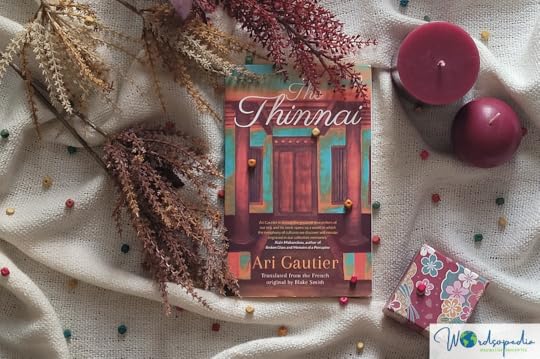
Ce livre est le récit du destin tragique d'âmes errantes qui échouent sur le thinnai d'une petite maison de Pondichéry à la recherche d'un moment de répit dans leurs vies tourmentées. Sur ce thinnai, l´Histoire et les histoires se mê des marins bretons font naufrage aux Maldives, des coolies partent vers les Antilles vivre des destins brisés, des enfants malheureux sont jetés dans des rues sordides de Bombay, et Gilbert Tata erre, muni d'une pierre précieuse funeste et mystérieuse.
Ari gautier has blended the daily eccentricities of a small neighbourhood with the tales of foreign lands and history, splendidly. The most delightful thing about this book is that it reminds me of the stories I use to read in school, set in poor and noisy areas of townships with some peculiar characters and their strange names. It has both a nostalgic as well as a native vibe to it.
The Thinnai by Ari Gautier. Translated from French to English by Blake Smith.
A million stars and more for this book please! ✨✨✨✨✨
Reading The Thinnai brought back fond memories of my gallivanting about in Madagascar, Mauritius and the Reunion 2 years ago. I am a lover of island life. The islanders sense of music and rhythm is indeed captivating. Passionately composed songs highlighting their lives and livelihoods set to a handsome tune and groovy beats. A greater sense of peace and joy despite the odds stacked against them. The creole community suffer most at the hands of a religiously fanatic government in Mauritius. The creole music, the Baila music and the Mauritian Sega dance resonating in the grand Indian Ocean is paradisiacal. How I miss them all.
I’m a little embarrassed to admit I haven’t visited Pondichèry, a significant Francophone. After reading The Thinnai, I’ve made up my mind to witness firsthand the sensual treat Pondichery has to offer while it stands through the test of time. This book has made me even curious to go on a discovery journey to Pondicherry.
Pondicherry was a former French colony and an existing French speaking state in the Tamil country. The Pondichery creole is an ensemble of French, Portuguese and Tamil, spoken with a Tamil sounding diction. A melange of cultures, textiles, food, languages. I’ve to tell you I love any type of Creole. I am fascinated with its charming wordplay. Beyond its multilingualism, it serves to be a reminder of resistance against slavery.
Thinnai in the Tamil tongue means a verandah. More of raised platforms flanking the entrance of the house, supported by teak round pillars, that provides a shelter for anyone passing by to stop, rest, have one or two idle chatters or tête-à-tête and then continue their journey. The principle of a Thinnai is deeply ingrained into the Tamil cultural heritage, the first being ‘Virunthombal’ – Hospitality.
Ari Gautier wittily tells his story from a Thinnai where his story’s characters meet. He creates a neighbourhood out of Kurusukuppam and the heart of this was the Thinnai , a relic that stood through the test of time and war and the idealistic premise for his story to come alive. The whimsical characters in the story through their eccentricities, tell the cruel oppression of the caste system which even discriminated the Creole community with high and low classes. The high Creoles were direct descendants of the French colonists and lived in affluent colonial houses while the low creoles who had a mixed pedigree / shared ancestry with the Scottish, Danish, Portuguese, English and Dutch, shunned away from the main towns and lived in ghettoised slums and fishing villages.
The uprising against the French monarchy in France reverberated in Pondichery too when the subjects were under the French rule. There was chaos and divided loyalties because one side were the Tamil rebels led by VVS Aiyar and Vanchinathan were working their independence movement to oust the European Imperialists in Tamilnadu. While on the other hand, the caste-oppressed creole communities identified themselves with the French, became French citizens, converted to Catholicism and were ready to leave their motherland for France. Fate was cruel when the French handed over Pondichery to the Indian government. In turn displacing the French subjects on Indian soil and denied passage for those who filed papers to go to France.
‘And that’s why there’s no French flag flying here?’ the old man asked my father, who had sunk into his memories. ‘In a way, yes. I never was much for patriotism. I don’t feel the need to show my love for a country. My friends can feel it; they can put up a French flag in front of their houses, or the French and Indian flags together. I respect them. Personally, I don’t feel it. I don’t feel any pride either. The flag is just what the government uses to wrap corpses.’
– THE THINNAI BY ARI GAUTIER
There was a treacherous group of Tamils exploiting the crisis by bending over backwards to serve their colonial masters by selling Tamils as slaves to French colonies. Many unsuspecting Indians were sold as slaves to other French colonies like Guadeloupe in the Caribbeans to work the sugarcane plantations for their French masters.
A political satire had its mark in this story in the form of Monsier Michel and Manickam Anna pitting against each other just the way their ideals clashed: Capitalism vs Communism. Cameos of Marx, Lenin and Stalin were caricatured as ‘Mop head, The Baldy and The Moustache’
The spiritual invasion in Pondicherry threw a spanner into the Catholic missionaries’ propaganda and the caste hegemony. The ashram of Aurobindo was erected. Along with it came the procession of the spiritually woke folks – hippies. A variety of psychedelic narcotics were peddled in Pondicherry to enable the cult following.
You’d meet quirly characters with peculiar names. Three-balls Six faces : I figured the Arumugam part, a little while later discovered the reason. The Tamil word spoken in parlance for Three Balls made me chuckle. Moment of revelation for me
The creole gastronomy mentioned in the story was droolworthy: Baffade prepared with generous spices, fruits and nuts, Hyderabadi briyani from the Nizams, Nawayath Muslim’s Bhatkali briyani, Piitasattaykarichi / dingdings.
The sightscapes, soundscapes were sensual treats. Even made my nose twitch when reading on the fish market stalls run by fiesty creole women, the palate tingling spice bazaars, meat butchers, the noisy haggling with the sellers and even beef selected by connoisseurs.
My favourite character was Lourdes, a curmudgeon at times. I loved her clever rejoinders in creole to the men who enjoyed winding her up.
Then came along the white old man Gilbert thatha with his sidekick to this Thinnai. He made it its pit stop, mainly to relish in the tantalizing aroma from Lourdes’s cooking of Creole dishes. He made himself comfortable in the Thinnai. Found himself a target audience for his war stories who was the house owner, a former French soldier. So long as he kept his listeners entertained, he knew he could ensure his flow of Bagpiper’s whisky, cheroot and Lourdes’s hot scrumptious meals. For a seasoned streetwise man and always on the move, survival tactics had to be very clever. The Thinnai and all that it provided him with was luxury. So he waited it out cleverly.
Like an illusionist trick he conjured up a tall tale of the Sita’s curse. In it he interlaced his personal life anecdotes from birth to Pondichery. He built up the climax to The Sita’s curse in calculated moves after making sure his audience had already fallen hook, line, and sinker. He sold his irresistible story so well. It was a true art. So atmospheric and moving.
I’m still reeling from the effects of the story. Such is the ingenuity of Ari Gautier. A scintillating, panoramic mise-en-abyme.
Ari Gautier is a phenomenal storyteller. He is a rare gem in the literary world. He’s ability to arouse the reader’s senses and his talent to weave the stories with history together are a force to reckon with. I hope Le Thinnai/ The Thinnai receives the international readership and that his art of story telling travels across the oceans. I mean it from the depths of my heart. I am lucky to have read The Thinnai originally written in French by Ari Gautier. Translated to English by Blake Smith.
What a brilliant translation! Given the dynamics of the story, this is no easy feat! Thank you Blake for making my world a lot richer and giving me the opportunity to read this beautiful story in English.
The Thinnai was originally penned in French by Ari Gautier, but I delved into the English rendition skillfully translated by Blake Smith. This captivating tale unfolds in the charming fishing village of Kurusukuppam, not only offering a window into Pondicherry’s past and present but also whisking readers away on a journey spanning from a quaint village in northern France to the Maldives, various parts of coastal India, and even the Caribbean islands.
The writing exudes an old-world charm, characterized by great attention to visual imagery and detailing. The author masterfully highlights the disparities within this diverse community, weaving these differences into the narrative’s very fabric.
Apart from these themes, food plays a major role in the story. The mouth-watering cuisines are a gastronomical delight!
Readers unacquainted with Tamil vocabulary might not enjoy the subtleties of humor beneath the eccentricity. The translation works well and coveys the essence of the story, with the exception of the spelling of Tamil words. Most Tamil words are spelt with an ‘H’. e.g., grandfather is Thaatha and not Thaata. This and a few other references act as a disconnect. Non-Tamil readers would be minimally affected by this.
The Thinnai offers an enriching literary voyage, one that promises readers a nostalgic and thoroughly enjoyable experience.
A thinnai is an architectural feature - a shaded verandah outside traditional homes in South India. It is common for passersby to rest here in the heat of the afternoon, or even spend a night here.
The unnamed narrator returns to Kurusukuppam, a locality that borders the White Town of Pondicherry, and finds that somebody has been inhabiting the thinnai of his locked-up house. He rediscovers old acquaintances, and goes down memory lane, recalling from childhood, another such inhabitant of the thinnai - the Caucasian-looking raconteur Gilbert Tatha who arrived one Bastille Day with Little Gilbert in tow, adding colour to an already vibrant cast of characters in the locality.
I loved the array of characters and their names, from Emile Kozhukattai-Head to Pattakka, Killer Widow to Karika Bhai, Three-Balls Six-Faces, the quirkily named Asamandi Bayacaca Sonal and Manickam Anna's brood of children named after famous Russians. French and Tamil become simplistic ways of viewing the cultural melting pot that is Pondicherry.
The book is not life-changing or literary in its content, but memorable in its characters, snippets and snatches, much like a brief respite in the shade of a thinnai on a hot summer day.
This was really very good - the only reason it isn’t 5 stars is because it was so difficult to follow what character was speaking when, and many character felt underdeveloped and vague. I’m so glad this wasn’t too long too lol, finished it quite quickly. The ending made me laugh. I’m so sure I missed a lot but it feels like it would make a good re-read so that’s good. Honestly loved it, my favourite module reading so far (though when I finally finish ‘Sea of Poppies’ maybe that will change, who knows).
Reminded me so much of the Malgudi days with the quirkiest characters and so much nostalgia. It was wonderful to read French literature from India and reintroduced to the geography of Pondicherry through the book
I first came across the term Thinnai last year in a novel by a friend – it means a shaded verandah at the entrance to a home. I could not resist my temptation to read a novel named The Thinnai – was the verandah a lead character in the novel? I was not disappointed – the thinnai is indeed the lead prop where most of the action takes place.
The book is set in Kurusukuppam, a working class district in Pondicherry. The place has its fair share of all kinds of people – from a few who would appear to be eccentric, to upper class Franco-Indian soldiers who fought for the French in the World War, have now settled in this district, have Creole servants, still celebrate the King’s Day and the Bastille Day, are more French than possibly even the French, yet are Indians at heart and in their acts.
Into this potpourri of characters lands Gilbert Thaata, an old Frenchman, who comfortably settles himself in the thinnai of one such soldier. No one knows where he has come from. He finds a roof and food and good alcohol in this thinnai. He starts narrating a tale to his gracious host, and those who come to the thinnai – a tale of his ancestors, and how they came in possession of a precious stone, the Curse of Sita. His wrinkled experience understands the human psychology – this free life of relative luxury is his till he continues to spin his yarn.
Does he hand over this precious stone to his host when departing? Will there be another storyteller?
It was such a fine storytelling that I did not want the story to end. I also wished that I had learnt French to read the original version of the book too. I am certain that Blake Smith has captured all the nuances of the original.
Pondicherry is a place that's very close to my heart. The first thing that comes to our mind when we think of Pondicherry is the beautiful picturesque streets and of course 🍻🍾.
This is the other side of Pondy. The author paints the picture of the streets of Pondicherry that is not in the tourist brochures of must visit places.
A lively neighborhood with its fair share of chaos, where people from all walks of life rub shoulders and sometimes clash over everyday struggles like water scarcity. Their quirky personalities and dramatic moments can be both entertaining and infuriating.
A thinnai is where stories are conceived, given birth and die. In this book too 'the Thinnai' is what connects everyone in the area.
Gilbert Thaata a stranger, comes to our nameless narrator's Thinnai. He's a strange looking vellakaaran with a curse of Sita. Unraveling this mysterious man's story and curse is the rest.
It's a witty, funny and quick read. For someone from Pondicherry, this could be a treat, given the vivid descriptions of the area.
If you prefer a lighthearted story amidst a chaotic neighborhood pick this up!🥂
Set in the seaside neighborhood of Kurucchikuppam at Pondicherry, the book is a indulgence in Pondy nostalgia. And it has the nerve to present all things: the good the bad and the ugly as it is. The true pièce de résistance in this spread appears to be the Thinnai while Gilbert thatha's yarn being a mere appertif! A lot of childhood memories were evoked by this book and an intense longing for the sea breeze and sudden monsoon showers of Pondy are inevitable. Definitely recommended for Pondy lovers.
THE THINNAI BY ARI GAUTIER - TRANSLATED BY BLAKE SMITH
I happened to come across this book in the scroll’s translated book recommendations and I was intrigued by the cover and the title. Also after some thorough research, I found that the book is based on Pondicherry. Now that’s very very rare. Whenever I say I come from Pondicherry, people only ask me about the tourist places. But there are so many areas hidden in Pondicherry which do not come under tourist spots but are rich in culture and heritage. I knew this book was just meant for me and I made no mistake picking it up.
‘THE THINNAI’ literally translates to a front porch with a raised platform built on either sides of the main door of a house. This type of architectural beauty is common in south India, especially Tamil Nadu and Pondicherry. It’s meant for passersby to take shelter temporarily and it reflects the hospitality of the people. This was common during the older days and has become almost obsolete now.
The story is about one such passerby, Gilbert thatha (grandpa) who happens to be crossing the narrator’s house with a little boy. He is half Indian and half french and was separated from his family left to be a wanderer on the streets. People from the narrator’s house and his neighbourhood in the village of kurusukuppam gather every evening around the thinnai to hear stories of his ancestors and his separation from his family.
Pros: The story telling was just so amazing that I couldn’t stop reading it. I loved each and every character in the book including the quirky Gilbert thatha and his tales. It was a realistic depiction of the cultural background of unknown parts of Pondicherry. There were parts that made me emotional and there were parts that made me crack up. For everyone who love translated works with historical background. Love the cover and the title. The ending was such a twist just when I was thinking that it was going off track.
With the narrator returning to his village and wistfully looking at how it has changed over the years, the book seems to start out like yet another story that runs on childhood nostalgia. The villagers' eccentricities and small backstories seem to come from an established template for such books: The village drunkard, an unapologetic polygamist, an idealistic communist, a greedy capitalist as his antithesis, a movie-crazy wastrel and a woman with loose morals -- the works.
However, as the stories unfold, the personalities and their quirky names begin to stand out. For those who do not understand Tamil, unfortunately, the nicknames may not strike a chord as intended. The story behind Emile Kozhukattai Head’s name is part of the narrative but a non-native may not be able to picture what exactly a kozhukattai is. Similarly, Three-Balls Six-Faces might sound ridiculous enough to make one chuckle when it is read in English, but when translated into Tamil, the name takes on an altogether different level of hilarity. And then there is Asamandi Baiyacaca Sonal, a name that one may never figure out fully even after reading the incredulous story behind it.
I think I quite liked the book. The primary reason for my interest in it was my curiosity to explore French influence and the cultural dynamics of Puducherry. And I really appreciate the knowledge the book imparted. North East literature and Something from the unheard locales of India were always on my reading list. Explored Thinnai as one of the unheard parts of history. Now am all set to explore Mamang dai and some of the story collections from Assam, Tamilnadu etc.
Tempted by the many glowing reviews, I set out on what was a strange reading journey. Some beautiful writing, the rendering of the neighbourhood where the story is set is delightful, the characters wonderfully strange. But the story remained an unsatisfying mystery to me…
I mean, this book is based literally in the neighbourhood next to mine in Pondicherry so why wouldn't I read it?? Plus, I love reading books and knowing pretty well the locations they are talking about (though since this book is based decades ago, a lot of those landmarks are not there anymore)
I've always been curious about the effects of French colonisation in Pondy, and this book does offer some insight to it in terms of Indians being transported across the world, either as soldiers or as replacements to slaves that were freed post the abolition of slave trade. Also, the alcohol addiction amongst the men which is very prevalent even today, especially amongst the locals, and the class differences amongst the ones who speak French, Tamil or the Tamil-French creole.
The reason this gets three stars is because frankly I only enjoyed the latter half of the book. There were too many characters for me to keep track of (which I know is because the author wanted to re-create that chaotic yet calm atmosphere of these places with their idiosyncratic characters). Also it was annoying me to read about the men shamelessly wasting their days drinking and ordering the women around (a reality that still exists of course). But in terms of teaching me a bit more about the French influnce in Pondy, I liked it.
This is really just an okay book, not really able to relate to the superlative reviews here. This is a typical book on India , written from a white man s point of view. While not as dark, I was frequently reminded of The White Tiger. They continue to tell tales of impoverished Indians, class divide and caste divide , somewhat like Bollywood telling the same love story against hundred different backdrops. If the characters had any depth , it might have been more enjoyable, even if the story is a stale one.
You won't regret reading it, it's a light and a quick read, but i just wanted to record a contrarian view on the book here , so that no one falls for the title like I did.
All the French connection really does nothing other than give Christian names to the characters. So please don't fall for the Indo French literature trap.
Saw the cover of the book slapped on all the walls of Kuruchikuppam while cycling there, and bought the book. The charm of the book is the minute detailed descriptions of life inside Kuruchikuppam. I found I could picture each character based on the men and women I've spoken to and smiled at, while spending time inside this fishing village off Promenade Beach in Pondicherry. Maybe reading this book will propel the reader to go visit soon, because the village may be eaten up by the beach any day now :( Thank you, Ari Gautier, for immortalising Kuruchikuppam for us.
It was such a delight for me to read this novel with a backdrop of Pondicherry, the erstwhile French colony in Southern coast of India. Having lived there since my childhood, reading this took me back in time and made me relive few moments again.
'Thinnai' starts of as a commentary on the tragicomic lives of the people in Kurusukuppam and soon ventures into hundreds of years back and forth with anti colonial and socio political commentary with a tinge of magical realism. Thinnai is a longing for the stories to fill ourselves and others. By the time I finished the story, I didn't feel like getting up from the 'Thinnai'.
At Frankrike har hatt koloni i sjølve India var ukjend for meg. Boka skildrar livet i eit arbeidardistrikt i Puducherry. Her er det fargerike personlegdomar, samhald, krangling, liv og røre. Språket varierer mellom høgstatus fransk, kreolsk og tamilsk. På eit tidspunkt konverterte mellom anna kastelause/lågkaste til katolisisme for å koma seg vekk frå kastesystemet. Dei/det franske har mest prestisje og slik kan ein fransktalande, kvit tiggar få betre behandling og større stjerne enn mange andre. Når Gilbert stats i tillegg er ein god forteljar så kan han få mykje ut av sitt lydhøyre publikum. Boka er ikkje lang, men den er fornøyeleg.