

What do you think?

The Coming Bad Days
A woman leaves the man she lives with and moves to a low stone cottage in a university town. She joins an academic department and, high up in her office on the thirteenth floor, begins a research project on the poet Paul Celan. She knows nothing of Celan, still less of her new neighbours or colleagues.
She is in self-imposed exile, hoping to find dignity in her loneliness. Like everywhere, the abiding feeling in the city is one of paranoia. The weather is deteriorating, the ordinary lives of women are in peril, and an unexplained curfew has been imposed.
But then she meets Clara, a woman who is her exact opposite: decisive, productive and assured. As their friendship grows in intimacy Clara suggests another way of living - until an act of violence threatens to sever everything between them.
Reminiscent of Thomas Bernhard, Rachel Cusk and Gwendoline Riley, The Coming Bad Days is a penetrating portrait of feminine vulnerability and cruelty. It announces the arrival of a startling new voice in fiction: intelligent, brutal, sure, and devastatingly funny.
She is in self-imposed exile, hoping to find dignity in her loneliness. Like everywhere, the abiding feeling in the city is one of paranoia. The weather is deteriorating, the ordinary lives of women are in peril, and an unexplained curfew has been imposed.
But then she meets Clara, a woman who is her exact opposite: decisive, productive and assured. As their friendship grows in intimacy Clara suggests another way of living - until an act of violence threatens to sever everything between them.
Reminiscent of Thomas Bernhard, Rachel Cusk and Gwendoline Riley, The Coming Bad Days is a penetrating portrait of feminine vulnerability and cruelty. It announces the arrival of a startling new voice in fiction: intelligent, brutal, sure, and devastatingly funny.
265 pages, Paperback
First published April 22, 2021
About the author
Sarah Bernstein
18 books253 followersSarah Bernstein is from Montreal, Quebec and lives in Scotland where she teaches at Edinburgh University. Her fiction, poetry and essays have appeared in tender, Contemporary Women’s Writing, MAP and Cumulus. Now Comes the Lightning, a collection of poems, was published by Pedlar Press in 2015.
Ratings & Reviews
Friends & Following
Create a free account to discover what your friends think of this book!
Community Reviews
Displaying 1 - 30 of 97 reviews

April 16, 2024
"The vital thing is not to let anybody get to the bottom of you..."
I was introduced to Sarah Bernstein last year when I read her masterpiece, Study for Obedience, which was short-listed for the Booker. Stunning, brilliant, oblique, and captivating, I was riveted from start to finish. Not a plot-based author, her themes and ideas of isolation and emotional paucity fill the pages--and in Coning Bad Days, with her enigmatic voice. This earlier book is not as developed or as fully realized as Obedience, but it is familiarly cerebral and poetic. Each sentence is finely crafted; a number of them are interpretive and just out of reach. She makes me tremble.
The unnamed narrator is an academic who is teaching at an unnamed university in an unnamed city in an unnamed country which I think is England. She knew nothing about poet Paul Celan but landed a job as a scholar/researcher of his work. She’s a loner suffering from existential dread (and passing it on to me via osmosis!). She had left her last boyfriend and now lives in self-imposed exile. Her sense of being followed or spied upon adds a level of unease to the story.
The narrator eventually meets a woman, Clare, and they begin an intense alliance. The narrator saw Clare as a mirror, or the opposite of herself, a friend who pulled or persuaded her out of her scarce and blurry existence. “Sometimes we will the darkness into being because the anticipation is a thing much more terrible, and I knew that we both apprehended even in girlhood the bad days to come.”
Being with Clare made the days more distinct, even knife-like. “She was absent and electric all at once.” Clare called our narrator’s bluff, she pushed her to face her fears. Her new friend both liberates her and crushes her, she entered the narrator’s life like a “fugitive wind.” However, when Clare suffers a tragic event, the narrator fails to help. Instead, she retreats, helpless, and turns to silence.
Our protagonist is consumed by angst---the looming of adjacent violence, and her own need to perform, to stay apart from it all, to live behind the lines, to practice detachment. She feels absent in her own life but is thoroughly present in the reader’s. Passage after passage, I felt the atmosphere thickening, taking on a solid mass and closing in on me—the prosecuting prose, the lash of language. Male toxicity and dominance weigh heavily on the subtext and inevitably rise to the surface.
Contemplative and often backhanded, this novel is a moody piece that punctured my defenses. I often felt: I want to escape and there’s no escape. Tense and brooding, the story portrayed a woman on the verge, a woman hiding from her life. Was there redemption for the protagonist? Still deciphering this cipher.
I was introduced to Sarah Bernstein last year when I read her masterpiece, Study for Obedience, which was short-listed for the Booker. Stunning, brilliant, oblique, and captivating, I was riveted from start to finish. Not a plot-based author, her themes and ideas of isolation and emotional paucity fill the pages--and in Coning Bad Days, with her enigmatic voice. This earlier book is not as developed or as fully realized as Obedience, but it is familiarly cerebral and poetic. Each sentence is finely crafted; a number of them are interpretive and just out of reach. She makes me tremble.
The unnamed narrator is an academic who is teaching at an unnamed university in an unnamed city in an unnamed country which I think is England. She knew nothing about poet Paul Celan but landed a job as a scholar/researcher of his work. She’s a loner suffering from existential dread (and passing it on to me via osmosis!). She had left her last boyfriend and now lives in self-imposed exile. Her sense of being followed or spied upon adds a level of unease to the story.
The narrator eventually meets a woman, Clare, and they begin an intense alliance. The narrator saw Clare as a mirror, or the opposite of herself, a friend who pulled or persuaded her out of her scarce and blurry existence. “Sometimes we will the darkness into being because the anticipation is a thing much more terrible, and I knew that we both apprehended even in girlhood the bad days to come.”
Being with Clare made the days more distinct, even knife-like. “She was absent and electric all at once.” Clare called our narrator’s bluff, she pushed her to face her fears. Her new friend both liberates her and crushes her, she entered the narrator’s life like a “fugitive wind.” However, when Clare suffers a tragic event, the narrator fails to help. Instead, she retreats, helpless, and turns to silence.
Our protagonist is consumed by angst---the looming of adjacent violence, and her own need to perform, to stay apart from it all, to live behind the lines, to practice detachment. She feels absent in her own life but is thoroughly present in the reader’s. Passage after passage, I felt the atmosphere thickening, taking on a solid mass and closing in on me—the prosecuting prose, the lash of language. Male toxicity and dominance weigh heavily on the subtext and inevitably rise to the surface.
Contemplative and often backhanded, this novel is a moody piece that punctured my defenses. I often felt: I want to escape and there’s no escape. Tense and brooding, the story portrayed a woman on the verge, a woman hiding from her life. Was there redemption for the protagonist? Still deciphering this cipher.

May 27, 2021
The narrator of Sarah Bernstein’s debut novel lives in a menacing world that continually intrudes on her attempts to project a cool, collected persona, overwhelming her with floods of anxiety. Her elliptical references to her surroundings hint at deeply unnerving circumstances, a society bordering on dystopian, mired in sexual violence manifested through awkward encounters, and underlined by a series of disappearances of young girls. Everything here’s presented from this unnamed woman’s point of view but her perceptions seem far from reliable, there’s a constant feeling that crucial information’s being withheld or significant events glossed over. She’s ostensibly engaged in literary research at a university but making little real progress perhaps because her recent breakup with a male partner has left her living in the shadow of an unattainable, masculine model of success. But then the narrator’s solitude punctured by meeting the equally enigmatic Clara who moves in with her not long after. The bond between them’s amorphous, confused and confusing but it clearly involves some form of power struggle, in fact relations of power seem central to Bernstein’s story. But then something happens that shifts the delicate balance of their unfolding relationship and things take an even more ominous turn.
Although Bernstein’s cited Virginia Woolf and Fleur Jaeggy as key influences, for me the book this most called to mind was Susanna Moore’s In the Cut another unsettling portrait of a woman, also an academic, grappling with misogyny and her own self-doubt. But Bernstein’s story has less momentum than Moore’s, it’s denser, less direct and sometimes frustratingly static. In many ways it's a very promising piece, the writing often impressed me, it’s strikingly atmospheric, overflowing with potentially memorable images despite, or perhaps because of, the oddly archaic choice of register. I also admired the way in which Bernstein’s set out to construct a text that’s explicitly in dialogue with material and concepts from others: T.S. Eliot, Celan, Maggie Nelson, Sontag… But the more I read, the more I found myself struggling to sustain my interest or fully invest in the scenarios being served up to me. Bernstein’s making highly relevant points here about alienation, trauma and life for women in a dysfunctional contemporary society but for me her heavily underlined arguments lessened the force of her conclusions, and her ideas were weaker for being so overly drawn out when greater clarity and concision might have been more effective.
Although Bernstein’s cited Virginia Woolf and Fleur Jaeggy as key influences, for me the book this most called to mind was Susanna Moore’s In the Cut another unsettling portrait of a woman, also an academic, grappling with misogyny and her own self-doubt. But Bernstein’s story has less momentum than Moore’s, it’s denser, less direct and sometimes frustratingly static. In many ways it's a very promising piece, the writing often impressed me, it’s strikingly atmospheric, overflowing with potentially memorable images despite, or perhaps because of, the oddly archaic choice of register. I also admired the way in which Bernstein’s set out to construct a text that’s explicitly in dialogue with material and concepts from others: T.S. Eliot, Celan, Maggie Nelson, Sontag… But the more I read, the more I found myself struggling to sustain my interest or fully invest in the scenarios being served up to me. Bernstein’s making highly relevant points here about alienation, trauma and life for women in a dysfunctional contemporary society but for me her heavily underlined arguments lessened the force of her conclusions, and her ideas were weaker for being so overly drawn out when greater clarity and concision might have been more effective.

April 22, 2021
I will admit that I picked up this book on the strength of its gorgeous cover and the instantly captivating first page (and also the fact that it’s a Daunt Books paperback. They make such gorgeous physical books. They even smell nicer than other books). At first glance, the premise of The Coming Bad Days sounds interesting but perhaps a touch unoriginal. An unnamed woman abruptly leaves her partner and moves to a university town, where she lives in what the blurb calls ‘self-imposed exile’, testing the limits of her solitude. Until she forms an odd and intimate friendship with her boss’s wife, a woman named Clara, who becomes the obsessive focus of her musings.
Reading that description, or reading the blurb, one might assume it to be a tense psychological drama; I hesitate to say that’s wrong, exactly, but it doesn’t feel sufficient. Once you read as much as a single paragraph, it becomes clear how much this is a novel of style and language, not plot and character. I read the book marvelling at its style first, and taking in its events second. It’s one of those that had me noting down lines constantly; writing this review, I struggled to narrow down the passages I wanted to quote.
It can be abstract and obtuse. The tone is cool, surreal. The narrative is implicitly speculative: the town is plagued by a series of mysterious disasters, which seem to escalate in severity while always staying in the background. This gives the darkly amusing impression that the narrator’s soul-searching is taking place against the backdrop of an apocalypse she barely notices. Yet there are intrusions of real hurt, too, as when an incident – never articulated but nevertheless clear – causes a rift in the narrator’s relationship with Clara. And in its chill detachment, it captures exactly the experience of depression and suicidal ideation in a way emotionally charged writing never could.
I cycled through a load of comparisons while thinking about how I’d describe this to someone: in a note on my phone I wrote ‘the mood of Signs of Life and the setting of Communion Town, by way of Joel Lane and Anna Kavan’. I was quite some way into it before I realised that this is the closest non-translated thing I’ve read to Fleur Jaeggy, and as soon as that clicked, I knew it was perfect. This is no act of ventriloquism, though: while Bernstein is clearly influenced by Jaeggy’s style, her writing has its own cold economy, its own wry humour.
The cover, then, is not only beautiful but also perfect for the book: cool blue for its iciness; a shadowy face, wreathed in smoke, for its ambiguity. I was thrilled by Bernstein’s writing – by how good it is, and also just the discovery of it, the knowledge that this is an author I will follow from now on. I wouldn’t recommend it to everyone, but if you find the first page as invigorating as I did, you’ll love it.
TinyLetter | Linktree
Reading that description, or reading the blurb, one might assume it to be a tense psychological drama; I hesitate to say that’s wrong, exactly, but it doesn’t feel sufficient. Once you read as much as a single paragraph, it becomes clear how much this is a novel of style and language, not plot and character. I read the book marvelling at its style first, and taking in its events second. It’s one of those that had me noting down lines constantly; writing this review, I struggled to narrow down the passages I wanted to quote.
It can be abstract and obtuse. The tone is cool, surreal. The narrative is implicitly speculative: the town is plagued by a series of mysterious disasters, which seem to escalate in severity while always staying in the background. This gives the darkly amusing impression that the narrator’s soul-searching is taking place against the backdrop of an apocalypse she barely notices. Yet there are intrusions of real hurt, too, as when an incident – never articulated but nevertheless clear – causes a rift in the narrator’s relationship with Clara. And in its chill detachment, it captures exactly the experience of depression and suicidal ideation in a way emotionally charged writing never could.
I had loved this world, awfully. All the same and in truth I behaved badly. I had appetites. I stalked through the house at night, seeking high and low the petrol can, seeking high and low the last act, thinking all the while, Would no one tumble over the banisters, saying to themselves in a last flash: All this is no suffering. For what were we to our loved ones if not obstacles in a lifelong struggle to pretend we were otherwise. I had always known what I wanted. I wanted catastrophe. I cannot have been the only one.
I cycled through a load of comparisons while thinking about how I’d describe this to someone: in a note on my phone I wrote ‘the mood of Signs of Life and the setting of Communion Town, by way of Joel Lane and Anna Kavan’. I was quite some way into it before I realised that this is the closest non-translated thing I’ve read to Fleur Jaeggy, and as soon as that clicked, I knew it was perfect. This is no act of ventriloquism, though: while Bernstein is clearly influenced by Jaeggy’s style, her writing has its own cold economy, its own wry humour.
The cover, then, is not only beautiful but also perfect for the book: cool blue for its iciness; a shadowy face, wreathed in smoke, for its ambiguity. I was thrilled by Bernstein’s writing – by how good it is, and also just the discovery of it, the knowledge that this is an author I will follow from now on. I wouldn’t recommend it to everyone, but if you find the first page as invigorating as I did, you’ll love it.
I stood in the garden at night looking at the dark branches and thought, yes, this is it. This is what I have always wanted. This obscurity.
TinyLetter | Linktree

December 17, 2023
Sometimes we will the darkness into being because the anticipation is a thing much more terrible, and I knew that we both had apprehended even in girlhood the bad days to come.
The Coming Bad Days was Sarah Bernstein's debut novel in 2021, one which I admit I had not noticed at the time but which I read now because of her magnificent Study for Obedience, the stand-out novel on this year's Booker Prize.
The novel opens:
I left the man with whom I had been living one morning in late summer after opening the wardrobe and seeing the tidy line of his shirt collars, white and blue, white and blue. I felt sick. I began to see my life rolling out in front of me and it looked like the street on which we then lived, with the blue and green and white houses and the red and yellow doors. And I could discern in the distance the seasons rolling in, and the apples falling in the orchard, and the windows freezing shut, and the blue smell of spring, and the children in the wading pool in the baked summer light. And I knew that underneath it all were these hard and secret things. Prior to this moment, which proved in fact to be a decisive one in the course of my life, I had been afraid of being alone. The notion that I was free in theory but also in practice to do whatever I liked with my life was terrifying; it was nothing short of a nightmare. I moved to a low stone cottage on a street of low stone cottages. Soon it was autumn and the windows looked out onto the night, which fell promptly at half past four in the afternoon. All around me was quiet. During the day I sat at my desk and felt the light drain from the bedroom as the sun moved out of the eastern sky. I watched the trees submit to the passing of the seasons. Various birds came and went. Occasionally I ventured into the garden to collect leaves into a brown bin assigned to the address by the council, or else to cut back the ivy that grew around the garden’s perimeter. During these several months of making unsuccessful job applications from my desk, which was wide and beautiful, oak, I began to travel by train to the city nearby with some frequency. At first I had a fear of taking the train by myself. I had read a story about a girl who got on a train one night and was found dead weeks later in a forest far away. The local news affiliates circulated an image of this girl taken from CCTV footage. In the still she was standing on the railway platform wearing an expression that seemed to me familiar. In short the story about this girl confirmed what I had long suspected, namely that journeys of this kind, taken alone, taken by women, end in self-annihilation.
The succession of unsuccessful job applications in the novel mirror Bernstein's own experience when writing the novel and as she told Nidhi Verma in Platform, one key trigger for this novel was being declined for a job for being too 'affectless':
The ever-present fear of violence against women is at the heart of the novel. As is later on a state-imposed curfew (for reasons not entirely clear and perhaps merely an excuse, but at the time of increased climate-changed natural disasters).
It is true that in those days the concept of truth was by and large and obviously irrelevant, the mechanisms of power had been laid bare, the papers confusing balance for objectivity: the dog whistle, the wink and nod, the tacit injunc-tion to permit the impermissible, accept the unacceptable, even the charlatans surprised at the amount of airtime they were getting. What would it mean to tell the truth in such conditions?
As Bernstein also told Verma:
While the novel was written pre-pandemic it became prescient at the time of its publication in April 2021, a few weeks after the murder of Sarah Everard by a policeman who is believed to have abducted her under the pretence of an arrest for breaching social-distancing guidelines.
This is also a novel fused with literary references, some of which are referred in an afternote, although used more subtly that her failed-academic narrator who admits it occurred to me that I was basically a thief, absolutely a fraud, every word I had ever written cherry-picked from a rather narrow and certainly biased corpus of texts.
From a 2016 interview on rob mclennan's blog Bernstein cited some key writers for her:
Q: What other writers or writings are important for your work, or simply your life outside of your work?
A: I've already mentioned Beckett and Grace Paley. Also, Virginia Woolf, WG Sebald, Anne Carson, Edwidge Danticat, Joan Didion, Elena Ferrante, Margaret Atwood, Michael Ondaatje, Tove Jansson, Rebecca Solnit, Louise Erdrich, Thomas Bernhard... (ellipsis from the original)
In The Coming Bad Days the character of the narrator is specifically influenced by Muriel Spark's Selina Redwood (from The Girl of Slender Means) and Fleur Jaeggy's protagonists. From a 2021 interview in MAP Magazine with Anahit Behrooz:
In addition there seems a very deliberate nod to Maggie Nelson's Bluets (from the blue cover to the narrator, to the describing many things for their inherent blueness e.g. "the blue and wide open smell of spring")
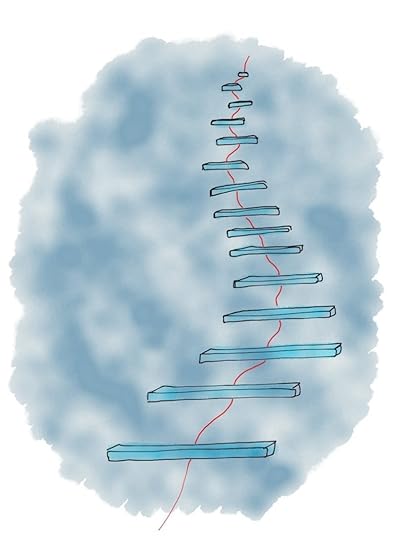
Hilary Reid White, ‘Everything has its season’, 2018 - which was chosen to illustrate an essay, Mostly No, by Bernstein in MAP Magazine, in 2018 and before this novel was published, on Spark's female characters and which includes words reproduced almost verbatim in the novel's opening page (contrast the passage below with the one quoted above)
The narrator herself is a complex character, much of her thoughts analysed through her own view of the perspective of her sometime companion Clara - I felt that Clara was bringing the things I said into being, that my thoughts were being admitted to the sensible universe, transformed into atoms of pure glass one could hold in the palm of one’s hand, turn over and over and this isn't a novel for those hoping for a linear narrative or any resolution - the action was being carried out according to some secret logic that, although indecipherable to me, retained its integrity..
Not as strong as Study for Obedience - but that's a high bar and can be dismissed with a reverse-Heller-on Catch-22 comment (unusually for a well-known 'quote', not apocryphal but one Heller actually made frequently), but certainly impressive.
The Coming Bad Days was Sarah Bernstein's debut novel in 2021, one which I admit I had not noticed at the time but which I read now because of her magnificent Study for Obedience, the stand-out novel on this year's Booker Prize.
The novel opens:
I left the man with whom I had been living one morning in late summer after opening the wardrobe and seeing the tidy line of his shirt collars, white and blue, white and blue. I felt sick. I began to see my life rolling out in front of me and it looked like the street on which we then lived, with the blue and green and white houses and the red and yellow doors. And I could discern in the distance the seasons rolling in, and the apples falling in the orchard, and the windows freezing shut, and the blue smell of spring, and the children in the wading pool in the baked summer light. And I knew that underneath it all were these hard and secret things. Prior to this moment, which proved in fact to be a decisive one in the course of my life, I had been afraid of being alone. The notion that I was free in theory but also in practice to do whatever I liked with my life was terrifying; it was nothing short of a nightmare. I moved to a low stone cottage on a street of low stone cottages. Soon it was autumn and the windows looked out onto the night, which fell promptly at half past four in the afternoon. All around me was quiet. During the day I sat at my desk and felt the light drain from the bedroom as the sun moved out of the eastern sky. I watched the trees submit to the passing of the seasons. Various birds came and went. Occasionally I ventured into the garden to collect leaves into a brown bin assigned to the address by the council, or else to cut back the ivy that grew around the garden’s perimeter. During these several months of making unsuccessful job applications from my desk, which was wide and beautiful, oak, I began to travel by train to the city nearby with some frequency. At first I had a fear of taking the train by myself. I had read a story about a girl who got on a train one night and was found dead weeks later in a forest far away. The local news affiliates circulated an image of this girl taken from CCTV footage. In the still she was standing on the railway platform wearing an expression that seemed to me familiar. In short the story about this girl confirmed what I had long suspected, namely that journeys of this kind, taken alone, taken by women, end in self-annihilation.
The succession of unsuccessful job applications in the novel mirror Bernstein's own experience when writing the novel and as she told Nidhi Verma in Platform, one key trigger for this novel was being declined for a job for being too 'affectless':
“I became obsessed with this idea, particularly as it pertains to gender: it was clear that my not performing a certain kind of ‘affect’ was only a problem because I was a woman. I wanted to write a protagonist, who actively acts against the injunctions to feel a certain way, pursues a kind of affective detachment.”
The ever-present fear of violence against women is at the heart of the novel. As is later on a state-imposed curfew (for reasons not entirely clear and perhaps merely an excuse, but at the time of increased climate-changed natural disasters).
It is true that in those days the concept of truth was by and large and obviously irrelevant, the mechanisms of power had been laid bare, the papers confusing balance for objectivity: the dog whistle, the wink and nod, the tacit injunc-tion to permit the impermissible, accept the unacceptable, even the charlatans surprised at the amount of airtime they were getting. What would it mean to tell the truth in such conditions?
As Bernstein also told Verma:
I was thinking a lot about what it’s like to be in a state of psychic crisis when the world around you is already in crisis and the extent to which each feeds into the other.
While the novel was written pre-pandemic it became prescient at the time of its publication in April 2021, a few weeks after the murder of Sarah Everard by a policeman who is believed to have abducted her under the pretence of an arrest for breaching social-distancing guidelines.
This is also a novel fused with literary references, some of which are referred in an afternote, although used more subtly that her failed-academic narrator who admits it occurred to me that I was basically a thief, absolutely a fraud, every word I had ever written cherry-picked from a rather narrow and certainly biased corpus of texts.
From a 2016 interview on rob mclennan's blog Bernstein cited some key writers for her:
Q: What other writers or writings are important for your work, or simply your life outside of your work?
A: I've already mentioned Beckett and Grace Paley. Also, Virginia Woolf, WG Sebald, Anne Carson, Edwidge Danticat, Joan Didion, Elena Ferrante, Margaret Atwood, Michael Ondaatje, Tove Jansson, Rebecca Solnit, Louise Erdrich, Thomas Bernhard... (ellipsis from the original)
In The Coming Bad Days the character of the narrator is specifically influenced by Muriel Spark's Selina Redwood (from The Girl of Slender Means) and Fleur Jaeggy's protagonists. From a 2021 interview in MAP Magazine with Anahit Behrooz:
Fleur Jaeggy is another writer that I was reading quite a bit of, and her cutting cruelty. That’s one thing I found inspiring, the way she designed these women protagonists, who are exceedingly unlikable in the sense of being difficult to understand and not giving much up. There’s a hardness to her protagonists, they’re so self-contained. It comes off as cruelty, but it’s not quite, it’s just a resistance to softness.
In addition there seems a very deliberate nod to Maggie Nelson's Bluets (from the blue cover to the narrator, to the describing many things for their inherent blueness e.g. "the blue and wide open smell of spring")
Hilary Reid White, ‘Everything has its season’, 2018 - which was chosen to illustrate an essay, Mostly No, by Bernstein in MAP Magazine, in 2018 and before this novel was published, on Spark's female characters and which includes words reproduced almost verbatim in the novel's opening page (contrast the passage below with the one quoted above)
I felt then like I could see my life rolling out in front of me, and it looked like the street on which I then lived, with the blue and green and white houses and the red and yellow doors. And I could discern in the distance the seasons rolling in, and the apples falling in the orchard, and the windows freezing shut, and the blue smell of spring, and the children in the wading pool in the baked summer light. And I knew that underneath it all was the savage secrecy of simple things.
The narrator herself is a complex character, much of her thoughts analysed through her own view of the perspective of her sometime companion Clara - I felt that Clara was bringing the things I said into being, that my thoughts were being admitted to the sensible universe, transformed into atoms of pure glass one could hold in the palm of one’s hand, turn over and over and this isn't a novel for those hoping for a linear narrative or any resolution - the action was being carried out according to some secret logic that, although indecipherable to me, retained its integrity..
Not as strong as Study for Obedience - but that's a high bar and can be dismissed with a reverse-Heller-on Catch-22 comment (unusually for a well-known 'quote', not apocryphal but one Heller actually made frequently), but certainly impressive.

May 27, 2021
I wish I had more time to write about this. I took too long to read it and now it feels like there are gaps in my memory of the text where connections might be made. But this could also be due to the nature of the text itself. Gauzy and elusive, it stubbornly resists efforts to parse its underpinnings. On the surface level it offers a cross-section of a single life lived and what happens when that life intersects with other lives. The vague dystopian and cli-fi elements are only occasionally and matter-of-factly referenced, adding bits of dry fuel to the low flame of anxiety pervading the text. It is at times both sublime in its descriptions (e.g., see below) and sharply perceptive in its observations. If I had to lodge a minor complaint it would be about the way it ends, just kind of petering out as it does, and yet I was not surprised to find it this way and it will hopefully inspire me to revisit the book one day.
Leaving the station, I watched the rare sunlight streak across the tracks, across the gardens, the silver northern light. The following week the clocks would go forward, more dim mornings and the long, bare evenings of unbroken cloud. As the train sped through the surrounding landscape, a feeling came over me of electric emptiness, of exhiliration as the mind unhooked itself. Or perhaps it was only a delay, a suspension of feeling. Crows flew over a green hollow, the tin roof of a building centre. I thought of a summer, far away now, when I had painted a house. Pollen covering the floorboards of the screened-in porch, a clinging heat. The long row of pines dripping sap. Lying on the rocks by the river. The cold plunge. My thoughts looped on themselves, catching somewhere. A field of unreaped corn. A searing. And then rain. I arrived in the capital, and it was spring, evening, the low golden light bisected by black boughs on the river, the same light that made a delicious magic of the path along the canal. I felt desire and grief twisting together, appearing as rendings in everyday life.

December 9, 2024
sarah bernstein is definitely an author i’m interested in reading more from. the coming bad days was atmospheric, mysterious, and quick, if a bit uneven. i flew through the first 80 pages in one sitting then lost a bit of momentum in the middle of the book, but was roped back in by the last 60 pages.
the story follows an unnamed protagonist in her late 20s who leaves a relationship to live and work in a university town as the world around her deteriorates in ways that will feel familiar to readers - intense weather, violence against women, and a sense of doom prevails. she meets a woman named clara, who is a foil to our protagonist, embodying everything she is not.
i felt a bit let down by the plot but found that it really reflected modern struggles with connection, identity, and one’s purpose in the world. there’s an overwhelming feeling of ambivalence and melancholy that felt perfect for this time of year. i think the point of the book is the ambivalence and unanswered questions, but i wanted just a bit more from the plot. the narrative voice was very engaging and i really enjoyed the way bernstein strings together words. an underhyped addition to the depressed woman moving genre!
3.5 ⭐️ rounded up
“To begin with I explained that my life, thought of as a series of days which were discrete in themselves but nevertheless added up to a collective something, seemed inconceivable. I had now experienced over ten and a half thousand mornings.
I had woken up as myself over ten and a half thousand times. What these days amounted to remained, I said, a sheer mystery to me.”
the story follows an unnamed protagonist in her late 20s who leaves a relationship to live and work in a university town as the world around her deteriorates in ways that will feel familiar to readers - intense weather, violence against women, and a sense of doom prevails. she meets a woman named clara, who is a foil to our protagonist, embodying everything she is not.
i felt a bit let down by the plot but found that it really reflected modern struggles with connection, identity, and one’s purpose in the world. there’s an overwhelming feeling of ambivalence and melancholy that felt perfect for this time of year. i think the point of the book is the ambivalence and unanswered questions, but i wanted just a bit more from the plot. the narrative voice was very engaging and i really enjoyed the way bernstein strings together words. an underhyped addition to the depressed woman moving genre!
3.5 ⭐️ rounded up
“To begin with I explained that my life, thought of as a series of days which were discrete in themselves but nevertheless added up to a collective something, seemed inconceivable. I had now experienced over ten and a half thousand mornings.
I had woken up as myself over ten and a half thousand times. What these days amounted to remained, I said, a sheer mystery to me.”
January 4, 2024
Study for Disobedience
Review of the Daunt Books paperback edition (April 22, 2021)
With Sarah Bernstein's recent win of the 2023 Giller Prize and her shortlisting for the 2023 Booker Prize for Study for Obedience, the above interview made me curious to read her first novel, which had been mostly ignored at the time of its release.
I actually found The Coming Bad Days to be more approachable with its academic setting as opposed to the more surreal world of Study for Obedience. There was more humour to it as well, even though there was an overall atmosphere of oppression and disaster which loomed at every turn. I think the dark humour combined with the sense of dread shows in the status update quotes which I noted along the way (which should be available below this review).
I managed to source a copy of the original Daunt Books (UK) paperback release. I wonder whether after the breakthrough success of Study for Obedience that a wider audience may yet discover this first novel as well.
Other Reviews
I highly recommend Paul Fulcher's review on Goodreads which contains links to some interviews with Sarah Bernstein and one of her essays.
A Study in Unknowability by Lauren Elkin, The Guardian, June 3, 2021.
Review of the Daunt Books paperback edition (April 22, 2021)
Bernstein has had to adjust to the accolades. Her first book, "The Coming Bad Days," received little attention, perhaps in part because it was published during the first half of 2021 when the COVID-19 pandemic prevented the usual publicity events that surround a book launch.
"The only two events that I did were over Zoom," she recalled.
The plaudits for "Study for Obedience" came as something of a surprise, she said, because it isn't very different from her debut. Both examine separateness and femininity, and neither is particularly plot-driven.
"It's a style of writing that people are encountering that they may not have encountered before, because it's less focused on narrative," she said. "That doesn't tend to be the case with books that have a wide readership." - excerpt from an interview with Sarah Bernstein in The Toronto Star by Nicole Thompson, The Canadian Press, November 6, 2023.
With Sarah Bernstein's recent win of the 2023 Giller Prize and her shortlisting for the 2023 Booker Prize for Study for Obedience, the above interview made me curious to read her first novel, which had been mostly ignored at the time of its release.
I actually found The Coming Bad Days to be more approachable with its academic setting as opposed to the more surreal world of Study for Obedience. There was more humour to it as well, even though there was an overall atmosphere of oppression and disaster which loomed at every turn. I think the dark humour combined with the sense of dread shows in the status update quotes which I noted along the way (which should be available below this review).
I managed to source a copy of the original Daunt Books (UK) paperback release. I wonder whether after the breakthrough success of Study for Obedience that a wider audience may yet discover this first novel as well.
Other Reviews
I highly recommend Paul Fulcher's review on Goodreads which contains links to some interviews with Sarah Bernstein and one of her essays.
A Study in Unknowability by Lauren Elkin, The Guardian, June 3, 2021.

April 16, 2021
Full disclosure: the author, Sarah Bernstein, is one of my favourite lecturers and while I thought this was going to influence my reading of the book, I couldn’t have been more wrong because within pages the voice of the narrator overtook entirely my reading with the author in mind.
Set against a backdrop of fear, confusion, and mystery which seeps subtly into the events of the novel, readers see almost dreamlike flashes and glimpses of a half-lived life. The protagonist could be me, or you, or anyone, and the city in which she lives could be anywhere. This universality is emphasised by the frequent musings on the nature of solitude, desire, hatred, memory, and time, and their insidious effects on us.
The prose style is beautiful: seven segments made up of short episodes making it easy to dip in and out but which provoke increasingly rapid page turning. Contrasting the brief moments dripped before us, I found myself racing through long sentences like I was tearing into a well-wrapped present. Many sentences are equal parts bitter, beautiful, and bitingly funny.
I’ve come away from this novel sure I have yet to soak it up entirely as it is understated and delicate, and I have a feeling that the next time I read this I will take in even more from its existential meditations. The descriptions of the weather and the changing seasons are seductive and sticky, it is a novel filled with ‘what if’s’ and a sense of things being just out of reach, there is a constant give-and-take in its writing, its plot, and between the characters resulting in a delicious sense of unfulfilment.
This is a brilliant novel and I cannot wait to see where the next one takes me. Also +10 points for queer subtext !
Set against a backdrop of fear, confusion, and mystery which seeps subtly into the events of the novel, readers see almost dreamlike flashes and glimpses of a half-lived life. The protagonist could be me, or you, or anyone, and the city in which she lives could be anywhere. This universality is emphasised by the frequent musings on the nature of solitude, desire, hatred, memory, and time, and their insidious effects on us.
The prose style is beautiful: seven segments made up of short episodes making it easy to dip in and out but which provoke increasingly rapid page turning. Contrasting the brief moments dripped before us, I found myself racing through long sentences like I was tearing into a well-wrapped present. Many sentences are equal parts bitter, beautiful, and bitingly funny.
I’ve come away from this novel sure I have yet to soak it up entirely as it is understated and delicate, and I have a feeling that the next time I read this I will take in even more from its existential meditations. The descriptions of the weather and the changing seasons are seductive and sticky, it is a novel filled with ‘what if’s’ and a sense of things being just out of reach, there is a constant give-and-take in its writing, its plot, and between the characters resulting in a delicious sense of unfulfilment.
This is a brilliant novel and I cannot wait to see where the next one takes me. Also +10 points for queer subtext !
May 24, 2021
Confusingly compelling to read.
I found some phrases and sentences so elegant I wanted to keep them with me. But at other times found myself trying to skim to get to what may happen and search for if there was a story here or a collection of thought episodes - disconnected and depressed.
I feel like I need to go back through to search for answers I didn’t see the first time, that it’s my error as a reader.
I found some phrases and sentences so elegant I wanted to keep them with me. But at other times found myself trying to skim to get to what may happen and search for if there was a story here or a collection of thought episodes - disconnected and depressed.
I feel like I need to go back through to search for answers I didn’t see the first time, that it’s my error as a reader.
May 23, 2021
I would have liked to give this book zero stars, but I see the algorithm works against me, so I guess I’ll have to choose the one-star option.
To start with, I was very excited to read this book, especially as it’s written by a junior academic. Always curious to see what counts as prose these days, I eagerly set aside one rainy afternoon for some quality time with this book. Alas, my delight was cut short after the first few pages. To explain (spoiler alert!): this is a story about a young female academic, the main character, living and (occasionally) working in a windy University town somewhere in the UK. The main character broods, pouts, feels constantly threatened (she’s not sure by what), breaks up with men, seduces then rejects them, superficially contemplates self-annihilation but then decides it’s too much work, takes on a fellow female academic as a flatmate and has the most mind-shatteringly boring conversations over canned soup. She also goes on walks during which she regales us with gems of wisdom such as: if things don’t go my way I get very upset; at the end of our lives we die; when it rains I am cold; men who don’t like me are mean, women who don’t like me are also mean etc. I hope you’ll agree - this is heavy-duty, ground-breaking stuff.
It would be unfair towards this book’s author to repeat her error and be unidimensional, so I will admit and appreciate that in her descriptions of nature and local atmosphere, especially her evocation of Helsinki, she excels at graceful leaps of imagination and exquisitely light, elegant writing. This is where the good stuff stops. What follows in the No Man’s Land of spasmodic paragraphs and agonisingly contorted phrases is textbook, self-indulgent, self-absorbed, non-redeeming victimhood storytelling that shines through its complete lack of self-awareness, and talent. To say that this book’s main character is obnoxious would be generous, to argue that the writing has substance would be ludicrous. Instead, here is a list of things that create an emotional melee for our female character, allowing for harmonious growth & development expressed through hatred of:
a) People in general – everybody in this Uni town is afflicted by a mysterious disease as they drag themselves and “mewl” through most of the day; you see, these are not your regular commuters, but unfortunate beings struck by an overwhelming, unfathomable ennui
b) Women who hiss at each other, having apparently lost the ability to speak
c) Men, simply for being male
d) Academia for….insert reason here
e) Previous boyfriends for dumping her at Christmas & other holidays
f) Male and female colleagues, for being career-oriented and low-key successful
g) Therapists for being emotionally detached and objective (?!)
h) Buses, for not arriving at regular times and as a consequence creating a perfect environment for temper tantrums
i) Doctors for being in possession of irony & self-deprecatory humour
After going through the ordeal of reading the main character’s stream of consciousness, I was struck by how pervasive the author’s disingenuousness is:
- In the way she treats her main and peripheral characters: these are supposed to be highly intelligent, resourceful women, well-travelled and attuned to the subtle nuances of encroaching socio-cultural and political trends. Creating such female characters was always a noble goal and is now a very fashionable endeavour. However, the author does stumble atrociously: her young(ish) female academics are grotesque stock figures, hypochondriacs plagued by delusions of grandeur, alienated from anything except their own private chagrin (whatever that may be) which they nurse with due vitriol. This bitterness translates into cold contempt towards their students, work colleagues, partners and relatives
- In the way she tries to describe an allegedly authoritarian environment, but actually provides a mellow, bland, vanilla version of a university city. As a reader, I cringed at the author’s at best naïve, at worst infantile attempts to portray a Western student town as the ultimate dystopian, totalitarian, iron-curtain clad city labouring under the insidious control of a manipulative government, morally corrupt educational institution and a rigged medical system. What we see here, ladies and gents, is first-world victimhood at its best. The author really strains (and fails) to create characters that are ostracised and oppressed – hey, reading this I could almost feel the sweat pouring in Gargantuan fashion, as Ms Bernstein tried again and again to create plausible individuals in a faux-dictatorial decor.
I get this is supposed to be a “novel” or whatever non-defining category of narrative you choose, but even fiction has its limits, and where this author errs is in her disregard of verisimilitude as a device for good fictional writing.
The biggest fail for me was the author’s attempt at describing an environment where aspiring academics are subjected to regular, enforced medical check-ups and are removed from their jobs if they don’t adhere to the institution’s rhetoric.
Given the right author, this sinister situation would produce some hair-raising, challenging, difficult and therefore worthwhile writing. Nevertheless, in the hands of this author, the characters’ not-entirely-dynamic-and-riveting daily life in Academia can only be described as “meh…” The main character doesn’t really encounter any conflict or struggle in her career, gets fellowships and secures tenure without effort (this here is good fiction!) and occasionally visits a therapist, while asking at all times: “what’s going to happen?” In itself reminiscent of Gauguin’s late-life meditations, mouthed by this book’s character the question takes on the annoying, soul-crushing “are we there yet” staccato of toddlers on overheated, overcrowded family trips.
To be fair, half-way through the book I was also asking an increasingly desperate “what’s going to happen?” The answer, many will find, is nothing at all. Well, if I am honest something does happen: we witness an author’s attempt to provide edgy quotes from writers such as Svetlana Alexievich, while at the same time trying to write in a style that pastiches in turn Sylvia Plath, Philip Roth, Aleksandr Solzhenitsyn, Susan Sontag, Joan Didion and many others. This effort is impressive, the resulting work of fiction is tragic. And I do not mean tragic through the substantive content it provides, but tragic through how ridiculous it is in its failure to achieve any stylistic or narrative coherence.
But, after all, beauty (and value) lies in the eyes of the beholder. If you are a fan of winy, self-flagellating, entitled, privileged characters playing at being serious; if you want to read a book that boasts 200+ pages only to find that half of them are inhabited by a single, “profound” paragraph; if you don’t mind wasting 2-3 hours of your life, then my fellow readers, this is the book for you.
If, however, you do like trees (and occasionally hug one or two) then this book is not for you – this book will break your heart…in the knowledge that a lot of paper was used to have it printed.
To start with, I was very excited to read this book, especially as it’s written by a junior academic. Always curious to see what counts as prose these days, I eagerly set aside one rainy afternoon for some quality time with this book. Alas, my delight was cut short after the first few pages. To explain (spoiler alert!): this is a story about a young female academic, the main character, living and (occasionally) working in a windy University town somewhere in the UK. The main character broods, pouts, feels constantly threatened (she’s not sure by what), breaks up with men, seduces then rejects them, superficially contemplates self-annihilation but then decides it’s too much work, takes on a fellow female academic as a flatmate and has the most mind-shatteringly boring conversations over canned soup. She also goes on walks during which she regales us with gems of wisdom such as: if things don’t go my way I get very upset; at the end of our lives we die; when it rains I am cold; men who don’t like me are mean, women who don’t like me are also mean etc. I hope you’ll agree - this is heavy-duty, ground-breaking stuff.
It would be unfair towards this book’s author to repeat her error and be unidimensional, so I will admit and appreciate that in her descriptions of nature and local atmosphere, especially her evocation of Helsinki, she excels at graceful leaps of imagination and exquisitely light, elegant writing. This is where the good stuff stops. What follows in the No Man’s Land of spasmodic paragraphs and agonisingly contorted phrases is textbook, self-indulgent, self-absorbed, non-redeeming victimhood storytelling that shines through its complete lack of self-awareness, and talent. To say that this book’s main character is obnoxious would be generous, to argue that the writing has substance would be ludicrous. Instead, here is a list of things that create an emotional melee for our female character, allowing for harmonious growth & development expressed through hatred of:
a) People in general – everybody in this Uni town is afflicted by a mysterious disease as they drag themselves and “mewl” through most of the day; you see, these are not your regular commuters, but unfortunate beings struck by an overwhelming, unfathomable ennui
b) Women who hiss at each other, having apparently lost the ability to speak
c) Men, simply for being male
d) Academia for….insert reason here
e) Previous boyfriends for dumping her at Christmas & other holidays
f) Male and female colleagues, for being career-oriented and low-key successful
g) Therapists for being emotionally detached and objective (?!)
h) Buses, for not arriving at regular times and as a consequence creating a perfect environment for temper tantrums
i) Doctors for being in possession of irony & self-deprecatory humour
After going through the ordeal of reading the main character’s stream of consciousness, I was struck by how pervasive the author’s disingenuousness is:
- In the way she treats her main and peripheral characters: these are supposed to be highly intelligent, resourceful women, well-travelled and attuned to the subtle nuances of encroaching socio-cultural and political trends. Creating such female characters was always a noble goal and is now a very fashionable endeavour. However, the author does stumble atrociously: her young(ish) female academics are grotesque stock figures, hypochondriacs plagued by delusions of grandeur, alienated from anything except their own private chagrin (whatever that may be) which they nurse with due vitriol. This bitterness translates into cold contempt towards their students, work colleagues, partners and relatives
- In the way she tries to describe an allegedly authoritarian environment, but actually provides a mellow, bland, vanilla version of a university city. As a reader, I cringed at the author’s at best naïve, at worst infantile attempts to portray a Western student town as the ultimate dystopian, totalitarian, iron-curtain clad city labouring under the insidious control of a manipulative government, morally corrupt educational institution and a rigged medical system. What we see here, ladies and gents, is first-world victimhood at its best. The author really strains (and fails) to create characters that are ostracised and oppressed – hey, reading this I could almost feel the sweat pouring in Gargantuan fashion, as Ms Bernstein tried again and again to create plausible individuals in a faux-dictatorial decor.
I get this is supposed to be a “novel” or whatever non-defining category of narrative you choose, but even fiction has its limits, and where this author errs is in her disregard of verisimilitude as a device for good fictional writing.
The biggest fail for me was the author’s attempt at describing an environment where aspiring academics are subjected to regular, enforced medical check-ups and are removed from their jobs if they don’t adhere to the institution’s rhetoric.
Given the right author, this sinister situation would produce some hair-raising, challenging, difficult and therefore worthwhile writing. Nevertheless, in the hands of this author, the characters’ not-entirely-dynamic-and-riveting daily life in Academia can only be described as “meh…” The main character doesn’t really encounter any conflict or struggle in her career, gets fellowships and secures tenure without effort (this here is good fiction!) and occasionally visits a therapist, while asking at all times: “what’s going to happen?” In itself reminiscent of Gauguin’s late-life meditations, mouthed by this book’s character the question takes on the annoying, soul-crushing “are we there yet” staccato of toddlers on overheated, overcrowded family trips.
To be fair, half-way through the book I was also asking an increasingly desperate “what’s going to happen?” The answer, many will find, is nothing at all. Well, if I am honest something does happen: we witness an author’s attempt to provide edgy quotes from writers such as Svetlana Alexievich, while at the same time trying to write in a style that pastiches in turn Sylvia Plath, Philip Roth, Aleksandr Solzhenitsyn, Susan Sontag, Joan Didion and many others. This effort is impressive, the resulting work of fiction is tragic. And I do not mean tragic through the substantive content it provides, but tragic through how ridiculous it is in its failure to achieve any stylistic or narrative coherence.
But, after all, beauty (and value) lies in the eyes of the beholder. If you are a fan of winy, self-flagellating, entitled, privileged characters playing at being serious; if you want to read a book that boasts 200+ pages only to find that half of them are inhabited by a single, “profound” paragraph; if you don’t mind wasting 2-3 hours of your life, then my fellow readers, this is the book for you.
If, however, you do like trees (and occasionally hug one or two) then this book is not for you – this book will break your heart…in the knowledge that a lot of paper was used to have it printed.
September 16, 2023
Similar to my feelings about Seven Steeples, I enjoyed the beauty and complexity of the sentences and images in this work much more than the writing as a novel. It operated on me more like an extended poem than a novel, with contradictory thoughts and images frequently juxtaposed that portrayed the narrator's alienation and detachment and the environment's decay and hostility more than any logical exposition.
For example, early in the book she writes about standing by the window of her office and "At least once a week I witnessed one [of my female colleagues] being waylaid by undergraduates and carried off into a doorway." An effective and horrific image, but why no follow up? Why no reporting? Why never mentioned at faculty meetings? Are we meant to understand the text in some way other than literally?
The narrator's relationship with Clara was mystifying to me. What draws Clara to the narrator and what causes her to leave? The narrator sees Clara as "a genius made possible by a refusal of the world" but she also notes Clara's curvy softness compared with the narrator's cold angularity. There are several scenes where the narrator and Clara look at each other through glass or the reflection of glass, and I started thinking of Clara as a kind of double, the narrator/author in reverse, like antimatter (Clara/Sarah) but it didn't take me very far.
What is the significance of the notes given to her? Who gives them? For what purpose? What impact do they have on her? Why doesn't she investigate? What special meaning do they have in terms of the narrator's understanding of her situation or ours of the novel? Are they in opposition to the narrator's own insights or complementary?
How does she survive with such passivity?
The colour blue recurs frequently in unusual contexts. Why does it repel her in the contexts of her boyfriend's shirts, the rows of houses, the coming of "the blue smell of spring"?
More questions than answers, I'm afraid.
For example, early in the book she writes about standing by the window of her office and "At least once a week I witnessed one [of my female colleagues] being waylaid by undergraduates and carried off into a doorway." An effective and horrific image, but why no follow up? Why no reporting? Why never mentioned at faculty meetings? Are we meant to understand the text in some way other than literally?
The narrator's relationship with Clara was mystifying to me. What draws Clara to the narrator and what causes her to leave? The narrator sees Clara as "a genius made possible by a refusal of the world" but she also notes Clara's curvy softness compared with the narrator's cold angularity. There are several scenes where the narrator and Clara look at each other through glass or the reflection of glass, and I started thinking of Clara as a kind of double, the narrator/author in reverse, like antimatter (Clara/Sarah) but it didn't take me very far.
What is the significance of the notes given to her? Who gives them? For what purpose? What impact do they have on her? Why doesn't she investigate? What special meaning do they have in terms of the narrator's understanding of her situation or ours of the novel? Are they in opposition to the narrator's own insights or complementary?
How does she survive with such passivity?
The colour blue recurs frequently in unusual contexts. Why does it repel her in the contexts of her boyfriend's shirts, the rows of houses, the coming of "the blue smell of spring"?
More questions than answers, I'm afraid.

August 29, 2021
Eh. This was okay, I didn't really get the hype? Like, it was experimental and cool in that way, and in fairness it was a good portrayal of depression? Other than that, eh?
January 30, 2025
2.5 reading experience was akin to wandering a very large yet sparsely populated art museum and feeling unsure of what exactly i was supposed to focus in on. i am equal parts perplexed, irritated, and intrigued
February 4, 2023
3.75⭐️
"The truth is, we all try to find some kind of dignity in our loneliness. There is little we can say in defence of these insane tribulations, according to one poet, except perhaps that they are a supreme act of love."
Let's preface this by saying this: reading this book felt like starring at a wall and spiraling into a deep black hole of thoughts to the point of delusion and no escape (in a good way).
The story follows this woman- a professor- who has just left her husband and appears to have become obssessed with Clara, the chair's wife. The novel largerly focuses on the protagonist's existential thoughts and obssession with this mysterious woman which she eventually lives with for a while. As you progress through this stream of consciousness and mundane life events of the mc, you slowly unravel more of herself and her past which then become apparent causes of her current personality. She often goes off into existential tangents about her life and humans in general annd will occasionally drop such dark comments in a very emotionless tone, which then makes you realise how delusional she is becoming (imo). A lot of the book is based off of reflection and the yearning for wanting to understand the human condition. Personally saw myself/ my personality clearly reflected in the mc's thoughts which I loooveedd!! Berstein's skill of writing intellectual prose and highly descriptive imagery is what had me hooked for most of the novel. So much of the imagery made me feel so warm yet tense- perfectly complimenting the whole atmosphere of the book. Overall, it's hard to honestly explain exactly what you get into once you start getting into the book, but an enjoyable experience overall. I recommend this for fans of rachel Cusk and Elif Batuman, and those who enjoy the contemporary "no plot just vibes" books.
"The truth is, we all try to find some kind of dignity in our loneliness. There is little we can say in defence of these insane tribulations, according to one poet, except perhaps that they are a supreme act of love."
Let's preface this by saying this: reading this book felt like starring at a wall and spiraling into a deep black hole of thoughts to the point of delusion and no escape (in a good way).
The story follows this woman- a professor- who has just left her husband and appears to have become obssessed with Clara, the chair's wife. The novel largerly focuses on the protagonist's existential thoughts and obssession with this mysterious woman which she eventually lives with for a while. As you progress through this stream of consciousness and mundane life events of the mc, you slowly unravel more of herself and her past which then become apparent causes of her current personality. She often goes off into existential tangents about her life and humans in general annd will occasionally drop such dark comments in a very emotionless tone, which then makes you realise how delusional she is becoming (imo). A lot of the book is based off of reflection and the yearning for wanting to understand the human condition. Personally saw myself/ my personality clearly reflected in the mc's thoughts which I loooveedd!! Berstein's skill of writing intellectual prose and highly descriptive imagery is what had me hooked for most of the novel. So much of the imagery made me feel so warm yet tense- perfectly complimenting the whole atmosphere of the book. Overall, it's hard to honestly explain exactly what you get into once you start getting into the book, but an enjoyable experience overall. I recommend this for fans of rachel Cusk and Elif Batuman, and those who enjoy the contemporary "no plot just vibes" books.
September 7, 2021
This book is exquisitely written, the language deep an expressive . My thoughts are summed up perfectly by another reviewer’s description . Is it a story or is it a collection of thought episodes disconnected an depressing ? At times I marvelled at the beauty of the phrasing and at other times simply ploughed through it hopeful of a satisfactory outcome .

Read
April 1, 2024strange little melancholic novel

September 29, 2021
A novel inspired by many grand authors like Woolf, Beauvoir, Sontag, Barthes and etc; sounds promising, and there’s a real reason for it. Bernstein’s debut novel, The Coming Bad Days, surprised me in many ways. Namely, I was swept away by how mature it was. Unsettling and poignant, it’s an atmosphere driven novel, where the plot, as you might guess, isn’t a king. If Freud had had an opportunity to read this book, he probably would have strengthened his theory on the uncanny as the whole novel embodies the uncanny in various ways, demonstrating how usual surroundings are changing into dreading ones. And, well, in the middle of this, we have our unnamed protagonist which is working at a university. The world is collapsing around her and so does she, although on her own. She’s bravely flirting with death and is ready to embrace all the shades of darkness. She craves the unknown, craves it almost carnally, the unknown is sexy to her. In the Jungian sense, the whole book gravitates towards the shadow of our protagonist but we’re not naive - it’s not so easy to approach it. Bernstein’s thick language here does help and I’m still digesting what I just read. Without a doubt, it’s a remarkable and well-written debut.
‘Each of us has in our months the incomparable taste of our own lives. We roll it around with our tongues, over and under, above and below. We hold it in or else we spit it out. And sometimes, sometimes we choke on it’.
‘Each of us has in our months the incomparable taste of our own lives. We roll it around with our tongues, over and under, above and below. We hold it in or else we spit it out. And sometimes, sometimes we choke on it’.

January 11, 2025
whatever this genre is. i hate it. its not a bad book, actually its written a little too well and captures that horrible horrible depressive out of body dissociative hopeless feeling that i dont like experiencing !!! at all. sorry

February 9, 2021
this book put me under a spell until i could do nothing but read it, in awe. mesmeric.

October 2, 2021
I had high hopes for this book which were sorely dashed. I love books that don't give much away, but this was such an exercise of restraint and the unsaid, that it actually became a bit frustrating. There were elements of it which reminded me of Rachel Cusk - particularly when extraneous characters intrude with their interior monologues; implicating and revealing themselves in often unflattering ways to the implacable judgement of our narrator. The whole book made me feel a bit nauseous, chilled and unsettled - which proved to me that bits of it were successful. Like The Water Cure, this book exists in an unnameable place, in a strange, almost dystopian future that is queasily not too far away from the world we inhabit. This is a world where women are routinely going missing, the world is on fire, cities are sinking, political resistance is bringing the normal world to a standstill.
Considering all of these elements, and the many nods to huge heroes of mine (Sontag, Woolf, Mary Ruefle, Maggie Nelson, Simone De Beauvoir) I found the novel to be mostly stagnant. I don't need resolution or answers in the novels I consume, but I do need something beyond the purely aesthetic. The form and content was just too flat, pessimistic and removed for me to feel invested. The violent outbursts and flashes of anger and hostility towards men felt too horribly familiar - they made me laugh, but darkly, and tragically. I don't want to feel scared and angry all of the time.
"No, he was not bad-looking, merely repugnant in the ordinary way of men, evoking in me a parallel disgust that was as commonplace as it was primal. In effect, though I was sexually interested in men, I was at the same time profoundly sickened by them. Their bodies, their voices, their weakness and incompetence. My feelings alternated between pity and loathing, one often leading to the other....I pondered my colleague, as he inched his body closer and closer to mine, I was overwhelmed with a sense of the hopelessness of it all."
"I turned back towards the cross street and saw a man walking in my direction. He walked like any man and as he approached, he smiled. In that moment it was not fear that gripped me, no, but fury at the way he was in the world and the way I was, the frictionless manner by which he progressed through the city, while I crept low to the ground like a slug, my soft and slimy body licking the tarmac, aware of the perils awaiting me above and below but basically powerless to stop them coming. And he smiled. I wanted to whip him. I wanted to flay him alive."
"If being around Clara has caused me to begin remembering things about myself, it had at the same time pulled back the cotton wool quality of the days, the events happening around me became more distinct, they became knife-like. And these events demanded attention. What was needed, I felt vaguely, was a reckoning, it was no longer enough merely to know what was happening, which was a problem in itself; one must allow oneself to be changed by the knowledge, unbearable though it may seem."
"Why was it that desire was generated by motion, by travelling long distances? And what, in the end, was the difference between desire and grief?.. And houses, did they bear the imprints of the people who lived in them, as we carried our homes with us?"
Considering all of these elements, and the many nods to huge heroes of mine (Sontag, Woolf, Mary Ruefle, Maggie Nelson, Simone De Beauvoir) I found the novel to be mostly stagnant. I don't need resolution or answers in the novels I consume, but I do need something beyond the purely aesthetic. The form and content was just too flat, pessimistic and removed for me to feel invested. The violent outbursts and flashes of anger and hostility towards men felt too horribly familiar - they made me laugh, but darkly, and tragically. I don't want to feel scared and angry all of the time.
"No, he was not bad-looking, merely repugnant in the ordinary way of men, evoking in me a parallel disgust that was as commonplace as it was primal. In effect, though I was sexually interested in men, I was at the same time profoundly sickened by them. Their bodies, their voices, their weakness and incompetence. My feelings alternated between pity and loathing, one often leading to the other....I pondered my colleague, as he inched his body closer and closer to mine, I was overwhelmed with a sense of the hopelessness of it all."
"I turned back towards the cross street and saw a man walking in my direction. He walked like any man and as he approached, he smiled. In that moment it was not fear that gripped me, no, but fury at the way he was in the world and the way I was, the frictionless manner by which he progressed through the city, while I crept low to the ground like a slug, my soft and slimy body licking the tarmac, aware of the perils awaiting me above and below but basically powerless to stop them coming. And he smiled. I wanted to whip him. I wanted to flay him alive."
"If being around Clara has caused me to begin remembering things about myself, it had at the same time pulled back the cotton wool quality of the days, the events happening around me became more distinct, they became knife-like. And these events demanded attention. What was needed, I felt vaguely, was a reckoning, it was no longer enough merely to know what was happening, which was a problem in itself; one must allow oneself to be changed by the knowledge, unbearable though it may seem."
"Why was it that desire was generated by motion, by travelling long distances? And what, in the end, was the difference between desire and grief?.. And houses, did they bear the imprints of the people who lived in them, as we carried our homes with us?"

February 6, 2026
Sarah Bernstein’s debut novel is one of the most abstract fictions I’ve read. It is, therefore, very hard, for me, to say anything concrete about it, and when I read concrete statements, even by the author, I keep wanting to say, “Yes, but” or “No, but.” I can say that it held my interest, especially the many odd sentences and thoughts and transitions, the logic that isn’t quite logical, the relationships that aren’t quite relationships, the events both in the foreground and the background. It doesn’t hold together looking back, in some ways, but this didn’t matter to me when I was reading it, nor can I honestly say that it matters a great deal now.
Bernstein includes pages with short quotations in italics, and gives the citations at the end: they’re from luminaries like Woolf, Sontag, Beauvoir, Adorno. But my favorite is from Popeye, via God at Exodus 3:14: I yam what I yam, and that’s all (Popeye adds another "that I yam," but Bernstein’s shortening is a nice touch). Does it get more abstract and yet meaningful than this?
It must be said that this is a very dark book, dark about the societal and the personal, dark as a post-apocalyptic, but it’s not quite apocalyptic, although the background cries out to be called that, falling as short as the narrator does. A fascinating debut, which is wonderfully followed by Study for Obedience.
Bernstein includes pages with short quotations in italics, and gives the citations at the end: they’re from luminaries like Woolf, Sontag, Beauvoir, Adorno. But my favorite is from Popeye, via God at Exodus 3:14: I yam what I yam, and that’s all (Popeye adds another "that I yam," but Bernstein’s shortening is a nice touch). Does it get more abstract and yet meaningful than this?
It must be said that this is a very dark book, dark about the societal and the personal, dark as a post-apocalyptic, but it’s not quite apocalyptic, although the background cries out to be called that, falling as short as the narrator does. A fascinating debut, which is wonderfully followed by Study for Obedience.

February 11, 2023
2.75 / 5 stars
It took me embarrassingly long to finish this rather short book as I simply was drowning in confusion a lot of the time.
This was an elegantly written book, full of insights and feelings that I never before had managed to put into words (or had been not bold and brave enough to put into words rather, which is a resolution of mine actually, to be unflinchingly honest in my self-observation, much like Susan Sontag in Reborn: Journals and Notebooks, 1947-1963) and in that sense Bernstein's The Coming Bad Days compelled me greatly.
In other ways it fell short and while it did successfully manage to conjure up an impeccably bleak and oppressive atmosphere it did not enthral me as much as other books with a similar objective have managed to do. I did not connect to our protagonist and was not equally as fascinated with Clara. I feel something lacking, something I wanted to from this book, something I was waiting for the whole entire time. It might be that this was the book's goal, to leave you unsettled and uncomfortable in an unforgiving and vague world. But I did not enjoy my travels there.
It took me embarrassingly long to finish this rather short book as I simply was drowning in confusion a lot of the time.
This was an elegantly written book, full of insights and feelings that I never before had managed to put into words (or had been not bold and brave enough to put into words rather, which is a resolution of mine actually, to be unflinchingly honest in my self-observation, much like Susan Sontag in Reborn: Journals and Notebooks, 1947-1963) and in that sense Bernstein's The Coming Bad Days compelled me greatly.
In other ways it fell short and while it did successfully manage to conjure up an impeccably bleak and oppressive atmosphere it did not enthral me as much as other books with a similar objective have managed to do. I did not connect to our protagonist and was not equally as fascinated with Clara. I feel something lacking, something I wanted to from this book, something I was waiting for the whole entire time. It might be that this was the book's goal, to leave you unsettled and uncomfortable in an unforgiving and vague world. But I did not enjoy my travels there.

August 15, 2023
i found myself highlighting excerpts of this book again and again and this has to be attributed to the poetic nature of the author’s writing as well as how the indistinct nature of the protagonist creates a unique viewpoint for us to see through. the unnamed protagonist was me the most interesting feature of the book, with her cynical viewpoints on the world and its inhabitants seeming to describe our world and yet also another, one of slight yet important differences. the world in this book is of an intimidating and dystopian quality and is intimately entwined with the female perspective it is viewed through, repeatedly drawing attention to gulf that can appear between the sexes and how it can affect one’s life, especially that of women. i feel like i could talk about this book for hours, it has been one of my favourite recent reads. “why was it, she said, lifting her mug of tea to her lips, that we went on and on, when it was precisely this going on and on that should fill us with terror”.
February 1, 2024
I just finished Bernstein’s more recent book, a study for disobedience, a couple of weeks ago, and this book, her first, had a similar feel. While the subject matter was different, we again had an unreliable, woman narrator in an unnamed town, and the book was focused on the woman’s thoughts and her few relationships. In the book, the woman was an academic instead of a sister taking care of her brother.
While both books are spare, disobedience, gave the reader more details in order to connect with the book. The writing style here is just as good as in disobedience, but I would have liked more information to work with.
I will read future books from this author.
While both books are spare, disobedience, gave the reader more details in order to connect with the book. The writing style here is just as good as in disobedience, but I would have liked more information to work with.
I will read future books from this author.

February 17, 2025
This is what happens when you don’t check your iron levels long enough.
In general - overwrought, but with a fascinating sense of total detachment to it that fills the novel with a futuristic and dystopian atmosphere. Sort of, if you had to play Disco Elysium but from the opposite side, inhabiting a literature major female protagonist instead of a cop.
In general - overwrought, but with a fascinating sense of total detachment to it that fills the novel with a futuristic and dystopian atmosphere. Sort of, if you had to play Disco Elysium but from the opposite side, inhabiting a literature major female protagonist instead of a cop.

November 15, 2024
Not for me.
April 26, 2025
a beautiful, brilliant book. climate change lit, queer-feminist existential poetics, drawing on celan and other poet-theorists
October 4, 2025
Going to think of this book every time I try to self isolate

January 24, 2026
I didn’t get it

April 22, 2024
A superb, unsettling drama
I read this in one sitting, drawn in by Sarah Bernstein's incredible writing. And what writing! There were passages here I read twice. Wonderful stuff and highly recommended for all fans of literary fiction.
I read this in one sitting, drawn in by Sarah Bernstein's incredible writing. And what writing! There were passages here I read twice. Wonderful stuff and highly recommended for all fans of literary fiction.
Displaying 1 - 30 of 97 reviews