

What do you think?

The 9.9 Percent: The New Aristocracy That Is Entrenching Inequality and Warping Our Culture
A “brilliant” (The Washington Post), “clear-eyed and incisive” (The New Republic) analysis of how the wealthiest group in American society is making life miserable for everyone—including themselves.In 21st-century America, the top 0.1% of the wealth distribution have walked away with the big prizes even while the bottom 90% have lost ground. What’s left of the American Dream has taken refuge in the 9.9% that lies just below the tip of extreme wealth. Collectively, the members of this group control more than half of the wealth in the country—and they are doing whatever it takes to hang on to their piece of the action in an increasingly unjust system. They log insane hours at the office and then turn their leisure time into an excuse for more career-building, even as they rely on an underpaid servant class to power their economic success and satisfy their personal needs. They have segregated themselves into zip codes designed to exclude as many people as possible. They have made fitness a national obsession even as swaths of the population lose healthcare and grow sicker. They have created an unprecedented demand for admission to elite schools and helped to fuel the dramatic cost of higher education. They channel their political energy into symbolic conflicts over identity in order to avoid acknowledging the economic roots of their privilege. And they have created an ethos of “merit” to justify their advantages. They are all around us. In fact, they are us—or what we are supposed to want to be. In this “captivating account” (Robert D. Putnam, author of Bowling Alone), Matthew Stewart argues that a new aristocracy is emerging in American society and it is repeating the mistakes of history. It is entrenching inequality, warping our culture, eroding democracy, and transforming an abundant economy into a source of misery. He calls for a regrounding of American culture and politics on a foundation closer to the original promise of America.
352 pages, Hardcover
Published October 12, 2021
Ratings & Reviews
Friends & Following
Create a free account to discover what your friends think of this book!
Community Reviews
Displaying 1 - 30 of 74 reviews

October 22, 2021
3.5 "needed just a little more fizz for this pop politcial sociology " stars !!
This will be a bit of a difficult review to write as this book is packed full of ideas and analysis and I had a bit of difficulty parsing everything out.
The author is a philosopher/historian who also did some work in management consulting where he joined the 9.9 percent (he defines them as families with net assets of at least 1.2 million). He offers a very gentle critique of their way of life (gated communities, educational achievement, keeping up and surpassing the Joneses, liberal democrats, mostly white (but oh so open), self deluded, arrogant in their quest of nirvana and envious of the 0.1 percent while mostly judging those in the bottom deciles of economic (in)stability.
Unknowingly these handmaidens to the rich (lawyers, doctors, management, finance) uphold the status quo of both classism and racism (often unknowingly) by not only pandering and serving the ultra wealthy but upholding systems of law, taxation and thinking that uphold the status quo. For these services they are passed the finest cuts of meat but need to be chained to their desks and be mostly unproductive and somewhat miserable. Who knew that these liberal democrats were in cahoots with Republicans who are busy stoking anger in poor whites who demonize other even more disenfranchised groups. Meanwhile the Kardashians butts get bigger, Elon wants to live on Mars and Bezos continues to be a bozo. There is so much here though and I will guarantee you that if you are not a sociopath that you will feel guilt if you occupy even the top 30 percent of financial privilege as this is costing our brother and sisters of all races a lot of hardship with low paying jobs, no access to healthcare or decent housing. This is the way of the world no matter if you support Biden, racial equality, lgbt and disablity rights ! You see the super rich know what they are doing while the 9.9 percent pretend to do good by attending yoga, being helicopter parents and vying for the choicest homes in the best districts. Unknowingly other races that reach the 9.9 percent also behave in similar ways and are kicking their bros in the balls and twisting their mamis teats. I do not mean to be so blunt but this is what I took from this book. People are people but the more unequal our societies become the higher the crime rates, the worse health is for everybody, addictions skyrocket, domestic abuse increases etc etc etc
It is up to the 9.9 (heck I would say 30 percent) that have some power and influence to create a more just society for all and not hide behind pseudo progressive liberal agendas that in many ways are more dishonest than what the right does to not only maintain status quos but to increase in huge ways the power that the super-rich have while being protected and facilitated by the 9.9 percent to a big degree and I think to a lesser degree the next twenty percent that mostly hugely aspire to be in the 9.9 percent.
We need to move away from a mindset of deserving(meritocracy) to serving all of our brothers and sisters in more just and equitable ways through social justice, evidence and compassion !
Enough about that for now but seriously an interesting book that could really use some chapter summaries as well as more systematic approach to implementing real changes that will address increasing wealth and racial inequities.

This will be a bit of a difficult review to write as this book is packed full of ideas and analysis and I had a bit of difficulty parsing everything out.
The author is a philosopher/historian who also did some work in management consulting where he joined the 9.9 percent (he defines them as families with net assets of at least 1.2 million). He offers a very gentle critique of their way of life (gated communities, educational achievement, keeping up and surpassing the Joneses, liberal democrats, mostly white (but oh so open), self deluded, arrogant in their quest of nirvana and envious of the 0.1 percent while mostly judging those in the bottom deciles of economic (in)stability.
Unknowingly these handmaidens to the rich (lawyers, doctors, management, finance) uphold the status quo of both classism and racism (often unknowingly) by not only pandering and serving the ultra wealthy but upholding systems of law, taxation and thinking that uphold the status quo. For these services they are passed the finest cuts of meat but need to be chained to their desks and be mostly unproductive and somewhat miserable. Who knew that these liberal democrats were in cahoots with Republicans who are busy stoking anger in poor whites who demonize other even more disenfranchised groups. Meanwhile the Kardashians butts get bigger, Elon wants to live on Mars and Bezos continues to be a bozo. There is so much here though and I will guarantee you that if you are not a sociopath that you will feel guilt if you occupy even the top 30 percent of financial privilege as this is costing our brother and sisters of all races a lot of hardship with low paying jobs, no access to healthcare or decent housing. This is the way of the world no matter if you support Biden, racial equality, lgbt and disablity rights ! You see the super rich know what they are doing while the 9.9 percent pretend to do good by attending yoga, being helicopter parents and vying for the choicest homes in the best districts. Unknowingly other races that reach the 9.9 percent also behave in similar ways and are kicking their bros in the balls and twisting their mamis teats. I do not mean to be so blunt but this is what I took from this book. People are people but the more unequal our societies become the higher the crime rates, the worse health is for everybody, addictions skyrocket, domestic abuse increases etc etc etc
It is up to the 9.9 (heck I would say 30 percent) that have some power and influence to create a more just society for all and not hide behind pseudo progressive liberal agendas that in many ways are more dishonest than what the right does to not only maintain status quos but to increase in huge ways the power that the super-rich have while being protected and facilitated by the 9.9 percent to a big degree and I think to a lesser degree the next twenty percent that mostly hugely aspire to be in the 9.9 percent.
We need to move away from a mindset of deserving(meritocracy) to serving all of our brothers and sisters in more just and equitable ways through social justice, evidence and compassion !
Enough about that for now but seriously an interesting book that could really use some chapter summaries as well as more systematic approach to implementing real changes that will address increasing wealth and racial inequities.

November 20, 2021
I already knew America != Meritocracy
Not about class despite the title, the 9.9% is a state of mind rather than a group of people. Instead critiques the american upper-middle class idea of meritocracy, that most on the top are patting themselves on the back for winning what was actually a rigged game.
Scattershot ideas where everything is a cause of and caused by inequality. Inequality itself distorts our ideas of wealth progress and wellbeing. Over time lumps ideas together: republicans, libertarianism, the rich (0.1%, 1% and 10%), Trump etc. Many references to the nefarious “they” of the 0.1% manipulating everybody else like Emperor Palpantine.
Stewart tries to cover so much ground that he loses both nuance and credibility. Compared to better works such as Deaths of Despair, Billionaire Wilderness, Winners Take All, Capital in the 21st Century, or even the YA novel The Last Graduate, this one is tough to finish and tougher to recommend.
DNF Chapter 5.
Not about class despite the title, the 9.9% is a state of mind rather than a group of people. Instead critiques the american upper-middle class idea of meritocracy, that most on the top are patting themselves on the back for winning what was actually a rigged game.
Scattershot ideas where everything is a cause of and caused by inequality. Inequality itself distorts our ideas of wealth progress and wellbeing. Over time lumps ideas together: republicans, libertarianism, the rich (0.1%, 1% and 10%), Trump etc. Many references to the nefarious “they” of the 0.1% manipulating everybody else like Emperor Palpantine.
Stewart tries to cover so much ground that he loses both nuance and credibility. Compared to better works such as Deaths of Despair, Billionaire Wilderness, Winners Take All, Capital in the 21st Century, or even the YA novel The Last Graduate, this one is tough to finish and tougher to recommend.
DNF Chapter 5.

December 14, 2023
If irony could kill, historian and philosopher Matthew Stewart would've died two years ago when he wrote "The 9.9 Percent". He rages and complains with the same broad-sweeping fire and spirit that the stereotypical boomers do that he so greatly condemns, and then peppers in a plethora of seemingly obvious contradictory statements, that I wanted to shake him by the shoulders just to know what he really thinks.
I would care about the amount of slander Matthew Stewart spews, except that it's against the most pitiful straw men, who feel more like villains from a bad dystopian novel written by a high schooler, than anything that resembles real people.
He writes as if he's getting to the true "bottom of things" but then ends his buttered piano wire thoughts with lines like, "The way to tell if you are poor is if you are dying unnecessarily." Brilliant.
However, he would catch me off guard by making some simple statements that I very much agreed with, or by inserting a quote from an author I admire like Steven Pinker or G.K. Chesterton. But this is ultimately why this book is most definitely one star: he doesn't seem to truly consider the implications of those simple statements he practically mumbles, and the quotes from the great authors are some of the most harmless in all their writings (used more like annecdotal quips.) So if he truly does know the simple things, and has read the works of brilliant people like Pinker or Chesterton, then my goodness, he should know better than to smoke-screen his cluttered opinions with indignation. Much better.
I would care about the amount of slander Matthew Stewart spews, except that it's against the most pitiful straw men, who feel more like villains from a bad dystopian novel written by a high schooler, than anything that resembles real people.
He writes as if he's getting to the true "bottom of things" but then ends his buttered piano wire thoughts with lines like, "The way to tell if you are poor is if you are dying unnecessarily." Brilliant.
However, he would catch me off guard by making some simple statements that I very much agreed with, or by inserting a quote from an author I admire like Steven Pinker or G.K. Chesterton. But this is ultimately why this book is most definitely one star: he doesn't seem to truly consider the implications of those simple statements he practically mumbles, and the quotes from the great authors are some of the most harmless in all their writings (used more like annecdotal quips.) So if he truly does know the simple things, and has read the works of brilliant people like Pinker or Chesterton, then my goodness, he should know better than to smoke-screen his cluttered opinions with indignation. Much better.

Read
December 24, 2021“Statistically speaking, conservatives are much more likely to find religion, especially if that religion offers clear instruction on how the genders are supposed to behave. All of this can be read from the simplest demographic comparisons between America’s red states and blue states: red states correlate with both higher porn usage AND higher church attendance, with both higher divorce rates AND higher levels of “pro-family” belief.”

June 8, 2022
Matthew Stewart has some things to say about inequality, but he'd also like you to know he's a woke white guy. Superfluous asides, amounting to humble bragging and virtue signaling, abound in this work. It could have been better, though it's not badly written. Still it's hard to slough through for the infrequent crumbs of substance.
December 5, 2021
A few respectable insights, but those seem to be either a product of a broken watch being right twice a day or the scattered bits of sound analytical reasoning around which the author decided he'd build a book, since that would pay better than a much less voluminous blog post containing only his supportable theses.
For the rest, this a disappointingly vapid triumph of narrative over argument. Causal relationships are basically assumed without any hint to testing counter-arguments (possibly because those tests would require more significant investment than the author had at his disposal, whereas making assumptions is both quick and cheap and lucrative enough to get you a book deal).
Some examples: He repeats the oft-cited statistic that stable marriages are becoming more and more a "luxury good," i.e., something enjoyed by "the 9.9 percent" (which he is quick to define as neither actually 9.9 percent of the population nor anything else that could be empirically tested and thus used to falsify his narrative). He jumps from there to the conclusion that the nouveau aristos are creating systems that destroy the marriages of those culturally unlike themselves, barely acknowledging the hypothesis that a strong marriage is not a privilege of his constructed privileged class but a pathway into it (or at least that the lack of one makes navigating the admittedly-steeper hill up the economic ladder more difficult).
He calls out the fitness culture of the new privileged set, calling out the costs of Peloton specifically (since he was releasing this during the pandemic--I'm sure he'd have conveniently substituted Equinox, SoulCycle, and other in-person luxury gyms for a different release date with no change in his narrative). Again, the author neither analyzes nor even asks whether two young people who started at the 50th percentile of either wealth or income (remember, again, "the 9.9 percent" refers to neither wealth nor income nor 9.9% of anything actually measurable, but I'm forced to be more specific for the sake of critique), one with strong nutrition and fitness habits and one without, actually have equal chances of moving into the top decile by middle-age. The possibility that health is actually a material advantage in moving up the income scale is dismissed (even as the assertion that it is a material advantage in staying there is prominent); the narrative requires an attack on the Peloton Wife archetype: "If you ask her why she is so fit and the people packing up her deliveries at the warehouse are not, she will probably say that, sadly, they do not have Peloton bikes. If you were to suggest to her that her good health has something to do with their bad health, she would likely give you a funny look, and return to her workout routine." Ironically, he talks elsewhere in the book about the results of the middle class arguably "turning on itself"--though his express examples did not include an at-least-upper-middle-class author taking rhetorical potshots at Peloton users.
All in all, a forgettable effort that I struggled through out of grim sense of duty as an arguable member of his elusive 9.9%--though of course, given how elusive his definition was, how would I even know? The most pleasure I got from reading it was the pleasure of writing a scathing Goodreads review.
For the rest, this a disappointingly vapid triumph of narrative over argument. Causal relationships are basically assumed without any hint to testing counter-arguments (possibly because those tests would require more significant investment than the author had at his disposal, whereas making assumptions is both quick and cheap and lucrative enough to get you a book deal).
Some examples: He repeats the oft-cited statistic that stable marriages are becoming more and more a "luxury good," i.e., something enjoyed by "the 9.9 percent" (which he is quick to define as neither actually 9.9 percent of the population nor anything else that could be empirically tested and thus used to falsify his narrative). He jumps from there to the conclusion that the nouveau aristos are creating systems that destroy the marriages of those culturally unlike themselves, barely acknowledging the hypothesis that a strong marriage is not a privilege of his constructed privileged class but a pathway into it (or at least that the lack of one makes navigating the admittedly-steeper hill up the economic ladder more difficult).
He calls out the fitness culture of the new privileged set, calling out the costs of Peloton specifically (since he was releasing this during the pandemic--I'm sure he'd have conveniently substituted Equinox, SoulCycle, and other in-person luxury gyms for a different release date with no change in his narrative). Again, the author neither analyzes nor even asks whether two young people who started at the 50th percentile of either wealth or income (remember, again, "the 9.9 percent" refers to neither wealth nor income nor 9.9% of anything actually measurable, but I'm forced to be more specific for the sake of critique), one with strong nutrition and fitness habits and one without, actually have equal chances of moving into the top decile by middle-age. The possibility that health is actually a material advantage in moving up the income scale is dismissed (even as the assertion that it is a material advantage in staying there is prominent); the narrative requires an attack on the Peloton Wife archetype: "If you ask her why she is so fit and the people packing up her deliveries at the warehouse are not, she will probably say that, sadly, they do not have Peloton bikes. If you were to suggest to her that her good health has something to do with their bad health, she would likely give you a funny look, and return to her workout routine." Ironically, he talks elsewhere in the book about the results of the middle class arguably "turning on itself"--though his express examples did not include an at-least-upper-middle-class author taking rhetorical potshots at Peloton users.
All in all, a forgettable effort that I struggled through out of grim sense of duty as an arguable member of his elusive 9.9%--though of course, given how elusive his definition was, how would I even know? The most pleasure I got from reading it was the pleasure of writing a scathing Goodreads review.
February 6, 2022
Stewart takes an interesting look at the wild culture near the top of the economic food chain. Simultaneously he seems to take aim at the insanity of trying to stay in the top ten percent of the American economy while also providing a host of reasons for rampant inequality. It has the feel of An Inconvenient Truth, a dire warning, but for economics. Stunningly brilliant in its perspective, the work is thoroughly researched and spattered with plenty of snark. My kind of guy. Wow, does he really know how to explain things. Sometimes his very long sentences and strive to explain seems to get lost, a little muddled, but this is an informative, thick book of facts, figures and well-considered theories.
But boy, it is BLEAK. I was getting totally depressed. Perhaps because every time he tore open a hole in my understanding of things, I had no idea how to fill it. There are ten chapters ripping everything from Peloton bikes to college admissions to groceries, and just about half a chapter on what we can do. Sure could have used a few more suggestions. Yes, each chapter seemed to have a few proposals, but those weren’t nearly as fleshed out as the critiques. So, I was left a little discouraged. Also, for a second there I thought he was shaming those of us who stay in shape. Wasn’t the case, but it was like a joke that didn’t land. Or I didn’t get. Meh.
Certainly worth a look, and I can’t wait to see the next book proposing solutions!
But boy, it is BLEAK. I was getting totally depressed. Perhaps because every time he tore open a hole in my understanding of things, I had no idea how to fill it. There are ten chapters ripping everything from Peloton bikes to college admissions to groceries, and just about half a chapter on what we can do. Sure could have used a few more suggestions. Yes, each chapter seemed to have a few proposals, but those weren’t nearly as fleshed out as the critiques. So, I was left a little discouraged. Also, for a second there I thought he was shaming those of us who stay in shape. Wasn’t the case, but it was like a joke that didn’t land. Or I didn’t get. Meh.
Certainly worth a look, and I can’t wait to see the next book proposing solutions!

April 18, 2024
A lot of people in the comments are angry about this book… which is why you should probably read it.
Not the type of thing I normally read but this book fundamentally changed the way I look at inequality in this country. Exceptionally well researched and intelligently argued—it started a bit slow and I definitely had to reread a few sections to fully understand, but stick around until you get to the merit chapter and it’ll come together!
Not the type of thing I normally read but this book fundamentally changed the way I look at inequality in this country. Exceptionally well researched and intelligently argued—it started a bit slow and I definitely had to reread a few sections to fully understand, but stick around until you get to the merit chapter and it’ll come together!

January 25, 2022
I expected this to be a rehash of Dream Hoarders and other stuff I already knew, but it's more a philosophy of wealth inequality and how it affects our society and politics. As such, I found it valuable, if a bit turgid in the latter chapters. Where it's not turgid, it's very witty!

January 18, 2022
Reads like a easy going college text book if there ever was such a thing. A must read if income inequality is dear to your ❤️.
What my 👂 heard ⤵️
we create our circumstances or our circumstances create us
sometimes it's not actual wealth but impressions of wealth
I've got quota to catch
average CEO makes about 16 million a year Americans have no clue how rich the rich really are
oligarch said never controlled anything with they're bare hands their power like all human power remains in the minds of human beings
I profit off the race hatred of other people
the problem with inequality today is not that some people earn more or are worth more than others... it is that some people earn much more then they are worth and most people are worth much more than they earn
he chuckled to life
the striking fact about inequality today is not that it exists it's that we do nothing about it we do nothing about it because we have figured out how not to see it
I still have a lot of weighty considerations
I detect a glint of excitement at their frown
gra·tu·i·tous
/ɡrəˈt(y)o͞oədəs/
Learn to pronounce
adjective
1.
uncalled for; lacking good reason; unwarranted.
"gratuitous violence"
it takes some education to value an educationan
I'm no longer injecting the venom into my own brain
sheltered from critique and failure
evictions have become a routine occurrence in modern America throwing people out of bad situations and into desperate ones
the quiet dread of an unwanted envelope
script together sentence fragments that going to the typical PowerPoint presentation
money follows a power law distribution the proportion of the population diminishes as an exponential function of distance from the origin for every 1,000 people with $100,000 saved up there will be 100 with $1 million 10 with 10 million and one with 100 million
which is ironically close to the distribution of wealth today in the United States
his voice has been strangled
the median black family has about three pennies for every dollar the white family has the median Latina family has about five pennies for every dollar the white has
black men are six times as likely to be incarcerated than white men
ra·pa·cious
/rəˈpāSHəs/
Learn to pronounce
adjective
aggressively greedy or grasping.
"rapacious landlords"
Donald Trump's spiritualized politics rarely does boots on the ground change happen
it's more feeling
posturing is a fine art
this triumph of unreason
facts are not whatever the loudest voice says they are
people fight for their servitude almost as if for salvation
we differ little in that respect
cash rich
facetious question why are mountains so high why is water so wet? joke
a string of business deals that went nowhere
hysterical accusations
What my 👂 heard ⤵️
we create our circumstances or our circumstances create us
sometimes it's not actual wealth but impressions of wealth
I've got quota to catch
average CEO makes about 16 million a year Americans have no clue how rich the rich really are
oligarch said never controlled anything with they're bare hands their power like all human power remains in the minds of human beings
I profit off the race hatred of other people
the problem with inequality today is not that some people earn more or are worth more than others... it is that some people earn much more then they are worth and most people are worth much more than they earn
he chuckled to life
the striking fact about inequality today is not that it exists it's that we do nothing about it we do nothing about it because we have figured out how not to see it
I still have a lot of weighty considerations
I detect a glint of excitement at their frown
gra·tu·i·tous
/ɡrəˈt(y)o͞oədəs/
Learn to pronounce
adjective
1.
uncalled for; lacking good reason; unwarranted.
"gratuitous violence"
it takes some education to value an educationan
I'm no longer injecting the venom into my own brain
sheltered from critique and failure
evictions have become a routine occurrence in modern America throwing people out of bad situations and into desperate ones
the quiet dread of an unwanted envelope
script together sentence fragments that going to the typical PowerPoint presentation
money follows a power law distribution the proportion of the population diminishes as an exponential function of distance from the origin for every 1,000 people with $100,000 saved up there will be 100 with $1 million 10 with 10 million and one with 100 million
which is ironically close to the distribution of wealth today in the United States
his voice has been strangled
the median black family has about three pennies for every dollar the white family has the median Latina family has about five pennies for every dollar the white has
black men are six times as likely to be incarcerated than white men
ra·pa·cious
/rəˈpāSHəs/
Learn to pronounce
adjective
aggressively greedy or grasping.
"rapacious landlords"
Donald Trump's spiritualized politics rarely does boots on the ground change happen
it's more feeling
posturing is a fine art
this triumph of unreason
facts are not whatever the loudest voice says they are
people fight for their servitude almost as if for salvation
we differ little in that respect
cash rich
facetious question why are mountains so high why is water so wet? joke
a string of business deals that went nowhere
hysterical accusations
January 17, 2022
This writer was not able to stay true to his advertised premise. He begins well, presenting a mass of interesting and apparently well documented material on the 9.9 percenters. Certain basic attributes of this group come to light including the ability to pay for the best in housing, education, health care and more. They are responsible for the great economic inequality in America and all the “obvious” problems this creates. He separates from his data when he infers our social problems from this group in recent presidential elections. He blames today’s divisiveness on the group of deplorables as if they are part of the 9.9 percent when he then proves they are really in the mid 50 percent. Which is it? Are our problems because of the inequality caused by the 9.9 percent? Or the middle clause that elected the last president?

December 18, 2021
This book is at its best where it imparts insightful vignettes from political history, research, and analyses of modern trends that contribute to inequality today. At its worst it meanders and rants; the author lets his love of critiquing go a bit overboard at times. Consequently I found each chapter to be 20-30% longer than it needed to be. The Atlantic article does a more concise overview of what’s in the book, but I stuck around for the additional research of this extended version.
The author Matthew Stewart uses the focus not on the top .1% but rather the 9.9% as his unique hook that differentiates from the many other writers lately who are shining light on the need for education, tax and healthcare reform, as well as overhauls of the political system (campaign finance, the electoral system, filibuster, et al). But his suggestions in the final chapter land are almost entirely what you’d find on the standard progressive agenda for addressing inequality. He provides solid cases throughout the book for those reforms but he provides no novel recommendations that offer a compelling call to action for those in the 9.9% other than staying politically active. He commends those in the government, private, and social sectors who overcome their own self interests, who opt for more equitable distribution of resources over maximizing their own wealth. He reminds us that buying products where a % goes to the cause is not the same as actually enacting policies that take greater action, like a carbon tax to counter climate change. That seems obvious, no?
It’s unfortunate that his last chapter of recommendations is where I learned the least. To be fair, I feel the same way about other books like Anand Giridharadas’ Winners Take All - important critiques on the current systems that perpetuate inequality, but unsatisfying amounts of thought about how to address those systemic failings. The hunt continues for thinkers who can deliver actionable ideas for a more equitable and sustainable future…
The author Matthew Stewart uses the focus not on the top .1% but rather the 9.9% as his unique hook that differentiates from the many other writers lately who are shining light on the need for education, tax and healthcare reform, as well as overhauls of the political system (campaign finance, the electoral system, filibuster, et al). But his suggestions in the final chapter land are almost entirely what you’d find on the standard progressive agenda for addressing inequality. He provides solid cases throughout the book for those reforms but he provides no novel recommendations that offer a compelling call to action for those in the 9.9% other than staying politically active. He commends those in the government, private, and social sectors who overcome their own self interests, who opt for more equitable distribution of resources over maximizing their own wealth. He reminds us that buying products where a % goes to the cause is not the same as actually enacting policies that take greater action, like a carbon tax to counter climate change. That seems obvious, no?
It’s unfortunate that his last chapter of recommendations is where I learned the least. To be fair, I feel the same way about other books like Anand Giridharadas’ Winners Take All - important critiques on the current systems that perpetuate inequality, but unsatisfying amounts of thought about how to address those systemic failings. The hunt continues for thinkers who can deliver actionable ideas for a more equitable and sustainable future…

June 3, 2023
3,5 stars; author makes some valid points; the preposterous presupposition that societal inequality is balanced out by socio-economic mobility (it is not, it is interdependent), the impossibility of a meritocracy; the ‘myth of merit’ (who determines worth and reward?), the self perpetuating mechanism of an elite education as a marker and enabler of high socio-economic status (it’s not about education anymore, at all). Insightful observations on the deleterious and dehumanizing effects of the commodification of health and the delivery of healthcare. Especially liked the author’s personal experiences in the inherent psychopathic world of consultancy and corporate business.

October 31, 2024
Great thesis. Good stuff about elite schools and fitness culture. Unfortunately it reads like an LD finals round. My value is being boring and obscure

November 13, 2023
Stewart shows us the psychology and vaunted perspective of the “upper-crust” 10% (minus the obscenely wealthy 0.1%, because they’re too far gone as Bezos and Musk and their grotesquery of peers illustrate all too well), and he also details how we got here and how the majority of the bottom 90% of us are complicit in this second Gilded Age of massive inequality, no matter how hard we type stuff into our keyboards and take selfies with cutesy signs in public protests. Some of us figured this out way back in the aftermath of the 2008 sub-prime mortgage disaster, and the Occupy Wall Street movement that accomplished absolutely nothing worthwhile: “the system”, as it is, is designed by and for the upper-crust 10%. Stewart doesn’t like the term capitalism (vampiric capitalism, late-stage-capitalism, etc.) to vilify the system. He prefers to use the term WACO for the global “wage-labor-corporate-ownership system” (p. 166). Fine, I concede that. As he highlights since the dawn of agriculture and city-building, humankind has been subservient to kings and pharaohs, emperors and popes, warlords and tyrants throughout most of the past 3,500 years. Archaeologists need only excavate the funeral rites and bone health of these upper-crusters and compare them to the servants buried alongside them to see such drastic differences in health and nutrition, never mind all the bejeweled ornaments and knickknacks these people tried to take to their fantasyland afterlives. (Fun fact: the same is true today between the well-to-do and the lower classes: public health can have direct correlations to inequality.)
The key takeaway is this: the system is racist, oppressive, and designed to benefit the wealthy over all else. It was designed that way over the past forty years, and hence this second Gilded Age and the rampant inequality and redistribution of wealth around the world. Stewart brings in Kahneman’s Thinking Fast and Slow, Desmond’s Evicted, Rothstein’s The Color Of Law, and many others to tear open the merit myth (bootstraps and gumption are all one needs to succeed) as well as the market myth (all those who lay prostrate before the Dow Jones Industrial Average every morning and spin the lies that keep history’s biggest casino pumping). From our for-profit sick-care system to our purposefully byzantine tax system, from the school-to-prison pipeline to omnipresent corporate welfare, from our seriously underfunded education system to our seriously worshipped stock-market gods, the WACO system has been bastardized into a behemoth of inequality and injustice, exacerbated most thoroughly in the digital age.
Look, the money in your wallet (if you even carry money around any more) is backed by nothing by promises for federal and global agencies and faith in those agencies to uphold their promises. Cryptocurrency is even laughably worthless since it is nothing but code. The entire global financial system is a fallacy held together by the wheeling and dealing of those who bow to the beck and call of the top 10%, and reap some personal rewards for the effort. The market is not free. It is gamed. The entire system is gamed.
”The problem starts with with a cognitive shortcoming in humans that makes it difficult to grasp that an income tax deduction is just a public expenditure by another name—with the added twist that it often permits private individuals to decide exactly how public resources will be allocated.
The invisible welfare system of tax expenditures now accounts for more federal spending than Medicare. According to the Congressional Budget Office, the federal government spends three times as much subsidizing tax-free employer sponsored healthcare ($250 million) as it does on subsides to those who can’t afford insurance in the non-tax-free private market ($84 billion). It spends three times as much on subsides to wealthy homeowners as it does on affordable housing. It spends three times as much absolving wealthy heirs of capital gains taxes on estates as it does on the school lunch programs that feed 30 million low-income children every school day. It lavishes as much money on churches and religious organizations simply for being religious as it does on the entire federal Department of Education. It hands out about as much money to the few ten of thousands of students attending universities with the largest tax-advantaged endowments as it does to the 7 million low-income students that receive Pell Grants.
The granddaddy of all tax subsidies is the preferential treatment of capital income over labor income. Somehow—actually, we know how, and it involved quite a few distinguished professors of economics—the rich managed to convince the public that income reared while sitting on the sofa and watching your stock portfolio grow is far more commendable than income earned while working. The subsidy that flows to those who make sofa money ($190 billion) would be more than enough to solve the problems of higher and lower education” (p. 277).
Stewart has vision in place that aligns with mine and most progressives. Amongst many like-minded concepts like aborting the Electoral College system, overturning Citizens United and getting money and lobbyists out of politics, supporting living wages for all, and making collective bargaining a right for all labor, he proposes adopting Thomas Jefferson’s vision of a progressive wealth tax, as much as breathing life into Harry Truman’s National Health Act of 1945. We need a simple tax code that alleviates pressure off the lower classes and places greater responsibility on the upper-crust, their corporations, and their stock portfolios. We need a national healthcare system that gives everyone affordable, if not free, proactive healthcare. We need the best public education system on Earth for all people, regardless of their zip code, skin tone, and first languages. Stewart is angry about this era of unreason and you should be too. What Shawn Fain and the UAW did recently is a testament to the power of what people can accomplish in reshaping what soulless corporations do (https://theintercept.com/2023/11/10/d...). We need more movement like this. The GOP and Corporate Democrats only care about their own stock portfolios, and some even tried to sell VA medical records (https://www.propublica.org/article/tr... Veterans Day, Magateers! We need dire systemic change and it won’t happen soon enough or fast enough to avoid years and decades of more of the same.
”On this slow path to sensible reform, the 9.9 percent have a special role to play. No less than in Jefferson’s time, a key to the possibility of meaningful change is having a 9.9 percent capable of seeing their gated communities from the perspective of those on the outside It means trying a little harder to see the world through the eyes of those who by natural right are the actual source of all wealth in human society” (p. 278).
Are you tired of a quarter of your paycheck going to taxes? Are you fed up with for-profit healthcare? Do you like your monopolistic telecommunication corporations, the insurance racket, and the for-profit energy sector? Can you afford a $500 emergency bill? Are you tired of paying exorbitant fees for rent and food and fuel and medications? Have you seen what private equity firms are doing to your neighborhoods and cities? All of this needs to change in drastic ways. Empathy for others wildly different than our own curated personas, most assuredly, is the first thing we need to bring about systemic, planetary changes. The second is voting in people who will fight for those systemic, planetary changes. We need the top 10% to see this, and help us, one way or another.
Further Reading:
Daniel Kahneman’s Thinking Fast and Slow (2011)
Adkins, Cooper, and Koning’s The Asset Economy: Property Ownership and the New Logic of Inequality (2020)
Gretchen Morgenson and Joshua Rosner’s These Are the Plunderers: How Private Equity Runs—and Wrecks—America (2023)
Richard Rothstein’s The Color of Law: A Forgotten History of How Our Government Segregated America (2017)
Grant Ennis’s Dark PR: How Corporate Disinformation Harms Our Health and the Environment (2023)
Peter S. Goodman’s Davos Man: How the Billionaires Devoured the World (2022)
Dorothy Brown’s The Whiteness of Wealth (2021)
Uncle Bernie’s It’s OK to Be Angry About Capitalism (2023)
Matthew Desmond’s Poverty, by America (2023) and Evicted: Poverty and Profit in the American City (2016)
Incite! Women of Color Against Incite!’s The Revolution Will Not Be Funded: Beyond the Non-Profit Industrial Complex (2017)
Gary Dorrien’s American Democratic Socialism (2021)
Playlist:
Reagan Youth’s “U.S.A.” from 1984 (https://www.youtube.com/watch?v=LCdSk...)
DRI’s “Manifest Destiny” from 1988 (https://www.youtube.com/watch?v=DXTLG...)
The Exploited’s “Law for the Rich” from 1996 (https://www.youtube.com/watch?v=E9XKV...)
Rage Against the Machine’s “Know Your Enemy” from 1992 (https://www.youtube.com/watch?v=eTTVI...)
August Burns Red’s “Poor Millionaire” from 2011 (https://www.youtube.com/watch?v=e2WBj...)
Bad Religion’s “Land of Endless Greed” from 2013 (https://www.youtube.com/watch?v=foaJg...)
Human Error’s “Billions Made as Millions Die” from 2017 (https://www.youtube.com/watch?v=sJHty...)
The Sound That Ends Creation’s “Staring Into the Jaws of Capitalism and Saying Yes Daddy Please” from 2020 (https://www.youtube.com/watch?v=aKVHa...)
Elephant Rifle’s “Every Billionaire Is a Crime” from 2023 (https://www.youtube.com/watch?v=d-4nK...)
Motorhead’s “Greedy Bastards” from 2023 (https://www.youtube.com/watch?v=a_JgL...)
The Elected Officials’ “Appetite for Corruption” from 2020 (https://www.youtube.com/watch?v=l2rsU...)
Ignite’s “Know Your History” from 2006 (https://www.youtube.com/watch?v=XjKRb...)
Liberteer’s “Class War Never Meant More Than It Does Now” from 2012 (https://www.youtube.com/watch?v=GZP62...)
Destrage’s “Everything Sucks and I Think I’m a Big Part of It” from 2022 (https://www.youtube.com/watch?v=rWAwD...)
Antagonist A.D.’s “The System Is Racist and Oppressive” from 2021 (https://www.youtube.com/watch?v=KoZzx...)
Cultural Warfare’s “Divided We Crawl” from 2018 (https://www.youtube.com/watch?v=pFUQz...)
Evildead’s “Unauthorized Exploitation” from 1989 (https://www.youtube.com/watch?v=IEGR4...)
Man Must Die’s “Price You Pay” from 2013 (https://www.youtube.com/watch?v=wHSGD...)
Mass Extinction’s “Profit-Driven Misery” from 2020 (https://www.youtube.com/watch?v=vYi-T...)
Cliterati’s “Ugly Truths / Beautiful Lies” from 2019 (https://www.youtube.com/watch?v=4vdnF...)
Incendiary’s “The Lie of Liberty” from 2023 (https://www.youtube.com/watch?v=OOzu8...)
Krutch’s “Working Class Slave” from 2021 (https://www.youtube.com/watch?v=wJz_j...)
Trial’s “Are These Our Lives?” From 1999 (https://www.youtube.com/watch?v=Msfi2...)
Sublime Cadaveric Decomposition’s “Paying For Their Own Oppression” from 2008 (https://www.youtube.com/watch?v=d9zsn...)
Anti-Flag’s “Kill the Rich” from 1996 (https://www.youtube.com/watch?v=BPKHU...)
Terminal Nation’s “Caskets of the Poor” from 2020 (https://www.youtube.com/watch?v=3y96f...)
Body Count’s “No Lives Matter” from 2017 (https://www.youtube.com/watch?v=hlk7o...), and “The Hate is Real” from 2020 (https://www.youtube.com/watch?v=tfBFj...)
Sacred Reich’s “Crimes Against Humanity” from 1990 (https://www.youtube.com/watch?v=kQ9V6...)
Black Thought’s “Welcome to America” from 2021 (https://www.youtube.com/watch?v=1aSex...)
Left For Dead’s “If You Support the System” from 2011 (https://www.youtube.com/watch?v=a4wpL...)
Fog of War’s “Victims of Progress” from 2015 (https://www.youtube.com/watch?v=Qt2N5...)
Against the Grave’s “Killing Us Slowly” from 2019 (https://www.youtube.com/watch?v=wrDm4...)
Oi Polloi’s “Blame It On the System” from 2020 (https://www.youtube.com/watch?v=ZHyB3...)
Clutch’s “Profits of Doom” from 2011 (https://www.youtube.com/watch?v=AA7-k...)
Nuclear Assault’s “Inherited Hell” from 1989 (https://www.youtube.com/watch?v=kT6iA...)
Pillaging Villagers’ self-titled album (the entire story-driven plot) from 2022 (https://www.youtube.com/watch?v=yy1UH...)
Stygian Obsession’s “Slouching Towards Consciousness” from 2020 (https://www.youtube.com/watch?v=tgHOg...)
Debb Johnson’s “Dancing In the Ruin” from 1970 (https://www.youtube.com/watch?v=WYtzB...)
Megadeth’s “Symphony of Destruction” from 1992 (https://www.youtube.com/watch?v=vfpgp...)
Bind the Sacrifice’s “There Is No Business To Be Done on a Dead Planet” from 2020 (https://www.youtube.com/watch?v=duLfh...)
Ektomorf’s “The Worst Is Yet to Come” from 2021 (https://www.youtube.com/watch?v=CUK0Y...)
Refused’s “I Want To Watch the World Burn” from 2019 (https://www.youtube.com/watch?v=68juS...)
Year of the Knife’s “Last Laugh” from 2023 (https://www.youtube.com/watch?v=mwINl...)
The key takeaway is this: the system is racist, oppressive, and designed to benefit the wealthy over all else. It was designed that way over the past forty years, and hence this second Gilded Age and the rampant inequality and redistribution of wealth around the world. Stewart brings in Kahneman’s Thinking Fast and Slow, Desmond’s Evicted, Rothstein’s The Color Of Law, and many others to tear open the merit myth (bootstraps and gumption are all one needs to succeed) as well as the market myth (all those who lay prostrate before the Dow Jones Industrial Average every morning and spin the lies that keep history’s biggest casino pumping). From our for-profit sick-care system to our purposefully byzantine tax system, from the school-to-prison pipeline to omnipresent corporate welfare, from our seriously underfunded education system to our seriously worshipped stock-market gods, the WACO system has been bastardized into a behemoth of inequality and injustice, exacerbated most thoroughly in the digital age.
Look, the money in your wallet (if you even carry money around any more) is backed by nothing by promises for federal and global agencies and faith in those agencies to uphold their promises. Cryptocurrency is even laughably worthless since it is nothing but code. The entire global financial system is a fallacy held together by the wheeling and dealing of those who bow to the beck and call of the top 10%, and reap some personal rewards for the effort. The market is not free. It is gamed. The entire system is gamed.
”The problem starts with with a cognitive shortcoming in humans that makes it difficult to grasp that an income tax deduction is just a public expenditure by another name—with the added twist that it often permits private individuals to decide exactly how public resources will be allocated.
The invisible welfare system of tax expenditures now accounts for more federal spending than Medicare. According to the Congressional Budget Office, the federal government spends three times as much subsidizing tax-free employer sponsored healthcare ($250 million) as it does on subsides to those who can’t afford insurance in the non-tax-free private market ($84 billion). It spends three times as much on subsides to wealthy homeowners as it does on affordable housing. It spends three times as much absolving wealthy heirs of capital gains taxes on estates as it does on the school lunch programs that feed 30 million low-income children every school day. It lavishes as much money on churches and religious organizations simply for being religious as it does on the entire federal Department of Education. It hands out about as much money to the few ten of thousands of students attending universities with the largest tax-advantaged endowments as it does to the 7 million low-income students that receive Pell Grants.
The granddaddy of all tax subsidies is the preferential treatment of capital income over labor income. Somehow—actually, we know how, and it involved quite a few distinguished professors of economics—the rich managed to convince the public that income reared while sitting on the sofa and watching your stock portfolio grow is far more commendable than income earned while working. The subsidy that flows to those who make sofa money ($190 billion) would be more than enough to solve the problems of higher and lower education” (p. 277).
Stewart has vision in place that aligns with mine and most progressives. Amongst many like-minded concepts like aborting the Electoral College system, overturning Citizens United and getting money and lobbyists out of politics, supporting living wages for all, and making collective bargaining a right for all labor, he proposes adopting Thomas Jefferson’s vision of a progressive wealth tax, as much as breathing life into Harry Truman’s National Health Act of 1945. We need a simple tax code that alleviates pressure off the lower classes and places greater responsibility on the upper-crust, their corporations, and their stock portfolios. We need a national healthcare system that gives everyone affordable, if not free, proactive healthcare. We need the best public education system on Earth for all people, regardless of their zip code, skin tone, and first languages. Stewart is angry about this era of unreason and you should be too. What Shawn Fain and the UAW did recently is a testament to the power of what people can accomplish in reshaping what soulless corporations do (https://theintercept.com/2023/11/10/d...). We need more movement like this. The GOP and Corporate Democrats only care about their own stock portfolios, and some even tried to sell VA medical records (https://www.propublica.org/article/tr... Veterans Day, Magateers! We need dire systemic change and it won’t happen soon enough or fast enough to avoid years and decades of more of the same.
”On this slow path to sensible reform, the 9.9 percent have a special role to play. No less than in Jefferson’s time, a key to the possibility of meaningful change is having a 9.9 percent capable of seeing their gated communities from the perspective of those on the outside It means trying a little harder to see the world through the eyes of those who by natural right are the actual source of all wealth in human society” (p. 278).
Are you tired of a quarter of your paycheck going to taxes? Are you fed up with for-profit healthcare? Do you like your monopolistic telecommunication corporations, the insurance racket, and the for-profit energy sector? Can you afford a $500 emergency bill? Are you tired of paying exorbitant fees for rent and food and fuel and medications? Have you seen what private equity firms are doing to your neighborhoods and cities? All of this needs to change in drastic ways. Empathy for others wildly different than our own curated personas, most assuredly, is the first thing we need to bring about systemic, planetary changes. The second is voting in people who will fight for those systemic, planetary changes. We need the top 10% to see this, and help us, one way or another.
Further Reading:
Daniel Kahneman’s Thinking Fast and Slow (2011)
Adkins, Cooper, and Koning’s The Asset Economy: Property Ownership and the New Logic of Inequality (2020)
Gretchen Morgenson and Joshua Rosner’s These Are the Plunderers: How Private Equity Runs—and Wrecks—America (2023)
Richard Rothstein’s The Color of Law: A Forgotten History of How Our Government Segregated America (2017)
Grant Ennis’s Dark PR: How Corporate Disinformation Harms Our Health and the Environment (2023)
Peter S. Goodman’s Davos Man: How the Billionaires Devoured the World (2022)
Dorothy Brown’s The Whiteness of Wealth (2021)
Uncle Bernie’s It’s OK to Be Angry About Capitalism (2023)
Matthew Desmond’s Poverty, by America (2023) and Evicted: Poverty and Profit in the American City (2016)
Incite! Women of Color Against Incite!’s The Revolution Will Not Be Funded: Beyond the Non-Profit Industrial Complex (2017)
Gary Dorrien’s American Democratic Socialism (2021)
Playlist:
Reagan Youth’s “U.S.A.” from 1984 (https://www.youtube.com/watch?v=LCdSk...)
DRI’s “Manifest Destiny” from 1988 (https://www.youtube.com/watch?v=DXTLG...)
The Exploited’s “Law for the Rich” from 1996 (https://www.youtube.com/watch?v=E9XKV...)
Rage Against the Machine’s “Know Your Enemy” from 1992 (https://www.youtube.com/watch?v=eTTVI...)
August Burns Red’s “Poor Millionaire” from 2011 (https://www.youtube.com/watch?v=e2WBj...)
Bad Religion’s “Land of Endless Greed” from 2013 (https://www.youtube.com/watch?v=foaJg...)
Human Error’s “Billions Made as Millions Die” from 2017 (https://www.youtube.com/watch?v=sJHty...)
The Sound That Ends Creation’s “Staring Into the Jaws of Capitalism and Saying Yes Daddy Please” from 2020 (https://www.youtube.com/watch?v=aKVHa...)
Elephant Rifle’s “Every Billionaire Is a Crime” from 2023 (https://www.youtube.com/watch?v=d-4nK...)
Motorhead’s “Greedy Bastards” from 2023 (https://www.youtube.com/watch?v=a_JgL...)
The Elected Officials’ “Appetite for Corruption” from 2020 (https://www.youtube.com/watch?v=l2rsU...)
Ignite’s “Know Your History” from 2006 (https://www.youtube.com/watch?v=XjKRb...)
Liberteer’s “Class War Never Meant More Than It Does Now” from 2012 (https://www.youtube.com/watch?v=GZP62...)
Destrage’s “Everything Sucks and I Think I’m a Big Part of It” from 2022 (https://www.youtube.com/watch?v=rWAwD...)
Antagonist A.D.’s “The System Is Racist and Oppressive” from 2021 (https://www.youtube.com/watch?v=KoZzx...)
Cultural Warfare’s “Divided We Crawl” from 2018 (https://www.youtube.com/watch?v=pFUQz...)
Evildead’s “Unauthorized Exploitation” from 1989 (https://www.youtube.com/watch?v=IEGR4...)
Man Must Die’s “Price You Pay” from 2013 (https://www.youtube.com/watch?v=wHSGD...)
Mass Extinction’s “Profit-Driven Misery” from 2020 (https://www.youtube.com/watch?v=vYi-T...)
Cliterati’s “Ugly Truths / Beautiful Lies” from 2019 (https://www.youtube.com/watch?v=4vdnF...)
Incendiary’s “The Lie of Liberty” from 2023 (https://www.youtube.com/watch?v=OOzu8...)
Krutch’s “Working Class Slave” from 2021 (https://www.youtube.com/watch?v=wJz_j...)
Trial’s “Are These Our Lives?” From 1999 (https://www.youtube.com/watch?v=Msfi2...)
Sublime Cadaveric Decomposition’s “Paying For Their Own Oppression” from 2008 (https://www.youtube.com/watch?v=d9zsn...)
Anti-Flag’s “Kill the Rich” from 1996 (https://www.youtube.com/watch?v=BPKHU...)
Terminal Nation’s “Caskets of the Poor” from 2020 (https://www.youtube.com/watch?v=3y96f...)
Body Count’s “No Lives Matter” from 2017 (https://www.youtube.com/watch?v=hlk7o...), and “The Hate is Real” from 2020 (https://www.youtube.com/watch?v=tfBFj...)
Sacred Reich’s “Crimes Against Humanity” from 1990 (https://www.youtube.com/watch?v=kQ9V6...)
Black Thought’s “Welcome to America” from 2021 (https://www.youtube.com/watch?v=1aSex...)
Left For Dead’s “If You Support the System” from 2011 (https://www.youtube.com/watch?v=a4wpL...)
Fog of War’s “Victims of Progress” from 2015 (https://www.youtube.com/watch?v=Qt2N5...)
Against the Grave’s “Killing Us Slowly” from 2019 (https://www.youtube.com/watch?v=wrDm4...)
Oi Polloi’s “Blame It On the System” from 2020 (https://www.youtube.com/watch?v=ZHyB3...)
Clutch’s “Profits of Doom” from 2011 (https://www.youtube.com/watch?v=AA7-k...)
Nuclear Assault’s “Inherited Hell” from 1989 (https://www.youtube.com/watch?v=kT6iA...)
Pillaging Villagers’ self-titled album (the entire story-driven plot) from 2022 (https://www.youtube.com/watch?v=yy1UH...)
Stygian Obsession’s “Slouching Towards Consciousness” from 2020 (https://www.youtube.com/watch?v=tgHOg...)
Debb Johnson’s “Dancing In the Ruin” from 1970 (https://www.youtube.com/watch?v=WYtzB...)
Megadeth’s “Symphony of Destruction” from 1992 (https://www.youtube.com/watch?v=vfpgp...)
Bind the Sacrifice’s “There Is No Business To Be Done on a Dead Planet” from 2020 (https://www.youtube.com/watch?v=duLfh...)
Ektomorf’s “The Worst Is Yet to Come” from 2021 (https://www.youtube.com/watch?v=CUK0Y...)
Refused’s “I Want To Watch the World Burn” from 2019 (https://www.youtube.com/watch?v=68juS...)
Year of the Knife’s “Last Laugh” from 2023 (https://www.youtube.com/watch?v=mwINl...)
November 27, 2021
A book worth reading, whether or not you fall into the 9.9%. Stewart is not the first to notice that racism gets worse as wealth inequality grows, but his concept of the race dividend adds much to the analysis of this phenomenon.

December 19, 2021
Extremely informative, the way this author casually insults what I coin “wanna be elite class” aka top 9.9% group whose income are from 1.2 million-20 million is hilarious. A man who himself grew up privileged, whose family has connection all the way from Roosevelt to Washington and he also received degrees in philosophy and history from Princeton and Oxford universities. You can tell that he knows this crowd very well. “Visit any moderately respectable zip code today and you will see that, like a designer brand infiltrating the local shopping mall, the Menlo Doctrine has come to a suburb near you. SUVs thunder through the cold morning streets, their glassy-eyed drivers hauling scrawny youngsters off to the warm benches at faraway fencing tournaments. Pianos and violins wail under torture at the hands of small children…Play date snacks crafted from flaxseed and quinoa…Living rooms once lubricated with mixed drinks and sweaty games if charades have been made over into the shrines where every childhood epiphany has its photo, trophy, or ball of painted macaroni…A nation where 4% of the population buys 40% of the world’s toys to stash somewhere.” Throughout this factual book he rips the upper class so hard in so many ways lol, you can tell he was definitely in that group and in the know and you will lose a lot respect for this demographic, deservedly so! He dispels a lot of myths and dogmatic misconceptions to say the least. Highly recommended!

June 3, 2022
If you’re looking for a snarky & cynical diatribe about how Stewart views the world, this book is for you. While Stewart clearly states that “the 9.9%” is not specifically the percentiles of wealth or income but rather a group mentality, I’m not convinced he really has met many folks in percentiles 80-95. He continually references the Ivy League educated, investment bankers, management consultants, and the like…most of these people are in percentiles 95+. It’s worth noting that Stewart himself graduated from Princeton in the 80s and worked various management consulting jobs over the years.
The book is primarily written as a rant lacking clarity, as ideas blend together. He uses all the buzz words. His attempt to “prove” various causal relationships are often backed with anecdote over real data. The data used is obscured and jumbled.
2 stars because his chapter on monopoly power was well written and has valid points. I would greatly question anyone that found this book particularly insightful. Putting on Stewart’s cynical hat, I can’t help but think the title and content of this book is deliberately controversial to drive book sales form the 9.9%.
The book is primarily written as a rant lacking clarity, as ideas blend together. He uses all the buzz words. His attempt to “prove” various causal relationships are often backed with anecdote over real data. The data used is obscured and jumbled.
2 stars because his chapter on monopoly power was well written and has valid points. I would greatly question anyone that found this book particularly insightful. Putting on Stewart’s cynical hat, I can’t help but think the title and content of this book is deliberately controversial to drive book sales form the 9.9%.

November 7, 2021
I mean....yeah.

April 18, 2022
The Rising Tide Aphorism Writ Large
That gross inequality plagues the U.S. shouldn’t be a secret to anyone. That it corrodes nearly every aspect of American life, however, does seem to escape many, including those who suffer from its ill effects. In this relatively short, given the broad subject, and often pithy volume, philosopher, ex management consultant, and resident in the 9.9% Matthew Stewart examines the effects of inequality on various aspects of our lives, among them education, meritocracy, housing, economic life, healthcare, racism, and rampant partisanship. The book first originated as an article in the June 18, 2018, issue of the Atlantic Monthly under a similar title.
The thrust of his argument is that economic inequality is toxic and antithetical to the ideal attempted by our admittedly imperfect founders and commonly expressed by our political and economic leaders, all of whom, it is safe to say, reside with the author in the 9.9 and .01%.
The value here for readers is seeing our system from another perspective, one that illustrates just how distorted and delusional is our view of ourselves. The solution to our dilemma, assuming at some point the majority of us recognize it, is, as John Kennedy speechified: “A rising tide lifts all boats.” That is, to finding ways to ensure all members of our society share in its riches, and in doing so provide everybody with a better life, including those who already have it pretty good. After all, as wrote John Donne in his Devotions upon Emergent Occasions: “No man is an island, entire of itself; every man is a piece of the continent, a part of the main.” In other words, you didn’t amass that wealth all by your lonesome, but with the help of the many, and thus you owe those many a share of that wealth. Yes, for sure, an idea anathema to the many, including those in the sinking 90%. To that point, Stewart concludes with a collection of thoughts on how we might accomplish such sharing.
While readers may not entirely, or maybe not even at all, agree with Stewart, they will be reminded of some things lost in history. Take education, for example. Who remembers the Morrill Acts that created land-grant colleges throughout the United States? As Stewart observes: “The two Morrill Land-Grant Acts ultimately involved the transfer of more than 17 million acres of federal land and spurred the establishment of sixty-nine universities that now enroll 4.6 million students.” Today, some might call that socialism, to which Morrill and others would retort with nonsense, just helping with the general good, an American ideal.
Stewart also pens some insights, which hopefully will strike those of us, that is all of us, who have slogged through the first quarter of the 21st century, as cogent summaries of our predicament, such as: “It has been said that human beings can be quite unreasonable, even before they get political. They think fast when they should think slow. They come to their conclusions first and then hunt around for the reasons later. They weight recent and familiar evidence more than the strange and remote. They judge what is true based on what other people are saying, and they often confuse authority with truth.” That last sentence should be bolded.
And he clarifies some things which have been muddied in our minds by years of political rhetorical distortion, in this case the tax system: “The federal tax system is indeed progressive … but it represents only about one third of the total tax burden on Americans …. Federal payroll taxes, which represent roughly a quarter of all taxes, are steeply regressive; every penny earned above a cap conveniently situated around the bottom of the 9.9 percent income level is payroll-tax-free. State taxes take the next largest bite, but many states continue to rely on sales taxes on the kinds of things that poor people buy in greater proportion to their income than rich people. And then there are local taxes, most of them property taxes, that spare the very rich (whose wealth is concentrated in financial assets, not houses), and return much of the revenue collected back to their middle-class base in the form of local schools and services. When you put the whole house of cards together … it turns out that the working class pays about 25 percent of its income on tax, the middle class pay 28 percent, and the richest four hundred Americans pay 23 percent.” In short, it just feels like the tax system is fair and that the rich more than pay their fair share. That’s certainly an interesting way to define fair.
Again, as with most of these type books, Stewart will find himself preaching to the choir of those who know the common good is an afterthought, if even that much, in American life, and those who should read and consider his argument will pass it by. Too bad, because one day the truth will come out, and not in a pretty way.
That gross inequality plagues the U.S. shouldn’t be a secret to anyone. That it corrodes nearly every aspect of American life, however, does seem to escape many, including those who suffer from its ill effects. In this relatively short, given the broad subject, and often pithy volume, philosopher, ex management consultant, and resident in the 9.9% Matthew Stewart examines the effects of inequality on various aspects of our lives, among them education, meritocracy, housing, economic life, healthcare, racism, and rampant partisanship. The book first originated as an article in the June 18, 2018, issue of the Atlantic Monthly under a similar title.
The thrust of his argument is that economic inequality is toxic and antithetical to the ideal attempted by our admittedly imperfect founders and commonly expressed by our political and economic leaders, all of whom, it is safe to say, reside with the author in the 9.9 and .01%.
The value here for readers is seeing our system from another perspective, one that illustrates just how distorted and delusional is our view of ourselves. The solution to our dilemma, assuming at some point the majority of us recognize it, is, as John Kennedy speechified: “A rising tide lifts all boats.” That is, to finding ways to ensure all members of our society share in its riches, and in doing so provide everybody with a better life, including those who already have it pretty good. After all, as wrote John Donne in his Devotions upon Emergent Occasions: “No man is an island, entire of itself; every man is a piece of the continent, a part of the main.” In other words, you didn’t amass that wealth all by your lonesome, but with the help of the many, and thus you owe those many a share of that wealth. Yes, for sure, an idea anathema to the many, including those in the sinking 90%. To that point, Stewart concludes with a collection of thoughts on how we might accomplish such sharing.
While readers may not entirely, or maybe not even at all, agree with Stewart, they will be reminded of some things lost in history. Take education, for example. Who remembers the Morrill Acts that created land-grant colleges throughout the United States? As Stewart observes: “The two Morrill Land-Grant Acts ultimately involved the transfer of more than 17 million acres of federal land and spurred the establishment of sixty-nine universities that now enroll 4.6 million students.” Today, some might call that socialism, to which Morrill and others would retort with nonsense, just helping with the general good, an American ideal.
Stewart also pens some insights, which hopefully will strike those of us, that is all of us, who have slogged through the first quarter of the 21st century, as cogent summaries of our predicament, such as: “It has been said that human beings can be quite unreasonable, even before they get political. They think fast when they should think slow. They come to their conclusions first and then hunt around for the reasons later. They weight recent and familiar evidence more than the strange and remote. They judge what is true based on what other people are saying, and they often confuse authority with truth.” That last sentence should be bolded.
And he clarifies some things which have been muddied in our minds by years of political rhetorical distortion, in this case the tax system: “The federal tax system is indeed progressive … but it represents only about one third of the total tax burden on Americans …. Federal payroll taxes, which represent roughly a quarter of all taxes, are steeply regressive; every penny earned above a cap conveniently situated around the bottom of the 9.9 percent income level is payroll-tax-free. State taxes take the next largest bite, but many states continue to rely on sales taxes on the kinds of things that poor people buy in greater proportion to their income than rich people. And then there are local taxes, most of them property taxes, that spare the very rich (whose wealth is concentrated in financial assets, not houses), and return much of the revenue collected back to their middle-class base in the form of local schools and services. When you put the whole house of cards together … it turns out that the working class pays about 25 percent of its income on tax, the middle class pay 28 percent, and the richest four hundred Americans pay 23 percent.” In short, it just feels like the tax system is fair and that the rich more than pay their fair share. That’s certainly an interesting way to define fair.
Again, as with most of these type books, Stewart will find himself preaching to the choir of those who know the common good is an afterthought, if even that much, in American life, and those who should read and consider his argument will pass it by. Too bad, because one day the truth will come out, and not in a pretty way.
February 15, 2023
very interesting, wide-ranging screed vs. income and especially wealth inequality, tracing its many pernicious effects on our politics, culture, health, race relations, and more. The difference from some finger-pointing essays/books on this issue is that he doesn't do much with the top 0.1% but instead aims the outrage machine at rest of top 10%. As a faculty member, i was never quite sure I actually fit, and a lot of the examples he gave were well above my pay grade, but I recognize at least enough of it that it got uncomfortable, as these issues should be. So for instance when he talks about property taxes being funneled back into local schools and thereby perpetuating educational inequities, it's not as easy to laugh off as the usual anecdotes about Richard Branson's private island, Jeff Bezos' outer-space adventures, etc.
The scope is tremendous, and no doubt an expert on any one issue he addresses (e.g., where and how we went wrong when Truman initially proposed single-payer national health care plan; how our nation's founders [if you over look the bit about their being enslavers] actually had the vision of equality we now need to reinvigorate; how the tax code amounts to a bunch of lobbyist-rigged giveaways to the rich.......) would find aspects with which to argue, but at least in my reading it is an impressive, coherent argument.
I suspect the library will want their copy back, so I'm unlikely to do this, but I could picture its being helpful to keep the book and dive back into it a chapter at a time, looking up the works cited in the Notes to add depth. I'd probably skip/skim the chapter on fitness industry -- he gets off some good shots at Peloton ads and what not, but for the most part I don't think yuppie accountants wearing overpriced spandex on their weekend bike outings is really a major factor in the increase in deaths of despair or other indicators of health problems among the bottom 90% of the SES distribution. The inequities involved in how we dole out health care and health insurance seem a bit more pressing.
Stylistically it goes down easy. He's pretty funny. More David Brooks (in the "Bobos in Paradise" vein) than Elizabeth Warren in communication mode, though his policy prescriptions are very much in Sen. Warren's wheelhouse.
The scope is tremendous, and no doubt an expert on any one issue he addresses (e.g., where and how we went wrong when Truman initially proposed single-payer national health care plan; how our nation's founders [if you over look the bit about their being enslavers] actually had the vision of equality we now need to reinvigorate; how the tax code amounts to a bunch of lobbyist-rigged giveaways to the rich.......) would find aspects with which to argue, but at least in my reading it is an impressive, coherent argument.
I suspect the library will want their copy back, so I'm unlikely to do this, but I could picture its being helpful to keep the book and dive back into it a chapter at a time, looking up the works cited in the Notes to add depth. I'd probably skip/skim the chapter on fitness industry -- he gets off some good shots at Peloton ads and what not, but for the most part I don't think yuppie accountants wearing overpriced spandex on their weekend bike outings is really a major factor in the increase in deaths of despair or other indicators of health problems among the bottom 90% of the SES distribution. The inequities involved in how we dole out health care and health insurance seem a bit more pressing.
Stylistically it goes down easy. He's pretty funny. More David Brooks (in the "Bobos in Paradise" vein) than Elizabeth Warren in communication mode, though his policy prescriptions are very much in Sen. Warren's wheelhouse.

June 11, 2025
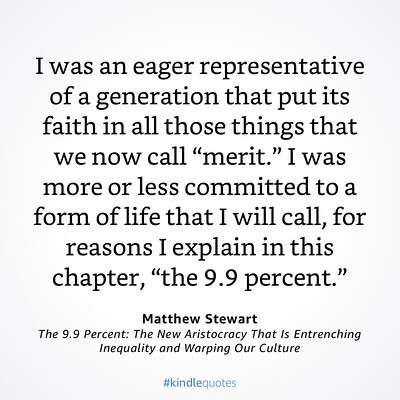
Matthew Stewart was born into the 9.9 percent, that (upper) class that feeds wealth to the real beneficiaries of the class system, that 0.1 percent, and they do so almost unwittingly but certainly willingly in order to keep their upper decile privilege. So intent on keeping their separate (and white) neighborhoods and Peletons that they knock themselves out with constant work to keep from falling off the SS 9.9 Percent into the ocean, or even worse into steerage.
Stewart is a punchy and entertaining writer where these are virtues even when reading a nonfiction book filled with history and fact. He does a wonderful job in describing the current malaise besetting the tribes of Trump’s America with radically opposed concepts of what objective reality really is.
With the 9.9 Percent pushing the ever growing inequality that itself fuels the social divide, what is the solution?
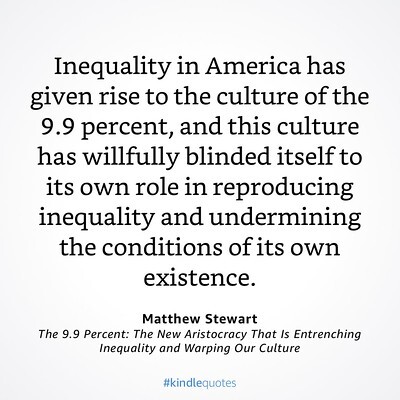
I’m cynical, jaded, and old. From my viewpoint in steerage, I don’t see many of the 9.9 Percent giving up their seat even for the public good. I’m definitely willing to be surprised though. But once on duty in America’s FIRE house (the professions in Finance, Insurance, and Real Estate) with not the sparest time to read books not related to career advancement, I won’t get my hopes up.
But as Stewart says, “In the end, we have nothing to lose but our illusions.” Stewart is informed and and persuasive. But persuasive enough?
Stewart is a punchy and entertaining writer where these are virtues even when reading a nonfiction book filled with history and fact. He does a wonderful job in describing the current malaise besetting the tribes of Trump’s America with radically opposed concepts of what objective reality really is.
With the 9.9 Percent pushing the ever growing inequality that itself fuels the social divide, what is the solution?
I’m cynical, jaded, and old. From my viewpoint in steerage, I don’t see many of the 9.9 Percent giving up their seat even for the public good. I’m definitely willing to be surprised though. But once on duty in America’s FIRE house (the professions in Finance, Insurance, and Real Estate) with not the sparest time to read books not related to career advancement, I won’t get my hopes up.
But as Stewart says, “In the end, we have nothing to lose but our illusions.” Stewart is informed and and persuasive. But persuasive enough?

October 28, 2021
The wealth and privilege of “the 1%” in the US has been well documented, although this fraction is actually closer to 0.1% . However, the top 10% of the US owns about half of all the wealth in this country. Stewart’s book focuses on the other less documented 9.9%.
What starts as a fraction/percentage soon becomes useful as an allegory and framework for the ideologies and world views of this 9.9% (entry level around 1.2 million dollars net worth) and the way it has defined contemporary society in this country. A simple premise is soon complicated by thorough and convincing discussions of the many vehicles through which this segment of society attained this status.
Stewart furthermore shows how the world views of the 9.9% have been shaped and why its members believe in their own value, worth and in essence, birth right to be in this strata.
Implications are far-reaching, and Stewart traces the ways in which these inequitable systems have shaped various aspects of American life, such as education, healthcare, mental health, political agendas and misinformation campaigns, housing, parenting, tax laws and the laws of economics. This book sheds a light on why society is structured in its current form, reminisces back/forward on alternative more equitable structures, and the ways to effect these egalitarian outcomes. Serious topics treated with reverence and surprisingly, humor. Highly elucidating and enjoyable. 5*s. 📚
What starts as a fraction/percentage soon becomes useful as an allegory and framework for the ideologies and world views of this 9.9% (entry level around 1.2 million dollars net worth) and the way it has defined contemporary society in this country. A simple premise is soon complicated by thorough and convincing discussions of the many vehicles through which this segment of society attained this status.
Stewart furthermore shows how the world views of the 9.9% have been shaped and why its members believe in their own value, worth and in essence, birth right to be in this strata.
Implications are far-reaching, and Stewart traces the ways in which these inequitable systems have shaped various aspects of American life, such as education, healthcare, mental health, political agendas and misinformation campaigns, housing, parenting, tax laws and the laws of economics. This book sheds a light on why society is structured in its current form, reminisces back/forward on alternative more equitable structures, and the ways to effect these egalitarian outcomes. Serious topics treated with reverence and surprisingly, humor. Highly elucidating and enjoyable. 5*s. 📚

June 7, 2022
I enjoyed reading this clearly written, brilliant book with a depth of understanding of politics, economy and history that was a true pleasure. The author has a good grasp of the economic status of current day America and the culture that pervades it.
‘ markets are levelers as a matter of principle, not concentrators of wealth, for competition prevents the kind of sustained excess returns that are generally required to produce massive accumulations of wealth. ( This is the conclusion at which Thomas Jefferson and Thomas Paine arrived, by the way, with an assist from Adam Smith; they took for granted that the immense fortunes of European aristocrats in their time should count as evidence of the absence of competitive markets, not of their presence.)’
‘The merit myth promotes the falsehood that talent is the origin of wealth- but a genuine meritocracy rests on the truth that justice is the origin of all wealth. Call this the Golden Rule of Merit.’
‘The share of workers represented in unions fell into a steep decline, dropping from 27.0 percent in 1979 to 11.6 percent in 2019. The minimum wage was allowed to drift lower and is now 29 percent below what it was in 1968 in constant dollar terms- notwithstanding the fact that the productivity of American workers has doubled in the interim.’
‘ markets are levelers as a matter of principle, not concentrators of wealth, for competition prevents the kind of sustained excess returns that are generally required to produce massive accumulations of wealth. ( This is the conclusion at which Thomas Jefferson and Thomas Paine arrived, by the way, with an assist from Adam Smith; they took for granted that the immense fortunes of European aristocrats in their time should count as evidence of the absence of competitive markets, not of their presence.)’
‘The merit myth promotes the falsehood that talent is the origin of wealth- but a genuine meritocracy rests on the truth that justice is the origin of all wealth. Call this the Golden Rule of Merit.’
‘The share of workers represented in unions fell into a steep decline, dropping from 27.0 percent in 1979 to 11.6 percent in 2019. The minimum wage was allowed to drift lower and is now 29 percent below what it was in 1968 in constant dollar terms- notwithstanding the fact that the productivity of American workers has doubled in the interim.’

December 11, 2021
Stewart is both entertaining and humorous as he rushes in with an explosion of thoughts, facts and ideas on the very nature of wealth and poverty. The examination turns the world on its head. Stewart sets out to prove that 'extreme inequality", rather than being the result of such things as the political divide, lack of education, inherited wealth, etc. is in fact the cause of these same things.
"9.9%" is a land of Ultramom’s and Ultradads, and their Amazing children. His chapter on Education is a coup-de-grace and well worth reading by itself. From its start in the founding fathers' plan for a more equal nation, and through Johnson's 1964 war on poverty, we have in fits and starts, attempted to whittle down inequality, only to see it slide backwards during the last 40 years as the politics of "unreason" ensured the divide remained.
Finally, "9.9%" offers hope that in coming to grips with the structural weaknesses in our politics, economy and understanding, we can shift the paradigm and the conversation to something that will make a difference.
"9.9%" is a land of Ultramom’s and Ultradads, and their Amazing children. His chapter on Education is a coup-de-grace and well worth reading by itself. From its start in the founding fathers' plan for a more equal nation, and through Johnson's 1964 war on poverty, we have in fits and starts, attempted to whittle down inequality, only to see it slide backwards during the last 40 years as the politics of "unreason" ensured the divide remained.
Finally, "9.9%" offers hope that in coming to grips with the structural weaknesses in our politics, economy and understanding, we can shift the paradigm and the conversation to something that will make a difference.
February 5, 2022
Matthew Stewart blames the 9.9 percent for inequality in the United States. It's an interesting approach but he often overstates his ideals to prove his point. I wasn't aware that investing in the stock market was similar to sitting on a sofa and collecting income. Buying a nice house in a solid neighborhood is crushing the other 90 percent. Capital gains tax should remain lower to encourage people to invest in American companies. He barely mentions how some build a business that produces income for their family. Sending your kids to elite universities is somehow wrong. Most 9.9 percenters probably don't send their children to The Ivy Leagues, Duke , University of Chicago and Stanford. If you find yourself in the top 9.9 percent you may not care for this book. I'm glad I checked it out at the local library and saved $28.

June 14, 2022
What would Karl Marx say?
Matthew Stewart provides the answer in both argumentative style and substance.
The difference between Stewart and Marx is that Marx recommends violent revolution, Stewart recommends more taxation by government, e.g. a wealth tax.
I read the first and last chapters of his book, skimmed the remainder, he routinely attributes causation to correlation, or mere coincidence, he substitutes imagination for research, he generalizes from anecdotal stories to condemn current society. He appears ignorant of statistical research methods.
He plays to the emotions of envy for what readers don't have, and guilt for what readers either have or aspire to.
He condemns the results of human action as the results of human design as if he has never heard of biological markets.
Matthew Stewart provides the answer in both argumentative style and substance.
The difference between Stewart and Marx is that Marx recommends violent revolution, Stewart recommends more taxation by government, e.g. a wealth tax.
I read the first and last chapters of his book, skimmed the remainder, he routinely attributes causation to correlation, or mere coincidence, he substitutes imagination for research, he generalizes from anecdotal stories to condemn current society. He appears ignorant of statistical research methods.
He plays to the emotions of envy for what readers don't have, and guilt for what readers either have or aspire to.
He condemns the results of human action as the results of human design as if he has never heard of biological markets.

October 4, 2024
I understand why people disagree with this book. It’s a book that reflects your values. I largely agree and I feel like many of the reviews disagree. It’s well written. Did it tell me things I already know? Absolutely. That would be true of almost any book in this and many other book in social political economical genres. But it packages these better than most, I don’t think he’s being unreasonable in his assessments. It’s well written and does a good job of stating a world view. It might not deserve a full 5 stars but I feel like it’s being underrated because it starts an interesting exploration of the upper middle class and then it makes a pretty hard turn into leftist politics which upsets republicans and half of democrats. Since we’re so far from occupy Wall Street I didn’t see this as what if a former consultant was a Bernie Bro but that’s kind of what this is.

October 2, 2025
It definitely identifies the problems with the US but the remedy is liberal reform of the system when the system is the problem and can’t be reformed. It is steeped in Western propaganda when it comes to socialism. This is to be expected because the author comes from a family that benefited from capitalism and thus he wouldn’t want to destroy the system he has benefited from. Instead, just reform it to make it seem like he is doing something that is good. It is quite clear that he didn’t want to confront the actual mechanisms that lead to the inequality he discusses so throughly in the book. Yes, reform will bring relief but just as they were repealed and eliminated before, it will happen again eventually leading back to where we are right now.

January 1, 2022
This was enjoyable as a ruthless and hilarious skewering of the meritocratic elite (the group he really is targeting in the so-called 9.9%; run-of-the-mill boomers, generally retirees, with $1.2 million+ net worth don't fit here, culturally speaking). But Stewart provides no real solutions for what he thinks the meritocrats should actually do with their lives (and their children) instead of jumping through the usual hoops. I ultimately disagree with how much this group is really keeping the other deciles down, but Stewart's broader historical analysis is interesting and he has correctly identified a lot of discrete issues with the so-called 9.9% and their thoughtless approach to life.
Displaying 1 - 30 of 74 reviews