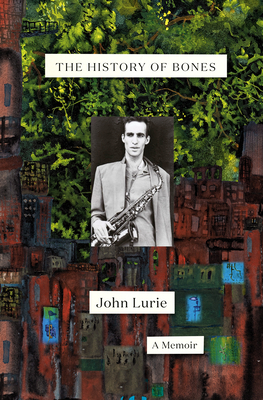
The quintessential depiction of 1980s New York and the downtown scene from the artist, actor, musician, and composer John Lurie
In the tornado that was downtown New York in the 1980s, John Lurie stood at the vortex. After founding the band The Lounge Lizards with his brother, Evan, in 1979, Lurie quickly became a centrifugal figure in the world of outsider artists, cutting-edge filmmakers, and cultural rebels. Now Lurie vibrantly brings to life the whole wash of 1980s New York as he developed his artistic soul over the course of the decade and came into orbit with all the prominent artists of that time and place, including Andy Warhol, Debbie Harry, Boris Policeband, and, especially, Jean-Michel Basquiat, the enigmatic prodigy who spent a year sleeping on the floor of Lurie's East Third Street apartment.
It may feel like Disney World now, but in The History of Bones, the East Village, through Lurie's clear-eyed reminiscence, comes to teeming, gritty life. The book is full of grime and frank humor--Lurie holds nothing back in this journey to one of the most significant moments in our cultural history, one whose reverberations are still strongly felt today.
History may repeat itself, but the way downtown New York happened in the 1980s will never happen again. Luckily, through this beautiful memoir, we all have a front-row seat.
"My stomach is upset, from breakfast at Duke's. It's gurgling and it burns. As they call me in, a memorably horrendous fart rises up inside of me. I think that it's fine, I'l leave it in the hallway. But this molten horror fart stays in the cloth of my pants. It enters the room with me. It wafts into every corner, burning chips of paint off of the ceiling. Scalding the eyes of the casting agent's assistant. Nearly everyone dies. I begin to sweat. I think that fart ended my acting career, right there." (PG. 237)
Who is John Lurie? I found out this week. After reading Just Kids by Patti Smith I have become somewhat curious of New York life between the years of 1970-2000 and this hit the mark. John Lurie is an interesting figure that started the Lounge Lizards band. The "fake" jazz he called his genre.
The first 3/4 of the book were great and I would have given it a 4 stars but then I get to the last 1/4 and I am so bored and over it. He overdid it. It started repeat ranting of things he already ranted. And he admits it in one of the last chapters. There was no linear timeline. It was really confusing. In one page his dad was dead and then he'd bring him back to life in the next paragraph. He would have his band mates and then he was trying to create a band. He was all over the place with his memories and thoughts.
In most of the book he was always high on everything. He loved coke most of all but had a love affair with heroin. He always had women. Sex galore. I wasn't put off with this because it is a memoir and he's baring his life to us to judge but then, this again, becomes too much. I got high, had sex. I had sex, got high. Okay, John, let's move it along. I felt sorry that he was so disgusting and even when he was disgusted with his hygiene or himself and would try and kick his habits he wouldn't change much. All it would take was a friend or a girlfriend showing him a baggy. He claims the heroin from Thailand inspired his music, like a holy moment, so I Googled him and his band. They are actually really good and different except when he's talking you can tell he's either a weirdo or just high. Probably high.
He name drops A LOT! Which, coming from L.A., I love the high drama name dropping and he calls out people in this book, to the point of probably having a lawsuit dropped on him. He knew some pretty important people and many of them were douche-bags. He shows us that the music and film industry creates many horrible dishonorable men and women and he tried never to behave that way to anyone. John got screwed over financially so much, and according to him, much credit taken away.
Madonna makes an appearance as a sleep around town kind-of-girl. I'd like to see her memoir. He knew Andy Warhol, Jean-Michel Basquiat, Debbie Harry etc. How come I never heard of this guy? Random library pick.
John Lurie is hilarious and had a mission of making and creating pure, beautiful music. This type of scene isn't my thing but I like stories and Lurie had so much to tell. His disdain for people also cracks me up.
"Crowds in Europe's bigger cities seem to grasp the music in a more real way, but this was not that kind of crowd. These were people who buy their culture for the season and go to every event because that is their social life. They don't understand a thing, they don't care to, but their clothes are very expensive. So we laughed at them and pointed. Perhaps I have not managed my career so well." (PG. 144)
I would actually recommend this, but stopping at around page 300.
Captures Lurie's gently prankish hipster sensibility, a man who has really lived the kind of bohemian life that, say, Steely Dan sings about, sex and drugs and jazz and iconic movies, someone who has obstinately held on to a creative spark and has the accomplishments and fuckups to show for it. The massing of boldface names makes it worthwhile for anybody remotely interested in NYC or alternative culture in the late twentieth century, but if you haven't you should watch Stranger Than Paradise and listen to Voice of Chunk (and maybe an episode of Fishing with John) to get an idea of exactly the kind of American archetype Lurie embodies and helped define.
There's a little of the David Crosby doc or Morrissey memoir here, of somebody who has burned a lot of high-profile bridges, and you have to read between the lines to understand all of what happened. But that's not to say he isn't completely honest about the way he sees things. When you get an earnest accounting of why he thought Marc Ribot insisting on union rates for the Lounge Lizards was an insult, you get both a transparent picture of how he believed he was doing his best, and how his bandmates may have gotten a different impression with its own truth to it. This kind of naked candor is what gives his art, music, acting and writing an unaffected, happy intensity of feeling. But sometimes it gets you in trouble when unmoderated in life.
The apex of his career - his work with Jim Jarmusch - gets a muted recollection due to Jarmusch's remoteness and Lurie's unresolved feelings of getting ripped off. Same with Fishing with John - a truly iconic TV show whose insane anti-premise is a forerunner to so much modern comedy - since what he remembers most is the money fuckups. The gripes are genuinely interesting and a better reflection of life than just running from peak to peak. I could have even used more - he holds back from talking about the infamous New Yorker profile of a few years back at all, other than a few pointed zingers.
Like with Flea (who makes a few cameos here) and his completely pre-RHCP memoir of a few years back (and Just Kids, and Richard Hell's, or that David Lynch one - perhaps you can tell I love this shit), the first, pre-fame half of the book is what really gives him a chance to show off his style. Watching him dip allusively across years and drug experiences and hitchhiking excursions and shitty suburbs of Boston to illustrate the origins of a creative life has the same feel as one of his stunning, hilarious paintings or albums, the profound wide-eyed silliness of a good acid trip.
Once he becomes the coolest dude in New York, there's the requisite parade of hookups and drug binges and tour dates. Thankfully no rehab, which is as close as real life comes to a cliche. The kaleidoscopic parade of interesting artists of various degrees of fame is hypnotic. Did you know that the singer from Blonde Redhead came to America to follow John Lurie after she was a production assistant filming the Lounge Lizards in Japan? And that they lived together for years in an unusual domestic partnership, he introduced her to the rest of Blonde Redhead, and they had a falling out over raisins in a chicken sandwich? I did not. He says exactly how he feels about everybody which is brave and crazy. He apologizes to Debbie Harry for writing that she gave him his first line of heroin. The drug preferences of a wide swath of minor jazz figures are detailed. Do we need to know his detailed moral assessments of a panoply of European tour managers? Perhaps not per se, but as with any memoir it's really more of deep dive into Lurie's perspective, and a way to explore the excitement, paranoia and disappointment of touring.
There is quite a bit of Basquiat content, for any Basquiat-heads, some of it newish. He's defensive about it, which makes sense - it's got to be disconcerting to have been a mentor and good friend to somebody like that. Lurie's own fame, such as it is, seems disconcerting enough for him. But he's very good at it, in a wry way. Maybe that is his medium, his masterpiece - being John Lurie, being “cool”, living a real and hard-lived life in the arts without any attention paid to boundaries. Perfect for a memoir to tie together.
A well written, fast paced dive into the making (and unmaking) of an artist.
From his roots in Worcester, Massachusetts, John Lurie led a wild ride into the downtown New York City arts scene in the late 1970s and 1980s.
By the end of the 20th century, he had catapulted himself to fame towards which he has developed a more jaundiced perspective. Wearing 2nd hand clothes from flea markets he ended up being called a fashion icon by Vogue magazine. Starting out he befriended other struggling young artists including Jean Michel Basquiat, Madonna, Wilhelm Defoe, Tom Waits and Jim Jarmusch.
Entertaining a string of girlfriends, he also developed a decades long drug habit that could have easily derailed his true quest. Accidentally becoming an acting phenomenon, his true love was for music. His group the Lounge Lizards which he co-founded with his brother Evan was an interchanging parade of great musicians who were often more difficult to control than a pack of wolves. On worldwide escapades he dealt with unscrupulous promotors, venue dives, and record executives with tin ears. Despite these obstacles he was able to create and compose music that, at times, resulted in his feeling close to God.
This memoir is touching, insightful, honest,funny, hard hitting, unrelenting and, at times, philosophical. Reading this unique story one comes away with an affection for the man and artist; a real charmer who has survived his battles and today is a wizened soul who can be viewed on HBOs Painting with John.
By p. 5 we're told that Lurie's first girlfriend named his penis Everett. Fortunately, the frequency of (not terribly interesting) penis stories peaked quickly and only made occasional appearances after p. 50 or so.
These days I'm rather allergic to brain dump-style autobiographies. I complained mightily about Patti Smith's Just Kids, but that was a tight and reasonable read compared with Lurie's book. I have to skip chunks of this, and look for sections on the events that I'm interested in (the formation of Lounge Lizards, Jarmusch's Stranger than Paradise, etc). There are outrageous stories of course, but also rather haphazard continuity and no editing. It's like Lurie got drunk and just started spewing. That's fun for a bit, but not 400+ pages.
Lurie also complains about not being given enough credit for ideas; for example, he goes on at length on how he came up with the original concept for Stranger than Paradise, and still sounds angry with Jarmusch. And there are some really over-the-top stories about how people screwed him over, poor guy. I sympathize, but I'm not sure I need to know things in such detail.
I'm too old to continue past p. 330 or so. If there are essential stories I should check out later, somebody please let me know, ok?
I'm revisiting some early Lounge Lizards. I have to say, the band is pretty tight, and the material is fun if a little stiff. I could totally understand Lurie's complaints with the first album, how Arto Lindsay's noise guitar was mixed way down (largely inaudible, in fact).
I've never been so sad a book was over. I listened to the audiobook, which the author performs himself. Usually, when I listen to audiobooks, I speed them up. My brain reads at about 1.75 times the pace of the average audiobook narrator. John Lurie is not the average audiobook narrator.
"The History of Bones" is a wild, drug-fueled ride, full of beautifully human moments and painfully human moments. Lurie's a gifted storyteller, and I bet it's wonderful to sit near a beach bonfire and listen to him pontificate.
Anyway. Some memoirs are lists of the author's famous friends. This is not that. This is more a meditation on the nature of fame, and the nature of humanity, and the nature of addiction, and the nature of music. It looks at how people connect with one another, and in that sense it's more than a memoir.
After listening to the part of this book where Lurie describes the production of the Lounge Lizards album "Queen of All Ears," I decided I had to go back and listen to it. Driving down a rolling Iowa highway, surrounded by corn and other Wisconsin drivers desperate to make it home after a long weekend of Big Ten football, I got brain tingles like you wouldn't believe. Who needs drugs to make your brain feel good when Lounge Lizards music exists?
I had the surreal experience of listening to Lurie's recounting of the production of "The Last Temptation of Christ," and then going home to pop in a movie I'd checked out from the library for totally unrelated reasons (the movie was "Wild at Heart," a David Lynch flick I'd never seen, but was interested in because Alex de la Iglesia made a sequel to it called "Perdita Durango" and I wanted to watch "Perdita Durango" so I figured I should watch "Wild at Heart" first) and then, while watching the movie, realize, oh shit, John Lurie is in this. And then to get in my car to drive to work and hear Lurie discuss making the movie, which I'd had no idea he was in until I watched it hours before.
It's a weird life, but a good one. When things are hard, we get stronger, we learn, we grow out of the crucible and become people we would not be otherwise (whether better or worse, who's to say? Who cares, really, since we can never know?). In this book, John Lurie tells you stories, like he would if you were, say, fishing together, or perhaps painting together. He doesn't tell you what the stories mean, and I appreciate that. They mean different things to him than they do to me. That's part of being human.
"Painting With John" on HBO brought me to this one! I honestly didn't know anything about John Lurie outside of what I'd gleaned from the show (famous for some reason in the 80s?!? friends with Basquiat in his early days!) but John's kooky storytelling left me wanting more and his memoir did not disappoint. John writes with incredible wisdom and humor and the kind of self-awareness you'd think it would be impossible to hold onto after living a life like his. There are revealing stories about Basquiat, David Byrne, and Jim Jarmusch I don't think have been out there before. The narration is so quirky and natural (John breaks the fourth wall a few times a la, "I was about to turn the book in saying this but decided to blah blah...") that you can tell a ghostwriter or third party or whatever couldn't have had much, if any, presence in between him and his editor. John often waxes about what makes a "true artist" but instead of coming off preachy, it all feels earned, and pretty damn inspirational.
John Lurie is one of those New York downtown figures (of the 1980s onward) who was always mentioned in other books about the time period but I had never managed to read or listen to any of his work.
Even though the memoir jumps in feet first and assumes you know most of the players - I found it very readable and surprisingly funny.
Of course now I see John Lurie everywhere in other things now- and I'm excited to check out his new HBO Max series' Painting With John.
Легко ставлю 5 зірок, це одні з найкращих музичних мемуарів, які я читав взагалі. Хоча "читав" саме тут буде недоречно, бо цю книгу я слухав. Взагалі я не фанат аудіокниг і майже ніколи їх не купую і не слухаю, але тут побачив що сам Джон Лурі начитав її - це стало вирішальним моментом. Дуже подобається його тембр і звісно все, що він розповідає тут звучить вдвічі відвертіше, коли це його власний голос, а не просто рядки тексту у книзі.
Загалом я став фанатом Лурі ще десь з нульових, коли вперше почув Lounge Lizards. Це музика яка дуже глибоко торкає мене і зараз, майже 20 років потому. Пізніше я дізнався про Лурі-актора і Лурі-художника. Конкретно ця книга розповідає про пре-фейм період, а також власне про той самий фейм - десь до кінця 80х. Лурі не сильно заглиблюється у 90ті, свою хворобу і тим більше нульові.
Чого тут багато, так це рок-н-ролу (або джазу), сексу і наркотиків. А також різних зірок - від Скорсезе і Джармуша (якого Лурі нещадно просто парафінить) до Віллема Дефо, Жана-Мішеля Баскія (багато нового я дізнався) і навіть Трампа (один з найсмішніших моментів книги). Купа гумору, але купа і відвертої критики конкретних людей, абсолютно без купюр. Інколи це майже переходить в old man yells at clouds, але все ж не переходить.
Книга тримає просто шикарний баланс між угаром (деякі історії про нью-йорк 70х та 80х просто шалені), внутряками музичного і кіно бізнесу, а також просто поглядами на творчість як таку, чисте мистецтво. Все це у фірмовому стилі Лурі з його фірмовим гумором, повторюсь - дуже відверто і без купюр.
Той випадок коли мені прям прикро що ця книга закінчилась. Полюбив Джона Лурі ще більше, God bless his soul.
Absolutely loved this book and was sad when it was over. Like, “what am I going to do without my John Lurie stories” for several days.
For people complaining about his writing style, I think you’re missing the point. John writes like he talks, and that’s not a bad thing for a memoir, which is literally the voice of an individual. If you don’t like it, you’re probably not interested in his voice, so why are you reading his memoir?
A good memoir makes you feel like you know the writer, and I definitely have that feeling now. It’s presumptuous as hell to feel that way, but I think it speaks to the breadth of the stories included in this book. This guy has some STORIES, man. I think we should rename the game/meme “Six Degrees of John Lurie” based on how many people he knows.
I hope there are more stories to come, because the bit at the end about how he felt when he was in Africa was really intriguing.
Definitely recommend, and definitely try the audiobook, narrated by the author…I have both editions but really enjoyed his narration—mostly while painting, drinking whiskey, and cackling my head off. Good times!
If you were ever a bandleader (in jazz), a struggling heroin addict, or a seeker of truth swimming in deep wells of creativity while rubbing shoulders with celebrities and icons, this memoir will feel familiar and even validating. But most people are not those things, so it’s extraordinary that John Lurie can tell these stories with so much appeal. He’s an outsider who invites the whole world to check out his stuff. Pulling back the curtain on the glamor industries and the stark reality of those who are almost too sensitive to be on this planet, he reveals his own flaws and those of others while also fighting for beauty and realness, a battle he wins. I enjoyed the audiobook for the same reason I loved “Kitchen Confidential” read by the author; it’s like a great hang with a friend. John continues to make beautiful and real things that make the world a better place. I have even more respect after listening to “History of Bones.” #Fortitude
Amazing memoir, amazing artist. John Lurie is a musician, composer, actor, and artist from NYC. This memoir goes through pretty much his whole life accounting the tales of him coming up as an artist in nyc in the 80s, through to almost the present time.
Great writing style, insane life and lifestyle, great read.
Lurie is a multi-hyphenate talent: musician-composer-actor-painter and now book-writer. Initially making his mark as the bandleader for downtown New York group, The Lounge Lizards, he quickly went on to establish himself as an actor in several films. He created and starred in the enigmatic, must-see TV show Fishing with John and the more recent Painting with John. He’s toured the world, composed several film scores, and has even done some modeling. And all along, he’s also managed to keep up a serious painting practice. Is there anything this man can’t do? Tosh and Kimley have some varying thoughts on this…
So good I listened to most of it twice. A no-holds barred account of John Lurie's life as a world-famous musician & actor, and covers his forays into TV productions (Fishing..), taking place in NYC of the 70s/80s/90s & in places far flung when on tour/filming internationally. He's quite the story teller, and has a great reading voice. Highly recommended
I’ve been paying attention to John Lurie for decades. “Stranger Than Paradise” came out when I was a teenager and changed how I looked at movies. I’ve listened to “Queen of All Ears” about 900 times. I think “Fishing with John” is a deadpan work of genius. I followed the whole Tad Friend kerfuffle closely. That painting show cracked me up.
So here’s John in the 80’s and 90’s being a junkie. Finding his way. Name dropping. Becoming famous. Being angry. Talking shit.
This book is between a 3 and a 4. The bitterness and resentment are a bit thick at times. There’s not enough coherence and flow across the whole story. And yet, this guy is hilarious. He is a no compromise creative nut job and I love him for it.
i’ve always known john lurie as the artist, the musician, the actor. but what i didn’t realize is he’s also hysterically funny. like tears streaming down your cheeks funny - and one of the greatest storytellers ever. he’s got heart. this book arrived in the mail the day my vacation started. by page two, my sides ached from laughing so hard. and it’s as moving as it is funny. like i said, heart. i found myself intentionally slowing down my reading to draw it out, make it last longer. as much as i was dying to know what was coming next, i also never wanted it to end. it did end, though. i am now listening to the audiobook.
He doesn’t sell himself (or his story) out on what YOU think is important. I am also so very glad that he didn't cowtow to writing about what people want to hear and it’s glorious.
There are a bunch of random reviews out there that will entice you by saying things like: a great book about the grit of NY in the late 70s. Sure, I guess. But really and this is what I got out of it... it's all about the value and desire of a musician to make a difference in the world and what he has to do to get there. It's gritty as things get with no apologies, but it's really self reflection and not hot goss about Studio 54 and the East Village which is what some of the preliminary reviews were and I couldn't have wished for anything more different. There are some incredibly gut wrenching funny stories and some incredibly gut wrenching stories that almost broke my heart. But each story... so good.
The first five chapters are so important to the rest of the story do not skip them. Truly. It’s a side I certainly did not know. I mean I read the book so I could know more but this was very important reading to understand who Mr. Lurie is and why he pursues everything in the way that he writes about. To me, this was wildly brave.
It’s a semi-linear story told in fits and starts which while reading it’s like listening to John Lurie tell you the story directly… and yes there is an audio book that will be just be that exact piece of art. If you have watched "Painting with John" (and I suggest that you do), there is a familiarity in the narrative. If you have seen "Fishing with John" then you definitely are in familiar narrative territory.
About halfway through is where the book fine tunes (no pun I promise) so there are some of the more juicer tales. The pace is the same but things get busier and more prolific for John Lurie.
Lots of drug use without apology so it can be triggering and honestly hard to read. But he puts it out there and it’s brave. Lots of memoirs talk of drug use and this is so matter of fact that you have to wonder... how can this be, but knowing that there are no other punches pulled, welp, it can and it was. He doesn't glorify it at all. It's pretty heavy to read.
There is an interlude (one of many) that was so touching and seriously kind an observation about Andy Warhol when I read it my idea of both of them are actually changed.
86 % in the book (at least according to my reader counter thingie) we get this quote- "making a record is a very artificial thing to do. You are trying to encapsulate , in sound, this thing that is a little moment of soul." I sucked in a huge gasp of air when I read that. It was like "boom" this is what this book is about.... little moments of soul , further peppered with moments of struggle, love and other creative gestures.
That is what this book really is about in my opinion, John Lurie... the musician. Every bit of the book always comes back to the music for Lurie.
It was a great read.
There are some great pictures shared too of his life which if you read all the way through the book, then go and look at them and then they will make more sense. So read the book, then look at the pictures. I am glad that I waited to look at what photos he did share.
I honestly will be ordering the audio book because I really want to hear John Lurie tell me these stories again. Truthfully I am looking forward to it!
The book is a great read, but be prepared for something a little different than what you might expect!
A great autobiography, with a degree of honesty that is occasionally repulsive but nearly always funny. The established genius pulls no punches about his hapless younger self: failed drugs, failed sex, failed relationaships, failed art, failed music - but not very often. John Lurie was a quick learner as to what worked in each sphere, and, essentially, had no fear about making the same mistakes again, tweaking them to his advantage and making something better from them.
The career of the Lounge Lizards is covered in painstaking detail at times, and at times left sketchy. It was a cracking band, but like all great bands didn't get that way out of magic; the LL musicians were very talented guys, but a collection of loose cannon egos that at times threatened to tip the whole thing down the plughole. It's astonishing how much of himself John Lurie gave to the band, his time, his nerves and ultimately, his money, every last cent rallied and offered whenever scheming and inept promoters and record company people let him down, which was far too often, and sometimes a sign that John Lurie has been too nice a guy too many times to have stayed in the music business.
His acting career is tied up almost exclusively with Jim Jarmusch - however, it was never the perfect working relationship seen by we film fans. Jarmusch seems to have been as scheming and evasive as anybody else John Lurie had to deal with in his professional life, a great shame.
Bitter? Never. Despite the tribulations, he has come up with a gem of a book of his life, entertaining to the last page.
John Lurie is certainly having a moment, especially with a second successful season of "Painting with John" on HBO and this memoir. I had the good fortune to listen to the audiobook which he reads. Like Springsteen reading Born to Run and Robbie Robertson reading Testimony, the listener feels as if the stories and insights being spun by an old friend. Lurie's stories are generous, funny, sometimes absurd, maddening (how naive a business person was he?), and always interesting. There are many touching moments, including the phone calls to the great Ornette Coleman regarding how to manage unruly members of the band. His bitching about Jim Jarmusch is a bit confounding at first, until you realize that Lurie has a strong sense of loyalty to others. I've gone back to listen to the Lounge Lizards, and once again I amazed by their brilliant innovation. Lurie was so right when he admitted that his comment that the Lounge Lizards were "fake jazz." They were the real thing, and I think that if John Lurie was Japanese he would be rendered a National Treasure, along with Bob Dylan and Tom Waits.
I only discovered the extent of John's works in May of this year. And man, as a writer and artist myself, I have been sorely missing out. The brash, take-no-shit attitude that John employed in his career is precisely the kind of model I've needed.
Now, to The History of Bones. If you've ever seen Fishing with John, you might have noticed a particular smirk plastered on John's face. You could call it a wry smile. But, something I noticed when reading the book is that suddenly I had this smirk. To me, that's a sign of good storytelling, like living vicariously through a great actor's performance.
John never insults your intelligence or censors himself - his tales of both triumph and woe are laid bare. Memoirs can have the tendency of sounding like a mea culpa or a defense of one's legacy, but I don't believe that is what John is after in this book. Fairly early, he states the goal of his art, and by extension this book (and his life in a way) is to find and express God, or that which is greater than us.
And by the end, I personally felt that. Quite intensely in fact.
But something that shouldn't be overlooked is the laugh out loud humor riddled throughout these 448 pages. Perhaps his brand of humor is something I relate to, also having grown up with a brother with whom I shared a secret language. So, when John shares inside jokes like, "The mayor's hair is on fire!" it feels like you're being let into this familial relationship, and who can't love that.
If you're like me, and you stand against the Conspiracy to Maintain Mediocrity (as John puts it), then check out this memoir and get a rare glimpse into a type of life that simply can't be lived anymore. It's a wild ride told with sincerity, pathos, and an irreverent spirit that we can never allow to die out in this world.
''I wanted to find my soul and live in it. All the time."
I love this book so much. I love the small-town beginnings. The genuine naivety and madness that comes with innocence and creative spirit. The commitment to keep moving even if you don't know where or why or have any sort of barometer other than your own sense of self. The depiction of living with intense depression. I love that he's humanized his peers by refusing to allow them to be deified.
I've always loved Lurie's onscreen performances but when I discovered his music, that was something else. His music is always playing in my mind somewhere. I hope he does an audio version because if you haven't heard him speaking I feel like you'll miss out on his rhythm and absurdity in general. Special mention: the time he tried to shoot a shark with a handgun on 'Fishing with John' whilst Jarmusch tempted it with a slice of cheese. Hahahahaha.
Many memoirs I've read tell their story through a filtered lens. I imagine it's how we would like the world to see us, from our own view of our life, the first person narrative. What John Lurie does in this powerful portrait of his life, as an artist, as a musician, as a man, a brother, a human on earth, just trying to live a life that is authentic and curious and unapologetic offers an unfiltered , raw expression of his truth and experience.. He is hugely generous, He writes with skill and heart. His story is both incredibly heartwarming and funny, even in the dark sordid moments. This is a brave venture, beautifully written, expertly crafted and gives one a visceral experience of the art scene in NYC in the 80's. Get this book.
Random pick off the DPL new release shelf. Truthfully, I really only knew John Lurie from the Fishing with John shows and a smattering of Lounge Lizards songs. This memoir filled in the blanks, from his work with (and loathing of?) Jim Jarmusch, friendship with Basquiat, film work, and of course, the music. He jumped from topic to topic, sometimes within the same sentence, yet for some reason it always worked. The memoir ends in the late 80's/early 90's, but maybe that makes sense considering that he's been battling Lyme disease for quite a while. Lurie could be more than a little egotistical (often), but his story was an interesting one.
Absolutely fantastic look into John Lurie’s life and times, sort of reads like a more forwardly funny Lucy Sante. Focuses mostly on childhood up until the late 80s with a few digressions into his later years. There’s certainly a little mud slinging, but he mostly keeps it positive and on the level. I think he really says it best, “We are all flawed. We are all flawed. We are all flawed. In a way, that is the point of the whole thing, how we are all individually, uniquely flawed.”