Wolfgang Hildesheimer was an acclaimed German-born author, playwright, and visual artist who became a central voice in post-WWII European literature. Born into a Jewish family in Hamburg on December 9, 1916, he fled the Nazi regime in 1933, moving to Britain and later to Palestine. He initially trained as a painter and stage designer in London. After the war, his deep linguistic skills led him to work as a simultaneous interpreter and court stenographer at the Nuremberg trials in 1946.
This dark historical experience heavily influenced his transition from painting to writing. He joined the influential West German literary circle Gruppe 47, establishing himself as a pioneer of the Theatre of the Absurd in Germany. His early fame grew with the short story collection Lieblose Legenden (Loveless Legends, 1952) and the deeply psychological existential novel Tynset (1965). For his profound literary contributions, he received Germany's most prestigious literary award, the Georg Büchner Prize, in 1966.
Hildesheimer achieved international bestseller status with his groundbreaking, demythologizing biography Mozart (1977). He followed this success with Marbot (1981), a brilliant postmodern satire written as a serious historical biography of a completely fictional Victorian nobleman. In his final decade, deeply concerned with global environmental destruction, he completely abandoned writing to focus on visual collage art. He lived his remaining years in Switzerland, where he died of a heart attack on August 21, 1991.
Der wahre Künstler ist - ohne es zu wissen - sich selbst ein Rätsel, das er aber in jedem Werk aufs neue zu lösen versucht, und dessen Lösung ihm, subjektive betrachtet, niemals gelingt.
Wer es nicht besser weiß, könnte diese Biografie glatt für echt halten. Einzig der Umschlagtext weist darauf hin, dass es sich in Wirklichkeit um einen Roman handelt. Die Lebensgeschichte des englischen Adeligen und Kunstkritikers Sir Andrew Marbot ist nämlich reine Fiktion, bis auf das kleinste Detail von Wolfgang Hildesheimer erfunden. Marbot hat es nie gegeben, aber es hätte ihn geben können. Jedenfalls möchte man das gerne glauben, lässt ihn sein Biograf doch als idealtypischen Vertreter seiner Zeit und Klasse vor dem inneren Auge des Lesers erscheinen.
Ein Spross des englischen Hochadels, im Gegensatz zum philisterhaften Vater feinsinnig und mit außergewöhnlichen Talenten gesegnet, der in inzestuöser Liebe zu seiner Mutter, der schönen Lady Catherine entbrennt. Eine verbotene Liebe, die ihm in schicksalhafter Weise am Ende zum Verhängnis wird. Denn das Tragische im Fall Marbot ist einem generellen Unvermögen geschuldet, das auch als Impotenz bezeichnet werden kann. Keine Impotenz körperlicher, sondern vielmehr geistiger Natur, die dafür aber in zweifacher Hinsicht vorliegt. Zum einen in Form der, aus Angst vor einem gesellschaftlichen Skandal, nicht auslebbaren Beziehung zur Mutter. Eine Bindung von der sich Marbot nie wirklich lösen kann, mit dem Preis auf eigene Nachkommen verzichten zu müssen.
Um der Gefahr des libidinösen Vollzuges zu entgehen, stellt Marbot in einem Akt der Sublimierung seine gesamte Schaffenskraft in den Dienst der Kunst. Genauer gesagt, widmet er sich der Kunstkritik. Besonders interessiert ihn die Frage nach dem Ursprung künstlerischer Inspiration. Er geht dabei ganz neue Wege, indem er die Kunst unter psychoanalytischen Aspekten betrachtet, womit er in gewisser Weise die Moderne vorwegnimmt. Doch bleibt auch die (Ersatz-) Liebe zur Kunst unfruchtbar. Marbot erkennt, dass das tiefste Wesen der Kunst sich nur denen erschließt, die sie selbst erschaffen. Er kann zwar die Bedingungen der Entstehung eines Kunstwerks untersuchen, aber letztlich fehlt ihm die Erfahrung des kreativen Akts. Aus dieser Einsicht entspringt sein Entschluss seinem Leben ein Ende zu setzen.
Das ist kein Spoiler. Auf den mysteriösen Tod von Marbot wird gleich zu Beginn hingewiesen, ist er doch der Dreh- und Angelpunkt der angeblichen Biografie. Überhaupt stehen die entscheidenden Fakten von vornherein dem Leser zur Verfügung. Einen spannenden Handlungsbogen darf man also nicht erwarten. Das Buch ist in erster Linie ein intellektuelles Vergnügen, eine spielerische Auseinandersetzung mit der Psychoanalyse und der Malerei. Beachtlich ist zudem, wie nahtlos sich der fiktive Marbot in die historische Wirklichkeit des frühen 19. Jahrhunderts einfügt. So begegnet er einer Vielzahl berühmter Persönlichkeiten, u.a. auch Goethe, Schopenhauer und Lord Byron. Letzterer könnte übrigens als Modell für Marbot gedient haben, soll er doch eine ähnlich skandalöse Beziehung zu seiner Schwester gehabt haben. Allerdings mit dem entscheidenden Unterschied, dass er tatsächlich künstlerisch produktiv war.
Darin besteht für mich auch die eigentliche Pointe des gesamten Romans. Dem Schriftsteller Wolfgang Hildesheimer gelingt, woran seine Figur Andrew Marbot scheitert: ein Kunstwerk.
This is a kind of literary trompe l'oeil: a novel appearing in the form of a biography. A faux biography. Its subject, a British aristocrat named Andrew Marbot, "lived" from 1801 to 1831 and in his short life was acquainted with Wordsworth, Coleridge, Thomas De Quincey, William Blake, Goethe, Byron, Schopenhauer, Delacroix, Hector Berlioz, and others I'm forgetting. Some of them he met at his parents' estate in Northumberland, some on his extended Grand Tour, and some in Urbino where he lived out the last years of his life before committing suicide because he wanted to spare himself "the routine of repetitive experience" - he had done, thought, seen everything he wanted to and felt nothing could be new to him after age 30. He had the soul of an artist (doubtful, really) but none of the ability, so he became someone who thought and wrote about art. Sample: 'The true artist does not portray nature but his own image of her essence: not nature itself, but his own nature.'
All of the art criticism (from Hildesheimer, channeled through Marbot) is quite good.
Marbot disliked his father, who was an outdoorsy, anti-intellectual type, and fell in love with his mother: a full-on Oedipal complex. They became lovers and in fact were each other's true loves.
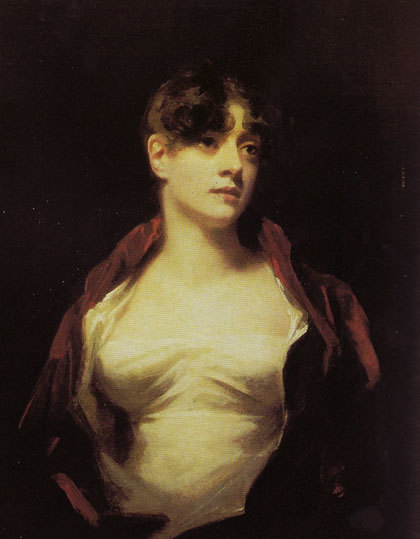
Hildesheimer includes black and white plates - a portrait of Marbot done by Delacroix (if that came from Delacroix I'm a pig's uncle), portraits of his parents by Henry Raeburn (the portrait of his mother Catherine Marbot I've identified as Mrs. Scott Moncrief, the portrait of his father I haven't been able to trace), photos of the two great Marbot houses (I would have to brush up on my treasure houses of Britain to be able to recognize these), and paintings that were either in the Marbot houses, or that he came across in his travels and found significance in.
Mrs. Scott Moncrieff, Henry Raeburn (used as Lady Catherine Marbot's portrait)
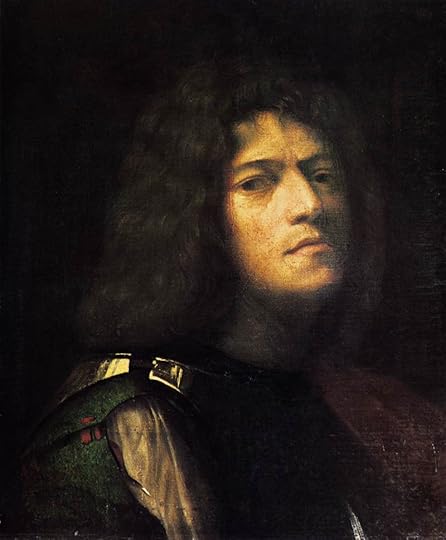
Marbot sees Giorgione's painting in the collection of Duke Anton Ulrich and writes to his mother:
"It is so perfect that I hope if may accompany my dreams. A gaze of positively piercing vagueness, of tormented, passionate and yet doubting self-love. It must be a self-portrait; Rembrandt apart, no painter penetrates so deeply into the soul of another. Moreover, I believe that I can always recognize a self-portrait, not only from the gaze directed at the beholder, but also from the nature of that gaze, which as the artist wishes, is supposed to divulge only what his consciousness and hence his self-estimation allow or command it to divulge. Whatever else it betrays is his hidden possession, which we steal from him where we can. Seldom, however, do the eyes speak as candidly as here: They say: 'This is I, whose work you are admiring, and you are right to admire it. For I am your superior.'
The true artist loves only himself, and of himself only the creative part, while he neglects the human part or fails to consider it or ruins it with earthly pleasures, as, if we read Vasari rightly and believe him, Giorgione did. It is not that he egotistically desires the best for himself, but the creative self occupies the whole of his will and constantly demands self-expression. The true artist is - without knowing it - an enigma to himself, which he seeks to solve afresh in every work and never, subjectively speaking, succeeds in solving....He parts easily from things for which he has no further use, not throwing them away but dropping them. Then, as I looked long at the painting I remarked in that gaze a barely disguised cast of contempt, as if the artist would say: 'In reality you will learn nothing about me, you cannot'." (pp. 134-135)
Self-Portrait, Giorgione
If I understand correctly, this is a portion of a larger work from which it was cut. It shows Giorgione as the biblical David; elsewhere in the painting was the severed head of Goliath. I'm with Marbot on this; before even getting to the part of the novel where Marbot discusses the work, I stared at the reproduction of the painting in the book and repeatedly went back to it. It's unbelievably compelling. Somehow the poorer quality of a black and white book reproduction (background details smudged into darkness) made the face, and the facial features, stand out all the more.
Die Idee, die Biographie einer fiktiven Figur zu erstellen ist reizvoll, schließlich gestattet dies dem Autor - anders als für dieses ansonsten nicht-fiktionale Genre üblich - zu tun, was er will. Warum es dann ausgerechnet auf Inzest hinauslaufen muss, bleibt weitgehend offen, angedeutete Hinweise auf Psychoanalyse gehen ins Leere. Die Hauptperson Andreas (Andrew) Marbot ist ein Pionier des sogenannten reaction content. Da das Künstlertum ihm selbst versagt blieb, beschränkt er sich auf die Betrachtung und urteilt radikal subjektiv, indem er niederschreibt, was er darüber denkt. Dies ist (zwei-)sprachlich immer reizvoll und die gewonnenen Einsichten sind durchaus tief, wiederholte Verweise auf die abwesende Geliebte und in schwülstigem Ton gehaltene Brieffragemte führen jedoch zu Irritation. Es drängt sich die Frage auf, ob es denn nicht auch ohne gegangen wäre. Highlight des Buches ist zweifellos der Mentor des jungen Marbot und verständnisvolle Geistliche: Pater Gerardus - what a name! Eine empfehlenswerte Lektüre für Literaturwissenschaftler und alle die es noch werden wollen.
It took me more than 3 weeks to finish these 250 pages, which is unusually long - and hard work it was. "Marbot" is a "fictional biography", and I am sure it is well researched in order to place the fictional character within its time. There is a lot of namedropping, references to places, other biographies, essays, etc., which is all very well, but just doesn't make for a very compelling read. At times it felt more like a - albeit not perfectly academic - thesis at university than a novel. Marbot is an English 19th century aristocrat and art critic, who travels all over Europe. He had to leave England after an incestuous love affair with his mother and finds his only remedy in the paintings he encounters on his way - this could possibly have made for a more compelling plot, unfortunately the book just was not constructed in that way. Right from the start the reader knows about the incest, about Marbot leaving England and starting to travel, and about him killing himself at the end. I am really not even giving away any spoilers here. The only question that remains is: Why keep reading then? Even though I managed to last all the way through 250 pages, I actually can't answer that.