Kniha podává především svědectví o tom, jak každé literární dílo vyrůstá z konkrétního místa, které určuje podobu literatury a zároveň určitá podoba literárních děl propůjčuje místům magickou moc. Dílo řady literárních badatelů je příběhem literatury a zeměpisu, spočívající však v obtížně realizovatelné rovnováze mezi obecným a konkrétním. Mnohé kapitoly (eseje), navozují atmosféru místa, vtahují čtenáře do světa literatury, mají charakter spíše subjektivního pohledu (viz kapitola o literárním životě na Broadway od A.Millera, nebo Beatnická generace, Svět po pádu berlínské zdi). Naopak jiné kapitoly jsou zase sumarizujícím výčtem literárněhistorických faktů. Přestože je snaha o celostní pohled, byla větší pozornost věnována literatuře psané v angličtině. Atlas měl původně oslovit především anglicky mluvící publikum. Kapitola Autoři a jejich díla přináší též informace o nových českých překladech těchto děl. V mnohých ohledech byly doplněny druhové a žánrové charakteristiky, informace o dějové výstavbě, tvaru, zvláštnostech daných děl. Česká verze publikace vznikala několik let, její konečná podoba je dílem řady literárních vědců.
Sir Malcolm Stanley Bradbury CBE was an English author and academic. He is best known to a wider public as a novelist. Although he is often compared with David Lodge, his friend and a contemporary as a British exponent of the campus novel genre, Bradbury's books are consistently darker in mood and less playful both in style and language. His best known novel The History Man, published in 1975, is a dark satire of academic life in the "glass and steel" universities—the then-fashionable newer universities of England that had followed their "redbrick" predecessors—which in 1981 was made into a successful BBC television serial. The protagonist is the hypocritical Howard Kirk, a sociology professor at the fictional University of Watermouth.
He completed his PhD in American studies at the University of Manchester in 1962, moving to the University of East Anglia (his second novel, Stepping Westward, appeared in 1965), where he became Professor of American Studies in 1970 and launched the world-renowned MA in Creative Writing course, which Ian McEwan and Kazuo Ishiguro both attended. He published Possibilities: Essays on the State of the Novel in 1973, The History Man in 1975, Who Do You Think You Are? in 1976, Rates of Exchange in 1983, Cuts: A Very Short Novel in 1987, retiring from academic life in 1995. Malcolm Bradbury became a Commander of the British Empire in 1991 for services to Literature, and was made a Knight Bachelor in the New Year Honours 2000, again for services to Literature.
Bradbury was a productive academic writer as well as a successful teacher; an expert on the modern novel, he published books on Evelyn Waugh, Saul Bellow and E. M. Forster, as well as editions of such modern classics as F. Scott Fitzgerald's The Great Gatsby, and a number of surveys and handbooks of modern fiction, both British and American.
He also wrote extensively for television, including scripting series such as Anything More Would Be Greedy, The Gravy Train, the sequel The Gravy Train Goes East (which explored life in Bradbury's fictional Slaka), and adapting novels such as Tom Sharpe's Blott on the Landscape and Porterhouse Blue, Alison Lurie's Imaginary Friends and Kingsley Amis's The Green Man. His last television script was for Dalziel and Pascoe series 5, produced by Andy Rowley. The episode 'Foreign Bodies' was screened on BBC One on July 15, 2000.
If you love reading all the classics and wish to learn more about their importance within modern history, or want to view the other side of the spectrum and see how the progress of western culture influenced the greatest writers through the ages, this volume should be included in your personal library.
Bear with me: I know this introduction sounds as if I were lauding some ponderous academic tome that would bore any casual reader to death, but do not be fooled, this book is actually a pleasant surprise and an entertaining read from cover to cover despite its informative nature. Well, I find learning new things to be very entertaining.
This book is filled with concise but intriguing chapters from two to four pages long, each chapter focusing on an important period of history, beginning with the Middle Ages / Renaissance and ending with culture and the world after the fall of the Berlin wall. Famous authors and their history-making masterpieces of literature are discussed in each chapter, some authors, cities, countries and geographical areas receive special attention for certain centuries or epochs, like the sections entitled “Cervante’s Spain”, “Washington Irving’s Europe” or “London in the 1890s”. It is quite useful if you have just bought a copy of 'Gulliver’s Travels' or 'Wurthering Heights', to cite a few examples, and want to understand their general background, the authors who wrote them, the cultural history of the times, and how these works may have influenced the creativity of other writers.
This beautifully produced work is filled with interesting colour maps and graphs, not only pictures charting historical events, but special illustrations marking out sites in various cities where a famous scene in a novel occurred, plus charts plotting the travels of fictional characters. Plans of cities showing where authors loved to ‘hang out’ and discuss their ideas are also included, places that may still be found today or that no longer exist are clearly marked. There are also numerous illustrations, sketches and artworks that help evoke a ‘feeling’ of each period, such as paintings, artworks, photographs, book covers and illustrations not to mention authors’ portraits. The reader will find that this work really is an “Atlas of Literature”, my only complaint—it’s a shame that the publisher did not delve deeper and include chapters on ancient civilizations and their literary culture, like the epics and dramas of ancient Greece and Rome. How could the ´Illiad´ by Homer and the ´Aeneid´ by Virgil not be included in this book? These great classics influenced more writers than can be imagined. The contributors certainly missed out on the charts they could have included of ancient Troy plus the wanderings of Ulysses and Aeneas. Never mind, the book is still enjoyable, so I’m giving it the full five stars.
Last but not least, there is an informative appendix with an alphabetical listing of authors and their works, more lists featuring interesting international places to visit that are associated with the literary world such as museums dedicated to specific writers, book clubs, homes of famous authors, also cemeteries where they are buried to name few sites. There is also a suggested list of books for further research, and a useful index for quick referencing if you do not feel like reading this volume straight from beginning to end. This “atlas” is a treasure for literature lovers.
Contents:
Introduction
Part One: The Middle Ages and the Renaissance “Dante's Worlds” “Chaucer's England” “Shakespeare's Stratford and London” “Montaigne's France” “Cervante's Spain” “The Discovery of the New World: Arcadia and Utopia”
Part Two: The Age of Reason “The France of the Enlightenment” “The Journeys of the Age of the Novel” “Eighteenth Century London” “Eighteenth Century Dublin” “Eighteenth Century Edinburgh and Scotland”
Part Three: The Romantics “The Lake District of the Romantics” “The Romantic Abroad” “Jane Austen's Regency England” “The Paris of the French Romantics” “Weimar and the German Romantics” “Washington Irving's Europe” “James Fenimore Cooper's Frontier”
Part Four: The Age of Industrialism and Empire “The Sleeping Giant: Pushkin's, Gogol's and Dostoevsky's St Petersburg” “Stendhal's, Balzac's and Sand's France” “Dicken's London” “Steaming Chimney's: Britain and Industrialism” “Wild Yorkshire: The Brontës of Haworth” “Emerson's and Hawthorne's New England” “Dreaming Spires: Nineteenth Century Oxford and Cambridge”
Part Five: The Age of Realism “Mark Twain's Mississippi” “The South, Slavery and the Civil War” “Paris as Bohemia” “The European Apple: Henry James's International Scene” “Thomas Hardey's Wessex” “Scandinavia: The Dark and the Light” “Precipitous City: Robert Louis Stevenson's Edinburgh” “London in the 1890s” “Dreams of Empire” “The Irish Revival” “Chicago's World Fair”
Part Six: The Modern World “Wittgenstein's Vienna” “Kafka's Prague” “James Joyce's Dublin” “Writers of the Great War” “Paris in the Twenties” “The World of Bloomsbury” “Berlin: The Centre of German Modernism” “Greenwich Village” “Harlem's Renaissance” “Main Street, USA” “William Faulkner's New South” “Writer's Hollywood” “Depression America” “Depression Britain” “The Spanish Civil War” “Writers go to War”
Part Seven: After the Second World War “Existentialist Paris and Beyond” “Germany After the War” “Post-war Italian Fiction” “Scenes From Provincial Life” “Broadway” “Dylan Thomas's Wales” “The Beat Generation” “Cold War Tales”
Part Eight: The World Today “Russia and Eastern Europe After the Second World War” “The Fantasywallas of Bombay” “Japan: Land of Spirits of the Earth” “Campus Fictions” “Divided Ireland” “The Writing of the Caribbean” “Australian Images: Sydney and Melbourne” “Contemporary Israeli Writing” “In Search of Andalusia: Arabic Literature Today” “South African Stories” “Latin American Writing: A Literary Heritage Explored” “The Writing of Africa Today” “Canadian Images” “Everywhere the Wind Blows: African-American Writing Today” “Manhattan Tales: Who's Afraid of Tom Wolfe?” “ ´This Grey But Gold City´ The Glasgow of Gray and Kelman” “London: The Dislocated City” “The World After the Wall”
Appendixes: Authors and their works Places to visit Further reading
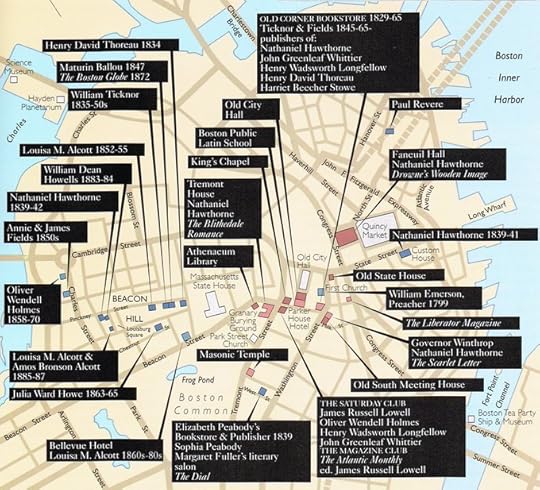
This sizable and scopey tome aims to provide "a unique account of literature through the ages and across the continents". Theoretically it occupies a space similar to that of Atlas of the European Novel: 1800-1900; a space defined by questioning and reflecting on the era and context of authors and key literary works. This questioning and reflection process is illustrated liberally throughout with intriguing maps juxtaposing Louisa M. Alcott against Nathaniel Hawthorn in Nineteenth Century Boston and Chinua Achebe against Ben Okri in a discussion of the West Coast of Africa.
Structurally, this book adopts a broad temporal grouping and splits itself into eight key sections: The Middle Ages and The Renaissance, The Age of Reason, The Romantics, The Age of Industrialism and Empire, The Age of Realism, The Modern World, After the Second World War and The World Today. Each section is then split into several futher parts exploring European and global aspects of the topic. Part Six 'The Modern World' sees an investigation into Kafka's Prague, Paris in the Twenties, Harlem's Renaissance and The Spanish Civil War amongst others.
As a text The Atlas of Literature does suffer from poor proofreading. I noticed a few typographic errors and several homonyms throughout. In addition, I would have welcomed each individual essay to have the author's name attached to it - at present, these are grouped under an initial list: 'the contributors' and then ordered alphabetically and not by the title of their essays.
The strengths of the volume include its resolute breadth and depth of coverage. With regards to children's literature, as with many other titles of its ilk there's not much covered here save for some oddly jarring moments come when discussing Lewis Carroll and Jonathan Swift's work in particular.
Whilst out of the remits of my research, the chapters on Broadway and Scenes From Provincial Life (Britain in the 1940s and 1950s) are fascinating, and well worth reading in their own right. Of particular interest is the acknowledgement of mixed-media authors - so in this latter chapter, we have a map illustrating theatres and writers such as Kingsley Amis, Alan Ayckbourn and Liz Lochead. As a whole, this is where the Atlas shone for me and it was striking that the strengths of such a global approach were very much within a British context. Perhaps that reflects more upon my knowledge of the literary world than it does of the Atlas itself. Regardless, it's still a striking feature of this immense tome.
I'm really impressed with this book. It's a thorough review of literature as a whole. I began by just perusing it, checking out maps of my favorite literary cities and such, but soon realized how good the articles were and decided to read straight through.
The absolute highlight of the whole book is Arthur Miller's article on the hypocrisy of Broadway, and Hollywood by association (p 244). Also, Dostoevsky's St. Petersburg (p 88), Balzac's France (p 92), Kafka's Prague (p 163), Joyce's Dublin (p166), etc. The book grows understandably weaker and more broad towards more recent history. One can only approximate who our current fundamental writers are, so I'm not surprised by how general the final chapters become. NB: Surprising how different the final Manhattan article (p 314) is as it was published pre-9/11.
The only issue I take with the book is how poorly proofed it is. At least in my '96 edition, there are typos on nearly every page. This seems to occur often in coffee table style books. I take comfort in the fact that this isn't a true reference book or authority, and most likely its readership (or glancer-ship) is familiar with basic literary history and most interested in solely geographic info.
Remarkably unstuffy for a survey of such daunting magnitude. The chapter on Washington Irving’s Europe irks. Irving may well have felt the need to return to Europe to wander its historic roads, but the colonial sentiment that such history was lacking in America should have been countered by the chapter’s essayist. On top of this, the book’s Western bias is never really laid bare. Obviously, the book’s creators feel this as they cram chapters on Indian, Japanese, Arabic, African and other literatures into the book’s final section. It might have been better to own the earlier bias and just go with 'An Atlas of Western Literature,' or are these tokenistic late editions better than nothing? The books appears to have been first published in 1996, so post-modernisms pluralism was no doubt less developed. The many and various paintings, drawing and etchings are frustratingly not credited in the main text, one has to look to the fine print on the final page. There are maps of each region, showing where various writers lived. My geography of all but London is non-existent, so I bypass these maps. Whose geography is extensive enough to make much of such maps? Not this dyslexic… This book is an ambitious project. It’s probably not really meant to be read cover to cover as I have done (albeit very slooowly), e.g. the chapter on World War II almost becomes but a dense list of authors’ names (a contradiction to the aforementioned lack of stuffiness I know, but this speaks to a compromise in the book’s design; the decision to make each chapter roughly the same length, no matter how vast or localised its geography / no matter how many writers fit its criteria). I didn’t realise some of the chapter writers were so famous until I hit the chapter on Broadway, which stood out for its unreserved scathing. The chapter’s author? Arthur Miller. I had to dig for a list of chapter authors as much for I did for image credits!? Problematic, but easy to read, informative and rich with quotes. I discovered or was reminded of many old and older books and authors I’ve since added to my reading list. Great to more fully understand some of these books and authors in their geographical and historical contexts.
Being a geographer and a big reader, I love literary atlases and I have several in my collection. This book is a great resource to browse through. Over the years I’ve skimmed the text and studied the maps – there are dozens of them.
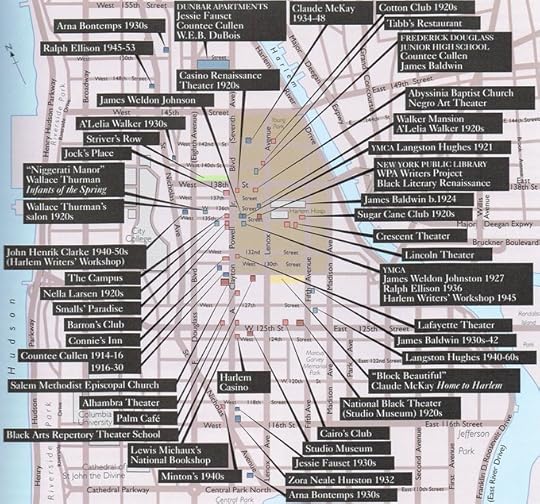
Map above of the Harlem Renaissance
Almost all of the maps and illustrations are in color. Besides maps there are dozens of photos of authors, their homes and hangouts, landscapes, and photos of sketches illustrating society at the time.
As you would expect, the content is heavily oriented toward western literature, especially Europe and the US. London, New York and Paris feature prominently in the maps and text – there are about a half-dozen maps of each city over time. When you think of it, where would Western literature be without those three cities? So, for example, there are four maps of London at various times: of Shakespeare's era, 18th Century London, Dickens' London and London in the 1890s.
There are maps of districts within cities where clusters of writers and artists lived, hung out and interacted at certain times such as Bloomsbury, Greenwich Village, Harlem and “Existentialist Paris.” The last features Sartre, Camus, Baldwin, Jean Genet, Richard Wright, Simone de Beauvoir, William Burroughs, Roland Barthes, Claude Levi-Strauss and others.
Map of 19th Century Literary Boston
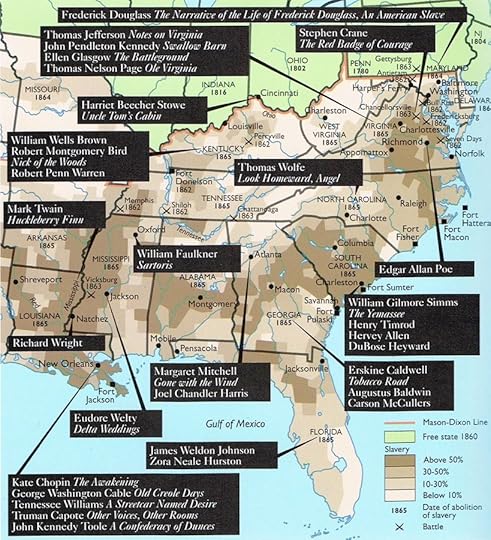
Some maps are of writers’ fictional worlds, based on the reality that nourished them, but created through their fictional works. Examples are Thomas Hardy’s Wessex; Faulkner’s American South and the Brontes’ Yorkshire. There’s an occasional map of travels, such as those of Jack Kerouac.
It’s fascinating to think of how small the populations of cities were in previous centuries and yet they produced clusters of great thinkers and writers. The map of 18th Century Edinburgh with a population of only 60,000 or-so people, features Percy Shelley, Robert Burns, Walter Scott, David Hume, Thomas Carlyle, James Boswell, Adam Smith and others. The centers of cities were obviously much smaller in those days, so all these folks lived within an area roughly 20 streets north-south and 20 streets east-west – today’s Old Town Edinburgh. (They all did not necessarily interact because some of those mentioned were in old age when others were children.)
Maps of many other European areas are included: Kafka’s Prague, Wittgenstein’s Vienna, Joyce’s Dublin, Germany, Scandinavia, the Spanish Civil War, etc.
Noticing trivia is fun too. I wondered what a couple of residences of Ernest Hemingway are doing in Toronto? It turns out that one his first jobs was as a reporter for four years for the Toronto Star. (It amazes me to realize Hemingway was born in 1899!)
The remainder of the world is summarized in several maps: Russia, Australia, Canada, Bombay (Mumbai), Japan, Australia, Israel, the Caribbean, the Arabic world, Africa.
Literary Map of the American South
A few maps are overly simplistic. The map of Latin American literature is just made up of arrows pointing to countries accompanied by a list of famous authors from each nation. The overall focus is on authors of classics and I imagine that every Noble Prize winner since 2001, when my edition was published, is on one of these maps. Since this book was published in 2001, and an author had to be “famous” by that time to be included, the most recent authors you’ll find are folks born in the 1920s and 1930s like Kingsley Amis, Tom Wolfe, James Baldwin and Margaret Atwood.
A great resource to leave on your coffee table and skim through!
Maps in the book shown above are all from posts on Twitter (X.com) by Randall Stephens@Randall_Stps
Boy is this useful. Even if you were never to read a word of this, pore over the maps of cities, countries, parts of the world in different decades or centuries. They pinpoint locations where authors lived and/or wrote and their significant works of the time. It's a brilliant resource and an insightful way to put things in perspective. It's also a great list of book recommendations. Chapter headings in Part Six The Modern World alone include Paris in the Twenties, Harlem's Renaissance, Writers' Hollywood, Writers go to War--and those invaluable maps (in every section).
Bradbury is the general editor of this collection of encyclopedic two to six page essays on literature of, about, and from a geographic and chronological location. It works best as a reference work, and gave me reading suggestion that will represent a year's worth of well-spent hours.
Suffers from the encyclopedia effect of many contributors with different styles and focuses, and is too specific in some areas and broad in others, but those are quibbles about a great $2 find at the Wake County Book Sale.
This is your basic 'survey of literature' tome. But, for me, the design really sets this one apart.
It makes a good use of photos and maps. Plus, certain text is in bold or highlighted in a way so that recall is good and "flipping back to check something" is easy.
It doesn't bog itself down in analysis. I'm sure lit pros and English majors have more detailed books. But this is just right, if even a little fun, for average joes like me.
This is one of Alice's favorite refernce books which selects certain eras and places such as the Harlem literary renaissance or18th century Edinburgh and dinetifies authors, where they lived and what they wrote. Alice has mined this book for many ideas and inspirations.
Fantastic layout. The atlas is divided by place, time period. I've pulled out this book before going to London and Canada and across the USA. I also plan itineraries for my home: New York City.