

What do you think?

David's Crown: Sounding the Psalms
As well as the name of a virus, a corona is a crown, the pearly glow around the sun in certain astronomical conditions and a poetic form where interlinking lines connect a sequence. It is the perfect name therefore for this new collection of 150 poems by the bestselling poet Malcolm Guite, each one written in response to the Bible s 150 psalms as they appear in William Coverdale s timeless translation. The Psalms express every human emotion with disarming honesty, as anger and thankfulness alike are directed at God. All of life is here with its moments of beauty and its times of despair and shame. Like the Psalms themselves, the poems do not avoid the cursing and glorying over the downfall of your enemies, but wrestle honestly with them as we do when we come to say them.
150 pages, Paperback
First published January 15, 2021
Ratings & Reviews
Friends & Following
Create a free account to discover what your friends think of this book!
Community Reviews
Displaying 1 - 30 of 67 reviews
April 3, 2021
Wow! I read this alongside Psalms and several books about Psalms for Lent this year. This book is a delight. It really gave me new eyes to see Psalms. I love how Guite kept the spirit of the Psalm, but included Christ explicitly. He also included modern things, like the exile we’ve all felt due to Covid. I’ll return to this and recommend it far and wide!

May 30, 2026
Rich and vivid. Malcolm Guite knows his Bible and helps it come alive with these poetic reflections. I admire his commitment to a specific form throughout the collection. It makes the imagery and range of emotion expressed that much more compelling.

October 6, 2026
A collection of 150 outstanding sonnets. Guite is one of my favourite poets, and this collection is well worth anyone’s time, especially as a devotional companion.

May 16, 2022
Malcolm Guite restores my faith in Christian poetry. And Christian poetry restores my faith.
These 150 poems, composed in lockdown, perform duets of contradiction - they disarm and strengthen; cleanse and enrich; startle and comfort. Just like the gospel.
The poems are woven into a ‘corona’ - a crown or coronet, where the last line of one becomes the first line of the next. The result is a never-ending breath of praise, which garlands the head of Jesus, who himself wore a bitter crown of thorns for us.
Each poem is a response to a psalm - not a paraphrase. They’re best enjoyed as echoes or sweet refractions, read straight after the original.
These 150 poems, composed in lockdown, perform duets of contradiction - they disarm and strengthen; cleanse and enrich; startle and comfort. Just like the gospel.
The poems are woven into a ‘corona’ - a crown or coronet, where the last line of one becomes the first line of the next. The result is a never-ending breath of praise, which garlands the head of Jesus, who himself wore a bitter crown of thorns for us.
Each poem is a response to a psalm - not a paraphrase. They’re best enjoyed as echoes or sweet refractions, read straight after the original.

June 9, 2021
2021. Malcom Guite’s poetry is always worth revisiting so in 2023 I began my second reading, but this time I started reading it out loud to my husband during his final days, but I didn’t get through it before he entered into the presence of God, our Father. No doubt I will read David’s Crown again in another year or so.
2026: I should get in the habit of reading David’s Crown yearly. It is so good!
2026: I should get in the habit of reading David’s Crown yearly. It is so good!
September 1, 2024
A beautiful collection of poems. I began these without really liking Guite's other poetry, but these were good. I think the difference was that these are all interconnected and rely on one another, and taken in chunks (I read about twenty or so at a time), they create a really beautiful whole. There are some particular gems in here, too.

May 29, 2025
I’ve been enjoying Malcom Guite’s poetry. These poems were perfect companions as I read through the Psalms.

April 15, 2026
I have favorite Psalms - Psalms that have held me and been spoken over me in times of trial (Psalm 18), Psalms that were engrained into my memory bank as a child (Psalm 23), Psalms that are favorites of my sister (Psalm 123) and were beloved by my dearest Mama Nick (Psalm 16). I’ve always enjoyed the duality of encouragement and lament within this book of poetry, the range of human emotion is poignant in its need for Christ’s redemption. The Psalter in its entirety could be summed up with “_________ (insert reason to rejoice or lament), followed by the encouragement, “…..for His steadfast love endures forever.”
Even as direct as the Psalmist is with his mirrored statements of faith and doubt, Malcom Guite’s poetic response to each Psalm further contextualizes David’s coronet of praise unto God.
“The poems are woven into a corona, a crown or coronet of poems, where the last line becomes the first line of the next, and the last line of the final poem returns to the opening line of the first: completing the crown and, in the poet’s own words, “forming a chaplet of praise to garland the head of the one who wore the Corona Spinea, the crown of thorns for us.”
Even as direct as the Psalmist is with his mirrored statements of faith and doubt, Malcom Guite’s poetic response to each Psalm further contextualizes David’s coronet of praise unto God.
“The poems are woven into a corona, a crown or coronet of poems, where the last line becomes the first line of the next, and the last line of the final poem returns to the opening line of the first: completing the crown and, in the poet’s own words, “forming a chaplet of praise to garland the head of the one who wore the Corona Spinea, the crown of thorns for us.”
July 23, 2026
Beautiful. Magnificent. I used it devotionally reading the Coverdale translation of the Psalm and then the poem (as he recommends). I did this slowly, limiting myself to one per day during my lunch breaks while working at my office whenvever I had time. It has been a huge blessing.

April 21, 2026
I read these along with the Psalms. It’s my first time reading anything by Guite. I liked that he uses classical structures, not sure what it’s called, instead of modern ‘poetry.’ I liked his idea of the flow between the 150 psalms, connecting them with the repeating lines at the end and beginning of the following psalm. However, that effect was rather lost on me because I read these one or two per day after reading the psalm. I could even like his idea of responding devotionally to the psalms rather than rewording them in poem form, something that has been done in psalters like the Scottish Psalter or in Isaac Watts’ psalms and hymns.
However, to be honest, I didn’t always relate to or agree with his applications or “responses,” whatever they’re called. I felt his hermeneutic wasn’t literal enough, and sometimes it bothered me when what seemed like an obvious application wasn’t mentioned. I realize he was doing a personal response so how can I argue with that, nevertheless I do. I hardly ever read the ideas of evangelism/missions to the world, even when it was the prevailing idea of a psalm; likewise with the idea of repentance. I was annoyed by his Covid references and modern “social justice” issues from 2020 at the beginning of the psalms, but then it seemed to lessen, hopefully he saw what a lack of justice was involved from that time period. I learned to gain some distance from current events before incorporating them into unrelated art. It isn’t that the psalms don’t apply to current events for sure, but that I didn’t agree with what I thought was his liberal slant. Sometimes he put Christ into a poem for a psalm that I didn’t necessarily think pointed very clearly to Christ but then on occasion missed a better chance to put Him into another poem. I didn’t agree with how he handled imprecations psalms. He simply denied them, and said I can’t pray this, as if he could rebuke David, or as if the Holy Spirit only inspired that for OT times? Not good! In the end, I wasn’t very moved by these; and I think that is mainly because he departed from the main points of the psalms, often. I’m going to read Watts’s poems next, and I think I’ll like them much better.
However, to be honest, I didn’t always relate to or agree with his applications or “responses,” whatever they’re called. I felt his hermeneutic wasn’t literal enough, and sometimes it bothered me when what seemed like an obvious application wasn’t mentioned. I realize he was doing a personal response so how can I argue with that, nevertheless I do. I hardly ever read the ideas of evangelism/missions to the world, even when it was the prevailing idea of a psalm; likewise with the idea of repentance. I was annoyed by his Covid references and modern “social justice” issues from 2020 at the beginning of the psalms, but then it seemed to lessen, hopefully he saw what a lack of justice was involved from that time period. I learned to gain some distance from current events before incorporating them into unrelated art. It isn’t that the psalms don’t apply to current events for sure, but that I didn’t agree with what I thought was his liberal slant. Sometimes he put Christ into a poem for a psalm that I didn’t necessarily think pointed very clearly to Christ but then on occasion missed a better chance to put Him into another poem. I didn’t agree with how he handled imprecations psalms. He simply denied them, and said I can’t pray this, as if he could rebuke David, or as if the Holy Spirit only inspired that for OT times? Not good! In the end, I wasn’t very moved by these; and I think that is mainly because he departed from the main points of the psalms, often. I’m going to read Watts’s poems next, and I think I’ll like them much better.

June 29, 2026
couldn’t recommend more! read the psalms in a month alongside these poems, and it was wonderful.
one of my favorites: psalm 40
“the stone itself will soon be rolled away.
i wait in patience, all expectantly,
firm on this rock above the miry clay
where he has set me in his loving mercy.
i sing my psalm in Christ who sings in me,
a new song made in his Love’s mystery:
‘your wondrous works all rise like wings in me
and lift my heart to praise. i hear your call,
the simple call of Love: oh come to me!
bring me no gifts, for i have made them all,
just bring yourself, and open up your heart.’
and so i come to you and bring you all,
all that i am and have been: joy and hurt,
glory and shame. i bring you everything,
that you might make me whole in every part.”
one of my favorites: psalm 40
“the stone itself will soon be rolled away.
i wait in patience, all expectantly,
firm on this rock above the miry clay
where he has set me in his loving mercy.
i sing my psalm in Christ who sings in me,
a new song made in his Love’s mystery:
‘your wondrous works all rise like wings in me
and lift my heart to praise. i hear your call,
the simple call of Love: oh come to me!
bring me no gifts, for i have made them all,
just bring yourself, and open up your heart.’
and so i come to you and bring you all,
all that i am and have been: joy and hurt,
glory and shame. i bring you everything,
that you might make me whole in every part.”

May 4, 2024
This is a fascinating concept. Each poem is based on a Psalm, though many diverge in unexpected directions. And each poem has fifteen lines written in a specific structured form, with the last line of each forming the first line in the next. Last of all, the 150th poem ends with the same line which began the first, making a complete circle, or crown, of praise. It looks like quite a challenge to make all of that work, and it was interesting to me to see how he managed it.
Guite, as usual, has a beautiful command of language and makes lovely pictures with his words. I spent over a year grazing on this book at random intervals, and it was a joy.
Guite, as usual, has a beautiful command of language and makes lovely pictures with his words. I spent over a year grazing on this book at random intervals, and it was a joy.

April 14, 2023
A wonderful volume of poetry that I read with a friend! This Corona of poems consistently was one of the best parts of my day as I read. Guite managed to make this look at the Psalms both immensely personal yet deeply theological. I recommend this for anyone who enjoys Christian poetry or is looking for a companion to their reading of the Psalms.

November 30, 2024
Another stunning collection of poems from Malcolm Guite.
"Keep your security in Christ, who hears
The slightest murmur of your smallest prayer,
And do not be afraid, but trust in him,
Your heart's in heaven, keep your treasure there."
"Keep your security in Christ, who hears
The slightest murmur of your smallest prayer,
And do not be afraid, but trust in him,
Your heart's in heaven, keep your treasure there."
December 30, 2025
If you love Christian poetry this is the book for you
Malcolm Guite has written a poem that goes with each of the Psalms I always read the one that goes with the psalm I have just read and see even more
Malcolm Guite has written a poem that goes with each of the Psalms I always read the one that goes with the psalm I have just read and see even more

August 3, 2021
A wonderful way to start each morning, reading a psalm and Malcolm’s poem to accompany it. His interpretations may echo, enhance, even contradict mine, but always resulted in a worshipful experience.

August 1, 2022
LOVE this collection.
Talk about a baptized imagination!
Talk about a baptized imagination!
April 22, 2024
profound and astounding.

June 4, 2025
I didn’t love this, but will always love Malcolm!

April 19, 2026
A poem (a sonnet) to accompany each psalm with heart and creativity. This was delightful added to my mornings for the past while. Recommend for anyone who loves Jesus and wants to love poetry.

September 21, 2026
Delightful meditations on the Psalms. Food for the mind and heart.

December 9, 2025
a good intro to Malcolm Guite. I was rather impressed

January 18, 2024
I loved this book. It offers a contemporary echo to the psalms. And it makes them connected to our experience of God today. The best way is to read the psalm in the bible first and then read the corresponding poem a couple of times.

January 26, 2022
I loved this. Written during 2020, it’s a collection of 150 poems that are responses to each of the Psalms. I found it comforting and challenging and entirely timely; with its personal responses to Scripture, it so often resonated with my own thoughts and emotions from the past couple years of pandemic and general upheaval. This is one I’m sure I’ll go back to again and again in tandem with my reading of the Psalms.

July 28, 2025
I really enjoyed this sequence of poems based on the sonnet crown form (they were not sonnets but repeated lines at the beginning/ending of each poem) and the psalms (they are entirely Christocentric). I read it along with my read-through of the Psalter, and enjoyed connecting each poem to its psalm. Some try to get the sense of the whole psalm, and some tease out one or two ideas. I found it fresh that Guite occasionally connected directly to modern issues (see below) but more often relied on timeless meanings. Yet, I found a little too much Christianese for my taste, even though it makes it great for personal devotional use, it leaves the poetry just a little bit lacking. (Maybe that's after being knocked sidways by Ravenna Cole's The Alchemy of Grace, which is highly devotional and not given to Christianese.) Recommended for Guite fans or anyone looking for poetry inspired by the Bible that's not imitative.
-----
from "Psalm 2: II Quare fremuerunt gentes?"
Then let the chaff of life just blow away:
The cynic scoffer and the evil troll,
The hunters and the haters who hold sway
In raging twitter storms, the ones who scroll
Through hate- and hit-lists in their tiny rage
Are dust upon the mirror of your soul.
from "Psalm 17: XVII Exaudi, Domine"
...I avail
Myself of compline's long familiar chant
To call on you. I ask you to prevail
Over the powers that dull and disenchant,
Over the scoffing of a world that's steeped
In its own excess, and instead to plant
Me firmly by your waters...
"Psalm 130: CXXX De profundis"
Ask him for mercy, you won't be denied.
Call on him de profundis, from the deep;
The places where the child in you has cried
All night unheard, and where your spirit weeps
As Rachael wept and would not be consoled.
Cry from the place where grief unspoken seeps
Into a bitter silence, never told
And never healed. So cry out from the deep:
Bring every grief to God, do not withhold
A tear from him. Give him your tears to keep
For they are precious to him. Flee to him,
His heart was pierced and he knows how to weep,
For he is full of mercy, and with him
Is plenteous redemption. Let him sound
The depths that he might draw you out from them.
-----
from "Psalm 2: II Quare fremuerunt gentes?"
Then let the chaff of life just blow away:
The cynic scoffer and the evil troll,
The hunters and the haters who hold sway
In raging twitter storms, the ones who scroll
Through hate- and hit-lists in their tiny rage
Are dust upon the mirror of your soul.
from "Psalm 17: XVII Exaudi, Domine"
...I avail
Myself of compline's long familiar chant
To call on you. I ask you to prevail
Over the powers that dull and disenchant,
Over the scoffing of a world that's steeped
In its own excess, and instead to plant
Me firmly by your waters...
"Psalm 130: CXXX De profundis"
Ask him for mercy, you won't be denied.
Call on him de profundis, from the deep;
The places where the child in you has cried
All night unheard, and where your spirit weeps
As Rachael wept and would not be consoled.
Cry from the place where grief unspoken seeps
Into a bitter silence, never told
And never healed. So cry out from the deep:
Bring every grief to God, do not withhold
A tear from him. Give him your tears to keep
For they are precious to him. Flee to him,
His heart was pierced and he knows how to weep,
For he is full of mercy, and with him
Is plenteous redemption. Let him sound
The depths that he might draw you out from them.

May 17, 2022
Dec 2025. Resuming at "As the deer." This volume suits the season much better than Bernanos's IMPOSTOR. Update: 40 left to go. Still reading quickly, about ten per sitting. This pace seems right for two reasons: it maintains the "coronal" thread, and the rhymes and repeated lines are often modified or slant.
Two observations about the content: Guite's solution to the problem of imprecatory psalms is rejection ("I cannot pray this psalm"). He cannot reconcile them with the Lord's command to love our enemies, and naturally he prefers Jesus to David. I have encountered two other solutions to this problem in my reading: Augustine somewhere gives a figurative interpretation to the death of earthly foes, as indicating their conversion to Christ and "rebirth" as brethren. Other Fathers read the foes allegorically, as signifying the demons or our sins, rather than men. In my opinion, all three solutions work, but Guite's ranks last.
Secondly, is it just me, or are other readers put off by all these references to the coronavirus? I suppose it was natural for authors in 2020 to reflect so often on the "plague" (Guite's word), but it wears thin pretty quick, here at the end of 2025.
Finished, good.
Oct 2025. Starting over, lovely. Not taking them slowly; the interlinked form invites speed. Alas, quitting again after 40, life too busy.
May 2022. Gift from a colleague. Quitting after 25 psalms. Thought I'd have time for it this summer, but Aquinas and Tolstoy crowded out almost everything else.
Two observations about the content: Guite's solution to the problem of imprecatory psalms is rejection ("I cannot pray this psalm"). He cannot reconcile them with the Lord's command to love our enemies, and naturally he prefers Jesus to David. I have encountered two other solutions to this problem in my reading: Augustine somewhere gives a figurative interpretation to the death of earthly foes, as indicating their conversion to Christ and "rebirth" as brethren. Other Fathers read the foes allegorically, as signifying the demons or our sins, rather than men. In my opinion, all three solutions work, but Guite's ranks last.
Secondly, is it just me, or are other readers put off by all these references to the coronavirus? I suppose it was natural for authors in 2020 to reflect so often on the "plague" (Guite's word), but it wears thin pretty quick, here at the end of 2025.
Finished, good.
Oct 2025. Starting over, lovely. Not taking them slowly; the interlinked form invites speed. Alas, quitting again after 40, life too busy.
May 2022. Gift from a colleague. Quitting after 25 psalms. Thought I'd have time for it this summer, but Aquinas and Tolstoy crowded out almost everything else.

June 15, 2021
This book follows the author's personal journal through the psalter with his own poems. The technical achievement is marvelous overall, though it did mean a few lines seem forced or less musical than I would have liked. Normally, I do not like poetry that is "uplifting." However, these poems are for many of the same reasons the actual book of Psalms is.
Even those who do not read poetry may find this a refreshing and edifying volume.
Even those who do not read poetry may find this a refreshing and edifying volume.
May 23, 2026
This collection of poetry is a fabulous accompaniment to a reading of the Psalms. The content is not a deep dive, but a response to the text and is often not even the response I would have had, but I found it made me pause and look at the familiar words in a new light. The thought process often went something like this, "Oh, he got this poem out of that Psalm, I didn't even notice that phrase. Maybe I should go back and read it again."
To each Psalm, there is an accompanying fifteen line poem that is connected by the last line of each poem doubling as the first line of the next poem. The last line of the book also completes the circle as the first line of the book. While there is a lot going on in the text, the poetry of Malcolm Guite is attainable for a surface read, but goes well beyond that if you care for such things.
Pleasant, provoking, and practical...how is that for a one line book review?
To each Psalm, there is an accompanying fifteen line poem that is connected by the last line of each poem doubling as the first line of the next poem. The last line of the book also completes the circle as the first line of the book. While there is a lot going on in the text, the poetry of Malcolm Guite is attainable for a surface read, but goes well beyond that if you care for such things.
Pleasant, provoking, and practical...how is that for a one line book review?

April 22, 2024
What an exquisite collection of poems!
The form of the corona captured me. The last line of each poem links (is repeated) to the first line of the next poem. And the final line of 150 is the same as the first line of 1. Guite is very clear that these poems for each psalm are neither a translation nor a commentary, but more like a prayer journal.
In my own journal I wrote down a phrase from each poem.
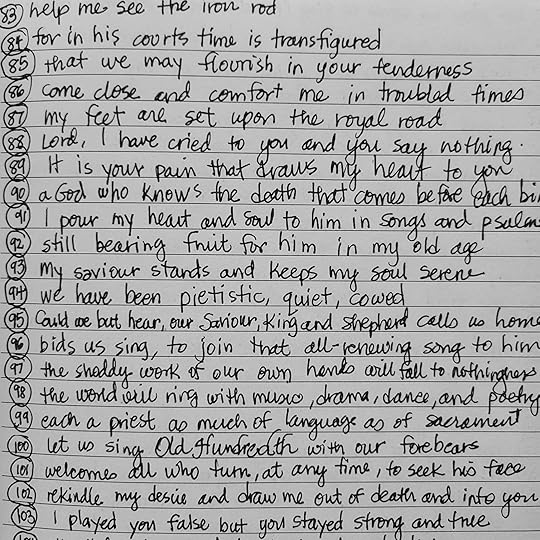
The form of the corona captured me. The last line of each poem links (is repeated) to the first line of the next poem. And the final line of 150 is the same as the first line of 1. Guite is very clear that these poems for each psalm are neither a translation nor a commentary, but more like a prayer journal.
In my own journal I wrote down a phrase from each poem.
August 23, 2023
I was amazed how Malcolm wrote a poem for every Psalm, and how it was so fitting for each Psalm. He wrote in such a way that made the Psalm seem even clearer in depth and meaning.
I have given this to some who are fighting cancer, as a comfort of how God hears us regardless of what we are going through. I think the Psalms are written to show us that we are all human and our emotions can range from high to low as we go through life and face difficult challenges.
Well written Malcom Guite!
I have given this to some who are fighting cancer, as a comfort of how God hears us regardless of what we are going through. I think the Psalms are written to show us that we are all human and our emotions can range from high to low as we go through life and face difficult challenges.
Well written Malcom Guite!
Displaying 1 - 30 of 67 reviews