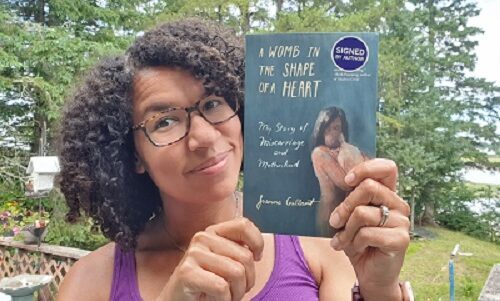
An intimate memoir of miscarriage, premature birth, and motherhood from a bold and brilliant new voice in Atlantic Canada I am the space between motherhood and longing for it, bit it's a space that doesn't exist. I can't be both fertile and infertile, our language doesn't have space for it. So, this is the space I have created for myself. This is where I love. Forever fertile and infertile. A mother to six, a mother of one. I am childless, with child. Barren and fruitful. Pregnant and then not. Luckly, unlucky. A thirty year old pediatric nurse with dreams of motherhood, Joanne Gallant was confident that she and her partner would conceive soon after they married - it was a matter of when, not if. And yet. Her first pregnancy, a set of twins, is riddled with dangerous complications that endanger her life, and results in devastating loss. After emergency surgery, Gallant is diagnosed with biconuate uterus, a rare condition also known as a heart shaped womb . There is no cure, no pill, no surgery that can alter her fate. What is happening to her now was preordianed long before her own birth.
As motherhood continues to elude her, Gallant and her partner navigate the world of infertility - up until the pregnancy that results, to their astonishment, in the premature birth of their son. What follows are not the blissful, pastel day of early motherhood, but months of severe post-partum anxiety and post traumatic stress; she is sure her son will be taken from her. It is a matter of when, not if. Punctuated by moments of incredible joy as she raises her young son, A Womb in the Shape of a Heart is the intimate story of Gallant's journey through miscarriage and motherhood, holding space for the complicated paradoxes of grief and gratitude, of life and death, and the impenetrable depths of a mother's love.
This is an amazing book! It’s thought provoking. Informative. Heartbreaking and inspiring. It digs into the reality of how a pregnancy doesn’t always result in the birth of a baby nine months later.
This is a story of the loss of innocence. Of how we expect or assume our life will be. For years, she writes, she took the daily birth control pill with the understanding that an unwanted pregnancy was the worst possible thing that could happen to a girl’s dreams.
Infertility happens to one in eight couples. Though most women never think they will be the one.
I count myself fortunate I never struggled with infertility, or heard the words, “I’m sorry, but you’ve lost the baby.”
But relate to giving birth and things not turning out as expected.
With my first pregnancy in 1981, I’d had no ultrasound, no way of knowing my baby would be born with a birth defect and spend the first month of her life in hospital after undergoing surgery when she was only one day old.
The author says that as a newly pregnant woman and as a pediatric nurse, she had not been able to explain all the ways in which pregnancy could go wrong. How people tried to ease her loss, saying, “the good news is, you can get pregnant.”
She was told that miscarriages happen all the time. That she was young. Could try again. It brings home the first dismissal of the loss and the grief a woman goes through.
The author said she found no instructions on how to live with the baby that would never be.
Since I never experienced a miscarriage, I had no up-close personal insight into what it is like. This book shows the reality of what a woman goes through, both physically and emotionally.
I also had never heard of a bicornuate uterus, hence the name of the book: A Womb in the Shape of a Heart. Instead of the usual upside-down pear shape, a heart-shaped uterus is divided at the top forming a sharp point in the middle instead of the expected smooth rounded edge.
The author also writes about blaming her body for the miscarriages. Blaming ourselves is something we often do, I think, especially as women.
Her therapist had her make a list of what she was feeling. What she could control and what was out of her control. To name her fears. To allow her to regain a sense of balance in her life. The therapist told her that by stating things out loud or writing them down it would force her to revaluate what was real and what was not.
One of the other exercise the therapist had her do was to figure out where her anger was most being directed. She had the author draw a circle and divide it into sections, giving each section a title or label, to help find its source, in order to deal with it and move forward
The author was most angry at her body. She had a hard time forgiving herself for her imperfections.
There are so many interesting parts in this book. I’m barely scratching the surface.
It makes the reader think about how every woman’s experience is different.
The importance of mourning our losses. Questions such as: If they never got to live, did they ever die?
I was told to prepare myself several times when starting this book but there’s no readying yourself for the level of emotion this memoir contains and the feelings it will dig up for you.
The heartbreaking account of Joanne Gallant’s experience “in between” the space of fertile and infertile is a story so needed, so devastating, so much more common than we want to to talk about. Beyond that, though, I think I could read her writing forever, it’s so visceral, immediate, beautiful.
I read the whole thing with a lump in my throat fighting against tears. I’m so glad this book exists, so sad that it had to.
I loved this book… it’s difficult but necessary content, the way it challenges our health care system, how it speaks to/for women and opens up conversation on loss and grief and love and family and how complicated all of those things can be. Gallant writes not only a much needed memoir, but a call to action around the connection between women’s reproductive and mental/emotional health. If you are a mother, if you know a mother or hope to be one, this book is a must read!
I finished this book in a matter of days and immediately lent it to my mother. In that time, I’ve only grown to love this memoir more.
Joanne is a skilled writer. She expertly invites readers to share in her hopes and fears with prose that is both lyrical and honest. We cannot help but root for her and her partner as they begin their lives together and embark on the journey to parenthood.
One of the things I admire most about this book is how easily Joanne navigates the topic of women’s autonomy. Even in this deeply personal narrative, she makes space for a myriad of experiences with pregnancy and motherhood, positioning them in a such a way that clearly shows her respect for women’s ability to choose how to build their lives. In so doing, she demands the same level of respect for herself.
This book is a story of strength and a lesson in empathy. It was an eye-opening read for someone who has never experienced pregnancy, and I’m sure I will keep coming back to it in years to come. I look forward to reading Joanne’s future literary endeavours.
A Womb in the Shape of a Heart was recommended to me by a friend who had a shared experience of miscarriage. For those who have gone through infertility and pregnancy loss know how isolating of an experience it can be. When reading this book, Joanne felt like a friend who was able to articulate all the emotions I went through during my miscarriage that I myself have never been able to properly put into words. Her pain, and bravery, felt like it was mine. I couldn’t put her book down. I would also recommend this book to anyone who has experienced the pain of yearning to be a parent, which comes in so many shapes and forms.
I started reading this book whilst in the midst of my second miscarriage. I often have difficulty expressing how I’m feeling in words, this memoir by made my feelings feel so tangible.
I relate so deeply with being both infertile and fertile. The abrasive language used in healthcare. Thank you so much for this memoir, it helped me grieve and feel less alone.
Every word of this book is written with love, hope, longing and heartbreak. The author courageously takes us along a roller coaster of yearning and disappointment. I think this is a must read for any parent or parent, regardless of your fertility journey, so that we can consider, compassion, the struggles those women around us may or may not be facing.
Joanne Gallant's A WOMB IN THE SHAPE OF A HEART is a story of motherhood and loss, a motherhood story that didn't always promise a happy ending either, though Gallant had no inkling of this when she and her husband set out to have a baby. A pediatric nurse, a person who'd always seem in control of her own destiny, the grief and powerlessness of miscarriage and infertility would rock Gallant to her core.
A WOMB IN THE SHAPE OF A HEART is a beautifully woven story of loss and love, Gallant eventually giving birth to her son, but the pregnancy was fraught with anxiety, and the early days of his life were spent in the newborn the intensive care unit.
And it's just a story so gorgeously crafted, honest and brave in so many ways, a story that encapsulates the experience of so many families but is still considered taboo or shameful. Joanne Gallant shattering that stigma with beautiful prose and such compelling storytelling that will assure so many people that they aren't alone.
Joanne Gallant’s beautiful memoir about motherhood and miscarriage is raw and vulnerable, with such power infused throughout. I was completely blown away.
An insightful and brave read, perfect for anyone who’s suffered the pain of infertility, pregnancy loss and secondary infertility.
. . . 𝓷/𝓪* While we usually don’t assign formal star ratings to memoirs, I would happily pluck every star from the sky and present them to @joannegallantwrites , because she deserves them all. Joanne writes so openly and honestly about pregnancy loss, grief, womanhood and motherhood it’s truly astounding to behold.
I entered cautiously into this book: as someone who has experienced a miscarriage ( who comes up with these terms anyway ) and is currently pregnant, I knew I was going to be have some big feelings while navigating my way through these pages. However - despite all the pain, I cried most not at the scenes of loss - but at the great BIG love that overshadows everything else - the love she has her little boy Teddy.
Usually if pregnancy loss is mentioned in a book or movie - IF it’s mentioned - it’s so quick. A frame or a page and then it’s over - which is unfortunately not at all what it is like, and Joanne doesn’t shy away from that. She leans all the way in and walks you alongside her through the experience, and the pain, and the strength, and the healing, and the breaking.
Joanne is a local nurse ( like us! ) a mother ( like us ), and someone you should throw all your money at ( if you’re able ) by supporting her and buying this book ASAP!
October is Pregnancy & Infant Loss Awareness month. If you haven’t directly been impacted by the earth-shattering loss of a pregnancy, baby, or infertility, you likely know someone who has. Be gentle with the people in your life, be gentle with yourself💜.
I was almost forty when I saw my first positive pregnancy test. We’d given up hope of conceiving years before so I hadn’t been taking care of myself. We’d just come through the holiday season with the usual amount of good cheer. So, I was anxious about an unplanned pregnancy and at an age that’s considered risky. I couldn’t quite believe the news. Weeks later, having wholly embracing the image of us as a little family, the bleeding started. I waited in a hospital emergency room to find out the worst. In my case, it was a false alarm. I carried my son to term (though it was a bit of a dramatic birth story). All of this to say that I had the briefest glimpse into the depth of that kind of loss; invisible to the outside world but earth-shattering for a couple with dwindling fertility.
Raw and honest, Joanne Gallant lets us into her darkest moments. As a pediatric nurse she’s uniquely able to tell the harrowing story of her miscarriages in a way that is both matter-of-fact and moving. One passage really stuck with me:
“I have discovered that grief is not something to endure to become un-bereaved. It is something you learn to live with, an unwanted companion that, at times, you scream at, and others, you cling to, because it’s the only thing reminding you that what you lost is real.”
For anyone who has endured the loss of child or knows someone who has, this is a much-needed story.
Pregnancy courses I've attended have highlighted the abrasive medical terminology revolving women, their bodies and the supposed link resulting in miscarriage. Terms such as, misshapen/faulty uterus, incompetent anatomy, etc. This book reiterates this problematic language and reflects how incredibly disheartening this is from the receiving end. This book also shows how miscarriages are brushed aside as a somewhat normal occurance; and reveals how unheard the affected populace is. As a woman, this book gives me encouragement. As a health care provider it pushes me to be better. To be aware/reflective of how I communicate with patients.
"I have never been asked how I am doing in any of these visits. Nobody has asked if I feel like I am drowning at night beneath a wave of grief or if I cried so hard that morning that my throat is raw, my voice hoarse." (page 48) "We need places to go that aren't emergency rooms filled with callous doctors and unfeeling words. I want a place that is caring and understands the complex emotions early pregnancy loss can produce. I don't wish for platituds; I simply wish for care." (page 231)
Thank you Joanne for your honest words and giving us a very personal glimpse into your beautiful life.
This book has brought back so many memories of my pregnancies, my deliveries, my live births and my losses between the 15 years from my first child and my last child, and the years of wondering about the what ifs for my lost children and my lost grandchildren. I sense them, I feel them, and I love them.
I want to share a small portion of this memoir which touched me and I believe will touch many: "I feel immense joy for my son, and I also feel deep sorrow for the babies I lost. I don't need well- intended friends to tell me how great my life is, as though you can distract a person out of their grief. And even though I am sad, it does not mean I am not enjoying my son. I feel the joys of motherhood perhaps an octave higher than most. I understand how close I was to losing him, and there are very few days I forget the miracle that is his survival."
Thanks to this author, Joanne Gallant, for sharing her life, her pain and her joy. I hope that it will help many mothers (and fathers) work through the pain and the trauma they feel. A book well written and certainly needed for the healing of our bodies and souls.
A Womb in the Shape of a Heart by Joanne Gallant is a memoir about miscarriage and motherhood. Gallant has a condition called Bicornuate Uterus meaning that her womb is heart-shaped, making a full-term pregnancy very difficult. Gallant walks us through her fertility issues, the trauma of miscarriage, and the anxiety and grief she has endured. Her bravery and unsparing openness are admirable as she discloses both the joy and fear involved in the eventual birth of a healthy, miraculous child. So, too, is Gallant’s depiction of post-partum depression, bringing to the fore her grief over the babies she lost pre-term and her journey as she seeks a way forward. This is an incredibly honest and moving memoir. Anyone who has ever struggled with fertility issues, miscarriage, or the longing for a child, will find comfort in the pages of Gallant’s story. Highly recommended.
I was pursuing the library on a day off work, and stumbled upon this book. I read the back and had never felt so seen in my life. I too am a mother to six, and a mother to one. I instantly connected.
I thoroughly enjoyed reading this book. It spoke to all ends of the spectrum of my soul. I am a pediatric nurse, with one living son who spent time in the nicu, and have had 6 pregnancy losses. I appreciated the honesty and rawness describing her journey. The gut wrenching fear and crushing weight of grief was captured throughout.
Giving this 4 stars, as sometimes I had a hard time following the timeline, it jumped around quite a bit.
Also giving a warning for graphic content that may be triggering to some. But overall, loved the book, and I personally appreciated the graphic information as I feel it isn’t shared often enough.
Gripping and gut-wrenching yet beautifully vulnerable. While reading this book, where the author shares her devastating experience with multiple miscarriages, and a 'miracle baby' born in the middle, you almost feel guilty, like a voyeur witnessing such raw, deeply personal, emotional and physical trauma. Yet, I beleive it's the very reason the author has written her story...to invite the reader in and de-stigmatize miscarriage and open the conversation, no matter how hard it will be. This book will take a hold of your throat as you fight back the tears, then release you as you let the flood gates open and cry with Joanne and for all the women who have had the same experience, maybe even yourself or a loved one. Keep the kleenex handy. Absolutely a must read.
Joanne Gallant shares her story of pain, loss, grief and hope as a gift to readers who have experienced similar situations in life. Beautifully written, full of emotion, and a true page turner, I couldn’t put this one down. Highly recommend!
a really moving memoir by an Edmonton nurse who had a bicornuate uterus, endometriosis, adenomyosis, and uterine fibroids that complicated her quest for motherhood.
Ms. Gallant always imagined having children so once she and her husband decide its time to start, she imagines that all will go well. When this is not the case, and she has miscarriages, she starts to question what role she will have if not that of mother. After she has a premature son, she is plunged into postpartum depression. Both miscarriage and mental health issues, including postpartum depression, are topics that are still not widely talked about. Ms. Gallant shows courage by bringing her experiences to life on the page. She weaves in stories from her past seamlessly to give the reader respite from the intensity of her experiences. This amazing book is an important read which shows us that miscarriage and mental health should not be hidden away, because they affect so many people.