

What do you think?
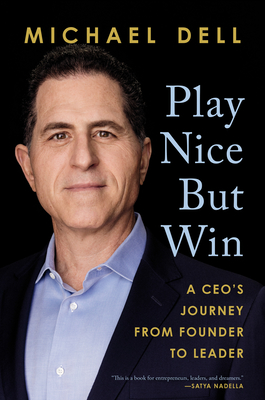
Play Nice But Win: A CEO's Journey from Founder to Leader
WALL STREET JOURNAL BESTSELLER
From Michael Dell, renowned founder and chief executive of one of America's largest technology companies, the inside story of the battles that defined him as a leader
In 1984, soon-to-be college dropout Michael Dell hid signs of his fledgling PC business in the bathroom of his University of Texas dorm room. Almost 30 years later, at the pinnacle of his success as founder and leader of Dell Technologies, he found himself embroiled in a battle for his company's survival. What he'd do next could ensure its legacy--or destroy it completely.
Play Nice But Win is a riveting account of the three battles waged for Dell Technologies: one to launch it, one to keep it, and one to transform it. For the first time, Dell reveals the highs and lows of the company's evolution amidst a rapidly changing industry--and his own, as he matured into the CEO it needed. With humor and humility, he recalls the mentors who showed him how to turn his passion into a business; the competitors who became friends, foes, or both; and the sharks that circled, looking for weakness. What emerges is the long-term vision underpinning his success: that technology is ultimately about people and their potential.
More than an honest portrait of a leader at a crossroads, Play Nice But Win is a survival story proving that while anyone with technological insight and entrepreneurial zeal might build something great--it takes a leader to build something that lasts.
From Michael Dell, renowned founder and chief executive of one of America's largest technology companies, the inside story of the battles that defined him as a leader
In 1984, soon-to-be college dropout Michael Dell hid signs of his fledgling PC business in the bathroom of his University of Texas dorm room. Almost 30 years later, at the pinnacle of his success as founder and leader of Dell Technologies, he found himself embroiled in a battle for his company's survival. What he'd do next could ensure its legacy--or destroy it completely.
Play Nice But Win is a riveting account of the three battles waged for Dell Technologies: one to launch it, one to keep it, and one to transform it. For the first time, Dell reveals the highs and lows of the company's evolution amidst a rapidly changing industry--and his own, as he matured into the CEO it needed. With humor and humility, he recalls the mentors who showed him how to turn his passion into a business; the competitors who became friends, foes, or both; and the sharks that circled, looking for weakness. What emerges is the long-term vision underpinning his success: that technology is ultimately about people and their potential.
More than an honest portrait of a leader at a crossroads, Play Nice But Win is a survival story proving that while anyone with technological insight and entrepreneurial zeal might build something great--it takes a leader to build something that lasts.
336 pages, Hardcover
Published October 5, 2021
Ratings & Reviews
Friends & Following
Create a free account to discover what your friends think of this book!
Community Reviews
Displaying 1 - 30 of 220 reviews

January 8, 2025
I came across this book on a website that listed it as one of the best business books.
I like the title Play Nice But Win—it’s simple yet impactful.
The phrase "Play fair in business but don't shy away from competing to win" perfectly captures the essence of the book.
This book is a blend of personal memoir and business wisdom, offering valuable lessons for aspiring entrepreneurs, leaders, and anyone curious about the story behind one of the world’s leading tech companies.
Michael Dell's journey in building Dell Technologies is a testament to the power of hard work, perseverance, and a relentless pursuit of excellence.
I learned a lot about effective business practices from this book. 🧐
Have you used a Dell computer before? 💻🖥
I like the title Play Nice But Win—it’s simple yet impactful.
The phrase "Play fair in business but don't shy away from competing to win" perfectly captures the essence of the book.
This book is a blend of personal memoir and business wisdom, offering valuable lessons for aspiring entrepreneurs, leaders, and anyone curious about the story behind one of the world’s leading tech companies.
Michael Dell's journey in building Dell Technologies is a testament to the power of hard work, perseverance, and a relentless pursuit of excellence.
I learned a lot about effective business practices from this book. 🧐
Have you used a Dell computer before? 💻🖥

October 6, 2021
This is a very detailed description of Dell's journey to going private in 2013 and public in 2019, alongside the founder's own story, and the story of how Dell was born.
Unlike other business memoires of the same ilk, such as the biographical accounts of Steve Jobs or the autobiography of Phil Knight, there's a lack of introspection in Michael Dell's accounts of his life. He relishes in the opportunity to retell stories of how he humiliated his teachers with his intelligence and money-making, and jumps from achievement to achievement, without pausing to think why he was driven to making money at such a young age, despite being from an affluent family, and whether it had harmful effects on his life and those around him. The constant assertions of his brilliance in entrepreneurship and computer science don't make you feel that he's brilliant, but only that he really wants you to believe he is. After a while, you find yourself doing the introspection for him: "why does he need my validation so much," you may find yourself asking.
While the tone of the book attempts to project an air of nonchalance, annoyed by everyone's constant and manipulative attempts to get near him, you end up finishing the book feeling as though Michael Dell is someone that struggles to see the hurt he brings to others. I also began to doubt the integrity of the stories told, as such self-glorifying accounts rarely tell the story as it really happened. Phil Knight's Shoe Dog is on another planet compared to this account, where you witness him grow and change as a person and a businessman. Michael Dell projects himself as a natural prodigy, emerging as a highly successful businessman immediately from pre-teens. There's no growth, no development as a person, and no introspection on what that means. The obstacles are against him, not within him, and the problem is everyone else's.
Unlike other business memoires of the same ilk, such as the biographical accounts of Steve Jobs or the autobiography of Phil Knight, there's a lack of introspection in Michael Dell's accounts of his life. He relishes in the opportunity to retell stories of how he humiliated his teachers with his intelligence and money-making, and jumps from achievement to achievement, without pausing to think why he was driven to making money at such a young age, despite being from an affluent family, and whether it had harmful effects on his life and those around him. The constant assertions of his brilliance in entrepreneurship and computer science don't make you feel that he's brilliant, but only that he really wants you to believe he is. After a while, you find yourself doing the introspection for him: "why does he need my validation so much," you may find yourself asking.
While the tone of the book attempts to project an air of nonchalance, annoyed by everyone's constant and manipulative attempts to get near him, you end up finishing the book feeling as though Michael Dell is someone that struggles to see the hurt he brings to others. I also began to doubt the integrity of the stories told, as such self-glorifying accounts rarely tell the story as it really happened. Phil Knight's Shoe Dog is on another planet compared to this account, where you witness him grow and change as a person and a businessman. Michael Dell projects himself as a natural prodigy, emerging as a highly successful businessman immediately from pre-teens. There's no growth, no development as a person, and no introspection on what that means. The obstacles are against him, not within him, and the problem is everyone else's.

December 1, 2021
Someone has recommended me M.Dell's story as a "fascinating story about leadership".
Well, the only two words from that description I agree with are "story about".
It's a self-sugaring paean, where M.Dell - definitely an ultra-successful businessman - tries to add some mythology to the history of himself and his company. Probably to put him in the same row with people who have sparked imaginations a bit more ... Well, it didn't work out.
As the story is rather boring and far from inspiring, he's jumping between the early days and two "dramatic" moments - going back private and acquisition of EMC. The problem is: those moments may be interesting only for people passionate about M&A ... All three of them. There's no big lesson there, no conclusions to draw from.
I mean - one doesn't have to be Musk, Jobs, or Bezos to become material for a good book. But such a book at least has to be realistic - filled not only with glory and triumph, but also mistakes, misshots, and lessons learned. This book is not a good learning experience.
Well, the only two words from that description I agree with are "story about".
It's a self-sugaring paean, where M.Dell - definitely an ultra-successful businessman - tries to add some mythology to the history of himself and his company. Probably to put him in the same row with people who have sparked imaginations a bit more ... Well, it didn't work out.
As the story is rather boring and far from inspiring, he's jumping between the early days and two "dramatic" moments - going back private and acquisition of EMC. The problem is: those moments may be interesting only for people passionate about M&A ... All three of them. There's no big lesson there, no conclusions to draw from.
I mean - one doesn't have to be Musk, Jobs, or Bezos to become material for a good book. But such a book at least has to be realistic - filled not only with glory and triumph, but also mistakes, misshots, and lessons learned. This book is not a good learning experience.

December 29, 2021
At the beginning of my career, I was charged with helping to decide which PCs my company would buy. I worked for a top oil company, so we bought a lot of PCs, and we chose PCs Limited. This was the early name of Dell Computers. Dell was a couple years younger than I was, so I always wanted to know how he started and grew his company. This book tells that story. He starts his story earlier, regaling the reader with his money making prowess in high school before selling computers. His early business stories are often about risks his company faced, like growing need for warehouse and factory space, personnel issues, money issues, and the like. Quite interesting to this buyer, and had I known some of these things were happening with the company, I wouldn’t have been so positive on the company early on.
I was intrigued by Dell stock early on. I remember having bought some shares in the early 90s, then asking a wiser co-worker what to do when they went up 30% in a couple of weeks. His suggestion – don’t be a pig, sell. I did. About 5 years later, at that co-worker’s retirement party, I told the story that I followed his advice and earned enough to buy a small desktop PC. But had I kept the shares for 5 years, I could have bought my house. Dell touches on the stock’s rise by mentioning his employees creating and wearing t-shirts that said “Dellionaires”. I toured Dell’s laptop factory and saw line workers wearing said shirts in the mid 90s.
I especially enjoyed learning the behind-the-scenes anecdotes about Dell’s various governance and financial engineering passes, taking the company private and buying EMC. I owned the tracking stock and read the various financial statements, and wondered at the time how Dell could engineer more money for his shareholders with each change. And it seems he did. This fills in some of the details missing from those financial statements. It’s not a riveting story, but I found it of interest.
I have read other reviewers who point out that there isn’t much reflection or growth described here. That is true. This is more like listening to Dell tell stories, mostly bragging. If you are in the mood for this, it’s pretty interesting.
I was intrigued by Dell stock early on. I remember having bought some shares in the early 90s, then asking a wiser co-worker what to do when they went up 30% in a couple of weeks. His suggestion – don’t be a pig, sell. I did. About 5 years later, at that co-worker’s retirement party, I told the story that I followed his advice and earned enough to buy a small desktop PC. But had I kept the shares for 5 years, I could have bought my house. Dell touches on the stock’s rise by mentioning his employees creating and wearing t-shirts that said “Dellionaires”. I toured Dell’s laptop factory and saw line workers wearing said shirts in the mid 90s.
I especially enjoyed learning the behind-the-scenes anecdotes about Dell’s various governance and financial engineering passes, taking the company private and buying EMC. I owned the tracking stock and read the various financial statements, and wondered at the time how Dell could engineer more money for his shareholders with each change. And it seems he did. This fills in some of the details missing from those financial statements. It’s not a riveting story, but I found it of interest.
I have read other reviewers who point out that there isn’t much reflection or growth described here. That is true. This is more like listening to Dell tell stories, mostly bragging. If you are in the mood for this, it’s pretty interesting.

November 25, 2025
I wanted to like this more than I did.
The business story is impressive. The hustle at the beginning is actually fun to read and i get the business acumen to build dell from nothing is incredible.
The bigger problem for me was leadership. When I read autobiographies, I usually walk away thinking, “This person figured out something real about leading people.” I didn’t get that here. He talks about leadership like it’s self-evident. For someone who built a company this big, I expected more reflection on the human side of scaling a business. That part felt thin.
The Carl Icahn rivalry takes up way too much space. Icahn tried to take Dell off the board. That battle clearly shaped him. But the way it’s told feels like a personal feud that he can’t quite let go of. At times he wants to sound detached and fair. Other times he throws shots at Icahn. It ping pongs. And him not being able to articulate his feelings clearly and positively in book that went through multiple edits and revisions I think is clear evidence that in real life Dell is is probably rabid about Icahn.
I read Bob Iger’s book right before this. The difference is wild. Iger talks about rivals and challenges with respect and perspective. Dell talks about rivals like he’s still in the fight and challenges like his brilliance solved them. The contrast makes Dell sound smaller than the company he built.
3/5 stars. Good business lessons. Not the leadership example I hoped for.
The business story is impressive. The hustle at the beginning is actually fun to read and i get the business acumen to build dell from nothing is incredible.
The bigger problem for me was leadership. When I read autobiographies, I usually walk away thinking, “This person figured out something real about leading people.” I didn’t get that here. He talks about leadership like it’s self-evident. For someone who built a company this big, I expected more reflection on the human side of scaling a business. That part felt thin.
The Carl Icahn rivalry takes up way too much space. Icahn tried to take Dell off the board. That battle clearly shaped him. But the way it’s told feels like a personal feud that he can’t quite let go of. At times he wants to sound detached and fair. Other times he throws shots at Icahn. It ping pongs. And him not being able to articulate his feelings clearly and positively in book that went through multiple edits and revisions I think is clear evidence that in real life Dell is is probably rabid about Icahn.
I read Bob Iger’s book right before this. The difference is wild. Iger talks about rivals and challenges with respect and perspective. Dell talks about rivals like he’s still in the fight and challenges like his brilliance solved them. The contrast makes Dell sound smaller than the company he built.
3/5 stars. Good business lessons. Not the leadership example I hoped for.

October 25, 2021
Second book by Michael Dell - very different in tone from the last one, which felt more like a biz textbook. This one feels a lot more like a memoir.
For tech geeks, there’s lots of thrills in seeing behind the scenes on Dell’s reactions to PC era tech twists. The notebook debacle and Dell’s journey in PC manufacturing were cool tech lessons. It’s insane how much evidence there already was in Dell’s abilities to transform from PC to server to services, but public markets didn’t seem to buy the story. Good examples of how companies think about transformational tech curves and how fast they react to them.
For non-tech biz types, the Dell going private story is brilliant and mind-boggling. Lead villain in that story is played by Carl Icahn, the corporate raider who seems to be the twin of Trump, media darling spreading misinformation. But also, the behind-the-scenes story of the Dell+EMC merger is fascinating. I had to refer investopedia a few times to understand the nuances of debt types and tracking stocks. The scale is massive, this merger still being the largest pure tech acquisition in software history.
Michael Dell has a reputation of being humble, fair and a very grounded leader. But the book comes off a bit harsh in many places where he passes down judgments and seems to lack in self reflection. The editing likely could have toned down some of the sharp edges.
All that said, gotta say founder led companies just have a higher bar of vision and boldness. Michael Dell is indefatigable, has remarkable risk-taking ability and a fighting spirit!
For tech geeks, there’s lots of thrills in seeing behind the scenes on Dell’s reactions to PC era tech twists. The notebook debacle and Dell’s journey in PC manufacturing were cool tech lessons. It’s insane how much evidence there already was in Dell’s abilities to transform from PC to server to services, but public markets didn’t seem to buy the story. Good examples of how companies think about transformational tech curves and how fast they react to them.
For non-tech biz types, the Dell going private story is brilliant and mind-boggling. Lead villain in that story is played by Carl Icahn, the corporate raider who seems to be the twin of Trump, media darling spreading misinformation. But also, the behind-the-scenes story of the Dell+EMC merger is fascinating. I had to refer investopedia a few times to understand the nuances of debt types and tracking stocks. The scale is massive, this merger still being the largest pure tech acquisition in software history.
Michael Dell has a reputation of being humble, fair and a very grounded leader. But the book comes off a bit harsh in many places where he passes down judgments and seems to lack in self reflection. The editing likely could have toned down some of the sharp edges.
All that said, gotta say founder led companies just have a higher bar of vision and boldness. Michael Dell is indefatigable, has remarkable risk-taking ability and a fighting spirit!

October 13, 2021
It's a fascinating story of his evolution from a teen wunderkind defying his parents to put together his fledgeling startup, to a mature leader making huge bets on the future of the technology industry and market as a whole. Use of analepsis, in my view, made it a more compelling read. As the various crisis points in the story are brought forth, it's clear that his history and principles guide Dell Technologies in the new challenges it faced. Whether it was the above board handling of the go private transaction, which was uncomfortable for Michael, but ultimately saved the deal when it faced litigation, or keeping his word to honor the legacy of the EMC founders, principles mattered and principles paid a dividend. A few themes emerge, but one of the biggest is that skulduggery is short term profitable and long term fruitless. Doing business with integrity, ensuring everyone wins, is its own reward. Michael is an autodidact whose curiosity ends up being the engine of transformation for the company. From not having a good sense of his cash position in the early days, to use of more sophisticated tools (such as a tracking stock), the evolution is interesting to read. The book is full of interesting nuggets on grit, talent acquisition, retention, sales (interesting that Michael still meets with customers), innovation and a good primer on corporate finance. It's a recommended read for anyone in business / technology.
November 29, 2021
Was disappointed that there weren’t more insider stories or lessons in this book about taking Dell private and the merger with EMC. I felt like I didn’t really learn anything new and it was just an opportunity for Michael Dell to tell about his successes over Carl Icahn and Meg Whitman
May 28, 2026
Audiobook, do so thoroughly appreciate when someone reads their own book in the first person for some reason

May 28, 2022
Phenomenal story told by a better storyteller. Highly recommend!

November 13, 2022
Reading through this I can't help wondering what he's leaving out.
While I'll buy that he made 18,000 during a summer working for a local paper (I don't doubt he's a genius at business), the whole spiel about how, due to the freedom of information act, he knew he could get this-or-that information, seems odd. People don't tend to just know about the FOI act, especially a high-schooler back in the 80s with no relatives in the legal profession. But maybe I'm just picking nits.
Another odd point is when his parents are dead against his taking a leave from school to pursue his business, which is apparently already making 30K a *month* (in the 80s!). I don't know many parents who had been so supportive while he was a child who wouldn't at least entertain the fact that this might be a good path to follow.
Anyway, otherwise it's interesting to read a general history of Dell. He keeps alternating history with his efforts in taking the company private, which was also quite interesting, mainly because of Carl Icahn's efforts to derail everything.
While I'll buy that he made 18,000 during a summer working for a local paper (I don't doubt he's a genius at business), the whole spiel about how, due to the freedom of information act, he knew he could get this-or-that information, seems odd. People don't tend to just know about the FOI act, especially a high-schooler back in the 80s with no relatives in the legal profession. But maybe I'm just picking nits.
Another odd point is when his parents are dead against his taking a leave from school to pursue his business, which is apparently already making 30K a *month* (in the 80s!). I don't know many parents who had been so supportive while he was a child who wouldn't at least entertain the fact that this might be a good path to follow.
Anyway, otherwise it's interesting to read a general history of Dell. He keeps alternating history with his efforts in taking the company private, which was also quite interesting, mainly because of Carl Icahn's efforts to derail everything.

October 9, 2021
There are two things I liked about this book: 1/ the behind-the-scenes story of how Michael Dell took his company private and then public again. Through this story, readers may learn a bit about M&A and corporate governance. 2/ His candid opinion of Carl Icahn. There must have been some bad blood for the author to end a chapter in which he emerged victorious from a battle against Carl Icahn with a parting thought on how the great Carl Icahn underperformed the S&P500.
The rest of the book, in my opinion, is more about how awesome he is, and less about how he made mistakes or grew as a person or a businessman.
The rest of the book, in my opinion, is more about how awesome he is, and less about how he made mistakes or grew as a person or a businessman.

October 11, 2021
Too many chapters about how much he hates Carl Icahn. It felt very weird to weave these chapters in between the chronological journey. I enjoyed much of this book though!
January 30, 2023
Dell, the founder and CEO of Dell Technologies, takes readers on a journey through his own experiences as a leader, detailing the challenges and triumphs he faced as he built his company into one of the most successful in the world.
Dell's writing style is engaging and easy to follow, making the book accessible to both business and tech enthusiasts. He shares valuable lessons he learned along the way, including the importance of having a clear vision, the power of persistence, and the need to adapt and evolve as the market changes.
One of the most interesting aspects of the book is Dell's honest and candid account of the ups and downs of building a company. He shares the struggles he faced and the mistakes he made, and how he overcame them. This makes the book relatable and inspiring for anyone looking to start or grow their own business.
Dell also provides valuable insights into the importance of building a strong team and fostering a culture of innovation and collaboration. He emphasizes the importance of "playing nice" with others and building strong relationships, even in the face of fierce competition. He also provides practical advice for leaders looking to build and scale a successful business.
The book is not only a great read for entrepreneurs and business leaders but also for anyone who is interested in learning about the technology industry and its evolution over the past few decades. Dell's story is inspiring, and his insights and advice will be invaluable for anyone who wants to start and grow a successful business. Overall, "Play Nice But Win" is a valuable and well-written book that provides a unique perspective on the leadership and business strategies that have helped Dell Technologies become one of the most successful companies in the world.
Dell's writing style is engaging and easy to follow, making the book accessible to both business and tech enthusiasts. He shares valuable lessons he learned along the way, including the importance of having a clear vision, the power of persistence, and the need to adapt and evolve as the market changes.
One of the most interesting aspects of the book is Dell's honest and candid account of the ups and downs of building a company. He shares the struggles he faced and the mistakes he made, and how he overcame them. This makes the book relatable and inspiring for anyone looking to start or grow their own business.
Dell also provides valuable insights into the importance of building a strong team and fostering a culture of innovation and collaboration. He emphasizes the importance of "playing nice" with others and building strong relationships, even in the face of fierce competition. He also provides practical advice for leaders looking to build and scale a successful business.
The book is not only a great read for entrepreneurs and business leaders but also for anyone who is interested in learning about the technology industry and its evolution over the past few decades. Dell's story is inspiring, and his insights and advice will be invaluable for anyone who wants to start and grow a successful business. Overall, "Play Nice But Win" is a valuable and well-written book that provides a unique perspective on the leadership and business strategies that have helped Dell Technologies become one of the most successful companies in the world.

April 16, 2022
Play Nice But Win - Book Review
One of the best business books I've read (Just completed yesterday). A must buy, must-read. WHY?
It's GENUINE! No bragging inside (except the last 20 pages), no "Gyaan-Patti" (Mumbaiyaa language for giving unnecessary wisdom), no 'evangelising' or "visioning etc.
It's about more PAIN than Gain. The life of Michael Dell is full of struggles and wins, but this book really focuses on the effort, hard work and sheet pain on the road to super glory.
A REALITY check for those dreaming of 'BIG" outcomes. Maybe after reading this book, you will wonder if it is worth it!
A deep insight into WHY Companies should NOT go public or IPO. (Dell starts private, then goes public, then goes private and then again goes public as lucidly narrated in this book)
The not so nice run-ins with Carl Icahn (My Idol)
Super nuggets, information, trivia, knowledge inside:
The challenging part of trying to EXPLAIN a changing business model to the world :
“We’re really not a PC company anymore,” I told Fortune editor in chief Andy Serwer in July 2012, at Fortune’s Brainstorm Tech conference in Aspen. But Andy was a tough sell. “Is it really the case that you’re not a PC company now or that you don’t want to be a PC company in the future?” he asked me.
How it all began and the genius of 'customising' PCs that made Dell - Dell!
One doctor called and said he wanted to buy an IBM PC for me to customize; what model should he get? I told him not to bother—I’d buy the computer, put in everything he needed, and sell it to him at a reasonable markup. That sounded fine to him. So I bought a new PC, ordered the parts I needed from the back pages of Byte, installed them, and delivered the doctor a Michael Dell Special. He was very pleased, and so was I. Then it happened again. And again. Suddenly I was in business.
"In plain English: all possibilities were on the table. Including staying public—and including the possibility of replacing me."
Taking hard criticism "CNN: "Critics say Michael Dell isn't much of an innovator, so he'll never turn Dell into the next Apple or Samsung."
I'd been happily working sixteen-hour days, eating at the office, sleeping at the office. My work was my life; my company was my second family.
Anyone who says you can start a company and have work-life balance is lying. Was there something off about this? I had an enormous desire to succeed, but I was human, and I knew something was missing from my life. Still, there didn’t seem to be much I could do about it.
"Persistence is an all-important quality on the road to success. (And success presents its own challenges, avoiding complacency being the first and biggest. Which is why, along with kaizen, PBNS—pleased but never satisfied—has been part of our culture since the beginning.)."
Once when someone asked Steve Jobs what he thought of Compaq’s portables, he said, “Well, they make great plastic and handles.”
The interesting equity instrument called the "Tracking Stock."
Get the book!
One of the best business books I've read (Just completed yesterday). A must buy, must-read. WHY?
It's GENUINE! No bragging inside (except the last 20 pages), no "Gyaan-Patti" (Mumbaiyaa language for giving unnecessary wisdom), no 'evangelising' or "visioning etc.
It's about more PAIN than Gain. The life of Michael Dell is full of struggles and wins, but this book really focuses on the effort, hard work and sheet pain on the road to super glory.
A REALITY check for those dreaming of 'BIG" outcomes. Maybe after reading this book, you will wonder if it is worth it!
A deep insight into WHY Companies should NOT go public or IPO. (Dell starts private, then goes public, then goes private and then again goes public as lucidly narrated in this book)
The not so nice run-ins with Carl Icahn (My Idol)
Super nuggets, information, trivia, knowledge inside:
The challenging part of trying to EXPLAIN a changing business model to the world :
“We’re really not a PC company anymore,” I told Fortune editor in chief Andy Serwer in July 2012, at Fortune’s Brainstorm Tech conference in Aspen. But Andy was a tough sell. “Is it really the case that you’re not a PC company now or that you don’t want to be a PC company in the future?” he asked me.
How it all began and the genius of 'customising' PCs that made Dell - Dell!
One doctor called and said he wanted to buy an IBM PC for me to customize; what model should he get? I told him not to bother—I’d buy the computer, put in everything he needed, and sell it to him at a reasonable markup. That sounded fine to him. So I bought a new PC, ordered the parts I needed from the back pages of Byte, installed them, and delivered the doctor a Michael Dell Special. He was very pleased, and so was I. Then it happened again. And again. Suddenly I was in business.
"In plain English: all possibilities were on the table. Including staying public—and including the possibility of replacing me."
Taking hard criticism "CNN: "Critics say Michael Dell isn't much of an innovator, so he'll never turn Dell into the next Apple or Samsung."
I'd been happily working sixteen-hour days, eating at the office, sleeping at the office. My work was my life; my company was my second family.
Anyone who says you can start a company and have work-life balance is lying. Was there something off about this? I had an enormous desire to succeed, but I was human, and I knew something was missing from my life. Still, there didn’t seem to be much I could do about it.
"Persistence is an all-important quality on the road to success. (And success presents its own challenges, avoiding complacency being the first and biggest. Which is why, along with kaizen, PBNS—pleased but never satisfied—has been part of our culture since the beginning.)."
Once when someone asked Steve Jobs what he thought of Compaq’s portables, he said, “Well, they make great plastic and handles.”
The interesting equity instrument called the "Tracking Stock."
Get the book!

January 15, 2022
prioritizing profit over growth and share, and a company’s success is always a balance between those three.
There are very stringent rules about when and how an insider like me can buy or sell our stock: soon, but not too soon, after quarterly earnings have been announced.
He struck me as very smart, aggressive, and bold.
if your company has a lot of cash, its equity can’t appreciate nearly as much because in a sense it’s weighed down by the cash. Cash doesn’t appreciate. If, on the other hand, you use the cash to buy back stock, the stock can appreciate far more.
That the fundamental reason for my desire to explore a proposal to acquire the company was that I believed Dell could be better managed as a private company without public-company pressures for short-term performance and the other disadvantages of being public. (Changing and evolving a business—transforming it—is an uncertain process, one that involves financial volatility. And public investors don’t like uncertainty or volatility.)
When my mom and dad talked, it wasn’t gossip or chitchat. They were constantly discussing the economy: What was the Federal Reserve doing? Where were oil prices and interest rates and currencies and the stock market? We had Forbes and Fortune and Barron’s in the house; we used to love watching Louis Rukeyser’s Wall Street Week. Even before my mom started working as a stockbroker, she had these huge Value Line books, with pages and pages of information on individual companies.
my family and I were driving along Loop 610, I would look out the window at all the shiny new buildings with flagpoles in front and think to myself that one day I would have a company and be in charge and have flagpoles in front.
my heroes became businesspeople, especially entrepreneurs who’d challenged the status quo and built businesses out of nothing—people like Charles Schwab, Fred Smith (FedEx), Ted Turner, and William McGowan (MCI).
How did a thirteen-year-old happen to have that kind of money lying around? Entrepreneurship was the air my family breathed.
For my fourteenth birthday I was allowed to take almost thirteen hundred dollars of my hardearned savings out of the bank and order an Apple II. took it to my bedroom, unboxed the beautiful computer—it even smelled beautiful—and immediately took it apart to see how it worked. My parents were horrified. And furious. But (I thought but didn’t say) how could you understand it if you didn’t take it apart? Assembled or disassembled, the Apple II was a beautiful thing.
Word got around that I knew a thing or two about computers. I soon began tutoring kids in the neighborhood on how to get the most out of their Apple IIs. That became a pretty lucrative sideline.
the Apple III, which promised to be to the Apple II what the Apple II had been to the Apple I.
I’d already learned how to program in machine language, which is like talking directly to the microprocessor and is a pretty complicated process.
I now had my driver’s license, which expanded my horizons dramatically.
(now-defunct) Houston Post, calling random people on the phone and trying to talk them into getting the paper.
-I observed three things: first, that if you sounded like the people you were trying to sell a subscription to, they were much more likely to buy from you.
-The second thing I noticed was that people who were moving into a new residence were more likely to subscribe to the paper.
And the third thing I observed, kind of a corollary of the second, was that people who were getting married were much more likely to buy a subscription—maybe out of some kind of excitement at settling down and beginning grown-up life.
In Texas, when you want to get a marriage license you have to go to the county courthouse to apply, giving the address you want the license sent to. And I figured out that under the Freedom of Information Act (FOIA), I, as a fellow Texas citizen, was entitled to go to any county courthouse in the state and say, “I want to see all the marriage license applications you received during the past year.”
In one stroke I had gone from the hit-or-miss of cold-calling to discovering a gold mine of people who were way more likely than not to subscribe to the paper.
And then it hit me that there were sixteen counties surrounding Houston, they all had courthouses, and every courthouse had records of marriage applications. Jackpot times sixteen.
and then I conducted a massive direct-mail campaign, sending subscription offers to every young married couple on that huge list.
I would go to these places and say, “I’m from the Houston Post, and we’ve got this great offer where all your new residents can get the paper free for two weeks. Just fill out this little form.” Between all the young marrieds and the new apartment dwellers, I made a little over $18,000 that summer.
fantasy games—Wizards and Warlocks stuff
A super-nice guy, forty or so, and extremely knowledgeable.
The board has duties to the shareholders; the CEO reports to the board. The board sets the CEO’s salary, oversees his or her activities; the board has the power to fire him or her.
competitors who stir up FUD— fear, uncertainty, and doubt—about your company.
When you take a company private, you’re basically putting it up for sale. with one or more private equity firms: whoever would offer the highest price to our shareholders.
There are very stringent rules about when and how an insider like me can buy or sell our stock: soon, but not too soon, after quarterly earnings have been announced.
He struck me as very smart, aggressive, and bold.
if your company has a lot of cash, its equity can’t appreciate nearly as much because in a sense it’s weighed down by the cash. Cash doesn’t appreciate. If, on the other hand, you use the cash to buy back stock, the stock can appreciate far more.
That the fundamental reason for my desire to explore a proposal to acquire the company was that I believed Dell could be better managed as a private company without public-company pressures for short-term performance and the other disadvantages of being public. (Changing and evolving a business—transforming it—is an uncertain process, one that involves financial volatility. And public investors don’t like uncertainty or volatility.)
When my mom and dad talked, it wasn’t gossip or chitchat. They were constantly discussing the economy: What was the Federal Reserve doing? Where were oil prices and interest rates and currencies and the stock market? We had Forbes and Fortune and Barron’s in the house; we used to love watching Louis Rukeyser’s Wall Street Week. Even before my mom started working as a stockbroker, she had these huge Value Line books, with pages and pages of information on individual companies.
my family and I were driving along Loop 610, I would look out the window at all the shiny new buildings with flagpoles in front and think to myself that one day I would have a company and be in charge and have flagpoles in front.
my heroes became businesspeople, especially entrepreneurs who’d challenged the status quo and built businesses out of nothing—people like Charles Schwab, Fred Smith (FedEx), Ted Turner, and William McGowan (MCI).
How did a thirteen-year-old happen to have that kind of money lying around? Entrepreneurship was the air my family breathed.
For my fourteenth birthday I was allowed to take almost thirteen hundred dollars of my hardearned savings out of the bank and order an Apple II. took it to my bedroom, unboxed the beautiful computer—it even smelled beautiful—and immediately took it apart to see how it worked. My parents were horrified. And furious. But (I thought but didn’t say) how could you understand it if you didn’t take it apart? Assembled or disassembled, the Apple II was a beautiful thing.
Word got around that I knew a thing or two about computers. I soon began tutoring kids in the neighborhood on how to get the most out of their Apple IIs. That became a pretty lucrative sideline.
the Apple III, which promised to be to the Apple II what the Apple II had been to the Apple I.
I’d already learned how to program in machine language, which is like talking directly to the microprocessor and is a pretty complicated process.
I now had my driver’s license, which expanded my horizons dramatically.
(now-defunct) Houston Post, calling random people on the phone and trying to talk them into getting the paper.
-I observed three things: first, that if you sounded like the people you were trying to sell a subscription to, they were much more likely to buy from you.
-The second thing I noticed was that people who were moving into a new residence were more likely to subscribe to the paper.
And the third thing I observed, kind of a corollary of the second, was that people who were getting married were much more likely to buy a subscription—maybe out of some kind of excitement at settling down and beginning grown-up life.
In Texas, when you want to get a marriage license you have to go to the county courthouse to apply, giving the address you want the license sent to. And I figured out that under the Freedom of Information Act (FOIA), I, as a fellow Texas citizen, was entitled to go to any county courthouse in the state and say, “I want to see all the marriage license applications you received during the past year.”
In one stroke I had gone from the hit-or-miss of cold-calling to discovering a gold mine of people who were way more likely than not to subscribe to the paper.
And then it hit me that there were sixteen counties surrounding Houston, they all had courthouses, and every courthouse had records of marriage applications. Jackpot times sixteen.
and then I conducted a massive direct-mail campaign, sending subscription offers to every young married couple on that huge list.
I would go to these places and say, “I’m from the Houston Post, and we’ve got this great offer where all your new residents can get the paper free for two weeks. Just fill out this little form.” Between all the young marrieds and the new apartment dwellers, I made a little over $18,000 that summer.
fantasy games—Wizards and Warlocks stuff
A super-nice guy, forty or so, and extremely knowledgeable.
The board has duties to the shareholders; the CEO reports to the board. The board sets the CEO’s salary, oversees his or her activities; the board has the power to fire him or her.
competitors who stir up FUD— fear, uncertainty, and doubt—about your company.
When you take a company private, you’re basically putting it up for sale. with one or more private equity firms: whoever would offer the highest price to our shareholders.

April 17, 2024
This was a fascinating way to learn about a person and company, whose products I interact with multiple times each week. However, as the book progressed, it got very in the weeds of negotiations for various mergers and deals, whereas I was hoping this was more biography focused. The first part of the book was more focused on Michael’s growing up, which I greatly enjoyed. I’m glad I read it, but it wouldn’t be at the top of my recommendations list.

September 14, 2024
Esta testimonio de Michael Dell me pareció aburridísimo. El libro se siente monótono, ya que el autor pasa demasiadas páginas detallando el proceso de re-privatización de Dell y la lucha con Carl Icahn. Aunque el libro ofrece una mirada profunda a los retos corporativos de un CEO, el enfoque en este aspecto específico puede resultar tedioso para quienes busquen una narrativa más equilibrada sobre liderazgo y visión empresarial.
October 9, 2024
An engaging read that vividly illustrates how a young man’s passion for customizing computers laid the foundation for Dell’s rise to a global powerhouse. Michael Dell’s journey is both inspiring and insightful, as he defied his parents’ expectations to pursue his love for technology, ultimately creating one of America’s iconic companies. His intelligence and vision shine through his writing.

January 5, 2026
Solid memoir, Michael Dell was super ambitious and driven, always able to attract smarter people to help bring make his dream a reality. It was always the man in the arena.
“Goodbye to the legions of whiners, backseat drivers, curbside experts, rearview-mirror thinkers, and second-guessers” (190).
“Only when the tide goes out do you discover who’s been swimming naked.” -Warren Buffet
“Goodbye to the legions of whiners, backseat drivers, curbside experts, rearview-mirror thinkers, and second-guessers” (190).
“Only when the tide goes out do you discover who’s been swimming naked.” -Warren Buffet

November 5, 2022
A leader worth emulating. Humble yet confident. Determined yet patient. Persistent yet accepting. All the qualities people in senior positions must learn in order to succeed with dignity.
One of the best reads in a long while. I would just want to meet Mr. Dell and shake his hand!
One of the best reads in a long while. I would just want to meet Mr. Dell and shake his hand!

October 29, 2025
it’s always better when the author reads their own audio book.
michael dell now joins my short list of founders i admire and want to emulate with my life. top two so far are james dyson and michael dell.
michael dell now joins my short list of founders i admire and want to emulate with my life. top two so far are james dyson and michael dell.

June 20, 2026
Good, part about the start of Dell was exciting and I was pretty engaged.
Two man critiques. First, I did not enjoy the back & forth narrative in the first part of the book. I wish he just used a consistent timeline. Second, book felt way to finance focused. Like yeah it’s a business book but all that stuff went over my head and then I got a bit bored.
Glad I read it though, cool story of the company’s history.
Two man critiques. First, I did not enjoy the back & forth narrative in the first part of the book. I wish he just used a consistent timeline. Second, book felt way to finance focused. Like yeah it’s a business book but all that stuff went over my head and then I got a bit bored.
Glad I read it though, cool story of the company’s history.

October 11, 2021
As a team member on Michael's team at Dell Technologies ( full disclosure) I really appreciated the insight his telling of his own career journey brought to me. I really am looking to apply some of the approaches Micheal discussed in this book to better my work style approach, productivity, and even help improve my mental health! Thank you, Micheal!
I certainly recommend this book for anybody looking for inspiration in what it takes to be an effective leader.
I certainly recommend this book for anybody looking for inspiration in what it takes to be an effective leader.

November 16, 2021
Great book
Interesting and complete sequel of time periods from the beginning of the company to the present, Dell takes the reader in a smooth and easy way from page to page.
Interesting and complete sequel of time periods from the beginning of the company to the present, Dell takes the reader in a smooth and easy way from page to page.

April 2, 2026
Great story! Some of the going public stuff went over my head but solid read!
September 17, 2026
Honestly one of the best books I've ever read.

December 3, 2021
Definitely one of the best CEO / Leader books I have read. For me it is on par with Jack Welch’s Straight From the Gut, a high compliment. Play Nice But Win was real and humble and honest and optimistic. As a Dell employee myself, it was fun to learn more about the company history and to get into the mind of a great leader.

September 13, 2024
Fascinating business journey and the founder story is remarkable. Really loved the flash backs and fast forwards. The go private and public processes really interest me. ✌️Dell

December 15, 2021
A little bit work-y, but I still enjoyed it more than I expected.
Displaying 1 - 30 of 220 reviews