The revolutionary life of an 18th-century dwarf activist who was among the first to fight against slavery and animal cruelty.
Prophet Against Slavery is an action-packed chronicle of the remarkable and radical Benjamin Lay, based on the award-winning biography by Marcus Rediker that sparked the Quaker community to re-embrace Lay after 280 years of disownment. Graphic novelist David Lester brings the full scope of Lay's activism and ideas to life.
Born in 1682 to a humble Quaker family in Essex, England, Lay was a forceful and prescient visionary. Understanding the fundamental evil that slavery represented, he would unflinchingly use guerrilla theatre tactics and direct action to shame slave owners and traders in his community. The prejudice that Lay suffered as a dwarf and a hunchback, as well as his devout faith, informed his passion for human and animal liberation. Exhibiting stamina, fortitude, and integrity in the face of the cruelties practiced against what he called his "fellow creatures," he was often a lonely voice that spoke truth to power.
Lester's beautiful imagery and storytelling, accompanied by afterwords from Rediker and Paul Buhle, capture the radicalism, the humor, and the humanity of this truly modern figure. A testament to the impact each of us can make, Prophet Against Slavery brings Lay's prophetic vision to a new generation of young activists who today echo his call of 300 years ago: "No justice, no peace!"
David Lester is a painter, graphic designer, cartoonist, and the guitarist in the rock duo Mecca Normal. His graphic novel The Listener was a finalist for ForeWord Reviews' "2012 Book Of The Year Award" in the graphic novel category and was also selected as one of the best books of 2011, so far, by the School Library Journal (New York). His first book, The Gruesome Acts of Capitalism went into a revised second printing. He has created the poster series "Inspired Agitators," archived at The Center for the Study of Political Graphics in Los Angeles, and designed the popular t-shirt "Actually, I like crap." Lester also does a weekly illustration, with text by Mecca Normal bandmate Jean Smith, for Magnet Magazine. His comics appeared in Drippytown #4, Warburger (Slovinia) and Broken Pencil magazine. As well, his cartoons appeared regularly for a year in the San Diego Reader. Mecca Normal recorded an album in late 2012 with Kramer as producer. David is currently working on a graphic novel about Emma Goldman. He lives in Vancouver, Canada.
I RECEIVED A DRC FROM THE PUBLISHER VIA EDELWEISS+. THANK YOU.
My Review: In today's world, Benjamin Lay would be a firebrand and a demanding moral force. IMAGINE how he came across in the slave-owning times of the early eighteenth century. A dwarf...an iconoclast...an uncompromising, flinty, arrogantly sure of himself and his rightness, public speaker with a real gift for propaganda.
He would be literally inescapable in this media landscape.
We are the poorer for the absence of someone like him, taking on the horrors of international capitalism. The export of jobs has meant the export of problems like labor relations and environmental regulations, which no one can ever convince me was serendipity. Author and Artist Lester (The Listener and The Gruesome Acts of Capitalism are some of the other titles he's created) clearly understands the value of theater and public perception in the winning of the culture wars: He's got the entire subject of the Quaker dwarf with an outsider's grasp of the social and moral corruption around him in the economical monochrome of these spreads. Things *are* black-and-white when one reduces them to lines drawn in the sand. Using the palette he chose makes the starkness of Benjamin Lay's moral universe simply part of the experience of learning about him.
It is unsurprising that, in this twenty-first century of information overload, we're needing to learn about Benjamin Lay. His brand of vegan, animal-rights activism, his uncompromising adherence to his moral understanding of the world, reminds me of Greta Thunberg. Only louder. While he had less command of the broader public's attention than she does, he used his voice, his mind's single focus on The Greatest Good, and his unique viewpoint as she has. His unswerving opposition to slavery was so broad in its intellectual base that he refused to ride horses or eat slaughtered animals. In the eighteenth century.
After the Confederacy won the US Civil War in the courts, and gifted us with the Jim Crow laws and the voter suppression laws that they're succeeding in re-installing, the life of a man like Lay would've been deeply threatening to their agenda. A shining moral example? And one who took it to the extremes that Lay did...throwing fake blood on slave owners?! writing angry screeds filled with passion and yet based on reason?! blasphemy to the Capitalist Elite!...well, best to bury him again.
They did; it worked. I'd never heard of him before I was granted this graphic novel's DRC by Beacon Press, that monadnock of Unitarian probity in publishing. The graphic-novel format has never been my favorite among publishing choices. I'd say that, despite this one's five-star rating, it still isn't. I've also given the full five stars to Nationalist Love, and the same reason obtains here: The only effective tool to use in bringing this story to a broad audience is the one used here. There's no way most people would pick up an all-text biography of Benjamin Lay, eighteenth-century dwarf; marry it to this format, they're more likely give it a shot.
What Lay accomplished, in practical terms, was to change the hearts and minds of younger people...which is what the Ruling Elite did in the 1970s and 1980s with rampant consumerism and cheap, disposable goods. This long-buried story will make the effectiveness of that trick very obvious. Ray Bradbury, a true autodidact, famously said, "You don't have to burn books to destroy a culture. Just get people to stop reading them." The books by and about Benjamin Lay aren't widely read today, and there's a good reason for that: Their message is still resonant, and still damaging to the System's actions and inactions.
Before anyone says it to me, let me say now that I am no Benjamin Lay. I'm a meat-eating cheap-goods-buying 21st-century consumer. That does not make me insensible to the man's message; it merely means that my inner struggle, to reconcile the way I live with the way I understand the world, is apparently endless. It's never a comfortable place to be. I exist because modern exploitive capitalism created medicines that prevent me from dying. I eat because of factory farming and cheap electricity. I am not naked because the supply chain includes vast quantities of cotton goods. The chemical industry has gifted me power, shoes, soaps and shampoos and tooth-cleaning goop.
I am the problem Benjamin Lay railed against: I exist inside a system that requires others to be outside its benefits in order to function. He chose the morally superior course of opting out. He chose a lifetime of rejection and excoriation and outrage heaped upon him, in the name of standing up to be counted for his beliefs. I admit: I lack that courage.
That does not impair my ability to see his message and know its rightness. It makes me more willing to shout and point and wave my arms at this simple, beautiful expression of a simple, beautiful soul's purpose on this Earth. We can all aspire to be celebrated Home as was Benjamin Lay.
I have to admit that I didn’t love the art or the way this story was told, but I did like that it was being told. So my star rating is actually rounded up a bit as I’m grateful to have been introduced to a man who dedicated his life to speaking out about what he found wrong. Benjamin Lay was born a Quaker and when he realized the Quaker people were endorsing and supporting slavery he was appalled. He saw the tenants of their faith as clear that all people had value and greed should not corrupt. He wasn’t well received for much of his life, but he remained faithful to his beliefs and calling out those he saw as hypocritical. I hadn’t heard of Benjamin Lay, but I am glad I now have and that he can be remembered for all of his hard work for human rights.
I'm not particularly fond of the art or the script, but I'm rounding my rating up simply out of gratitude for being introduced to such a fascinating historical figure as Benjamin Lay. He was an activist, who was repeatedly "read out of Meeting" -- unfriended, that is, by the Religious Society of Friends, or Quakers -- for daring to call out their hypocrisy and sin for owning and trading slaves. From the early 1700s until his death in 1759, Lay would make speeches, perform attention-getting stunts, boycott goods produced by slave labor, and even have a book published by Benjamin Franklin, all to call attention to the humanity and suffering of slaves and demand the immediate abolition of their enslavement.
And his efforts helped to move the needle, with Quakers banning slave trade in his lifetime, banning the ownership of slaves amongst members in 1776, and becoming a force in the abolition movement leading up to the Civil War.
Also of note: this social justice warrior was a vegan who advocated against animal cruelty, stood all of four feet and seven inches, and doted on his wife.
I saw this graphic novel on the library’s website and later that day actually learned about the character online, albeit only as a brief mention, so it seems I had to go read the book. Because a. what are the odds and b. Lay was simply too wildly original and interesting of a character to only merit a few minutes worth of notice. A hunchbacked dwarf who stood only about four feet tall, Lay nevertheless cast a tall shadow. Propelled by a seal of devout faith and strong humane leanings, he was a Quaker who tirelessly advocated for abolition of slavery. Employing theatrics or rhetoric, he was determined to see his people, the Quakers, do away with what he considered to be an institutionalized abomination. And remarkably enough, he did. It took years and wasn’t easy, but eventually (and in no small way owning to Lay’s advocacy) the Quakers did indeed do away with slavery a long, long time before the rest of America followed the suit. Lay was a remarkable figure in many rights - a righteous man of principles who walked the walk, who produced his own food, abstained from meat and any sort of animal abuse in general, and practiced integrity he preached in all things. The man lived a surprisingly long life for the time and then ended up promptly forgotten by time. And this may be the best thing to come out of the current wave of historical revisions…the discovery of these genuinely authentic excellent and important characters who advocated for and caused real change. An admirable man, small in stature and large in spirit, Lay deserves to be known and remembered and I’m glad to have read this book. Since this is a graphic novel, it stands to mention the graphics, which here are quite unconventional. A starkly black and white imagery that puts on in mind of lithographs and etchings, it seems strongly suited for the story and the dynamics of it are absolutely fascinating in the way the artist depicts emotional states and actions. Very original. All in all, a quick read well worth checking out and an important historical person well worth learning about. Recommended.
On one level, this graphic novel has struck a spark in me to find out even more about its subject, Benjamin Lay, an 18th-century abolitionist Quaker. Born in England and raised in the Quaker religion, Lay challenges the hypocrisy of Quaker leadership who at the time still profited and made use of slaves. Throughout his life, he is chased out of Quaker communities and ends up in Pennsylvania. Continually dismissed for his ideas (and likely discrimination for his kyphosis--extreme-forward curving of the back), he challenges Quakers to align their beliefs with their actions. While he does not see the fruit of his labor, his lifetime of work and humble living (literally living in a cave on a vegetarian diet) inspires younger Quakers and has a lingering effect in many Quakers abandoning and rejecting the supposed necessity of slavery in the 1800s. The sketching linework coupled with some (black and white) watercoloring more often enhances the story, with the sketch work communicating action and emotion while the sections of watercolor capture dialogue and story progression. It's a powerful tale that will linger with readers because at the center of the story is the fact that people knew racialized slavery was inhuman and wrong and people at the time said it, but it still took generations for that change to happen. In the contemporary world, where folks seem to think we cannot hold the past to high standards (under the idea that they didn't know better), Lay's tale reminds us that they most certainly did know better but chose to do wrong instead. If the book has a drawback, it is that it can at times not provide enough clarity and detail. There are moments when gaps in years happen and it's unclear how Lay's story progresses in these gaps, so it can feel like we're only getting a part of the story. Still, that part of the story is enough to fuel interest in learning much more.
And today's pick is Prophets Against Slavery: Benjamin Lay by David Lester With Marcus Rediker (who wrote the book that this is a graphic novel adaption of) and Paul Buhle. This volume was published by Beacon Press in 2021. Unfortunately my library only has the digital edition. But we'll make it work.
Content notes for torture, chains, nudity and suicide.
While I would characterize the depiction of torture of both white quakers and enslaved Black people as more matter of fact then edgy, your milage may vary. It is certainly trying to make a point.
I picked this book up shortly after I started writing my review of Under the Banner of King Death Review both because I was pretty impressed with that book and because they are from the same creative team, plus the content for this volume sounded really intriguing.
Keywords that came to mind include: quakers, disability, morality and prophetic.
The publisher's summary is "The revolutionary life of an 18th-century dwarf activist who was among the first to fight against slavery and animal cruelty.
_Prophet Against Slavery_ is an action-packed chronicle of the remarkable and radical Benjamin Lay, based on the award-winning biography by Marcus Rediker that sparked the Quaker community to re-embrace Lay after 280 years of disownment. Graphic novelist David Lester brings the full scope of Lay's activism and ideas to life.
Born in 1682 to a humble Quaker family in Essex, England, Lay was a forceful and prescient visionary. Understanding the fundamental evil that slavery represented, he would unflinchingly use guerrilla theatre tactics and direct action to shame slave owners and traders in his community. The prejudice that Lay suffered as a dwarf and a hunchback, as well as his devout faith, informed his passion for human and animal liberation. Exhibiting stamina, fortitude, and integrity in the face of the cruelties practiced against what he called his "fellow creatures," he was often a lonely voice that spoke truth to power.
Lester's beautiful imagery and storytelling, accompanied by afterwords from Rediker and Paul Buhle, capture the radicalism, the humor, and the humanity of this truly modern figure. A testament to the impact each of us can make, _Prophet Against Slavery_ brings Lay's prophetic vision to a new generation of young activists who today echo his call of 300 years ago: "No justice, no peace!"
As I already highlighted, this is the second book by Lester, Rediker and Buhle that I'm reviewing this year so please check out the link to The Banner of King Death review to find out more about each of them.
Looking at the writing and art style I enjoyed both and feel like this creative team has demonstrated an above average skill at putting together graphic novels that are both highly political and very interesting and easy to read. This balance has proven difficult for many, so kudos. My only complaint is that this does veer close to alternative great men of history territory.
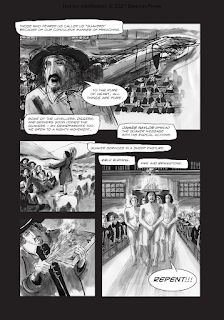
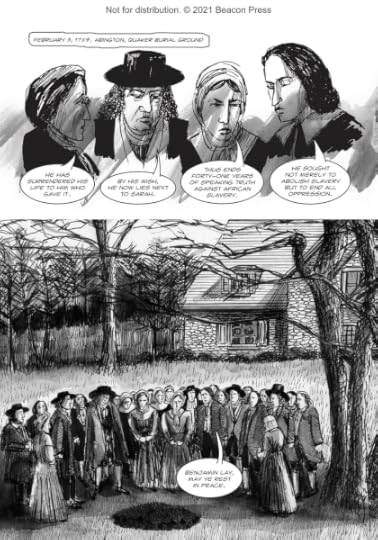
Page layouts were varied and Lester does a very nice job using pattern, the juxtaposition of different line qualities and visual metaphors.
Looking at the different identities and themes I like to look at in each of my reviews:
Race should come first because this book's narrative centers around the trans Atlantic slave trade that targeted Black Africans. That said, the eyes we are looking through are those of a white man who was also a quaker and a little person. This framing is not necessarily a problem in and of itself. Benjamin Lay is a striking figure and is an abolitionist even when his fellow quakers were not. That said, I (albeit as a white person myself) do think it would have been a good idea to work in more then one line and one action by Black people. Because as it stands, as I read this volume it felt like, despite the fact that Lay was initially inspired to abolition by the suicide of an enslaved person who refused to continue to allow themselves to be enslaved, Black people were almost exclusively objects that were acted upon rather then 3D characters that, among other things, talked and often fought for their own freedom.
Doing a bit of research it is fair to say that the majority of documented rebellions of Black slaves (sometimes in solidarity with poor white people and indigenous people) happened after Lay's life. Communication was not what it is now and news like this could have been suppressed. I'm not an expert. But I do think that it would have made the book better to figure out a way to provide the reader with this wider context, even if Lay was not aware of it.
I feel strongly about this because it wasn't until after I graduated university and started educating myself further that I fully appreciated that Black chattel enslavement didn't end because white people became more enlightened, but is largely due to many Black people through time and space taking their own emancipation into their own hands. Which not only changed my perspective on historical events, but also about the potential nature of future change. I probably could have explained that in a slightly more succinct way, but if you want to correct this issue for yourself I would recommend checking out Nat Turner by Kyle Baker, Run For It by Marcelo d’Salete and Maroon Comix_ Origins & Destinies.
Disability and ability also played a much larger role then average in this graphic novel. As I mentioned Benjamin Lay was a little person. The book, as you have likely already noted, uses the term Dwarf. Searching around the world wide web it didn't seem like the most favored term but also maybe not a slur either? Very big question mark. Definitely don't take that as a statement of any kind of authority. Also, some of the racial terms also felt similarly dated...
Anyway, Benjamin's condition certainly combines with his other identities to present a very unique and striking figure of history. I appreciated how the volume did highlight that people accused Lay of being "cracked in the head" for being an abolitionist. It reminded me of a similar movement in white enslavers to characterize Black people's apatite for freedom as a mental illness.
Overall, I thought that Prophets Against Slavery did a pretty good job of depicting the unique collection of struggles and strengths that kept our protagonist ticking.
An aspect of identity that doesn't always come up in any review is that of religious identity. With Lay's identity as a quaker being an outsized motivational factor. And while many quakers were abolitionists, that was not the case for Lay's community and he felt this was hypocritical because quakers were a christian sect that had faced a lot of persecution back in England and were supposed to see their fellow humans as equals.
In addition to apposing slavery, Lay did not wear woolen garments and became a vegetarian.
There is also some mention of the lollards, levelers and the diggers. A selection of other interesting subversive English uprisings. My notes also include a line "But they are protestant lol". Which I don't exactly remember writing down but I assume it had more my own anti-protestant biases and not Lay's? And of course not all protestants, but good heavens.
Overlapping religiousness with the only sexuality represented. Lay married Sarah Smith Lay who apparently shared his short stature but was perceived by the community as much more quiet and pious. It even sounds like the quacker community recognized her as having been blessed by the spirit to be a minister of the gospel.
Neither cis gender or any other sort of gender was very much explored in this volume perhaps unsurprisingly.
Class had a bit of a passing representation since Lay was much poorer then the rich enslavers he was critiquing.
Place was mentioned as Lay moved around but I didn't come away feeling like it was particularly developed.
Wrapping things up. A lot to chew on, which is always fun. Not as good as Under The Banner of King Death, but that only means they are on an upward trajectory. Four stars.
I hadn’t heard about Benjamin Lay until this year, and this was a quick way to learn about his life as an outspoken Quaker abolitionist before Quakers got on board with abolitionism, decades before. He was excommunicated from four different Quaker meetings for speaking out against slavery. He wasn’t afraid to get in people’s faces and call out the rich and powerful on their hypocrisy.
I’m glad to know more about this incredible man, and I enjoyed the pencil sketch style of the artwork. The afterword was worth reading, as well as the commentary on the artist, David Lester, and the thought process behind his artistic choices. Lay’s dwarfism is portrayed visually and through a few comments without making the book more about that than what he accomplished.
The downside for me was the dialogue, which didn’t sound so much like dialogue as it did different characters (including Lay) telling each other about/commenting on the events of Lay’s life. There wasn’t a lot of natural flow to it, and I found that distracting. It’s a good read for its educational value and the artwork.
Great graphic elements and also good oportunity to know more about this man, who was incredibly ahead of his time, antiracist, pro gender equality and vegan Benjamin Lay.
Prophet Against Slavery is a fantastic graphic novel and historical biography, written and illustrated by David Lester. I had not heard of Benjamin Lay before reading this, which is slightly embarrassing to admit, given how singular his presence appears in the early abolitionist movement against American slavery.
Benjamin Lay was an Anglophone Quaker residing in Pennsylvania during the early 18th-century. The provocativeness of his theatrical approach to abolition was matched only by the uniqueness of his physical appearance. Lay - who was described by his peers as a "hunchback" - most likely had the genetic malformation of dwarfism. However, what he lacked in stature, he made up for in moral courage and a staunch commitment to Christian virtue.
Indeed, Lay was revolutionary in nearly every way imaginable. He was one of the earliest public opponents of chattel slavery in the Americas, and he maintained this position well before most of his fellow Quakers, even. Moreover, Lay was a vocal proponent of animal liberation and he practiced veganism at a time when it was considered radical and extreme. His absolute commitment to the abolitionist cause put him at odds with practically everyone around him, often leading to ostracism, assaults, and charges of piety.
Yet, what struck me the most about Lay was the way in which his body informed his unique sense of personhood and his revolutionary politics. He represents an early example of the intersection between disability advocacy, slavery abolition, and animal rights. I have seen scholars make the connection between abolitionism and animal treatment elsewhere, and Lay certainly embodied that extension of moral consideration between the two domains. While it is an uncomfortable connection, and one that should be explored delicately, it is quite clear to me that the proprietary and sub-human status of 'cattle' shared a striking similarity with 'chattel' during the period in question. Whether it makes sense to interpret abolitionism as an outgrowth of the push for the humane treatment of animals, that I cannot say. However, it seems to me that the connection is valid, and one that is exemplified in the historical record through Lay’s political philosophy and social activism.
Social frictions and personal animosities were compounded by his physical deformities and eccentric behaviours, which bordered on guerrilla-style performance art. The trans-Atlantic historian, Marcus Rediker, offered an apt comparison between Lay and Diogenes the Cynic in the "Afterword". Apparently Lay was familiar with the Ancient Greeks and admired the more confrontational philosophers, such as the vagabond Diogenes, who imitated dogs and devoted himself to all things ironic and absurd. I must confess that I also share Lay's fondness for Diogenes, who, coincidentally, was sold into slavery himself.
If I can take issue with one element in Prophet Against Slavery, it would be the editor's decision to situate Rediker's comments at the very end of the book, rather than in a preface at the beginning. Paul Buhle's thoughts work quite well as after-thoughts, but Rediker's could have provided some much-needed historical context before jumping into the main text of the graphic novel. That's really my only gripe with this work.
Undoubtedly, Benjamin Lay was an historical figure worthy of moral praise. Not only did he act in a manner that was consistent with his beliefs, but he did so without restraint or compromise. Crucially, it must be noted that his beliefs were also righteous and true. The bravery required to stand firm amidst a wealth of moral bankruptcy and human atrocity is, quite simply, amazing. His legacy is a wonderful example of the power of applied ethics and the steadfast commitment to virtue, love, and equality.
I received a free copy of this via Goodreads Giveaways.
While a bit confusing at times due to scene/time jumps, this was really powerful. It's made me quite scared to see how history repeats itself, but reminds me to be more like Benjamin Lay.
"Must I shock you into awareness of your own moral failings?"
Beautiful artwork and powerful imagery, but the the way the narrative is told leaves a lot to be desired. Would’ve worked okay as an animated short with fade to black moments, but as a reading experience very odd and not great narrative choice.
I was familiar with Benjamin Lay before reading this, but only loosely. I knew he was a person with dwarfism, a Quaker, and an early abolitionist. I love a good graphic novel history, so I figured this would be a great way to be further introduced to him. I'm glad I gave it a read.
Benjamin Lay was a fascinating figure, one we should all aspire to emulate, and it's truly a shame we don't all know more about him. He was an abolitionist at a time before Quakers were known for their abolition works, at a time when many Quakers were slavers. He was excommunicated from four separate Quaker communities for his beliefs and his activism against slavery. Lay was also a vegetarian and animal rights activist, boycotted all products produced by oppressed peoples (such as sugar or tea), and he believed in gender equality, race equality, and class equality. He lived a simple life in a cave with his hundreds of books and the wife he adored (the dream tbh). His story is one we all can learn from.
While the art style isn't my typical taste, I do think it suits this story well. I do wish the storytelling were more linear, as I think that in media res isn't ideal for a book as short as this one. I also wish it was longer. Still, it did an excellent job introducing Lay's incredible life and works.
I definitely recommend checking this one out. I hope I get the chance to read Marcus Rediker's biography of Lay after this as well, since I definitely want to learn more.
I loved the art of this graphic novel. The simple, black ink drawings, sometimes layered over one another, felt appropriate to the story of an 18th century Quaker abolitionist (before such a term existed). I imagine Benjamin Lay would appreciate not being rendered in anything that looks lush and soft or ornate and colourful.
Reading that the artist was inspired in part by woodcut artists like Lynd Ward didn’t surprise me because many of the drawings evoked that sense of simple lines of carved out light.
The relative size of characters and the looseness of the drawings gave a sense of movement and emotion—which is good because the text felt a little dry to me.
There was a ton of exposition that made the novel feel more concerned with informing the reader about Benjamin Lay than telling a story. It’s not a long read, and I was intrigued by this man who I had never heard of before, but I was not taken by the prose.
I have read that the modern image of Quakers as calm pacifists and the face of oatmeal hides how militant they could be in their protests and public statements in the 17th and 18th centuries.
In spite of not loving the text, I would still recommend the graphic novel. I was moved to learn about this man, fighting against the supposed norms of his time and speaking truth to power, even when it cost him dearly. And perhaps rightly, ashamed of the ways I turn my face away from the modern injustices of our global economy because it is so very easy to do so
I had to read this for a class but it’s really nice knowing that back In the day people were fighting for human rights. Especially people facing deep and harsh pressures from society because of their differences. The visual imagery is haunting and gruesome but needed to tell the tale of how harsh slavery was and the hypocrisy that these individuals faced. I really appreciated this graphic novel and to all the people that fought for the rights of humans even when it felt like their efforts didn’t work.
Very neat way to learn about a man who paved the way for future abolitionists. I'd never heard of Benjamin Lay until this graphic novel, & I highly recommend that anyone read to learn more about him.
The art style is interesting, but I believe it fits with the story being told.
I did not know the Quaker's history, nor did I know of the hero Benjamin Lay. It was an excellent book for a basic background but also a revelation on what a great man Benjamin was. I enjoyed this quick read.
I had never heard of Benjamin Lay but I was very impressed by the story of his perseverance in fighting against slavery in the Quaker church in the 1700s! 4 stars only because the art style wasn't my favorite but the note in the end explaining the artist's process was helpful.
Illustrasjonane er så som så, og ein del av forteljargrepa opplever eg som ganske platte. Men hovudpersonen og saka er interessante, så boka er verd å lesa for dei som vil ha ei rask innføring.
If it is possible; I would definitely want to see this graphic novel’s style done for Christian heroes William Wilberforce, John Brown, and Harriet Beecher Stowe
It is a shame that this man was 'lost to history' for so long. I believe they only touched on what he must have endured. Shame on those original, hypocritical Quakers! Thank you David Lester for embracing this project and bringing it to life for us, as readers :)
This is the story of Benjamin Lay. An early-18th century anti-slave campaigner. A surprisingly modern style of activist in many ways. He used confrontational 'happenings' to draw attention to the hypocrisy of Quaker slaveowners. He was banned from four separate Quaker congregations, which is something of a record, the last of which only undid the ban in 2018. A dwarf and a hunchback. An autodidact. He ended up living in a cave, with a front entrance built on to it, and a library of 200 books.
He was intersectional before that was a thing. He made his own clothes, to avoid contributing to both the slave economy and to avoid doing harm to animals. He was a believe in the equality of all humanity (and animals.) A vegetarian. He cut himself off as much as possible from the economic exploitation of other people.
He wrote "All Slave Keepers That keep the Innocent in Bondage, Apostates" in 1737, which was published by Benjamin Franklin with whom he became friends, although Franklin owned three slaves of his own. Lay wrote "With What Right?" In April 1757 to ask Franklin - and others - by what right they owned slaves.
He was, probably, a right royal pain in the arse but needed to be. He was almost entirely forgotten as the 18th century gave way to the 19th and until recently was a figure only of interest to specialist historians or as a footnote to the stories of people like Franklin.
Lester's art is simple and sharp. It is without frippery, which fits the story that is being told. There are probably influences in the style here that I - with my limited knowledge - will have missed. The is a short article at the end that does explain some of them. Marcus Rediker writes a short Afterword, 'Why We Need Benjamin Lay', which is well-worth a read.
Books like this are a reminder that when people say, "We shouldn't judge people in the past by modern standards" they're missing the point that people judged actions as wrong even at the time. Lay was one of many people who knew slavery was wrong when they were in a minority. It's always worth remembering that.
This was a great read. Firstly, I always love reading about someone is history who I had no clue existed. Benjamin Lay was a Quaker man who did not believe in slavery as it went against the moral codes of the Quaker faith. Despite this many Quakers owned slaves and profited from slave labor. Lay was not simply someone who disagreed with slavery but put his own life and well being at risk to end the use of slaves particularly among the Quakers. He did some crazy things, which in his day were seen as horrible and today would probably make him a media sensation. According to the text, Lay also did not believe in a number of societal ills and went to extremes to make sure that he lived his life as "pure" as possible. For example, he was what we would call a vegan, choosing not to eat meat because it meant harm was done to a living creature. The illustrations at first bothered me because I first thought they did not match the story line. However, then I started to realize many of the illustrations encompassed movement and action. The expressions on the faces also made the emotions of each character come to life in strong in your face type of way. As a follow up I am planning to read the Fearless Benjamin Lay to learn more about his life.