

What do you think?

A New World Begins
From an award-winning historian, a “vivid” ( Wall Street Journal ) account of the revolution that created the modern world The French Revolution’s principles of liberty and equality still shape our ideas of a just society—even if, after more than two hundred years, their meaning is more contested than ever before. In A New World Begins , Jeremy D. Popkin offers a riveting account of the revolution that puts the reader in the thick of the debates and the violence that led to the overthrow of the monarchy and the establishment of a new society. We meet Mirabeau, Robespierre, and Danton, in all their brilliance and vengefulness; we witness the failed escape and execution of Louis XVI; we see women demanding equal rights and Black slaves wresting freedom from revolutionaries who hesitated to act on their own principles; and we follow the rise of Napoleon out of the ashes of the Reign of Terror. Based on decades of scholarship, A New World Begins will stand as the definitive treatment of the French Revolution.
627 pages, Paperback
First published December 10, 2019
About the author
Jeremy D. Popkin
26 books62 followersJeremy D. Popkin received his B.A. and Ph.D. degrees from the University of California, Berkeley and holds an A.M. degree from Harvard University. When he was hired on a one-year contract at the University of Kentucky in 1978, the History Department secretary put him in what was then the department's conference room, saying, "Since you won't be staying long, it won't matter." Popkin is still occupying the same office.
Popkin's scholarly interests include the history of the French and Haitian revolutions, autobiographical literature and American Jewish history.
Popkin's scholarly interests include the history of the French and Haitian revolutions, autobiographical literature and American Jewish history.
Ratings & Reviews
Friends & Following
Create a free account to discover what your friends think of this book!
Community Reviews
Displaying 1 - 30 of 355 reviews

August 11, 2020
“Hardly any of the hundreds of figures readers will meet in these pages can be portrayed in simple terms. Louis XVI and Marie-Antoinette could not comprehend the revolutionary principles of liberty and equality, but they had a sincere devotion to what they saw as their duty to defend the nation’s long-established institutions. Prominent revolutionary leaders, from Mirabeau to Robespierre, advocated admirable principles, but they also approved measures with a high human cost in the name of the Revolution. Ordinary men and women were capable of both acts of courage, such as the storming of the Bastille, and acts of inhuman cruelty, including the September massacres of 1792. Certainly all of the participants could have agreed on at least one thing: the truth of the words of a young revolutionary legislator, Louis-Antoine de Saint-Just, when he remarked that ‘the force of things has perhaps led us to do things that we did not foresee…’”
- Jeremy D. Popkin, A New World Begins: The History of the French Revolution
The French Revolution is one of the more momentous and complex events in history. Somehow, over the course of a single decade, France’s dire financial straits led to the overthrow and execution of a king, a massive social reordering, the gruesome execution of thousands, and ultimately, years of bloody warfare that killed tens of thousands of people all across Europe. The reverberations have never fully subsided, and exist down to our own day.
To put it in television terms, there is enough drama here for six or seven seasons of prestige drama on Netflix or HBO.
Of course, if you want to read something while waiting for the show, you will find no shortage of books on the French Revolution.
Up until now, however, I have found it difficult to find a volume that does not already presuppose a rather broad working knowledge of the subject. My past efforts to study this event has been stymied by unexplained concepts, authorial assumptions, and the parroting of the Revolutionaries’ proto-Orwellian Newspeak. I have been hampered by my preternatural inability to differentiate between Jacobins, Girondins, and Montagnards. I would read about sans culottes, and be left puzzling over why these people didn’t have culottes.
The great thing about Jeremy Popkin’s A New World Begins is that even though it is written by an expert, he’s an expert who doesn’t mind explaining things to a relative ignoramus such as myself. This is a book that can make a learned case for revising our view of Maximilien Robespierre, but only after properly introducing Robespierre and identifying his role in the proceedings.
Another great thing is that A New World Begins is a complete history. It begins with the fall of the Old Regime, and ends with the rise of Napoleon Bonaparte. Thus, instead of focusing on a discrete part of the Revolution, such as the Reign of Terror, Popkin tries to embrace it all. Reading this provides an all-important framework for understanding the ebb and flow of things, for seeing how one moment – after a fashion – led to another. Not only has this given me a better springboard for learning about the Napoleonic Wars, it also affords a fuller sense of other historical eruptions, such as the Bolshevik Revolution during the First World War.
Popkin begins this sweeping tale with a fun introductory chapter, comparing and contrasting the lives of two Frenchmen on the eve of tumultuous times. The first is Jacques-Louis Menetra, a glazier who later became one of the few “ordinary people” to leave an account of his life during the Revolution. The other is Louis XVI, the King of France and “heir to fourteen centuries of French monarchy.” By giving an overview of the roads traveled by these two men, Popkin provides a panoramic view of the country just before it changed forever.
From there, A New World Begins takes you through the upheavals, the upheavals, and the upheavals that marked the years from 1789 to 1799. Popkin approaches the material chronologically, and as I mentioned above, he finds the sweet balance between accessibility and scholarliness. In 560-pages of text, he manages to touch on just about everything, from the storming of the Bastille to the writing of the Declaration of the Rights of Man, from the death of a King to the Revolution’s consumption of its own.
With a topic this vast, no single volume can hope to give every aspect the depth it really needs. Because space is at a premium, Popkin never takes the time to build a scene or deliver a satisfactory narrative set-piece. The trial and execution of Louis XVI, for instance, is covered in barely two pages. A book that did not have quite so much other ground to cover might have taken this sequence as an opportunity to provide some of the novelistic details that truly bring the past to life. Furthermore, while Popkin does an exceptional job of keeping all the players straight, we rarely get an insight into what men like Danton, Marat, and Mirabeau were like as people.
That said, I was impressed with Popkin’s ability to broaden his scope beyond the continental Revolution in order to cover France’s colonies as well. In what becomes a major sub-theme of A New World Begins, Popkin spends a lot of time with Toussaint Louverture in Saint-Domingue (now Haiti), as he forged a revolutionary movement out of an insurrection against his enslavers. It makes sense that Popkin would cover this angle in some detail, since he has written a book about the Haitian Revolution, and doing so allows for an exploration of both the French Revolution’s ideals and limitations.
Popkin is certainly an admirer of the French Revolution, and there are good reasons for this. Unlike the earlier American Revolution, the French counterpart seriously grappled with the notion and meaning of equality. Revolutionary France outlawed slavery and even welcomed representatives of color into the legislature. It broadened suffrage, at least for men. It rid itself of laws criminalizing homosexual activity. It even had meaningful discussions about the role of women in society, instead of operating under the broad assumption that women did not have a role in society, outside the home. Not all of these ideals and practices – especially with regard to slavery – outlasted the Revolution, but it cannot be said that Revolutionary France did not try to put enlightenment thought into the daily workings of the state.
Yet for all that, the French Revolution is also a bit terrifying, and Popkin does not shy away from that. The guillotine fell thousands of times, taking the heads of people who did nothing more than think differently than the Revolutionaries. Indeed, many of those who lost their heads weren’t even guilty of that. They were simply caught up in a frenzy in which it was very easy to even old scores by a simple accusation. Trials for the accused – if trials were even held – were often farcical. When the defendants started to make their point, they were often removed from the courtroom. Beyond the blade in Paris, innocents were slaughtered throughout France, including the hideous drownings in Nantes.
An omelet, we are often told, cannot be made without breaking a few eggs. The cliché is used to express a utilitarian ethic, in which some loss is acceptable as long as it is for the greater good. To me, the French Revolution is the perfect representation of this expression, as the Revolutionaries truly believed that the only way to achieve their righteous ends was through a painful transformation that leveled an old world to make way for the new. Popkin does justice to this material by acknowledging the virtues of the Revolution, while dutifully tallying its costs. This is necessary, because too often when we talk about omelet making, we only focus on the chef and the diners, without worrying too much about the opinion of the eggs.
- Jeremy D. Popkin, A New World Begins: The History of the French Revolution
The French Revolution is one of the more momentous and complex events in history. Somehow, over the course of a single decade, France’s dire financial straits led to the overthrow and execution of a king, a massive social reordering, the gruesome execution of thousands, and ultimately, years of bloody warfare that killed tens of thousands of people all across Europe. The reverberations have never fully subsided, and exist down to our own day.
To put it in television terms, there is enough drama here for six or seven seasons of prestige drama on Netflix or HBO.
Of course, if you want to read something while waiting for the show, you will find no shortage of books on the French Revolution.
Up until now, however, I have found it difficult to find a volume that does not already presuppose a rather broad working knowledge of the subject. My past efforts to study this event has been stymied by unexplained concepts, authorial assumptions, and the parroting of the Revolutionaries’ proto-Orwellian Newspeak. I have been hampered by my preternatural inability to differentiate between Jacobins, Girondins, and Montagnards. I would read about sans culottes, and be left puzzling over why these people didn’t have culottes.
The great thing about Jeremy Popkin’s A New World Begins is that even though it is written by an expert, he’s an expert who doesn’t mind explaining things to a relative ignoramus such as myself. This is a book that can make a learned case for revising our view of Maximilien Robespierre, but only after properly introducing Robespierre and identifying his role in the proceedings.
Another great thing is that A New World Begins is a complete history. It begins with the fall of the Old Regime, and ends with the rise of Napoleon Bonaparte. Thus, instead of focusing on a discrete part of the Revolution, such as the Reign of Terror, Popkin tries to embrace it all. Reading this provides an all-important framework for understanding the ebb and flow of things, for seeing how one moment – after a fashion – led to another. Not only has this given me a better springboard for learning about the Napoleonic Wars, it also affords a fuller sense of other historical eruptions, such as the Bolshevik Revolution during the First World War.
Popkin begins this sweeping tale with a fun introductory chapter, comparing and contrasting the lives of two Frenchmen on the eve of tumultuous times. The first is Jacques-Louis Menetra, a glazier who later became one of the few “ordinary people” to leave an account of his life during the Revolution. The other is Louis XVI, the King of France and “heir to fourteen centuries of French monarchy.” By giving an overview of the roads traveled by these two men, Popkin provides a panoramic view of the country just before it changed forever.
From there, A New World Begins takes you through the upheavals, the upheavals, and the upheavals that marked the years from 1789 to 1799. Popkin approaches the material chronologically, and as I mentioned above, he finds the sweet balance between accessibility and scholarliness. In 560-pages of text, he manages to touch on just about everything, from the storming of the Bastille to the writing of the Declaration of the Rights of Man, from the death of a King to the Revolution’s consumption of its own.
With a topic this vast, no single volume can hope to give every aspect the depth it really needs. Because space is at a premium, Popkin never takes the time to build a scene or deliver a satisfactory narrative set-piece. The trial and execution of Louis XVI, for instance, is covered in barely two pages. A book that did not have quite so much other ground to cover might have taken this sequence as an opportunity to provide some of the novelistic details that truly bring the past to life. Furthermore, while Popkin does an exceptional job of keeping all the players straight, we rarely get an insight into what men like Danton, Marat, and Mirabeau were like as people.
That said, I was impressed with Popkin’s ability to broaden his scope beyond the continental Revolution in order to cover France’s colonies as well. In what becomes a major sub-theme of A New World Begins, Popkin spends a lot of time with Toussaint Louverture in Saint-Domingue (now Haiti), as he forged a revolutionary movement out of an insurrection against his enslavers. It makes sense that Popkin would cover this angle in some detail, since he has written a book about the Haitian Revolution, and doing so allows for an exploration of both the French Revolution’s ideals and limitations.
Popkin is certainly an admirer of the French Revolution, and there are good reasons for this. Unlike the earlier American Revolution, the French counterpart seriously grappled with the notion and meaning of equality. Revolutionary France outlawed slavery and even welcomed representatives of color into the legislature. It broadened suffrage, at least for men. It rid itself of laws criminalizing homosexual activity. It even had meaningful discussions about the role of women in society, instead of operating under the broad assumption that women did not have a role in society, outside the home. Not all of these ideals and practices – especially with regard to slavery – outlasted the Revolution, but it cannot be said that Revolutionary France did not try to put enlightenment thought into the daily workings of the state.
Yet for all that, the French Revolution is also a bit terrifying, and Popkin does not shy away from that. The guillotine fell thousands of times, taking the heads of people who did nothing more than think differently than the Revolutionaries. Indeed, many of those who lost their heads weren’t even guilty of that. They were simply caught up in a frenzy in which it was very easy to even old scores by a simple accusation. Trials for the accused – if trials were even held – were often farcical. When the defendants started to make their point, they were often removed from the courtroom. Beyond the blade in Paris, innocents were slaughtered throughout France, including the hideous drownings in Nantes.
An omelet, we are often told, cannot be made without breaking a few eggs. The cliché is used to express a utilitarian ethic, in which some loss is acceptable as long as it is for the greater good. To me, the French Revolution is the perfect representation of this expression, as the Revolutionaries truly believed that the only way to achieve their righteous ends was through a painful transformation that leveled an old world to make way for the new. Popkin does justice to this material by acknowledging the virtues of the Revolution, while dutifully tallying its costs. This is necessary, because too often when we talk about omelet making, we only focus on the chef and the diners, without worrying too much about the opinion of the eggs.
July 17, 2020
Sometimes, you just want a perfectly solid history of a major event, informed by recent research. Here you go. This is easy to read, if not a Gibbonesque masterpiece; it includes Haiti, and women, and slavery, without pointing giant fingers at itself to make you aware of its own moral rectitude; it does cultural stuff and political stuff and military stuff; it doesn't try to blow your mind. If you would like to learn about the French revolution, this is your book.

November 26, 2023
“You will smile here at the consistency of those democratists who, when they are not on their guard, treat the humbler part of the community with the greatest contempt, whilst, at the same time, they pretend to make them the depositories of all power.”
Edmund Burke, Reflections on the Revolution in France
The French Revolution is perhaps one of the most famous (or in a way, infamous) historical events in world history. Its profundity and gravity has made it an enduring symbol of the onset of modern history. The revolution's original aspirations are still widely considered fundamental principles of liberal democracy, and the institutions it inspired remain highly significant in modern French politics and economics. I have always found the subject extremely fascinating, and it has led me to read many books on it, the latest being this one by the American scholar Jeremy D. Popkin.
The book opens by showcasing the shielded world of young Louis XVI, the last king of France before the revolution and heir to a monarchy that dates back over a millennium. The king’s life is contrasted with the life of master glass-fitter Jacques-Louis Ménétra, whose memoir serves as a reflection of everyday ordinary life in France of the time. The subsequent chapters are a glimpse into pre-revolution France. The nation was in a massive debt crisis owing to the Seven Years’ War (17 May 1756 – 15 February 1763). Louis XV had levied crippling taxes to service loans. While the remonstrations to these new taxes were going on, there was a conflict brewing up between the king and the provincial appellate courts (Parlement), a body of government that supposedly provided a check on royal edicts.
In the midst of these crises, King Louis XV passed away suddenly in 1774, leaving the throne to his twenty-year-old grandson Louis XVI. Popkin discusses the fifteen-year reign of the new monarch before the revolution, starting from his first major crisis, guerre des farines or the flour war. The flour war was an outbreak of huge public protests due to the inflated prices bakeries were demanding for bread, which in turn was the result of grain supply shortages within the cities. It showed cracks in the system that was quickly spreading between France’s elite and the rest; bringing to front issues that would dominate the stage during the revolution.
To make matters worse, the Parlements were becoming more emboldened in their protests towards new edicts from the king and France's support for America’s revolutionary wars was plunging it into unsustainable levels of debt. As if all that was not enough, the queen, Marie Antoinette, had become deeply unpopular for her excessively opulent lifestyle and for originally being from the Austrian royal family.
In 1787, In a desperate attempt to relief some of the financial pressure, King Louis XVI and his finance minister, Charles Alexandre de Calonne, gathered a selected group of individuals collectively called The Assembly of Notables. Popkin describes The Assembly of Notables as follows;
‘’They included seven ‘princes of the blood’ who stood in the line of royal succession, fourteen archbishops and bishops, and an impressive contingent of ‘dukes and peers’, including ‘marshals of France’ representing the military aristocracy;........... The royal administration was represented by a selection of councillors of state and intendants, outnumbered three to one by judges from various parlements. Twenty-five mayors, nearly all of them nobles, were to speak for the interests of France's cities’’

From this description of the men that made up The Assembly of Notables of 1787, it’s clear to see that they can hardly be mistaken for a true representative of French society. However, most of them had years of experience in public administration, and they were not totally oblivious to the currents of change sweeping through France. The Assembly was nothing but tumultuous from the beginning.
‘’The people…were out of control…. The countryside joined in, peasants came from all over, armed with axes, pitchforks and guns’’
The Royal Commander of Grenoble’s report, June 1788
Of course, all the run-up up to this point serves as a prelude to the central story this book wants to tell. So has it achieved its objective? In my opinion, it has achieved it and even surpassed it at points.
Beginning discussions with ‘’Day of the Tiles’’ at the city of Grenoble, where the population rose up on June 7, 1788, to overwhelm authorities, Popkin meticulously dissects pivotal knots that led to the revolution. The Grenoble protests showed the king and his ministers, the lower classes could be mobilized for a cause that’s not necessarily associated with price hikes on food items. However, crop failures all over France due to an exceptionally horrid weather ensured that there were going to be protests over food shortages anyway.
The finance minister Jacques Necker sent out invitations for writers to state how they thought the Estates-General should be organised. One of the writers that responded to the invitation was the Abbé Emmanuel Joseph Sieyès. His pamphlet, Qu'est-ce que le Tiers-État? (What Is the Third Estate?), went on to be one of the most influential pamphlets of the early revolution. Popkin writes;
‘’Members of the Third Estate performed all the useful work necessary for society to function, [Sieyès] said: they raised the crops, manufactured the necessities of life, and like Sieyès himself in his church post, did the work for which nobles and church dignitaries claimed credit. The Third Estate, Sieyès wrote, ‘has… within itself all that is necessary to constitute a complete nation.’ He emphasized the numerical disparity between the 25 million members of the Third Estate and ‘about 200,000 nobles or priests’’’.
The delineation of events in this book, from the opening session of the Assembly of the Estate General to The formation of the National Assembly, is well paced and exquisitely narrated. After the revolution had acquired its own armed force in the form of Garde nationale (the National Guard), royal troops started to mobilize to critical points close to Paris and Versailles. The capital was in disarray already at this point. Of course, what came next is probably the most popular symbol of the French Revolution, The Storming of the Bastille on July 14, 1789. I think the challenge any book on the French Revolution faces is to make the presentation of The Storming of the Bastille as fresh as possible. In my opinion, Popkin was successful in this respect. He writes;
‘’With [Pierre-Augustin] Hulin in the lead, the soldiers headed for the Bastille. They reached the fortress around 3:30 PM….. Inside the fortress, Delaunay [Bastille’s commander] realized he could not hold out very long…… When the crowed rejected any terms other than unconditional surrender, Delaunay and his soldiers yielded and lowered a small drawbridge. One eyewitness reported, ‘The people threw themselves into the moat of the Bastille, climbed on each other’s back. A dozen of the most vigorous, armed with axes, broke the gate….two thousand people rushed in, and soon a white flag announced that the Bastille was ours.’’

After an account of the period that is generally referred to as The Great Fear (22 July to 6 August 1789), the book goes on to cover the August Decrees that were aimed towards the abolition of feudalism, privileges of the nobility, and seigneurial rights. The August Decrees is Popkin’s third milestone in the revolution, after the formation of the National Assembly and The Storming of the Bastille. On August 27, 1789, the ‘’Déclaration des droits de l'Homme et du citoyen de 1789’’ (‘’Declaration of the Rights of Man and of the Citizen of 1789’’) was articulated.
The Assembly was now convening at Salle du Manège, while the royal family were moved to The Tuileries Palace. Popkin delves into the reforms the Assembly enacted from their new quarters, such as the expropriation of church properties, reorganisation of the provinces into new administrative subdivisions called département and the rights of minorities as a citizen of France. After the botched attempt at escape by the royal family on June 20, 1791, the Assembly invoked emergency powers, citing an overwhelming crisis.
On August 10, 1792, Louis XVI and the royal family were forcefully taken out of the Tuileries Palace and detained, on what turned out to be the bloodiest day of the Revolution in Paris. The next day, the legislative Assembly put forward a motion that basically incapacitated any power the king was left with. A special Revolutionary Tribunal established to try the king for treason found him guilty and set his execution date for January 21, 1793. The tribunal’s proceeding is superbly depicted in the 2018 French film, Un peuple et son roi. The events of that day are described by Popkin as follows;
‘’The streets were lined with troops as the king’s carriage took him across the city to the Tuileries Gardens……in spite of a cold rain, a large and mostly silent crowed lined the streets….. According to the account in Révolutions de Paris, while the executioners were strapping Louis XVI down, he distinctly pronounced: ‘I die innocent, I forgive my enemies and I wish that my blood will be of use to the French and that it will appease the anger of God’’....cries of ‘Long live the Republic!’ were heard from all directions….. Political activists now realized that the stakes in their quarrels were literally life and death: if the monarch could be sent to the guillotine, all citizens were just as vulnerable.’’

The next phase of the revolution would be dominated by a young lawyer from the Pas-de-Calais department in the Northeast of France, who went by the name Maximilien Robespierre. A member of the Jacobin Club, Robespierre’s legacy would be closely associated with the period of the French Revolution known as The Reign of Terror (September 1793–July 1794). The queen Marie-Antoinette, many Girondins, other prominent political figures and tens of thousands of ordinary citizens were ruthlessly executed during The Reign of Terror. Popkin points out, during his time at the Committee of Public Safety, Robespierre tried to bridge the gap between the revolutionary government and the public. But perhaps Robespierre’s downfall began after his involvement in the execution of the once revolutionary darling Georges Danton. However, Popkin holds Robespierre had tried repeatedly to convince Danton to return to orthodox revolutionary views held by the Committee of Public Safety.
At this point in time, revolutionary tribunals were denying defendants the right to counsel and convicting about 80% of them to be passed on to the guillotine. Robespierre was largely unaware of the conspiracy fomenting around him. By July 28, 1794 Maximilien Robespierre and about a 100 of his supporters were executed at the guillotine. To his own demise, his devotion to the revolutionary cause made him excessively suspicious of conspiracies. Popkin writes;
‘’[Robespierre] never indulged in the open advocacy of bloodshed….. But he justified such violence as inevitable and necessary if the goals of the revolution were to be achieved…. But he was a gifted politician, capable of sizing up the forces at work in complicated situations.’'

After the conclusion of this important phase in the revolution, what followed was a period known as The White Terror, in which those identified as being associated with the Reign of Terror, followers of Robespierre and members of local Jacobin clubs were persecuted. Even though France was winning the wars outside her soil, the internal politics was getting highly toxic. What many consider to be the end of the revolution happened on November 9, 1799 when a young Corsican general by the name of Napoleon Bonaparte was brought to power as First Consul of France through the coup d'état of 18 Brumaire. The last chapter of the book is dedicated to the rise of Napoleon onto the French political scene up to his coronation as Emperor of the French on December 2, 1804.
This book is an all-round solid and accessible entry point for anybody who wants to understand what the French Revolution was all about. And sometimes that is all you might want. Further down the line, you may want to reach for books that are much more detailed or maybe that are focused on a specific phase of the revolution. But as far as a single volume history book on the revolution is concerned, I think this is a wonderful book. Having said that, this is not a book you would want to pick up to read about, say, Napoleon. The inclusion of Napoleon here in this book serves only to discuss the last days of the Revolution. Andrew Roberts and Adam Zamoyski each have written much more comprehensive and modern popular history books about Napoleon’s life. Overall, I found this book to be a well-balanced work written by a very adept historian.

April 19, 2020
. . .

April 6, 2021
Like—I suspect—most Americans, I never really understood the French Revolution. I knew about the guillotine and the storming of the Bastille, I'd heard of Robespierre and the Jacobins and Marie-Antoinette, but I couldn't have put the major events in chronological order or even told you what the ultimate objective of all this storming and head-removing was supposed to be. The Revolution crops up constantly in Western literature, movies, magazine titles, and memes, but always with the assumption that the audience either has all the relevant background already or else doesn't need to know anything beyond Louis XVI + guillotine = Viva la Révolution!
Since I like to be informed on such things generally and also have a personal interest in revolutionary movements past and present, my ignorance on this particular topic had started to weigh on me. So when I learned about this recently-published overview of the subject via a GR review, I decided it was time to educate myself. And that was the right call, because this is exactly the book anyone in a position like mine should start with.
A New World Begins is the type of popular nonfiction you don't see enough of these days: the kind written by a credentialed expert who's not compelled to make his own presence felt or push an exciting new theory, but who aims instead to inform ordinary readers about the basic contours of a broad and multifaceted subject. Popkin's book simply tells the story of the French Revolution, from its very first rumblings decades before the Bastille to the official death of the Republic at the coronation of Napoleon in 1804. It's detailed—by the time we arrive at July 14, 1789, a hundred or more pages have already passed—but not exhaustive. I can now tell my Montagnards from my Girondins, the sans-culottes from the muscadins, and the Directory from the Committee of Public Safety, but it's a general enough sort of knowledge that I'm sure I could follow this up with any number of other books on more specific Revolutionary topics and not be bored by repetition.
In service of his humble (yet momentous) task, Popkin's prose is direct and unembellished. At first I was almost put off by the borderline-bland simplicity of the writing, but I quickly came to appreciate the way Popkin's straightforward sentences balance out the increasingly convoluted events he's using them to describe. Of course, the downside of both his sweeping scope and his dutiful style is that you rarely get the kinds of illustrative character sketches or quotes which do so much to add color and flavor to more stylish works of history. The mode here is definitely more textbook than page-turner (as evinced by the fact that it took me more than three months to turn these 600-ish pages), and Popkin never goes out of his way to set a scene or put you in a particular personage's head. I was happy to have recently read Hilary Mantel's Mantel Pieces , which includes some very writerly essays on Robespierre, Danton, and Marie-Antoinette and helped me go into this with a fuller picture of those individuals' respective personalities, at least.
I said a couple paragraphs ago that Popkin isn't interested in pushing an agenda, but the work of a historian is the work of interpretation and Popkin's interpretations of these events do of course shade A New World Begins. I'm not really qualified to guess to what extent his views depart from the established orthodoxy, but for the most part his book is sympathetic to the Revolutionaries while also skeptical of their more bloody and indiscriminate tactics and more than fair to their opponents, too. He often flags up the Revolution's unique social justice accomplishments, and only occasionally feels the need to editorialize (e.g. comparing the Terror to the authoritarian regimes of the 20th century).
Popkin's most obvious rehabilitation effort here is his treatment of Robespierre: he informs us that the man never possessed—or sought—any sort of exclusive political authority, and that he differed from his Revolutionary colleagues primarily in his nearly-unwavering commitment to his radical convictions. Those convictions led him to sign off on plenty of unnecessary killings, of course, and gradually he was consumed by a (reasonable enough) paranoia which only escalated the bloodshed; but he was also a highly visible and not especially charismatic figurehead for a very dark period of the Revolution, and when that period ended it was easy—and convenient—to pile all the blame on him specifically. (This is also more or less Mantel's conclusion.) Napoleon, on the other hand, comes off here as a violent and frequently incompetent narcissist with a genius for self-promotion, obsessed with personal power above all else and eager to crush the very Revolution which created him in service of his own planet-sized ego. It's interesting to contrast these two men's lives and personalities, as well as the way in which history has remembered them both.
Also interesting is the fact that, having now read 600 pages of explanation, I still don't really know what to make of the decade-plus jumble of events we call the French Revolution. It would be almost impossible to place the various factions on a modern political compass (though Louis XVI donning a tricolor brocade and doing PR appearances for the Revolutionaries the day after they took the Bastille is now my favorite illustration for the way in which powerful people still try to co-opt radical movements), and even the period's most progressive figures frequently displayed shockingly conservative or even reactionary ideals, too. At various points the Revolutionaries professed advocacy for all people, all white people, all white men, or all white property-owning men, and each of these contradictory shifts were reflected to varying degrees in the laws they passed and the actions they took.
On the one hand, French Revolutionaries beheaded an absolute monarch and established something which at least resembled a representative democracy; (briefly) abolished slavery and extended equal rights to people of color; granted marriage rights to women and inheritance rights to illegitimate children; decriminalized homosexuality; broke down legal barriers between classes and drove most of the nobility out of the country; demolished the influence of the Catholic Church in France and even established a new secular calendar (albeit one with a nine-day work week, ugh). On the other hand, they willfully embroiled themselves in various wars of aggression (in order to "spread the ideals of liberty," naturally); clung to France's colonial holdings and sought new ones; forcefully squashed anti-capitalist sentiments wherever they arose; massacred peasants of all ages in the name of counter-insurgency; suspended democratic functions whenever it became convenient to do so; consistently failed to prioritize women's rights, despite the massive Revolutionary role played by women; and spent most of the Revolution more inclined to appease slaveholders than to free those they enslaved, at least until Toussaint Louverture and co. took matters into their own hands. And all that's to say nothing of the constant vacillation and in-fighting in the Revolutionaries' own ranks, the periodic shifts from radicalism to centrism to conservatism and back to radicalism again. It's dizzying just to think about, and it's no wonder most people opt for a more simplified version of the story.
But A New World Begins is not, gratefully, the simplified version. While Popkin's book may be somewhat lacking as a work of literature, it is an undeniably solid work of history. I read this mainly as background for other books—this specific Revolution has never caught my interest much, hence my ignorance about its details—but I can say sincerely that Popkin kept me engaged throughout, and that he even has me considering some follow-up reading on the subject. It may be true that I finished this book almost more perplexed than I was when I started, but in this particular case I think that means the author did his job admirably.
Since I like to be informed on such things generally and also have a personal interest in revolutionary movements past and present, my ignorance on this particular topic had started to weigh on me. So when I learned about this recently-published overview of the subject via a GR review, I decided it was time to educate myself. And that was the right call, because this is exactly the book anyone in a position like mine should start with.
A New World Begins is the type of popular nonfiction you don't see enough of these days: the kind written by a credentialed expert who's not compelled to make his own presence felt or push an exciting new theory, but who aims instead to inform ordinary readers about the basic contours of a broad and multifaceted subject. Popkin's book simply tells the story of the French Revolution, from its very first rumblings decades before the Bastille to the official death of the Republic at the coronation of Napoleon in 1804. It's detailed—by the time we arrive at July 14, 1789, a hundred or more pages have already passed—but not exhaustive. I can now tell my Montagnards from my Girondins, the sans-culottes from the muscadins, and the Directory from the Committee of Public Safety, but it's a general enough sort of knowledge that I'm sure I could follow this up with any number of other books on more specific Revolutionary topics and not be bored by repetition.
In service of his humble (yet momentous) task, Popkin's prose is direct and unembellished. At first I was almost put off by the borderline-bland simplicity of the writing, but I quickly came to appreciate the way Popkin's straightforward sentences balance out the increasingly convoluted events he's using them to describe. Of course, the downside of both his sweeping scope and his dutiful style is that you rarely get the kinds of illustrative character sketches or quotes which do so much to add color and flavor to more stylish works of history. The mode here is definitely more textbook than page-turner (as evinced by the fact that it took me more than three months to turn these 600-ish pages), and Popkin never goes out of his way to set a scene or put you in a particular personage's head. I was happy to have recently read Hilary Mantel's Mantel Pieces , which includes some very writerly essays on Robespierre, Danton, and Marie-Antoinette and helped me go into this with a fuller picture of those individuals' respective personalities, at least.
I said a couple paragraphs ago that Popkin isn't interested in pushing an agenda, but the work of a historian is the work of interpretation and Popkin's interpretations of these events do of course shade A New World Begins. I'm not really qualified to guess to what extent his views depart from the established orthodoxy, but for the most part his book is sympathetic to the Revolutionaries while also skeptical of their more bloody and indiscriminate tactics and more than fair to their opponents, too. He often flags up the Revolution's unique social justice accomplishments, and only occasionally feels the need to editorialize (e.g. comparing the Terror to the authoritarian regimes of the 20th century).
Popkin's most obvious rehabilitation effort here is his treatment of Robespierre: he informs us that the man never possessed—or sought—any sort of exclusive political authority, and that he differed from his Revolutionary colleagues primarily in his nearly-unwavering commitment to his radical convictions. Those convictions led him to sign off on plenty of unnecessary killings, of course, and gradually he was consumed by a (reasonable enough) paranoia which only escalated the bloodshed; but he was also a highly visible and not especially charismatic figurehead for a very dark period of the Revolution, and when that period ended it was easy—and convenient—to pile all the blame on him specifically. (This is also more or less Mantel's conclusion.) Napoleon, on the other hand, comes off here as a violent and frequently incompetent narcissist with a genius for self-promotion, obsessed with personal power above all else and eager to crush the very Revolution which created him in service of his own planet-sized ego. It's interesting to contrast these two men's lives and personalities, as well as the way in which history has remembered them both.
Also interesting is the fact that, having now read 600 pages of explanation, I still don't really know what to make of the decade-plus jumble of events we call the French Revolution. It would be almost impossible to place the various factions on a modern political compass (though Louis XVI donning a tricolor brocade and doing PR appearances for the Revolutionaries the day after they took the Bastille is now my favorite illustration for the way in which powerful people still try to co-opt radical movements), and even the period's most progressive figures frequently displayed shockingly conservative or even reactionary ideals, too. At various points the Revolutionaries professed advocacy for all people, all white people, all white men, or all white property-owning men, and each of these contradictory shifts were reflected to varying degrees in the laws they passed and the actions they took.
On the one hand, French Revolutionaries beheaded an absolute monarch and established something which at least resembled a representative democracy; (briefly) abolished slavery and extended equal rights to people of color; granted marriage rights to women and inheritance rights to illegitimate children; decriminalized homosexuality; broke down legal barriers between classes and drove most of the nobility out of the country; demolished the influence of the Catholic Church in France and even established a new secular calendar (albeit one with a nine-day work week, ugh). On the other hand, they willfully embroiled themselves in various wars of aggression (in order to "spread the ideals of liberty," naturally); clung to France's colonial holdings and sought new ones; forcefully squashed anti-capitalist sentiments wherever they arose; massacred peasants of all ages in the name of counter-insurgency; suspended democratic functions whenever it became convenient to do so; consistently failed to prioritize women's rights, despite the massive Revolutionary role played by women; and spent most of the Revolution more inclined to appease slaveholders than to free those they enslaved, at least until Toussaint Louverture and co. took matters into their own hands. And all that's to say nothing of the constant vacillation and in-fighting in the Revolutionaries' own ranks, the periodic shifts from radicalism to centrism to conservatism and back to radicalism again. It's dizzying just to think about, and it's no wonder most people opt for a more simplified version of the story.
But A New World Begins is not, gratefully, the simplified version. While Popkin's book may be somewhat lacking as a work of literature, it is an undeniably solid work of history. I read this mainly as background for other books—this specific Revolution has never caught my interest much, hence my ignorance about its details—but I can say sincerely that Popkin kept me engaged throughout, and that he even has me considering some follow-up reading on the subject. It may be true that I finished this book almost more perplexed than I was when I started, but in this particular case I think that means the author did his job admirably.

July 26, 2026
The Best of Times, The Worst of Times
This book in my opinion, is one of the best single-volume histories of the French Revolution available to the causal reader. That is no small achievement given the sheer complexity of the subject! Between the constitutional experiments, factional struggles, provincial revolts, foreign wars, economic crises, and the Revolution’s constant reinvention of itself, it is remarkably easy for a historian to lose the reader. As I have found in other works, but Jeremy D. Popkin never does.
A New World Begins is clear and linear. Popkin has produced a work where he has been able to untangle events that often seem so disconnected. He presents them in a logical, accessible sequence without oversimplifying them. If you have read about the Revolution before, I’m sure you will appreciate just how difficult that balancing is. The transitions from the fall of the Ancien Régime to constitutional monarchy, from republic to Terror, and finally to the Directory and Bonaparte’s rise are handled with impressive economy and precision.
I noticed that in A New World Begins Popkin deliberately avoids emotional engagement. He is not interested in recreating the atmosphere of Parisian crowds or dwelling on the personalities of the major figures beyond what is necessary for the narrative. There is little rhetorical flourish and few attempts to dramatise events. Instead, he offers a measured, almost detached account that prioritises explanation over storytelling. Some readers may miss a stronger sense of the human drama behind the Revolution, but there is something to be said for this restraint. In a field so often coloured by ideological interpretation, Popkin lets the events speak largely for themselves.
If you are an expert on this period of history, you are unlikely to encounter many new interpretations, but that is not the book’s purpose. Rather, it synthesises decades of scholarship into an account that is both authoritative and remarkably readable. Even so, if you are well versed in the Revolution and Napoleon, I’m sure the book will have a use. It’s good to refresh the memory and in any case I admired the skill with which Popkin compresses ten years of complex history into a single coherent volume without reducing it to caricature.
I have often been asked this, and I will state it again; if I were recommending just one popular history of the French Revolution to someone wanting to understand what happened, why it happened, and how it ultimately created the world from which Napoleon emerged, A New World Begins would almost certainly be my first choice.
This book in my opinion, is one of the best single-volume histories of the French Revolution available to the causal reader. That is no small achievement given the sheer complexity of the subject! Between the constitutional experiments, factional struggles, provincial revolts, foreign wars, economic crises, and the Revolution’s constant reinvention of itself, it is remarkably easy for a historian to lose the reader. As I have found in other works, but Jeremy D. Popkin never does.
A New World Begins is clear and linear. Popkin has produced a work where he has been able to untangle events that often seem so disconnected. He presents them in a logical, accessible sequence without oversimplifying them. If you have read about the Revolution before, I’m sure you will appreciate just how difficult that balancing is. The transitions from the fall of the Ancien Régime to constitutional monarchy, from republic to Terror, and finally to the Directory and Bonaparte’s rise are handled with impressive economy and precision.
I noticed that in A New World Begins Popkin deliberately avoids emotional engagement. He is not interested in recreating the atmosphere of Parisian crowds or dwelling on the personalities of the major figures beyond what is necessary for the narrative. There is little rhetorical flourish and few attempts to dramatise events. Instead, he offers a measured, almost detached account that prioritises explanation over storytelling. Some readers may miss a stronger sense of the human drama behind the Revolution, but there is something to be said for this restraint. In a field so often coloured by ideological interpretation, Popkin lets the events speak largely for themselves.
If you are an expert on this period of history, you are unlikely to encounter many new interpretations, but that is not the book’s purpose. Rather, it synthesises decades of scholarship into an account that is both authoritative and remarkably readable. Even so, if you are well versed in the Revolution and Napoleon, I’m sure the book will have a use. It’s good to refresh the memory and in any case I admired the skill with which Popkin compresses ten years of complex history into a single coherent volume without reducing it to caricature.
I have often been asked this, and I will state it again; if I were recommending just one popular history of the French Revolution to someone wanting to understand what happened, why it happened, and how it ultimately created the world from which Napoleon emerged, A New World Begins would almost certainly be my first choice.

May 9, 2022
¿Qué tanta humillación, rencor y coraje requiere una sociedad para alzarse en contra de una figura sagrada como lo era la monarquía francesa que tenía 14 siglos gobernando y esquilmando a sus súbditos? El 14 de julio de 1789 da inicio un proceso embriagador, legendario, complejo, despiadado y a la vez heroico. Una gesta plagada de sangre, de injusticias y de hechos violentos a los que fueron arrastrados pueblo y autoridades a fin de acometer una labor titánica consistente en rediseñar una nueva sociedad más justa y más libre, estando involucrados todos los estamentos del antiguo régimen: pueblo, campesinado, clero, aristocracia, ejército, economía, potencias extranjeras, la vigorosa presencia femenina, división política, nobleza, educación, legislación, así como las colonias de ultramar con sus esclavos y, por supuesto, la familia real. Ese día el pueblo francés cruzó el Rubicón. Era un camino que había que recorrer con todas sus penurias y su dolor; había que destruir absolutamente todo y construir algo totalmente nuevo y diferente sobre la sangre de la monarquía.
La Revolución Francesa es un acontecimiento capital en la historia moderna no sólo para Francia, si no para el mundo entero que a pesar de tanta sangre derramada suele coronársele con un aura romántica. Este brillante trabajo del historiador Jeremy D. Popkin (1948) nos detalla no solamente los hechos violentos, si no también nos da cuenta a bastante detalle de todas las facciones políticas, instituciones e ideas que se fueron desarrollando durante este movimiento revolucionario incluyendo, desde luego, a sus personajes más sobresalientes.
Nunca está de más una nueva aportación sobre la épica historia de la Revolución Francesa y esta obra es un admirable esfuerzo de documentación, investigación y organización del ingente material que le permitió al autor desplegar y articular de manera amena e inteligente ese universo de datos, de historias, de ideas, de personajes y tal vez de algunos hechos que se mueven entre la realidad y la leyenda.
Mención aparte merece la aportación que el autor nos hace acerca de lo que iba sucediendo paralelamente en la colonia francesa llamada entonces Saint-Domingue, que ahora es Haití, cedida por España a Francia desde 1697 y que por 1790 era la colonia más rica de Francia. En la realidad de esa colonia encontramos una gran contradicción entre las ideas libertarias defendidas a capa y espada por los revolucionarios y el estado de esclavitud que Francia siguió permitiendo en esa posesión por algunos años más.
También llama la atención los pasajes de la vida mundana, que el autor entrevera entre todo el tumulto revolucionario, de un artesano llamado Jacques-Louis Ménétra quien aporta una visión sencilla del entorno y los hechos que él vive tanto antes como durante la Revolución.
Los ideales utópicos del movimiento iniciado en 1789 se fueron transformando durante los siguientes 10 años al término de los cuales el joven Napoleón Bonaparte, mediante un golpe de estado, fue nombrado Cónsul en 1799 y posteriormente Emperador en 1804.
Durante ese decenio (1789-1799) el pueblo francés fue testigo de múltiples luchas para establecer una forma de gobierno que llegó a oscilar entre la extrema izquierda y la extrema derecha con todas las modalidades que podamos imaginar dentro de ese amplio espectro, pero lo cierto es que los franceses dejaron de ser súbditos para convertirse en ciudadanos con derechos y obligaciones y sobre todo con derechos humanos, dando pie a que la percepción del yo cambiara. Sin embargo el régimen social y político siguió jaloneándose por muchos años más pasando por varias modalidades, unas más democráticas que otras; digamos que Francia fue un laboratorio donde se ensayaron varias formas de gobierno que sirvieron para modelar regímenes de épocas posteriores en todo el mundo.
Interesante la forma en que el pensamiento de Rousseau, Voltarire, Condorcet, Montesquieu, Diderot, d’Alembert y otros más dio paso a los implacables nombres revolucionarios de Robespierre, Marat, Danton, Couthon, Mirabeau (cuyo apodo me gustó: “La antorcha de Provenza”), Saint-Just, Desmoulins, Bonaparte y muchos más. Ninguno de los pensadores sobrevivió para ver cómo sus ideas generaron ese movimiento revolucionario cuya finalidad era modelar una mejor sociedad, ya que todos habían fallecido antes de 1789 con excepción de Condorcet quien murió en 1794 en plena época del “Terror”. Sólo este último pudo presenciar lo que las ideas filosóficas engendraron. Sólo él presenció la encarnizada lucha por establecer una República, no únicamente en la arena del pensamiento y las ideas, si no en la cruenta arena de la acción bélica.
La traducción de este titánico trabajo corrió a cargo de Ana Bustelo Tortella (1964) quien es una editora, correctora, traductora, redactora y asesora editorial española. Sin duda su labor, igualmente titánica, es digna de todo mi reconocimiento.
La Revolución Francesa es un acontecimiento capital en la historia moderna no sólo para Francia, si no para el mundo entero que a pesar de tanta sangre derramada suele coronársele con un aura romántica. Este brillante trabajo del historiador Jeremy D. Popkin (1948) nos detalla no solamente los hechos violentos, si no también nos da cuenta a bastante detalle de todas las facciones políticas, instituciones e ideas que se fueron desarrollando durante este movimiento revolucionario incluyendo, desde luego, a sus personajes más sobresalientes.
Nunca está de más una nueva aportación sobre la épica historia de la Revolución Francesa y esta obra es un admirable esfuerzo de documentación, investigación y organización del ingente material que le permitió al autor desplegar y articular de manera amena e inteligente ese universo de datos, de historias, de ideas, de personajes y tal vez de algunos hechos que se mueven entre la realidad y la leyenda.
Mención aparte merece la aportación que el autor nos hace acerca de lo que iba sucediendo paralelamente en la colonia francesa llamada entonces Saint-Domingue, que ahora es Haití, cedida por España a Francia desde 1697 y que por 1790 era la colonia más rica de Francia. En la realidad de esa colonia encontramos una gran contradicción entre las ideas libertarias defendidas a capa y espada por los revolucionarios y el estado de esclavitud que Francia siguió permitiendo en esa posesión por algunos años más.
También llama la atención los pasajes de la vida mundana, que el autor entrevera entre todo el tumulto revolucionario, de un artesano llamado Jacques-Louis Ménétra quien aporta una visión sencilla del entorno y los hechos que él vive tanto antes como durante la Revolución.
Los ideales utópicos del movimiento iniciado en 1789 se fueron transformando durante los siguientes 10 años al término de los cuales el joven Napoleón Bonaparte, mediante un golpe de estado, fue nombrado Cónsul en 1799 y posteriormente Emperador en 1804.
Durante ese decenio (1789-1799) el pueblo francés fue testigo de múltiples luchas para establecer una forma de gobierno que llegó a oscilar entre la extrema izquierda y la extrema derecha con todas las modalidades que podamos imaginar dentro de ese amplio espectro, pero lo cierto es que los franceses dejaron de ser súbditos para convertirse en ciudadanos con derechos y obligaciones y sobre todo con derechos humanos, dando pie a que la percepción del yo cambiara. Sin embargo el régimen social y político siguió jaloneándose por muchos años más pasando por varias modalidades, unas más democráticas que otras; digamos que Francia fue un laboratorio donde se ensayaron varias formas de gobierno que sirvieron para modelar regímenes de épocas posteriores en todo el mundo.
Interesante la forma en que el pensamiento de Rousseau, Voltarire, Condorcet, Montesquieu, Diderot, d’Alembert y otros más dio paso a los implacables nombres revolucionarios de Robespierre, Marat, Danton, Couthon, Mirabeau (cuyo apodo me gustó: “La antorcha de Provenza”), Saint-Just, Desmoulins, Bonaparte y muchos más. Ninguno de los pensadores sobrevivió para ver cómo sus ideas generaron ese movimiento revolucionario cuya finalidad era modelar una mejor sociedad, ya que todos habían fallecido antes de 1789 con excepción de Condorcet quien murió en 1794 en plena época del “Terror”. Sólo este último pudo presenciar lo que las ideas filosóficas engendraron. Sólo él presenció la encarnizada lucha por establecer una República, no únicamente en la arena del pensamiento y las ideas, si no en la cruenta arena de la acción bélica.
La traducción de este titánico trabajo corrió a cargo de Ana Bustelo Tortella (1964) quien es una editora, correctora, traductora, redactora y asesora editorial española. Sin duda su labor, igualmente titánica, es digna de todo mi reconocimiento.

June 1, 2020
The French Revolution is a massive contradiction. It was one of the most progressive movements of all time. Revolutionary France was:
The first European state to decriminalize homosexuality.
The first to declare nonwhites citizens.
The first to have universal manhood suffrage.
The first to have nonwhite representatives.
Among the first to support feminism.
These are a big deal, and some aren’t something you’ll see again for more than a century!
And then there’s the flipside. The Revolution was a period of mass slaughter of a sort not seen before. Mob violence ruled the streets and mob justice saw the slaughter of perceived traitors and political adversaries. Thousands of executions following brief show trials, were carried out en masse by guillotines set up on the public squares of Paris. War was declared against all neighbors as the largest army the world had ever seen to date was used to spread revolutionary ideals to all the subjugated people of Europe by force. The Revolutionary leadership ate itself until few remained of the original members. Long before Napoleon the Republic had descended into dictatorship and authoritarian excess. It’s a contradiction.
Or is it? While he doesn’t lay the comparison on thick, Popkin’s presentation seems to suggest that the French Revolution was not so different from later events such as the Communist Revolution in Russia. The Communists had a lot of good ideas, especially given the repressive regime of the Romanovs, but ultimately when their goal of reforming the social order conflicted with matters of justice or representation they barely hesitated. Ideology trumped practicality. Fanaticism replaced compromise. Disagreements became treason. A rainbow of views became enforced conformity. Simply put, they were both social movements more than objections to specific abuses. The new regime cared even less for the lives of its supporters than the old. For what could be more noble than to die for their ends?
What is odd to me is that the men who carried out the worst atrocities were actually the moderates, although what that position meant depended on when in the Revolution you were. The Rightists who dominated the early years of the Revolution were the extreme Leftists of the Old Regime. They wanted traditional liberal things: voting rights for all landowning males, a free market economy, and the protection of property rights. The Cordeliers were far more extreme. They wanted universal male suffrage, price controls on essential food items, and the confiscation of noble and church estates.
And then you get the Jacobins in between the two, who murdered both sides of the argument. Because what was truly radical about them was not their goals but their methods. The crimes of the old regime paled in comparison to those of the new, but the men who had been the loudest protestors of those abuses were the perpetrators of these worse ones. Why? Because their motives were pure. Anything done to preserve the revolution was necessary. Censorship of the press, murder of political opponents, trials without the right of defense, summary justice, violation of property, etc. They formed an unholy alliance with the mobs of Paris that allowed them to seize control but left them unable to (and uninterested in honestly) control mob violence. And so the guillotines began chopping heads.
Another thing that the author didn’t necessarily say but seemed to imply is that the Revolution (and the Enlightenment in general) still thought in terms of corporate interests. What was important was to protect the interests of the citizens en masse, and if a few thousand of those citizens had to be executed without trial for the greater good then so be it.
The book doesn’t really try to explain the Revolution’s failure. I suppose a more pertinent question would be what made the American Revolution succeed, for it truly is the outlier in these matters. Still, a few issues keep cropping up:
1. The Third Estate was filled with people of wildly different backgroundsand most of the leaders didn’t recognize that. Lawyers and shopkeepers were as ignorant of the needs of peasants and city-folk as the nobles had been, but were so accustomed to being grouped together they thought they knew better.
2. The needs of Paris were opposed to many of the needs of the provinces, yet since the Assembly was located in Paris it had to adopt policies that the rest of the country couldn’t accept.
3. Some factions used mob violence to advance their power. This committed them to more and more extreme measures.
So what makes this book better than others on the same topic? I’ve only read Simon Schama’s Citizens, but I felt like this book had a much clearer focus on ideology. In fact, if I had to define the book’s main topics it would be (in descending order): ideology, reforms, individuals. I never really had a sense of Jacobin goals before this and found that this explained the nature of their cause as well as the reason for their descent into sheer butchery. As a book of the 21st century it also includes a strong focus on issues that wouldn’t necessarily come to the fore in earlier overviews. Women’s rights, for example, appear repeatedly. As does the anti-slavery campaign and colonial affairs in general. Toussaint Louverture justly receives more attention than Napoleon.
The first European state to decriminalize homosexuality.
The first to declare nonwhites citizens.
The first to have universal manhood suffrage.
The first to have nonwhite representatives.
Among the first to support feminism.
These are a big deal, and some aren’t something you’ll see again for more than a century!
And then there’s the flipside. The Revolution was a period of mass slaughter of a sort not seen before. Mob violence ruled the streets and mob justice saw the slaughter of perceived traitors and political adversaries. Thousands of executions following brief show trials, were carried out en masse by guillotines set up on the public squares of Paris. War was declared against all neighbors as the largest army the world had ever seen to date was used to spread revolutionary ideals to all the subjugated people of Europe by force. The Revolutionary leadership ate itself until few remained of the original members. Long before Napoleon the Republic had descended into dictatorship and authoritarian excess. It’s a contradiction.
Or is it? While he doesn’t lay the comparison on thick, Popkin’s presentation seems to suggest that the French Revolution was not so different from later events such as the Communist Revolution in Russia. The Communists had a lot of good ideas, especially given the repressive regime of the Romanovs, but ultimately when their goal of reforming the social order conflicted with matters of justice or representation they barely hesitated. Ideology trumped practicality. Fanaticism replaced compromise. Disagreements became treason. A rainbow of views became enforced conformity. Simply put, they were both social movements more than objections to specific abuses. The new regime cared even less for the lives of its supporters than the old. For what could be more noble than to die for their ends?
What is odd to me is that the men who carried out the worst atrocities were actually the moderates, although what that position meant depended on when in the Revolution you were. The Rightists who dominated the early years of the Revolution were the extreme Leftists of the Old Regime. They wanted traditional liberal things: voting rights for all landowning males, a free market economy, and the protection of property rights. The Cordeliers were far more extreme. They wanted universal male suffrage, price controls on essential food items, and the confiscation of noble and church estates.
And then you get the Jacobins in between the two, who murdered both sides of the argument. Because what was truly radical about them was not their goals but their methods. The crimes of the old regime paled in comparison to those of the new, but the men who had been the loudest protestors of those abuses were the perpetrators of these worse ones. Why? Because their motives were pure. Anything done to preserve the revolution was necessary. Censorship of the press, murder of political opponents, trials without the right of defense, summary justice, violation of property, etc. They formed an unholy alliance with the mobs of Paris that allowed them to seize control but left them unable to (and uninterested in honestly) control mob violence. And so the guillotines began chopping heads.
Another thing that the author didn’t necessarily say but seemed to imply is that the Revolution (and the Enlightenment in general) still thought in terms of corporate interests. What was important was to protect the interests of the citizens en masse, and if a few thousand of those citizens had to be executed without trial for the greater good then so be it.
The book doesn’t really try to explain the Revolution’s failure. I suppose a more pertinent question would be what made the American Revolution succeed, for it truly is the outlier in these matters. Still, a few issues keep cropping up:
1. The Third Estate was filled with people of wildly different backgroundsand most of the leaders didn’t recognize that. Lawyers and shopkeepers were as ignorant of the needs of peasants and city-folk as the nobles had been, but were so accustomed to being grouped together they thought they knew better.
2. The needs of Paris were opposed to many of the needs of the provinces, yet since the Assembly was located in Paris it had to adopt policies that the rest of the country couldn’t accept.
3. Some factions used mob violence to advance their power. This committed them to more and more extreme measures.
So what makes this book better than others on the same topic? I’ve only read Simon Schama’s Citizens, but I felt like this book had a much clearer focus on ideology. In fact, if I had to define the book’s main topics it would be (in descending order): ideology, reforms, individuals. I never really had a sense of Jacobin goals before this and found that this explained the nature of their cause as well as the reason for their descent into sheer butchery. As a book of the 21st century it also includes a strong focus on issues that wouldn’t necessarily come to the fore in earlier overviews. Women’s rights, for example, appear repeatedly. As does the anti-slavery campaign and colonial affairs in general. Toussaint Louverture justly receives more attention than Napoleon.

September 13, 2022
O Liberté, que de crimes on commet en ton nom!
I can't help myself! I am obsessed with the French Revolution, Napoleon and anything French, really!
This book was much better and understandable than Carlyle's but one star less than Durant's.
I can't help myself! I am obsessed with the French Revolution, Napoleon and anything French, really!
This book was much better and understandable than Carlyle's but one star less than Durant's.
March 17, 2024
Perhaps more than a non-historian really needs to get a decent overview of France during the period 1787-1800 (from the fracturing of the ancien regime's grip on power, through the revolution, the reign of terror, and the Republic's decadence, to the consolidation of Napoleon's hold on power), it is nevertheless comprehensive if not quite always engaging in its chronicling of people, places, and events—which at times does seem to acquire a somewhat pile-on quality, with the chronicling much-exceeding the requisite (often absent) analysis.
The overall effect, though, is to impart a sense of great promise lost, or squandered, or betrayed. Here are two lengthy passages from 1793 and 1794, respectively, when things were pretty much at their worst (direct links below for larger pics damn you GR!):
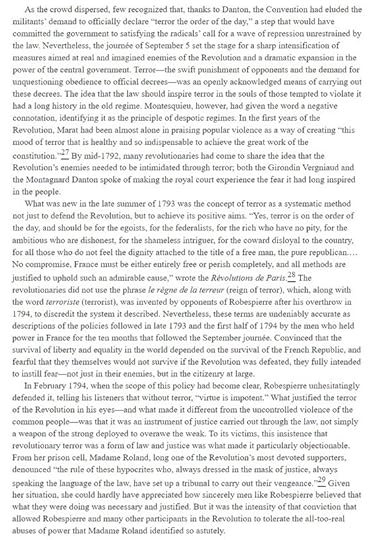

https://i.postimg.cc/rwyRp6VT/Screens...
https://i.postimg.cc/jS2LyzGn/Screens...
Small wonder, then, about the continued resistance to the ideas of the Enlightenment which the Revolution supposedly stood (and at times did stand) for, or the desire to return to the arms of monarch and Church (never snuffed out by any Bill of Rights or secularization drive), or for order at all costs (with the elevation of the Little Corporal, "Despite the constant references to the ways in which Julius Caesar and Oliver Cromwell had used military force to overthrow the republican institutions of ancient Rome and Puritan Britain that punctuated French revolutionary debates").
With Napoleon, rights of commoners, slaves and women were rolled back, and above all, the rights of men of property re-entrenched:
The overall effect, though, is to impart a sense of great promise lost, or squandered, or betrayed. Here are two lengthy passages from 1793 and 1794, respectively, when things were pretty much at their worst (direct links below for larger pics damn you GR!):
https://i.postimg.cc/rwyRp6VT/Screens...
https://i.postimg.cc/jS2LyzGn/Screens...
Small wonder, then, about the continued resistance to the ideas of the Enlightenment which the Revolution supposedly stood (and at times did stand) for, or the desire to return to the arms of monarch and Church (never snuffed out by any Bill of Rights or secularization drive), or for order at all costs (with the elevation of the Little Corporal, "Despite the constant references to the ways in which Julius Caesar and Oliver Cromwell had used military force to overthrow the republican institutions of ancient Rome and Puritan Britain that punctuated French revolutionary debates").
With Napoleon, rights of commoners, slaves and women were rolled back, and above all, the rights of men of property re-entrenched:
In 1804 the new Code civil des Français (Civil Code of the French) showed how key concepts of the Revolution could be interpreted in ways that served very different purposes than those the revolutionaries of 1789 had had in mind. The new set of laws did reflect the revolutionaries’ determination to make the independent male individual the basic unit of society: all adult men now had the same legal rights. The code’s definition of property consolidated the abolition of the old regime’s panoply of feudal, seigneurial, and communal rights and erected safeguards against the limitations on economic individualism proposed by revolutionary radicals. The drafters accepted the view of Jean-Baptiste Say, whose Treatise on Political Economy, destined to shape economic thinking for decades afterward, appeared in 1803. Say insisted on “the freedom that men should have to dispose of their persons and their goods; freedom without which social happiness and property are meaningless words.”36 The code’s provisions were framed to favor property-owning patriarchs, who were to rule over their families and their employees as Bonaparte now ruled over France.Above all, I am left with two thoughts: the inevitable perfidy of those who would rule in the name of the people, and the apathy which allows the tyrant to gain and maintain power.
Whereas the Revolution’s civil legislation, especially the laws concerning the family, had tended to equalize the rights of men and women, the Civil Code gave husbands authority over wives and fathers authority over children. Husbands now had full control of the family’s property, and married women could only work or conduct businesses with their permission. The authority of fathers over children was enhanced by a revision of the Revolution’s egalitarian law on inheritance giving them the right to award a part of the family estate as they wished, meaning that they could privilege favored heirs. “Natural” children and unwed mothers were deprived of the rights that had been granted to them under revolutionary legislation; in the interest of protecting family property, paternity suits were prohibited, and such children could not claim any inheritance, even if their fathers acknowledged them.
Condemned to death along with nineteen of his accomplices, the conspirator Cadoudal remarked, “We wanted to establish a king, we established an emperor.” As in 1800 and 1802, a plebiscite was held to legitimate the change in the constitution. The approval rate was substantial—with 3,572,329 voting in favor and only 2,569 against—but more than half the eligible voters did not participate.

January 17, 2020
Popkin's lifetime of scholarship brings a richness and depth to material, that, for a former scholar of the 18th century like myself, I thought I knew inside out. Because of his knowledge of Haitian history and his use of new understandings of disease, health and history, Popkin shed light on the French Revolution and its place in the history of ideas that was totally new to me. An amazing work of scholarship. Reasonably accessible to the general reader but the detail might seem a little tiresome to many.

November 12, 2021
Jeremy Popkin's A New World Begins offers a solid, workmanlike recapitulation of the 18th Century's greatest upheaval. The book offers colorful sketches of France's long road to revolution: the decaying Ancien Regime and the decadence of the Bourbons, juxtaposed with middle class ferment and peasant unrest. The American Revolution's financial cost, the ineptitude of Louis XVI and the unwillingness of king and ministers to consider reforms turned France into a powder keg which exploded in July 1789, changing Europe forever. Popkin takes us through the familiar events and flamboyant personages: the Vendee counterrevolution, the rise and fall of Robespierre and the Reign of Terror, the King and Queen's execution, foreign intervention and Thermadorian. As a primer on this most complex of its events it's commendable and ably clear-minded, incorporating elements like Haiti's slave rebellion and the role of women that are often reduced to footnotes. But Popkin lacks much in the way of prose style or flare, with the book often feeling like a rote listing of facts and figures. Nor does he bring much fresh interpretation to these well-trod events, beyond concluding that the Revolution's gains probably weren't sustainable without some descent into dictatorship considering the opposition they faced. I'm torn between recommending this book as a fine account of the French Revolution, and wishing it had been more fresh or engaging.

April 24, 2020
Excellent! The first history of the French Revolution that I’ve been able to get through without falling asleep. Not only that–I found it very moving at times. Popkin brings late-18th century France to life, drawing on the perspectives of those who lived through it rather than giving a dry overview of events. He provides a balanced portrayal of all the Revolution’s atrocities and triumphs, evoking the excitement, fervor, and fear that permeated the events that shaped the Republic, and he shows how its ideals still echo through the generations. Highly recommend to anyone interested in the period!

September 14, 2021
A clear, well-written and well-researched work.
Popkin begins with the revolution’s background and origins and ends with Napoleon’s coronation as emperor in 1803 (he is pretty critical of Napoleon, unlike some recent works) He doesn’t provide a lot of new information, and for the most part Popkin deals with the politics of the Revolution. Along with root political and social causes, Popkin pays a lot of attention to the role played by contingency and by individuals. He provides us with enough information about these people to shed light on the broader story, without getting bogged down in tangents. He also does a great job covering issues like religion, women, slavery, the colonies, foreign policy, France’s revolutionary wars, and the revolution in Saint-Domingue. He considers the revolution a “laboratory” where a lot of modern political ideas were created and tested.
The narrative is evenhanded and very engaging. It moves along at a fast pace, and he can cover complex issues and events in clear and insightful ways. Sometimes, though, the narrative jumps back and forth. Also, it seems that Popkin believes that Napoleon’s takeover was ultimately a bad thing, but his coverage of this could have been more balanced and nuanced. At one point Popkin calls Robespierre “the last figure who could truly claim to have embodied the vision of liberty and equality,” (meaning what?) then writes that “Even in hindsight, it is difficult to say that the basic achievements of the Revolution could have been preserved in 1793 and 1794 without something resembling a revolutionary dictatorship.” Um, I would certainly hope that there are ways to achieve reforms that don’t involve violent dictatorships.
Still, a comprehensive and readable work.
Popkin begins with the revolution’s background and origins and ends with Napoleon’s coronation as emperor in 1803 (he is pretty critical of Napoleon, unlike some recent works) He doesn’t provide a lot of new information, and for the most part Popkin deals with the politics of the Revolution. Along with root political and social causes, Popkin pays a lot of attention to the role played by contingency and by individuals. He provides us with enough information about these people to shed light on the broader story, without getting bogged down in tangents. He also does a great job covering issues like religion, women, slavery, the colonies, foreign policy, France’s revolutionary wars, and the revolution in Saint-Domingue. He considers the revolution a “laboratory” where a lot of modern political ideas were created and tested.
The narrative is evenhanded and very engaging. It moves along at a fast pace, and he can cover complex issues and events in clear and insightful ways. Sometimes, though, the narrative jumps back and forth. Also, it seems that Popkin believes that Napoleon’s takeover was ultimately a bad thing, but his coverage of this could have been more balanced and nuanced. At one point Popkin calls Robespierre “the last figure who could truly claim to have embodied the vision of liberty and equality,” (meaning what?) then writes that “Even in hindsight, it is difficult to say that the basic achievements of the Revolution could have been preserved in 1793 and 1794 without something resembling a revolutionary dictatorship.” Um, I would certainly hope that there are ways to achieve reforms that don’t involve violent dictatorships.
Still, a comprehensive and readable work.

July 26, 2024
Just finished:
"A New World Begins: The History of the French Revolution"
By: Jeremy Popkin
New York: Basic Books, 2021 (Hardcover 2019).
Would highly recommend this book for novice and expect alike. Although it is long, it's good. Even the author, who has studied the French Revolution learned something new.
The French Revolution started when a convention to reshape the countries institutions got deadlocked and members of the Third Estate decided to force their hand, taking an other inside the Tennis Court at Versailles. The big takeaway was how quickly events got away not only from the King and nobility, but from the people themselves. Once the King refused the acts of the people and tried to flee, he was executed. The Committee on Public Safety filled a vacuum under the leadership of Maximilian Robespierre, who made the law into a weapon of death. But even he couldn't survive after a while. Ultimately the power vacuum got filled by Napoleon Bonaparte. In many ways, 1789 and 1804 looked very similar to each other, as if no revolution happened at all.
My Takeaways.
1. Power Corrupts.
2. Extreme Social Experimentation leads to drastic consequences.
3. Yes, things changed, but it didn't in the short term. It took til about 100 years to make it's biggest impact.
"A New World Begins: The History of the French Revolution"
By: Jeremy Popkin
New York: Basic Books, 2021 (Hardcover 2019).
Would highly recommend this book for novice and expect alike. Although it is long, it's good. Even the author, who has studied the French Revolution learned something new.
The French Revolution started when a convention to reshape the countries institutions got deadlocked and members of the Third Estate decided to force their hand, taking an other inside the Tennis Court at Versailles. The big takeaway was how quickly events got away not only from the King and nobility, but from the people themselves. Once the King refused the acts of the people and tried to flee, he was executed. The Committee on Public Safety filled a vacuum under the leadership of Maximilian Robespierre, who made the law into a weapon of death. But even he couldn't survive after a while. Ultimately the power vacuum got filled by Napoleon Bonaparte. In many ways, 1789 and 1804 looked very similar to each other, as if no revolution happened at all.
My Takeaways.
1. Power Corrupts.
2. Extreme Social Experimentation leads to drastic consequences.
3. Yes, things changed, but it didn't in the short term. It took til about 100 years to make it's biggest impact.

July 13, 2020
Probably the best recent French Revolution book, this is a thorough review of the period which begins with the conditions that lead to the the Estates General and ends with the coronation of Napoleon. Inbetween, this very complicated and rapidly evolving political situation is lucidly explained, but not to the point of tedium. If you want a recent book on this period, you cannot go wrong with Popkin's account, and you will be well served by his narrative.
Personally, it didn't quite touch my 5 star button prose wise. It's not something I can place my finger on, but that's my own tastes. It also contains next to no illustrations (6-8 black and white political cartoons, tops within the text). Inexplicable. Besides that, it is a great addition to French history on any bookshelf.
Personally, it didn't quite touch my 5 star button prose wise. It's not something I can place my finger on, but that's my own tastes. It also contains next to no illustrations (6-8 black and white political cartoons, tops within the text). Inexplicable. Besides that, it is a great addition to French history on any bookshelf.

January 11, 2020
A very well written and documented history of France through the turbulent and formative years of The French Revolution of the 18th century. It was exciting, thrilling even in places, to read but it has the seriousness of an academic work as well. It took me days to wade through the exercise but I thoroughly enjoyed the experience. I recommend this book.

February 3, 2020
How do you make the French Revolution so BORING?

April 9, 2022
A Revolução Francesa (RF) é um dos eventos mais marcantes da História da Europa, em grande parte responsável pelo desenho societal que ainda hoje vigora no continente. Por isso, e porque tenho vindo a ler cada vez mais ficção histórica, foi com alguma pena que percebi que os livros passados na RF não são tantos como se esperaria. Ainda assim, tendo encontrado uma obra escrita pela notável Hilary Mantel — "A Place of Greater Safety" (1992) — fez-me acreditar que o assunto estava resolvido. Mas não estava. Pouco depois de o começar, sentindo a falta de contexto, acabei por ir atrás de suporte, acabando a ler simultaneamente "A Revolução Francesa 1789-1799" (1992) de Michel Vovelle, "Citizens: A Chronicle of the French Revolution" (1989) de Simon Schama, e ainda o mais recente, "A New World Begins: The History of the French Revolution" (2019) de Jeremy D. Popkin.
continuar a ler:
https://virtual-illusion.blogspot.com...
continuar a ler:
https://virtual-illusion.blogspot.com...
February 25, 2021
Well Researched but over whelmingly boring....I understand your points and intentions but this reads like a technical manual. I would rather watch paint dry.

January 22, 2024
This is by far the most comprehensible- without framing things through a contemporary lense- narrative of the French Revolution that I've read. Highly recommend to the interest layperson.

January 31, 2023
This is one of, if not the, most engaging history book I've ever read. It also feels very complete, even-handed, and it views things from multiple dimensions. It follows the stories of two different individual people (one of the King Louis, and the other a glassmaker named Menetre) in addition to the broader descriptions. It pulls together from a huge number of sources and has many endnotes if you want to go deeper. And all this while still managing to be very engaging (sans the last fourth of the book, which is just inherently a less interesting phase of the revolution as it fizzled out and was gradually dismantled by the Thermidorians and Napoleon).
Popkin even does a good job of foreshadowing, introducing important characters and foreshadowing important events before they happening. I don't think I've ever read a history book before where I genuinely just really wanted to keep reading to find out what happened next.
He addresses many of the glaring faults of different revolutionaries and doesn't really making anyone into a saint. He addresses questions that we as modern readers would be more interested in, such as the revolutionaries' treatment of women and slaves. He also tells you which things had lasting effects hundreds of years into the future and what those affects were, which helps you understand how important certain things were, as well as which things quickly fizzled out and went nowhere. He makes the time period very fascinating, and pitches it as being a period where there was a cauldron or incubator of every idea imaginable about government and representation, etc. So many things were first tried here. You can see the seeds of communism, fascism, women's rights, the end of slavery, anti-colonialism, and so many other things here.
It's a time of great desperation and violence, where even women stage violent uprisings, often because people are starving. It's also the age of many enlightenment ideas getting tried out for the first time. It's an age of so many things. He explores at the beginning what conditions led to this era happening. He also explores why it developed the way it did, why he doesn't think the French Revolution was inevitable, and what King Louis could have done differently to avert it.
He also shows the rise of Napoleon, although this book isn't primarily about him, but it's a good introduction to his character and importance to ending the French Revolutionary period. I get a feeling this is an ideal thing to read first and then launch into reading a more detailed biography of Napoleon, and/or history of the Napoleonic Wars. By the way, if you didn't know anything about Napoleon, don't get your hopes up to high. He was quite racist and authoritarian, not a hero of our time, but he is a very fascinating character in history.
There are so many other good things I could say about this book. Just read it.
Popkin even does a good job of foreshadowing, introducing important characters and foreshadowing important events before they happening. I don't think I've ever read a history book before where I genuinely just really wanted to keep reading to find out what happened next.
He addresses many of the glaring faults of different revolutionaries and doesn't really making anyone into a saint. He addresses questions that we as modern readers would be more interested in, such as the revolutionaries' treatment of women and slaves. He also tells you which things had lasting effects hundreds of years into the future and what those affects were, which helps you understand how important certain things were, as well as which things quickly fizzled out and went nowhere. He makes the time period very fascinating, and pitches it as being a period where there was a cauldron or incubator of every idea imaginable about government and representation, etc. So many things were first tried here. You can see the seeds of communism, fascism, women's rights, the end of slavery, anti-colonialism, and so many other things here.
It's a time of great desperation and violence, where even women stage violent uprisings, often because people are starving. It's also the age of many enlightenment ideas getting tried out for the first time. It's an age of so many things. He explores at the beginning what conditions led to this era happening. He also explores why it developed the way it did, why he doesn't think the French Revolution was inevitable, and what King Louis could have done differently to avert it.
He also shows the rise of Napoleon, although this book isn't primarily about him, but it's a good introduction to his character and importance to ending the French Revolutionary period. I get a feeling this is an ideal thing to read first and then launch into reading a more detailed biography of Napoleon, and/or history of the Napoleonic Wars. By the way, if you didn't know anything about Napoleon, don't get your hopes up to high. He was quite racist and authoritarian, not a hero of our time, but he is a very fascinating character in history.
There are so many other good things I could say about this book. Just read it.

February 7, 2020
I read lots of books about or set during the French Revolution, so there wasn't that much new overall here, though it followed the fates of some lesser-known participants contrasting them with one another or with famous persons, as well as intertwined the story of slavery and civil rights in Haiti (and France which was the first western country to seat black deputies in the parliament in 1793 though it turned out to be temporary of course) for the black and mixed-race population which brought many contradictions of the Revolution to light, but overall the book was still gripping and quite balanced read that went beyond the usual customary Thermidor reaction to Napoleon's coronation when the Revolution was finally dead, so in particular, the lesser-known story of the Directory government of 1795-1799 with its twists and turns gets a full airing here
Highly recommended
Highly recommended

March 7, 2025
4.5
A marvelous book about the French Revolution. The first chapter which traces the parallel lives of Louis XVI, King of France, and Jacques-Louis Menetra, a glass fitter, is worth reading as a standalone article. Beginning with these two distinct lives showed how connected and disconnected the average person and the King truly were.
Dr. Popkin’s ability to connect events from the French Revolution to modern day issues was a highlight. His section on Babeuf a proto-communist was excellent. Showing that even Babeuf knew violence would have to be used to ‘compel’ people to give up their property would playout time and again during the Communist Revolutions of the 20th Century.
Unfortunately, a major negative was the number of times we would go back in time to previously covered dates, I can understand having to do this sometimes, but it felt excessive. An easy solution could have also been a subheader indicating the specific topic and time period. Somone somewhere has a drawer full of subheaders of which Dr. Popkin was in desperate need.
A marvelous book about the French Revolution. The first chapter which traces the parallel lives of Louis XVI, King of France, and Jacques-Louis Menetra, a glass fitter, is worth reading as a standalone article. Beginning with these two distinct lives showed how connected and disconnected the average person and the King truly were.
Dr. Popkin’s ability to connect events from the French Revolution to modern day issues was a highlight. His section on Babeuf a proto-communist was excellent. Showing that even Babeuf knew violence would have to be used to ‘compel’ people to give up their property would playout time and again during the Communist Revolutions of the 20th Century.
Unfortunately, a major negative was the number of times we would go back in time to previously covered dates, I can understand having to do this sometimes, but it felt excessive. An easy solution could have also been a subheader indicating the specific topic and time period. Somone somewhere has a drawer full of subheaders of which Dr. Popkin was in desperate need.

September 2, 2026
Si lo que buscas es un libro sobre la Revolución Francesa que te ayude a hacerte una idea general, porqué no has leído nada antes...este no es tu libro.
Si lo que buscas es un libro que te ayude a profundizar en las causas y en como se interrelacionan los factores que llevaron al estallido de la Revolución...este SÍ es tu libro.
Con una narración amena, llena de detalles y con un profundo repaso a las personalidades dominantes del período revolucionario. Jacobinos y Girondinos, el Juramento del Juego de Pelota, el movimiento sans-culotte, cordeliers y enragérs...todo ello lo combina Jeremy Popkin para crear una obra magistral y con una narración amena sin perder el rigor histórico.
Aunque a veces puedes perderte por sus numerosos detalles y anécdotas, tranquilos que el autor volverá a conducirte a la senda de los acontecimientos revolucionarios y te ayudará a comprender la profundidad de un movimiento que cambió para siempre el signo de la Europa Occidental y del mundo entero.
Si lo que buscas es un libro que te ayude a profundizar en las causas y en como se interrelacionan los factores que llevaron al estallido de la Revolución...este SÍ es tu libro.
Con una narración amena, llena de detalles y con un profundo repaso a las personalidades dominantes del período revolucionario. Jacobinos y Girondinos, el Juramento del Juego de Pelota, el movimiento sans-culotte, cordeliers y enragérs...todo ello lo combina Jeremy Popkin para crear una obra magistral y con una narración amena sin perder el rigor histórico.
Aunque a veces puedes perderte por sus numerosos detalles y anécdotas, tranquilos que el autor volverá a conducirte a la senda de los acontecimientos revolucionarios y te ayudará a comprender la profundidad de un movimiento que cambió para siempre el signo de la Europa Occidental y del mundo entero.

October 4, 2024
I didn't know a lot about the French revolution before this book and now I know much more than the general population and can keep relatively casual conversation about the topic. I felt like it was decently written and quite detailed as well. Sometimes I was phasing out because it was boring (from Robespierre death until Napoleon it's just one or another kind of coup over and over again) but for the most part it was like a good thriller.
Kinda explains why french don't trust their government by default.
Kinda explains why french don't trust their government by default.
January 9, 2024
I doubt any author will cover the French Revolution as good as Popkin did here.

April 12, 2024
La Revolución Francesa: Ese evento que todos los abanderados de la libertad y la democracia en el mundo entero, citan con ligereza y muchas veces con profundo desconocimiento, mientras afirman estar siguiendo el ejemplo de los parisinos que asaltaron la Bastilla el 14 de julio de 1789. Pero más allá de los sucesos ocurridos en la fortaleza / prisión o de la siempre recordada jornada de guillotina del 21 de enero de 1793 en donde el rey Luis XVI perdió -literalmente- la cabeza; son pocas las personas que conocen realmente todo el proceso revolucionario que se inició en 1789 y que luego de un montón de giros, contrarrevoluciones, ascensos, caídas, sangre, terror, guillotinas y discusiones ideológicas encarnizadas; desembocó 10 años después en el Consulado de Napoleón Bonaparte, el preámbulo del Primer Imperio francés.
Si bien es cierto, las obras que desenmarañan la compleja red de la Revolución Francesa se pueden contar por miles, son pocas las que lo hacen de manera directa, erudita y con un manejo embriagador del ritmo narrativo, amén de alejarse completamente de la interpretación poco objetiva hecha por la mayoría de los historiadores de corte marxista frente a las causas y consecuencias de la Revolución. Es así que llega a mis manos "El nacimiento de un nuevo mundo: Historia de la Revolución francesa del profesor norteamericano Jeremy D Popkin, sin lugar a dudas, uno de los mejores libros que he leído sobre la Revolución Francesa. Quedan perfectamente explicados sus orígenes; el desarrollo de los acontecimientos que con su propia dinámica conflictiva y muchas veces incontrolables, lograron derribar definitivamente el antiguo régimen feudal, poner contra las cuerdas el concepto de monarquía absolutista y dar el pistoletazo de partida para la Edad Contemporánea. El autor a través de una estructura narrativa cronológica aborda el relato desde la historiografía política, social y hasta biográfica, dejando de lado la crónica eminentemente bélica de otros textos. También resulta supremamente interesante la introducción de elementos que tienden a olvidarse o simplemente no se tocan en otros relatos: El papel de la mujer en el proceso revolucionario o la importancia de las revueltas de esclavos en la colonia de Saint-Domingue (hoy Haití) que generaría encarnizadas discusiones sobre la postura abolicionista de la esclavitud frente a los ideales de libertad e igualdad revolucionaria.
Con potencia narrativa y rigor histórico, el autor logra organizar la sucesión veloz y galopante de acontecimientos que van desde una monarquía agonizante, los levantamientos populares en armas, la pérdida de influencia de la iglesia católica, el movimiento del poder constituyente hacia los Estados Generales, la configuración de la Asamblea Nacional, las discrepancias internas, las contrarrevoluciones, la caída definitiva de la monarquía, la "Segunda Revolución" de 1792, el auge de los jacobinos, el "Terror", los virajes de "Termidor" y "Brumario" hasta el surgimiento de Napoleón, su Consulado y posterior declaratoria como emperador de los franceses... todos estos eventos están quirúrgicamente narrados y contextualizados para que como lectores podamos comprender cómo la Revolución Francesa fue el laboratorio en el que se probaron por primera vez todas las posibilidades de la política moderna, tanto las positivas como las negativas y por qué entre 1789 y 1917, la política mundial consistió en una lucha ardorosa en pro o en contra de los principios esbozados por los revolucionarios, que proporcionaron el vocabulario y los programas de los partidos liberales, radicales y democráticos de la mayor parte del mundo. De todas las revoluciones que la precedieron y la siguieron, la Revolución Francesa fue la única revolución social de masas y que dejó huella importante en todas partes del mundo. Por eso no me queda más que recomendar este libro para quien quiera conocer más de ella.
Si bien es cierto, las obras que desenmarañan la compleja red de la Revolución Francesa se pueden contar por miles, son pocas las que lo hacen de manera directa, erudita y con un manejo embriagador del ritmo narrativo, amén de alejarse completamente de la interpretación poco objetiva hecha por la mayoría de los historiadores de corte marxista frente a las causas y consecuencias de la Revolución. Es así que llega a mis manos "El nacimiento de un nuevo mundo: Historia de la Revolución francesa del profesor norteamericano Jeremy D Popkin, sin lugar a dudas, uno de los mejores libros que he leído sobre la Revolución Francesa. Quedan perfectamente explicados sus orígenes; el desarrollo de los acontecimientos que con su propia dinámica conflictiva y muchas veces incontrolables, lograron derribar definitivamente el antiguo régimen feudal, poner contra las cuerdas el concepto de monarquía absolutista y dar el pistoletazo de partida para la Edad Contemporánea. El autor a través de una estructura narrativa cronológica aborda el relato desde la historiografía política, social y hasta biográfica, dejando de lado la crónica eminentemente bélica de otros textos. También resulta supremamente interesante la introducción de elementos que tienden a olvidarse o simplemente no se tocan en otros relatos: El papel de la mujer en el proceso revolucionario o la importancia de las revueltas de esclavos en la colonia de Saint-Domingue (hoy Haití) que generaría encarnizadas discusiones sobre la postura abolicionista de la esclavitud frente a los ideales de libertad e igualdad revolucionaria.
Con potencia narrativa y rigor histórico, el autor logra organizar la sucesión veloz y galopante de acontecimientos que van desde una monarquía agonizante, los levantamientos populares en armas, la pérdida de influencia de la iglesia católica, el movimiento del poder constituyente hacia los Estados Generales, la configuración de la Asamblea Nacional, las discrepancias internas, las contrarrevoluciones, la caída definitiva de la monarquía, la "Segunda Revolución" de 1792, el auge de los jacobinos, el "Terror", los virajes de "Termidor" y "Brumario" hasta el surgimiento de Napoleón, su Consulado y posterior declaratoria como emperador de los franceses... todos estos eventos están quirúrgicamente narrados y contextualizados para que como lectores podamos comprender cómo la Revolución Francesa fue el laboratorio en el que se probaron por primera vez todas las posibilidades de la política moderna, tanto las positivas como las negativas y por qué entre 1789 y 1917, la política mundial consistió en una lucha ardorosa en pro o en contra de los principios esbozados por los revolucionarios, que proporcionaron el vocabulario y los programas de los partidos liberales, radicales y democráticos de la mayor parte del mundo. De todas las revoluciones que la precedieron y la siguieron, la Revolución Francesa fue la única revolución social de masas y que dejó huella importante en todas partes del mundo. Por eso no me queda más que recomendar este libro para quien quiera conocer más de ella.

August 30, 2021
For someone that knows nothing about the French Revolution (eg me) this is the perfect book. Written as the great (though horrific and salutary) tale that it was, rather than as a dry academic text, I cannot recommend this book highly enough. It takes you from the increased demands for representation from the bourgeoisie in the 1780’s; through to the end of absolute monarchy and a period of constitutional monarchy; followed by democracy / anarchy / civil war, before the arrival of a new type of monarch-dictator in the form of mumbling psychopath Emperor Napoleon in 1804. In summary, from monarchy to monarchy, with only a change of family name and few hundred thousand dead in the the meantime. Many thousands of people died violent / cruel / pitiful deaths, including the little-remembered loss of 250,000 people in a civil war in the Vendee (who weren’t very keen on a republic led by Tony Blair types in Paris). Though we associate the guillotine with the revolution, it was a much better end than most victims got. As with all socialist revolutions the economy collapsed, Mickey-mouse currencies came and went, and everyone apart from Marie Antoinette and Josephine Bonaparte starved. Why the Russians would go on to have a revolution based on the same principles is baffling. I can only assume it was because they didn’t have this book available to them...
Perhaps the most sobering aspect of the story is that all of the worst types of human behaviour were writ large in this period. Witch hunts, sadistic cruelty and human blood-sport (including the routine murders of women and children), were the order of the day. The more barbarous the method the better (many people were torn limb from limb after being found ‘guilty’ and thrown out of the front doors of courthouses to the waiting crowds). A solution to prison overcrowding (used several times) was to go from cell to cell and kill every prisoner, even though many had not been convicted of any crime.
What struck me most perhaps was how the soldiers of France (once the fools in charge decided that they should export their form of republicanism) were always regarded as expendable resources. Literally cannon fodder / numbers not names. Remember that if you are ever thinking of signing up...
Perhaps the most sobering aspect of the story is that all of the worst types of human behaviour were writ large in this period. Witch hunts, sadistic cruelty and human blood-sport (including the routine murders of women and children), were the order of the day. The more barbarous the method the better (many people were torn limb from limb after being found ‘guilty’ and thrown out of the front doors of courthouses to the waiting crowds). A solution to prison overcrowding (used several times) was to go from cell to cell and kill every prisoner, even though many had not been convicted of any crime.
What struck me most perhaps was how the soldiers of France (once the fools in charge decided that they should export their form of republicanism) were always regarded as expendable resources. Literally cannon fodder / numbers not names. Remember that if you are ever thinking of signing up...
March 19, 2020
This book demonstrates intensive research, often focused on those who did not make the pages of most histories. The author covers the period from just before the calling of the Estates General to Napoleon proclaiming himself Emperor. He follows the convoluted politics- as today’s liberal hero becomes tomorrow’s reactionary villain - with conviction and often insight. The reader interested in the Revolution and its politics could do far worse.
But, and to me this is a huge flaw, there are always the clear good guys (often “the people”). The radicals are on the right (ok, left) side of history. Shame they had to murder so many people to get there. They had ideals, and fought bravely for them. So, of course, did the SS. From my viewpoint, too many eggs were slaughtered to build that particular failed omelet. And, while the author admits the failings, he remains far too partial.
But, and to me this is a huge flaw, there are always the clear good guys (often “the people”). The radicals are on the right (ok, left) side of history. Shame they had to murder so many people to get there. They had ideals, and fought bravely for them. So, of course, did the SS. From my viewpoint, too many eggs were slaughtered to build that particular failed omelet. And, while the author admits the failings, he remains far too partial.
Displaying 1 - 30 of 355 reviews