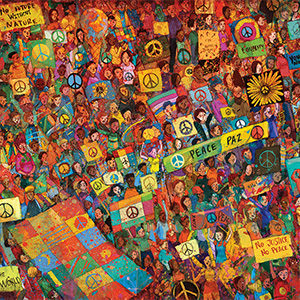
Three Lines in a Circle tells the history of the peace symbol and how it became a powerful icon used in marches and movements around the world.
One line straight down. One line to the right. One line to the left, then a circle. That was all—just three lines in a circle. This bold picture book tells the story of the peace symbol—designed in 1958 by a London activist protesting nuclear weapons—and how it inspired people all over the world. Depicting the symbol's travels from peace marches and liberation movements to the end of apartheid and the fall of the Berlin Wall, Three Lines in a Circle offers a message of inspiration to today's children and adults who are working to create social change. An author’s note provides historical background and a time line of late twentieth-century peace movements.
One line straight down. One line to the right. One line to the left, then a circle. That was all—just three lines in a circle.
This bold picture book tells the story of the peace symbol—designed in 1958 by a London activist protesting nuclear weapons—and how it inspired people all over the world. Depicting the symbol's travels from peace marches and liberation movements to the end of apartheid and the fall of the Berlin Wall, Three Lines in a Circle offers a message of inspiration to today's children and adults who are working to create social change. An author’s note provides historical background and a time line of late twentieth-century peace movements.
The story of the peace symbol and how Gerald Holtom designed it. I doubt that even he had any idea how universal it would become. A great introduction to this iconic symbol and how it transcended what it was originally designed to represent. Now more than ever I think it is important to understand what a given symbol really means - vibrant and engaging illustrations!
The last few pages in the book giving background information including a timeline and the illustrations throughout are what made this book for me. I did think it was smart for the book proper to be presented as a story rather than as a list of facts but it was a bit too thin for me. I wanted more, even when I thought about school-aged children reading it. Perhaps it’s the right amount of story for very young pre-school aged children? I needed the pages at the end with “A Short History of the Peace Symbol” and “A Partial Time Line of Peaceful Protests since 1958” and while each was only two pages long they filled in with information important to me. The true story itself was also compelling and I was glad to learn about the symbol’s creator and the its use from its earliest days to the present. It’s written in a way I think today’s young people will find interesting and perhaps inspirational. I like the message of not being discouraged or disheartened by those who might not believe in your work or your dreams.
The illustrations are marvelous! Colorful and detailed and with a lot to peruse. I loved the various people, the diversity, and particularly enjoyed the small thumbnail paintings. Looking carefully, I grinned a couple of times. I will probably reread this for the pictures alone.
The peace symbol was an important part of my adolescence but back then I knew nothing of its creation and its history. I’m glad that books such as this one are available because I love the historical information. I love knowing about the origins of the peace symbol. I would have been interested 50 years ago too but never was aware of the particulars contained in this book.
There are so many symbols in the world but have we ever given a thought to how they came into being? This book explains the origin of one of the most ubiquitous symbol of our times: the peace symbol.
Three Lines in a Circle begins with Gerald Holtom poring over his drawing board, and finally coming up with the simple design to be used in a protest march against nuclear weapons. The book then goes on to show how he faced rejection, how the symbol won over opponents, and how it is used today.
What I loved about the book was its concept (I mean, really!?!? An entire book dedicated to a symbol! How original is that!!!), the illustrations (vivid and mind-blowing) and the message (especially -> don’t give up in the face of rejection.)
What I felt could have been better was the backstory. There are two whole pages dedicated to the origin of the peace symbol and Holtom’s background, but these are at the end of the book, in quite a small-sized font, and in not-so-simple vocabulary. In other words, the target readers of the book won’t understand most of that content, though it is fabulous. The story begins directly with Gerald creating the symbol. It doesn’t include who he was, why he was creating the symbol, how he arrived at the design… All this content is only in the end note. So the start is quite abrupt. Having a simplified version of the background as part of the story itself would have worked much better.
At the same time, the concept is innovative. And it will get you thinking about how such a simple design has ended up as one of the most enduring symbols of our times. I’m not sure how the book will work as a purchase for individual readers, but I would definitely recommend it wholeheartedly to children’s libraries and schools.
Thank you, NetGalley and Flyaway Books, for the Advanced Review Copy of the book in exchange for an honest review.
*********************** Join me on the Facebook group, Readers Forever!, for more reviews, book-related discussions and fun. Follow me on Instagram: RoshReviews
In 1958, Gerald Holtom created the 3 Lines and a Circle to protest the nuclear bomb. This started in England, but went on to spread all over the world. It is known as the symbol of Peace.
The Illustrations were Great and Made the Book! It was said that the Symbol ‘Does Not Mean a Thing and Will Never Catch On’. Clearly, this was not true. So, it was interesting to see how sometimes simple works better and it’s important that children understand that their ideas can be correct even if others disagree with them.
There was a chart showing how the Peace Symbol was used each year from 1958 until 2021. I do wish a bit more information was given in the basic part of the book though.
So, loved looking at the pictures and reading how this simple concept changed the world.
Thank you NetGalley, Michael G. Long, and Flyaway Books for an ARC of this book.
Three Lines in a Circle by Michael G. Long and illustratedby Carlos Velez tells the story of the peace symbol, from its inception in 1958 to its enduring place in the world today. The pictures virtually leap off the page with their vibrancy and colour, and the text is written in such a way that it will be absorbed and enjoyed by even the youngest of children. A detailed timeline at the end of the book shows just how prominent and recognizable the simple symbol, three lines in a circle, remains in the world today, and how it has informed peaceful protest, from the Vietnam War, to Black Lives Matter. This is a wonderful and accessible lesson in history that will be an asset to any library. 4.5 stars
Many thanks to NetGalley and Flyaway Books for an ARC.
[Gerald Holtom] explained that when drawing the symbol, he adopted letters from semaphore, the alphabet used by people sending messages by flags. The two lines pointing downward and to the sides came from the semaphore letter for N, and the center line represented the letter D. Placed on top of each other and enclosed in a circle, the three lines stood for "nuclear disarmament."
I really loved this little info book about the history and use of the peace symbol. The bulk of the book is a lovely little children's book with great, vibrant colours and pictures about how the peace symbol has been used for activist movements. Each page lauds diversity, representation and acceptance. Such a lovely overall message! At the end of the book, there's a history section about the peace symbol with a more in-depth overview that I really enjoyed reading. Definitely recommend!
What a wonderful picture book! I had thought that the peace symbol had originated in the United States as a cry for an end to the senseless Vietnam War. In fact, British graphic designer Gerry Holton devised it in 1958 — the year of my birth — to support nuclear disarmament. What a storied history for this symbol, used to oppose war, apartheid, discrimination and more.
A more detailed history takes up the final four pages for youngsters and adults who want to know more.
I'm old enough to remember when the peace symbol seemed ubiquitous in this country as conflict rocked the nation over its continued involvement in the Vietnam War. How cool to learn about its origins dating back to 1958! While naysayers didn't think the symbol, originally intended for use during marches on behalf of nuclear disarmament, would catch on, clearly that was not the case. The symbol was seen in marches in London and then spread to the United States and the rest of the world. And while it still represents peace, it also takes its place alongside other movements, including those for gun control and efforts to halt climate change. Additional information about the symbol is provided in the back matter in the section entitled "A Short History of the Peace Symbol." There's also a partial timeline of peaceful protests dating back to 1958 when this all began. While I appreciate having this explanation about the symbol's birth, I really haven't seen it much on the protest signs for current movements or even in popular culture, which made me wonder if the author has perhaps exaggerated its importance--not the importance of peace but of the peace symbol itself--or painted a more romantic view of the symbol than was the case. I remember there being talk about its similarity to some Satanic symbol back in the day so maybe including a bit more about that and how peace movements unfold and use the symbol alongside some photographs of individuals wearing it or carrying it would have made this picture book stronger. Or if there'd been amplification of how other causes took the symbol as their own Still, I'd include it along with other picture books about Gilbert Baker and the Rainbow Flag as well as stories about Betsy Ross and her flag. Symbols, of course, are important, but it's essential to understand what they stand for.
Have you ever wondered where the peace symbol came about? The story I always heard was that it was the foot of a dove, which usually stood for peace.
But this picture book explains that there was a lot of thought that went into this, and it was designed by a graphic designer, Gerald Holton, in the UK, in 1958. And far from being the foot of a dove, it actually was two semaphore symbols joined together that stood for the letter N and D. And how, you might ask, do the letters ND mean anything that has to do with peace? Well, in 1958 people were worried about being wiped out by nuclear weapons, so ND stood for Nuclear Disarmament.
Holton went on to carry signs with the symbol in a great protest march from London to Aldermaston.
And when people in the US began to pick it up, they used it to fight against the war in Vietnam.
This is all told at the end of the book. The main part of the boo the picture book part, makes history much easier to follow. That makes sense because it is a picture book.
Glad that there is a book out that tells the true history.
Thanks to netgalley for making this book available for an honest review.
The peace symbol was designed by Gerald Holtrom, a graphic artist, in 1958. He adopted the letters N and D (for nuclear disarmament) from semaphore, and placed them on top of one another. The symbol soon began appearing at rallies and marches the world over. That's really it as far as a story to this book goes. The real highlight is the stunning artwork by Carlos Velez.
There's also an excellent two page explanation of the symbol's history, followed by a list of peaceful protests that have occurred since the its creation.
Thanks to NetGalley and the publisher for the opportunity to read this one.
The illustrations perfectly capture the creativity that Gerry had when he decided to use a simple symbol to mean a powerful message. Most children of today do not understand what it was like ten years ago, and so to show a relatable book which documented an important part of the LGBTQ plus history from the 1960s both Michael Long and Carlos Velez should be proud by their accomplishment. I read this book to my class and this book wowed them. Also they were able to relate their learnt knowledge of Buddhism including the ideas of peace and knowledge and relate it to this book meaning if Key stage 1 was your target audience you scored. The rhyming pattern throughout the book would also appeal to younger audiences much like Dr Seuss books attract them. The warm colours of the paintings also would soothe them compared to most LGBTQ plus books which use the rainbow flag as a visual focal point, and yet many young children may be set off my such bright mixed colours. I received a complimentary copy of this book. Opinions expressed in this review are completely my own.
The art work was perhaps my favorite part of this book! So vibrant and lovely, and really captured the global use of the peace sign.
Like the symbol itself, the story and text is very simple but effective. The backmatter includes more historical details and a timeline of peaceful protests in history.
As a child growing up in the 1970s, it seemed the peace symbol was everywhere. But, I never gave a thought to who created it or why. Gerald Holtom, a graphic design artist and objector to Nuclear War, was planning a protest march. He created a symbol as part of their Direct Action Committee against Nuclear War. He called it three lines in a circle. But, he was told it didn’t mean anything and it wouldn’t catch on. Boy, were they wrong!
By drawing one line straight down, one line to the right, one line to the left, and then a circle around, he believed this to be the symbol that would show people to fight for a world without bombs. Even though he was told it would never catch on, it did catch on. All over London and all over England his symbol was shared and used to fight for peace. It eventually made its way across the ocean to the USA. Soon it wasn’t just used as a symbol against war, but as a symbol for Black people, women, poor people, and other disadvantaged populations. Eventually, it caught on all across the world.
Readers will notice so much diversity on the pages of this book. The illustrations show the great variety of people and places in our world with all colors, religions, and abilities. A variety of children making their own peace symbol encourages others to keep the movement going for another sixty years or more.
The end of the book has a more detailed history of the peace symbol that, I’m sure adults like me, will be interested to learn about.
With all that has been and is going on in the world, kids will find inspiration in one man who had a vision and how that vision gained momentum to change the world and still is going strong over sixty years later.
Three Lines in a Circle introduces young readers to Gerald Holtom, the man who designed the popular symbol, and the many peace movements that the sign has been a part of. Beginning with the London to Aldermaston March against nuclear weapons, all the way to nationwide protests for racial justice in 2020, readers will follow along as the world embraces Gerald’s symbol and demand peace, justice, and equality.
The illustrations by Carlos Vélez are so wonderful! I love the way the peace sign is sprinkled throughout the illustrations, creating a perfect opportunity to engage readers by finding them throughout the story.
The back-matter contains an informative author’s note, along with a timeline of peaceful protests across the world. Opening the door to further history lessons, Three Lines in a Circle would make a great addition to classroom and school libraries.
Many years ago, I became aware of the peace symbol as I watched march after march in protest of the Vietnam War on TV. Then I went to college and it was everywhere. We had it on tie dyed t-shirts, on leather cords around our necks and plastered all over our notebooks. However, I can never once remember wondering about the origin of that important symbol. Happily, this story answers all of those questions.
The vibrant illustrations lead us through this empowering story, which began back in 1958 when Gerry Holtom created the peace symbol for a protest march against nuclear weapons in London. It quickly grew in popularity in England, and after a feature story in LIFE magazine, it was embraced by activist groups in the U.S. who were protesting against nuclear weapons and then later the Vietnam war. As the years went by, it became a part of many other social movements including BLACK LIVES MATTER, LGBTQ+ Rights, Women’s rights and the environment.
This simple story with friendly, diverse illustrations is a great introduction to the history of the peace symbol to ages K and up. The back matter contains a short history which tells us even more as well as a timeline of peaceful protests since 1958. THREE LINES IN A CIRCLE IS a reminder that peace is an important part of all activist campaigns and we can be a part, no matter what our age. It’s available August 31.
Many thanks to the publisher for the review copy of this book.
The colorful and busy illustrations make this an appealing book and the subject matter, the ubiquitous peace symbol, is still very popular with kids of all ages. The allusion to various peace movements throughout the text, beginning with the origin of the symbol in anti anti-nuclear movement in England in the late fifties, is ripe fruit for discussion for older children. The two page history of the peace symbol and timeline of protest movements in the back will give kids a jumping off point for further exploration. I just wish there was a bit more information in the actual text. Younger children, who might be attracted to the sparse text and the illustrations, there is too much to have to explain. Not that preschoolers can’t understand what a protest march is. There have been plenty of the stroller set at the recent marches as there always have been. But this text isn’t for them. A more concrete and simpler text would serve the storytime audience better. I think this is a fine book for nine year olds and up to pour over on their own or with an adult. Especially an adult who has taken part in marches over the past 70 years and particularly recently and can fill in the gaps. Those kids who see themselves in the ones portrayed in last few pages of the book will hopefully be inspired and see the three lines in a circle with a new perspective.
Thank you to NetGalley and Flyaway Books for an advanced e-book copy.
The peace sign is ubiquitous, and yet the story is little known. Michael Long’s book addresses its development in crisp, concise text and the accompanying artwork by Carlos Velez brilliantly illustrates the story. Bright, dramatic artwork depicts people of all types in many situations, often joyous and always inclusive. The book concludes with hopeful words about catching on, / fighting on, / moving on… / TO / YOU."
British peace activist and graphic designer Gerald Holtom created the peace sign In 1958 for a march to protest nuclear weapons. Its use spread to social change and protest movements around the globe. The call for peace expanded to climate justice and justice for all - women, people of color, poor people, folks with disabilities, and LGBTQ+ persons.
This is one of those books that can be read on more than one level. Read as a picture book for young children, an adult can use the pictures to help explain and deepen the story at the child’s level. For grade school kids, it is both a good story and an introduction to peace movements and justice initiatives, and for middle grades, it could be included with relevant books for a unit on peace. The endnote features a timeline and explains the story in much more depth, facilitating its use in classrooms.
I received an ARC from NetGalley in exchange for this honest review
This picture book tells the simple story of a simple symbol. I'm going to actually start the review with the back of the book. I gained insights from the "Short History of the Peace Symbol" section. I was not aware that the peace symbol came about from the letters N and D in semaphore (signaling letters through body positions with a flag in each hand) standing for "nuclear disarmament." I also appreciated the "Partial Timeline of Peaceful Protests since 1958." I learned about protests I had not heard of before.
The main narration really simplified this juicy information. The illustrations help to associate the text to the time and place of the events, as do the font choices, but there are few details in the text. The drawings are captivating and show a world of different types of people. There are positive messages of what the peace symbol stands for today.
To enhance the end sections, I would have liked to have seen real photographs of the first peace symbol or the designer Gerald Holtom. The drawings, however, are fitting for the narrative.
This is a worthwhile read, especially for art/design lovers.
I was provided an advanced reader copy by Flyaway Books in exchange for an honest review. #ThreeLinesinaCircle
Some symbols are so ubiquitous and installed in our culture, it's hard to consider that they had an origin, an actual creator. One of these symbols is the Pride flag, the history of which is outlined in Pride: The Story of Harvey Milk and the Rainbow Flag.
Perhaps even more familiar than the Pride flag is the peace symbol, the history of which is outlined in Three Lines in a Circle: The Exciting Life of the Peace Symbol. The first surprising piece of history I learned was that the peace symbol originated in England. And do you know the symbolism behind the straight line down and the lines to the right and the left?
After presenting the origin story of the peace symbol, Three Lines in a Circle provides examples of the movements that employed the symbol. The ideas and images grow wider and more universal, but ultimately return to the idea of individual action.
I encourage you to take a few minutes to read this children's non-fiction picture book and you will see this familiar symbol in a whole new light.
The premise of Three Lines in a Circle -- sharing the origin and evolution of the peace sign in a picture book format -- intrigued me, as I was interested in its beginnings and didn't know the semaphore inspiration; the three lines in a circle represent the N and D letters, for nuclear disarmament.
In accessible language and vivid illustrations, author Michael G. Long and illustrator Carlos Velez trace the symbol's development and worldwide embrace.
I found the richest portion to be the short history at the close of the book, expanding in more detail about the development of the symbol to advocate for nuclear disarmament and how various groups have adopted it for their peaceful protests. Its origins have expanded to include a desire for peace in many forums. The book is richer for the end notes, as otherwise it could feel lacking. Now, though, adults can expand beyond the included sentences and describe the accompanying images in age-appropriate language, if they wish.
(I received a digital ARC from the publisher via NetGalley in exchange for my honest review.)
A graphic designer and peace activist created a simple symbol for peace in England. He was told no one would use it. He made it for a 50 mile long March for nuclear disarmament. It was taken up by others as the peace sign was used in several movements . In the 1960s it was used for protesting the Vietnam War.. it was used another time for protesting the Berlin Wall. It has been used in so many movements. It is a world wide symbol for all.
The author has written this picture book for a new generation of activists. It’s well written and illustrated. At the end of the book, there is “A short history of the peace symbol” and includes a partial list of peaceful protests to present day. It’s an important book to remind us that protests don’t have to be violent. It’s a fascinating nonfiction book.
Disclaimer: I received an ar of this book from the author/publisher from Netgalley. I wasn’t obligated to write a favorable review or any review at all. The opinions expressed are strictly my my own.
I received a free advanced copy of this book from the LibraryThing Early Reviewers giveaway in exchange for an honest review.
This is a beautifully illustrated story about the creation and history of the peace symbol. After I first read it, I wished the author had explained more about the facts and historical context of the time when Gerald Holtom created the peace symbol and how he came up with the design. This is really well explained in the short history of the peace symbol at the end of the book. Looking at the age range this book is being marketed to (3-7), I understand why the author did not go into too much detail about nuclear weapons protests in the late 1950s. Overall, this is a nice introduction for younger children on social change movements and the use of the peace symbol over the years.
This book is fabulous! I wish I had known about it a few months ago! As a grade 3 teacher (in Canada) I often teach about symbols of peace, such as dove, poppy and the peace symbol, around Remembrance Day (Nov. 11). My students this year were so interested in the peace sign. This book would have been perfect for that lesson as it describes the world during war and during protests and gives context for young students about what events led to the need for a symbol of peace. The book is easy to follow, appropriate for young and middle grade readers and would be a great addition to classroom libraries. I can easily see myself using this book as a starting point for lessons in the future.
Thank you to Netgalley and the Publisher for giving me the opportunity to read and review a copy of this book! I look forward to purchasing a copy for my classroom soon!
I absolutely loved this!!!! It's very rare that a children's book is so full of detail that as an adult you would learn something new. This book is exceptional! I have now learnt how/why the Peace symbol was created, and then how it grew traction all over the world!! I never knew it was created by a guy in London either. I just assumed it was created in America!
As well as it being super detailed, the illustrations are fab!! SO many different styles and colour palettes to reflect the different time periods. The pictures of the 1960's/70's i loved!!! I would love to have a print like this for the walls in my home.
This book should be read and appreciated just like the peace symbol itself. Love this book and everything it stands for!!
Beautifully illustrated, this book shows the artist’s creative process in making the peace symbol. As a life long lover of the symbol, I had no idea it’s origins even tho I had googled it before when told the popular story that it represented the devil, which I knew couldn’t be true. I’ve come across the symbol in my religious studies as well and credible sources only pointed to positivity. However, I didn’t know it was originally made to oppose nuclear weapons. I love it all the more now. The illustrations of the varied causes where the symbol has been used bring warmth, pride, peace & reminded me of humanity’s, well humanity. I received an ebook through NetGalley in exchange for my honest review.
I certainly learned something! We don't often think about the origins of things that are so well-known and ubiquitous. But, the peace symbol is a symbol that has a distinct history and creator. This is interesting and worth knowing. The book could be appreciated by a range of creators and would be a useful took in the classroom to kick off a study of symbols, peace, internationalism, or many other topics. At home, a parent could use it to spark conversation on events that are of importance to them. And of course those of us who are old hippies can reminisce about our first pair of peace sign earrings and share that story with our grandkids. (Just saying.)
Thank you to NetGalley for an advance copy of this book.
Do you know the origins of the peace symbol? It was first used in England in a 1958 match against nuclear weapons. It appeared in a photo in Life magazine 10 days later, but wasn’t used by an organization in the US until 1960 for a San Francisco to Moscow Walk for Peace. It really caught on when antiwar activists starting using it in their protests against the Vietnam War. Since then, it has “caught on and on and on, standing for peace for all and especially for” groups seeking peace, justice, and equality. The main text introduces the use of the symbol, first in England, then in the US and then internationally. The back matter includes additional details about its development and spread and includes a timeline of main activist movements that widely used the symbol.
This is an informative picture book about the creation of the now famous peace sign. A young man in England started it all as he created a symbol to display during a protest against nuclear weapons. IT made its way to the United States and became a symbol of peace during the Vietnam War. There is a detailed list of the many times the symbol appeared at gatherings focused on peace. I enjoyed learning about this sign that was introduced the year I was born and still spreads a message to the world without saying a word. Great to share with the younger generations to reinforce the power of symbols in society. Thank you to Flyaways Books through NetGalley for a complimentary digital copy of this book.
I had high hopes for this book as I thought the subject matter would make for an interesting read- aloud to my kindergarten/first grade students. The target age group is listed as ages 3-7 however I found the content of the story to be a little too mature for those ages! Young students such as the ones I teach are too young to be getting into discussions or explanations of bombs, etc in my opinion. I think this book would be much more suitable for grade 3 and up. There is an author’s note and timeline in the back of the book which is helpful. Special thanks to NetGalley and the publisher for providing a free electronic ARC in exchange for an honest review.