Jump to ratings and reviews
Rate this book

Siphonophore

Rate this book
MacGregor is desperate to return home. Unfortunately, he’s marooned in the Gulf of Darién, following independent Scotland’s doomed colonisation attempt at the end of the 17th century. Worse still, he’s a character in a novel whose author is dying, and he’s running out of time.

As the author’s preoccupations, memories and spiralling thoughts start to pollute MacGregor’s world, he finds his narrative eroding and his escape routes blocked. Desperately clinging to hope, MacGregor is determined to keep his Creator writing long enough to deliver him home. But will he be able to drive the story to its end before his Creator reaches theirs?

176 pages, Paperback

First published February 4, 2021

2 people are currently reading
139 people want to read

About the author

Jaimie Batchan

1 book7 followers
Jaimie Batchan co-hosts and produces the literature podcast Unsound Methods. His first novel, Siphonophore, was published by Valley Press in February 2021. He grew up in Hook Norton, a village on the edge of the Cotswolds famous for its beer. He has lived in various places including Reading, Oxford, Lancaster and Ljubljana, Slovenia, where he worked as an English teacher, copy-editor, proof-reader and football journalist. He currently lives in East London.

Ratings & Reviews

What do you think?
Rate this book

Friends & Following

Create a free account to discover what your friends think of this book!

Community Reviews

5 stars
9 (33%)
4 stars
12 (44%)
3 stars
4 (14%)
2 stars
2 (7%)
1 star
0 (0%)
Displaying 1 - 7 of 7 reviews
Profile Image for Paul Fulcher.
Author 2 books1,992 followers
April 26, 2021
This is the end of the world.
A dot shrinks on the horizon, blinks out.
It will not reappear.
Terminus.
I sit on the root-knotted dirt at the base of my tree and begin the count:
One.
Two.
Three.
The process of my execution has begun; my Darien wields the axe and I am nought but neck
In defiance I declare a Sitzkreig against the universe.
The dot was a ship, returning the hollow-cheeked remnants of Scotland’s mighty Empire. I am not one of those cowards. I have the courage to remain on my throne; the abandoned heir to New Edinburgh.


Siphonophore is the debut novel from Jaimie Batchan, co-host of the wonderful Unsound Methods Podcast, one that has featured Jon McGregor, David Keenan, Gabriel Josipovici, Douglas Robertson (most recent translator of Thomas Bernhard), Vesna Main, Anakana Schofield, Hamid Ismailov, Tony White, Mathias Énard and other brilliant writers.

And indeed recently Batchan himself (https://unsoundmethods.co.uk/2021/02/...) talking about this novel where, as his publisher summarise on their blog (https://valleypress.medium.com/a-book...) “Jaimie reveals his pride at having written a book that is almost impossible to make into a film or TV series.” [I am sure Milan Kundera once gave a similar quality as a key feature of important novels, although I can never source the quote]

The novel is published by Valley Press, in their words “an independent publishing house based in Scarborough, North Yorkshire, UK. In the past decade, we have published more than 150 books of fiction, non-fiction and poetry, by authors based anywhere from York to Leeds, London to Bermuda, China, South Africa and (almost) everywhere else.”

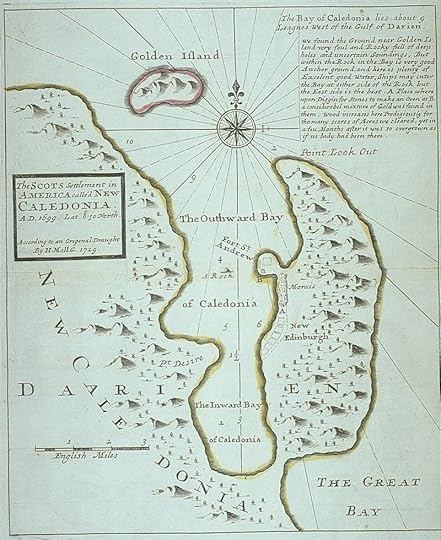
The novel is narrated by McGregor from the year 1700. He is, as the opening quote suggests, the last person left behind in the ill-fated and short-lived New Caledonia colony in Panama, established under the (real-life) Darien Scheme (https://en.wikipedia.org/wiki/Darien_...), an attempt of sorts to establish a Scottish Empire.

description

(By H.G. Moll - According to an original draught by H. Moll G. 1729., Public Domain, https://commons.wikimedia.org/w/index...)

The collapse of the scheme was to contribute to the 1707 Act of Union, as Wikipedia tells us, with (my observation) some interesting resonances for the present day.

The failure of the Darien colonisation project has been cited as one of the motivations for the 1707 Acts of Union. According to this argument, the Scottish establishment (landed aristocracy and mercantile elites) considered that their best chance of being part of a major power would be to share the benefits of England's international trade and the growth of the English overseas possessions and so its future would have to lie in unity with England. Furthermore, Scotland's nobles were almost bankrupted by the Darien fiasco.

Some Scottish nobility petitioned Westminster to wipe out the Scottish national debt and stabilise the currency. Although the first request was not met, the second was, and the Scottish shilling was given the fixed value of an English penny.


The first part of the novel gives us a fascinating account of the colony. But this is far from a conventional historical novel. McGregor refers often to his ‘Creator’, and the reader soon realises (no spoiler needed as the blurb reveals this) that he is referring not to God, but rather the author of the novel, which is first made clear when McGregor comments on his own use of modern terms he would not have known at the time:

I guess what I'm saying is this: don't think my Creator didn't want to do the necessary research. Don't relish the opportunity to share what may be the last days of my life while nit-picking about the language I use or some technical maritime detail that slips like a stone through the gaps in my words. You'll only notice if you have some esoteric knowledge of naval technology at the end of the seventeenth century — if you do possess such mental flotsam, congratulate yourself, but don't expect credit from me.

Literature still means something to my culture. It's not a game of I Spy for us, nor a busted flush, a discarded husk. Robinson Crusoe, the entity with whom I share so much, will not be published for another nineteen years. Just think of all the art I have ahead of me. It's only natural for you to look back at me through jaded lenses. For you there are no new ideas, surrounded as you are by a slew of reboots, mash-ups and sequels, whereas I get to savour the earliest days of the novel as an art form.


And the novel’s title references the symbiotic nature of the relationship of author and character, and indeed reader and editor - https://en.wikipedia.org/wiki/Siphono....

But if that makes the novel instead sound like an elaborate but sterile post-modern game, it isn’t that either.

The present-day author himself is suffering from insomnia, which proves to be a case of the extremely rare condition fatal insomnia (https://en.wikipedia.org/wiki/Fatal_i...) and as the novel progresses the present-day author struggles to reconcile with his current girlfriend, looks back on his life, and gradually his cognition starts to disintegrate as he rapidly deteriorates. The story is told powerfully and sensitively.

Meanwhile McGregor is his in his own parallel race against time, to be rescued from the isthmus before he is captured by the approaching Spanish, and to have the author finish his story while he still can. And in a third strand, the author’s own Wikipedia fuelled research leads him, and the reader, down some fascinating rabbit holes (such as the neutral territory of Moresnet, or the story of Witold Pilecki who infiltrated Auschwitz).

Overall a fascinating novel, one that has been entered I understand for the Goldsmiths Prize, and a real contender.

After posting the review I came across this more detailed and erudite take by the always-fascinating Daniel Davis Wood in This is Splice: https://www.thisissplice.co.uk/2021/0...
Profile Image for Robert.
2,327 reviews265 followers
July 20, 2021
Jaimie Batchan’s Siphonophore starts off as one thing and over the course of a few pages mutates into something else entirely. I admit I was taken by surprise because I have rarely experienced such a thing in a novel.

The book opens in 1700 with a cartographer called MacGregor who is stranded in Darién (Panama) as part of a botched Scottish colonisation attempt. At this point it looks like the rest of the book is going to be a tale of survival. A sort of Robinson Crusoe story. In fact early on MacGregor asks for his creator to help him.

In a way Siphonophore is a survival tale and it does involve the intervention of a creator but not in the conventional way.

It transpires that MacGregor is a character in an unfinished novel and his creator is the author. Furthermore we readers find out that the author is suffering from a fatal disease. This puts MacGregor in an uncomfortable position. If the author dies before finishing the novel, then he will be trapped in Darién. Thus MacGregor has to persuade his creator to develop the novel so that it reaches a rightful conclusion.

Siphonophore is an exploration between the relationship between an author and the characters created. Since MacGregor started out as an idea in the author’s mind he has intimate knowledge about him: His tastes in music ( he is a fan of Sheffield band , Longpigs – yes I understand the irony of what a long pig is as well considering there’s a desert island theme) , the types of books he likes to read and his past and present relationships.

At one point during the book the author, like MacGregor, is isolated. His current girlfriend leaves him, stops writing and takes a look at the past, especially what he has accumulated over the years. Both are now fighting to survive however MacGregor’s situation is more urgent as he needs the author to finish the novel in order to break free. Siphonophore is also a classic example of how an author is God and has the power to control whatever is created.

Whether MacGregor is saved or not, is something the reader will find out but I can say that sometimes an author may not be as powerful as we think they are.

Siphonophore is an excellent take on the historical novel, probably because I didn’t see it explicitly as one, or at least in the conventional sense. Instead it is from a meta aspect, where the character breaks the fourth wall and the reader gets a different type of history, one of the creator, thus cleverly Jaimie Batchan manages to present both the 1700’s and present day simultaneously. For that alone the book should get accolades but Jaimie Batchan also sticks to the literary style that was used in adventure stories back then (just as a reminder Robinson Crusoe was written in 1719). I see this as a masterful stroke as MacGregor mentions contemporary groups such as Tricky and books such as The Naked Lunch in that style as well AND it’s not jarring. As I said before, the book functions as an intelligent look at the how a creator and his characters are bound to each other in more ways than one.

Although I use the word often, I did find Siphonophore to be a unique novel. Not many dare to subvert genres in such a way and emerge with a playful book. If one does find experimental novels intimidating, hopefully Siphonophore will change one’s mind. It’s both a fun and profound book and not many can pull that off so well.

Many thanks to the author for providing a copy of Siphonophore.
Profile Image for Danny Allan.
2 reviews
February 13, 2021
I loved this novel. It starts as a wonderful, historical piece about travel to the new world. Then takes you on an unexpected journey into the life of another character, so joined to the main.
A tale of trial, suffering, hope and life inside a troubled mind.
5 stars.
Profile Image for Bob.
285 reviews3 followers
August 6, 2021
4.5 stars...

A genuinely interesting book. It doesn't so much break the fourth wall, as install a revolving door in it, with a door attendant who just smiles all the time... It's sharply written prose, that journeys between the mundane reality of life, of existence - and the hypereal surreality of a fever dream.

A cracking debut, and I look forward to whatever Jamie writes next.
24 reviews19 followers
July 30, 2021
Siphonophore starts out like any historical novel. It is the year 1700, our protagonist is MacGregor, a down-on-his-luck Scot marooned on the Bay of Darien, known to us as Panama. The first settlement (New Edinburgh) of an envisioned Scottish Empire, it was quickly deserted after a combination of misfortune and mismanagement had doomed the colonial endeavour. MacGregor, the only one to publicly complain about the dire circumstances of their subsistence, had become persona non grata of the colony, and so had been abandoned when the other settlers returned to Scotland.
The setup is written in masterfully succinct and evocative prose:
“The process of my execution has begun; my Darien wields the axe and I am nought but neck.”

“Life stowed below deck was soon marked by darkness and noise, mixed with the clammy smell of death that soaked into our planks. A gossamer-thin veil separates our world from the animal kingdom and this barrier is brushed aside in the dark dank bowels of a ship.”

However, we soon discover that this is not your run-of-the-mill historical novel, when our narrator addresses the reader directly, remarks on some anachronistic language use on the previous pages, and mentions Robinson Crusoe, “the entity with whom I share so much”, admitting that the novel won’t be published for another 19 years. He admonishes the reader’s cynicism:
“Literature still means something to my culture. It’s not a game of I Spy for us, nor a busted flush, a discarded husk. […] Just think of all the art I have ahead of me. It’s only natural for you to look back at me through jaded lenses. For you there are no new ideas, surrounded as you are by a slew of reboots, mash-ups and sequels, whereas I get to savour the earliest days of the novel as art form.”

So the novel morphs into a surprisingly original metafictional narrative. While self-conscious fiction isn’t anything new in and of itself, Batchan, by turning it into a race against time, adds a refreshing element of tension to the discourse between creator and creation: The author of McGregor’s tale gets diagnosed with a fatal illness that slowly robs him of his mental faculties and our protagonist is desperate for him to continue writing to bestow upon him a successful return from Panama. While the author is inundated with regrets about unfulfilled potential and failed relationships, McGregor bemoans his Creator’s tendencies for listlessness and procrastination. As the author’s health declines, the narrative becomes increasingly fragmented, the lines between the two blurry, and at some point the writing resembles vivid free verse poetry rather than prose.
Both author and character dwell on thoughts of nonexistence, the former inserting short paragraphs on historical figures who found an early death, disappeared things, and extinct animals into the text, the latter reflecting on the relationship between his existence, the author, and the reader:
“I am, therefore I am.
Isn’t that enough for a character such as myself?
Created by an all-powerful Creator, I needn’t concern myself with the tangibility of the things that surround me. As long as your eyes are scanning these words, I am. I gloriously exist.

What about those moments your mind wanders? I must take that up with my Creator. He must take ultimate responsibility.”
Here the significance of the title becomes clear: Siphonophores, the eponymous sea creatures, appear like individual organisms, but are in fact colonies of highly specialised organisms that rely on each other for their existence, as neither can fulfil all necessary functions to sustain life on their own.

Of course, I did fall into the trap of the “I Spy” game the narrator laments and was particularly intrigued by the interspersed wikipedia-like entries on disappeared things, some of which echo the stories in Judith Schalansky’s An Inventory of Losses. Both mention the extinct Caspian Tiger and reflect on the disappearance of small islands mentioned in historical sources, and I really want to know whether Batchan has read her, or whether it is just a coincidence that shouldn’t surprise me as much as it did, seeing how both books deal with the impermanence of human existence.

Self-referential observations on the nature of fiction aside, Siphonophore delights with crisp writing, witty and all-too-real observations of our dithering social media-addled lives and explores the question of what is important to us in the face of certain death, what we choose to dedicate our limited time to, knowing that all our efforts may ultimately be for naught.
Profile Image for David Hebblethwaite.
345 reviews245 followers
March 9, 2022
Our narrator for this novel is MacGregor, marooned on the Darién isthmus (now Panama) in the 16th century following a failed attempt to establish a Scottish colony. The book begins straightforwardly enough, with McGregor explaining how he ended up in his current predicament. He communes with his Creator – who isn’t quite the kind of being one might anticipate:

His procrastinating, for example, is noticeably absent from the scriptures. Once He becomes committed to the work he must undertake, this stalling finds a fresh set of robes in which to creep upon the earth. His time-wasting swiftly dons the attire of legitimate research. So much for omniscience. He diligently bookmarks web pages for future reference, scribbling notes in his spidery handwriting and hiding away in the ailing libraries dotted about the borough.



MacGregor is fully aware that his Creator is a 21st-century novelist. The Creator’s life and speech patterns bleed into McGregor’s narration, which ties the two timeframes together. We discover that the novelist has a rare terminal illness, and is desperate to complete his book. McGregor, in his turn, wants the writer to stay alive long enough to get him home.

This has the effect of giving a real sense of urgency to an approach that might otherwise seem just a gimmick. MacGregor and his Creator are mutually dependent on each other (like the marine organism after which Batchan’s novel is titled). Siphonophore examines their differing thoughts on living life when time is short.

Batchan’s novel creates a whirlwind of perspective that only grows more intense as language breaks down and the line between MacGregor and Creator blurs. It’s quite a ride.
Displaying 1 - 7 of 7 reviews

Can't find what you're looking for?

Get help and learn more about the design.