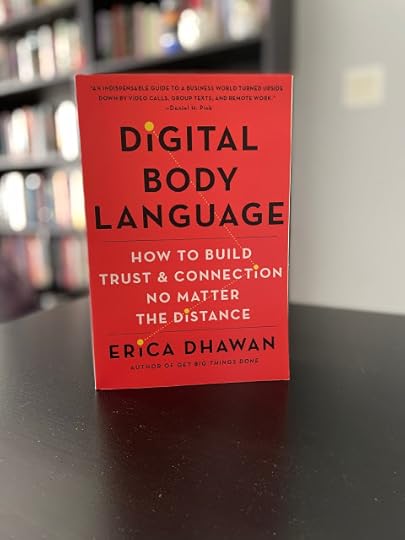
The definitive guide to communicating and connecting in a hybrid world.
Email replies that show up a week later. Video chats full of “oops sorry no you go” and “can you hear me?!” Ambiguous text-messages. Weird punctuation you can’t make heads or tails of. Is it any wonder communication takes us so much time and effort to figure out? How did we lose our innate capacity to understand each other?
Humans rely on body language to connect and build trust, but with most of our communication happening from behind a screen, traditional body language signals are no longer visible -- or are they? In Digital Body Language, Erica Dhawan, a go-to thought leader on collaboration and a passionate communication junkie, combines cutting edge research with engaging storytelling to decode the new signals and cues that have replaced traditional body language across genders, generations, and culture. In real life, we lean in, uncross our arms, smile, nod and make eye contact to show we listen and care. Online, reading carefully is the new listening. Writing clearly is the new empathy. And a phone or video call is worth a thousand emails.
Digital Body Language will turn your daily misunderstandings into a set of collectively understood laws that foster connection, no matter the distance. Dhawan investigates a wide array of exchanges—from large conferences and video meetings to daily emails, texts, IMs, and conference calls—and offers insights and solutions to build trust and clarity to anyone in our ever changing world.
Erica Dhawan is a globally recognized leadership expert and keynote speaker helping organizations and leaders innovate faster and further, together. Erica has spoken, worldwide, to organizations and enterprises that range from the World Economic Forum to U.S. and global Fortune 500 companies, associations, sports teams, and government institutions. Named as one of the top management professionals around the world by Global Gurus, she is the founder and CEO of Cotential - a company that has helped leaders and teams leverage twenty-first-century collaboration skills globally. Her writing has appeared in dozens of publications, including Fast Company and Harvard Business Review. She has an MPA from Harvard Kennedy School, MBA from MIT Sloan, and BS from The Wharton School. Learn more at ericadhawan.com and follow her @ericadhawan. Join the community at ericadhawan.com/digitalbodylanguage.
Digital Body Language by Erica Dhawan How to Build Trust & Connection No Matter the Distance
Communication. 50% of our emails are misinterpreted. Digital body language. Liking a post. Making a comment. Answering an email in detail. Using emoji. Laughing during a video meeting. Responding promptly to a text. Using an emoji in a digital meeting. Communicate carefully. Collaborate competently. Trust totally. Generational differences, cultural variants, Zoom, texting, email, Gen Z, introvert, managers and emojis.
These are some of the concepts covered in this wonderfully concise text. Worth reading or listening to for anyone in business or managing people or projects. Or simply to figure out why your emails aren’t being returned. The author did a great job narrating the test. She was easy and pleasant to listen to. I received a copy of this audiobook from the publisher. I also purchased a copy to keep for reference.
I found Digital Body Language to be a solid refresher about best practices and general etiquette for digital communications, the majority of it focused on email. This book had been patiently waiting on my shelf since it was published in 2021 and I think I would have gotten more out of it then, than I did now, as I head into year 4 of remote work.
“Effective digital body language is about tailoring communication — not to fit the natural preferences of one generation over the other but to meet the demands of the task at hand.”
While I may not have learned a ton of new information from Digital Body Language, I recognize there’s always room for improvement. Knowing your audience, and being concise while still providing enough context for an update/request remains critical. Author Erica Dhawan did a good job narrating this audiobook too — 3.5 stars
De real ajutor in cumunicarea digitală, în special dacă serviciul tău implică asta! Explică nevoile diferite ale fiecăruia și cum poți adapta comunicarea astfel încât toată lumea să simtă siguranță și să colaboreze armonios.
This was an interesting but uneven read. From the start, I was nodding my head in recognition and agreement at Erica Dhawan’s descriptions of how workplaces actually work now. Things at work have shifted a lot in the last few years for me, with most of my colleagues working from different offices and locations. We are now heavily reliant on video calls, messaging and email to communicate with each other and get things done.
Some of the guidance on digital communication was helpful, but a lot of it I just didn’t find relevant or actionable. Much of the book is targeted at senior leaders in an organisation, who can set policy or implement specific directions to everyone. I appreciated learning about this, but I’m not in a position right now to implement much of it. I got some confirmation of things that I already do, and it firmed up how I think about some other things - like what channels are best for what kinds of communication.
I hope to find and read more books like this in the future. With digital communication being so heavily used at work, with only limited in-person contact with many of my colleagues, learning and establishing how to work together digitally is really important.
I received a copy of this book from the publisher in exchange for an honest review.
A necessity for the digital workplace! Have you ever wanted to pull your hair out because someone chose to "reply all" or cringed at an emoji-filled communication from a young staff member to a member of upper management? You may have thought "why don't they know better?" but the fact of the matter is that although we are all so plugged in, we haven't been taught basic digital etiquette. Author Erica Dhawan not only provides a primer for how to better communicate and understand each other through our digital mediums but also adds crucial insight into the different digital body languages between genders, generations, and cultures. I really loved this book and think it should be integrated into every company's onboarding and training program. I agreed with Dhawan about just about everything...except one thing. She suggests all people be on camera during a video call. I'm going to have to take a hard pass on that one. No. Just...no.
REFRESHING, RELEVANT, REVOLUTIONARY I highly recommend this book to anyone who is interested in getting themselves or their companies out of a production rut! This book gives you a new way of thinking about connecting and working with others digitally that’s relevant to the 21st century. The book has something for everyone regardless of age, socioeconomic status, gender, etc. It’s got something to teach large and small companies and individuals who may not have their own companies, but do have a dream of leading teams one day. I love the book. Highly recommend it!
As someone whose job is heavily reliant on digital communication, I found this book pretty relevant. It pointed some good tips and things to think about, but I think it would be more helpful for older generations who are not as fluent in digital communication.
Humans rely on body language to connect and build trust, to maintain relationships, and to convey meaning not captured in the words we choose. However, the shift to digital workspaces where we can only see each other from the shoulders up — if at all! — makes millennia of biological nuance evaporate. In this book, Dhawan wants to help the reader reclaim some of that body language by instructing how best to set themselves up in the digital space. The book attends to digital hygiene, cultural differences between email openers and sign-offs, hierarchy and patriarchy in digital spaces, and many more topics that affect how we perceive and are perceived in digital spaces.
Oh boy, the number of video calls, emails, and phone calls that the modern day worker is exposed to is sometimes mind boggling. We’re just monkeys screaming into the void and unfortunately it’s listening back. Dhawan’s book is meant to help clean up our digital body language — a really good term by the way — so that we can better act and react in professional settings. So the aim and intention of the book is absolutely there and it absolutely addresses a real need.
However, I felt this was not the best medium for the messages. She already provides these learnings in seminars and workshops, coachings, and other mediums that better promote the messages she’s trying to give. Unfortunately I, as a digital native, felt condescended at several points, even though I could at the same time clearly tell that was not Dhawan’s intention. I also thought about digital aliens in my life and felt this wouldn’t be pragmatic enough for them since it’s stagnant text rather than a conversation.
Overall it’s an absolutely needed discussion, and Dhawan very clearly knows what she’s doing. I just don’t feel a book is the right format unless it’s done in a very, very particular way.
Digital Body Language promises to be the definitive guide to connecting to the hybrid world. And the audiobook delivered big time. The book covered different communication mediums from texting, email, to phone conversations with a real world perspective. This was definitely not the stuffy business book I was expecting!
Erica did a deep dive on how text and email communications can affect those around you. It even made me question a text I had sent the same week to a friend who shared a victory and probably got a short response in return when I was busy during the day. She has definitely made me more aware of the need to take the time to read the intention of the message that comes through, and giving some messages the time and response they deserve.
The book also covered team engagement and how a manager's poor communication with their team can cause serious issues. A manager not using emojis could come across as cold, and the "OK." is apparently not so ok. This is definitely a book that will make you more thoughtful in your communication, and may even encourage you to include an emoji, or an exclamation point or two! I'm glad I read this communication book and recommend it--especially to those with managerial responsibilities and aspiring managers.
Body language has been actively studied since the 1960's with the general public becoming more aware of its existence with the book "Body Language" published in 1978. My undergraduate degree was in Communications and I have a pretty good understanding of non-verbal cues so my first reaction to "Digital Body Language" was all this information is intuitive. I already know and do these things. But as I continued to read, I realized there were new concepts and ideas that I could use. There were helpful ways to proceed.
Author Erica Dhawan has provided a complete roadmap for teams to understand the new signals and cues through her guidelines and anecdotal stories. She explains what digital body language is, discusses the four laws that will make a team more successful, and follows up with a discussion bringing awareness to digital communication differences in gender, generations, and culture. The book includes an extensive list of footnotes and the Appendix includes a downloadable link to The Digital Language Guidebook and other useful materials.
Here are some of my personal takeaways:
Reading carefully is the new listening. Writing clearly is the new empathy. A phone or video call is worth a thousand emails. If you follow up twice with no response, switch to a different medium. The return and importance of the exclamation point. Older generations almost always end up adopting the vocabulary of younger generations (emojis). I also discovered I'm a 'digital native' rather than a 'digital adapter'.
Highly recommended and appropriate for strengthening teams in any organization as well as those of us with questions about how to sign our e-mails!
This book covers a lot of interesting aspects of what can be seen to replace body language in virtual communication, such as punctuation, emojis, channels and channel switching, the importance of communicating clearly, how to show respect, think before you type. I particularly liked how the author described the anxiety that can come from unclarity and lack of body language in written/virtual communication.
Some of my notes on some points I found interesting:
Navigating Power Plays and Anxiety TRUST - Traditional Body Language: keep your palms open; uncross your arms and legs; smile and nod. - Digital Body Language: use language that is direct with clear subject lines; end emails with a friendly gesture (Text me if you need anything! Hope this helps.); never bcc anyone without warning; mirror the sender’s use of emojis and/or informal punctuation. ENGAGEMENT - Traditional Body Language: lean in with your body as another person is talking; uncross your arms and legs; smile; nod; make direct eye contact. - Digital Body Language: prioritize timely responses; send responses that answer all questions or statements in the previous message (not just one or two); send a simple Got it! or Received if the message doesn’t merit a longer response; don’t use the mute button as a license to multitask; use positive emojis like thumbs-up or smiley faces. EXCITEMENT - Traditional Body Language: speak quickly; raise your voice; express yourself physically by jumping up and down or tapping your fingers on your desk. - Digital Body Language: use exclamation points and capitalization; prioritize quick response times; send multiple messages in a row without getting a response first; use positive emojis (smiley faces, thumbs-up, high fives). URGENCY - Traditional Body Language: raise your voice; speak quickly; point your finger (or make any other exaggerated gesture). - Digital Body Language: use all caps paired with direct language or sentences that end in multiple exclamation marks; opt for a phone call or a meeting over a digital message; skip greetings; use formal closings, Reply All, or Cc to direct attention; issue the same message on multiple digital channels simultaneously.
Choosing the best digital medium (email, slack, phone, text) is essential 1. How important or urgent is the message? 2. To whom are you communicating?
Sending a calendar invite without info or context: neutral to some, very cold and impersonal to others - not worthy of even the most standard office niceties - about to be fired?
Channel switching From message to email: signal that the issue warrants a more thoughtful approach When approaching someone, get a better connection and response by using their preferred medium Sometimes we choose the wrong channel: after three emails realise that the issue is too complex for an asynchronous approach, schedule a call or video meeting Switching mediums abruptly can shock people - unexpected digital body language Phone-phobia: many people so accustomed to messaging, email, that they get flustured, even panicked when called out of the blue.
Punctuation and symbols: the new measure of emotions Emojis and exclamation marks are useful tools to infuse emotion into otherwise flat, one-dimensional digital communications Can be seen as a sign of friendliness, approachability, comradery, convey energy - or as too informal How do you want your relationship to progress? If it's formality you're after, or uncomfortable using excessive signals, stick to bare bone facts, end sentences with periods. Mirror formal body language of boss or client If you want to develop closeness and the other person seems receptive, then go ahead with smileys and lmaos
Exclamation marks: one of the most epic comebacks in the history of punctuation Can convey friendliness and a personal touch at the beginning of an email An email without any can seem cold, even terrifying Women use them more of them: represent the frequent smiles and nods common in female friendships
Exclamation points primer Used to say sth loudly, or extra nicely, kick things up a notch Adds velocity, signals sincerity Can also be seen as shouting Email reply "okay." leaves people guessing, while "okay, great!" can help to build trust and comradery
Emoji primer Add texture and context to our messages Can enhance workplace efficiency, culture of clarity Important to tailor emoji use to your audience
The period Now signals cold cruel fury, undecided reaction, lack of excitement, perceived as insincere in texts - not in e-mail, aggressive
Probably a useful one to read for the older people who struggle even with emails and prefer everything to be voice calls. Some of the recommendations of the author are a bit questionable. For instance she keeps with the usual idea that women and perceived as such should use a lot of exclamation marks and emojis to show their empathy and how apparently when the exclamation mark abuse or emojis are lacking and no overtly emotional words are used it apparently means rudeness, whereas the same exact message without the punctuation or emoji abuse if written by a male person is just professional. Dare I wonder why guys are easier to communicate with? Am I showing signs or old age or just nonamericanness or is it just my autism or engineering mind that just interprets overly emotional words, and abusive punctuation with too many emojis in a work communication to show more immaturity, lack of authority, and just insincerity and lack of emotional control instead of interpreting as “empathy”? Quit with the binary standard of requiring different emotional display and language by males and females. (Note to self: change first name to gender non-obvious or just shorten to initials at the next workplace to not have to perform as a female).
The author is a “geriatric millennial” (her own words) whose parents migrated to US from India, and her self bio at the end of the book is certainly written with a full American confidence. It seems odd she writes so much about her work is so international, yet the only non-anglo names of any person she used in any context or example were in the last two chapters. Even then, a specific example from Brazil and some from Asia were mentioned, but how is it that everyone she ever encountered sounded based on their name to be white and very anglo? Did she only ever work with a bunch of Erics and Karens, or did she use some outdated writing guidelines that suggested that all audiences of the book would prefer anglo names? Is it her, or is it the problem of US workplaces when there are no Hispanic, Black, Asian or any clearly non-US names anywhere? Since there wasn’t really anything much about how even within US different cultures (other than hers, or main white) differ from each other, I’ll make a wild guess there weren’t people telling what kind of differences there are with how digital communications are interpreted e.g. by black or hispanic women compared to white women, or what kind of communication problems black or hispanic men usually face when communicating with the default white woman in a workplace.
I work with both internal and external clients in my 9-5, with primary communication via email. My introverted self loves that, except...when it doesn't, haha. - The emails that come in with all-caps subject lines. - The reply-alls. - The vague emails: "I need help," but they don't say with what. "It isn't working," but they don't say what isn't. "I'm getting an error message," but they don't say what it is.
You (and I) get the picture.
This book is a fantastic resource to help with that. Digital body language was an issue pre-covid, and now that we're 14+ months in, it's even more so. I'd love to hand this book to everyone I interact with--hmm, not a bad idea!--and will certainly start with recommending it in conversation.
Dhawan is uniquely positioned to speak on the topic, and I found her journey to writing this utterly fascinating. She herself seems very relatable as a person; certainly, her book is. It's also one I could easily either read straight through, or jump around from topic to topic as desired. A fantastic resource I'll revisit regularly.
I received an eARC of the book from the publisher. All opinions are my own.
I run a fast-growing writing education technology company. Our team and customers are remote. Even though we're great writers, our communications still suffer from confusion and misunderstanding. This is why Digital Body Language is so important. Erica Dhawan does a fantastic job of distilling many key lessons for how we can create connections digitally. The book is both inspiring and practical. Lessons such as "always assume the best intent" foster understanding and stop conflict before it occurs. Every person – from executive to manager to the frontline – will benefit from reading this book. Read it to get ahead in your career, better communicate and collaborate with your team, and decrease your stress in the workplace. Enjoy!
While there was some interesting information, the book itself was choppy - and repeated itself constantly. It read like a series of blogs and completely lacked the organization of a longer work. And it never went deeper than surface level advice. I felt like I could have learned the same information in a 10 minute.
I guess fine for absolutely clueless, had some good tactical tips, but overall had tad higher expectations. Also many tips about many cultures were canceling each other so can be summed as "it depends on cultural context"
This Gen-X’er learned he needs to use more exclamation marks. (!) It’s killing me inside but I’m doing it. Overall recommended reading especially for my generation.
This is my second book by the author and I was really excited to listen to the audio version as it was narrated by the author. She does a wonderful job as a narrator. Her work as a professional speaker and coach really shines through in her narration. You can really tell she has a passion for the subject, and I really appreciated that she provided personal and professional examples in the book. This book is so relevant given our current situation with many companies working virtually due to the COVID pandemic. I worked from home several days a week prior to COVID and found so many points that were made in this book very relevant. I wish I had read this several years ago. I can't tell you how many times I have questioned the tone in an email I received or sent, and this book may have made translating it a little easier. It has become more and more difficult to network in my industry during this time when face to face events aren't happening, and the "return to normal" isn't clear yet. We have transitioned to a "zoom" meeting culture and getting involved can become difficult. There are some really good tips on how to manage that in here. Now that much of the workforce has proven the ability to work from home, I expect more and more flexibility from companies moving forward from the corporate sector. I believe books like this can really help many of us navigate this world of video chats, professional texting, instant messages, and deciphering tone in digital communications.
I liked that she discussed gender and age differences when it comes to communicating digitally. As we move to a more digital forum, what I feel is professional as a mid-career professional may seem blunt and cold to an intern who as accepted an entirely different way of communicating. I also liked that she pointed out that you have to tailor your communication to your audience and your business environment. As a seasoned project manager I have always had a communication plan for my stakeholders so this makes perfect sense to me. By adding a few more criteria to that plan I can be much more successful in communicating with others in and out of the workplace.
I was provided an audio arc via Netgalley, all opinions are my own. This releases today May 11, 2021 and I plan on purchasing a physical copy for myself so I can reference some of the key points that the author made about punctuation and use of emojis as well as other ideas in this new digital world of communications. This would also be a great gift for new college graduates as they plan to enter the work force and head off into virtual interviews and crafting quality digital communications. I'll be recommending this to my professional colleagues as well.
Very clear and fast read - but I wanted to have to slow down and get thoughts provoked.
"Four most anxiety provoking types of digital body language..: Brevity Passive Aggressiveness Slow Responses Formality"
"The word deadline can be traced back to the American Civil War...back then POW camps had physical boundaries known as dead lines. Prisoners who crossed them would be killed....Deadlines were serious."
"One guy....never responds to questions. But often posts his opinions. He's not there it seems to engage your help; he simply wants an appreciative audience. We all known to avoid him and ignore his behavior....Digital man-splaining...is about conveying an unassailable entitlement in tone and style."
Must read for those who work in the digital space!
Very engaging narrative mixed with tips based on personal stories. I could relate to many examples and realize mistakes I've made. For example, by trying to be short in emails in order to mind and respect everyone's time you might be seen as dry and unfriendly. By trying to be professional you might be seen as being cold and closed. And the most important question: "How can we show appreciation nowadays?" Highly recommend reading if you would like to know the answer!
As a remote worker, this book was phenomenal. As a millennial and digital native, I thought I had a firm foundation on virtual communication, but this book expanded my perspective in a big way. It dives into how gender, age, and digital adaptability shape the way we interpret tone, punctuation, and even response time. Who knew a single exclamation point could mean so many things? A must-read for anyone on a remote or hybrid team.
A book worth reading! Especially now with all the digital tools available and after a pandemic more or less forcing companies to be remote. It gives you new insight and perspectives on not only your own digital body language but your collegues, friends and family even across gender, culture and age. This is a book I am going to return too during my career
A lot of the topics Dhawan discusses are, admittedly, fairly intuitive. However, it is good to see some of the rules and expectations written down. There were a few things that I found that I've been inadvertently guilty of - including not using emojis, not always replying immediately and using short, curt replies. Oh, and I really need to watch my use of full stops in text! Digital Body Language is worth a read, even if just to confirm that you are on the same page as everybody. :) <3
Full of great insight and useful information, the concepts in Erica Dhawan's book are really important in today's digital communication. Whether it's personal or business related, communications by email and text have to be concise. Dhawan walks the reader through many, many examples of situations where digital communications might be misconstrued, the possible reasons why, and how to correct the problem.
I know in my own life, I have both been guilty of sending a rushed, unclear or incomplete communication; and I've certainly received my fair share. This book really helps focus your engagement with others through digital platforms and how to be perfectly understood. I never consciously recognized how something as simple as culture or location can totally change the way something is interpreted or is perceived.
This book can really help your effective communications be spot on, and help grow trusted and treasured relationships.
I received a copy from the publisher through NetGalley in exchange for an honest review.