Far from being pessimistic or nihilistic, as modern uses of the term "cynic" suggest, the ancient Cynics were astonishingly optimistic regarding human nature. They believed that if one simplified one's life - giving up all unnecessary possessions, desires, and ideas - and lived in the moment as much as possible, one could regain one's natural goodness and happiness. It was a life exemplified most famously by the eccentric Diogenes, nicknamed "the Dog," and his followers, called dog-philosophers, kunikoi, or Cynics.
Rebellious, self-willed, and ornery but also witty and imaginative, these dog-philosophers are some of the most colorful personalities from antiquity. This engaging introduction to Cynicism considers both the fragmentary ancient evidence on the Cynics and the historical interpretations that have shaped the philosophy over the course of eight centuries - from Diogenes himself to Nietzsche and beyond. Approaching Cynicism from a variety of thematic perspectives as well - their critique of convention, praise of natural simplicity, advocacy of self-sufficiency, defiance of Fortune, and freedom - William Desmond offers a fascinating survey of a school of thought that has had a tremendous influence throughout history and is of continuing interest today.
William James Desmond (born January 7, 1951) is an Irish philosopher who has written on ontology, metaphysics, ethics, and religion. Desmond earned his B.A. and M.A. from University College, Cork, in 1972 and 1974; Ph.D. from Pennsylvania State University in 1978.
Former president of the Hegel Society of America (1990–1992) and the Metaphysical Society of America (1995), Desmond is a professor of philosophy at the Higher Institute of Philosophy at the Katholieke Universiteit Leuven in Belgium, and also at Villanova University in Pennsylvania. He is a past president of the American Catholic Philosophical Association. In his trilogy, Being and The Between, Ethics and The Between, and God and The Between, Desmond works out an entirely new and complete metaphysical/ontological philosophical system based on what he calls the potencies of being and the senses of being. His most original contribution in his metaphysics is the notion of the "metaxological", which will be explained below. Desmond's program consists mainly in exploring the senses in which modernity has devalued being and what "to be" and "the good" might mean.
This is a very good introduction to Capital-C Cynicism the philosophy, which is much different in many ways from cynicism the social behavior, though Cynics did at times act in a way that we might today call specifically cynical.
In the first semester of my college Philosophy 101 course, Cynics (and Skeptics) got short shrift among ancient Greek philosophies, not only compared to Socrates/Plato/Aristotle, but also compared to the Stoics, the Presocratics and to a degree, even the Epicureans.
Which is too bad, and was partially founded on wrong ideas.
First, the Cynics aren't sprung from the font of Socrates; the movement arguably has Presocratic roots, as Desmond shows. And, since Zeno the founder of Stoicism studied from a Cynic before going off on his own, Desmond notes the parallels between the two, and the likely direction of influence, an influence that continued as late as Epictetus and Marcus Aurelius both shows tints of Cynic stances.
Second, Desmond shows that Cynics were acting the way they were in what might be called an activist Westernized version of Zen. At their best, Cynics were encouraging a kind of activist detachment from conventional thoughts and mores, and even from all but the barest of physical needs.
That said, while some of their antics, like Diogenes telling Alexander to get out of his light, sound courages and enlightened, others, like Diogenes' masturbating in public, were as repulsive to his fellow Greeks as they are to readers today. But that was the intent.
Finally, Desmond addresses the "new search for the historical Jesus" types like John Dominic Crossan, who claim Jesus was the Jewish equivalent of a Cynic sage, and finds them largely wanting. It is true that Gadara of Legionary demoniac fame was an old center of Cynic thought, but the parallels between Jesus and a Iamblichus or similar are few and tendentious.
You'll learn all that and much more in this easy-to-read introduction to a sadly neglected and misunderstood school of philosophical thought.
Very good introduction to Cynicism (of the ancient kind, a school of philosophy having very little to do with the modern meaning of the word). We get to see the development of Cynical thought through its historical beginnings (which are a bit controversial, either Antisthenes is the first Cynic, or Diogenes is) through the classical Greek period, the empires of the Hellenistic and roman eras, and finally get a discussion of the influences of Cynical thought on thinkers after the disappearance of "true" Cynics. This later discussion covers likenesses in a critical fashion (being careful not too far reaching conclusions) and finding them in early Christianity (where we also find heavy criticism of at least some aspects of Cynicism) and later in the renaissance with the renewed interest in classical Greek thought besides the church endorsed philosophy of Plato and Aristotle. Finally we also see some influences in the enlightenment and the romantic period, among philosophers such as Rosseau and Nietzsche, as well as in more recent times in the post-modernist movement.
The book is very accessible, at least to readers with some basic familiarity with philosophy. It may be a bit hard to keep track of all the personalities and movements covered if one is not at all familiar with stocism, epicureanism and other movements in the classical Greece after Socrates, but it does not require the reader to know anything about Cynicism beforehand. It is, in other words, an introductory text to Cynicism specifically, but not to philosophy, or even ancient philosophy, in general.
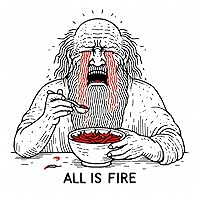
one cannot really want what one does not really need, and so the happiness of these deluded hedonists is always spoiled by something. Their typical vice is mempsimoiria: that is, they "blame fate", and are satisfied with nothing that comes their way, like the tyrant who will behead his guests if they flatter him - and if they do not flatter him. True pleasure, the Cynics often contend, can only be had by scorning it and by welcoming its opposite, pain. There will always be pain, and so rather than escape it, or try to control uncontrollable fortune, one should grasp the serpent by the neck (Stob. 3.1.98), put out the fire with ones tongue, rush into the fray fearlessly, and fearlessly stare down the barking dog (D. Chr. 8.17-19): that is, one should welcome pains as inevitable, love them, or at least accept them as ponoi, preparing one for the pleasures of the satisfaction that will come. Ponos, as both "pain" and "labour", becomes the Cynics' means for maximizing his pleasure. More paradoxically, pain is the cause of pleasure, and the Cynics are a strange breed of ascetic hedonists, or hedonistic ascetics. Or, rather, theirs is the hedonism of nature itself. Pleasure can exist in conjunction with pain. Therefore, “hunger is the best sauce" (as the Greeks said also) and only ponos can give piquancy to experience. "Despising pleasure is the greatest of pleasures", says Diogenes (DL 6.71), as he enjoys his "tub" more than Xerxes his palace
A long-winded overview of the book: This book goes into the history and influence of the Cynic "school" of philosophy. The term has its origins in the Greek word for dog, as the philosophers lived in a fashion, out in the open and shamelessly, that was pejoratively linked with the animal, which Greeks thought was sort of filthy, rather than man's best friend. They generally tried to free themselves from the burdens of human customs and lived instead for the present in nature. Nature they viewed as generally benign, and the world and people were good. Viewing the present as the only thing that men could truly know, it was important to bask in the here and now, rather than dwell on the past or future. Somewhat strangely for a philosophy, they were adamantly against book learning. Yet at the same time they seemed very inventive with literary styles and word play. Witty repartee seemed highly valued by them.
These philosophers were an odd lot, generally living simply, without home or employment, wandering around, stirring up trouble and generally living in the present. They ate simply, and scandalously by eating in public and in temples. Similarly some thought nothing wrong with sex in the public arena, for if animals would do such a thing, it is natural and cannot be bad. Rather than being fixated on patriotism and civic pride, they claimed to be "citizens of the cosmos." They wished to speak freely and rule themselves.
One fascinating way they prepared for this was to toughen themselves by being rid of the conveniences of contemporary society. No shoes, no warm clothes, no fancy hair cuts or shaving (and on occasion, radically shaving half of a head to show the ridiculousness of any style, and no fancy foods (perhaps even shunning cooked food (although how one would eat lentils and peas raw escapes me, and those were highly touted by the Cynics).
They seemed fixated on pointing out the foibles of elitism and conspicuous consumption as foolish wastes of efforts in trying to impress others, when one should be equal and love all of mankind. This philanthropy seemed to be a central tenet, along with self-sufficiency and speaking freely. However, this self-sufficiency often relied on begging, and the free speaking was often viewed as shameless self-promotion. Also, there were charges of hypocrisy.
As for the book, it does a good job of giving the background, although the first chapter is a long and occasionally tedious list of the major players in the school. More interesting were the implications of Cynics interacting with the world, particularly the political world, and how various Cynic views reverberated down to the present day. The contrast between Cynicism and modern cynicism is fairly wide, considering the optimism of the ancient strain and the pessimism of modern cynics. Lastly, this book has annoying references. If you aren't well versed in ancient literature, parathetical references like (Aug, De civ. D.) are not very helpful. All and all, it's an edifying read.
A wonderful history of the Cynics and how they influenced those thereafter. The claim that modern day cynics must find a way to return to the cheekiness of the classics sits well with me, as well as the core cynical ideal of living naturally.
This book was incredibly informative, and well organized, a fantastic read.
In Christianity the great sin of man was his separation from nature. His innate judgement mechanism was furthermore aroused by curiosity, so that he couldn't take his life for granted, his reason pierced through law, necessity, good and bad so to see for himself which is which. Thinking the nature separated the man from nature. Cyinsm foreshadows Christian's dogma of returning to the primordial unity, leaving all the futile behind, unconditionally love every human being, for we are part of the nature, and nature is good, she will provide for us if we trust her. Similarities of cynicism with Christianity are talked at length in this book, one very bold hypothesis in this instance for example, is that of considering Jesus a cynic. A life according to nature ("kata physis" in Greek) is a fundamental aspect of Cyinsm. Logically, whoever actively pursues the opposite direction is an enemy to cynics. To get to the point; cynics have no respect for custom, yet considering Prometheus act of enabling humans to bend the nature to their will and need a "crime" is one impacting cynic' opinion. And it is lovely. The author goes at length with every aspect while keeping an up pace rhythm and an well around cheerful tone. He refreshes the notion of "cynic", for he, the ancient one, is far from the gloomy idea of today. "Radical optimism" characterize their doctrine and those who read this amazing book might understand the author's powerful insight.
Excellent book, very readable and clear with excellent references. Before reading this book I thought I knew something about the Cynics, turns out I knew very little about them, their thought and lifestyles through history. After reading this book I know much more and have a strong admiration for them, not strong enough to emulate their lifestyle ;-), but enough to absorb much of their thought, and to know where some of mine come from - I owe them more than I knew.
An overview of the history and philosophy of the ancient Cynics, who, rather than the altogether misanthropic characters the word describes today, believed living simply and naturally, owning nothing one could not carry with them, bowing before no master, and focusing only on the here and now (in other words living like an animal in their natural environment, such as their namesake, the dog) is the true key to a healthy and happy life.
This is a pretty good introduction to Cynicism, and I think it's quite easy to understand. However, it assumes some prior knowledge of post-Socratic ancient Greek philosophical schools like Stoicism and Epicureanism.
These philosophical schools are related to each other, so it's helpful to have some basic understanding of ancient Greek philosophy before diving into this book.
But don't worry, if you're completely new to Cynicism, "Cynic" is a suitable book to begin with.
I don't know what I expected, but... Cynics are a breed of "philosophers" that were mostly like "dogs". They had sex in public, they deficated where they stood and did everything they could to put "it in the man's face" sort of thing. One of the main Cynics was called "dog". If I knew what it was going to be like I probably whould have read about Stoics.
I read this book on a rainy afternoon at a bookstore and was very satisfied. This book, for its length, offers a comprehensive assessment of the historical and doctrinal beliefs of the Cynics, as well as the biographies of their great thinkers. Though I did not buy it, being on a student budget, I think it would nicely compliment any philosophical cranny on the bookshelf.
Started out well but delved too far into extremes. I like the idea of renouncing (or at least questioning) traditional customs but this seemed to delve into an area where things just start to become counterproductive in everyday life. An interesting look at this chapter of history but I'm glad to society on some levels has moved past it.
I liked the earlier portions of the book on the lives of the ancient Cynics best and I of course wish more of their original writings survived as well as those of their contemporaries.