'Magisterial ... Immensely readable' Douglas Alexander, Financial Times'Insightful, productively provocative and downright brilliant' New York Times A compelling history of catastrophes and their consequences, from 'the most brilliant British historian of his generation' (The Times) Disasters are inherently hard to predict. But when catastrophe strikes, we ought to be better prepared than the Romans were when Vesuvius erupted or medieval Italians when the Black Death struck. We have science on our side, after all. Yet the responses of many developed countries to a new pathogen from China were badly bungled. Why? While populist rulers certainly performed poorly in the face of the pandemic, Niall Ferguson argues that more profound pathologies were at work - pathologies already visible in our responses to earlier disasters. Drawing from multiple disciplines, including economics and network science, The Politics of Catastrophe offers not just a history but a general theory of disaster. As Ferguson shows, governments must learn to become less bureaucratic if we are to avoid the impending doom of irreversible decline. 'Stimulating, thought-provoking ... Readers will find much to relish' Martin Bentham, Evening Standard
Niall Ferguson is a senior fellow at the Hoover Institution at Stanford University, former Laurence A. Tisch Professor of History at Harvard University and current senior fellow at the Center for European Studies at Harvard University, a visiting professor at Tsinghua University, Beijing, and founder and managing director of advisory firm Greenmantle LLC.
The author of 15 books, Ferguson is writing a life of Henry Kissinger, the first volume of which--Kissinger, 1923-1968: The Idealist--was published in 2015 to critical acclaim. The World's Banker: The History of the House of Rothschild won the Wadsworth Prize for Business History. Other titles include Civilization: The West and the Rest, The Great Degeneration: How Institutions Decay and Economies Die and High Financier: The Lives and Time of Siegmund Warburg.
Ferguson's six-part PBS television series, "The Ascent of Money: A Financial History of the World," based on his best-seller, won an International Emmy for best documentary in 2009. Civilization was also made into a documentary series. Ferguson is a recipient of the Benjamin Franklin Award for Public Service as well as other honors. His most recent book is The Square and the Tower: Networks on Power from the Freemasons to Facebook (2018).
“All disasters are at some level man-made political disasters, even if they originate with new pathogens.“ Discuss. In Doom, Niall Ferguson roams the world, history and even science fiction to examine disasters. There is no shortage holding him back. Too often, he finds midlevel managers at fault.
The disasters he investigates cover the spectrum from war to pathogens, floods, earthquakes and in the end, planetary invasions. It is an education, a peek behind the scenes, a rollercoaster and an argument rolled into one bubbling and appealing package. The conclusion is that government has and continues to fail us:
“Approaching disasters within this broader framework makes it clear that democratic institutions by themselves are far from a sufficient safeguard against disasters of all kinds—especially those that are not normally distributed but follow power-law distributions—regardless of whether we insist on classifying them as either natural or man-made.”
Ferguson examines various plagues through the ages, as knowledge of how they work gradually grew, and how such knowledge was usually ignored or abused by those in power. This of course is most evident right now, as the Trump administration bungled the COVID-19 pandemic so badly that the USA leads the world in all the worst categories.
The implications, he says, are gigantic. Not only do Americans not trust their own democratic government, which has been crumbling in terms of effectiveness and service since the 1970s, but now the world is rethinking its evaluation of American leadership and presence. Ferguson presents polls and data from all over that show how others no longer think America is a worthy leader, ally or partner.
This plays right into the hands of China, the up and coming contender to replace the USA. In what is the best, most insightful chapter of the book, Ferguson examines Cold War II, which China initiated years ago, to isolate and diminish the USA. Ferguson thought he made that up, but when he spoke of it to Chinese experts, no one protested or disagreed. It is an active, if undeclared war the USA is not fighting. Yet.
This is not a natural disaster, or a disaster of any kind, really, and readers will have to contort themselves to make it fit the theme. But it is the most interesting and thought-provoking concept presented, and it makes the book.
China’s Belt and Road program clearly seeks to displace loyalty to America with loyalty to China. It is spending hundreds of billions of dollars to buy friends in key places. Its aggressive actions in Hong Kong, the South China Sea and towards Taiwan are muscle-flexing to foreshadow things to come. China wants it all, and it wants it now.
It is gathering all the intellectual property it can, and all means are approved for use. (Its own scientists don’t seem capable of innovations leading to patents at all. The atmosphere is not really conducive to creativity, he says.) TikTok, the global Chinese social media app, collects data on individuals, opening the way to a global surveillance society that the Chinese at home must live under today. This goes beyond mere tracking of movements to include actions and even attitudes. Unapproved traits or actions can result in travel bans and forced re-education. Reputation is a critical, compulsory foundation-piece of Chinese life. China clearly seeks fans for this brand of repression worldwide, and money talks.
The chapter on the COVID-19 pandemic is the least satisfying, if only because it is far too early to write such a chapter. Ferguson’s data ends in August 2020, before there was even a second wave. And long before a potential third wave fueled by the new variants, now exploding globally. He says he has hopes that a vaccine might be produced soon, what with so many candidates in various trials. The conclusions he draws are of little use with the unpredicted acceleration of infections and deaths. Written in August of 2021 instead, this chapter would read much differently.
Nonetheless, at least one of his conclusions merits real thought: “But arguing that Trump could have averted the public health disaster is rather like saying that Bill Clinton could have prevented the dismemberment of Bosnia or the Rwandan genocide. It is like claiming that Bush could have saved New Orleans from Hurricane Katrina or avoided the 2008 financial crisis, or that Obama had the power to avert or end quickly the Syrian Civil War—or the capacity to save hundreds of thousands of Americans from opioid overdoses. All these arguments are versions of Tolstoy’s Napoleonic fallacy that do a violence to the complexity of political disaster by imagining the U.S. president as an omnipotent executive, rather than an individual perched atop a bureaucratic hierarchy that would appear to have gotten steadily worse at managing disasters over a period of several decades.”
Other chapters deal with death, disease and war, ranking them by their effectiveness in diminishing the population. Extremely detailed descriptions of the effects of things like plague and yellow fever add great levels of discomfort for readers. War, by contrast, seems to be straightforward slaughter in his hands. He dwells on World War I for the horror we no longer think of it as being, restoring its place in the pantheon of disasters.
There is a chapter on the zoology of disasters, as the current fashion would have it. There are gray rhinos, black swans and dragon kings scampering about, wreaking unprecedented havoc. Hurricanes get personalized with human names. All of them have one thing in common – doom.
Meanwhile, back at government, it is fairly common to blame government for famines (and justifiably so), but Ferguson points to wars as the ultimate of manmade disaster, a perspective we don’t often appreciate. Recently, remote control wars have limited the toll on soldiers, but civilian deaths, the real crime, are as out of control as ever. Nonetheless, soldiers in World War I were far more likely to die from disease on the way to battle than in battle itself. It turns out that was a very common situation throughout history.
Also common throughout history is defiance of quarantines. Life must go on, even if it means killing yourself and your family. Today, masks are fiercely resisted once again. Several writers have compared them to condoms, which have the potential to stop HIV infections and are similarly resisted. The HIV pandemic was the COVID-19 of its day, frightening the whole world. Today, there is still no cure or vaccine to cancel HIV.
In pandemics and plagues, government has often given horrible advice and direction. Mao’s stunning famines were of his own making. In the Irish famine, the strictly Christian English government refused most aid to the Irish and even continued exporting oats away from Ireland, because it was clearly God’s will to punish the evil Irish, and the English government wasn’t about to cross God. Others, like Trump, were simply not up to the task and kept saying it would magically disappear by itself, we’re turning the corner, we’ve got it beaten, we’re leading the world in dealing with it, it’s really hard to get, it’s nothing to worry about, etc., until deaths near half a million and total cases pass 25 million as I write this. China reveals only what it wants to, and directs the population, right down to the individual, in attempting to manage it all for public relations purposes.
So what general conclusions can we draw form all this misery? Ferguson coolly says: “Most disasters occur when a complex system goes critical, usually as a result of some small perturbation. The extent to which the exogenous shock causes a disaster is generally a function of the social network structure that comes under stress. The point of failure, if it can be located at all, is more likely to be in the middle layer than at the top of the organization chart. When failure occurs, however, society as a whole, and the different interest groups within it, will draw much larger inferences about future risk than are warranted—hence the widespread conclusion from a small number of accidents that nuclear power was chronically unsafe.”
Regardless of the potential for death and doom, people carry on regardless, always believing it won’t happen to them. And despite all the evidence to the contrary, so it must be.
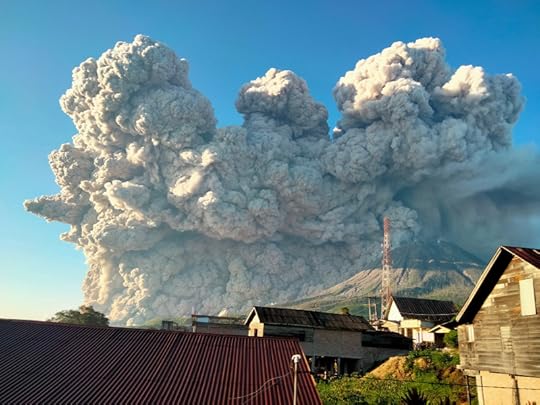
“Doom” by Niall Ferguson is analogous to a hastily and haphazardly whipped up world encyclopedia. While the reader is treated to an extraordinary variety of incredible information, she is also plagued by data fatigue. This feature of death by data detracts, from the original essence of the book, which in itself is extremely engrossing and absorbing. Ferguson, a Scottish historian and the Milbank Family Senior Fellow at the Hoover Institution at Stanford University, claims that most of the disasters that have rocked humanity is man-made. Even some of the greatest convulsions of nature such as tectonic earthquakes and roaring volcanic eruptions cause untold misery because of humanity settling and resettling on fault lines and in vulnerable cities. When Mount Vesuvius for example left Pompeii in smoldering ruins, in an apocalyptic explosion, it did not take time for the ruined city to be once again transformed into a teeming and bustling hotbed of trade. But in trying to arrive at this conclusion, Ferguson takes a path that is extraordinarily and excruciatingly circuitous. The exploits of Pliny the Elder in courageously venturing towards Pompeii to chronicle the devastation, before suffocating to death takes up quite a lot of pages and consequently the reader’s time.
Ferguson’s novel reasoning is based, to a great extent, on the three concepts of “gray rhinos”; “black swans” and “dragon kings”. The term gray rhino as popularized by American author, commentator, and policy analyst, Michele Wucker, refers to an event that is “dangerous, obvious, and highly probable”. Classic examples being Hurricane Katrina, and the Financial Recession of 2007. A black swan event, on the other hand, according to author Nicholas Nassim Taleb, refers to a situation that “seems to us, on the basis of our limited experience to be impossible.” The COVID-19 pandemic that is at the time of this writing wreaking havoc is a black swan event. Professor on the Chair of Entrepreneurial Risks at the Swiss Federal Institute of Technology, Didier Sornette defines a dragon king as an event so extreme that it lies outside a power law distribution. According to Sornette, examples of dragon king events can be found in six domains: City sizes, acoustic emissions associated with material failure, velocity increments in hydrodynamic turbulence, financial drawdowns, energies of epileptic seizures in humans and animals, and possibly earthquakes. Dragon kings “are extreme events that are statistically and mechanistically different from the rest of their smaller siblings.”
Ferguson also writes that when it comes to any disaster, the scale of damage is dependent on the contagion. Social network structure plays out a vital role in this regard. Banking on the concept of weak ties as elucidated by Mark Granovetter, Ferguson identifies the importance of nodes and networks. For example, the spread of the COVID-19 pandemic is a direct factor of the basic rate if reproduction, which in turn is a direct outcome of adherence to or neglect of social distancing norms. Paraphrasing Emile Durkheim’s term for elucidating an element of disconnectedness associated with modernity, Ferguson writes that “an economy without crowds is not a ‘new normal’.
This notion of network effects, says Ferguson is also corroborated by the founder of the Ethernet, Robert Metcalfe. According to Metcalfe, greater the number of nodes in a network, the more valuable the network to the nodes collectively, and therefore to its owners. “The history of mankind’s changing susceptibility to infectious diseases tends to be written as a history of pathogens. But it might make as much sense to tell this history as the story of our evolving social networks.”
Ferguson also dwells on two types of errors that primarily trigger manmade disasters, namely, active, and latent errors. Initially proposed by psychologist James Reason, active errors represent errors that are perpetrated by people who are in direct contact with human system interface. Active errors can either be skill-based, rule-based, or knowledge-based. On the other hand, latent errors according to Reason, are the “delayed consequences of technical and organizational actions and decisions – such as reallocating resources, changing the scope of a position, or adjusting staffing.” Ferguson uses the examples of active and latent errors to describe the sinking of the Titanic and the Andrea Gail. Ferguson also claims that untrammeled advances in the field of transportation and conveyance in the form of steamships and rail networks spread disease across continents. The spread of from the Ganges to the rest of the world, for example.
In the final chapters, Ferguson dwells on a potential conflict between two behemoths, the United States and China, which has the potential of bringing untold harm to the world. He also mulls on the potential perils of artificial intelligence and genome mapping which may bring misery to mankind if fallen into wrong hands. A clustered regularly interspaced short palindrome repeats (CRISPR) technology facilitating gene editing is now so cheap that a genetic engineering home lab kit was available for just $1,845 in the year 2020. Ferguson ends his book with references to a whole horde of Dystopian works which presciently predicted novel and unique disasters. Mary Shelley’s The Last Man, Emily St. John Mandel’s Station Eleven, Yevgeny Zamyatin’s We, George Orwell’s 1984, Aldous Huxley‘s Brave New World and Philip K. Dick’s Do Androids Dream of Electric Sheep all make the cut.
“Doom” is an unrelenting compilation of events, situations, circumstances, and outcomes. It is also a confusing assemblage of qualitative and quantitative information that has the ability to send the reader into a dizzying journey. While the assertion that most, if not all, catastrophes that has plagued mankind thus far is attributable to manmade causes, is bold and ingenious, the back up arguments in favour of such a proposition are, unfortunately convoluted, contrived, and complex. On the whole, “Doom” represents fodder for thought and further evaluation. Currently we as humanity are going through some extraordinary times. Conflicting prerogatives such as vaccine diplomacy and vaccine nationalism are tugging and pushing at the invisible strings of emotion. As the word grapples with a calamity of unimagined proportions, how we tide though this crisis would not just represent a reflection of who we are as an interconnected global family but also how we are as evolved human beings of character.
“Doom” – just a beginning of possibilities, extensive.
(Doom: The Politics of Catastrophe by Niall Ferguson is published by Penguin Press and would be released on the 4th of May 2021)
Ferguson seems more concerned about showing off how much he knows than he does about getting his actual point across. This book feels to me like the encyclopedic ramblings of a self-important man who’s been cooped up in quarantine for too long. I’m 109 pages in and have lost faith that the rest of the book will be worth the time.
Lo que nos cuenta. El libro Desastre (publicación original: Doom. The Politics of Catastrophe, 2021), con el subtítulo Historia y política de las catástrofes, es un intento de ofrecer al lector una historia general del desastre y su correspondiente gestión, ya sea biológico, geopolítico, tecnológico u otros, desde una perspectiva que conecta los eventos con la economía, la cultura, la política y la sociedad para sostener su hipótesis de que, en todos los casos, es la acción humana la que origina, permite, favorece o gestiona mal dichas catástrofes.
¿Quiere saber más de este libro, sin spoilers? Visite:
A lengthy historical examination of the political drivers of Catastrophe (natural and man-made : one of the author’s key points is that even naturally arising catastrophes are man-made in their severity) – one which is never entirely dis-interesting in the issues it discusses and arguments it advances but is also never really coherent in pulling those issues and arguments together.
There are two comments pertinent to the writing and presentation of this book.
Firstly it made use of extensive sources – there are nearly 60 pages of small font references at the back of the book. Now while it is impressive that the author is so widely read and makes the book have an academic historian feel, it does feel like he has perhaps done a little too much research and not enough editing, or to put it another way too often he seems to simply state facts and figures or reproduce quotes from his sources without enough in the way of synthesis (see below) or sometimes explanation. As an example there is a very interesting review over 3-4 pages of the origins and natures of various diseases but it is littered with scientific terms.
Secondly for a book which sets out to provide a historical perspective on catastrophes and in particular to link those to the COVID-19, the book was written very much in the relatively early days of the crisis. It is in many ways brave (and possibly admirable) to see an account written during the crisis and trying to come to terms with it and bring a historical perspective. However an account largely compiled up to late Summer 2020 and completed that Autumn can feel very out of date even in early 2022 when I read this (there is notes on vaccines in development and a paragraph which speculates about the small risk waning immunity and variants – but otherwise the book captures very little of the reality of COVID-19 in 2021).
And in some cases these two faults come together – for example one chapter is named (after Keynes infamous post Versailles Treaty tract) “The Economic Consequences of the Plague” but seems to largely consist of a forest of statistics as well as precis of the views of various economists, econometricians and financial forecasters and commentators which is both hard to follow and out of date.
There are though lots of interesting ideas in the book – albeit not very many original ones.
He starts by examining historical societal attitudes to death, disaster and doomsdays. He argues interestingly, if controversially, that climate change activists fit into an eschatological tradition of forecasting doom and demanding extreme and penitent action.
The second chapter is rather odd – attempting to demolish several cyclical theories - his arguments effectively being that the power law nature of extreme disasters means they do not follow cycles, and that most cyclical theories are too simplistic and ignore interplays. He for example takes time to explain why he disagrees with Jared Diamond’s “Collapse” – which is interesting but also points at a weakness with this book – a book with a simpler, easier to express idea is often much more memorable and impactful while most readers can work out for themselves that any such approach is inevitably reductive and not the whole picture. He then crowbars in a discussion of Kahneman/Tversky cognitive traps to show why we do not react “logically” to those warning of disasters.
Ferguson is fond of the ideas of “Black Swan” (from Taleb) together with Michele Wucker’s “Grey Rhino” (events which are dangerous, obvious and highly probable but which in many cases society still avoids) and argues that in some cases a misunderstanding of power-laws (a recurring theme) means that large grey rhinos are somehow seen as Black Swans – even more so when the events are so extreme they sit outside even power laws (often associated with phase transition or tipping points) and become what Didier Sornette describes as “Dragon Kings“. He then looks at a number of natural disaster types and argues that the magnitude of the resulting loss of property and life is as much as a property of man made decisions on where to locate settlements and infrastructure (often in defiance of common sense and historical records) than the peril itself – something of course obvious to catastrophe modellers in insurance companies with a split of peril and vulnerability models and exposure databases.
His fourth chapter covers Network effects – much of this is a rework of the ideas in his book “The Square and the Tower” but he does argue convincingly for the importance of social networks in propagating epidemics and how even older societies despite typically completely misunderstanding the causes of famous epidemics and diseases intuitively understood the need to disrupt social networks to stop them spreading.
The fifth chapters argues that while we have seen great progress in scientific understanding (eg of diseases and epidemics) in the last 200 years, this has to be offset by some of the wider networks spurred by globalisation. He also argues that the Spanish Flu at the end of World War I showed the then limitations to the scientfic advances.
The next chapter looks at political incompetence – he takes Amartya Sen’s argument that famines almost never occur in functioning democracies and are caused by unaccountable governments and avoidable market failures and then extends this to other disasters including wars – but this chapter feels like a warm up for the view that the standard of public government/administration in both the UK and US has declined significantly over the last decades and this is a large part why both countries failed to deal with COVID-19.
The next chapter starts with what he sees as a successful attempt to deal with a pandemic – the response of the Eisenhower government to the dangerous 1957 flu epidemic where he argues that a nimble federal government (that had learnt from past mistakes) as well as international co-operation (even across the then very wide Cold War divide) led to a low number of deaths but without blanket lockdowns but instead targeted non-pharmaceutical and pharmaceutical interventions. He then looks at how AIDS was something of a federal disaster and how MERS/SARS/Ebola all proved challenging (albeit the deadliness and short period between peak infection and clear symptoms was a limiting factor for each).
The next chapter looks at the fractal geometry of disaster – its core argument being that even small disasters tell us a lot about large disasters. In practice the chapter more looks at some of the world’s greatest disasters but from different perils – effectively accidents (plane crashes, ship sinkings, nuclear disasters, spaceship crashes). His key point and one he is very keen to draw out is that the key failings are typically not in the leaders or in those on the coal face but in middle management/bureaucracy – something which fits his views on COVID and the culpability of the various federal and local organisations that should have dealt with it rather than top politicians (in previous chapters he argues against a Napoleon/Great Man theory of history.
After the two COVID chapters the book takes a rather abrupt turn into examining the US-China relationship in a chapter which feels like it would be better covered in more detail in a different book.
A final chapter looks at possible future shocks and interestingly draws heavily on speculative fiction for its ideas.
While the rest of us spent lockdown learning to bake sourdough, Niall Ferguson applied his intellect to the task of placing the pandemic in historical context. In Doom, the Scottish-born Harvard historian sets out to understand why humanity, time and again through the ages, has failed to prepare for catastrophe.
There’s no doubt that Ferguson's inquiry is dazzlingly broad, covering a host of natural and man-made disasters. He mixes Vesuvius, wars, famine, Chernobyl with a variety of disciplines. These range from network science to epidemiology. However, I found the whole thing a massively confusing, rambling mishmash. An unconvincing blend of statements of the readily apparent and laborious theorising. Was the pandemic a black swan (an unexpected event that catches humanity unawares), a grey rhino (an obviously dangerous event that people nonetheless do nothing about), or a dragon king (an event that flattens civilisation)? Ferguson says it was a grey rhino. Ok, so? And when not playing with grand concepts, he indulges in tiresome liberal-baiting. For example, Black Lives Matter was a "contagion".
Another problem with this book is that it is already outdated. Concluding his narrative last autumn, Ferguson predicts the Covid-19 pandemic will be remembered not in the same league as the 1918 Spanish influenza, but rather the (now largely forgotten) Asian flu of 1957. A lot, however, has happened since: the second wave, the emergence of scary new variants, and the roll-out of vaccines.
I’ll save you the job of wading through this. Insofar as the book has an overall thesis, it is that disasters are usually less the product of poor leadership than of vulnerabilities of the system.
Feels like reading thousands of tidbits from a thousand Wikipedia pages. No wonder there's 62 pages of reference. Ferguson obviously knows a lot and likes to show it, but he would be more interesting in a quiz show in common knowledge than as a writer. "Doom" presents theory after theory about anything without linking any of them together in a coherent way.
Nem tudom, most akkor én változtam meg, vagy Ferguson, de valamelyikünk biztos. Emlékszem, jó tíz éve milyen elementáris hatással volt rám a „Civilizáció” című kötete, aztán meg „A világ háborúja” is. Olyan műveknek találtam őket, amelyek minden hiányosságukkal együtt egy új világmagyarázat igényével léptek fel, és arra késztették az embert, hogy átstrukturálja azt, amit a dolgokról tud. Ugyanakkor már legutóbbi könyvénél, „A tér és a torony”-nál is némi blöffszagot orrontottam – mintha egy érdekes, de nagyjából kétszáz oldalra hitelesített tanulmányt igyekezne a szerző felpuffasztani minél nagyobbra, mert úgy tekintélyesebb. Ráadásul a felpuffasztás melléktermékeként megkísérli gondolatrendszerét olyannyira univerzálissá tenni, hogy az a végén épp azért nem lesz igaz, mert az írói szándék szerint mindenre igaz.
Most meg ugye túl vagyok ezen a köteten is, és konkrétan meg vagyok győződve róla, hogy Ferguson csak olyan méretű könyvet hajlandó nyomdába adni, amivel aztán embert is lehet ölni. „A katasztrófa politikája” központi magja két, a maga nemében okos, provokatív tanulmány, az egyik a Covid-járványról szól, és szerintem 60 oldal lenne a normális terjedelme, a másik meg a Kína-USA közti „második hidegháború”-ról, ami szerintem optimálisan 30 oldal. De hát milyen bendzsa lenne már, ha a szerző ezt a két tanulmányt csak úgy pőrén megjelentetné mondjuk a The Economist-ban? Szóval inkább csinál belőlük egy világmagyarázatnak álcázott böszmét azzal, hogy egyfelől ilyen-olyan módon átkötéseket teremt a két téma között, másfelől meg beilleszti őket egy általános katasztrófatörténetbe. Aztán az egészet megkísérli felfűzni egyetlen közös paradigmára, ami nem könnyű, mert a Vezúv kitörése, az első világháború, Csernobil vagy a pestis merőben különböző események, de sebaj – a kapocs közöttük az, hogy emberekkel történtek, és az emberek reagáltak rájuk. Igen, kábé ennyi.
Azért adjuk meg a szerzőnek, ami jár neki: ha blöfföl is, elég jól csinálja. Ha például a könyvet egyfajta katasztrófalexikonként olvassuk, akkor hasznos olvasmány, mert sok érdekességet leír mindenféle (szelektíven összeválogatott) szörnyűségről. Tényleg csak annyi a baj, hogy a kötet többnek akar látszani, mint ami. Nem elégszik meg azzal, hogy érdekes, hanem univerzális is akar lenni. Ám hiába csillant fel helyenként tetszetős magyarázatokat – ilyen például Barabási Albert-László hálózatelméletének alkalmazása a járványokra -, azokról jobbára kiderül, hogy 1.) csak a katasztrófák egy bizonyos halmazára húzhatók rá 2.) esetleg nem is a szerző találta ki őket. Ezzel együtt helyenként bele tudtam feledkezni, mert Ferguson lendületesen ír – de annyira sosem, hogy felül tudjak emelkedni megalapozott gyanúmon, miszerint ennek a könyvnek nagyobb a füstje, mint a lángja.
Ferguson is so dang smart and interesting that it frightens me.
This is a short history of disaster.
So yeah.
I’m in.
Of course.
Ferguson makes the point that all disasters are man-made. In other words, earthquakes are only disasters because people build stuff like skyscrapers and nuclear power plants on fault lines.
Otherwise it would just be a rumble in nothingness.
After a bit of theory, Ferguson takes us on a historical misery tour of plague, famine, war, and sundry such.
The back nine of the book focuses on COVID-19.
And Ferguson has interesting politics.
So you’re never quite sure what he’s getting at, but he’s clearly always getting at something.
He identifies as a “classical liberal” i.e. he advocates civil liberties under the rule of law with an emphasis on economic freedom.
So in other words.
He’s like a smart Republican.
Without the crazy Trump-Tard Qbased paranoia, xenophobic racism and Christian zealot homo hatred.
And (and)…
He’s European.
So it’s all a little more reasonable than we’re used to over on this side of the pond.
Anyway.
It’s interesting and refreshing to read something (anything) on this subject that isn’t utterly entangled in ridiculous, polarizing nonsense.
My three stars probably don't fairly reflect the thought and scholarship that Niall Ferguson put into this work. It was good, but I essentially felt that he throws so many facts, figures and historical examples, his thesis tends to be somewhat clouded.
As far as I can tell, this was basically a book that says: life is complicated, we are not that great at predicting the future because it is complicated, and societal solutions to these complex disasters suck because they themselves are complicated. No arguments on the thesis (if I'm reflecting it accurately), but Ferguson doesn't really give us much new to chew upon.
Indeed, history is full of examples where some sort of disaster comes along and sets human civilization back a step of so. Some, like the black death of the middle ages, have large-scale, long-term and wide-ranging effects, while others, like a localized earthquake, are somewhat contained and practically forgotten in a generation. Ferguson gives us many historical examples and classifications of various disaster scenarios, and does readily show us how our human responses, i.e. political responses, can either mitigate and exacerbate outcomes.
Many reviewers have criticized Ferguson for trying to write a book that uses the Covid-19 pandemic as a prime example. Since he was writing mostly in 2020, they argue it was a bit too early to draw any valid conclusions. I don't really see this as a fair criticism, as, although he uses the recent pandemic as a key example, he uses it because it is timely and not necessarily because we had learned the results of our approaches. He was comparing the response to past responses of the body politic, and the trends are indeed similar. If anything, I think Ferguson was relatively far-sighted with his analysis of the political response and its shortcomings in some areas and its strengths in others. He also glimpsed some of the fallout that we are now encountering with rampant inflation and the ratched-up intensity of global politics, especially between the West and China and Russia.
In short, this is a decent book but perhaps targeted at the more academic reader. For magnitude of footnoted facts tends to obscure the message for the rest of us.
This is the kind of book ChatGPT will be able to write with the simple prompt: “List all the catastrophes of any kind with little commentary and no synthesis.”
So yeah, it’s basically a list of disjointed history facts slammed out to profit from the covid hysteria and make a quick buck.
A better title would be: 'Brief Discussions of Some Catastrophes Throughout European History, and Three Chapters Summarising the COVID-19 Pandemic'.
The first of these two main sections (the discussions of historical catastrophes) was certainly interesting, and I enjoyed learning more about the Black Death, Spanish Flu, etc., but it didn't provide much in the way of historical analysis. If we're here to learn about the Politics of Catastrophe, I would expect that we would be seeing some historical patterns in the way people/cultures/organisations/governments responded to catastrophes and were shaped by them. There must be some kind of historical resonances that make these events similar to each other, and we must be able to discern some rippling effects that they have on our societies, in a way that is inherently human and meaningful. But if that kind of thing was to be found in this book, I failed to see it. There wasn't a message or a piece of wisdom that I could take away from my reading of this book. Still, interesting!
As for the COVID-19 stuff, it was almost painful to read. He uses the same approach as in the earlier chapters (information without much analysis), only now he has access to such a wealth of finely detailed information that we are subjected to a blow-by-blow account of how the pandemic unfolded in the Western world. None of this will be a revelation to anyone who has kept up with the news for the last two years, even in a casual way (which my relationship with news definitely is). The pearls of wisdom are rather insipid (e.g. highly networked societies with rapid transportation and crowded events are a good way to spread a contagious virus - who knew!), and the connections between our current catastrophe and the catastrophes of the past are not explored nearly enough to make any kind of sense from it.
I wouldn't recommend this book very strongly. If you are curious about Pompeii, plagues, Spanish Flu, the earthquake of Lisbon, Chernobyl, or any of the awful calamities of history, then you would be better off finding a book specifically about those events instead. If you want to read more about COVID-19, then you need a news subscription.
This was almost entirely a waste of time. It reads like a wikipedia list of disasters without really diving deep on any of them. There is really only one interesting chapter. This is primarily an information dump without any commentary with exception of The Three Body Problem chapter.
COVID's rampage across the globe has changed everything. We all know it, we all sense it, and to some degree, we see it. But how much? How permanent will those changes be? And what does it it say about our collective fear of catastrophe striking us out of the blue? Niall Ferguson has written a fascinating study on the general theory of disasters throughout history, showing why we seem to never really learn from them. Indeed, as Ferguson points out, we actually seem to be getting worse at dealing with becoming more bureaucratic and complex in our responses which seem never to truly address the threat at hand. Ferguson's analysis is deep and, as par for the course with all of Ferguson's works, deeply and richly researched. There is a lot here for practitioners of political risk to mine in their work. A great read and superb resource.
Yes, as other reviewers are saying, this is a hastily thrown together mashup loosely tied around the theme of mankind's disasters - manmade and natural. The first few chapters read like a freshman's attempt at a 'paper' that is really just a mashed up wikipedia-fest. As he gets on to the various forms of plague it gets more interesting. NF is clearly quite a formidable historian, and he does a good job of being informative (I did not know that half of Napoleon's Grand Army that went into Russia died of typhus rather than cold), and tying things together. The last few chapters however descend into a rambling, uninformative circus of speculation and prophesy. Really, I would not bother with this book if I were you (presuming you have not read it already), although I get the feeling that NF's more historical books might be worth tackling.
This book is a hastily-thrown together mess. It's obvious Ferguson took an existing idea and then tried to force the Wuhan Plague into his pre-existing frame, and the results are not pleasing. We can leave aside the unscientific Covid alarmism (he wrote in October 2020, in Montana, where he had fled), and the sloppy editing. Ferguson just doesn't say anything especially coherent or insightful; he merely strings together banal musings and history lectures about topics the well-educated already know. Boring and disappointing.
“We are all doomed.” That’s basically how Niall Ferguson starts the first chapter of his latest book to emphasise the inevitability of death. As suggested by the four horsemen of the Book of Revelation—Conquest, War, Famine, and the pale rider Death—, it looks highly unlikely that disasters could be predicted and much less avoided. According to Ferguson, in every disaster, there will always be a Cassandra figure who prophesied the upcoming catastrophe, much as the real Cassandra warned the people of Troy about the attack of the Greek warriors who were hiding in the Trojan Horse while they were celebrating their victory over the Greeks with feasting. However, her warnings were disregarded by her people. In 2015, Bill Gates took the role of Cassandra in telling us that we are not ready for the next epidemic after his lessons in handling the Ebola epidemic in West Africa. In this sense, it is a kinda unique proposition that many of the Cassandra figures will be largely ignored due to the inability of the common people to comprehend the warnings prior to the disasters.
Much of this book draws heavily on the previous work of the author, The Square and the Tower: Networks and Power, from the Freemasons to Facebook (2017) which highlights the importance of networks to understand historical events. And as in his previous book, I find that this latest book by Ferguson also lacks focus. It’s as though he wants to explain from A to Z about the history of catastrophes and the political events that accompanied them. His central idea is every disaster whether they are man-made (war and famine) or natural (earthquake, flood, volcano eruption, plague), is essentially at some level man-made political disasters (p. 381). There is a detailed explanation on why the United States as a country that used to be a leader in overcoming the 1957-1958 influenza pandemic from limiting the contagion into developing the vaccines, ended up with ineffective mitigation measures to COVID-19 pandemic. Much blame has been attributed to President Trump’s dismissive attitude, but there’s much more to discover through Ferguson’s analysis in this book.
According to Ferguson, it is important to understand the concept of networks to overcome the outbreak of COVID-19. His research has shown that in every epidemic case in the past, there is always the role of superspreaders—people who were not aware that they were infected by the virus and ended up infecting other people who are within their networks. In this sense, the superspreaders are within the highest degree of centrality in their networks, and it got much worse with the way our globalisation support the network further. It deconstructs the complexities of our networks and how fragile it is to take down a complex system by only taking small factors to disrupt it. It is interesting to see how his theory of network could be applied to analyse the shortcomings in COVID-19 mitigation strategies and why most developed countries turned out to mishandle the pandemic more than some of their developing counterparts.
Even so, much of the contents in this book remains speculation. For the analysis on COVID-19 pandemic parts, the literature that Ferguson used are derived heavily from news and the latest trends. It remains uncertain what the future of the post-COVID-19 pandemic looks like, even though some of the predictions that the author offers does ring true. It looks to me that this book is research that is hastily carried out to fit the momentum of the COVID-19 pandemic. It hardly offers something new in terms of mitigation strategies, besides the actuality of the case being discussed in it. If I were Ferguson, I would opt to wait at least a few more years before trying to put up a discussion on the COVID-19 pandemic to gain a better picture of what lays ahead. I am in the opinion that this is a working book, which might need further revision to meet the real conditions of what will really happen during the course of the COVID-19 pandemic, otherwise, it will be dismissive of some important factual events.
And finally, as Ferguson has said at his conclusion, we might get some better understanding of what awaits us in the future by turning to the works of science fiction. In the words of Paul Samuelson, declines in US stock prices have correctly predicted nine of the last five American recessions, but science fiction has correctly predicted nine of the last five technological breakthroughs (p. 395). There is an element of freedom of expression in science fiction that it’s not constrained by traditional fictional boundaries. In 1981, Dean Koontz wrote in his novel The Eyes of Darkness with the setting of a world devastated by a man-made virus called Wuhan-400 since the virus was developed at RDNA labs outside the city of Wuhan (too much of coincidence with the city where COVID-19 was originated!). Albeit, the Wuhan-400 in Dean Koontz reality has a 100% fatality rate, which is different from COVID-19 which discriminately favours older people and spare the youngsters. Overall, I would recommend Ferguson’s latest book for his thorough references more than his analysis.
Thanks to Penguin Press UK for providing the electronic advance reading copy through NetGalley.
A reflection on catastrophe - from the difficulty of predicting 'black swan' events, to the influence of social networks on the spread of disease and the failure of mid-level corporate and political management to prevent crisis.
Curve-fitting is the unavoidable bane of anyone with high convictions. Niall Fergusson falls prey to this spectacularly in Doom in trying to accommodate Covid-19 events to his previously crafted narratives on historic trends. Unfortunately for the author, many Covid affairs have unfolded differently within a few months of the book's publication. If the author were to revise the book to include the new events, he would surely find ways to fit the new events too in agreement with his pre-formed views and conclusions. Still, such methods only expose the weaknesses of pop history - and the methods used to construct it - championed in the book.
The book is at its best while detailing and describing historic episodes of disasters. The episodes covered are from all over the world and span three thousand years. The author's biases are visible in the episodes he selects (they reflect the aspects of history he knows extremely well), but rich details that emerge from the author's knowledge base more than make up for the flaw.
The book also makes a handful of interesting deductions in these disjointed chapters that jump from one doom to the other. One such point is when the author shows how most disasters have been made worse by the incompetence of the prevailing authorities. That said, it is also equally clear that few governments will ever emerge unscathed or competent-looking in the face of egregious events, the way few communities come out intact when caught in the eye of a storm. Many other theories - like those on grey rhinos, black swans, dragon kings, or network effects - are less original, without new conclusions, but still imminently readable.
The author stops being an accomplished scholar and turns into another average individual with strong views on where the world is headed whenever he turns to Covid 19 and tries to project its vicissitudes on current politics/geopolitics. The lessons he tries to draw from historic episodes are contrived and carefully sieved to bolster the conclusions he had reached long ago.
A bit macabre, a bit dismissive, Niall Ferguson's upcoming history of catastrophe alternates between fascinating and a little too disconnected from reality, where frontline workers have boots on the ground. Essentially, everything but the sections actually dealing with COVID are excellent, well-realized, and highly interesting accounts of different disasters, the context in which they became all too possible, and the series of actors that played important roles, big and small. Meanwhile, the COVID insights (outside the scientific) are already too outdated and, as a result, too callous to be taken as seriously as I suspect the author would wish. Oh well. The final chapters, focusing on China and the role sci-fi has in predicting future disasters, more than made up for the slouching middle.
Did not finish. Book feels rushed; I suspect the publisher wanted to take advantage of the ongoing pandemic. The organization is chaotic with no real thesis, just a barrage of facts and figures about anything and everything. The author is coasting on his reputation.
Cum s-o spun elegant? Cartea asta este despre prea multe și despre nimic în același timp. Scrisă cu pandemia în gând, în timpul pandemiei (la începutul ei, dacă judec după momentul în care mă aflu, în primăvara-vara 2020), despre pandemie, își ratează mult ținta. În general, sunt de părerea că o carte despre un eveniment trebuie scrisă după ce evenimentul se stinge. Autorul a anticipat critica asta (pe care o numește „oțioasă”), care probabil i-a venit din multe părți, și se apără spunând că „cine poate spune când se încheie o pandemie?” și că „nu e niciodată prea devreme să începem să învățăm din greșeli”. Apărarea asta nu ține atunci când te avânți în previziuni despre efectele evenimentului care sunt deja demontate când iese cartea de sub tipar.
Autorul încearcă să înainteze un fel de teorie, o struțo-cămilă. Conform lui, 1. dezastrele sunt imprevizibile; 2. nu există o separare clară între dezastre naturale și cele provocate de om (război sau pandemie, efectele dezastrelor depind mai mult de factorul politic, decât de proveniența lor, pentru că dacă la nivel politic și administrativ un dezastru – inundație, furtună, tsunami, pandemie sau război – ar fi gestionat cum trebuie, nu ar mai fi dezastru); 3. erorile nu se fac la vârf, ci undeva pe la mijloc (intră, într-o oarecare măsură, în contradicție cu punctul 2), de funcționari și experți de nivel mediu; 4. contagiunea nu se datorează doar agenților patogeni, ci și contagiunii mentale, adică știrilor false și acțiunii ostile a unor actori pe rețelele sociale. O altă idee pe care o înaintează este că suntem mai vulnerabili la dezastre precum pandemia covid din cauza rețelelor în care trăim. Mă rog, într-un fel globalizarea e de vină pentru pandemie. Nu o spune direct, dar se înțelege.
Problema este că, chiar dacă a înaintat ideile de la punctele 2 și 4, autorul absolvă aproape în totalitate liderii politici de responsabilitate în privința efectelor pandemiei. Se axează cel mai mult pe SUA și UK, spunând că Trump și Boris Johnson au făcut greșeli, dar nu au fost chiar atât de grave. Îmi este greu să înțeleg punctul acesta de vedere. Când definești un dezastru prin felul în care acționează oamenii cu putere de decizie și mai spui că știrile false, manipularea, conspirațiile au un efect foarte mare în răspândirea unei pandemii, nu poți să spui că Trump, președintele țării, cu zeci de milioane de adepți fideli, dar adresându-se întregii populații, nu e responsabil de felul în care a fost gestionată pandemia știind ce tâmpenii a propagat în spațiul public și ce eforturi a făcut pentru a minimiza efectele pandemiei. Nu poți da vina doar pe birocrație, când toată lumea primea și aștepta indicații de la administrația prezidențială.
În fine, pandemia covid face obiectul a doar 1/3, poate 2/5 din carte. Restul cărții este plină de informații, într-o ordine aproape lipsită de logică (există multe capitole, dar nu reușesc să-mi dau seama acum dacă a tratat fiecare un subiect distinct), despre războaie, dezastre, pandemii, boli, vaccinuri, tehnologii și avertismente despre cum urmează lucruri rele, cum ar fi o confruntare rece (care deja a început) cu China. Ciorba lui Niall Ferguson are de toate.
Niall Ferguson clearly felt a strong compulsion to get busy on this, while he was in lockdown. Inspired by the events of our present pandemic he has gone looking for historical parallels in past contagions, and in human responses to disasters more generally, and what lessons they might have for our present predicament. It is therefore curious to me that he chose to bring the project to completion at a time (Aug 2020) when the full narrative of the virus was yet to be fully disclosed and, in many respects, so much more left to unfold. That is not to say that the book is flawed as such, but from the perspective of Mar 2021 it does feel essentially unfinished. It is a book rich in historical detail but perhaps vague in argument and conclusions drawn. Hence my headline 'too soon to tell'.
The book falls into multiple parts, the first of which forms the bulk of the text with an examination of disasters throughout history, both natural and man-made, some in the deep past, others in more recent memory. Points that are emphasised include that the border line between natural and man-made disasters can often be difficult to draw as political and cultural factors can often determine the impact that even a natural disaster can have and what kind of response can be mounted. Disasters often come in trains, disease and famine following on from and exacerbating war; population declines or migrations leading to political upheaval and so on. A point frequently made, and carried forward to the next section is that while it may seem obvious to lay blame with leaders for failed and botched responses it is more often than not the friction at lower levels of organisational hierarchies where the ultimate causes of such failures lie. He is keen to expose the 'great-man' view of history as untenable once one begins to examine the details.
The next section focusses on humanity's more recent brushes with pandemics, looking quite closely at the truly ghastly Spanish Flu pandemic of 1918-20, and the inadequacies of its handling (he makes less of the limitations of medical knowledge at the the time than he might have). He then examines the largely forgotten Asian Flu pandemic of 1957-58 which had a mortality profile very similar to the present Covid outbreak, at least as it stood in Aug, 20, but which predominantly affected the young and fit, thus having a higher impact on total years of life lost. At this time the US just got on with it, 'took it on the chin', and made almost no efforts towards quarantine and distancing intervention patterns. Fascinatingly, an irascible chap called Maurice Hilleman developed a vaccine. It was only 40% effective and arrived too late to be of help, but he went on to develop nine of the standard childhood vaccinations that we routinely administer to this day.
Then we come to a couple of chapters on the present Covid-19 experience. This is packed with seemingly endless details of newspaper articles, op-eds, scientific papers, congressional findings, from both sides of the lives saved vs. economic disruption divide. This all makes for a voluminous bibliography, and for anyone wanting to really sink themselves into the details for the rest of their lives they would be more than able to. Economist that Ferguson is he makes the point that using the typical actuarial value of a human life being worth ~ $10,000,000 then the equation of lives saved versus economic chaos and costs of mitigation measures rendered the earliest lockdown a mistake, at least in dollar terms. Of course, subsequent developments may well have rebalanced that equation to something more evenly decided. He seems motivated to moderate the popular blame of leaders, Trump and Johnson, both being heads of states that should have performed better in the crisis, given technical capabilities. Again it is friction down at the level of state/federal interactions in the US where the innumerable small failures in response accumulate. For the UK, he accuses Chris Witty of prevarication on lockdown and quarantine of air travel, with Dominic Cummings being the one to force the decisive response, pretty much the precise opposite of what I would have expected. So, in this section we get a blizzard of facts, opinions, contradictory studies and no chance of any proper clarity being achieved until we eventually arrive at a place with effective vaccines and the hi-tech variant detection programs which have suddenly arrived to replace an absurdly and possibly criminally bungled testing program with the sequencing technology with which the UK really was an established world leader. A long term consequence of its enforced leadership in the human genome project. Any conclusions as to who was to be held accountable; who should have known what was to be done, now lost down among the ranks of faceless and unaccountable civil servants, buried in the bowels of White Hall.
Lastly, a brief set of speculations on future possible tragedies and likelihoods of adequate responses completes the book. This rapidly takes a left hand turn into post-Covid territory such that we are focussed now pretty much on China's great power strategy for its region, and the south China Sea, more generally. This section does become a little spine chilling. I myself have my own concerns about China's super-power ambitions and about how quickly a new Cold War could turn hot. While it has long been clear that China's, indeed Xi Jinping's, most cherished foreign policy goal is the restoration of Taiwan, with Tonkin and Annam Vietnam a secondary objective, I find myself looking at developments in the South Eastern Asian region with a new and more jaundiced eye. The present instability in Myanmar/Burma of a ruthless regime that has got itself into debt entrapment with Chinese companies starts to seem like just the place that a nakedly aggressive China might pick to send signals of a new reality to the region and the wider world. It seems somehow that discussion here has drifted towards the possibility of a rather different type of disaster of the human deliberate variety. One that could put Covid into a rather more constrained perspective.
Lots to think about but leaves you to form your own conclusions.
Another stimulating and insightful read from Prof. Ferguson. While it's a challenge to write about the COVID pandemic while we are still in the midst of it, his comments and insights are not aimed towards predicting how it will develop and end, but rather on how people (collectively and individually) respond to disasters and catastrophes - including how they are not avoided, and even made worst, by group dynamics, politics, and other impersonal and personal forces.
This is the 10th book from Ferguson that I've read, and it's good to see him exploring discrete historical/political concepts that are not often really expounded upon (at least in popular works of fiction for a general audience), like networks of people - as he did in the The Square and the Tower: Networks and Power, from the Freemasons to Facebook, or, here, the politics of catastrophes.
Niall Ferguson, as I noted a few years ago in my review of The Great Derangement, seems to consist of two or more authorial personas. Having now read Doom, his most recent book, I can confirm and expand this observation. Ferguson indeed has multiple authorial personalities, and I believe that he gives voice to most of them in this book. (Although it's thoroughly footnoted and referenced, I find the archive-digging, monograph-writing historian is the missing persona in this book). But we do experience the scholar-data-digger; the purveyor of sweeping narrative; the innovative analyst; the philosopher of (and about) history; and the political commentator. Reading this book, I sensed that while quarantined by the pandemic, Ferguson performed a mind-dump into this book. But I say this not by way of criticism. The contents of Ferguson's mind never prove boring. Aggravating at times, yes; but never dull. When I went back in my blog over the last twelve years, I find many considerations of his work, some enthusiastic and some critical; but--at least to my mind at the time--certainly worth having read and commenting upon. This work doesn't disappoint, even if it is a bit unwieldy and unfocused.
The overarching theme of the book concerns the human reactions to catastrophes and how responses can vary for good or ill. Catastrophes happen; some are natural disasters, some man-made. We can can't control earthquakes or volcanic reactions in the least bit, nor can we hope to completely tame droughts and floods and hurricanes, although we've certainly--if unwittingly--learned how to exacerbate them. So while we have little or no control over the occurrence of some events, we do have a measure of control over how we humans anticipate and respond to natural and man-made disasters. ("Man-made"? Think "accidents" like Chernobyl, Three-Mile Island, Fukushima, Bhopal, mining disasters, plane crashes, and famines as examples.) Ferguson provides abundant examples and analysis of such occasions. Ferguson sometimes gets a bit long-winded with statistics and lists, but you come away with a comparative appreciation of the many events that have challenged humankind.
As Ferguson turns to the recent pandemic (now likely to morph into endemic status), he compares it to the 1957 "Asian flu." The comparisons and contrasts are intriguing. The response to the arrival of the Asian flu in the U.S. was more or less business as usual in terms of risk avoidance and daily life. Of course, in writing about COVID-19, Ferguson must shift from history to the journalism of current events (he completed his manuscript in late summer 2020), so some of these observations and anticipations don't have the benefit of hindsight that history offers. Here he treads on less solid ground, and he allows his contrarian and (politically) conservative instincts freer rein.
Toward the end, Ferguson explores The Three-Body Problem as manifest not only in Liu Cixin's sci-fi novel, but also as an analogue for the rise of China and its relation to the U.S. and the rest of the world. He also wonders (not unprofitably) off into Mary Shelley's The Last Man, Thomas Mann's Death in Venice, Margaret Atwood's MaddAdam Trilogy, and Emily St. John Mandel's Station Eleven, among others. Even the very learned historian must turn to the imagination of fiction, especially science fiction, to try to peer more deeply into the fog of the future.
I also want to mention that Ferguson talks about some who've written about the patterns of history. Of course, there are the older school, represented by the likes of Spengler and Toynbee. But more recently we find the work of sociologist Jack Goldstone and biologist-turned-historical theorist, Peter Turchin, both of whom have promoted the "structural-demographic theory" of social and political patterns of historical events. Ferguson thinks highly of this line of thinking, but he notes (correctly, in my opinion) that such patterns are not inevitabilities but likelihoods, given the "black swan" nature of events outside the dynamics of the patters, such as natural catastrophes (earthquakes, volcanos, droughts, floods, etc.) or wars. Ferguson also touches on the recent work of investor Ray Dalio, who's posted his claim of identifying a pattern of political-economic change. The same reservations--about the effects of exogenous shocks to the system (pattern)could modify or even destroy the pattern Dalio identifies (assuming he's in some measure accurate). Ferguson, as a historian and someone who seems to appreciate history as a way of knowing, has developed some interesting ideas of his own about the contingency of history and the use of counterfactuals. (In a future blog, I intend to explore more deeply Ferguson's ideas about history, his relation to the work of R.G. Collingwood (whom he's often cited), and criticisms of Ferguson's work in relation to Collingwood's, especially as set forth by my fellow Collingwood enthusiast, David Pierce (here and here).
Doom is a big, detailed work about what has and will no doubt continue to go seriously wrong in our world. It displays Ferguson's skills as an analyst, the breadth of his knowledge, his narrative skill, and his willingness to wade into controversy. Its classic Ferguson in one big book. And given that catastrophes of various sorts are unlikely to disappear by some magic of good fortune, we'd do well to consider what Ferguson has revealed, take heed, and govern ourselves accordingly. I don't recommend adopting a sense of doom, but we certainly could use of a strong dose of prudence.
Niall Ferguson has a remarkable ability to take a complex subject and explain it clearly. In this case he deals with how we deal with catastrophes. Not surprisingly he spends a lot of time on pandemics including the 1918, 1957 and Covid events. But he also deals with polio and even some events which are not disease related. This book is full of revelations.
For example, the "Spanish" flu pandemic in 1918 actually can be traced to Fort Riley Kansas - but the Spanish newspapers were more than ready to cover the story.
He has a couple of great quotes - After Three Mile Island - Jimmy Carter is quoted as saying to Jody Powell - "There are too many people talking and half of them don't know what they are talking about." Sounds like most of the public officials blathering on about COVID in 2020. Or this classic quote from Donald Trump (Ferguson is appropriately harsh on him) "When somebody is President of the United States, the authority is total AND that's the way it has to be." Or from Larry Summers on why the dollar would not be replaced as the reserve currency "Europe is a museum, Japan and old age home , China a prison and bit coin is an experiment." (Somehow Summers never gets talked about as someone with diplomatic skills!)
He also points out that most of the chatter as COVID was developing was on the threats of global warming. He has some choice comments about how each our recent administrations miss a developing trend by concentrating on the perceived errors of the previous incumbent.
He contrasts black swans (Taleb's idea of unexpected events) with grey rhinos (a danger that’s slow moving, obvious and yet is conveniently ignored) and dragon kings (a double metaphor for an event that is both extremely large in size or impact (a "king") and born of unique origins (a "dragon") relative to its peers (other events from the same system).
Ultimately this book offers two cautions - if we are going to get the benefits of increased integration (and he seems to think that is a good thing - as do I) we should be prepared for dealing with catastrophic events. Second, he has several excellent descriptions of the failures of governmental systems both in the US and in other so called developed countries.
Doom went to press in the late summer or early fall of 2020, because of this their analysis of the American election or COVID-19 is of limited value...though interesting. On occasion, the sheer weight of detail is distracting.
Otherwise, the book is a brilliant analysis of natural and manmade disasters and their outcomes. Definitely worth a read.
The eminent historian Niall Ferguson has delivered a formidable tract on the "general history of catastrophe," Doom. Ferguson's scope includes both natural and man-made disasters, which also enables one of the work's animating claims: even natural calamities tend to have elements of human or social failure that enable or propagate them.
Ferguson invests usefully in totaling the carnage of history's major catastrophes, highlighting how wars and pandemics have unquestionably had the most deleterious impact on human life. He then questions the predictability and cyclicality of, disasters, where he asserts that many tragedies are difficult if not impossible to predict, especially with specificity. It is unclear if Ferguson is making a case for improved forecasting or abandoning an emphasis on forecasting for general preparedness though. He goes on to distinguish between foreseen (gray rhinos), unexpected (black swans), and world-altering (dragon kings) disasters and then describes how network architectures constrain or enable the scale of disaster, pointing out that contagion (interpreted broadly) is usually necessary for dragon king effects.
After developing this history and partial theoretical framework, Ferguson shifts toward more contemporary commentary (recent pandemics, recent wars, recent accidents, and of course COVID-19). He is less sanguine about the capacity of science relative to thinkers like Steven Pinker, highlighting its previous failures to mobilize to predict, prevent, and allay doom of all sorts but especially disease. Ferguson is also a bit pessimistic about our governing and social institutions, highlighting the malice and incompetence of empires and nation-states (e.g. Rome, the USSR, Mao's China) and arguing the Western democratic governance has grown increasingly incompetent, especially in the vast bureaucracies of the USA and UK. Ferguson wraps up with an extended discussion of the COVID-19 pandemic, focusing on the failures at the bureaucratic level of governance and the potential effects on the "Cold War" between the USA and China. Ferguson concludes by asserting that our institutions should ideally develop greater resilience and Antifragility (see N. Taleb's book) so that when doom inevitably comes knocking we are ready and can grow through the pain.
Doom was an engrossing read though I felt Ferguson's thesis was a bit ambiguous. He's somehow on many sides of the same issue simultaneously, which is jarring. The work would have definitely benefitted from some reduction and a tighter focus. The work on network theory was intriguing (a clear strength of Ferguson's) and should have been developed and extended. However, I don't penalize him for the ambitious and wide-ranging nature of the project.
Any reader would benefit significantly from exposure to the content of this book and Ferguson's analysis of disaster history. It is clear he's extremely wide-read on the subject (including dystopian fiction) and very thoughtful, productively critiquing some of the sweeping theories of decline (e.g. Turchin's elite overproduction). In many ways I wanted Doom to be both more and less, but the reading experience was still edifying and entertaining nonetheless. I strongly recommend.
*Disclosure: I received an ARC for Doom through NetGalley.
Well, that's 18 hours of my life I will never get back.
What a disappointing book.
I haven't the faintest idea what this book was about. How Covid is similar to all other catastrophes and disasters of the past? Or how the reactions to Covid are similar to the reactions towards all other catastrophes in the past? How the way historians look at the world is wrong because they don't know enough about network theory to properly analyze and categorize how it affected the playing out of historical events and situations? How bureaucracy is bad? How populists and elitists both are idiots? How China is the greatest threat to world peace in the coming age?
I have no idea.
Oh, and by the way, the blurb on goodreads is wrong. This book is not about how our governments need to become less bureaucratic if we are to avoid the impending doom of irreversible decline, that idea merited barely 3 pages in the whole book. That may indeed have been one of his points, but if it was the main point, it was sadly underrepresented and underdeveloped.
I don't know what I learned from this book.
I don't know what the point of the book was other than to illustrate how vastly well read Niall Ferguson is and how utterly dismissive he is of American politics.
That's not to say that the book wasn't well written. It was. I found it fascinating to listen to. It's not to say that the contents weren't interesting. Again, they were. It's just that I have no idea what the overarching theme was. What tied all of the little stories and the little wanderings into network theory, chaos theory, and half a dozen other theories, together? I haven't the faintest idea.
Not only can I not get a grasp on what the intent of the book was, I can't get a grasp on the beliefs of the author. I don't know what his worldview is. Half of the time I was nodding my head in agreement, and half the time I was deeply offended. The cavalierness of his attitude towards some things and the absolute certainty with which he stated other things just got my hackles up. At the same time that he said that Obama couldn't be blamed for the increase in deaths of despair under his leadership, because Ferguson doesn't aspire to the great men of history lens by which to interpret history, Trump can be blamed for not responding to Covid properly and thus the deaths that happened. You can't have both of those things. Why can't we just say both men are to blame, at least in part, for having policies in place or supporting policies that contributed to negative outcomes?
I don't think this book has aged well, or will age well, I think that it's way too early to write a historical analysis of Covid when Covid is still happening or at the very least the effects of Covid are still happening. We don't know what the long term effects of Covid are, we can't even accurately determine how many people actually died of Covid; it wasn't as if autopsies were being performed on every person who died during that time. We have a hypothesis, that those who died while testing positive for Covid, died from Covid. This is a logical, and rational hypothesis, but it is a hypothesis. It is not a fact. The truth is, we don't know. Just like we don't know a lot of things. Does a patient who dies of congestive heart failure die because of their heart? Or because of other things that coincide with a failing heart, like water in their lungs? The original cause is the heart failure, but the proximal cause of death is the water in the lungs. Which one do you put down? If something about which we know as much as we do, like congenital heart failure, is hard to parcel out, why do we think that Covid, something we know very little about, seeing as how it just came into being 3 years ago, would be simple? It's laughable how certain we all are in our guesses and opinions and how willing we are to shove them down other people's throats.
One such area of certainty was when he called the idea that Covid came out of the Wuhan lab nothing but a conspiracy theory, whereas it's probably far better to say, we don't know. We don't know where Covid came from, we have no definitive proof either way, and there are still open hypotheses about it held by great scientists and government officials. I don't know where it came from, you don't know where it came from, nobody knows where it came from (except for maybe some Chinese officials, and they're not talking), all we have is hypotheses, and we should be able to talk about those coolly and rationally instead of declaring which one we believe to be true as the absolute final truth and refusing to hear anyone else.
At the beginning of the book I was overwhelmed by how much Mr. Ferguson seems to know about everything and anything under the sun. I was like, am I wrong about everything? Am I a horribly ignorant person groveling for crumbs of knowledge at the feet of giants? But then he said that gun sales went up in 2020 and therefore, obviously, gun violence went up too. Yes, those two things are correlated, but someone as smart as Mr. Ferguson obviously is, should know that correlation is not causation! For all we know, gun violence went up, and then gun sales went up in response! Or maybe gun violence and gun sales both went up because of another, third, factor like the increase in mental illness! We don't know! But if you can so baldly state such an erroneous conclusion, what other bald statements in the book are erroneous and I just didn't catch them because I don't happen to know as much about them? Not that I know a lot about how statistics work, but correlation is not causation is something they really slam into your head from the very get go. It's practically the foundational idea.
So now I just look at the book in absolute confusion. Was it good? I don't know. Was it terrible? I don't know. Is Niall Ferguson a narcissistic prig? I don't know. It didn't seem so when I listened to him on the podcast that led me to pick up this book. Did it seem so while I was reading this book? Kind of, yeah. It felt like I was being sniffed at, and that he was condescendingly saying 'everything you've ever been taught is wrong', no, that's not quite right, it was more like 'everything you've ever thought is wrong', and I just don't react well to that kind of elitism.
Yes, a lot of what I have thought is or was wrong. A lot of what I think now is probably wrong....that's why I keep thinking. How are you supposed to arrive at true thoughts without working your way through false ones?