

What do you think?

FDR's Last Year
A monumental book that cuts through the headlines and dry reportage to create an intimate portrait of a great leader... Here is the President eager to see the fulfillment of his dreams for a troubled world...a man often sunk in apathy, weariness, and pain, yet able to resume his characteristic sprightliness in public and with cherished friends...a man sometimes vacillating in his decisions but driving himself to the end, until at last this exhausted giant was laid to rest in his beloved rose garden.
633 pages, Hardcover
First published January 1, 1974
About the author
Jim Bishop
56 books39 followersJames Alonzo "Jim" Bishop (November 21, 1907 – July 26, 1987) was an American journalist and author.
Born in Jersey City, New Jersey, he dropped out of school after eighth grade. In 1923, he studied typing, shorthand and bookkeeping, and in 1929 began work as a copy boy at the New York Daily News. In 1930, he got a job as a cub reporter at New York Daily Mirror, where he worked until 1943, when he joined Collier's Magazine. He remained until 1945.
His plans to write for his friend and mentor, Hollywood producer Mark Hellinger, ended with Hellinger's death in 1947. Bishop wrote a biography of Hellinger in 1952. From 1946 to 1948, he was executive editor of Liberty magazine, then became director of the literary department at the Music Corporation of America until 1951. He was then founding editor of Gold Medal Books (the juvenile division of Fawcett Publications) until 1953. In the 1950s, Bishop would do his writing at the Jersey Shore in Sea Bright, New Jersey, going back to his home in Teaneck, New Jersey on weekends to see his wife and children.[1] In 1957, he started his column, "Jim Bishop: Reporter" with King Features Syndicate, which continued until 1983. It also landed him on the master list of Nixon political opponents.
The remainder of his career was spent writing biographical books about notable figures, and Christian-themed books. His book The Day Lincoln Was Shot was published in 1955, and became an instant best-seller. Bishop also wrote The Day Christ Died, The Day Christ Was Born, and The Day Kennedy Was Shot. Perhaps his most critically acclaimed book was FDR's Last Year: April 1944-April 1945, which brought to public awareness the secrecy that surrounded President Franklin D. Roosevelt's declining health during World War II.
The Day Lincoln Was Shot was dramatized on TV twice, first as a 1956 live special starring Raymond Massey as Abraham Lincoln and shown on the Ford Star Jubilee anthology series, and again as a 1998 made-for-television film starring Lance Henriksen as Lincoln. The Day Christ Died was made into a television film in 1980, starring Chris Sarandon as Jesus Christ, and Keith Michell as Pontius Pilate.
Born in Jersey City, New Jersey, he dropped out of school after eighth grade. In 1923, he studied typing, shorthand and bookkeeping, and in 1929 began work as a copy boy at the New York Daily News. In 1930, he got a job as a cub reporter at New York Daily Mirror, where he worked until 1943, when he joined Collier's Magazine. He remained until 1945.
His plans to write for his friend and mentor, Hollywood producer Mark Hellinger, ended with Hellinger's death in 1947. Bishop wrote a biography of Hellinger in 1952. From 1946 to 1948, he was executive editor of Liberty magazine, then became director of the literary department at the Music Corporation of America until 1951. He was then founding editor of Gold Medal Books (the juvenile division of Fawcett Publications) until 1953. In the 1950s, Bishop would do his writing at the Jersey Shore in Sea Bright, New Jersey, going back to his home in Teaneck, New Jersey on weekends to see his wife and children.[1] In 1957, he started his column, "Jim Bishop: Reporter" with King Features Syndicate, which continued until 1983. It also landed him on the master list of Nixon political opponents.
The remainder of his career was spent writing biographical books about notable figures, and Christian-themed books. His book The Day Lincoln Was Shot was published in 1955, and became an instant best-seller. Bishop also wrote The Day Christ Died, The Day Christ Was Born, and The Day Kennedy Was Shot. Perhaps his most critically acclaimed book was FDR's Last Year: April 1944-April 1945, which brought to public awareness the secrecy that surrounded President Franklin D. Roosevelt's declining health during World War II.
The Day Lincoln Was Shot was dramatized on TV twice, first as a 1956 live special starring Raymond Massey as Abraham Lincoln and shown on the Ford Star Jubilee anthology series, and again as a 1998 made-for-television film starring Lance Henriksen as Lincoln. The Day Christ Died was made into a television film in 1980, starring Chris Sarandon as Jesus Christ, and Keith Michell as Pontius Pilate.
Ratings & Reviews
Friends & Following
Create a free account to discover what your friends think of this book!
Community Reviews
Displaying 1 - 10 of 10 reviews
June 30, 2026
The twilight time of Franklin Delano Roosevelt was the most momentous year in the history of the United States. FDR, president since 1933, knew he was dying, and used his remaining days to transform America and the world. Jim Bishop, journalist and freelance historian whom many of us remember from grammar school book orders (THE DAY LINCOLN WAS SHOT, THE DAY CHRIST DIED) decided to tell the dramatic story of Roosevelt on the wane from April of 1944 to his death in April 1945 in exacting chronological detail, at times hour per hour, and in purple novelistic prose. Do we really need to know the color of the leaves at Hyde Park in summer, or require a full guest list of every White House dinner? FDR'S LAST YEAR is neither political history nor historical assessment and more a personal look at what it was like to be president of the United States at the helm of the ship of state through two transoceanic wars, forging the United Nations, keeping afloat the Grand Alliance of the Big Three, FDR, Churchill, and Stalin through its roughest waters at Yalta, deciding the fate of nations from Indochina to Greece, unwittingly and unwillingly presiding over the division of Europe into two rival camps, coming home to realize the Soviets had sabotaged everything they had pledged, and that his life's work for peace abroad and shared prosperity at home might have been a pipe dream he indulged while listening to the fluttering wings of the angel of death. This thick and exciting volume is the story of Roosevelt the man, husband, father, and lover, and politician, gaming the Democratic Party to secure his legacy, and statesman, juggling peace, the atom bomb, and secret treaties.
I had a professor of history at UCLA who said of the godawful television mini-series starring Jason Robards made from this book, "It should have been called I LOVE LUCY". Bishop's writing of history up close and personal often turns gossipy, though he has the good grace to save the details of Franklin's thirty-year affair with Lucy Mercer for the last one hundred pages, when she stood with him at Warm Springs, Georgia as he lay dying. A much bigger problem for the reader is Bishop taking FDR at his word that all politics is personal. He had charmed a whole nation for a dozen years. Why shouldn't that charm work on Joseph Stalin and King Ibn Saud of Saudi Arabia, De Gaulle and Chiang Kai Shek? Roosevelt knew he was deathly sick when his personal White House physician, Admiral McIntire, assigned him a permanent heart specialist, Doctor Bruenn, after his April 1944 physical check-up. He and Bruenn engaged in what Bishop calls "a conspiracy of smiles". They would pretend all was well and neither would ask the other about the state of Roosevelt's body, nor give a hint to the press. How many of FDR's decisions during the next tumultuous year were made by a man too confused and unstable to grasp a pen, much less international relations? Did his hurting Eleanor on account of his numerous extramarital affairs make him more or less likely likely to seek her counsel? Bishop wants his readers to believe Roosevelt's body and mind were the crucial element in the key decisions he made that final year of life, whether in running for a fourth term or working feverishly to construct the United Nations (UN), even if it might cost Poland her independence. A great leader's moods no doubt have their place in history, but this book reads at times like medico-psycho history gone berserk.
Roosevelt's decision to accept the Democratic nomination in 1944 and run for a fourth term was neither predictable nor inevitable. Some of his closest political allies, like the estranged Jim Farley and White House intimates who could guess at his true medical condition by the wan look on his face and trembling hands, urged him not to run. On this issue, at least, Eleanor had no comment. He most likely would not survive, and with him gone there was a chance the country might not either. Roosevelt felt he was an indispensable man, the great always do, and for that very reason must run. Who else could finish the war and win the peace by getting Congress to vote yes to the UN? The specter of Woodrow Wilson hung over FDR constantly. His mentor, sick like himself, had triumphed in war and lost in politics when the Senate refused to endorse the League of Nations. FDR felt sure he could sell the UN to the public, leaving the Senate no choice but to vote yes. However, he and his intimates knew that whoever got the number two spot for Vice-President likely would occupy the Executive Mansion by 1946. His second Vice-President, Henry Wallace, was popular with liberals, labor, and Eleanor, but not in the South. Another worthy was Supreme Court Justice William O. Douglas, whose progressive record on the bench FDR admired. The third choice was the one the party elders recommended and convinced Roosevelt and the 1944 convention, after some pro-Wallace playacting on the part of Franklin, to accept: Senator Harry Truman, a Southerner loyal to FDR and the New Deal. If the Democrats had planted a mole among the Republicans, they could not have gotten a better opponent than Thomas Dewey, FDR's mirror image. Dewey was colorless, humorless, supercilious, and thought it a good idea to call Roosevelt and the New Deal Communistic. He lost in November by a landslide.
The war was by no means over, and Roosevelt found himself immersed in controversy with subordinates and allies. He pushed Stalin, who finally received his Second Front on D-Day, to launch an offensive in the East a few weeks later only to have the Red Army pause in front of Warsaw, Poland while the Nazis slaughtered the anti-communist Polish Home Army. Churchill pressed Roosevelt to stop Stalin by either pursuing a single-thrust strategy by the English and Americans into the Ruhr and on to Berlin, or let General Alexander in northern Italy turn east towards the Balkans and Vienna. FDR vetoed both suggestions, siding with Marshall and Eisenhower. In the Pacific MacArthur got permission from Roosevelt to retake the Philippines against opposition from the Navy, which instead wanted Formosa for an air base against Japan. Meanwhile, work progressed on the Manhattan Project, kept secret from Congress and Truman. FDR was in a miasma of troubles over war aims and sought a summit meeting with Churchill and Stalin to settle the future of Germany, Japan, and the rest of the world for good measure.
The Yalta conference of the Big Three in February of 1945 takes up over one hundred pages in Bishop's book, and rightly so. There the post-war world was forged, and what FDR considered his greatest achievement turned to dust, for it was an exercise in smoke and mirrors. There was no agenda set for the meeting, and neither Roosevelt nor Churchill came prepared with notes. Roosevelt arrived at Yalta with three goals in mind: Secure agreement on the structure of the United Nations Assembly and Security Council; motivate the Soviet Union to enter the war against Japan; and, third, not widely appreciated then or now, end colonialism. He was not about to repeat Wilson's mistake of calling for self-determination only for European nations, and had a particular interest in taking Indochina away from the French and placed into UN trusteeship. The first two points were aimed at Stalin and non-negotiable and all other issues, including the most contentious, Poland and Germany, took second place or lower, while the third threatened the British Empire and Churchill. That might take time and could be parsed. FDR felt he could accomplish all three through triangulation. In joining with Stalin against Churchill he could obtain Soviet concessions and look like the peacemaker in the group. By occasionally siding with Churchill, on the future of Eastern Europe above all, he could moderate Soviet behavior over the lands the Red Army was about to conquer. FDR did not question the right of the Big Three to create the post-war world. He simply believed he was the only one at Yalta whose motives were not mercenary but altruistic. The world must move beyond Stalin and Churchill's attachment to spheres of influence and into one world of peace patrolled by the United Nations. What did not occur to him was that Stalin might gaze at the same issues and come to different conclusions. The United Nations mean nothing to him. It was little more than a talking shop that he could concede to FDR so long as the Big Three, later raised to five, with China and France, had veto power in the Security Council. He was already set on war with Japan anyway, through an invasion of Manchuria. What he wanted from Roosevelt was a guarantee he would receive in return all the territory Russia had lost to Japan in the Russo-Japanese War of 1904-05. Of decolonization of today's Third World, Africa, Asia, and Latin America, he cared nothing at all. His priorities were carving up Poland, keeping the territory he had seized in 1939, installing a Moscow-friendly government in Warsaw, and setting up pro-Soviet regimes in Romania, Bulgaria, and Hungary. Interestingly, he never brought up Czechoslovakia, and was willing to go along with Churchill on a 50-50 split of influence over Yugoslavia. His demands did not extend to Greece, which he had surrendered to Churchill. Stalin was adamant on the dismemberment- he insisted on the word- of Germany, plus German reparations to the U.S.S.R. in the form of factories, minerals, and laborers all shipped to him. Churchill, a fellow master of realpolitik, had promised these things to Stalin in Moscow in 1944. If anyone "sold out" Eastern Europe to the Soviets, it was the British Prime Minister. FDR went along with these demands too, provided Stalin agreed to a Polish government that included non-communists and pledged to hold free elections after the war. Since Stalin had no intention of keeping these promises, he was more than happy to sign off on them. The Atlantic Charter, calling for free governments through free elections for all peoples, was a dead letter. A false peace had been won by FDR at Yalta, and the Cold War had begun. Churchill's fear of an "Iron Curtain across Europe" was reality in less than a year. FDR, leaving Yalta thinking he was a winner, sailed for home elated and empty-handed. Bishop concludes that Roosevelt was naive in trusting Stalin. Self-deluded is a more apt description. Stalin was not Al Smith and not even Tom Dewey. He understood only one thing, power, and unless, FDR later told Eleanor, Americans were willing to go to war over Poland or the Baltic states, there was no dislodging him from Eastern Europe. Harry Hopkins, himself extremely ill at Yalta, urged FDR to notify Stalin about a terrible new weapon the U.S. would test soon, but Roosevelt demurred. Why threaten an ally with a bomb still untested? Yalta ended in acrimony and the aura of false friendship. The "Crimea Communique" signed by the Big Three was a testament of good will to fool the public and nothing more.
Roosevelt had one more stop to make in his quest for a peaceful post-war world. FDR summoned the men he called "the three kings"---Abdul Aziz Ibn Saud of Saudi Arabia, Farouk of Egypt, and Haile Selassie of Ethiopia---to individual meetings aboard his flagship in the Suez Canal. Only the first interview was memorable, and produced fireworks. Roosevelt started the conversation by plugging his plan to irrigate the Middle Eastern deserts and make them bloom; an idea he had earlier tried out, with dismal results, on the young Shah of Iran. Ibn Saud said he was just an old warrior who did not understand agriculture. He suggested moving on to a more serious subject. Why, he wanted to know, were the Americans backing Jewish immigration to Palestine? FDR confided that he had "inside information" the Germans had exterminated 3 million Jews in Poland. ""Give them a slice of Poland", Ibn Saud said, coldly. That impasse was the start of a dialogue of the deaf between the U.S. and the Arabs that would continue over the next century.
Roosevelt returned to Washington in triumph, only to be met with tragedy. The press praised the Yalta agreement at the very moment the Soviets installed a pro-Moscow regime in Romania and announced American and British diplomats would not be permitted to observe any future Polish elections. Roosevelt responded with strongly worded late-night telegrams to Stalin who, with the Red Army conquering more territory every day, felt free to dismiss them. De Gaulle and Chiang were furious FDR had negotiated the future of their countries with Stalin without consulting them. On the domestic scene, his GI Bill of Rights encountered strong Republican opposition, though it passed, and industrial strikes roiled on. He had a batty plan to force workers to choose between conscription and staying on the job at defense plants against their will, which fortunately Eleanor shot down. Roosevelt spoke to her of attending the upcoming United Nations inaugural conference at San Francisco, perhaps retiring from the presidency to become the first UN Secretary General, and finally making that trip to Britain he had promised Churchill. In April of 1945 he was alone at the top, mortally ill, and unable to shape events as was his custom and gift. For one last time he took the train to Warm Springs to recuperate and collapsed while having a portrait done for his mistress.
Roosevelt had made no plans for succession. Truman, now president, had been kept ignorant of not only the atom bomb but the secret Yalta codicil invoking a Soviet war with Japan, the four-power division of Germany, and the American commitment to keep Greece free of communist control. He would have to start from scratch. That was not Roosevelt's only lapse of judgement. Bishop's FDR is a man of titanic energy and ego, enjoying the friendship of nearly all his cabinet members while listening to no voice save his own. After Eleanor's discovery of his affair with Lucy she was no longer a wife and more a confidante. Churchill called him "the best friend Britain ever had" but the feeling was not returned. That final year he came to see Winston as an old British bull dog determined to preserve a dying empire. His view of Stalin never wavered. His belligerent actions, Roosevelt mused to his aides, was probably the product of Politburo intrigue and not his wish. What he never lost, no matter what the circumstances, was a faith in the common man, who could be reached through reason to earn his "rendezvous with destiny".
Harry Truman, reflecting on Roosevelt in the Fifties called him "One of the greatest politicians ever, putting the art of politics above everything else". That gift guided him through a dozen years, but deserted him at the end. He became so fixated on the United Nations and winning the war in the Pacific that the challenges of the post-war world all seemed manageable to him if only he could have a word with the right people. Having no personal philosophy himself, "I am a Christian and a Democrat, that is all", he once told a young reporter, he could not appreciate the aims of committed ideologues like Stalin. By 1945 FDR came to feel he could solve all the world's problems. Bishop writes of his "insanity of megalomania". Churchill and Stalin suffered from megalomania too, but not self-righteousness. His idol Woodrow Wilson pursued idealism in foreign policy. American democracy could be exported abroad from Mexico to Germany. His other idol, Theodore Roosevelt, was hell-bent on turning America into the world's dominant power, international law be damned. FDR was a strange combination of both and neither; alternately a Machiavelli and St. Paul, and that is the spirit Bishop's book captures. His spell over the American people endures.
A Note on Sources: Bishop in his Forward thanks numerous individuals who knew FDR for their sharing their candid thoughts with him, particularly Roosevelt's secretary Grace Tully, constantly with him that last year. Other than that, FDR'S LAST YEAR contains not a single written reference. Bishop wanted desperately to reach a wide audience, but the lack of end notes makes it impossible for the reader to check a single fact. He sacrificed scholarship for the sake of sales.
I had a professor of history at UCLA who said of the godawful television mini-series starring Jason Robards made from this book, "It should have been called I LOVE LUCY". Bishop's writing of history up close and personal often turns gossipy, though he has the good grace to save the details of Franklin's thirty-year affair with Lucy Mercer for the last one hundred pages, when she stood with him at Warm Springs, Georgia as he lay dying. A much bigger problem for the reader is Bishop taking FDR at his word that all politics is personal. He had charmed a whole nation for a dozen years. Why shouldn't that charm work on Joseph Stalin and King Ibn Saud of Saudi Arabia, De Gaulle and Chiang Kai Shek? Roosevelt knew he was deathly sick when his personal White House physician, Admiral McIntire, assigned him a permanent heart specialist, Doctor Bruenn, after his April 1944 physical check-up. He and Bruenn engaged in what Bishop calls "a conspiracy of smiles". They would pretend all was well and neither would ask the other about the state of Roosevelt's body, nor give a hint to the press. How many of FDR's decisions during the next tumultuous year were made by a man too confused and unstable to grasp a pen, much less international relations? Did his hurting Eleanor on account of his numerous extramarital affairs make him more or less likely likely to seek her counsel? Bishop wants his readers to believe Roosevelt's body and mind were the crucial element in the key decisions he made that final year of life, whether in running for a fourth term or working feverishly to construct the United Nations (UN), even if it might cost Poland her independence. A great leader's moods no doubt have their place in history, but this book reads at times like medico-psycho history gone berserk.
Roosevelt's decision to accept the Democratic nomination in 1944 and run for a fourth term was neither predictable nor inevitable. Some of his closest political allies, like the estranged Jim Farley and White House intimates who could guess at his true medical condition by the wan look on his face and trembling hands, urged him not to run. On this issue, at least, Eleanor had no comment. He most likely would not survive, and with him gone there was a chance the country might not either. Roosevelt felt he was an indispensable man, the great always do, and for that very reason must run. Who else could finish the war and win the peace by getting Congress to vote yes to the UN? The specter of Woodrow Wilson hung over FDR constantly. His mentor, sick like himself, had triumphed in war and lost in politics when the Senate refused to endorse the League of Nations. FDR felt sure he could sell the UN to the public, leaving the Senate no choice but to vote yes. However, he and his intimates knew that whoever got the number two spot for Vice-President likely would occupy the Executive Mansion by 1946. His second Vice-President, Henry Wallace, was popular with liberals, labor, and Eleanor, but not in the South. Another worthy was Supreme Court Justice William O. Douglas, whose progressive record on the bench FDR admired. The third choice was the one the party elders recommended and convinced Roosevelt and the 1944 convention, after some pro-Wallace playacting on the part of Franklin, to accept: Senator Harry Truman, a Southerner loyal to FDR and the New Deal. If the Democrats had planted a mole among the Republicans, they could not have gotten a better opponent than Thomas Dewey, FDR's mirror image. Dewey was colorless, humorless, supercilious, and thought it a good idea to call Roosevelt and the New Deal Communistic. He lost in November by a landslide.
The war was by no means over, and Roosevelt found himself immersed in controversy with subordinates and allies. He pushed Stalin, who finally received his Second Front on D-Day, to launch an offensive in the East a few weeks later only to have the Red Army pause in front of Warsaw, Poland while the Nazis slaughtered the anti-communist Polish Home Army. Churchill pressed Roosevelt to stop Stalin by either pursuing a single-thrust strategy by the English and Americans into the Ruhr and on to Berlin, or let General Alexander in northern Italy turn east towards the Balkans and Vienna. FDR vetoed both suggestions, siding with Marshall and Eisenhower. In the Pacific MacArthur got permission from Roosevelt to retake the Philippines against opposition from the Navy, which instead wanted Formosa for an air base against Japan. Meanwhile, work progressed on the Manhattan Project, kept secret from Congress and Truman. FDR was in a miasma of troubles over war aims and sought a summit meeting with Churchill and Stalin to settle the future of Germany, Japan, and the rest of the world for good measure.
The Yalta conference of the Big Three in February of 1945 takes up over one hundred pages in Bishop's book, and rightly so. There the post-war world was forged, and what FDR considered his greatest achievement turned to dust, for it was an exercise in smoke and mirrors. There was no agenda set for the meeting, and neither Roosevelt nor Churchill came prepared with notes. Roosevelt arrived at Yalta with three goals in mind: Secure agreement on the structure of the United Nations Assembly and Security Council; motivate the Soviet Union to enter the war against Japan; and, third, not widely appreciated then or now, end colonialism. He was not about to repeat Wilson's mistake of calling for self-determination only for European nations, and had a particular interest in taking Indochina away from the French and placed into UN trusteeship. The first two points were aimed at Stalin and non-negotiable and all other issues, including the most contentious, Poland and Germany, took second place or lower, while the third threatened the British Empire and Churchill. That might take time and could be parsed. FDR felt he could accomplish all three through triangulation. In joining with Stalin against Churchill he could obtain Soviet concessions and look like the peacemaker in the group. By occasionally siding with Churchill, on the future of Eastern Europe above all, he could moderate Soviet behavior over the lands the Red Army was about to conquer. FDR did not question the right of the Big Three to create the post-war world. He simply believed he was the only one at Yalta whose motives were not mercenary but altruistic. The world must move beyond Stalin and Churchill's attachment to spheres of influence and into one world of peace patrolled by the United Nations. What did not occur to him was that Stalin might gaze at the same issues and come to different conclusions. The United Nations mean nothing to him. It was little more than a talking shop that he could concede to FDR so long as the Big Three, later raised to five, with China and France, had veto power in the Security Council. He was already set on war with Japan anyway, through an invasion of Manchuria. What he wanted from Roosevelt was a guarantee he would receive in return all the territory Russia had lost to Japan in the Russo-Japanese War of 1904-05. Of decolonization of today's Third World, Africa, Asia, and Latin America, he cared nothing at all. His priorities were carving up Poland, keeping the territory he had seized in 1939, installing a Moscow-friendly government in Warsaw, and setting up pro-Soviet regimes in Romania, Bulgaria, and Hungary. Interestingly, he never brought up Czechoslovakia, and was willing to go along with Churchill on a 50-50 split of influence over Yugoslavia. His demands did not extend to Greece, which he had surrendered to Churchill. Stalin was adamant on the dismemberment- he insisted on the word- of Germany, plus German reparations to the U.S.S.R. in the form of factories, minerals, and laborers all shipped to him. Churchill, a fellow master of realpolitik, had promised these things to Stalin in Moscow in 1944. If anyone "sold out" Eastern Europe to the Soviets, it was the British Prime Minister. FDR went along with these demands too, provided Stalin agreed to a Polish government that included non-communists and pledged to hold free elections after the war. Since Stalin had no intention of keeping these promises, he was more than happy to sign off on them. The Atlantic Charter, calling for free governments through free elections for all peoples, was a dead letter. A false peace had been won by FDR at Yalta, and the Cold War had begun. Churchill's fear of an "Iron Curtain across Europe" was reality in less than a year. FDR, leaving Yalta thinking he was a winner, sailed for home elated and empty-handed. Bishop concludes that Roosevelt was naive in trusting Stalin. Self-deluded is a more apt description. Stalin was not Al Smith and not even Tom Dewey. He understood only one thing, power, and unless, FDR later told Eleanor, Americans were willing to go to war over Poland or the Baltic states, there was no dislodging him from Eastern Europe. Harry Hopkins, himself extremely ill at Yalta, urged FDR to notify Stalin about a terrible new weapon the U.S. would test soon, but Roosevelt demurred. Why threaten an ally with a bomb still untested? Yalta ended in acrimony and the aura of false friendship. The "Crimea Communique" signed by the Big Three was a testament of good will to fool the public and nothing more.
Roosevelt had one more stop to make in his quest for a peaceful post-war world. FDR summoned the men he called "the three kings"---Abdul Aziz Ibn Saud of Saudi Arabia, Farouk of Egypt, and Haile Selassie of Ethiopia---to individual meetings aboard his flagship in the Suez Canal. Only the first interview was memorable, and produced fireworks. Roosevelt started the conversation by plugging his plan to irrigate the Middle Eastern deserts and make them bloom; an idea he had earlier tried out, with dismal results, on the young Shah of Iran. Ibn Saud said he was just an old warrior who did not understand agriculture. He suggested moving on to a more serious subject. Why, he wanted to know, were the Americans backing Jewish immigration to Palestine? FDR confided that he had "inside information" the Germans had exterminated 3 million Jews in Poland. ""Give them a slice of Poland", Ibn Saud said, coldly. That impasse was the start of a dialogue of the deaf between the U.S. and the Arabs that would continue over the next century.
Roosevelt returned to Washington in triumph, only to be met with tragedy. The press praised the Yalta agreement at the very moment the Soviets installed a pro-Moscow regime in Romania and announced American and British diplomats would not be permitted to observe any future Polish elections. Roosevelt responded with strongly worded late-night telegrams to Stalin who, with the Red Army conquering more territory every day, felt free to dismiss them. De Gaulle and Chiang were furious FDR had negotiated the future of their countries with Stalin without consulting them. On the domestic scene, his GI Bill of Rights encountered strong Republican opposition, though it passed, and industrial strikes roiled on. He had a batty plan to force workers to choose between conscription and staying on the job at defense plants against their will, which fortunately Eleanor shot down. Roosevelt spoke to her of attending the upcoming United Nations inaugural conference at San Francisco, perhaps retiring from the presidency to become the first UN Secretary General, and finally making that trip to Britain he had promised Churchill. In April of 1945 he was alone at the top, mortally ill, and unable to shape events as was his custom and gift. For one last time he took the train to Warm Springs to recuperate and collapsed while having a portrait done for his mistress.
Roosevelt had made no plans for succession. Truman, now president, had been kept ignorant of not only the atom bomb but the secret Yalta codicil invoking a Soviet war with Japan, the four-power division of Germany, and the American commitment to keep Greece free of communist control. He would have to start from scratch. That was not Roosevelt's only lapse of judgement. Bishop's FDR is a man of titanic energy and ego, enjoying the friendship of nearly all his cabinet members while listening to no voice save his own. After Eleanor's discovery of his affair with Lucy she was no longer a wife and more a confidante. Churchill called him "the best friend Britain ever had" but the feeling was not returned. That final year he came to see Winston as an old British bull dog determined to preserve a dying empire. His view of Stalin never wavered. His belligerent actions, Roosevelt mused to his aides, was probably the product of Politburo intrigue and not his wish. What he never lost, no matter what the circumstances, was a faith in the common man, who could be reached through reason to earn his "rendezvous with destiny".
Harry Truman, reflecting on Roosevelt in the Fifties called him "One of the greatest politicians ever, putting the art of politics above everything else". That gift guided him through a dozen years, but deserted him at the end. He became so fixated on the United Nations and winning the war in the Pacific that the challenges of the post-war world all seemed manageable to him if only he could have a word with the right people. Having no personal philosophy himself, "I am a Christian and a Democrat, that is all", he once told a young reporter, he could not appreciate the aims of committed ideologues like Stalin. By 1945 FDR came to feel he could solve all the world's problems. Bishop writes of his "insanity of megalomania". Churchill and Stalin suffered from megalomania too, but not self-righteousness. His idol Woodrow Wilson pursued idealism in foreign policy. American democracy could be exported abroad from Mexico to Germany. His other idol, Theodore Roosevelt, was hell-bent on turning America into the world's dominant power, international law be damned. FDR was a strange combination of both and neither; alternately a Machiavelli and St. Paul, and that is the spirit Bishop's book captures. His spell over the American people endures.
A Note on Sources: Bishop in his Forward thanks numerous individuals who knew FDR for their sharing their candid thoughts with him, particularly Roosevelt's secretary Grace Tully, constantly with him that last year. Other than that, FDR'S LAST YEAR contains not a single written reference. Bishop wanted desperately to reach a wide audience, but the lack of end notes makes it impossible for the reader to check a single fact. He sacrificed scholarship for the sake of sales.

October 16, 2020
This is a detailed examination of Franklin Roosevelt’s last year of life. He died April 12th, 1945.
Franklin Roosevelts’ life was a transcendent one and he was a major figure not only in his own country, but world-wide. His twelve years as the leader of a major nation during times of extreme turmoil took its toll and shortened his life span.
>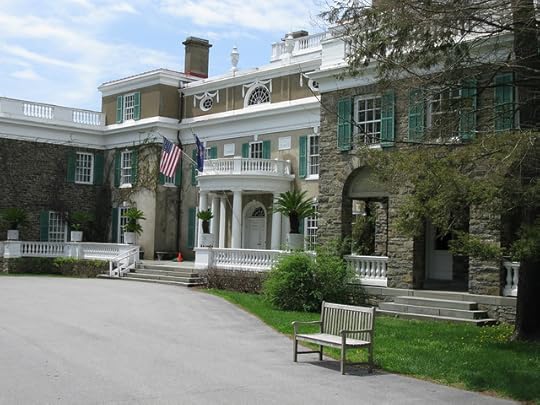
Franklin Roosevelt's ancestral home at Hyde Park which he visited frequently during his last year.
In the last year of his life his main goal, aside from ending the war in both Germany and Japan, was to establish the United Nations. The preliminary work was started on this way back in August of 1941 when the Atlantic Charter was signed with Winston Churchill off the coast of Newfoundland. Throughout all this the ghost of the failed League of Nations was always in the background.
There is much detail in this 650-page book – and there are over 200 pages on what transpired at the Yalta Conference of 1945. The author makes much of the failure of both Churchill and Roosevelt to constrain Stalin in acquiring much of Eastern Europe – especially Poland. However, agreement was reached at Yalta to have free and unfettered elections in Poland and to have the Poles who went into exile, join with the Lublin government that Stalin had set-up. This never happened; Stalin did not live up to this agreement. With Stalin’s Red Army ensconced in Eastern Europe there was not much that Roosevelt and Churchill could do besides pleading fitfully to Stalin to adhere to what he had agreed to at Yalta.
Roosevelt came out of Yalta with his two major goals intact – Soviet participation in the United Nations and an agreement from Stalin to participate in the war against Japan, after the Germans had surrendered. There were secret protocols to this – the Soviet Union was granted land and concessions from both China and Japan. The author minimized these two accomplishments.
The author points out that in March of 1944 Roosevelt was examined by a heart specialist, Dr. Howard Bruenn, and was diagnosed with serious issues surrounding his heart and circulatory system. Franklin never asked Dr. Bruenn any questions regarding these examinations – and why Dr. Bruenn accompanied Franklin daily for the rest of his life. It was kind of like a “don’t ask, don’t tell” scenario. Dr. Bruenn did make the standard recommendations – get more rest, cut down on the cigarettes… Many noticed Franklin Roosevelts' deteriorating physical appearance throughout the last year of his life. He continued to loss weight.
This is an exhilarating book to read of this crucial time in twentieth century history with the major historical figures interacting – Churchill, Stalin, de Gaulle. They all wanted to end the war – but each were pursuing different agendas for the aftermath. F.D.R.'s culminating purpose was the United Nations. The author believes that Roosevelt had been aspiring to this since 1920 when the United States failed to join the League of Nations. Franklin Roosevelt learnt from his predecessors mistakes and worked vigilantly to ensure that it would not happen again. To inaugurate and instill the United Nations in world affairs was the main reason that Franklin Roosevelt chose to run for a fourth term in 1944.
What is most interesting in the character of Franklin Roosevelt was his ability to try different approaches to resolve a problem. He was not afraid to make a mistake. If something did not work out it would be discarded and another attempt would be made. He was never in search of utopia. He was also a master at simplifying problems and their solutions – putting it into words that all could comprehend.
Like Churchill, he did make the error of trusting and believing in the word of Stalin. Some of this may have sprung from the dire position of the Soviet Union in 1941-42 when Stalin needed all the help he could get. By 1944 Stalin was in a position of power – and much more menacing.
This book looks at both the political and the personal – its an astonishing journey through this vital time period. Its’ a candid and emotional portrait of a key 20th century man.
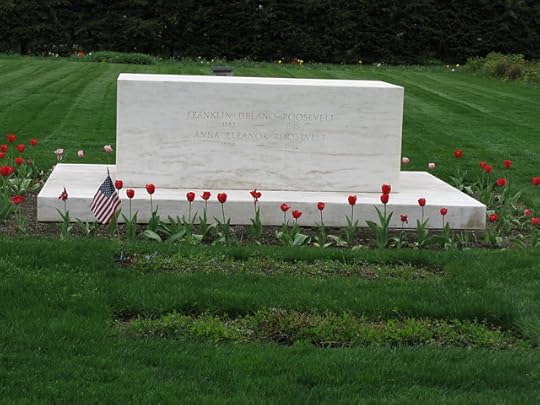
The grave of Franklin Roosevelt and Eleanor Roosevelt in the rose garden at Hyde Park
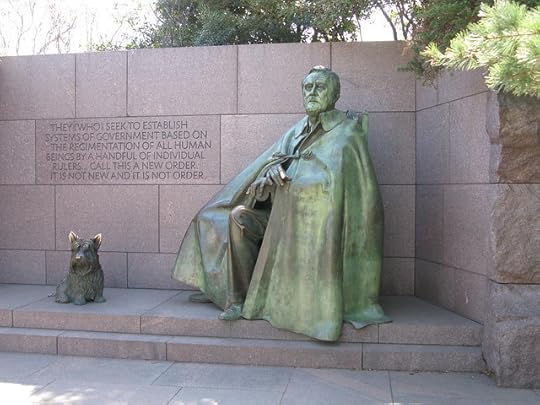
With his dog Fala - the Franklin Delano Memorial in Washington DC
Franklin Roosevelts’ life was a transcendent one and he was a major figure not only in his own country, but world-wide. His twelve years as the leader of a major nation during times of extreme turmoil took its toll and shortened his life span.
>
Franklin Roosevelt's ancestral home at Hyde Park which he visited frequently during his last year.
In the last year of his life his main goal, aside from ending the war in both Germany and Japan, was to establish the United Nations. The preliminary work was started on this way back in August of 1941 when the Atlantic Charter was signed with Winston Churchill off the coast of Newfoundland. Throughout all this the ghost of the failed League of Nations was always in the background.
There is much detail in this 650-page book – and there are over 200 pages on what transpired at the Yalta Conference of 1945. The author makes much of the failure of both Churchill and Roosevelt to constrain Stalin in acquiring much of Eastern Europe – especially Poland. However, agreement was reached at Yalta to have free and unfettered elections in Poland and to have the Poles who went into exile, join with the Lublin government that Stalin had set-up. This never happened; Stalin did not live up to this agreement. With Stalin’s Red Army ensconced in Eastern Europe there was not much that Roosevelt and Churchill could do besides pleading fitfully to Stalin to adhere to what he had agreed to at Yalta.
Roosevelt came out of Yalta with his two major goals intact – Soviet participation in the United Nations and an agreement from Stalin to participate in the war against Japan, after the Germans had surrendered. There were secret protocols to this – the Soviet Union was granted land and concessions from both China and Japan. The author minimized these two accomplishments.
The author points out that in March of 1944 Roosevelt was examined by a heart specialist, Dr. Howard Bruenn, and was diagnosed with serious issues surrounding his heart and circulatory system. Franklin never asked Dr. Bruenn any questions regarding these examinations – and why Dr. Bruenn accompanied Franklin daily for the rest of his life. It was kind of like a “don’t ask, don’t tell” scenario. Dr. Bruenn did make the standard recommendations – get more rest, cut down on the cigarettes… Many noticed Franklin Roosevelts' deteriorating physical appearance throughout the last year of his life. He continued to loss weight.
This is an exhilarating book to read of this crucial time in twentieth century history with the major historical figures interacting – Churchill, Stalin, de Gaulle. They all wanted to end the war – but each were pursuing different agendas for the aftermath. F.D.R.'s culminating purpose was the United Nations. The author believes that Roosevelt had been aspiring to this since 1920 when the United States failed to join the League of Nations. Franklin Roosevelt learnt from his predecessors mistakes and worked vigilantly to ensure that it would not happen again. To inaugurate and instill the United Nations in world affairs was the main reason that Franklin Roosevelt chose to run for a fourth term in 1944.
What is most interesting in the character of Franklin Roosevelt was his ability to try different approaches to resolve a problem. He was not afraid to make a mistake. If something did not work out it would be discarded and another attempt would be made. He was never in search of utopia. He was also a master at simplifying problems and their solutions – putting it into words that all could comprehend.
Like Churchill, he did make the error of trusting and believing in the word of Stalin. Some of this may have sprung from the dire position of the Soviet Union in 1941-42 when Stalin needed all the help he could get. By 1944 Stalin was in a position of power – and much more menacing.
This book looks at both the political and the personal – its an astonishing journey through this vital time period. Its’ a candid and emotional portrait of a key 20th century man.
The grave of Franklin Roosevelt and Eleanor Roosevelt in the rose garden at Hyde Park
With his dog Fala - the Franklin Delano Memorial in Washington DC

July 25, 2024
FDR'S LAST YEAR: April 1944 - April 1945 offers the reader both a poignant and incisive view of the final months in the life of one of America's great Presidents, Franklin Delano Roosevelt. What amazed me in reading this book is how it was that 2 of the U.S. Navy's physicians charged with caring for the President never disclosed to him that he was a dying man. Nor did they inform his family of the exact nature of his steadily declining health. FDR submitted himself to health checks pretty much every month over the last year of his life. But frankly, FDR was someone with an indomitable spirit and ebullient personality who was determined to shepherd the U.S. to victory in World War II and help establish the foundations for a lasting peace via the United Nations. He never queried either Admiral Ross T. McIntire or Lt. Commander Howard Bruenn (both of FDR's physicians) as to the various ailments (e.g. high blood pressure, congestive heart failure, and an increasing hardening of the arteries) that were gradually sapping him of his usual zest and vigor. FDR simply got on with the job, was renominated (though with a different running mate, Senator Harry S. Truman of Missouri, because the Democratic Party bosses did not want to retain the previous Vice President - Henry Wallace - because of his liberal leanings and their sense that FDR would not likely live out a 4th term as President), ran a somewhat perfunctory re-election campaign against Governor Thomas Dewey of New York, and once re-elected, met with British Prime Minister Winston Churchill and Soviet dictator Joseph Stalin at Yalta in February 1945, which proved to be the last Big Three conference FDR would attend.
The following remarks in the book I felt pretty much summed up the feelings about the Yalta Conference shortly after FDR had returned to the U.S. to report to Congress about it: “Roosevelt admirers called Yalta a triumph; his enemies referred to it as a defeat. It was both. He won a little, gave a lot. Personally, he was far removed from the vigorous champion of 1933. Fatigue and fear made him mellow and malleable. He made an error in seeing himself as the supreme arbiter between Stalin and Churchill; he was the rich target of two impoverished men. At moments when sparks were struck, he lapsed into stories which had but the barest relevance to the issue; at others he bargained shrewdly until he saw Stalin stand and rip the back of a chair – then he backed down a little at a time. In a childish way, he delighted in proving to Stalin that there could be no collusion between FDR and Churchill because he opposed and lectured the British Prime Minister at every opportunity. He was a man who despised treachery and deceit, and yet he permitted the Soviets to claim that the Big Three had no power to form a Polish government without consulting the Poles, while, on the other hand, he disposed of property belonging to a member of the Big Five --- China. Even the final communiqué was designed to lull the watching world into believing that there was noble unity among Russia, Great Britain and the United States.”
Though coming in at 939 pages, FDR's LAST YEAR never flagged and made for very compelling reading, revealing much about FDR's personal life and how the impact of his death affected his family, close aides, Harry S. Truman, and political contemporaries - as well as the nation at large.
The following remarks in the book I felt pretty much summed up the feelings about the Yalta Conference shortly after FDR had returned to the U.S. to report to Congress about it: “Roosevelt admirers called Yalta a triumph; his enemies referred to it as a defeat. It was both. He won a little, gave a lot. Personally, he was far removed from the vigorous champion of 1933. Fatigue and fear made him mellow and malleable. He made an error in seeing himself as the supreme arbiter between Stalin and Churchill; he was the rich target of two impoverished men. At moments when sparks were struck, he lapsed into stories which had but the barest relevance to the issue; at others he bargained shrewdly until he saw Stalin stand and rip the back of a chair – then he backed down a little at a time. In a childish way, he delighted in proving to Stalin that there could be no collusion between FDR and Churchill because he opposed and lectured the British Prime Minister at every opportunity. He was a man who despised treachery and deceit, and yet he permitted the Soviets to claim that the Big Three had no power to form a Polish government without consulting the Poles, while, on the other hand, he disposed of property belonging to a member of the Big Five --- China. Even the final communiqué was designed to lull the watching world into believing that there was noble unity among Russia, Great Britain and the United States.”
Though coming in at 939 pages, FDR's LAST YEAR never flagged and made for very compelling reading, revealing much about FDR's personal life and how the impact of his death affected his family, close aides, Harry S. Truman, and political contemporaries - as well as the nation at large.

July 18, 2007
This is one of my favorite historical works written by one of my favorite historians, Jim Bishop. Roosevelt died almost 15 years before I was born, but from all accounts he was clearly not a well man when the American voters selected him to be their president for an unprecedented fourth term. A few months later, he died, and Harry Truman became one of the most unlikely presidents in our history. How much did the American public know when it voted to keep FDR in the White House in 1944? This book goes into great detail about a remarkable year in our history. I would recommend it to anyone.

April 8, 2014
I know I've read this book long ago. Undoubtedly it was during one of my read about FDR jags. The man was dying when the book opens but his Navy doctor, FDR himself and everyone else wouldn't acknowledge it. He never asked doctors about his health and they made sure not to tell him --or anyone else. Makes an amazing story of what this man could will himself to do (truly superhuman)--but that's not what struck me. Meticulously detailed about the official work of the President, the chapters on Yalta are remarkable. Perhaps not everyone's cup of tea but the back and forth between Churchill, Stalin and FDR does raise the question on how the Big 3 made it through the war and how the UN came to be. For the first time I stopped to realize that FDR's view was principled, noble and dreadfully naive. The man believed in personal diplomacy. Look someone in eye, explain yourself and you've made a friend and ally. Too bad the rest of the world doesn't work that way. I must also give Bishop credit for showing us a Charles de Gaulle even more arrogant, odious and infuriating that we had imagined. Yuck!
Want to Read
March 20, 2025"Details the fantastic cover-up involving medical men and government officials alike, of the state of the President's physical and mental health in the crucial last year of the war. The image of Roosevelt at Yalta is that of a sick and hopelessly naive old man, hypnotized by his own platitudes, who didn't know what was going on. What "went on," of course, was the caning up of Eastern Europe for Uncle Joe."
IHR Revisionist Bibliography 1981
https://archive.is/LWkOQ
IHR Revisionist Bibliography 1981
https://archive.is/LWkOQ

900-999-geography-history
November 6, 2019973.9170924

February 17, 2009
Exhaustively detailed book about Franklin Roosevelt's last year of life, April 12th, 1944 to April 12th, 1945, the great travails of D-Day, the campaign of '44 against Tom Dewey and the dropping of Henry Wallace, disputes with Churchill and his own generals, the Manhattan project, Yalta and the aftermath of his death. Excellently done by the master of detail, Jim Bishop.

Want to Read
June 3, 2012FDR is one of my heroes. Bishop's book is well-researched but gets off to a slow start.
November 23, 2012
Compelling reading from start to finish.
Displaying 1 - 10 of 10 reviews