

What do you think?

The Glass Wall: Lives on the Baltic Frontier
Few countries have suffered more from the convulsions and bloodshed of twentieth-century Europe than those in the eastern Baltic. Caught between the giants of Germany and Russia, on a route across which armies surged or retreated, small nations like Latvia and Estonia were for centuries the subjects of conquests and domination as foreign colonizers claimed control of the territory and its inhabitants, along with their religion, government, and culture.
The Glass Wall features an extraordinary cast of characters—contemporary and historical, foreign and indigenous—who have lived and fought in the Baltic, western Europe’s easternmost stronghold. Too often the destiny of this region has seemed to be serving as the front line in other people’s wars. By telling the stories of warriors and victims, of philosophers and Baltic barons, of poets and artists, of rebels and emperors, and of others
who lived through years of turmoil and violence, Max Egremont sets forth a brilliant account of a long-overlooked region, on a frontier whose limits may still be in doubt.
The Glass Wall features an extraordinary cast of characters—contemporary and historical, foreign and indigenous—who have lived and fought in the Baltic, western Europe’s easternmost stronghold. Too often the destiny of this region has seemed to be serving as the front line in other people’s wars. By telling the stories of warriors and victims, of philosophers and Baltic barons, of poets and artists, of rebels and emperors, and of others
who lived through years of turmoil and violence, Max Egremont sets forth a brilliant account of a long-overlooked region, on a frontier whose limits may still be in doubt.
320 pages, Hardcover
Published February 8, 2022
Ratings & Reviews
Friends & Following
Create a free account to discover what your friends think of this book!
Community Reviews
Displaying 1 - 26 of 26 reviews
September 8, 2021
Sept. 9, 2021 Update Lisatud kommentaaridesse eesti keele ülevaade (Added Estonian language review in the comments).
Elegy for the Baltic Germans or Baltischdeutschedämmerung*
Review of the Picador UK hardcover edition (July 22, 2021)
[Rating 4.5 rounded up (some points off for errata, see below) from a Balto-Finnic point of view as there was plenty here that I had never known before, may be a 3 to 4 for other readers]
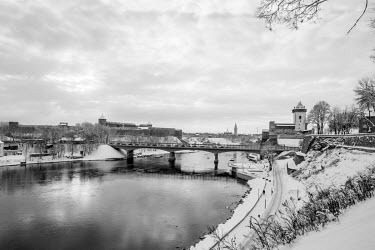
View of the Narva River on the border between Estonia and Russia viewed from the North. Ivangorod Castle (Russia) can see seen on the left and Hermann Castle (Estonia) can be viewed on the right. Photograph by Carlos Spottorno for Panos UK. Image sourced from Panos.Co.UK.
The Glass Wall is a curious mix of travelogue, memoir, historical anecdotes and the plot summaries of various fictional works. Writer Max Egremont travels to various cities in Estonia and Latvia and meets up with local friends & guides who take him primarily to visit various historic manor houses or their ruins from the times of the Baltic-German landowners who became dominant in Livonia since the Baltic Crusades of the 13th Century through to Tsarist times until Estonian & Latvian Independence in 1918. Lithuania, although a Baltic country, is not visited and is hardly mentioned, as it was more under Polish influence & domination during those times.
The structure of the book doesn't follow any geographical route or pattern that I could understand. Each chapter is usually based out of one city, town or manor. So the chapter themes jump from (in a simplified list) 1. Riga, 2. Narva, 3. Palmse, 4. Cēsis, 5. Narva, 6. Tallinn, 7. Orellen, 8. Rundāle, 9. Riga, 10. Jaunmoku / Liepāja, 11. Daugavpils [mostly about the Latvian heritage of the painter Mark Rothko], 12. Rēzekne, 13. Tallinn / Kolga, 14. Gut Blumbergshof (now Lobērģi), 15. [not centred on a town, mostly about German Army commanders], 16. Regen, Fortress Weißenstein in Bavaria [Vegesack family related], 17. [mostly about the Baltic years of Otto von Kursell & Max Erwin von Scheubner-Richter], 18. Stāmeriena [home of Licy von Wolff, later wife of Sicilian novelist Giuseppe Tomasi di Lampedusa, 19. Warthegau [the area of Poland expropriated by the Nazis for returning Baltic Germans], 20. Riga [about Jewish resistance to the Nazis), 21. [mostly about Siegfried von Vegesack] 22. Lestene, 23. [about the early Latvian & Estonian Presidents Ulmanis and Päts], 24. Lake Peipsi [about the Old Believers], 25. Saaremaa / Hiiumaa. Each chapter then usually focuses on a local historical personage, family, building of interest as in some of the examples i've detailed above.
When local site and historical anecdotes have been exhausted, Egremont turns regularly to various International, Baltic-German, Estonian and (hardly any) Latvian authors to bump up the content by inserting the plot summaries of works such as Georges Simenon's Pietr the Latvian (1931), Anthony Powell's Venusberg (1932) (about a fictional Baltic city), Siegfried von Vegesack's Die baltische Tragödie (The Baltic Tragedy: a trilogy of novels from 1933-1936), and Jaan Kross's Keisri hull (The Tsar's Madman) (1978). While most of the works may be based on some historical characters and events, they are still fiction, so it was odd to read so much about them in a non-fiction book. It was especially interesting though to learn about the books that I had never read or heard of previously.
Even with the somewhat rambling nature of the structure, I found a lot of the information to be new to me and it was quite fascinating. Certainly any history of the Livonian Baltics should contain a large reference to its Baltic-German presence and contribution and this book filled in a large gap in my knowledge of my own heritage.
Errata (These are mostly Estonian misspellings, someone who knows Latvian should copyedit this book for further possible corrections)
Page xiii "Jaan Kross, who in the 1970s was considered for the Nobel Prize." > incorrect information, as Jaan Kross had published only a few books by the 1970s. It would be more correct to say that he would have been considered for the Nobel Prize during the 1990's to 2000s, by which time he had published a few dozen books and additionally had several international translations.
Page 14 "Sinnimae or Blue Hills" s/b Sinimäe or Blue Hills
Page 15 "The Sinnimae battles" s/b The Sinimãe battles
Page 53 "Kalew" s/b Kalev
Page 131 "There'd had been previous deaths..." s/b There had been previous deaths...
Page 159 "Alexander is spruce, out on the land or seated in negotiations ..." may not be immediately clear to non-British readers. "Spruce" is the British English equivalent of "spruced up", i.e. used to describe someone who is looking clean, smart, spic and span, well turned out.
Page 223 "Ivars Avask" s/b Ivar Ivask (an Estonian poet, although perhaps his Latvian wife called him Ivars, the last name is wrong in any case)
Page 230 "such as such as" s/b such as
Page 240 "Kalivipoeg" s/b Kalevipoeg
Page 265 "Okasanen" s/b Oksanen (i.e. the Finnish novelist Sofi Oksanen).
Other Reviews
Life on the Edge of Europe by Tom Ball, The TImes, July 17, 2021.
A Baltic travelogue unearths a forgotten past by Edward Lucas, The Economist, July 24, 2021.
Icy Edge of Empires by Ian Thomson, Financial Times, July 30, 2021.
Knights and Commissars by Keith Lowe, Literary Review, no date.
Trivia and Links
The cover photograph for the Picador UK edition, although it is in Black & White and printed on a rather ancient looking piece of paper, is actually from a modern day photographic essay project by Carlos Spottorno which has been incorporated into a non-fiction graphic novel La grieta (The Crack) (2016) about the European immigration crisis. You can read more about the project and view some sample pages from the graphic novel at https://spottorno.com/la-grieta
* Baltischdeutschedämmerung = Twilight of the Baltic Germans, after Wagner's opera Götterdämmerung = Twilight of the Gods.
Elegy for the Baltic Germans or Baltischdeutschedämmerung*
Review of the Picador UK hardcover edition (July 22, 2021)
[Rating 4.5 rounded up (some points off for errata, see below) from a Balto-Finnic point of view as there was plenty here that I had never known before, may be a 3 to 4 for other readers]
View of the Narva River on the border between Estonia and Russia viewed from the North. Ivangorod Castle (Russia) can see seen on the left and Hermann Castle (Estonia) can be viewed on the right. Photograph by Carlos Spottorno for Panos UK. Image sourced from Panos.Co.UK.
The Glass Wall is a curious mix of travelogue, memoir, historical anecdotes and the plot summaries of various fictional works. Writer Max Egremont travels to various cities in Estonia and Latvia and meets up with local friends & guides who take him primarily to visit various historic manor houses or their ruins from the times of the Baltic-German landowners who became dominant in Livonia since the Baltic Crusades of the 13th Century through to Tsarist times until Estonian & Latvian Independence in 1918. Lithuania, although a Baltic country, is not visited and is hardly mentioned, as it was more under Polish influence & domination during those times.
The structure of the book doesn't follow any geographical route or pattern that I could understand. Each chapter is usually based out of one city, town or manor. So the chapter themes jump from (in a simplified list) 1. Riga, 2. Narva, 3. Palmse, 4. Cēsis, 5. Narva, 6. Tallinn, 7. Orellen, 8. Rundāle, 9. Riga, 10. Jaunmoku / Liepāja, 11. Daugavpils [mostly about the Latvian heritage of the painter Mark Rothko], 12. Rēzekne, 13. Tallinn / Kolga, 14. Gut Blumbergshof (now Lobērģi), 15. [not centred on a town, mostly about German Army commanders], 16. Regen, Fortress Weißenstein in Bavaria [Vegesack family related], 17. [mostly about the Baltic years of Otto von Kursell & Max Erwin von Scheubner-Richter], 18. Stāmeriena [home of Licy von Wolff, later wife of Sicilian novelist Giuseppe Tomasi di Lampedusa, 19. Warthegau [the area of Poland expropriated by the Nazis for returning Baltic Germans], 20. Riga [about Jewish resistance to the Nazis), 21. [mostly about Siegfried von Vegesack] 22. Lestene, 23. [about the early Latvian & Estonian Presidents Ulmanis and Päts], 24. Lake Peipsi [about the Old Believers], 25. Saaremaa / Hiiumaa. Each chapter then usually focuses on a local historical personage, family, building of interest as in some of the examples i've detailed above.
When local site and historical anecdotes have been exhausted, Egremont turns regularly to various International, Baltic-German, Estonian and (hardly any) Latvian authors to bump up the content by inserting the plot summaries of works such as Georges Simenon's Pietr the Latvian (1931), Anthony Powell's Venusberg (1932) (about a fictional Baltic city), Siegfried von Vegesack's Die baltische Tragödie (The Baltic Tragedy: a trilogy of novels from 1933-1936), and Jaan Kross's Keisri hull (The Tsar's Madman) (1978). While most of the works may be based on some historical characters and events, they are still fiction, so it was odd to read so much about them in a non-fiction book. It was especially interesting though to learn about the books that I had never read or heard of previously.
Even with the somewhat rambling nature of the structure, I found a lot of the information to be new to me and it was quite fascinating. Certainly any history of the Livonian Baltics should contain a large reference to its Baltic-German presence and contribution and this book filled in a large gap in my knowledge of my own heritage.
Errata (These are mostly Estonian misspellings, someone who knows Latvian should copyedit this book for further possible corrections)
Page xiii "Jaan Kross, who in the 1970s was considered for the Nobel Prize." > incorrect information, as Jaan Kross had published only a few books by the 1970s. It would be more correct to say that he would have been considered for the Nobel Prize during the 1990's to 2000s, by which time he had published a few dozen books and additionally had several international translations.
Page 14 "Sinnimae or Blue Hills" s/b Sinimäe or Blue Hills
Page 15 "The Sinnimae battles" s/b The Sinimãe battles
Page 53 "Kalew" s/b Kalev
Page 131 "There'd had been previous deaths..." s/b There had been previous deaths...
Page 159 "Alexander is spruce, out on the land or seated in negotiations ..." may not be immediately clear to non-British readers. "Spruce" is the British English equivalent of "spruced up", i.e. used to describe someone who is looking clean, smart, spic and span, well turned out.
Page 223 "Ivars Avask" s/b Ivar Ivask (an Estonian poet, although perhaps his Latvian wife called him Ivars, the last name is wrong in any case)
Page 230 "such as such as" s/b such as
Page 240 "Kalivipoeg" s/b Kalevipoeg
Page 265 "Okasanen" s/b Oksanen (i.e. the Finnish novelist Sofi Oksanen).
Other Reviews
Life on the Edge of Europe by Tom Ball, The TImes, July 17, 2021.
A Baltic travelogue unearths a forgotten past by Edward Lucas, The Economist, July 24, 2021.
Icy Edge of Empires by Ian Thomson, Financial Times, July 30, 2021.
Knights and Commissars by Keith Lowe, Literary Review, no date.
Trivia and Links
The cover photograph for the Picador UK edition, although it is in Black & White and printed on a rather ancient looking piece of paper, is actually from a modern day photographic essay project by Carlos Spottorno which has been incorporated into a non-fiction graphic novel La grieta (The Crack) (2016) about the European immigration crisis. You can read more about the project and view some sample pages from the graphic novel at https://spottorno.com/la-grieta
* Baltischdeutschedämmerung = Twilight of the Baltic Germans, after Wagner's opera Götterdämmerung = Twilight of the Gods.
March 28, 2023
Having read Max Egremont's excellent 'Forgotten Land' about his wanderings around and thought on the now vanished land of Prussia I was prepared for the extraordinarily rich and varied potpourri of history, travel, literature and culture that is the mixture of this book. It is in part, and I stress that, an examination of the Baltic Germans and this does link it with his book 'Forgotten Land' because in part he is looking at the German absence from a part of Europe were they existed since the 13th century. But he does not ignore or sigh away from how much Germans are responsible for this absence, just as he does not overlook their failures, cruelties and stupidities nor does he overlook the people of Latvia and Estonia, for way to long merely seen as peasants the backdrop and support of the German world of the Baltic. Lithuanian, part of the great Polish-Lithuanian Commonwealth is largely absent from this book but to an extent, this makes sense or at least reflects, as Egremont is traveling in, reading the literature of and looking at the Baltic lands that were once part of the Swedish empire and then passed to Russia after the conquest of Peter the Great (I am grossly simplifying a history of rich complexities).
It is the sort of history, travel, memoir and literary work that can either fascinate you as it introduces you to things, places, people and events that you either know nothing or almost nothing about or can infuriate because you don't know exactly what you are reading. I loved it. It told me much and left me wanting to know more. Any book that I keep looking to the footnotes to sources and leaves me hunting to see if author's mentioned have been translated into English (and all to often cursing my monolingualism when I find they have not been) is a great book and one that I love and will reread one day. For me this book is a window onto an area of fascination - for me the survival of small nations, languages and cultures after the attempts at destroying them in the 20th century is something to be celebrated and loved.
It is often the very small touched that you discover in books like this which leave the strongest impression. Very early in the book we are treated to an except from the diary of the very grand 19th century Marchioness of Londonderry who was traveling to the court of Tsar Nicholas I in St. Petersburg with her husband and extensive entourage and passed through Riga were her maid fell ill with pleurisy and she was forced to engage a new one before the travelled on leaving her original maid behind to die alone in a foreign city. The image of that poor girl, no doubt from some small hamlet on the Londonderry's extensive north of England or Irish estates, abandoned to die alone in a city and land whose language she did not speak horrified me in a way that greater tragedies sometimes fail to. It certainly prepared me to look with great skepticism on tales of tales of the noblesse oblige of the ancient regime in the Baltics or elsewhere.
So while not doubting their failings it doesn't mean that they were without merit or interest. The Baltic German world was flawed but fascinating there greatest failing was to live so long amongst people and know them so little.
As a journey through, a sporadic history of and in general an account of the passing of a little part of Europe's rich diversity the book is fascinating. It should make us cherish what diversity is left. It also makes me sad that the UK is so happy to pull away from and deny their links with 'Europe'. Even on the Baltic they are richly complex nd far more then might be imagined.
It is the sort of history, travel, memoir and literary work that can either fascinate you as it introduces you to things, places, people and events that you either know nothing or almost nothing about or can infuriate because you don't know exactly what you are reading. I loved it. It told me much and left me wanting to know more. Any book that I keep looking to the footnotes to sources and leaves me hunting to see if author's mentioned have been translated into English (and all to often cursing my monolingualism when I find they have not been) is a great book and one that I love and will reread one day. For me this book is a window onto an area of fascination - for me the survival of small nations, languages and cultures after the attempts at destroying them in the 20th century is something to be celebrated and loved.
It is often the very small touched that you discover in books like this which leave the strongest impression. Very early in the book we are treated to an except from the diary of the very grand 19th century Marchioness of Londonderry who was traveling to the court of Tsar Nicholas I in St. Petersburg with her husband and extensive entourage and passed through Riga were her maid fell ill with pleurisy and she was forced to engage a new one before the travelled on leaving her original maid behind to die alone in a foreign city. The image of that poor girl, no doubt from some small hamlet on the Londonderry's extensive north of England or Irish estates, abandoned to die alone in a city and land whose language she did not speak horrified me in a way that greater tragedies sometimes fail to. It certainly prepared me to look with great skepticism on tales of tales of the noblesse oblige of the ancient regime in the Baltics or elsewhere.
So while not doubting their failings it doesn't mean that they were without merit or interest. The Baltic German world was flawed but fascinating there greatest failing was to live so long amongst people and know them so little.
As a journey through, a sporadic history of and in general an account of the passing of a little part of Europe's rich diversity the book is fascinating. It should make us cherish what diversity is left. It also makes me sad that the UK is so happy to pull away from and deny their links with 'Europe'. Even on the Baltic they are richly complex nd far more then might be imagined.

December 18, 2021
Max Egremont has done something quite remarkable with his book: he has shown how complicated the lives of a clutch of Baltic Germans have been in the tiny countries of Estonia and Latvia. Together with Lithuania, the three are usually referred to as the Baltic States, but Egremont has decided to leave Lithuania aside, as it was not under German rule, is not a Lutheran country. As to the common denominator the Baltic States, I have heard it said that the label was invented by Russians, possibly the Soviets, but have never seen any evidence. Egremont does not discuss it either.
His book is like a long essay on Estonia and Latvia in the 20th century. The author travels from place to place, meets a local person with whom he visits country mansions and discusses the long-dead Baltic Germans who once ruled the roost. Egremont's sentences are packed tight, his is not light reading. It is history with a personal slant. I at least was left feeling rather melancholy because he succeeded in showing to what degree - profoundly - human life is affected by political events and war.
His book is like a long essay on Estonia and Latvia in the 20th century. The author travels from place to place, meets a local person with whom he visits country mansions and discusses the long-dead Baltic Germans who once ruled the roost. Egremont's sentences are packed tight, his is not light reading. It is history with a personal slant. I at least was left feeling rather melancholy because he succeeded in showing to what degree - profoundly - human life is affected by political events and war.
January 16, 2023
Anyone who has read this book cannot help but appreciate Max Egremont’s enormous amount of research of historical documents together with almost limitless personal interviews of government officials, authors, writers and Baltic citizens to weave a tapestry of the times and experiences of the relationship and history of the Baltic people with Russia, Germany, Sweden, Finland over a century and two world wars. His descriptions of so many of the people involved and their families over this period of time provides an insight into their lives and experiences during the most trying of times. His description of the Baltic towns, especially of Tallin and the effects of war and foreign occupation on Estonia are especially interesting, especially if you have visited some of these quaint city squares like Tallin, even for a limited time. Good book!

May 29, 2023
I have read countless history books but The Glass Wall is without a doubt one of my favorites. So many books focus on the political landscape and forget the common folk. Not Max Egremont. He has managed in less than 300 pages to capture the lives of not only Baltic Germans but also native Latvians and Estonians and even Russians in an entertaining but also informative way.
What I loved about this book is that it gives us real conversation and perspectives from not only normal people but also more famous individuals such as Matti Pats (grandson of the former leader of Estonia) and the few Holocaust survivors left in the Baltics. Egremont manages to keep you interested in people’s lives while also teaching you about historical events in Baltic history. It is truly a mixture of travelogue and history.
For those complaining about the lack of Lithuania, he explains the reasoning and instead focuses on the other two countries. I have no problem with this, as it wouldn’t have made sense to include Lithuania as it is so different historically and without German roots.
I highly recommend this book for anyone who enjoys history but wants a break from the eventually boring accounts of political fights and military battles without any understanding of the countries today or its people.
Amazing book and one I will read again, especially when I visit Estonia and Latvia.
What I loved about this book is that it gives us real conversation and perspectives from not only normal people but also more famous individuals such as Matti Pats (grandson of the former leader of Estonia) and the few Holocaust survivors left in the Baltics. Egremont manages to keep you interested in people’s lives while also teaching you about historical events in Baltic history. It is truly a mixture of travelogue and history.
For those complaining about the lack of Lithuania, he explains the reasoning and instead focuses on the other two countries. I have no problem with this, as it wouldn’t have made sense to include Lithuania as it is so different historically and without German roots.
I highly recommend this book for anyone who enjoys history but wants a break from the eventually boring accounts of political fights and military battles without any understanding of the countries today or its people.
Amazing book and one I will read again, especially when I visit Estonia and Latvia.

July 30, 2021
Meet the author here as he guides readers around the stunning Baltic locations! This is QUITE the journey!
I was honoured to get the chance to chat with this author and get his impressions and experiences around the Baltic region. Such a fascinating account of a region few of us really get the chance to explore. The maps, pictures and a real sense of adventure are perfect here and the writing peppered with just enough detail, cultural history and genuine love of travel and other people that an author of such a read should have.
Recommended!
April 21, 2024
It took me a while to warm up to this book as I felt (initially) that it praises or is too concerned with the lives of the former Baltic German aristocratic families at the expense of the local Estonian and Latvian nations. It still feels this way towards the end - however, I believe it succeeds in showcasing the entaglement of lives, destinies, identities, cultures, and languages that one can find in the Baltics, a melting pot of influences as a result of a very colourful and often tragic history. I took many notes of the books mentioned throughout, which are now on my wishlist, and was immersed into this fascinating part of Europe once more, after visiting Tallinn and Riga last summer. Truly incredible region that doesn't get nearly half the attention it deserves.

April 26, 2022
More of a travelogue with historical musings than a straight history of the Baltics. And even then, the historical musings are only about the ruling class, the Baltics Germans, who keep themselves separate from the native Estonians and Latvians (hence the title The Glass Wall).
At first, it was interesting to learn about the social structure and how the Germans stayed on top for some 500-600 years. But then, as Egremont tours former Baltic German family mansions, we get each family's history from the late 1800's through WWII or to the 1960's/70's. It's obvious that Egremont has done a lot of research into the Baltic Germans. The first couple of family histories are interesting, but it gets repetitive after that. And we only learn about the rest of the population, the Estonians and the Latvians, from their interactions with these German families.
Most of Egremont's time is spent in Latvia; Estonia comes a bit more to the fore in the last chapters. I kept flipping back to the map at the front of the book for the location of the towns Egremont visits. Lithuania is not included in the book, though it's considered one of the Baltic countries. Maybe it's because the Baltic Germans weren't as much of a factor there.
Not a bad book; just not the history of the Baltics that I thought it would be.
At first, it was interesting to learn about the social structure and how the Germans stayed on top for some 500-600 years. But then, as Egremont tours former Baltic German family mansions, we get each family's history from the late 1800's through WWII or to the 1960's/70's. It's obvious that Egremont has done a lot of research into the Baltic Germans. The first couple of family histories are interesting, but it gets repetitive after that. And we only learn about the rest of the population, the Estonians and the Latvians, from their interactions with these German families.
Most of Egremont's time is spent in Latvia; Estonia comes a bit more to the fore in the last chapters. I kept flipping back to the map at the front of the book for the location of the towns Egremont visits. Lithuania is not included in the book, though it's considered one of the Baltic countries. Maybe it's because the Baltic Germans weren't as much of a factor there.
Not a bad book; just not the history of the Baltics that I thought it would be.

October 28, 2022
DNF at around page 45. Prose was well-done, but the content didn't deliver what I was expecting. Very little discussion about the Baltic people, mostly focused on Germans. Lots of travelogues, rather than history and the author doesn't appear to speak a Baltic language or Russian, so doesn't seem like he was able to connect with the actual people there.
I sensed hostility and unwillingness to understand the Baltic people. The author a few times reduced them to singing peasants in the past, and resented those in the present, including criticizing a hotel worker for not smiling at him. He assumes this meant the worker (a young female) wants him to leave, but it really sounds like the author hasn't bothered to learn how the culture is there versus his native country (Britain, I think?). Between strangers smiling is rare and can be regarded as maniacal/creepy. This book claims to be a study of the Baltic people. I suppose it is, the author's refusal to remove his cultural biases results in it adding little insight and perpetuates misunderstanding in the subject the book claims to clarify.
I sensed hostility and unwillingness to understand the Baltic people. The author a few times reduced them to singing peasants in the past, and resented those in the present, including criticizing a hotel worker for not smiling at him. He assumes this meant the worker (a young female) wants him to leave, but it really sounds like the author hasn't bothered to learn how the culture is there versus his native country (Britain, I think?). Between strangers smiling is rare and can be regarded as maniacal/creepy. This book claims to be a study of the Baltic people. I suppose it is, the author's refusal to remove his cultural biases results in it adding little insight and perpetuates misunderstanding in the subject the book claims to clarify.

April 26, 2022
I wanted to like this book more. The author clearly did a lot of research and there's a good overview of Baltic history and present-day Estonia and Latvia. Bottom line, Germans and Russians have fought for control and influence there for centuries, but the Balts are their own people, and their independence is constantly threatened. But ultimately I think this book needed some heavy-duty editing. The narrative jumped all over the place, each chapter was supposed to have a unifying theme but I struggled to figure them out as each one jumped back and forth in time and introducing and reintroducing historical figures, modern-day people, fictional people from novels, and lots of "this person said that this person said such and such or that this thing happened." Oh and also I was unclear on why there was almost no discussion of Lithuania, which I am pretty sure is a Baltic state too or considered one? Anyway I do have a better understanding of Estonia and Latvia now, but the book was a difficult read.

Read
August 20, 2023This was a disorienting read, hopping between times and places constantly. I didn't get a good grasp of any of the people featured in the book, either.
I stuck with it because there's not a lot to read about this region (which I'm visiting now). By the end, I did come away with a slightly better understanding of the history, but most of the book was just seemingly random facts about a bunch of aristocrats, etc. The final chapter, about the grandchildren of the people profiled throughout, just emphasized how little I'd absorbed about any of them! I could not tell you the name of a single one right now.
I stuck with it because there's not a lot to read about this region (which I'm visiting now). By the end, I did come away with a slightly better understanding of the history, but most of the book was just seemingly random facts about a bunch of aristocrats, etc. The final chapter, about the grandchildren of the people profiled throughout, just emphasized how little I'd absorbed about any of them! I could not tell you the name of a single one right now.

November 2, 2025
This is my second book by this author. I have decided that I do not like his writing style as he has a talent of making history boring. There aren't a lot of books on the Baltic nations (same with his other book on Prussia), so I was eager to read books on countries that don't get a lot of attention.
The author subjects the reader to a bunch of interviews and intersperses that with historical facts. It feels disjointed and unfinished as you don't feel like you have the whole story of the person he is telling about or the history in general. So you get the "vibe" of the region but not the whole picture. I am glad I got this book from the bargain bin and didn't spend much money.
The author subjects the reader to a bunch of interviews and intersperses that with historical facts. It feels disjointed and unfinished as you don't feel like you have the whole story of the person he is telling about or the history in general. So you get the "vibe" of the region but not the whole picture. I am glad I got this book from the bargain bin and didn't spend much money.
Read
February 25, 2022I cycled all 3 Baltic republics in 2002 and 2003. In 2003, from Vilnius to St Petersberg via Daugaypils, Rezekne, Pskov and the Russian side of Lake Pskov and Lake Peipsi. I only wish that I'd read this book. There were no services. I didn't know Mark Rothko was born in Daugaypils or that I was crossing Latgale. Or there was such a place as Latgale. I didn't know the importance of Jelgava other than that there was a wonderful restaurant where they served forest mushrooms.
If only I'd had this wonderful book. It is a minor masterpiece.
If only I'd had this wonderful book. It is a minor masterpiece.

July 14, 2023
Baltic frontier nėra Lietuva - viskas čia apie Latviją ir Estiją iš Baltijos vokiečių perspektyvos. Daug asmeninių istorijų apie šią 1939 m. iš esmės išnykusią tautinę bendruomenę. Autorius maloniai žongliruoja skirtingais laikotarpiais, skirtingomis dvarvietėmis ir jų šeimininkų likimais. Per asmenines dramas pateikiama gana išsami Latvijos ir Estijos istorija. Greta to reporterio akimis aprašyta šių šalių nūdiena, Baltijos vokiečių gyventos vietos, sovietinės okupacijos randai. Kaimyninės šalys, bet gana menkai pažinta jų gyvenimo dalis. Tikrai malonus skaitymas.
July 14, 2025
Very well written history/travel book on Estonia and Latvia (my paper back edition mentions Lithuania at the back cover but it is not included). Best Baltic states book I have read so far and I learned a lot about Baltic German culture and literature.
Book concentrates heavily on the Baltic German experience. My minor complaints are that there could be more differentiation between the German merchant classes in the cities and the nobles in the country site; a bit more sociological/economic analysis and not all leftists in the Baltic states were bolsheviks as the writer seems to believe.
Book concentrates heavily on the Baltic German experience. My minor complaints are that there could be more differentiation between the German merchant classes in the cities and the nobles in the country site; a bit more sociological/economic analysis and not all leftists in the Baltic states were bolsheviks as the writer seems to believe.
May 10, 2025
This book is good, it should really have something in the title about Baltic Germans who it's nearly all about.
The author does a decent job walking us through the old families and how this place was controlled by Germans then Soviets. Some of the characters (family members) or people he meets with are hard to keep straight.
Given there aren't many books in English about the Baltics I'm glad he wrote it.
The author does a decent job walking us through the old families and how this place was controlled by Germans then Soviets. Some of the characters (family members) or people he meets with are hard to keep straight.
Given there aren't many books in English about the Baltics I'm glad he wrote it.
April 11, 2022
A frustrating book. Egremont conveys the complexity and length of the history of the Baltic states, which has some interesting connections and parallels with Finnish history. But his presentation wanders with his journeys around the landscape, and I'm just not able to put together a pattern that I understand from the information he's sharing.

November 9, 2025
Interesting read as an Estonian. The Baltic Germans are nowadays a forgotten breed to us, but it was them that lorded over Estonians for 700 years.
I found the writing beautiful at times, but too often it ventured into side remarks which lasted several pages. Often these were about the melancholical feelings of barons, which I found hard to sympathize with.
I found the writing beautiful at times, but too often it ventured into side remarks which lasted several pages. Often these were about the melancholical feelings of barons, which I found hard to sympathize with.

September 30, 2026
The author effortlessly weaves historical accounts of Baltic lands with contemporary characters. However, the writing style is a little difficult to follow. Some accounts can be a bit sad to read but then the history of these lands have been tragic for most parts. As an expat in one of the Baltic states, it did help me understand the history and likely trajectory for the near future.

January 22, 2023
It was really interesting to read it from a Latvian perspective. I wouldn't suggest it to Lithuanians since the author barely mentioned them but as for Estonians and Latvians - it goes very in depth about people and their lives and how both wars played a role. You should read this!
January 5, 2024
Shadows coming alive
I am myself from Latvia and the story of Baltic Germans who in my view shaped the country to a very large extent, often goes untold here. A brilliant book covering the topic and sparking more interest in my county's complicated yet fascinating history.
I am myself from Latvia and the story of Baltic Germans who in my view shaped the country to a very large extent, often goes untold here. A brilliant book covering the topic and sparking more interest in my county's complicated yet fascinating history.
April 27, 2024
Fascinating history of the Baltic states of Estonia and Latvia and the relationship of the native people and the German Balts who effectively ran these countries for 700 years. I found this a better read than the authors book on East Prussia although both were equally fascinating. Recommended.

March 13, 2025
I am sure some people like this book but I was very disappointed. I barely got through it. More about Russians and Germans than the people who live in the Baltics. Not sure what I expected but not this book.
May 13, 2025
Good, though I felt that there should have been more on Lithuanians, Latvians and Estonians themselves, though there was a lot of insight on what has gone on in the land and the Baltic Germans and what happened to them in the last century.
December 29, 2021
An interesting insight into a part of the world that I know so little about.

January 29, 2024
Could not get past page 99. Not a fan of the authors style
Displaying 1 - 26 of 26 reviews