

What do you think?
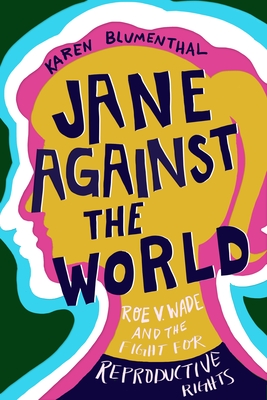
Jane Against the World: Roe v. Wade and the Fight for Reproductive Rights
A riveting look at the tumultuous history of abortion rights in the United States leading up to the landmark case of Roe v. Wade, by award-winning author and journalist Karen Blumenthal.
Tracing the path to the 19th century to the pivotal decision in Roe v. Wade and the continuing battle for women's rights, Blumenthal examines, in a straightforward tone, the root causes of the current debate around abortion and its repercussions that have rippled through generations of American women.
This urgent book is the perfect tool to facilitate discussion and awareness of a topic that affects each and every person in the United States.
Tracing the path to the 19th century to the pivotal decision in Roe v. Wade and the continuing battle for women's rights, Blumenthal examines, in a straightforward tone, the root causes of the current debate around abortion and its repercussions that have rippled through generations of American women.
This urgent book is the perfect tool to facilitate discussion and awareness of a topic that affects each and every person in the United States.
400 pages, Paperback
First published February 4, 2020
About the author
Karen Blumenthal
32 books149 followersKaren Blumenthal is a critically acclaimed author of narrative nonfiction for young people, who is fascinated by controversial subjects and social change. Her books include Steve Jobs: The Man Who Thought Different; Tommy: The Gun that Changed America; Hillary Rodham Clinton: A Woman Living History, and Let Me Play: The Story of Title IX. Her books have won a Sibert Honor and a Jane Addams Children's Book award and have been a finalist for YALSA's Excellence in Nonfiction for Young Adults award three times. She lives in Dallas, where Roe v. Wade originated. For more information, go to www.karenblumenthal.com.
Ratings & Reviews
Friends & Following
Create a free account to discover what your friends think of this book!
Community Reviews
Displaying 1 - 30 of 208 reviews

June 28, 2021
An educational, factual, but not unbiased look at the history of the fight for reproductive rights for women in the US. Geared toward a young adult audience but appropriate for adult readers as well, this book reads more like a conversation with a well-informed and throughly researched historian than a textbook. All readers have something to learn here, but pro-life readers may have difficulty with the approach to the subject matter which has no guise of being unbiased.

January 1, 2020
I picked up Jane Against the World: Roe v. Wade and the Fight for Reproductive Rights by Karen Blumenthal because of the colorful cover. I stayed for the interesting take on how the history of abortions has shaped the modern viewpoints on this topic. On track to be published in February of 2020, this non-fiction book intended for younger and more liberal audiences gives a detailed play-by-play on the events leading up to and following the Roe v. Wade court case, as well as describing the events of the actual case itself. Starting in the 1800s, the author, through inclusion of meaningful events from all throughout history, shows us just exactly how we got the point we are today with women’s rights. It turns out that if I hadn’t judged this book by its cover, I never would have chosen this incredible and informative read.
The format of this book is what made it particularly engaging for me. Although the book discusses true events, it is told as though it is a narrative, incorporating both facts and craft. I often find myself marveling at the power of some of the phrases in this book, and in more cases than one the narrative style has deepened the book’s impact. Furthermore, the author’s use of pictures in the text contributed greatly to my enjoyment of the book. Since all the “characters” mentioned are real, seeing what they looked like made them become even more real to me. A picture is worth a thousand words, and those thousand words saved from including a picture went to giving readers carefully researched and analyzed information, allowing them to formulate their own opinion about the issue based on the knowledge presented to them. As if a narrative format and images weren’t enough, the author included a recurring section entitled Pregnant Pause, in which the author provides extra information about the current topic she is discussing, usually bringing up a new historical figure or a different perspective on a given subject. The skillful use of unique formatting only contributes to the superior quality of this text. Because of how emotionally complex of a topic abortion is, I believe a non-fiction book with a narrative formate is defintely the best approach to get the necessary message across. It feels like a fiction book and you can connect and relate to the people mentioned, but you also get an abundance of information from many perspectives throughout history that a typical fiction book can’t provide.
The theme and overarching ideas of this novel made it not only an interesting read, but an incredibly great one. The emphasis the author puts on discussing not only women’s rights, but the rights of women of different races and social statuses adds a layer of complexity to the issues discussed that usually isn’t brought up. The author believes that women have a right to make their own well-informed decisions about their bodies. It is abundantly evident after reading this book that the author put many hours into finding the most relevant and powerful information to support this theme. There are countless examples included detailing the history of how women’s voices were surpressed in abortion debates and how until about 50 years ago there was little to no access to reliable sex education and contraception. The theme is easily understood, and the main message gets across extremely clearly. The simplicity in how the theme is conveyed leaves plenty of time for the reader to reflect and think about their own opinions on the topics discussed.
This book is extremely relevant and anyone looking to make themselves more well-informed should pick this book up. Abortion and women’s rights has been an extremely controversial issue in politics, and knowing about the history and causes of the issue lets me make my opinion based on facts. I never knew about the racial and wealth-related aspects of abortion before reading this book. As a teenage girl, I take the issue of abortion very seriously, and I like to seize every opportunity for educating myself. This book is the perfect way to make the complicated history of abortion and birth control accessible in one neat book. Reading this book made me better, more well-informed as a person, and I’m very glad that I was able to hear this story and learn more.
Jane Against the World: Roe v. Wade and the Fight for Reproductive Rights by Karen Blumenthal was definitely one of the better books I’ve read. I found myself always excited to pick up this book. There’s something magical about being able to educate yourself and read about history. I would highly recommend this book to anyone willing to go on a journey through time and experience the hardships faced by women over the past 200 years. After all, putting yourself in someone else’s shoes is the only way to grow and become more empathetic as a human being, and books can act as an outlet in which to do so.
The format of this book is what made it particularly engaging for me. Although the book discusses true events, it is told as though it is a narrative, incorporating both facts and craft. I often find myself marveling at the power of some of the phrases in this book, and in more cases than one the narrative style has deepened the book’s impact. Furthermore, the author’s use of pictures in the text contributed greatly to my enjoyment of the book. Since all the “characters” mentioned are real, seeing what they looked like made them become even more real to me. A picture is worth a thousand words, and those thousand words saved from including a picture went to giving readers carefully researched and analyzed information, allowing them to formulate their own opinion about the issue based on the knowledge presented to them. As if a narrative format and images weren’t enough, the author included a recurring section entitled Pregnant Pause, in which the author provides extra information about the current topic she is discussing, usually bringing up a new historical figure or a different perspective on a given subject. The skillful use of unique formatting only contributes to the superior quality of this text. Because of how emotionally complex of a topic abortion is, I believe a non-fiction book with a narrative formate is defintely the best approach to get the necessary message across. It feels like a fiction book and you can connect and relate to the people mentioned, but you also get an abundance of information from many perspectives throughout history that a typical fiction book can’t provide.
The theme and overarching ideas of this novel made it not only an interesting read, but an incredibly great one. The emphasis the author puts on discussing not only women’s rights, but the rights of women of different races and social statuses adds a layer of complexity to the issues discussed that usually isn’t brought up. The author believes that women have a right to make their own well-informed decisions about their bodies. It is abundantly evident after reading this book that the author put many hours into finding the most relevant and powerful information to support this theme. There are countless examples included detailing the history of how women’s voices were surpressed in abortion debates and how until about 50 years ago there was little to no access to reliable sex education and contraception. The theme is easily understood, and the main message gets across extremely clearly. The simplicity in how the theme is conveyed leaves plenty of time for the reader to reflect and think about their own opinions on the topics discussed.
This book is extremely relevant and anyone looking to make themselves more well-informed should pick this book up. Abortion and women’s rights has been an extremely controversial issue in politics, and knowing about the history and causes of the issue lets me make my opinion based on facts. I never knew about the racial and wealth-related aspects of abortion before reading this book. As a teenage girl, I take the issue of abortion very seriously, and I like to seize every opportunity for educating myself. This book is the perfect way to make the complicated history of abortion and birth control accessible in one neat book. Reading this book made me better, more well-informed as a person, and I’m very glad that I was able to hear this story and learn more.
Jane Against the World: Roe v. Wade and the Fight for Reproductive Rights by Karen Blumenthal was definitely one of the better books I’ve read. I found myself always excited to pick up this book. There’s something magical about being able to educate yourself and read about history. I would highly recommend this book to anyone willing to go on a journey through time and experience the hardships faced by women over the past 200 years. After all, putting yourself in someone else’s shoes is the only way to grow and become more empathetic as a human being, and books can act as an outlet in which to do so.

May 19, 2022
If you are looking for a quick reminder/overview of abortion rights in the US - given recent events and the leaked draft in Dobbs - this is a good read. It is possible it is written to be accessible to young adult audience as well as regular audience, but that likely contributes to readability and accessibility and does not take away from the content. The book covers the major court cases, provides a glossary of relevant terms, and some interesting, lesser known facts about the historical events - re the folks who argued some of the major cases; the political considerations that motivated positions on abortion taken by Nixon, Reagan, the Bushes and Trump; some of the details regarding SCOTUS deliberations; and the role played by various religious organizations in the shifting position of the Republican party.
This book provides insights about the pre-1973 abortion law that we would do well to remember at this time. But bringing pre-1973 laws into our 21st century surveillance society will be a privacy catastrophe, compromising the rights of all women in ways we are only beginning to understand.
This book provides insights about the pre-1973 abortion law that we would do well to remember at this time. But bringing pre-1973 laws into our 21st century surveillance society will be a privacy catastrophe, compromising the rights of all women in ways we are only beginning to understand.
May 14, 2022
This book is a MUST read.
Sadly this wonderful author passed away in 2020. What a loss.
I attended a Pro Roe rally today. I am even angrier now than I was when I started this book.
WTF has happened to our country??
“The issue is not whether we do or don’t have abortions. The issue is where - in some dirty hotel room or some dingy back room or a doctor’s office, or in a hospital under proper medical care.” Constance E Cook 1972
Sadly this wonderful author passed away in 2020. What a loss.
I attended a Pro Roe rally today. I am even angrier now than I was when I started this book.
WTF has happened to our country??
“The issue is not whether we do or don’t have abortions. The issue is where - in some dirty hotel room or some dingy back room or a doctor’s office, or in a hospital under proper medical care.” Constance E Cook 1972

March 15, 2021
An excellent history of the struggle for women's reproductive rights in the United States, including the background leading to the 1973 Roe v. Wade decision and ongoing attempts by the so-called "pro-life" movement undermine those rights.

July 16, 2020
This was very informative as I realized I didn’t know much before Roe v. Wade.

May 15, 2020
I purchased this one for my 16-year-old daughter, but since she's in the middle of another book, I gave it a quick read while I had the chance. Jane Against the World is a well-research and engaging non-fiction narrative of the history of reproductive rights. While it's a YA selection, I recommend it for all ages. It's great for anyone with an interest in feminist history, reproductive rights history, U.S. History, or constitutional law. It offers a much more complete story of the fight for reproductive health than most of us know or understand. Excellent!
November 19, 2024
really easy to follow + helpful history for the girlies trying to learn more about the history of how we think about repro justice in this country

October 6, 2022
Jane Against the World was very informative and easy to read, though not perfect. Still, books like this inspire me to read more non-fiction.

February 15, 2022
6/7. This was a terrific book. It was recommended on a book-related page I frequent and when I saw it was available at Book Outlet, I purchased it right away without looking too much into it. When I started reading it, it seemed very YA to me, and of course, it is a YA book. I was surprised and had I known it was YA, I probably would not have purchased it. But, I'm glad I did not know because I would have missed out on a great book. One from which I learned a few things. I'm glad to know there is a book such as this geared for a young audience, although there are certainly quite a few adults who would come down with a case of the vapors at the idea of teens reading anything having to do with reproduction. But I think this is an excellent book for teens (and adults). I'd love it if my 17 and 13 year old sons read it (although they won't, because they don't read much of anything. Sigh.). I recommend this book even if you're an adult who doesn't generally read YA books -- it's a fast read, and provides a great history of women's reproductive rights and the oppression that women have endured. Of note was that abortion existed but was not outlawed until the mid to late 1800s, as part of a greater effort to oppress women and was often tied up with contraception and pornography bans.

January 23, 2020
Thanks to MacMillanUSA for a free review copy to share with @kidlitexchange.
This comprehensive nonfiction book will be great for research projects on the right to choose. Covering the history of abortion in America from the 1800s to present, the book features several abortion advocates including Madame Restell, various clergy who were part of the Clergy Consultation Service, doctors, Margaret Sanger and more. Occasional breaks in the text titled "pregnant pause" add more context with statistics, specific laws, etc. Blumenthal highlights how race and class have been a part of the inequity of access from the start, as well. As Planned Parenthood doctor Alan Guttmacher said, "abortion, above all else in American medicine, reeked of class privilege. Money could and still can, buy a safe abortion, but poverty purchases butchery and death." Includes a glossary, a timeline, a list of important Supreme Court cases, a Bibliography and Notes. There is no Index, however, which is strange. I hope one will be added!
This comprehensive nonfiction book will be great for research projects on the right to choose. Covering the history of abortion in America from the 1800s to present, the book features several abortion advocates including Madame Restell, various clergy who were part of the Clergy Consultation Service, doctors, Margaret Sanger and more. Occasional breaks in the text titled "pregnant pause" add more context with statistics, specific laws, etc. Blumenthal highlights how race and class have been a part of the inequity of access from the start, as well. As Planned Parenthood doctor Alan Guttmacher said, "abortion, above all else in American medicine, reeked of class privilege. Money could and still can, buy a safe abortion, but poverty purchases butchery and death." Includes a glossary, a timeline, a list of important Supreme Court cases, a Bibliography and Notes. There is no Index, however, which is strange. I hope one will be added!

January 17, 2022
This book is FANTASTIC. (I really need to stop avoiding books just because they are classified as YA.) It's a concise, fact filled, accessible book that gives the reader a broad look at how long the fight for reproductive rights has been waged--and how the fight is far from over. This book, combined with Joshua Prager's The Family Roe offers a complete picture of Roe v Wade.
And in the immortal words of Constance Cook: “The issue is not whether we do or don’t have abortions. The issue is where.”
And in the immortal words of Constance Cook: “The issue is not whether we do or don’t have abortions. The issue is where.”
February 10, 2022
Grateful that Karen Blumenthal put the work into this book, and so sad she isn't here to continue the fight. Everyone should read this book.
August 2, 2021
Jane Against the World: Roe v. Wade & the Fight for Reproductive Rights // Karen Blumenthal
A thorough history of abortion and contraception in the United States, the legendary Roe V. Wade case, and the future of abortion rights under the Trump adminstration
REVIEW
At no point was I ready. Last month I was watching John Oliver with my boyfriend when Oliver delivered the news that Roe V. Wade would be returning to the Supreme Court in Sep. 2021. I immediately turned off the show and proceeded to bury my face in my boyfriend’s arm for a long duration of time in order to suppress anger, fear, and confusion. I then researched the reasoning as to why the case would be revisited and it is due to a argument of time, length, opportunity regarding Mississippi’s abortion regulations. In wanting to explore the history of this given the most recent Supreme Court Justice situation after the death of RBG and the recent political activity surrounding the case I suggested the book club read it. Wow. Going into this I was concerned about a lack of info. regarding women of color but what I got was quite thorough. The history plainly lays out the racism, activism, classim, sexism, religious aspects, eugenics, ableism and everything in between as aboriton has been a conversation. We got an outlook from male doctors (black and white), women's teams, religious leaders (for and against), feminist leaders, organziations history forgot, women people forgot, a thorough run through of the trials and none of it ever felt like i was reading a textbook. It was just the plain and simple history. Someone said it was biased and I don't think that’s it. I think our history has made it very clear that there is no way aboriton bans are ever going to succeed in this country. If you take the time to do any reading, from any point in time, from any perspective you will find that abortion bans have never previaled though they have indirectly encouraged a lot of harmful acts and deaths but it has neve succeeded in any of the goals put in place in support of them and those goals will continue to fail and falter. This has given me not only the information I need to be confident in my stance, but it gives me a solid understanding of where this whole thing is coming from, and it has given me the strength to fully, more thoroughly, argue a woman’s right to her own body on a both a personal level and a legal leve and if that’s not what we’re here for than what are we doing? My only note was that in its diversity it pretty much kept its basis black and white only mentioning the latinx and/or the indigneous and native american community once, never mentioning the AAPI community, and only discussing the disabled community once in passing and in the conversation of eugenics.
5/5 stars
A thorough history of abortion and contraception in the United States, the legendary Roe V. Wade case, and the future of abortion rights under the Trump adminstration
REVIEW
At no point was I ready. Last month I was watching John Oliver with my boyfriend when Oliver delivered the news that Roe V. Wade would be returning to the Supreme Court in Sep. 2021. I immediately turned off the show and proceeded to bury my face in my boyfriend’s arm for a long duration of time in order to suppress anger, fear, and confusion. I then researched the reasoning as to why the case would be revisited and it is due to a argument of time, length, opportunity regarding Mississippi’s abortion regulations. In wanting to explore the history of this given the most recent Supreme Court Justice situation after the death of RBG and the recent political activity surrounding the case I suggested the book club read it. Wow. Going into this I was concerned about a lack of info. regarding women of color but what I got was quite thorough. The history plainly lays out the racism, activism, classim, sexism, religious aspects, eugenics, ableism and everything in between as aboriton has been a conversation. We got an outlook from male doctors (black and white), women's teams, religious leaders (for and against), feminist leaders, organziations history forgot, women people forgot, a thorough run through of the trials and none of it ever felt like i was reading a textbook. It was just the plain and simple history. Someone said it was biased and I don't think that’s it. I think our history has made it very clear that there is no way aboriton bans are ever going to succeed in this country. If you take the time to do any reading, from any point in time, from any perspective you will find that abortion bans have never previaled though they have indirectly encouraged a lot of harmful acts and deaths but it has neve succeeded in any of the goals put in place in support of them and those goals will continue to fail and falter. This has given me not only the information I need to be confident in my stance, but it gives me a solid understanding of where this whole thing is coming from, and it has given me the strength to fully, more thoroughly, argue a woman’s right to her own body on a both a personal level and a legal leve and if that’s not what we’re here for than what are we doing? My only note was that in its diversity it pretty much kept its basis black and white only mentioning the latinx and/or the indigneous and native american community once, never mentioning the AAPI community, and only discussing the disabled community once in passing and in the conversation of eugenics.
5/5 stars

February 25, 2024
This was superb! I noticed in the acknowledgements Blumenthal noted that she had talked with Joshua Prager who wrote an award winning book on “Jane Roe”, whose actual name was Norma McCorvey and how the whole abortion movement was affected by her. I read that book last year. She interviewed a number of people still alive from the original case as well as many primary source material. Even though I read the excellent Prager title, I learned quite a bit from this one. It also was easier to follow than the Prager book which threw in a ton of material that could be considered tangential to the main story. Some of what made this easier is what I always say about the best juvenile and YA nonfiction: the authors have to make sure everything is explained. Adult oriented nonfiction can assume a lot of the basics are known.
You could see that Blumenthal and others knew that Roe was going to be overturned and she did an excellent and accurate job of guessing what it was going to look like. I am thrilled that this book is out because teens need to know this history since they will be the ones involved in regaining women’s right to control their own bodies. I wish them luck!
You could see that Blumenthal and others knew that Roe was going to be overturned and she did an excellent and accurate job of guessing what it was going to look like. I am thrilled that this book is out because teens need to know this history since they will be the ones involved in regaining women’s right to control their own bodies. I wish them luck!

July 7, 2022
This is YA but well worth the read even if you're an adult. It briefly covers the 1800s and early 1900s, and most of the focus is late 1960s to 2019, with particular focus on the 1970s--the decade in which the organization Jane performed abortions until Roe v. Wade made it legal. I appreciate all the detail about Roe.
There's enough info about the politics around abortion from the 1970s to 2019 to show that... Republifascists have indeed been coming for Roe since the 1970s, and during all that time Democrats didn't get organized and codify Roe.
I thought it weird that the book neglects to mention that on her deathbed, Norma McCorvey (Roe) admitted that the anti-abortion group paid her to pretend she was against abortion. But... it may have been written before she died.
https://www.thecut.com/2020/05/jane-r...
Page 275: Wow. The first recorded anti-abortion terrorist attack was in 1975... at a Planned Parenthood in the city where I now live.
A book that covers the 19th century more is _When Abortion Was A Crime_.
There's enough info about the politics around abortion from the 1970s to 2019 to show that... Republifascists have indeed been coming for Roe since the 1970s, and during all that time Democrats didn't get organized and codify Roe.
I thought it weird that the book neglects to mention that on her deathbed, Norma McCorvey (Roe) admitted that the anti-abortion group paid her to pretend she was against abortion. But... it may have been written before she died.
https://www.thecut.com/2020/05/jane-r...
Page 275: Wow. The first recorded anti-abortion terrorist attack was in 1975... at a Planned Parenthood in the city where I now live.
A book that covers the 19th century more is _When Abortion Was A Crime_.
This entire review has been hidden because of spoilers.

March 26, 2020
Richie’s Picks: JANE AGAINST THE WORLD: ROE V. WADE AND THE FIGHT FOR REPRODUCTIVE RIGHTS by Karen Blumenthal, Roaring Brook, February 2020, 371p., ISBN: 978-1-62672-165-4
“If men could get pregnant, abortion would be a sacrament.”
-- attributed to black feminist attorney Florynce Kennedy
“President Donald Trump pledged during his 2016 election campaign that he would appoint justices to the Supreme Court who would ‘automatically’ overturn Roe v. Wade, the landmark abortion decision.
Four years later, Trump is seeking reelection, and his two appointees, Justices Neil Gorsuch and Brett Kavanaugh, will determine whether that promise is kept.”
-- CNBC, “Supreme Court abortion case tests Trump’s campaign promise to overture Roe v. Wade” (3/3/20)
“Walking toward the water
With a fetus holding court in my gut
My body hijacked
My tits swollen and sore
The river has more colors at sunset
Than my sock drawer ever dreamed of
I could wake up screaming sometimes
But I don’t
I could step off the end of this pier
But I got sh-- to do
And an appointment on Tuesday
To shed uninvited blood and tissue
I’ll miss you
I say to the water, to the son or daughter
I thought better of
I could fall in love with Jersey at sunset
But I leave the view to the rats
And tiptoe
Back”
-- Ani Difranco, “Tiptoe” (1995)
In JANE AGAINST THE WORLD, Karen Blumenthal tackles the history of birth control and abortion, from ancient times to Roe v. Wade, and then shows how the fight over these issues continues today. I’ve long enjoyed reading Blumenthal’s work for young people. As a career journalist, she really knows how to tell a story.
JANE AGAINST THE WORLD provides young readers plentiful food for thought. Blumenthal is balanced in her reporting, although my opinion is that it is pretty damn hard to finish this book and not feel that the determination of women to control their own bodies and to have the resources necessary to do so--reproductive justice--is one more civil rights challenge to be fought and overcome.
The author does a great job of providing important background information. For example, while writing about an example of the sorts of restrictions that states and municipalities try to put on abortion, the author makes a point of including an informational parenthetical response to the account of a Sandra Day O’Connor dissent.
“[Supreme Court Justice Sandra Day O’Connor’s] first abortion test came during the 1982-83 term, a decade after Roe. The city of Akron, Ohio--along with some other cities and states--had passed a number of restrictions intended to make abortions more difficult to get. Among other things, second-trimester abortions had to be performed in a hospital, women had to wait twenty-four hours after signing consent forms before they could have the procedure, and minors had to get a parent’s consent. In addition, a doctor was forced to tell them that ‘the unborn child is human life from the moment of conception,’ that abortion was major surgery, and that they faced potential complications intended to make abortion sound dangerous, even though the true risks of complication were low.
In a six-to-three decision, issued in June 1983, the court ruled that those restrictions failed to contribute to a woman’s health or make an abortion safer. The waiting period increased the cost, the required lecture interfered with the doctor-patient relationship, and the required parental consent did not allow a young woman to prove she was mature enough to make her own decision.
O’Connor disagreed with the decision and wrote the dissent, which the two Roe v. Wade dissenters, Rehnquist and White, joined. She particularly took issue with the trimester approach, calling it ‘unworkable’ because medical technology changes. Viability would get earlier, she predicted, while abortion procedures would get easier and safer, ultimately colliding with each other.
(Today, infants born at twenty-five weeks have a fair chance of survival with intensive medical care, though most will have some disabilities. A small percentage of infants born at twenty-two weeks survive, but nearly all will have disabilities. Fetuses born earlier than that do not have the skin, lungs, or bodily systems to survive.)”
New York was one of the first states to legalize abortion. As that legislation was being debated a half-century ago, a key cosponsor, Constance Cook, spoke the truth that, regardless of laws and impediments, women will get abortions, It’s just a matter of where they will get them, how much they will cost, and how safe they will be.
“‘There are many who say this bill is abortion on demand,’ she told the assembly. ‘I submit that we have abortion on demand in the state of New York right now. Any woman who wants an abortion can get one. And the real difference is how much money she has to spend.’
A woman with $2,500 [equivalent to $16,500 today] could travel for a safe abortion. A woman with $25 ‘has it done here under the most abominable circumstances. And if she doesn’t have the $25, she can abort herself. And regretfully, this is happening more often than your or I like to admit.’”
The author concludes the book with backmatter that includes terminology, a timeline, and an annotated list of important cases.
JANE AGAINST THE WORLD is a perfect companion to the author’s 2005 LET ME PLAY: THE STORY OF TITLE IX, THE LAW THAT CHANGED THE FUTURE OF GIRLS IN AMERICA. Both of these books climax at the same time that the Equal Rights Amendment was being passed by Congress and sent off to the states for ratification. Together, these two essential reads for tweens and teens present an unrivaled history of women’s rights issues in post-WWII America that are just as relevant today.
Richie Partington, MLIS
Richie's Picks http://richiespicks.pbworks.com
https://www.facebook.com/richiespicks/
richiepartington@gmail.com
“If men could get pregnant, abortion would be a sacrament.”
-- attributed to black feminist attorney Florynce Kennedy
“President Donald Trump pledged during his 2016 election campaign that he would appoint justices to the Supreme Court who would ‘automatically’ overturn Roe v. Wade, the landmark abortion decision.
Four years later, Trump is seeking reelection, and his two appointees, Justices Neil Gorsuch and Brett Kavanaugh, will determine whether that promise is kept.”
-- CNBC, “Supreme Court abortion case tests Trump’s campaign promise to overture Roe v. Wade” (3/3/20)
“Walking toward the water
With a fetus holding court in my gut
My body hijacked
My tits swollen and sore
The river has more colors at sunset
Than my sock drawer ever dreamed of
I could wake up screaming sometimes
But I don’t
I could step off the end of this pier
But I got sh-- to do
And an appointment on Tuesday
To shed uninvited blood and tissue
I’ll miss you
I say to the water, to the son or daughter
I thought better of
I could fall in love with Jersey at sunset
But I leave the view to the rats
And tiptoe
Back”
-- Ani Difranco, “Tiptoe” (1995)
In JANE AGAINST THE WORLD, Karen Blumenthal tackles the history of birth control and abortion, from ancient times to Roe v. Wade, and then shows how the fight over these issues continues today. I’ve long enjoyed reading Blumenthal’s work for young people. As a career journalist, she really knows how to tell a story.
JANE AGAINST THE WORLD provides young readers plentiful food for thought. Blumenthal is balanced in her reporting, although my opinion is that it is pretty damn hard to finish this book and not feel that the determination of women to control their own bodies and to have the resources necessary to do so--reproductive justice--is one more civil rights challenge to be fought and overcome.
The author does a great job of providing important background information. For example, while writing about an example of the sorts of restrictions that states and municipalities try to put on abortion, the author makes a point of including an informational parenthetical response to the account of a Sandra Day O’Connor dissent.
“[Supreme Court Justice Sandra Day O’Connor’s] first abortion test came during the 1982-83 term, a decade after Roe. The city of Akron, Ohio--along with some other cities and states--had passed a number of restrictions intended to make abortions more difficult to get. Among other things, second-trimester abortions had to be performed in a hospital, women had to wait twenty-four hours after signing consent forms before they could have the procedure, and minors had to get a parent’s consent. In addition, a doctor was forced to tell them that ‘the unborn child is human life from the moment of conception,’ that abortion was major surgery, and that they faced potential complications intended to make abortion sound dangerous, even though the true risks of complication were low.
In a six-to-three decision, issued in June 1983, the court ruled that those restrictions failed to contribute to a woman’s health or make an abortion safer. The waiting period increased the cost, the required lecture interfered with the doctor-patient relationship, and the required parental consent did not allow a young woman to prove she was mature enough to make her own decision.
O’Connor disagreed with the decision and wrote the dissent, which the two Roe v. Wade dissenters, Rehnquist and White, joined. She particularly took issue with the trimester approach, calling it ‘unworkable’ because medical technology changes. Viability would get earlier, she predicted, while abortion procedures would get easier and safer, ultimately colliding with each other.
(Today, infants born at twenty-five weeks have a fair chance of survival with intensive medical care, though most will have some disabilities. A small percentage of infants born at twenty-two weeks survive, but nearly all will have disabilities. Fetuses born earlier than that do not have the skin, lungs, or bodily systems to survive.)”
New York was one of the first states to legalize abortion. As that legislation was being debated a half-century ago, a key cosponsor, Constance Cook, spoke the truth that, regardless of laws and impediments, women will get abortions, It’s just a matter of where they will get them, how much they will cost, and how safe they will be.
“‘There are many who say this bill is abortion on demand,’ she told the assembly. ‘I submit that we have abortion on demand in the state of New York right now. Any woman who wants an abortion can get one. And the real difference is how much money she has to spend.’
A woman with $2,500 [equivalent to $16,500 today] could travel for a safe abortion. A woman with $25 ‘has it done here under the most abominable circumstances. And if she doesn’t have the $25, she can abort herself. And regretfully, this is happening more often than your or I like to admit.’”
The author concludes the book with backmatter that includes terminology, a timeline, and an annotated list of important cases.
JANE AGAINST THE WORLD is a perfect companion to the author’s 2005 LET ME PLAY: THE STORY OF TITLE IX, THE LAW THAT CHANGED THE FUTURE OF GIRLS IN AMERICA. Both of these books climax at the same time that the Equal Rights Amendment was being passed by Congress and sent off to the states for ratification. Together, these two essential reads for tweens and teens present an unrivaled history of women’s rights issues in post-WWII America that are just as relevant today.
Richie Partington, MLIS
Richie's Picks http://richiespicks.pbworks.com
https://www.facebook.com/richiespicks/
richiepartington@gmail.com

July 20, 2023
This book is an excellent place to start reading and learning about the very long history of female reproductive health and rights in the United States. Taken from a pro-choice perspective, it encompasses all aspects of women’s reproductive health ranging from birth control to late term abortion. It’s interesting to read it now a year after the decision to overturn Roe v. Wade and how far society has regressed (in my opinion) and foreshadows some of the effects of overturning the decision that are already being seen in medical community. Makes some interesting points about how political reproductive justice has become even though it remains an intensely intimate decision made by the individual. I would recommend to anyone!

July 29, 2022
True wake-up. Such an opener.even for someone like me whose eyes were already wide open.
I always knew the successful passing of Roe V Wade was not an easy action while also leaving in a time when it was in place, but reading this book clearly brought to light many of the challenges that needed to be overcome. Sexist thinking and assumption that someone else can decide who I must tell, when I can and what hurdles I must overcome is horrifying. It is maddening to see the mountain climbed to only know we are starting over again.
Must read for those of us who want women to have responsibility for their bodies without being told by old men what we can and can’t do.
I always knew the successful passing of Roe V Wade was not an easy action while also leaving in a time when it was in place, but reading this book clearly brought to light many of the challenges that needed to be overcome. Sexist thinking and assumption that someone else can decide who I must tell, when I can and what hurdles I must overcome is horrifying. It is maddening to see the mountain climbed to only know we are starting over again.
Must read for those of us who want women to have responsibility for their bodies without being told by old men what we can and can’t do.
March 31, 2026
Why WHY! As a society do we continue to perscute women and take away their bodily autonomy!! If pro-life folks supported moms and babies afterwards maybe, but it still takes away a women's right to choose and if she chooses to keep it and keep needs help after we continue to perscute her. Additionaly as the book shares, women of color and poor women are likely to lose out on subsides to help so it continues to be a disadvantage. Women in history are always damed if they do and damed if they don't! UGH!
With my rant, i'll close with... great book, Very informative and easy to digest and read.
With my rant, i'll close with... great book, Very informative and easy to digest and read.

October 11, 2022
Really informative on the history of Roe and reproductive rights in general. This is a must read for those who unfamiliar with the issues and politics surround abortion rights in the USA. This was written before the Supreme Court reversal but the book hints heavily that what happened was very likely. I'm glad I read it for sure.
I will note that this book is very data heavy (especially for a YA book) and would have liked a bit more of a narrative approach to the data but this does not take away from the quality of the information.
Highly recommend this one!
I will note that this book is very data heavy (especially for a YA book) and would have liked a bit more of a narrative approach to the data but this does not take away from the quality of the information.
Highly recommend this one!
October 26, 2022
i'm in a little reading rut and i can't say this helped lol BUT it was also an incredibly educational and easily digestible breakdown of america's history with abortion, specifically pertaining to roe v wade. in light of recent events, i'd highly highly recommend anyone pick this up to learn a little more about the issue/decision and understand how truly impactful it was for women and how devastating it was/will be now that it's overturned

July 27, 2022
Very educational & easy to follow for those who get headaches reading legal jargon. Had to put it down a few times out of sheer anger given our current situation, but overall it made me more optimistic. So many people worked their asses off to make Roe happen/protect the right to choose, from lawyers to doctors to some Conservative justices (!) to average people and even priests. It is my hope that the same thing will happen again. The fight goes on.

March 24, 2024
So well-written for a young reader but also for an adult! It lays out the facts without getting bogged down in the pro-life/pro-choice messaging. At this time in my life, what strikes me the most is how little consideration is given to women: their rights as people, the respect of their choices, and the lack of knowledge/care/understanding of women’s health. It’s infuriating.

November 6, 2020
An important topic and very of-the-moment, I learned a ton from this book, a lot of history I didn't know and all kinds of things, but it is a more academic read, would be great for a heavy research project.
March 6, 2022
A detailed, informative history of abortion mostly free of legalese - so accessible to all. Unfortunately it was written in 2019 so does not take into account the absurdities of the past 2.5 years, which would have made for an even more depressing ending…

September 24, 2022
absolutely depressed out of my mind, sick to my stomach, etc. thinking about how this is no longer up to date... really great, in depth information about the abortion rights movement in america while still being clear, concise and easy to understand!

March 17, 2023
4 / 5 stars
It was really interesting. Given the scope of the project it absolutely could have gone more in depth and taken a more combined linear approach.
It did a good job of including women of color at times, but it was very white-focused. And I think queer women were mentioned once? And no mention of trans people because I guess it’s easier to just say women are the only ones in need of abortion rather than having to get into even more complicated issues.
I learned a lot and actually enjoyed the writing, which I wasn’t expecting because usually things like this are unbelievably dry.
It was really interesting. Given the scope of the project it absolutely could have gone more in depth and taken a more combined linear approach.
It did a good job of including women of color at times, but it was very white-focused. And I think queer women were mentioned once? And no mention of trans people because I guess it’s easier to just say women are the only ones in need of abortion rather than having to get into even more complicated issues.
I learned a lot and actually enjoyed the writing, which I wasn’t expecting because usually things like this are unbelievably dry.
November 4, 2024
Absolutely terrifying, jaw-dropping, and chilling. Brought many tears and a deep sense of connection with all the people who fight for reproductive rights. Very well researched, well written, and overall an indispensable read. Very accessible.

July 19, 2020
Probably 5 stars! Well-researched. A must for schools. Audiobook was good also.
Displaying 1 - 30 of 208 reviews