Fascinating story of the downfall of France's Second Empire and violent birth of its Third Republic, as experienced by its capital city, Paris, in the thick of the storm, amid France's shock defeat in the Franco-Prussian War 1870-71.
The book contains, as this review will also contain, just enough military history to make sense of and provide context to its
main subjects. These are the hardships and near starvation of the people of Paris under seige, and the subsequent turmoil of a crazy, radical left-wing regime called the Paris Commune, eventually suppressed by what in terms of their politics can be called 'moderate' forces. However, they were far from moderate in the murderous way they dealt with their radical enemies.
The author Sir Alistair Horne, as he was by the time he died, aged 91 in 2017, first published 'The Fall of Paris' in 1965, revised 2007. There will be newer books on the subject more up to date with research, but there may never be another as well written and interesting.
In 1870, France was ruled by an Emperor, Louis Napoleon, of the Bonaparte family that, more than 70 years before, produced a brilliantly successful military commander, the first Emperor Napoleon. Even though failed at the end, memories of Napoleon I's many great victories left France widely assumed to be, and still thinking herself, the World's leading military power, despite the more rapidly growing population and economy of her German neighbours.
Consequently, the French complacently blundered into an unnecessary War with Germany in 1870 and waged the War inefficiently. Somehow, both France's main armies were surrounded and forced to surrender. The Emperor, leading one of those armies in person, became a Prisoner of War in Germany.
This humiliation was the end of his regime, but the French leaders who came to the fore in the crisis, like Gambetta and Thiers, found it hard to accept that France was really beaten, and had to negotiate peace based on that reality. The war continued and the Germans beseiged Paris.
The Franco-Prussian War had its own unique character, due in part to its particular moment in technology.
The American Civil War has been called the Railroad War. The present War in Ukraine is the War of the Drone. The seige of Paris in 1870-71 was the day of the hot air balloon. which kept Paris, encircled by German troops, in contact with the rest of France.
The Germans developed the World's first anti-aircraft gun to try to stop the balloons, obliging the French to launch most flights at night. Gambetta became the first prominent political leader in the World to fly, escaping Paris in a balloon to help organise resistance in the rest of the country.
As hot air balloons cannot be steered, only taken higher or lower, the crew could do little more than take off and hope for the best as to where they landed. Usually, they came down somewhere in France or Belgium and could deliver sacks of mail and despatches to the authorities. One balloon was swept by the wind out into the Atlantic and its crew never seen again. Others landed in Germany and were captured. One drifted for hours over unbroken thick clouds until the crew caught sight of mountain peaks and realised they were over Norway.
While the seige of Paris involved trench warfare and artillery bombardment, this was not as devastating as trench warfare was to be in the First World War. The artillery shells of 1870-71, propelled by and containing gunpowder, had less range and destructive power than the cordite and High Explosive in use by 1914-18, nor did the Germans wish to devastate Paris. The countryside around the City never became like the lifeless, heavily cratered landscapes of mud of the later Verdun and the Somme, nor, fortunately, did Paris become like Stalingrad in 1942-3.
With food supplies cut off, Parisians were reduced to eating rats, dogs, cats and zoo animals; this in Paris, the city with more famous chefs and famous restaurants than anywhere else on Earth. Not to be entirely defeated, top chefs used their skills to invent sauces and recipes to enhance the flavour of rat. (As the saying almost goes 'If life gives you nothing but rats, make some Ratatouille!') Observers noticed that dogs and cats, who also began to be eaten, became wary of humans. Cats, being more sceptical and less impressed by humans, seemed to understand this more quickly than dogs.
The authorities had prepared for the situation by pasturing beef cattle in the public park the Bois de Boulogne to supply meat. However, they had not thought to keep a herd of dairy cattle. Little children's health suffered from lack of milk.
Even so, while Parisians went hungry, no one has been proved to have actually died of starvation unlike e.g. in the Seige of Leningrad in World War II.
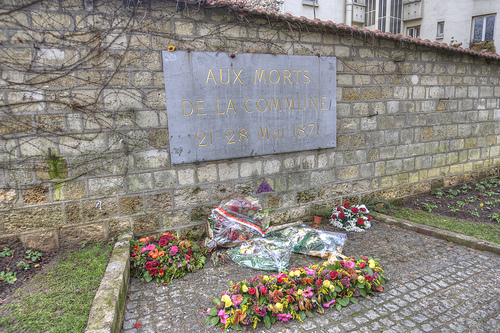
After France finally accepted peace terms, including loss of border territory and payment of large reparations, the French turned on each other, in what was both a conflict between left and right and between the Capital and the rest of the country. A left-wing Paris Commune was proclaimed. Not far away, at Versailles, Thiers, formerly a constitutional monarchist, but now prepared, for the sake of order, to accept a moderate Republic, gathered an army to put down the Commune.
The Communards never set out a clear programme. They did not establish socialism but they were hostile to the Church, Monarchy and aristocracy. They murdered the Archbishop of Paris and revived the French Revolutionary Calendar. They have ever afterwards inspired a, probably misplaced, romantic enthusiasm in left-wing circles. Two of Karl Marx's daughters married ex-leaders of the Commune.
Both the violence and chaotic incompetence of the Communards may be seen for example when they decided to massacre 48 prisoners, priests or former police under the previous regime. The execution was so disorganised that any supporter of the Commune with a gun could turn up and take part in the killing. Once it was over, there was one more dead body than there had been prisoners, indicating that the Communard executioners had accidentally shot one of their own number along with the priests and policemen.
Foreigners found it impossible to find Parisians to give an unbiased explanation of what was going on; everyone was committed to one side or the other. One of the few to try to steer a middle course was Clemenceau, then Mayor of the Paris district of Montmartre, who half a Century later would be Prime Minister of France in the First World War.
By the end, everyone knew Germany was now the leading Power in Continental Europe. Some consequences of that are portrayed in other books by the same author Alistair Horne, about Verdun in 1916 and the Fall of France in 1940.