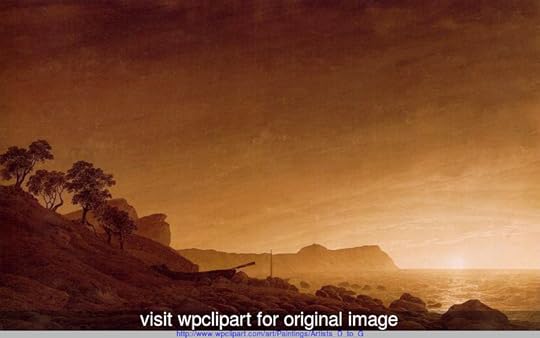
Caspar David Friedrich (1774 1840), the greatest painter of the Romantic movement in Germany, was perhaps Europe's first truly modern artist. His melancholy landscapes, often peopled by lonely wanderers, represent experiments towards a radically subjective art, one in which, as Friedrich wrote, the painter depicts not what he sees before him, but what he sees within him. Yet in their awesome power to capture the individuality of visible forms Friedrich's pictures also accept and express the irredeemable otherness of Nature. Winner of the 1992 Mitchell Prize for the History of Art, this compelling and highly original book is now made available in a compact pocket format. Beautifully illustrated, "Caspar David Friedrich and the Subject of Landscape" is the most comprehensive account ever published in English on this most fascinating of nineteenth-century masters.
“This is a model of interpretative art history, taking in a good deal of German Romantic philosophy, but founded always on the immediate experience of the picture. . . . It is rare to find a scholar so obviously in sympathy with his subject.”—Independent
This book is not flawless, but it is very good. It contains, as the GR friend who tipped me off to this has said - one of the best discussions of Romanticism you might ever find.
But I found myself having to skip certain sections - partially, some of it was more detailed than I needed, dealing with particulars that I found not very interesting - for example, some of the painting analysis, which wasn't really formal as…. well….,
if I'm reading a book about a late 18th/early 19th cen. landscapist, I don't want to read the name Merleau-Ponty, or be told that F.'s picture of snow is really about what Derrida thinks the world is about. This sort of stuff, imho, is just pretentious, and the sort of thing that has clogged the Humanities since WWII. There's too much subjective analysis - metaphor masquerading as analysis - for five stars.
Part of my problem is that I don't really like Friedrich's early paintings that much on a subjective level…. they feel somewhat artificial. But the paintings beginning in the early 1820's and running through to the end of his life, are different -- richer, with a greater depth of natural (as opposed to national) feeling -- and one can see in them the influence of Turner and Constable (e.g., the two Evening paintings of Sept. and Oct. 1824), and the transition to what will be termed the Barbizon style quite clearly (e.g., Morning, 1821; Noon, 1822), or the beautiful Landscape with Windmills, 1822. Friedrich fell out of favor later in life - critics charged his work had become too self-absorbed, nothing but waves of mist and fog. But the truth is quite the opposite - his work gains greater clarity, his palette actually lightens, and focus.
The book is nicely produced - with glossy color (and some black and white) photos -- not large format, but nice nonetheless.
Isaiah Berlin, in his Mellon Lectures on The Roots of Romanticism, said that Romanticism "seems to me to be the greatest single shift in the consciousness of the West that has occurred," influencing every major "shift" of the two centuries that followed. Such a remark is merely eye-glazing unless it's given substance and depth, and this is exactly what Koerner accomplishes in his remarkable book on the German painter Caspar David Friedrich. It's the best book I've read on Romanticism since M. H. Abrams's Natural Supernaturalism and Owen Barfield's What Coleridge Thought – and those were so long ago, I'm not sure they count.
Koerner illustrates how terms first defined by the Romantics still determine how we think and feel today. For example, the "familiar thesis of art as a secularized religion is a foundation of the historiography of painting as it developed in the discipline of art history since Romanticism. It is in Friedrich's Cross in the Mountains that it first appears self-consciously incarnated as art." Much of his book investigates the reception and influence of this painting in the multilayered context of German philosophy and current art criticism. It's the strength of his writing, and the depth of his observations, that make this journey far less ponderous than it sounds – rewarding the reader with rich observations at every turn.
A term new to me (exposing my ignorance) is Rückenfigur: a person in a painting seen from behind, an example of the Romantic motif of the "halted traveler." The most famous of these appears on (at least) three books buried on my shelves – Erich Heller's The Artist's Journey into the Interior; D. B. Brown's Romanticism and (of course) Nietzsche's Ecce Homo. Koerner's meditation on the role of this figure in Friedrich's paintings approach the uncanny. "The Rückenfigur is so prominent in the composition that the world appears to be an emanation from his gaze, or more precisely, from his heart."
(BTW another Friedrich painting adorns the Isaiah Berlin book referred to above.)
In the context of Koerner's discussion of Wanderer I also learned a new English word that instantly lends itself to metaphor. "The blurred trees and cliffs emerging from the fog would seem to have been set down first, perhaps in contours more definite and clear than they now appear, and then overpainted with white and grey scumbles." To scumble means to "modify (a painting or color) by applying a very thin coat of opaque paint to give a softer or duller effect." Who knew?
Finally, the English publisher Reaktion Books has done a fine job in providing this book with 150 reproductions, many of them in color. That didn't keep me from repeatedly calling up high-res images on my iPad, which makes Friedrich's images even more luminous. I'm still waiting for publishers to exploit the new tablet technology to give us art books that allow us to examine paintings in depth.
This exciting, wonderful work, in the bibliography of Gabriel Josipovici's What Ever Happened to Modernism?, caught my attention as I've long admired Caspar David Friedrich without figuring out why and was curious about his relationship to modernism. Caspar David Friedrich and the Subject of Landscape demonstrates how these seemingly straightforward paintings, sometimes of disturbingly simple subjects, embody the human struggle with art itself. Along the way one learns enough of Friedrich's life and ideas to give a clear sense of his artistic and intellectual milieu and its likely effect on his work.
Koerner's writing is a pleasure to read, even when it reflects the complexity of his analyses.
And in a deeply respectful way, paintings to be discussed in depth appear on the page in advance with only identification of title, date, and location, allowing readers to enter each on their own, absorbing the image and let their minds play over it before Koerner begins his ideas.
Having no specialized art knowledge and little experience of art criticism, reading paintings as Koerner does is new and immensely pleasurable and rewarding. Here is part of his discussion about Fog, a painting now in Vienna that requires much looking and thinking. This reproduction, like most on the web, renders the pictorial elements much more visible than they actually are.
"...Fog implies within the represented scene the subjective process of perception and interpretation. And therefore, rather than regarding the landscape's haze or the picture's compositional disjunctions as, respectively, natural or artificial analogies to the human history of departure or death, it may be more appropriate to regard the painting's ostensible subject-matter -- ships departing from the shore, the soul's journey to eternal life, etc. -- as so many narratives explicating the picture's more basic plot, which is the difficult relation between subject and object, ourselves and the Vienna canvas."
This is a very good—verging on excellent—read about Caspar David Friedrich. I think it shows some of the best formal analysis writing I have ever seen, breaking down the mechanics of how a painting works (and supplementing this with iconographic, biographical, etc. components, but honestly we're really here for the formal analysis.) It should not be the first, or only, thing you read about this artist, but it makes a good addition to other treatments of his work. I did have some issues with the book: I think the organization makes little to no sense, and I think a stronger grounding in Friedrich's biography would have helped with this. I wish Koerner had outlined his decisions about which paintings to discuss, and I wish there had been more explicit takeaways about what the analysis of each painting tells us about Friedrich's approach to landscapes.
Me encanta todo lo que tiene que ver con el arte del periodo romántico. Caspar David Friedrich era un pintor de paisajes, pero sus paisajes no eran solamente paisajes, sino que eran la representación de un mundo complejo interior. Este libro divide la obra del pintor alemán en diferentes secciones y nos muestra la evolución y al mismo tiempo lo repetitiva que fue su obra. Esa repetición esta basada en un sistema de creencias y valores que tenía el artista. Es un pintor de las ideas, del culto y de la filosofía del idealismo alemán.
El romántico trata de buscar el significado original del mundo. Explora los mitos y las leyendas del mundo antiguo. Vuelve a interpretar la edad media y el culto a las sagradas escrituras. Transforma el paisaje en símbolo; y llena de bruma y misterio a la naturaleza.
Caspar David Friedrich es un artista espiritual y místico como muy pocos. Su obra esta llena de paisajes llenos de muerte, donde solo quedan edificios destruidos y catedrales deshabitadas. La única señal de vida es el Rückenfiguren (personas de espalda), el cual contempla la inmensidad de estos paisajes.
El libro esta llenó de imágenes, tanto a color como en blanco y negro. Algunas ocupan una pagina entera y en otras la mitad. Creo que este libro no hace justicia a sus cuadros, ya que tienen tanto detalle que se pierde la experiencia. Lo sublime que describe Edmund Burke se pierde en un libro como este. A pesar de todo esto es un libro maravilloso.
Read this while following the 'Malerweg' (Painters' Way) in the Saxon Schweiz mountain ranges of Dresden. This was a trail where a great many influential 18th c. painters honed their craft, and the setting for most of Caspar David Friedrichs breathtaking landscape art. In this great collection of essays Koerner is able to demonstrate how these religiously inspired natural scenes are simultaneously able to capture the infinite nature of God whilst not becoming lost in his spirit and grounding his reality in a finite natural complexity. What most stayed with me were the parts where David Friedrichs project was defined as moving towards god, the portrayal of the struggle instead of the relief. A recognition of earth as a sanction if only the idea of something that defines its form and thus imbues its features with divinity is upheld, and that faith then being reflected in the intuitive reception of nature as beautiful.
I have also noted that works of art-theory are worth reading if only for the obvious pleasure that the authors taking in describing in 'picture perfect' detail the scene that they are about to analyse. Something so simple already seems to reveal new aspects of the work which speaks against the idea that thought and langauge can be held as synonymous. Someone should write a treatise on this and connect it to the Faculty of
Thanks to archive.org for providing this rare copy. This book dissects the work of German romantic painter, Caspar David Friedrich, thoroughly. It's my first experience reading an art book. I had difficulties comprehending Koerner's writing as he used high-level language code. Friedrich's prominent work, Wanderer Above The Sea of Fog, made me read this. I'm always in awe of his paintings of Rückenfigur — a silhouette of a figure. The figure just makes me feel small against the vastness of the landscape. Might revisit this book in the future