Jump to ratings and reviews
Rate this book

Take Them to the Stars #1

A History of What Comes Next

Rate this book
Brought to you by Penguin.

Imagine everything you thought you knew about human progress was wrong. What would you do?

Mia is not sure what she is, but she isn't human. Smarter, stronger than her peers, all she knows are the rules: there can never be three for too long; always run, never fight.

When she finds herself in Germany 1945, she must turn the Nazis' most trusted scientist with an offer: abandon the crumbling Nazi party, escape Germany with your life, come to work for the Americans building rockets.

But someone is watching her work. An enemy who's smarter, stronger, decidedly not human and prepared to do anything to retrieve something ancient that was long lost.

If only she had any idea what it was....
©2021 Sylvain Neuvel (P)2021 Penguin Audio

Audible Audio

First published February 2, 2021

323 people are currently reading
17674 people want to read

About the author

Sylvain Neuvel

22 books5,356 followers
Sylvain Neuvel dropped out of high school at age 15. Along the way, he has been a journalist, worked in soil decontamination, sold ice cream in California, and peddled furniture across Canada. He received a Ph.D. in linguistics from the University of Chicago. He taught linguistics in India, and worked as a software engineer in Montreal. He is also a certified translator, though he wishes he were an astronaut. He likes to tinker, dabbles in robotics and is somewhat obsessed with Halloween. He absolutely loves toys; his girlfriend would have him believe that he has too many, so he writes about aliens and giant robots as a blatant excuse to build action figures (for his son, of course).

Ratings & Reviews

What do you think?
Rate this book

Friends & Following

Create a free account to discover what your friends think of this book!

Community Reviews

5 stars
1,039 (19%)
4 stars
2,218 (40%)
3 stars
1,617 (29%)
2 stars
498 (9%)
1 star
95 (1%)
Displaying 1 - 30 of 930 reviews
Profile Image for Emily (Books with Emily Fox on Youtube).
627 reviews71.3k followers
January 31, 2021
(2.5?) This is my fifth book by the author but probably my least favorite (well maybe after the last book in the Themis Files series).

The concept was interesting, the flashbacks to older generations were great but I found the writing too dry.

I'm not a huge fan of historical fiction but I hoped the the rest would compensate, which it mostly did. I'm not sure it needed to be a series but I might still read the next book.
Profile Image for Emily May.
2,223 reviews321k followers
January 15, 2021
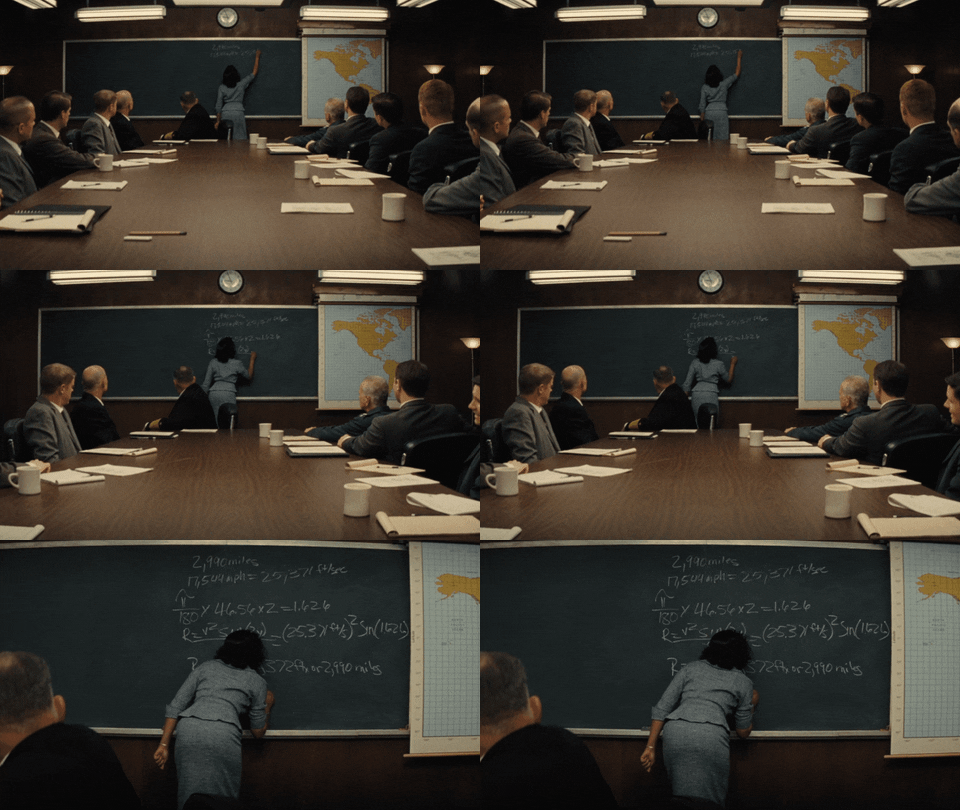
He found himself directing research on a small ballistic missile for the army. His rockets are light-years behind von Braun’s, but few people understand mathematics the way Hsue-Shen does. We have been bouncing ideas off each other for almost a decade, and I just wrote to him about my CO2 conundrum.

I hate to say it, but I think this book might exist on a level of nerd I'm incapable of reaching.

You can tell Neuvel put a lot of research and heart into his latest project, but I do wonder just how big the audience is for a book like this. I'm sure there are people out there looking for a convoluted sci-fi about the Soviet side of the space race if powerful aliens were aiding them in an attempt to get humanity off the planet before it all goes to shit, while simultaneously being hunted by Trackers (I mean, I think that's the general plot), but how many there are... who can say?

I've been stopping and starting this book for months and, in this, my final successful (sort of) attempt to finish it, I realized it had nothing to do with my own personal book slump and everything to do with the fact that this story is just not for me. I say "sort of" because I will readily admit that there was some skim-reading in the last quarter. I'm sorry. I did try not to.

The book is heavy on the scientific and technological details, which is a big snooze for me. The aliens - the Kibsu - seemed interesting at first, because they all work in mother-daughter pairs, with Mia and her mother being the Ninety-Nine (I'm not explaining this very well because it's hard to explain, and possibly I don't fully understand it). This has been going on for centuries. But I did not find we were ever encouraged to warm to any of the characters. If I was supposed to connect emotionally with Mia, it never happened. I was always kept at a distance.

Neuvel uses real people as characters - Wernher von Braun and Sergei Korolev. Just as in our own history, both have a major part to play in the advancement of space flight, though here we see Mia and her mother, Sarah, aiding them in escaping Nazi Germany so they can assist the Soviets in the space race.

It's a creative premise, to be sure, but without characters I cared about, I felt little attachment to the events of the narrative. It was also - for me, who is not a scientific genius - quite confusing. There was a lot I didn't understand.

I felt, too, that the book moved painfully slowly. This is quite surprising, really, as Neuvel returns throughout to the same style he used in the Sleeping Giants trilogy, which I loved, having the story unfold through dialogue. Where in his previous books, this kept things dynamic and exciting, I found these sections dragged here.

There are a couple of people I know who I may recommend this to. Hardcore space buffs who care more about techie details than they do about feeling something for the characters. If that sounds like you, I would check this one out. For myself, I think I'll just wait to see what Neuvel writes after this series.
Profile Image for Nataliya.
985 reviews16.1k followers
February 16, 2022
I thought I would be a perfect match for this book. I loved Sylvain Neuvel’s Sleeping Giants trilogy and I’m a bit of a space nerd — so Neuvel’s book about space race should have been a treat. But unfortunately, this one fell a bit flat.

This book is about the Kibsu — superpowered aliens which have gone though a hundred generations of Mother-Daughter pairs, whose sole goal is to help human civilization develop space flight and eventually get off the planet — to ensure our eventual survival. In that pursuit they stop at nothing to preserve their knowledge and the secret of their existence — even if it means bloodshed in the name of the greater goal. They are relentlessly pursued by mysterious Trackers who seem even more bloodthirsty and a bit unhinged. In pursuit of the space flight development, Sarah and Mia (our current 100th mother-daughter pair) must help smuggle German rocket-builders - namely Werner von Braun - from Nazi Germany and then aid the Soviets - namely Sergei Korolev - to pull ahead in the space race, as this space race competition can bring the spacefaring goal closer to fulfillment.
“The world is doomed, and we must get people off of it. That’s what’s important. Not this war, not the first one or the next one. Not the woman in the river. Our fight is against gravity, and von Braun can help us win it.”


Left: Wernher von Braun. Right: Sergei Korolev.

The premise is great, and I can get behind it even if I have quite strong reservations about using actual historical figures of the relatively recent past as book characters, ascribing them character traits and affairs and marriages with fictional characters that make me feel a bit uncomfortable (those are real people with real descendants, so taking liberty with their lives is questionable at best), and their discoveries should be theirs and not ascribed to supernaturally intelligent outworldly beings — but that’s just my reservations, and your mileage may vary.

I did appreciate the efforts to show the Soviet part of the space race, the part that for many Westerners is not well-known. I think to most Western readers the name of von Braun would be more familiar than that of Korolev, so this book fills in the gaps (although if you choose to not look up those people and their works right after their first appearances, you might not appreciate it as much as you would have otherwise). Although Neuvel does give us some facts, a deeper look would only be beneficial to the readers - both at the historical figures and the details of their work.
“He and most of his colleagues were arrested during the Great Purge. They said he was slowing down work at the research institute. Stalin labeled them “members of an anti-Soviet counterrevolutionary organization.” Korolev was tortured for days until he “confessed.” The charges against him were eventually reduced to sabotage. He got a new trial. Only he didn’t know. He was already on his way to the gulag. He went to a gold-mine prison with six hundred people. Six months later, when they found him, there weren’t even two hundred of them left. Now he has to work for the people who did that to him.”

The real problem for me was the stylistic execution, however. The book is largely written in dialogue - between our protagonist Mia and her mother, Mia and von Braun, Mia and Korolev, Mia and a few other characters - with a few chapters narrated journal-style by Mia’s mother and occasional interludes showing us the snippets of mostly violent lives of the Kibsu through our history, which were actually quite interesting and I wish had comprised a larger part of the book. But dialogue-based Mia’s story, interrupted only by her internal reactions to that dialogue, is the bulk of the book, and it’s the style that just did not work for me. I found that after a while my attention was starting to wander. Plus Mia’s inner voice asides were not endearing her to me — she seemed very teen-like, even in her adult years, very exasperated and often whiny and quite judgmental, petty and offputting (). See example below, which is how she sounds quite often - and even if it’s justified by the circumstances, it’s tiring to read about:
“—Mother, what is going on? You do the accounting, you buy people, you get the Russians to build V-2s. Why me? Why not you? Why do I have to do all this?”

My other gripes came from not quite understanding how many of the plot points would work, even when superpowered beings are involved. I mean, how do the Kibsu so easily move to both sides of the Iron Curtain without any suspicion? How are they able to ingratiate themselves so quickly even with the Soviet government? How are they able to so easily manipulate Party leaders? It’s mentioned that they have ways, but it’s never explained, and since those bits are done in dialogue, Neuvel never really ends up addressing the logistics, making it seem like those Hollywood movie scenes where in one scene the protagonist makes a decision, and in the other scene (after some off-screen manipulations, we assume) the grandiose plans are seamlessly in motion.
“—I hate to be the bearer of bad news, Nina—can I call you Nina?—but no one is going to put me in charge of anything.

I am! I’m going to put him in charge because… Because I want to. Also because Stalin doesn’t pay his people and I found someone at the Politburo who owes a shit ton of money to the Russian mafia.”

Also, all the talk about the Russian mafia in the 1940s and 1950s seemed just a bit off.

The pacing was a bit off, too - maybe because it’s the first entry in the series, but it feels like not much happens for over half of the book, despite the scenes filled with action (filtered through dialogue at times) and bloodshed. Stylistic and narrative choices made it not so easy to follow coherently, and left many parts barely sketched out and therefore less impactful. It was just too easy to feel very detached from the characters in this book, despite the first-person narration and viewpoint. I knew, for instance, that Mia cared about her girlfriend and her dog and even her husband — but the way the narrative was told, it was very hard to feel any connection to them. In the end, despite spending the whole book with Sarah and Mia, I felt like I still had no idea who they were as persons. I wish I could connect with even one character for this book to become more enjoyable. I mean, I felt more connected to Neuvel after reading his author notes in the end (and those are indeed interesting) than to any of the people we spent the whole book with.

Overall, I think it was an excellent premise (human space race as the culmination of millennia-long alien project!!!) that was served poorly by the gimmicky execution. The dialogue / journal entries style does not work well for this book. For a better Neuvel book, check out Sleeping Giants instead.

Now, if the next books goes easier on dialogue and instead is written more like the flashback Kibsu chapters, I may still check it out. (And Tadiana, we’ll find a more satisfying buddy read in the future, I’m sure!)

2.5 stars.
—————

Thanks to Netgalley and the publisher for providing ARC for review.

——————
Also posted on my blog.
Profile Image for Lala BooksandLala.
584 reviews75.5k followers
February 22, 2021
The topic was intriguing and I typically enjoy the pairing of real world with science fiction; the inexorable relationship between the space race and the war being an especially strong lure. Sadly the narration style lacked the emotional depth I hoped for and I found it really dragged overall. Full review on my youtube channel- thanks to TOR for the opportunity to read it early.
Profile Image for Tadiana ✩Night Owl☽.
1,880 reviews23.3k followers
February 11, 2021
A soft 3 stars for this alternative history novella focused on the space race post-WWII, with a SF twist to it.

description ... plus .

Final review, first posted on FantasyLiterature.com (along with my co-reviewer Bill's review):

In A History of What Comes Next, Sylvain Neuvel recasts history with a science fictional element, inserting a chain of mysterious mother-daughter teams who manipulate key events and powerful men through the ages to try to get the human race to reach toward the stars. Other than taking humans to space, “before Evil comes and kills them all,” the purpose of these women, the Kibsu, is pretty murky, even to themselves; most of their original knowledge, including about their own origins, has been lost. But they have an apparently inviolable rule that there can never be more than three Kibsu living at one time … and that many, not for long. And they know that they need to avoid drawing attention to themselves — difficult to do when they have some unusual physical and mental attributes, including that each daughter looks like a clone of her mother. They especially need to evade an equally shadowy group of men they call the Trackers, who are mercilessly hunting the Kibsu and killing them.

The main plotline follows two of the Kibsu women, Sarah and her daughter Mia. In 1945, Mia, who is then nineteen, is tasked by her mother with helping German rocket engineer Wernher von Braun to escape from Nazi Germany and get him into the hands of the Americans, to help them develop their rocketry science and bring humanity closer to space travel. Neuvel delves into the details of von Braun’s escapades during the waning days of World War II, helped along by Mia, who masquerades as his niece. This part of the plot takes almost a third of the book, too long for my taste, though it’s broken up by flashbacks that tell above lives of some of Mia’s Kibsu ancestors in ancient and medieval times.

After the war ends, Mia and Sarah make their way to the USSR and elsewhere, all in the service of their ultimate goal of fostering space travel. As Mia falls in love with Billie, a black girl living in Moscow, she has more difficulty accepting the Kibsu rules passed down to her and the way she’s expected to live her life.

Neuvel has an interesting gimmick here, following actual history, particularly the early days of the space race, quite closely, but weaving the Kibsu into it — which sheds new light on every historical event, and highlights the way women have been treated as secondary citizens through much of history. Personally, I also learned a lot about WWII and postwar rocketry history, and about monsters like Lavrentiy Beria, the influential Soviet politician who moonlighted as a sexual predator and (very likely) murderer. But WWII history isn’t my primary literary interest, so my interest flagged after a while, especially since the science fiction aspects relating to the Kibsu and the Tracker are disclosed only in small dribbles, and the flashes of humor that helped to make the THEMIS FILES books so appealing are absent here. The flashbacks were the most intriguing parts of A History of What Comes Next, but there are only a very limited number of those.

There are also a few chapters from the Tracker point of view, which tend to raise more questions than answers. Both groups, the Kibsu and the Tracker, are ruthless killers in pursuit of their goals, so it’s hard to really sympathize with anyone here. Complete answers about these people are never given, and the novel ends with the overall plot entirely unresolved. I was deeply disappointed at the time I finished the book (I really should have taken better notice of the “#1 in a new series” blurb). Neuvel also uses a quirky method of showing dialogue between characters, shades of the style he used in Sleeping Giants, but it fit better and made more sense there than it does here.

With the benefit of a little distance since I finished reading it, I’ve grown more forgiving of this book’s shortcomings, and more impressed with the amount of historic research Neuvel put into A History of What Comes Next. I don’t expect to ever love this series as much as I did the THEMIS FILES trilogy, but I’m quite curious about seeing where Neuvel goes with the next book in this new series.

Thanks to the publisher and NetGalley for the ARC. And thanks to Nataliya for the buddy read. We’ll have to try it again with a better book. :)

Initial post: I’ve got the ARC from NetGalley, cheers! This is the author of the Sleeping Giants trilogy, so my hopes are very high.
Profile Image for Gerhard.
1,304 reviews884 followers
April 16, 2021
One of the best reading experiences – and one that is increasingly rare in our oversaturated media age – is where you go into a book cold and it takes you so completely by surprise that, for a couple of days, it consumes you totally. Prior to this I had no idea who Sylvain Neuvel was.

‘A History of What Comes Next’ was one of those books I requested in a fit of pique from NetGalley, annoyed at being constantly ignored by publishers. You know what happens next, of course. Suddenly you get a spate of ‘accepted’ requests from NetGalley that pushes down your reader rating and leaves you with a lurking pile of arcs to get to that you barely remember enquiring after in the first place, let alone what they are about.

A caveat is that I have yet to read ‘The Lady Astronaut’ sequence by Mary Robinette Kowal, which I am now curious enough about to at least pick up the first book just to see how it stacks up against Sylvain Neuvel. Then I also have ‘V2’ by Robert Harris on my list, who is no stranger to that SF sub-genre of ‘alternative history’ with his superlative ‘Fatherland’.

What really intrigued me about ‘A History of What Comes Next’ is that the actual Kindle text ends at 88%, leaving a goodly chunk of ‘Further Reading’. The first line of this section is: ‘(Not as boring as it sounds, I swear)’. And it really isn’t. Not to mention one of the best parts of the book for me, particularly as it is intricately connected with the narrative itself. Neuvel explains: I learned a ton writing this book. I knew little of the space race when I began, nothing of rocket science. Writing in the past was the biggest challenge. Basically, nothing exists and women can’t do anything.

Neuvel proceeds to give his highly readable (and often very funny and irreverent) take on many of the major elements in the book. These range from the OSS (the Office of Strategic Services, which Indiana Jones worked for, according to ‘The Kingdom of the Crystal Skull’), the famous Operation Paperclip, and actual personages such as Wernher von Braun, Sergei Korolev and the particularly odious Lavrentiy Beria, who cosied up with Stalin in 1926. We also learn about Hsue-Shen Tsien, the genius behind the Jet Propulsion Laboratory who was sent to debrief von Braun and his team after they had surrendered to the Americans. And who was eventually labelled a Communist under the Red Scare and spent five years under house arrest. Go, America!

Neuvel notes further: There’s been so much written on the [American space program], lots of movies seen, that I chose to focus on smaller, lesser-known events. It’s also why the book ends in 1961, before Mercury, Gemini, and Apollo. This means that Act IV, for example, focuses on Mia going to Kasputin Yar, established in 1946 to test captured German V2s, and often referred to by conspiracy theorists as the ‘Russian Roswell’. There’s a lovely section on Russian space dogs, as part of the story is Mia trying to rescue Dezik and Tsygan. (We learn that between 1951 and 1960 at least 20 dogs made suborbital flights).

I could go on and on … This kind of factual background is manna for SF fans, and I must say it is a section that endeared me most to Neuvel. He understands intimately what makes the average SF nerd’s brain tick. And the brilliance of this section is the level of detail it adds to the main narrative, without being superfluous at all. If you’re thinking that a book which needs an explanatory appendix is fundamentally flawed, you’re missing the point entirely. Just read the damn thing, and you’ll be entranced as I was.

As for the plot? Neuvel himself describes his book as “my weird slightly-homicidal-alien-clone-space-race-story”, which is as good a summary as any. For me, the smartest kind of genre fiction is where the speculative component or the world-building is so deftly intertwined with the actual narrative that you cannot even see the seams. Clearly, a huge amount of research went into this. It is equally clear that, despite the fantastic elements of the Tracker and the Kibsu, a lot of this is depressingly true.

There is a popular, romanticised idea of the birth of the US Space Race effectively turning swords into ploughshares by recruiting the best of Nazi Germany’s scientists. The truth, as always, is much darker (if not greyer), as this included a lot of very morally dubious people, despite their supposed scientific credentials. And a lot of the less savoury Nazi R&D was simply taken over, and refined, by the Americans.

A note on the text: Neuvel takes the interesting step of blocking out all of the spoken dialogue as if it were speech in a play. At first this takes some getting used to, as it seems a bit jumpy and jarring, but the cumulative effect is that it makes for a much faster and more immersive read, which I also have to add contains a surprisingly vigorous quantity of violence, bloodshed and assorted mayhem.

If you think the idea of the Kibsu sounds familiar, like me you are probably reminded of the ‘Destiny’s Children’ series by Stephen Baxter. This is simply one of the best SF thrillers I have read in a long time. Yes, the plot elements have been recycled countless times before, and history is history. But it is what Neuvel does with all of this, and the story he tells of what happens next, that makes this such an extraordinary book.
Profile Image for Bradley.
Author 9 books4,866 followers
March 6, 2021
While the over-story in this is merely pretty okay and the end, well, the less I say about it, the better, I actually enjoyed the grand majority of this novel.

I really enjoyed the mother/daughter stories. Of course, it's not REALLY a mother/daughter kind of thing, but the biological twist, the cloning aspect that carries on for a hundred generations, IS fascinating and the vignettes through time were all a real treat.

But most interesting was the real history of the space race and rocket research by way of WWII, extricating Von Braun out of Germany, and the push and pull spycraft. This was by far the best part of the novel, but mixing this with aliens working their lives to the bone to take us to the stars (and taking themselves with us) is a very, very beautiful idea.

I'm going to enjoy reading all of these. :)

Profile Image for Faith.
2,229 reviews677 followers
February 18, 2021
This book is about a mother-daughter team from an alien race whose mission is to take humans to the stars (for reasons unclear). It basically rehashes the space race as if it were engineered by these aliens. The story in this book begins with the Nazi era, but there have been many generations of these identical aliens, going back centuries, and some are described in flashbacks. They are being pursued, for hazy reasons, by some all male counterparts. Unfortunately, the women have to find males in order to produce more female offspring and the men must find females to produce more males. This seems inefficient, but it does introduce a few more characters to the book.

The blurb says that the book is fast moving. I think it is more accurate to describe it as short. It doesn’t really move anywhere and is very repetitive. The duo tries to influence scientists, they encounter obstacles, they kill their way out of difficult situations, run away leaving dead bodies in their wake and change their identities. This happens repeatedly. The story ends somewhat abruptly in 1961. At that point, no one has gone to the stars, and the mother’s research on climate change has barely begun.

At the end of the audiobook there was a section on suggested further reading from the author. Many of the people and events described in the book were real and the author seems to have had a good time doing research. The author gave no indication of how many books are projected for this series. You might want to wait until he finishes it before reading this book, because book one leaves way too many unanswered questions and wasn’t very satisfying. 3.5 stars
Profile Image for La Crosse County Library.
573 reviews202 followers
January 5, 2022
Review originally published April 27, 2021

Take them to the stars

While this book is undoubtedly science fiction, it defies being pinned down so easily, incorporating elements of historical fiction, mystery, political intrigue, and even the supernatural. Having previously read Neuvel's "Themis Files" trilogy (2016-2018), I can attest to the author's resistance to telling stories in the traditional way. This tradition is carried on in A History of What Comes Next (2021), the first book in Neuvel's "Take Them To the Stars" series.

From the get-go, I enjoyed the premise: countless generations of identical mother-daughter teams' behind-the-scenes orchestration of the international space race. Take them to the stars is their central objective. They push to transform humanity into a spacefaring species lest evil--the mysterious "Tracker"--traps them before they can escape Earth. They only have vague notions of who they are, where they came from, and why they've sought to advance technological progress at any cost. That knowledge was lost long ago, so all that remains is a code of survival above all else centered around the directive take them to the stars and what they call themselves: the Kibsu.


The first book introduces us to "The Ninety-Nine," mother Sarah and her daughter, Mia (e.g. the 99th generation of the Kibsu mother-daughter teams). It's the end of WWII, and Mia's mission is to recruit German rocket scientists on behalf of the US government's Operation Paperclip, chief among them Werner von Braun. From Germany, the pair "go where the rockets are," from the Soviet Union, Kazakhstan, and by the book's end, America, where Mia takes up a computer position with NASA. (Yes, the computers of Hidden Figures (2016) fame, the women who helped get a man to the Moon.)


As in his previous works, Neuvel reverts to his storytelling-by-dialogue method. For readers unused to his writing style, A History of What Comes Next may be confusing and disorienting when paired with the narrative shifts that go on throughout the book, meant to give context for the events of the "present" (1945-1961). Even for me, it got a bit much at times, which is why I gave it four, rather than five, stars.

I will also concede that this writing style can make character development a bit more challenging, but not impossible. I felt Neuvel was able to start fleshing out both of them into unique individuals, and I can't wait for the sequel to see where it all goes.

If you can get past these flaws, A History of What Comes Next is a well-researched, rewarding story about the double-edged sword of progress, women scientists, and humanity's boundless penchant for exploration and discovery.


-Cora


Similar/related reads and movies:

At the end of A History of What Comes Next there is an afterword/further reading list compiled by the author that I think is worth the read!

The "Themis Files" series by Sylvain Neuvel; first book: Sleeping Giants (2016) A great introduction to Neuvel's works.

Hidden Figures: The American Dream and the Untold Story of the Black Women Mathematicians Who Helped Win the Space Race (2016) The movie, by the same name, released in 2016, is also awesome! Both taught me a great deal about the space race I did not know.

Arrival (2016) A fascinating sci-fi movie; sadly, there isn't a book version I'm aware of. A movie that shows the potential differences in perspective between us and extraterrestrials. (See the spoiler.)

"The Lady Astronaut Universe" series by Mary Robinette Kowal; first book: The Calculating Stars (2018) Awesome historical/science fiction that also features characters based on the computers of Hidden Figures.

Find this book and other titles within our catalog.
3,117 reviews6 followers
May 28, 2021
Book Reviewed on www.whisperingstories.com

A History of What Comes Next is an unusual book in that it blends history with sci-fi, two genres that are often on the opposite scale to one another. It is also a hard book to recap without giving the plot away.

What I can tell you is that we first meet teenager Mia towards the end of WWII. She is in Germany needing to locate and persuade Rocket Scientist, von Braun, to follow her instructions and leave the base he is at and head with her to the safety of the Americans. Von Braun isn’t sure about this new girl who is pretending to be his niece. Mia isn’t any normal teenager though she is not purely human.

Mia and her mother are the ninety-ninth generation of Kibsu women. Kibsu Women are an ancient race of women, around 3,000 years old and they always contain a mother-daughter pairing of near-identical females who are more intelligent, stronger, and have special abilities. Their mission is to sway history and to help defeat evil.

They are however being chased by a race of men, Trackers, whose mission is to kill the women and wipe their race out.

The book is told in six acts and a conclusion. Most of the story is told from either Mia or her mother’s point of view, though we do sometimes get to hear from the Trackers that are chasing them through time. There are also sections from back in time with previous Kibsu women.

I can’t say the book was a particularly easy read but it was certainly entertaining. It was strange to read about the war from Germany’s perspective and although Mia is trying to guide Von Braun and his team away from his base and into the safety of the Americans we still get to see and hear a lot of what was happening. Mia and her mother also travel through different countries and live in numerous places as they try to keep one step ahead of the evil coming for them.

If you are a lover of sci-fi novels then I think you will enjoy this book. Although it is set in history it didn’t always feel like a historical novel. Though if you are a fan of history then there are lots of facts about the space race and WWII dotted throughout, plus there is factual information written at the back too.

The plot is action-packed, fast-paced, and engrossing. I enjoy spending my time with Mia and her mother Sarah as they are easily likeable. This is the first book in a planned trilogy with book two out next year. I’m hoping to keep up with the fight and find answers to the questions that Mia has about who the Kibsu women really are so book two is on my radar.
Profile Image for Jerecho.
394 reviews52 followers
February 26, 2021
What comes next??? ... Try Mars... I'm going to sleep...
Profile Image for Bob Brinkmeyer.
Author 8 books83 followers
September 22, 2021
3.5 rounded down (see below)

I don’t often read science fiction, but this book caught my eye at the public library, primarily because of the title. It proved to be a good read, establishing a counter history to civilization’s technological development, particularly concerning rocketry but extending all the wayt back to ancient times. The premise is that for 100 generations aliens (each generation a single mother-daughter team) have been spurring civilization’s progress, with the end goal space travel. The novel focuses on the most recent team and their work during World War II and the early Cold War, as they scoot between Nazi Germany, the USSR, and the USA prodding the rocket scientists along. At the same time, the alien women are being pursued by other aliens, men apparently of the same race who for some reason are committed to wrecking their efforts. Along the way, some early history of the alien generations gets filled in (but not who they are or where they came from or why they are doing what they’re doing—that clearly will come in later novels, as this is the first of what Neuvel is calling the “Take Them to the Stars” series.) Neuvel does a good job of world building and of keeping the plot zipping along. I needed some escape reading and I certainly got that, and I’ll certainly read the next novel in the series.

One recommendation: do not read the section entitled “Further Reading (Not as boring as it sounds, I swear)” that Neuvel tacks on after the novel’s conclusion. In this section, which runs for 19 pages, Neuvel riffs on what he sees as all the cool stuff he found when doing historical research for the novel. Most of his comments, together with his breezily condescending tone, are so silly (he seems to perceive his audience in this section as unschooled children) that one wonders if he really had the smarts to write the novel—I mean, reading this section just about wrecked my positive feelings for the novel. Here are a few examples of Neuvel’s historical commentary, the first on fossil fuel: “Well, fossil fuel, petroleum for example, is still a bit of a mystery, but we know it comes from decomposed organic matter. Dead things. Very, very dead. We also know the process takes, like, forever.” And here’s his take on why the ancient Greeks at times made mistakes with the etymologies of foreign words: they were blinded by the brilliance of their own language. Neuvel explains: “Now, the Greeks back then have some problems, but a small ego isn’t one of them. They think their language is awesome.” And here’s how Neuvel characterizes Herodotus for making an etymological mistake on an Early Iranian word: “the guy doing the linguistic analysis was an idiot.” Huh? Just who is being idiotic here? (Unfortunately, of course, poor Herodotus didn't have access, as Neuvel does, to Wikipedia.)

“Further Reading” brought my 3.5 rating down to 3. It’s lucky I didn’t begin with “Further Reading” because I never would have started the novel.
Profile Image for Iulia.
203 reviews103 followers
February 27, 2021
Hmmph... I don't know what to make of this book. I did enjoy some parts, and I'm intrigued as to where the sequel would go, but I didn't love the writing and, at times, I felt underwhelmed and annoyed. The focus on the space race and the science aspects of the narrative sort of redeemed it, though, and managed to distract me from how much I didn't like any of the characters.
Profile Image for Kristen Beverly.
1,172 reviews52 followers
November 24, 2020
I absolutely loved Sylvain Neuvel’s Sleeping Giants, so I’ve been super excited to dive into this one. I think it’s perfect for fans of The Man in the High Castle. It stars powerful women that are racing to change the course of history by shaping the international space race. Little do they know, other dark forces are at play and will stop at nothing to make their wanted outcome part of history. It’s a deep exploration of how progress often comes at the expense of humans and brutal violence. It was a really fascinating and quick read that is a reimagining of history, based in fact. If you haven’t read Sleeping Giants yet, I highly recommend you start now while waiting for this one to come out in February!
Profile Image for 8stitches 9lives.
2,853 reviews1,724 followers
February 26, 2021
A History of What Comes Next is the first instalment in the fact-meets-fiction Take Them to the Stars trilogy of novellas, primarily set against the backdrop of World War II Europe. Showing that truth is stranger than fiction, Sylvain Neuvel weaves a sci-fi thriller that blends a fast moving, darkly satirical look at 1940s rocketry with an exploration of the amorality of progress and the nature of violence. It begins in 1945, and follows Mia Freed and her mother, Sarah, who are the ninety-ninth generation of Kibsu women — at the dawn of the space age. Kibsu are powerful and intelligent beings that are each genetically identical and whose origins go back 3,200 years to ancient Mesopotamia. They always consist of a badass mother and daughter pairing with their overarching mission being to “take [humanity] to the stars before Evil comes and kills them all.” Mia's family has helped shape human history to push them to the stars, making brutal, wrenching choices and sacrificing countless lives. Mia returns to Germany, a country her mother fled from back in 1932, in order to fulfil their prophecy which comes at the dawn of the age of rocketry. Her sole objective is to convince prominent aerospace engineer Wernher von Braun, a pioneer of rocket technology, to switch allegiance and come to America, join the Allied cause and partake in Operation Paperclip, a clandestine U.S. government program to poach and recruit Nazi scientists to advance America's chances in the space race. It's imperative the he's exfiltrated as soon as possible to lessen the chances of the Russians discovering him and his priceless knowledge. Sarah is employed by the Office of Strategic Services (OSS), an ancestor of the CIA.

Her purpose is to infiltrate the scientists working with the Nazis to bring them over to the Allied side and thereby control the creation of the potential nuclear bombs that not only could bring an end to the war, but also could shift the balance of world power. As time goes by and Mia gets older, she becomes the primary operative and is to join up with an OSS contact within the German ranks, Walter Dornberger, who can assist with the apprehension and safe transfer of von Braun to the US. The mission is aborted when Sarah discovers that the malicious Trackers, who have hunted the Kibsu for thousands of years, are on their tails. Mia and Sarah must remain one step ahead of their ardent pursuers and a known ruthless enemy. This is a captivating, compulsive and exciting first-contact historical science-fiction thriller. I loved the potent mix of historical accuracy as all included events actually took place; it's clearly extensively researched and the addition of the characters, or the fictional aspect, creates a more personal thread to the story. It's clever and compelling with thrills and mystery aplenty and a whole lot of action and unexpected twists in the tale. Dark and enthralling and with rich and superbly detailed world-building, we are treated to a palpably tense narrative consisting of mysterious secrets, conspiracy theories and the idea that alien beings could very well be living among us. Mia is a complex character and as we watch her come of age and embark on a journey of self-discovery, she questions whether her family’s multigenerational mission to save humankind really is an objective to strive for. After all she's seen, she can't help but wonder whether humans are worthy of saving. Highly recommended.
Profile Image for Mogsy.
2,265 reviews2,777 followers
February 16, 2021
3.5 of 5 stars at The BiblioSanctum https://bibliosanctum.com/2021/02/15/...

A strange yet intriguing version of the space race is retold in this first installment of Sylvain Neuvel’s Take Them to the Stars trilogy, an alternate history following the lives of several generations of women from a family of otherworldly beings. Sara and Mia are the latest members in a long line of Kibsu, an all-female society whose ancient origins are believed to go way back beyond the dawn of human civilization. Since then, a team consisting of a mother and her daughter, identical in their genetic makeup, has existed with the sole purpose to shape and influence humanity with the end goal of helping them reach the stars, else an evil which has been hunting them for millennia will catch up and kill them all.

The ninety-ninth generation, Mia finds herself traveling to Germany in the mid-1940s on a secret mission to recruit aerospace engineer Wernher von Braun as part of Operation Paperclip, an American program to secure the space race. Soon after though, her mother Sara fears that the age-old enemies of the Kibsu, known as the Trackers, are dangerously close to discovering their location, forcing them to flee to Moscow. There, the pair begin a new undertaking to aid the Russian space program, hoping that this would also send the United States scrambling to develop their own rockets. Time, however, is running out in more ways than one. Humanity is close to making a breakthrough, but the Trackers are also hot on the women’s trail. Furthermore, Sara knows that a new generation must be created if their mission is to continue, but there can never be more than two Kibsu for long. While Mia understands what needs to be done, her heart breaks at the idea of giving up everything for duty, not to mention she is not yet ready to lose her mother.

It’s an interesting premise, to be sure. That said, if you’re the kind of reader who prefers their stories with clear, logical plot progression and convincing explanations, A History of What Comes Next will probably not be your cup of tea. To start, if you were reading my summary and wondered what the motives of the Kibsu might be, you’re sadly not going to get much more beyond what I’ve already outlined. As for their origins, the whys and hows are foggy at best, and not even the many flashbacks sprinkled throughout the narrative were able to provide much clarity. Ultimately, one gets the sense you’re not supposed to ask too many questions, since the characters themselves are unsure of the answers.

On a positive note though, the ideas in this book were very unique. Neuvel incorporates real events, writing about everything from the post-WWII period to the tail end of the space race with an eye towards detail, a point which should win a lot of favor with historical fiction fans. At the same time, he’s also weaving in the supernatural and other speculative elements which fantasy and science fiction fans should eat right up. Of course, given that the overlap between these two groups is going to be much narrower, the question is whether this novel will find an audience, and here’s where I think things get a little trickier.

As well, I can see the story’s format being an obstacle for some, for not only does the book’s structure employ multiple perspectives with flashbacks, the writing style is also somewhat reminiscent of the author’s Themis Files trilogy, unfolding mostly in dialogue. It’s a gutsy move, since so much could go wrong, and I confess that during my experimentation with different formats for this novel, I found that the style made for a very poor audiobook experience even with a full cast doing the different voices. Even when reading in print, the prose simply felt too broken up, and because a lot of times we were limited to dialogue, I often felt I was missing out on a ton of context due to a lack of description.

In the end, I am torn. The ideas here were great, and I loved the blend of history and SFF, but the book would have been a richer, fuller experience for me had it been told in a more conventional style. This was a niche read, one that will probably struggle to find wide appeal, though on the other hand, I believe those whom it speaks to will absolutely adore it. There’s definitely potential here, a chance for this trilogy to grow and become so much more. I guess we shall see with the sequel.
Profile Image for Elizabeth (Plant Based Bride).
680 reviews11.7k followers
July 15, 2021
A History of What Comes Next by Sylvain Neuvel is, in my opinion, a fascinating blend of historical and science fiction with a dash of action and adventure. This first installment in what is to become a series focuses on mother and daughter duo Sarah and Mia Freed, the 99. They are the descendants of a line of women, the Kibsu, with a shared face and single-minded purpose - to take humanity to the stars. But who are the Kibsu, really? And why did they come to Earth in the first place?

I wasn't sure how to feel about this decidedly unique tale when I first picked it up. While I was intrigued by the premise and the author's clearly extensive research, the writing felt choppy and dispassionate - as if I was being held at arm's length from the narrative.

But at some point, maybe a third of the way in, I realized I had become deeply invested in the characters and their mission. Mia, especially, felt deeply human (though her humanity is perhaps in question) and real. She struggles with the path laid out for her by her mother, Sarah, with very little explanation. She agonizes over the violence she has seen and participated in. She wonders if humanity is truly deserving of their help or beyond redemption. And along with these larger questions of morality and purpose, she goes through the same coming of age experiences so many of us have shared - who is she, really, and what does she want out of life?

While Mia was by far my favourite character, there were several others of interest throughout the novel. In fact, even characters with comparatively little page time such as Von Braun, The Tracker, Hsue-Shen, Billie, and Korolev jumped off the page and straight into my imagination. There are no "good" and "bad" guys in the novel, only shades of grey - and that is exceptionally interesting to read.

This story is set predominantly in Germany and Russia from the end of the Second World War through the Cold War and has a clear focus on rocket science. I can't say I have ever read a work of fiction that told the history of the development of modern space travel from this perspective, but I have certainly had my appetite whetted for it!

Interspersed between chapters continuing the primary narrative is a series of Entr'actes exploring past generations of the Kibsu. These Entr'actes were wonderfully immersive vignettes adding depth and nuance to our understanding of these women and their place in history, and I loved them all. They do, however, tend to be extremely violent (as does the primary timeline), so please keep that in mind and check content warnings if you need them (I have included some at the end of my review).

I discovered after finishing the book that there is a playlist associated with it - one song per chapter. I would highly recommend listening to the playlist while reading, as each song evokes the time, place, and mood of each chapter in a delectable way! I ended up skimming through the book again as I listened to get the full experience, and it was just wonderful. I have a feeling that if I had known of the playlist and listened along the first time through, I may have enjoyed the early portion of the book much more.

I would highly recommend this novel to Sci-Fi and history lovers who have an interest in the exploration of human nature and the development of the technology required for space flight. It is perhaps a niche concept and likely won't work for everyone, but for those of us it does work for this could easily become a new favourite! I know I can't wait to read the rest of the series when it becomes available.


Trigger warnings: Suicide, murder, violence, extreme gore, body horror, the Holocaust, war, homophobia and conversation therapy, torture, imprisonment, racism, miscarriage, sexual assault


Thank you to NetGalley for proving an ALC in exchange for an honest review.

VIDEO REVIEW: https://youtu.be/8CMwKdLnhc4

You can find me on...
Youtube | Instagram | Twitter
Profile Image for Mara.
1,948 reviews4,324 followers
January 16, 2021
I'm somewhere between 2.5 and 3 stars... I really enjoyed THE TEST by this author, so I was excited to try a different SF series form him. Alas, while I think the premise of this one is really interesting (a matriarchal line of aliens who have infiltrated Earth to enable humans achieving space travel), the writing style did not jive with me. The individual sentences were beautifully written, but they didn't flow together in a way that I enjoyed. I would still try more from this author, but I'll pass on this series
Profile Image for Lata.
4,922 reviews254 followers
April 23, 2021
This was a fast and surprisingly enjoyable read. I loved all the references to actual people and events from WWII onwards. And I liked Sylvain Neuvel's take on the space race by way of aliens’ help/interference.
The various mother-daughter dynamics throughout the book and human history make for sometimes tense reading, as each must make tough and sometimes terrible decisions to keep on the one path they know they need to follow so they can return to the stars.
I liked this, and look forward to reading the next book in this series.
Profile Image for Lisa Wright.
632 reviews20 followers
November 9, 2020
There are always two; a mother and a daughter. They are the Kibsu and for 99 generations they have lived for one goal to "take them to the stars." They pass through history nudging, encouraging, hinting, helping scientists from Babylon to Werner Von Braun. Whatever it takes. They will survive and continue their work no matter how many people have to die. But there are others equally committed to stopping them.

Sci fi and history intertwine in this dark, compulsive thriller. Loved it!
Profile Image for Denise Ruttan.
448 reviews44 followers
December 8, 2020
This review is also on http://www.dnruttan.com.

I received the book “A History of What Comes Next” by Sylvain Neuvel (expected publication date of February 2, 2021, from Tor) as an e-ARC for an honest review from Netgalley.

First of all, I will try my very best not to review this book with SPOILERS because very few people have read it so far, seeing as it’s an upcoming release, and sadly I have no one to talk with about these spoilers yet; but I can’t wait for more people to read it so I can geek out over this. Yes indeed, this is one of those kinds of books. I was blown away. I need to geek out, people. Hurry up and read this book.

At first I thought that this was a time travel book. Then I thought it was a space exploration story. Then the mystery slowly and expertly unfolded and I realized it was all and none of those things. This is the story of the Kibsu. There are the 99; and there can never be three. They have a few rules: Survive. Carry on the knowledge. Achieve space travel. But they don’t know where they came from. They only know the code, passed down through the centuries of women who defied their place in history. This story is really a story about the mystery of their secret society, discovered through fragments of time.

The story follows a mother and daughter pair, Sarah and Mia, in the 1940s. It’s the end of World War II and Mia is sent, allegedly, by the Office of Strategic Services to infiltrate the German rocketry program to recruit Werner von Braun. At first, I was struggling with the idea that a 19-year-old woman could get anywhere in late 1940s Germany, given the restrictions of gender roles and sexism at the time. Even with advanced scientific knowledge, and only interacting with scientists who could appreciate her intellect, that would be a stretch. But then I read the author’s research notes after finishing the book and it finally made sense.

In fact, that’s a theme throughout the whole book; these generations of women sneaking into holes in history where they didn’t quite belong in order to influence events. They leave behind a trail of bodies to cover their tracks, which then leads them to the antagonist of the book, The Tracker, another figure with a mysterious origin story who is feared by the Kibsu. But therein lies spoiler territory.

So in short order, you have: feminism, 1940s rocketry and the beginnings of the space program, all done in an intense, lightning-fast literary style. This one had me at hello. Talk about one beautiful rush.

The story is written in the present tense, which I usually don’t like because it’s usually done poorly. Not so in this book. The first-person present tense was crafted perfectly and immediately sucked me into the story, adding to the tension and ramping up the pacing. I wasn’t sure I really liked the protagonists, Mia and Sarah; they were a bit cheeky and egotistical, but in the end, I was rooting for them to live the normal life they realized they wanted, after all, but could never have. They had dimension and complexity. And the tone was written in an irreverent, self-aware style that drew me into character with depth and style.

This was a gorgeous story. I eagerly await the sequel. Thank you again to the publisher for an advance look.
Profile Image for Laura.
366 reviews39 followers
November 16, 2020
This book is tough to rate - parts of it were super intriguing while others just didn't hold my attention.

Mia and her mother are the Kibsu, aliens who've worked for generations to help humans reach the stars. Always a mother and daughter pair. Always on the run from the Hunter.

While the novel shifts in time, showing us earlier generations of Kibsu and their subtle machinations to get human technology upto speed. Most of the story focuses on Sarah and Mia.

Mia's mission is to lure Wernher Von Braun away from the Nazi party and into the American rocket program, and secure the future of the space race. They're both involved in lots of WWII and Soviet Russia subterfuge and manipulation.

I wanted more information about the Kibsu and the Hunters - since this is the first book, maybe those answers come later. The characters are compelling and complex. Neuvel reveals their history one small morsel at a time, making the reader crave more.

I loved all of his notes at the end, particularly the possible etymology of the word Amazon.
Profile Image for Maryam.
935 reviews271 followers
July 13, 2022
Actual Rating 3.5

I am a huge fan of Neuvel's previous work Themis Files Series. That was a top notch work.

About this new book, I am not sure, I still enjoyed multiple POV story and how real world history and war was mixed with Science Fiction but the details didn't grow on me. There were times that I found myself losing focus while listening and had to go back and re-listen the part.

Gonna read/listen to second book and see how that one has shaped :)
Profile Image for Holly (The GrimDragon).
1,179 reviews282 followers
January 30, 2021
"I pulled a pen out of his shirt pocket, put it in his nostril, and drove it into his skull with my palm."

A History of What Comes Next is the first in the Take Them to the Stars trilogy by Sylvain Neuvel. 

I read Neuvel's novella, The Test, almost exactly two years ago & fucking LOVED it! It was intense & emotional & surprising all within something like 100 pages.

A History of What Comes Next is much longer & significantly less emotional. In fact, it was quite bland & often difficult to navigate. I just couldn't wrap my head around  everything. 

These are basically the worst books for me to review, seriously. The reason being, I want to love this. Truly! The bones to this are so fucking radical I cannot deal! Punching Nazis in the face & rocketry & alien clones!

Sylvain Neuvel seems like an author I would dig. Clearly a shit ton of research was put into this. It's intelligent, smartly crafted & as someone who is just as obsessed with music as they are with books, I absolutely loved the chapter titles corresponding with the playlist which signifies what year the chapter is taking place. Of course, I listened to each song while reading, most I've never heard of before now. It definitely put me in the time period, although I can't help but think of Fallout whenever I hear music from that era. I'M SUCH AN ELDER MILLENNIAL!

This was quite a mixed bag, overall. It just didn't click all the way for me, although I think it will for many others!

YMMV.

(Thanks to Tor.com Publishing for sending me a copy!)

**The quotes above were taken from an ARC & are subject to change upon publication**
Profile Image for Roomies' Digest.
297 reviews834 followers
March 23, 2022
Excellent audiobook! Really enjoyed this and it’s my first of his books so I KNOW sleeping giants is going to slap. More thoughts later but initially this was sooooo good and very interesting historical fiction

xx
-Christine
Profile Image for Sarah.
1,008 reviews262 followers
September 30, 2021
I’ve finished, and I’m no closer to knowing whether I loved it or not.

First, I’m a huge fan of historical fiction. Authors who conduct thorough research, and retell events with as much truth as they can while making it entertaining- well, to me it feels like finding a tiny treasure box, filled with trinkets made just for you, hidden in a place where only you might find it. Because I love history, but I struggle to read straight up history books. Historical fiction can make the mundane seem special or significant when done right.

And Neuvel crammed so many trinkets into this book. And he did it all while I was reading along stupidly thinking it was 95% fictional. (Read the Further Reading section folks.)

Anyway.

Have you ever had a conspiracy theorist tell you that computers and modern technology were given to us by aliens? And that’s the reason for the technological explosion in the 20th century? This book is a play upon that, though I hesitate to say more because spoilers. (And don’t read the other reviews because there are WAY too many unmarked spoilers in them.)

But- I did have my struggles too. I guess my chief complaint is the stream of consciousness style. It just got to be tiresome after awhile. It lent strong voice to the characters but I was really sick of it in the end.

Secondly- there’s a lot of CW: in this book. I don’t mean to make it sound like that’s all the book is about, or even that they are front and center (they really aren’t), it’s just that it hurts my soul to read about or imagine for any period of time, however brief. You become a little desensitized after the first couple but it was pretty unpleasant initially, and I do feel like this story could have been told without them.

I probably(?) will read the next book- but I’m ready for a good long break right now. I don’t need it like tomorrow, and I do feel that this book is complete and can totally be read as a stand-alone which I appreciate.
Displaying 1 - 30 of 930 reviews

Can't find what you're looking for?

Get help and learn more about the design.