

What do you think?

Good Night, Hem
Ernest Hemingway stars in three interconnecting short stories in this graphic novel.
Paris, 1925. Our story begins when Hemingway meets Athos, the last Musketeer, who, together with several more friends of Hemingway, travel to Spain's Pamplona for the fiesta. Festivities and complications ensue.
Paris, 1944. The second story starts the day after the liberation of Paris when Hemingway, now a war correspondent, decides enough is enough, and takes action to end the war for good. With a group of adventurers and resistance fighters, he parachutes into Germany to do just that.
Cuba, late 1950s. Our literary lion is in his twilight years, writing his memoirs, remembering his first and second meeting with the seemingly immortal Athos.
Mixing fact and fiction, Jason has imaginatively recreated one of America's greatest and most controversial writers of the 20th century.
Paris, 1925. Our story begins when Hemingway meets Athos, the last Musketeer, who, together with several more friends of Hemingway, travel to Spain's Pamplona for the fiesta. Festivities and complications ensue.
Paris, 1944. The second story starts the day after the liberation of Paris when Hemingway, now a war correspondent, decides enough is enough, and takes action to end the war for good. With a group of adventurers and resistance fighters, he parachutes into Germany to do just that.
Cuba, late 1950s. Our literary lion is in his twilight years, writing his memoirs, remembering his first and second meeting with the seemingly immortal Athos.
Mixing fact and fiction, Jason has imaginatively recreated one of America's greatest and most controversial writers of the 20th century.
160 pages, Hardcover
First published September 21, 2021
About the author
Jason
129 books723 followersJohn Arne Sæterøy, better known by the pen name Jason, is an internationally acclaimed Norwegian cartoonist. Jason's comics are known for their distinctive, stone-faced anthropomorphic characters as well as their pace reminiscent of classic films.
Jason was born in 1965 and debuted in the early 80's, when still a teenager, in the Norwegian comics magazine 'KonK'. His first graphic novel Pocket Full of Rain (1995) won the Sproing Award, one of the main national awards for cartoonist.
In 2001 Jason started a fruitful collaboration with the American publisher Fantagraphics, which helped him gain international notoriety. Besides Norway and the U.S., his comics have appeared in Sweden, Denmark, Finland, France, Germany, Italy, the Netherlands, Poland, Russia, Slovakia, Spain, Switzerland, Brazil.
Jason's stories feature a peculiar mix of dry humour, surrealism and tropes from a variety of pulp genres, such as noir novels and monster movies. His most celebrated works include: Hey, Wait... (2001), a tale of childhood and trauma; You Can't Get There from Here (2004), a re-telling of the myth of Frankenstein; The Left Bank Gang (2007), featuring fictional versions of Hemingway and other writers living in Paris in the 1920s; I Killed Adolf Hitler (2008), a story that mixes romance and time travel; The Last Musketeer (2009), a love letter to old sci-fi imaginary featuring king's musketeer Athos; Low Moon (2010), one of his many collections of short stories; Werewolves of Montpellier (2010); Isle of 100,000 Graves (2011), a pirate story co-written with French cartoonist Fabien Vehlmann; Lost Cat (2013), a thriller with a surreal spin.
Jason won a Harvey Award for best new talent in 2002 and Eisner Awards in the category 'Best U.S. Edition of International Material' for three consecutive years (2007-2009).
He has lived in Denmark, Belgium, the U.S., eventually setting for Montpellier, France in 2007.
Jason was born in 1965 and debuted in the early 80's, when still a teenager, in the Norwegian comics magazine 'KonK'. His first graphic novel Pocket Full of Rain (1995) won the Sproing Award, one of the main national awards for cartoonist.
In 2001 Jason started a fruitful collaboration with the American publisher Fantagraphics, which helped him gain international notoriety. Besides Norway and the U.S., his comics have appeared in Sweden, Denmark, Finland, France, Germany, Italy, the Netherlands, Poland, Russia, Slovakia, Spain, Switzerland, Brazil.
Jason's stories feature a peculiar mix of dry humour, surrealism and tropes from a variety of pulp genres, such as noir novels and monster movies. His most celebrated works include: Hey, Wait... (2001), a tale of childhood and trauma; You Can't Get There from Here (2004), a re-telling of the myth of Frankenstein; The Left Bank Gang (2007), featuring fictional versions of Hemingway and other writers living in Paris in the 1920s; I Killed Adolf Hitler (2008), a story that mixes romance and time travel; The Last Musketeer (2009), a love letter to old sci-fi imaginary featuring king's musketeer Athos; Low Moon (2010), one of his many collections of short stories; Werewolves of Montpellier (2010); Isle of 100,000 Graves (2011), a pirate story co-written with French cartoonist Fabien Vehlmann; Lost Cat (2013), a thriller with a surreal spin.
Jason won a Harvey Award for best new talent in 2002 and Eisner Awards in the category 'Best U.S. Edition of International Material' for three consecutive years (2007-2009).
He has lived in Denmark, Belgium, the U.S., eventually setting for Montpellier, France in 2007.
Ratings & Reviews
Friends & Following
Create a free account to discover what your friends think of this book!
Community Reviews
Displaying 1 - 30 of 68 reviews

October 20, 2021
Since I had read and loved Jason's The Left Bank Gang (2006) with all its silly focus on the Lost Generation ex-pats as starving cartoonists (and Hem in the center of it all), and have reread a lot of Hemingway in the last couple years, and because I had just read Robert Elder's Hemingway in Comics, I knew I would like this.
While it doesn't add that much to understanding Hem, it is nevertheless entertaining, adding a Jason character named Athos (from The Last Musketeer, 2008). The book tells stories from three different Hem periods: 1) Paris and Pamplona (The Sun Also Rises) 2) WWII, and 3) Cuba, where Hem is seen working on his memoirs (The Moveable Feast). Athos, in Jason's fantasy alt-history comics version of Hem's life, figures in the actual life of Hem, but as Jason has it, Hem just decides to never write about Athos in any of his books. Whimsical, mostly, but I enjoyed it.
While it doesn't add that much to understanding Hem, it is nevertheless entertaining, adding a Jason character named Athos (from The Last Musketeer, 2008). The book tells stories from three different Hem periods: 1) Paris and Pamplona (The Sun Also Rises) 2) WWII, and 3) Cuba, where Hem is seen working on his memoirs (The Moveable Feast). Athos, in Jason's fantasy alt-history comics version of Hem's life, figures in the actual life of Hem, but as Jason has it, Hem just decides to never write about Athos in any of his books. Whimsical, mostly, but I enjoyed it.

September 29, 2021
Jason’s immortal musketeer Athos finds himself in 1925 Paris where he meets a young Hemingway. Off they go to see the bulls run in Pamplona! In the second story, it’s 1944 Paris and Hemingway leads a team to assassinate Hitler and end the war. And finally in 1959 Cuba, an elderly Hemingway reminisces about his time with Athos.
Jason’s one of my favourite cartoonists so there aren’t many books of his that I don’t think much of, so I was surprised at how bored I was reading his latest, Good Night, Hem. All three stories are so uninspired and dull. All that happens between Athos and Hem when they meet is some goofy identity switch (their character designs, minus the clothing, are identical) so that Hem can attempt an affair with someone.
Otherwise, it’s the story of Hem going to Pamplona with other writers and getting the material to write Fiesta: The Sun Also Rises. I’ve read the novel and I know about The Lost Generation so there’s really nothing here for me except to be reminded of those things again.
The second story is even sillier with Hem taking it upon himself to assassinate Hitler. I would go so far as to say this one in particular reads like a parody of a Jason comic. It’s pointless, unfunny and uninteresting. I just don’t get it. Why Hem? Hmm. And then the third and final story, which is mostly an epilogue that basically summarises the previous stories, was a forgettable way to close things out.
The main problem is that Jason’s done these kinds of stories before, so it felt repetitive to me, and those previous stories were far more interesting than the ones offered up here. Read The Left Bank Gang for a better story featuring Hem; read The Last Musketeer and Athos in America for better Athos stories; read I Killed Adolf Hitler for a better Hitler assassination story.
I love Jason’s art style and the technical aspects of the comic are masterful but the actual stories themselves weren’t the least bit compelling and nearly put me to sleep reading them. A rare miss from an otherwise dependable and great cartoonist, Good Night, Hem is a disappointingly underwhelming book.
Jason’s one of my favourite cartoonists so there aren’t many books of his that I don’t think much of, so I was surprised at how bored I was reading his latest, Good Night, Hem. All three stories are so uninspired and dull. All that happens between Athos and Hem when they meet is some goofy identity switch (their character designs, minus the clothing, are identical) so that Hem can attempt an affair with someone.
Otherwise, it’s the story of Hem going to Pamplona with other writers and getting the material to write Fiesta: The Sun Also Rises. I’ve read the novel and I know about The Lost Generation so there’s really nothing here for me except to be reminded of those things again.
The second story is even sillier with Hem taking it upon himself to assassinate Hitler. I would go so far as to say this one in particular reads like a parody of a Jason comic. It’s pointless, unfunny and uninteresting. I just don’t get it. Why Hem? Hmm. And then the third and final story, which is mostly an epilogue that basically summarises the previous stories, was a forgettable way to close things out.
The main problem is that Jason’s done these kinds of stories before, so it felt repetitive to me, and those previous stories were far more interesting than the ones offered up here. Read The Left Bank Gang for a better story featuring Hem; read The Last Musketeer and Athos in America for better Athos stories; read I Killed Adolf Hitler for a better Hitler assassination story.
I love Jason’s art style and the technical aspects of the comic are masterful but the actual stories themselves weren’t the least bit compelling and nearly put me to sleep reading them. A rare miss from an otherwise dependable and great cartoonist, Good Night, Hem is a disappointingly underwhelming book.

February 29, 2024
The first story, I found it hard to keep track of the characters. Although it's riffing on The Sun Also Rises and I have the same trouble with that novel.
The second story, based on Hemingway's ww2 experience and his tendency to bullshit, is very funny in an Inglorious Basterds sort of way up until the final reveal, at which point it becomes quite melancholy.
The final story, Hemingway in old age in Cuba, remembering the past, wasn't much but it was a nice way to close out the book.
The second story, based on Hemingway's ww2 experience and his tendency to bullshit, is very funny in an Inglorious Basterds sort of way up until the final reveal, at which point it becomes quite melancholy.
The final story, Hemingway in old age in Cuba, remembering the past, wasn't much but it was a nice way to close out the book.

October 26, 2021
See Sam Quixote's review for valid reasons to dislike this book.
See Dave Schaafsma's review for reasons to like it.
I believe this great comic book creator was merely trying to exorcise Hemingway to make room for other topics to explore. If we never see Hem in another Jason work, please remember that you read it here first.
p.s. I'm rounding up a weakish 3.5
See Dave Schaafsma's review for reasons to like it.
I believe this great comic book creator was merely trying to exorcise Hemingway to make room for other topics to explore. If we never see Hem in another Jason work, please remember that you read it here first.
p.s. I'm rounding up a weakish 3.5

July 12, 2022
Read: July 2022
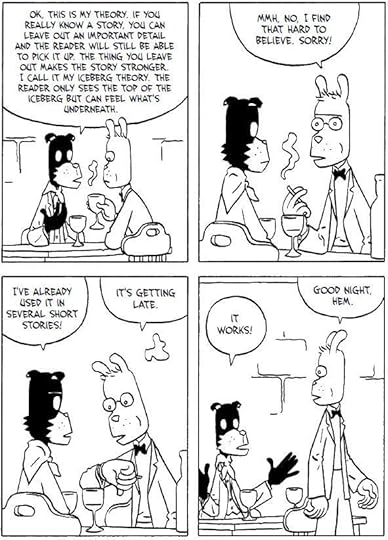
Good Night, Hem is well-worth a look, especially for fellow fans of Norwegian artist, Jason (John Arne Sæterøy). It depicts Ernest Hemingway at three major stages of his life: Paris & Spain in the 1920s; Paris in 1944; and old man Hem, in Cuba, 1959, with the smell of dead sailfish on his hands and the stuffed heads of big game mounted on his wall. Some familiar names are dropped: Miro, Max (Ernst), "Gertrude and Alice" (Stein, Toklas), among others. In one scene Hem is in a gallery with Max, viewing Miro's La Ferme. The price? 5,000 francs. (Miro is my favorite painter. I vividly remember seeing La Ferme in person a few years ago, in Paris.) Hem asks Max for his opinion. Max says, "I'd rather that you buy one of my paintings."
Among the characters is F. Scott Fitzgerald, here an early admirer of Hemingway’s work, and an as-yet unknown writer himself. Making a reappearance is Athos, one of the three Musketeers from an earlier Jason story. Except for his huge, feathered hat, he looks identical to Hem. So it’s amusing, if mildly so, when the two decide to switch outfits. The middle story is the best one, Hem training for combat, and parachuting into Germany to try and take out Hitler. It’s remindful of I Killed Adolf Hitler, Jason's earlier book about a time traveler with, of course, the same goal. I’d like to get my hands on The Left Bank Gang, another Jason, this time featuring Hemingway and Fitzgerald, and also Ezra Pound and James Joyce. A dream team, no? I hear it’s even better than this one.
Good Night, Hem is well-worth a look, especially for fellow fans of Norwegian artist, Jason (John Arne Sæterøy). It depicts Ernest Hemingway at three major stages of his life: Paris & Spain in the 1920s; Paris in 1944; and old man Hem, in Cuba, 1959, with the smell of dead sailfish on his hands and the stuffed heads of big game mounted on his wall. Some familiar names are dropped: Miro, Max (Ernst), "Gertrude and Alice" (Stein, Toklas), among others. In one scene Hem is in a gallery with Max, viewing Miro's La Ferme. The price? 5,000 francs. (Miro is my favorite painter. I vividly remember seeing La Ferme in person a few years ago, in Paris.) Hem asks Max for his opinion. Max says, "I'd rather that you buy one of my paintings."
Among the characters is F. Scott Fitzgerald, here an early admirer of Hemingway’s work, and an as-yet unknown writer himself. Making a reappearance is Athos, one of the three Musketeers from an earlier Jason story. Except for his huge, feathered hat, he looks identical to Hem. So it’s amusing, if mildly so, when the two decide to switch outfits. The middle story is the best one, Hem training for combat, and parachuting into Germany to try and take out Hitler. It’s remindful of I Killed Adolf Hitler, Jason's earlier book about a time traveler with, of course, the same goal. I’d like to get my hands on The Left Bank Gang, another Jason, this time featuring Hemingway and Fitzgerald, and also Ezra Pound and James Joyce. A dream team, no? I hear it’s even better than this one.

April 1, 2022
A lot of you might not realise I have read a lot of indie comics, being those without superheroes in.
Fewer will realise I've almost read every comic Jason has published. I really like Jason's style, and even though I am not that engaged by this memoir of Hemingway (a writer whose acclaim I'm yet to really appreciate). It was still an enjoyable read and ode to those American expat writers in Paris, and an alternative reality where Hemingway grows old and carries on. Odd coincidence how both this and Less Than Zero, my previous read, explicitly respond to Hemingway's suicide.
Don't read this, please instead read:
Hey, Wait
OR
Why Are You Doing This?
Jason's best when he is brave enough to be sad, and he has best achieved this in the above two stories.
Fewer will realise I've almost read every comic Jason has published. I really like Jason's style, and even though I am not that engaged by this memoir of Hemingway (a writer whose acclaim I'm yet to really appreciate). It was still an enjoyable read and ode to those American expat writers in Paris, and an alternative reality where Hemingway grows old and carries on. Odd coincidence how both this and Less Than Zero, my previous read, explicitly respond to Hemingway's suicide.
Don't read this, please instead read:
Hey, Wait
OR
Why Are You Doing This?
Jason's best when he is brave enough to be sad, and he has best achieved this in the above two stories.

September 25, 2021
"No, not really. It's not a true story. I made it up. He was a good guy."
Wszyscy już chyba zdajecie sobie sprawę, że mam kota na punkcie Ernesta Hemingwaya, i to od paru dobrych lat; mogą bardziej podobać mi się inne książki i autorzy w poszczególnych aspektach, ale nikogo dotąd nie obdarzyłam tak ogromną sympatią, u nikogo tak się nie zaangażowałam, mam na półce ogromny stożek jego książek, nagle zaczynam opowiadać przyjaciołom historie o nim, mieszka rent free w mojej głowie i tbh sprawia mi po prostu dużo radości. I tak mniej więcej od maturalnej; pierwszy raz po jego powieść sięgnęłam w gimnazjum i stała się moją ulubioną, ale to w trzeciej klasie liceum trafiłam przypadkowo na "A Moveable Feast" i już nigdy mi Ernest nie przeminął. Kiedy dowiedziałam się, że Jason (z którym w ogóle nie miałam przedtem nigdy do czynienia) połączył życie mojego ulubieńca z moją ukochaną postacią z niedawno przeczytanych "Trzech Muszkieterów", w powieść łączącą fakty i fantazyjną fikcję... Ten koncept brzmi tak pięknie, nie mogłam się doczekać tej historii.
I wyszło pięknie. Mam problem z portretowaniem Hemingwaya we współczesnych tekstach kultury, bo, jak chyba nawet wspominał Truman Capote, Ernest stworzył wobec siebie specyficzną legendę, mit, czasami jakby mogło się wydawać zbroję, i według mnie często się z niej wyłamywał; ten przerysowany Hemingway, Hemingway, na którego kreował samego siebie, i ten, który tak nieoczekiwanie pojawia się np. w jego narracji (a że główne postacie Ernesta i ich narracja są dość podobne do siebie, można podejrzewać, że to jego własna osobowość tak się w nie wlewała), to dla mnie czasami całkowicie inne postacie. Ale ta legenda najczęściej pojawia się teraz w jego portretach w mediach, bo rzeczywiście chcemy pokazać Hemingwaya tak, jak go większość adresatów tekstu kultury kojarzy, reputację miał, jaką miał, i tak jest najłatwiej i chyba najlepiej dla twórców - i wychodzi przerysowany. I nie zrozumcie mnie źle, bo przecież Ernest jest sobie winny (chociaż czy winny to dobre słowo?? to osobowość), tak, bywał tym macho, i bywał okrutny, i jejku, jak on się potrafił kłócić, i miał te swoje męskie zainteresowania, i specyficzne a anxious spojrzenie na śmierć i życie, i to wszystko się zgadza, i jeszcze przypisywał sobie wyczyny, do których to chyba jednak nie doszło, i przez to bywa okropny, ale... Równocześnie kryje się w nim tyle dobra i życzliwości, i w tym wszystkim wydaje mi się ogromny wewnętrznie. Tak jak pisał kiedyś Carlos Baker, Ernest Hemingway był pełen paradoksów.
Ale trochę zeszłam teraz z tematu. Nie chciałam czytać kolejnej powieści o przerysowanym wymachującym karabinem pół-fikcyjnym Erneście Hemingwayu (wystarczy ta fikcja, którą sam o sobie stworzył), ale może opis "Good Night, Hem" i sam dość życzliwy tytuł sprawiły, że pojawiło się u mnie przeczucie, że tutaj będzie lepiej, że Jason już widzi go inaczej. I widzi. Bo zatrzymał u Hemingwaya pewne te negatywnie kojarzące się cechy, o których wcześniej wspomniałam, ale równocześnie Ernest bywał w tej historii życzliwy, niezwykle inteligentny, spostrzegawczy, tęskniący, pragnący, odważny, tak urokliwie szczery, za to może go tak pokochałam, i jeszcze, jak mi najbardziej zależało, momentami taki drobny i wrażliwy; Ernest, którego poznałam przez te ostatnie lata, jest ogromnie wrażliwy, i to w najlepszy według mnie sposób. Scott Fitzgerald miał rację nazywając go "Sweetie" czy "bleeding boy", bo taki już był; to nie umniejsza jego sile, może w tej dziwnej cesze był jeszcze silniejszy. O, wiecie jakie jeszcze słowo mi się z Hemingwayem kojarzy? Spokój, tranquility. Ten Ernest w "Good Night, Hem" to był ten mój Ernest.
Podoba mi się, ile Jason "wyciągnął" rzeczy o Hemingwayu, jego przyjaciół, małe wątki jego życia, romanse, i też nasze domysły; chciałabym porównać z Jasonem nasze źródła. Tak się ucieszyłam na widok Sylvii Beach i wzmiankę o jej partnerce życiowej. Scena reunionu Hemingwaya i Beach jest cudowna. Wypowiedź Ernesta o jego ojcu ogromnie mnie poruszyła. Fragment z.. przemieniem historii o ratunku Athosa jest świetny. Jason naprawdę dobrze poznał się na Hemingwayu.
I te fikcyjne, fantazyjne losy Hemingwaya też tak idealnie do niego pasowały, Ernest rzeczywiście mógłby tego wszystkiego dokonać i wpaść na to wszystko, tak, widzę to u niego. Widzę, jak zmierza skończyć II wojnę światową. To bardzo w jego stylu. Tak łatwo się uśmiechnęłam.
A Athosa było tak miło zobaczyć, to naprawdę mój najkochańszy muszkieter. Bardzo chciałabym sięgnąć po następne tomy historii Dumasa.
Bardzo spodobał mi się również minimalistyczny styl Jasona i jego storytelling; powieść ogromnie mnie poruszyła, jest bardzo słodko-gorzka. Z chęcią sięgnę po jego inne komiksy, zwłaszcza, że podobno to nie był jedyny występ ani Athosa ani Hemingwaya u niego.
I jestem zakochana w tytule, Dobranoc, Hem, bo mam wrażenie, że oddaje całą... sympatię i życzliwość w stronę Hemingwaya, takie miłe uhonorowanie jego pamięci i pozdrowienie. Tak ja się czuję. I przypomina mi się wstęp do "True at First Light", napisany przez syna Ernesta, gdzie mówi, że ta ostatnia powieść to taka przytulanka pozostawiona po tacie. "Good Night, Hem" powoduje podobne odczucia.
Koniec jest prześliczny.
"We're a lost generation."
"Oh, shut up!"
Ernest, za tę "kłótnię" akurat można ci podziękować.
PS. Następną książką, której wystawię recenzję, powinna być powieść "Of Time and the River" znajomego Ernestowi Thomasa Wolfe'a, i nie mogę się doczekać, aż wam o niej opowiem.
Wszyscy już chyba zdajecie sobie sprawę, że mam kota na punkcie Ernesta Hemingwaya, i to od paru dobrych lat; mogą bardziej podobać mi się inne książki i autorzy w poszczególnych aspektach, ale nikogo dotąd nie obdarzyłam tak ogromną sympatią, u nikogo tak się nie zaangażowałam, mam na półce ogromny stożek jego książek, nagle zaczynam opowiadać przyjaciołom historie o nim, mieszka rent free w mojej głowie i tbh sprawia mi po prostu dużo radości. I tak mniej więcej od maturalnej; pierwszy raz po jego powieść sięgnęłam w gimnazjum i stała się moją ulubioną, ale to w trzeciej klasie liceum trafiłam przypadkowo na "A Moveable Feast" i już nigdy mi Ernest nie przeminął. Kiedy dowiedziałam się, że Jason (z którym w ogóle nie miałam przedtem nigdy do czynienia) połączył życie mojego ulubieńca z moją ukochaną postacią z niedawno przeczytanych "Trzech Muszkieterów", w powieść łączącą fakty i fantazyjną fikcję... Ten koncept brzmi tak pięknie, nie mogłam się doczekać tej historii.
I wyszło pięknie. Mam problem z portretowaniem Hemingwaya we współczesnych tekstach kultury, bo, jak chyba nawet wspominał Truman Capote, Ernest stworzył wobec siebie specyficzną legendę, mit, czasami jakby mogło się wydawać zbroję, i według mnie często się z niej wyłamywał; ten przerysowany Hemingway, Hemingway, na którego kreował samego siebie, i ten, który tak nieoczekiwanie pojawia się np. w jego narracji (a że główne postacie Ernesta i ich narracja są dość podobne do siebie, można podejrzewać, że to jego własna osobowość tak się w nie wlewała), to dla mnie czasami całkowicie inne postacie. Ale ta legenda najczęściej pojawia się teraz w jego portretach w mediach, bo rzeczywiście chcemy pokazać Hemingwaya tak, jak go większość adresatów tekstu kultury kojarzy, reputację miał, jaką miał, i tak jest najłatwiej i chyba najlepiej dla twórców - i wychodzi przerysowany. I nie zrozumcie mnie źle, bo przecież Ernest jest sobie winny (chociaż czy winny to dobre słowo?? to osobowość), tak, bywał tym macho, i bywał okrutny, i jejku, jak on się potrafił kłócić, i miał te swoje męskie zainteresowania, i specyficzne a anxious spojrzenie na śmierć i życie, i to wszystko się zgadza, i jeszcze przypisywał sobie wyczyny, do których to chyba jednak nie doszło, i przez to bywa okropny, ale... Równocześnie kryje się w nim tyle dobra i życzliwości, i w tym wszystkim wydaje mi się ogromny wewnętrznie. Tak jak pisał kiedyś Carlos Baker, Ernest Hemingway był pełen paradoksów.
Ale trochę zeszłam teraz z tematu. Nie chciałam czytać kolejnej powieści o przerysowanym wymachującym karabinem pół-fikcyjnym Erneście Hemingwayu (wystarczy ta fikcja, którą sam o sobie stworzył), ale może opis "Good Night, Hem" i sam dość życzliwy tytuł sprawiły, że pojawiło się u mnie przeczucie, że tutaj będzie lepiej, że Jason już widzi go inaczej. I widzi. Bo zatrzymał u Hemingwaya pewne te negatywnie kojarzące się cechy, o których wcześniej wspomniałam, ale równocześnie Ernest bywał w tej historii życzliwy, niezwykle inteligentny, spostrzegawczy, tęskniący, pragnący, odważny, tak urokliwie szczery, za to może go tak pokochałam, i jeszcze, jak mi najbardziej zależało, momentami taki drobny i wrażliwy; Ernest, którego poznałam przez te ostatnie lata, jest ogromnie wrażliwy, i to w najlepszy według mnie sposób. Scott Fitzgerald miał rację nazywając go "Sweetie" czy "bleeding boy", bo taki już był; to nie umniejsza jego sile, może w tej dziwnej cesze był jeszcze silniejszy. O, wiecie jakie jeszcze słowo mi się z Hemingwayem kojarzy? Spokój, tranquility. Ten Ernest w "Good Night, Hem" to był ten mój Ernest.
Podoba mi się, ile Jason "wyciągnął" rzeczy o Hemingwayu, jego przyjaciół, małe wątki jego życia, romanse, i też nasze domysły; chciałabym porównać z Jasonem nasze źródła. Tak się ucieszyłam na widok Sylvii Beach i wzmiankę o jej partnerce życiowej. Scena reunionu Hemingwaya i Beach jest cudowna. Wypowiedź Ernesta o jego ojcu ogromnie mnie poruszyła. Fragment z.. przemieniem historii o ratunku Athosa jest świetny. Jason naprawdę dobrze poznał się na Hemingwayu.
I te fikcyjne, fantazyjne losy Hemingwaya też tak idealnie do niego pasowały, Ernest rzeczywiście mógłby tego wszystkiego dokonać i wpaść na to wszystko, tak, widzę to u niego. Widzę, jak zmierza skończyć II wojnę światową. To bardzo w jego stylu. Tak łatwo się uśmiechnęłam.
A Athosa było tak miło zobaczyć, to naprawdę mój najkochańszy muszkieter. Bardzo chciałabym sięgnąć po następne tomy historii Dumasa.
Bardzo spodobał mi się również minimalistyczny styl Jasona i jego storytelling; powieść ogromnie mnie poruszyła, jest bardzo słodko-gorzka. Z chęcią sięgnę po jego inne komiksy, zwłaszcza, że podobno to nie był jedyny występ ani Athosa ani Hemingwaya u niego.
I jestem zakochana w tytule, Dobranoc, Hem, bo mam wrażenie, że oddaje całą... sympatię i życzliwość w stronę Hemingwaya, takie miłe uhonorowanie jego pamięci i pozdrowienie. Tak ja się czuję. I przypomina mi się wstęp do "True at First Light", napisany przez syna Ernesta, gdzie mówi, że ta ostatnia powieść to taka przytulanka pozostawiona po tacie. "Good Night, Hem" powoduje podobne odczucia.
Koniec jest prześliczny.
"We're a lost generation."
"Oh, shut up!"
Ernest, za tę "kłótnię" akurat można ci podziękować.
PS. Następną książką, której wystawię recenzję, powinna być powieść "Of Time and the River" znajomego Ernestowi Thomasa Wolfe'a, i nie mogę się doczekać, aż wam o niej opowiem.

June 2, 2023
Nie wiem na ile jest to hołd dla Hemingwaya, a na ile po prostu wariacja na temat wydarzeń z jego życia, w każdym razie nie pierwszy raz Jason daje wyraz swojej fascynacji sławnym pisarzem, co jest również sporą gratką dla innych jego fanów.
Pierwsza z tych historii posiłkuje się autentycznym kontekstem poprzedzającym napisanie powieści „Słońce też wschodzi”. Bohater z grupą ekspatriantów, stanowiących część paryskiej bohemy, rusza do Pampeluny, by zobaczyć walki byków i wziąć udział w hiszpańskiej Fieście. Na chwilę pojawia się Scott Fitzgerald z jego alkoholową chorobą, są relacje z autentycznymi przyjaciółmi i towarzyszami podróży, jest w końcu streszczenie filozofii twórczej artysty (tzw. Iceberg Theory) według której pisarz powinien przedstawiać tylko to co na wierzchu, a całą resztę pozostawiać w strefie domysłów czytelnika i pozwolić mu sememu odkrywać niedopowiedziane elementy dzieła. Jason nie byłby sobą, gdyby w całą historię nie wplątał kogoś z innej bajki, w tym przypadku jest to znany z wcześniejszych jego prac bohater powieści Dumasa - muszkieter Athos, który sporą rolę odegrał również w kończącym całość krótkim wspomnieniu opisującym wydarzenia lat 50-tych na Kubie.
W drugim obszernym opowiadaniu autor - już bardziej w swoim stylu - kreuje fikcyjną sytuację, w której przyszły noblista staje na czele grupy mającej zabić Hitlera i definitywne zakończyć wojnę. Znów wątek, który już w jego pracach występował, choć potraktowany zupełnie inaczej.
Być może nie jest to najwyżej oceniany album Jasona, ale chyba nie ze względu na same historie, które nadal trzymają bardzo wysoki poziom, a hermetyczny charakter całości. Jako ktoś słabo znający szczegóły biografii Hemingwaya, wyłapywałem smaczki i odniesienia do konkretnych postaci i wydarzeń z wyszukiwarką google i muszę przyznać, że fun był spory, a satysfakcja z rozszyfrowywania ukrytych znaczeń jeszcze większa
Pierwsza z tych historii posiłkuje się autentycznym kontekstem poprzedzającym napisanie powieści „Słońce też wschodzi”. Bohater z grupą ekspatriantów, stanowiących część paryskiej bohemy, rusza do Pampeluny, by zobaczyć walki byków i wziąć udział w hiszpańskiej Fieście. Na chwilę pojawia się Scott Fitzgerald z jego alkoholową chorobą, są relacje z autentycznymi przyjaciółmi i towarzyszami podróży, jest w końcu streszczenie filozofii twórczej artysty (tzw. Iceberg Theory) według której pisarz powinien przedstawiać tylko to co na wierzchu, a całą resztę pozostawiać w strefie domysłów czytelnika i pozwolić mu sememu odkrywać niedopowiedziane elementy dzieła. Jason nie byłby sobą, gdyby w całą historię nie wplątał kogoś z innej bajki, w tym przypadku jest to znany z wcześniejszych jego prac bohater powieści Dumasa - muszkieter Athos, który sporą rolę odegrał również w kończącym całość krótkim wspomnieniu opisującym wydarzenia lat 50-tych na Kubie.
W drugim obszernym opowiadaniu autor - już bardziej w swoim stylu - kreuje fikcyjną sytuację, w której przyszły noblista staje na czele grupy mającej zabić Hitlera i definitywne zakończyć wojnę. Znów wątek, który już w jego pracach występował, choć potraktowany zupełnie inaczej.
Być może nie jest to najwyżej oceniany album Jasona, ale chyba nie ze względu na same historie, które nadal trzymają bardzo wysoki poziom, a hermetyczny charakter całości. Jako ktoś słabo znający szczegóły biografii Hemingwaya, wyłapywałem smaczki i odniesienia do konkretnych postaci i wydarzeń z wyszukiwarką google i muszę przyznać, że fun był spory, a satysfakcja z rozszyfrowywania ukrytych znaczeń jeszcze większa

September 27, 2021
3.5/5
It's my own fault, really. I forgot that Jason cannot be read lazily, lying back in bed with ten other things on your mind. By the time I started paying complete attention, this clever chap was already on to me.
[image error]
But this actually helped me understand The Sun Also Rises better, heh. Full review to follow.
It's my own fault, really. I forgot that Jason cannot be read lazily, lying back in bed with ten other things on your mind. By the time I started paying complete attention, this clever chap was already on to me.
[image error]
But this actually helped me understand The Sun Also Rises better, heh. Full review to follow.
April 19, 2022
I have finally found a Jason book I do not enjoy :( His simple style is a detriment here, since all the characters ended up looking the same and I was never able to remember who I was supposed to be following (because even though there are "three interconnected short stories from Hemingway's life", they don't focus exclusively on Hemingway and they're not really connected). The last story feels unnecessary: it's incredibly short and rehashes most of what we've already seen.
All the stories were flat: where's the drama? The pathos? The action? I was bored.
All the stories were flat: where's the drama? The pathos? The action? I was bored.

December 26, 2021
Good Jason but not great Jason, which is how I've felt about his last couple of books. He knows what he's doing, but this stuff lacks the magic of his better work.
September 20, 2025
This just didn’t have the entertainment value of other Jason books. It felt like it was missing heart.
I’d recommend I Killed Adolf Hitler, The Left Bank Gang, Almost Silent, among others instead
I’d recommend I Killed Adolf Hitler, The Left Bank Gang, Almost Silent, among others instead
September 23, 2021
Jason is perhaps my favorite cartoonist, I think at this point I’ve read more comics by him than anyone else. His style is so up my alley that any book I read from him is going to rank highly for me. I truly think this is some of his best work. Combining his knack for 40ish page narratives, literary references and more, this book might be Jason at his most Jason.

September 13, 2021
Don't let my low score discourage you! I'm not a fan of Hemingway, and I don't know The Lost Generation very well, so many references, incidences and in-jokes were completely lost on me. I can't stand chest-thumping machismo and bravado, either, unless it's humorously over-the-top or ironic, which Hemingway's wasn't, so his inclusion in this didn't interest me at all. I picked it up because I've liked much of Jason's previous work and I like his character Athos, the Eternal Musketeer. But, for me, this had too much Hem, too many allusions I didn't get (and wasn't interested enough to look up) and characters who were given little-to-no context (other than F. Scott F.) (and how many nicknames/pet names did some of them have? Confusing, especially with Jason's art style, which sometimes only allows you the clothing to tell one character from another), and not enough Athos.
But(!), "Hem" is in the title, so what did I expect, eh? I'm curious to hear what a Hemingway fan thinks of this.
But(!), "Hem" is in the title, so what did I expect, eh? I'm curious to hear what a Hemingway fan thinks of this.

February 7, 2022
I am probably too far from Hemingway these days to truly appreciate this, but it still made me cackle in several places.

August 22, 2022
It's not up to the Jason standard that I'm used to.
Above all, what would made this much better is a "character personae". Since only pure black and white are used within and everybody is roughly the same stature, I had difficultly differentiating the characters- to the point that I had to go back a bunch of times to know who did what and so forth. Further to the point, aside from Athos, they are real people so I would've enjoyed a sentence or two about what they are "known for". The multi-confrontation causing female is never even referred to as more than "Duff". Then, that actually Hemingway's son in the second story?
What's with cartoonists and Hitler? Can't they see that he's way too over-used as the uber-villain? Jason already had Athos meet Hitler through time travel so what's his hang-up- or is he just lazy? Hemingway couldn't have done such a mission and surely didn't confront him anyway. What people in general seem to not realize is that, despite the multitude of horrors that Hitler was responsible for, Stalin was a much worse terror to the world. He wasn't hands off either like Adolf- Josep surely killed someone or at least was more intimate with his pan-executions. The guy even starved a whole nation of his own people!
Above all, what would made this much better is a "character personae". Since only pure black and white are used within and everybody is roughly the same stature, I had difficultly differentiating the characters- to the point that I had to go back a bunch of times to know who did what and so forth. Further to the point, aside from Athos, they are real people so I would've enjoyed a sentence or two about what they are "known for". The multi-confrontation causing female is never even referred to as more than "Duff". Then, that actually Hemingway's son in the second story?
What's with cartoonists and Hitler? Can't they see that he's way too over-used as the uber-villain? Jason already had Athos meet Hitler through time travel so what's his hang-up- or is he just lazy? Hemingway couldn't have done such a mission and surely didn't confront him anyway. What people in general seem to not realize is that, despite the multitude of horrors that Hitler was responsible for, Stalin was a much worse terror to the world. He wasn't hands off either like Adolf- Josep surely killed someone or at least was more intimate with his pan-executions. The guy even starved a whole nation of his own people!

November 2, 2021
A triptych of sorts featuring Ernest Hemingway during three phases of his life. They mix fact and fiction, but I think my favorite bit was how Jason included his version of Athos in the first story (which takes place in 1925 Pamplona with all the other expat American writers), first introduced in The Last Musketeer. It’s like he’s starting his own JCU over here :P



November 7, 2024
3.5/5

November 1, 2021
the lost generation go on a leaving cert holiday
October 12, 2023
Lo que tiene que se te olvide hacer las reviews durante meses es que luego no recuerdas lo que querías decir. Es mi vida. Con esta novela gráfica de Jason recuerdo que tuve la sensación de que fue mejor que algunas de las anteriores, que tenía sus temas de siempre pero algo más inspirado. Y esta es mi super review.

September 11, 2021
I’m sure I miss a ton of the references in this as I’m not super well versed in the goings on of The Lost Generation, I’ve read a chunk of Hemingway and Fitzgerald but not much else - I’ve also seen midnight in Paris which treads similar ground, but I still found my self laughing out loud at the stuff that didn’t fly past me. Also I realize now I should also probably read the Three Musketeers. Anyhow, I’ve liked Jason’s recent memoir style books, but it was nice to see a return to this territory. Great Stuff.

July 6, 2022
Is there a Jason shared universe? I think I need to go back and reread his other books to see how they all fit together.

November 27, 2021
I chose this book randomly because it was a graphic novel, and I like that format. I'm always willing to be pleasantly surprised. I guess Jason has written lots of other stuff, but I'm not familiar with his work, and at this point, not likely to become any more familiar.
I'm not a huge Hemingway fan, and this just had some imagined stories starring Ernest Hemingway - who is portrayed as a cat (?) - and another character, Athos (one of the three musketeers and also a character apparently seen in other works by Jason) who is portrayed as an identical cat. Only difference is the clothes. All of the characters were some kind of animal - Hadley Hemingway, Donald Ogden Stewart, F. Scott Fitzgerald - and I found it a struggle to tell who was who (or what). I had to keep checking back to see what the characters were wearing. A hat, a vest? Was their hair black or white?
At one point the author takes us on a fictional Tarantino-esque adventure wherein Hemingway, with the cooperation and encouragement of the US Army, leads a stealth operation into Germany to kill Adolph Hitler at the end of 1944. So, just kind of weird and not my thing. The plus is, it didn't take a lot of my time to read.
I'm not a huge Hemingway fan, and this just had some imagined stories starring Ernest Hemingway - who is portrayed as a cat (?) - and another character, Athos (one of the three musketeers and also a character apparently seen in other works by Jason) who is portrayed as an identical cat. Only difference is the clothes. All of the characters were some kind of animal - Hadley Hemingway, Donald Ogden Stewart, F. Scott Fitzgerald - and I found it a struggle to tell who was who (or what). I had to keep checking back to see what the characters were wearing. A hat, a vest? Was their hair black or white?
At one point the author takes us on a fictional Tarantino-esque adventure wherein Hemingway, with the cooperation and encouragement of the US Army, leads a stealth operation into Germany to kill Adolph Hitler at the end of 1944. So, just kind of weird and not my thing. The plus is, it didn't take a lot of my time to read.

March 6, 2022
Will Good Night, Hem go down in graphic novel history as Jason’s most underrated book? I think, yes.
Good Night, Hem consists of three short(ish) stories about Ernest Hemingway whom Jason has drawn into life before in The Left Bank Gang. In this book, we see excerpts from Hemingway’s life in Spain, during World War II in France, and finally, in Cuba, near the end of his life.
Of course, it’s not a straight-up biography. This is Jason we’re talking about! As in his short story about the life of Leonard Cohen in O Josephine!, we see a mix of fact and fiction. Having watched a BBC documentary about Hemingway, I felt I knew enough about his life to distinguish between these things, but most of the fictional aspects were apparent enough anyway, such as the inclusion of Athos, another Jason character seen in Athos in America and The Last Musketeer, and in addition, in the second chapter on page 138, Hemingway coming face to face with a character seen in How I Killed Adolf Hitler. The ‘cut away’ in this moment is hilarious. A truly deadpan Jason moment. In addition, we do learn something about the real Hemingway, such as when he says he felt his father was a coward for committing suicide, which is what I believe he really said.
Black and white panels again and I’m not sure how I feel about the ongoing absence of colour in Jason’s later stories. Does it subtract from or does it add to the content? Hmm. It doesn’t distract us from what we’re reading, that’s for sure. The picture in colour on the back of the back is the third panel on page 116, which allows us to make a comparison. I can’t decide which I prefer. I do miss the colour in his earlier works. Perhaps it would have been an improvement here. The four panels a page approach means we can read through the book relatively quickly, what with the somewhat limited number of words.
I admit that my first impression was of disappointment as Jason seemed to have indulged himself here. Why did he write this, I thought, he’s lost the plot! It all felt a bit pointless and not particularly engaging. It seemed like he hadn't shown the idea to anyone else before it was published. I wondered whether it would have read better if it had contained several shorter stories about Hemingway’s life, rather than two longish ones and one short final chapter.
Nonetheless, after a reread or two, it has really grown on me. I am tempted to say that I even believe it could be Jason’s masterpiece. The first chapter is a little slow at the beginning, but the middle and end of chapter two and chapter three itself are possibly the most exciting, hilarious, gut-wrenching and moving scenes he has ever written. So much is said in the silence. And what we do read is all the more poignant for it.
I am sorry I ever doubted the point of this book. Good Night, Hem makes all Jason’s other works seem less in comparison, no matter their greatness. It has struck a chord that will ring for a long time. I take my hat off to you, Jason!
Good Night, Hem consists of three short(ish) stories about Ernest Hemingway whom Jason has drawn into life before in The Left Bank Gang. In this book, we see excerpts from Hemingway’s life in Spain, during World War II in France, and finally, in Cuba, near the end of his life.
Of course, it’s not a straight-up biography. This is Jason we’re talking about! As in his short story about the life of Leonard Cohen in O Josephine!, we see a mix of fact and fiction. Having watched a BBC documentary about Hemingway, I felt I knew enough about his life to distinguish between these things, but most of the fictional aspects were apparent enough anyway, such as the inclusion of Athos, another Jason character seen in Athos in America and The Last Musketeer, and in addition, in the second chapter on page 138, Hemingway coming face to face with a character seen in How I Killed Adolf Hitler. The ‘cut away’ in this moment is hilarious. A truly deadpan Jason moment. In addition, we do learn something about the real Hemingway, such as when he says he felt his father was a coward for committing suicide, which is what I believe he really said.
Black and white panels again and I’m not sure how I feel about the ongoing absence of colour in Jason’s later stories. Does it subtract from or does it add to the content? Hmm. It doesn’t distract us from what we’re reading, that’s for sure. The picture in colour on the back of the back is the third panel on page 116, which allows us to make a comparison. I can’t decide which I prefer. I do miss the colour in his earlier works. Perhaps it would have been an improvement here. The four panels a page approach means we can read through the book relatively quickly, what with the somewhat limited number of words.
I admit that my first impression was of disappointment as Jason seemed to have indulged himself here. Why did he write this, I thought, he’s lost the plot! It all felt a bit pointless and not particularly engaging. It seemed like he hadn't shown the idea to anyone else before it was published. I wondered whether it would have read better if it had contained several shorter stories about Hemingway’s life, rather than two longish ones and one short final chapter.
Nonetheless, after a reread or two, it has really grown on me. I am tempted to say that I even believe it could be Jason’s masterpiece. The first chapter is a little slow at the beginning, but the middle and end of chapter two and chapter three itself are possibly the most exciting, hilarious, gut-wrenching and moving scenes he has ever written. So much is said in the silence. And what we do read is all the more poignant for it.
I am sorry I ever doubted the point of this book. Good Night, Hem makes all Jason’s other works seem less in comparison, no matter their greatness. It has struck a chord that will ring for a long time. I take my hat off to you, Jason!

October 26, 2021
A running theme throughout Jason's comics have been the dissection of myth. Where does the what a person represents end and who they are begin? Who creates myths about people? He explores it in Goodnight Hem with three points in Hemingway's life. First at the peak of his career in 1925, then his brief stint as a resistance leader during WWII in 1944, and finally during his twilight years in Cuba, reflecting on his life. Before I get to fawning over the book I must say one gripe. The first section is a bit clunky. While Jason's clumsiness when telling ensemble stories has certainly improved, a lot of the jankiness seeps though. His stripped down ligne claire style makes the geography and destination between characters a bit frustrating and definitely took me out of the story a couple times.
However, Goodnight Hem still remains to be spectacular. Jason's affinity for comics, literature, classic film and symbols of heroism/masculinity and an almost parable like story telling shine through here. Characters from his previous books make their return in some almost twisted post-modern avengers. First obviously Hemmingway from The Left Bank Gang, Athos from The Last Musketeer and Athos in America, and Hitler from I Killed Adolf Hitler all make their return. It's grand tragic and poignant. It reminds me of the non existent knight by italo calvino but definitely better. the 1944 section is definitely the best, easily the funniest and saddest of the bunch. I cannot wait for the man's next comic book to come out so I can slurp it all up. Sorry there sin't allot to say in this review I am very sleepy and I might come back tomorrow and edit it to add more thoughts but here are my thoughts at htemoment. good book and good job, and good nigh hem! nivce nice
However, Goodnight Hem still remains to be spectacular. Jason's affinity for comics, literature, classic film and symbols of heroism/masculinity and an almost parable like story telling shine through here. Characters from his previous books make their return in some almost twisted post-modern avengers. First obviously Hemmingway from The Left Bank Gang, Athos from The Last Musketeer and Athos in America, and Hitler from I Killed Adolf Hitler all make their return. It's grand tragic and poignant. It reminds me of the non existent knight by italo calvino but definitely better. the 1944 section is definitely the best, easily the funniest and saddest of the bunch. I cannot wait for the man's next comic book to come out so I can slurp it all up. Sorry there sin't allot to say in this review I am very sleepy and I might come back tomorrow and edit it to add more thoughts but here are my thoughts at htemoment. good book and good job, and good nigh hem! nivce nice

April 26, 2024
As always, the stripped-down drawings, practically schematic in simplicity, somehow facilitate the progress of the story (even though sometimes it is difficult to keep the characters apart). This particular Jason work is dark - a meditation on the consequences of macho selfishness, as imposed on the world around him by Hemingway. That at least is how I understood the story - the over-anxiety to project manliness by indulging in various sports, or going to bullfights, and consequently putting various rivals on the spot if they did not join him. Who knows if the novel is a fair estimate of Hemingway - was he really so dismissive of his wives and women in general? The social web of meetings, visits, and cross-pollination of artists, writers, and so forth in Paris of the 1920s is pleasant enough but the heart of the story is Hemingway's somewhat overbearing ego contrasted with that of the people who surrounded him, most of whom didn't go for the activities he seemed to relish. Every "adventure" is empty in the end because it ends in violence - the Allies did win WWII but the team of commandos Hemingway led (who knows if that was at all true?) ended up shot up with one participant brutally mangled bodily and mentally. Jason's work is always impressive and this is yet another manifestation of a particularly thoughtful, disciplined graphic novel artist and writer.

October 1, 2021
This was a unique graphic novel, but not up to the high bar set by some of Jason’s other work. Hemingway, Fitzgerald, and other writer/artsy types do what writer/artsy types have done since time immemorial—have adventures, get intoxicated, fight amongst themselves, make grandiose plans.
I enjoyed Athos the musketeer and the weird ways he inserted himself into the main characters’ lives. I also liked the way the stories played with history—Ernest Hemingway beating up Hitler was pretty funny.
Hemingway was famously a fan of bloodsports, especially bullfighting, and there is a scene in which his friends are dragged along with him to a bullfight and they leave abruptly, disgusted, over Hem's unkind protestations. I appreciated that the friends stated bluntly the horror that was going on before them, instead of using the flowery language of bloodsport apologists, and made clear this was nothing entertaining about it.
No one can accuse this one of being unoriginal, but I also felt GOOD NIGHT, HEM, could have used a bit more polish to be truly memorable.
I enjoyed Athos the musketeer and the weird ways he inserted himself into the main characters’ lives. I also liked the way the stories played with history—Ernest Hemingway beating up Hitler was pretty funny.
Hemingway was famously a fan of bloodsports, especially bullfighting, and there is a scene in which his friends are dragged along with him to a bullfight and they leave abruptly, disgusted, over Hem's unkind protestations. I appreciated that the friends stated bluntly the horror that was going on before them, instead of using the flowery language of bloodsport apologists, and made clear this was nothing entertaining about it.
No one can accuse this one of being unoriginal, but I also felt GOOD NIGHT, HEM, could have used a bit more polish to be truly memorable.

November 15, 2021
A charming collection of three short stories from the incredible Jason. My favorite of the three was by far the second story. The first was pretty muddy & confusing because of the plethora of characters. I'm not as familiar with the lore of Hemingway & the other authors of the "lost generation" so most of the names & references flew over my head. Essentially meaning I was drowning in a story I didn't understand. So the first one wasn't really for me, I didn't get it.
The second was incredible, the usual impeccable writing & storytelling that Jason is known for & this collection is worth buying if you can find it for $10 if just to read the second story!
The third story is a nice epilogue to the first story & helped me put together some of the confusion I had at the beginning. Again it was a nice display of Jason's witty and provocative storytelling capabilities.
The second was incredible, the usual impeccable writing & storytelling that Jason is known for & this collection is worth buying if you can find it for $10 if just to read the second story!
The third story is a nice epilogue to the first story & helped me put together some of the confusion I had at the beginning. Again it was a nice display of Jason's witty and provocative storytelling capabilities.
Displaying 1 - 30 of 68 reviews