

What do you think?

Krazy and Ignatz
The George Herriman Library: Krazy & Ignatz 1922-1924
One of the most renowned and celebrated comic strips in the art form's history waywardly treks on through the 1920s, with all its madcap animal inhabitants in tow, in this gorgeous, archival hardcover collection. In this volume: precarious coconuts, incarcerated elephants, and witty weather patterns. Krazy Kat themself take a swing at singing, astronomy, and starring in … their own comic strip! It also features essays by Herriman scholars, plus ten rare full-color experimental strips by Herriman.
This Eisner Award-nominated series, featuring all the Krazy Kat Sunday strips' eternally beguiling love triangle, luminous language, and grand desert décor, makes it plain to Herriman fans and newcomers alike why historians, scholars, and cartoonists consider this the best comic strip ever created.
This Eisner Award-nominated series, featuring all the Krazy Kat Sunday strips' eternally beguiling love triangle, luminous language, and grand desert décor, makes it plain to Herriman fans and newcomers alike why historians, scholars, and cartoonists consider this the best comic strip ever created.
228 pages, Hardcover
First published November 29, 2011
About the author
George Herriman
225 books49 followersGeorge Herriman was an American cartoonist celebrated for creating the groundbreaking comic strip Krazy Kat, a work widely regarded as one of the most inventive, poetic, and influential achievements in the history of comics. Raised in a culturally diverse environment and navigating complex racial identities throughout his life, Herriman developed a singular artistic voice that combined humor, surrealism, philosophical reflection, and emotional nuance. He began his career as a newspaper illustrator and political cartoonist before transitioning fully into comic strips, producing several short-lived features and experiments that helped him refine his sense of rhythm, timing, and visual storytelling. Krazy Kat, which emerged from an earlier strip called The Dingbat Family, became his defining work and ran for decades in newspapers across the United States. The strip centered on a triangular relationship among three main characters: Krazy, a blissfully optimistic and androgynous cat; Ignatz Mouse, who continually expressed his contempt or affection by throwing bricks; and Offisa Pupp, a dutiful dog who sought to protect Krazy and maintain order. What might have been a simple gag became, in Herriman’s hands, a lyrical exploration of love, longing, misunderstanding, and the complexities of emotional connection, articulated through shifting perspectives, inventive language, and a dreamlike visual landscape inspired by the American Southwest. Herriman developed a distinctive style that blended loose, expressive brushwork with carefully considered composition, often altering backgrounds from panel to panel to evoke mood rather than physical continuity. His dialogue employed dialects, puns, poetic phrasing, and playful linguistic invention, creating a voice for Krazy Kat that felt both musical and deeply human. The strip attracted a passionate following among intellectuals, writers, and artists, including figures such as Gilbert Seldes, E.E. Cummings, Willem de Kooning, and many others who recognized its sophistication and emotional resonance. However, Krazy Kat never achieved the widespread commercial popularity of contemporaries like Popeye or Li’l Abner and often relied on the support of influential newspaper magnate William Randolph Hearst, who admired Herriman’s work and insisted it remain in publication despite fluctuating readership. Herriman also produced the comic strip Baron Bean, as well as numerous illustrations, editorial drawings, and commercial work throughout his career, but it was Krazy Kat that defined his legacy and shaped the development of visual narrative art. The strip influenced generations of cartoonists and graphic storytellers, contributing to a lineage that includes artists working in newspaper strips, comic books, underground comix, graphic novels, animation, and contemporary experimental media. Herriman maintained a private, quiet personal life, working diligently and steadily, drawing inspiration from the landscapes of California, Arizona, and New Mexico, which he visited frequently and often featured in his art as stylized mesas, desert plateaus, and open skies. His deep engagement with the American Southwest brought texture, symbolism, and environmental presence to Krazy Kat, making setting an integral emotional and thematic component rather than a mere backdrop. Although widely honored posthumously, his work was recognized during his lifetime by peers and critics who understood the originality of his vision. Today, he is acknowledged as one of the key figures who expanded the expressive potential of the comic strip form, demonstrating that sequential art could convey subtle emotional states, philosophical ideas, and complex storytelling with elegance and humor. Herriman’s legacy endures in the ongoing study, republication, and celebration of Krazy Kat, which continues to be admired for its innovation, sensitivity, and unique artistic spirit.
Ratings & Reviews
Friends & Following
Create a free account to discover what your friends think of this book!
Community Reviews
Displaying 1 - 12 of 12 reviews

February 22, 2023
"Say it with Flowers. Or Bricks"
When Jazz meets the Comic Strips. Krazy Kat is an optimistic character who enjoys the bricks slung by Ignatz Mouse, considering them a sign of affection. The setting resembles Coconino County Arizona, with surreal deserts and mesas with names like: 'The Enchanted Mesa', and 'The Moon's Pool.' Often the art is lighthearted and warm, almost airy. Sometimes Herriman waxes poetic and grand with page-width scenes that are staggering in their intensity and flowing verbiage. Scattered among the high vocabulary, the reader finds a mix of inventive, almost Joycean wordplay: Vagabons become boom compenions. Day by the hour animals seek Law and Orda in undisarmamentlike ways, while living in lonesim hominy ova yenda by a rains-bo with a yumbarella. (My mix of common words found here.)
You can hear Artie Shaw play on clarinet the Krazy Kat score from the Ballet here on this Youtube link: Artie Shaw, Krazy Kat 1949
Krazy Kat sleeps, and wakes, and wonders about the whereabouts of Ignatz the Mouse in a Southwestern landscape that seems to move with enchanting, fluid scenery and zigzagging lines. While it is 'naught but gentle humor with the curtain of propriety' as Herriman was wont to remind us throughout the daily comic strip, the plot weaves through a love triangle between a cat, a mouse, and a dog. The writing is dense, with a heavy amount of strong vocabulary. And, the cat speaks in an accent somewhat like the flappers of the 1920's.
The main characters are:
Krazy Kat - Soft of heart and head who often hears the 'kall of kat' within
Officer Bull Pup - The Offisa is full of Law and Order
Ignatz Mouse - A rat with a Soul of Sin and Shame
There are a host of other characters sprinkled throughout the sets. My favorite character is Bum Bill Bee, an 'amiably petulant and irascibly winsome pilgrim en tour to anywhere via nowhere.' Not only is this bee pictured as a hobo with a scarf tied up on the end of a stick, but he often becomes integral to the plot. I also loved the Door-Mouse scenes. The trick is to decide whether Herriman was a writer who could draw, or an artist who could write. In this work he did both with an adept skill unmatched. And, his work came before everything else like it: such as Dr. Seuss, Looney Tunes, and Mickey Mouse even in his Steamboat Willie renderings.
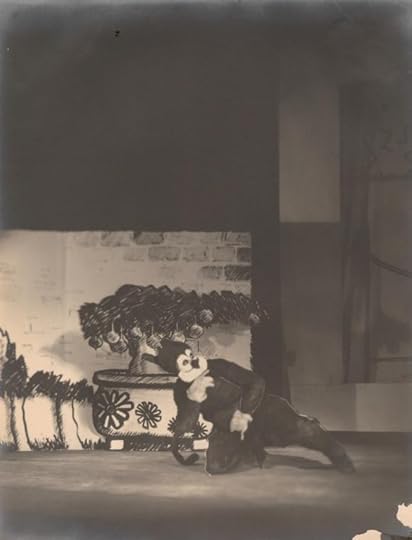
The Artist/ Writer, George Herriman was born in New Orleans in 1880, in a mixed-race family. His work definitely reflects his New Orleans origins. This e-comic includes the first three years of Krazy Kat strips, which first hit the streets in the New York Evening Journal on January 7, 1922, two weeks before the Carpenter Krazy Kat Ballet opened, starring Adolph Bolm as Krazy Kat pictured in this scene from the NY Public Library.
The digital resolution is not well formatted for the Hoopla reader, making the text often too small to read even when zoomed. I switched first to the laptop screen with no improvement, then to my desktop computer where it was quite satisfactory. I am unsure how the formatting is on Kindle. The price there is prohibitive. For their price, the hardback would be worth buying instead. But, I checked it out from the New York Public Library through Hoopla. I recommend this highly for all who enjoy comics and graphic novels.
When Jazz meets the Comic Strips. Krazy Kat is an optimistic character who enjoys the bricks slung by Ignatz Mouse, considering them a sign of affection. The setting resembles Coconino County Arizona, with surreal deserts and mesas with names like: 'The Enchanted Mesa', and 'The Moon's Pool.' Often the art is lighthearted and warm, almost airy. Sometimes Herriman waxes poetic and grand with page-width scenes that are staggering in their intensity and flowing verbiage. Scattered among the high vocabulary, the reader finds a mix of inventive, almost Joycean wordplay: Vagabons become boom compenions. Day by the hour animals seek Law and Orda in undisarmamentlike ways, while living in lonesim hominy ova yenda by a rains-bo with a yumbarella. (My mix of common words found here.)
You can hear Artie Shaw play on clarinet the Krazy Kat score from the Ballet here on this Youtube link: Artie Shaw, Krazy Kat 1949
Krazy Kat sleeps, and wakes, and wonders about the whereabouts of Ignatz the Mouse in a Southwestern landscape that seems to move with enchanting, fluid scenery and zigzagging lines. While it is 'naught but gentle humor with the curtain of propriety' as Herriman was wont to remind us throughout the daily comic strip, the plot weaves through a love triangle between a cat, a mouse, and a dog. The writing is dense, with a heavy amount of strong vocabulary. And, the cat speaks in an accent somewhat like the flappers of the 1920's.
The main characters are:
Krazy Kat - Soft of heart and head who often hears the 'kall of kat' within
Officer Bull Pup - The Offisa is full of Law and Order
Ignatz Mouse - A rat with a Soul of Sin and Shame
There are a host of other characters sprinkled throughout the sets. My favorite character is Bum Bill Bee, an 'amiably petulant and irascibly winsome pilgrim en tour to anywhere via nowhere.' Not only is this bee pictured as a hobo with a scarf tied up on the end of a stick, but he often becomes integral to the plot. I also loved the Door-Mouse scenes. The trick is to decide whether Herriman was a writer who could draw, or an artist who could write. In this work he did both with an adept skill unmatched. And, his work came before everything else like it: such as Dr. Seuss, Looney Tunes, and Mickey Mouse even in his Steamboat Willie renderings.
The Artist/ Writer, George Herriman was born in New Orleans in 1880, in a mixed-race family. His work definitely reflects his New Orleans origins. This e-comic includes the first three years of Krazy Kat strips, which first hit the streets in the New York Evening Journal on January 7, 1922, two weeks before the Carpenter Krazy Kat Ballet opened, starring Adolph Bolm as Krazy Kat pictured in this scene from the NY Public Library.
The digital resolution is not well formatted for the Hoopla reader, making the text often too small to read even when zoomed. I switched first to the laptop screen with no improvement, then to my desktop computer where it was quite satisfactory. I am unsure how the formatting is on Kindle. The price there is prohibitive. For their price, the hardback would be worth buying instead. But, I checked it out from the New York Public Library through Hoopla. I recommend this highly for all who enjoy comics and graphic novels.

April 14, 2024
oh if Moms for Liberty only knew how gay these century-old comic strips could be...

August 3, 2026
Fantagraphics began their Krazy Kat full-page collections with 1925-1926, nine years after the full-page strips launched in 1916. This is because Eclipse Comics had published the first nine years in collections that were still available at the time of Fantagraphics' undertaking in the early 2000s. When Fantagraphics reached the final years (1943-1944), they looped back around to collect the first nine years in their own editions, preserving a complete set. Accordingly, this is the last published Fantagraphics Krazy Kat volume, and they went all out by including the full runs of two other Herriman strips as bonus content, making 1922-1924 the largest book in the series by some distance (the Goodreads page count is incorrect; it's 252 pages, not 168).
Those bonus strips, Mrs. Waitaminute (1903) and Us Husbands (1926), remind us that Herriman did quite a bit more than just Krazy Kat. These two strips are similar in content, deriving gentle humor from domestic drama of husbands and wives. They lack the wild inventiveness of Herriman's main project, but his stamp is present in both, and they offer interesting peeks into the culture of the eras.
As for the Krazy Kat strips, they're as amazing and quirky as ever. Officer Pupp has increased presence here, always attempting to save Krazy from Ignatz's bricks and throw Ignatz in jail. If I have a criticism here, it's that the 1923 strips especially blur together with similar plots involving the main trio (I understand that every Krazy Kat strip is a variation on the same theme, but these ones are even more alike in structure than before; reading them back-to-back in the same sitting rather than weekly hammers this home). Still, I was wowed much more often than not. Herriman's language, paneling, and all-around creativity remains unmatched.
Also notable are the first Krazy Kat color pages, which ran every weekend for ten weeks at the beginning of 1922. This seems to have been a compromise, as the weird black-and-white Krazy Kat was not as popular as more straightforward color strips at the time, and the publisher wanted to broaden readership. Of course Herriman doesn't miss a beat moving to color. I know that the weekly strips eventually made the permanent switch to all color; I'm curious to see how Herriman fares with the change when I get to those volumes.
Those bonus strips, Mrs. Waitaminute (1903) and Us Husbands (1926), remind us that Herriman did quite a bit more than just Krazy Kat. These two strips are similar in content, deriving gentle humor from domestic drama of husbands and wives. They lack the wild inventiveness of Herriman's main project, but his stamp is present in both, and they offer interesting peeks into the culture of the eras.
As for the Krazy Kat strips, they're as amazing and quirky as ever. Officer Pupp has increased presence here, always attempting to save Krazy from Ignatz's bricks and throw Ignatz in jail. If I have a criticism here, it's that the 1923 strips especially blur together with similar plots involving the main trio (I understand that every Krazy Kat strip is a variation on the same theme, but these ones are even more alike in structure than before; reading them back-to-back in the same sitting rather than weekly hammers this home). Still, I was wowed much more often than not. Herriman's language, paneling, and all-around creativity remains unmatched.
Also notable are the first Krazy Kat color pages, which ran every weekend for ten weeks at the beginning of 1922. This seems to have been a compromise, as the weird black-and-white Krazy Kat was not as popular as more straightforward color strips at the time, and the publisher wanted to broaden readership. Of course Herriman doesn't miss a beat moving to color. I know that the weekly strips eventually made the permanent switch to all color; I'm curious to see how Herriman fares with the change when I get to those volumes.

January 1, 2022
There’s something almost metaphysical about reading Krazy Kat – the classic American comic from the 1910s to 1940s, by George Herriman.
On the surface it is all very simple. It is a “love triangle” of sorts: Ignatz (the mouse) hates Krazy Kat (the cat), and expresses his hatred by throwing bricks at Krazy’s head. Krazy Kat (who is, wonderfully, androgynous) loves Ignatz, and interprets the thrown bricks as expressions of love. Officer Pupp (a bulldog) hates Ignatz and tries to thwart his brick throwing in order to save Krazy, who he is fond of. Aside from a handful of minor characters, that’s pretty much it.
The perpetual, unresolvable scenario is told through idiosyncratic language (“there is a heppy lend, furfur away”) and plays out against an otherworldly, almost psychedelic desert landscape, with ever-changing mesas and alien-like Joshua trees. The line drawings themselves are spare and gorgeous.
This is not punchline humour; the pleasure is in the familiar, endless joke, played out again and again, through as many iterations as possible. It’s fantastic, and really quite bizarre.
On the surface it is all very simple. It is a “love triangle” of sorts: Ignatz (the mouse) hates Krazy Kat (the cat), and expresses his hatred by throwing bricks at Krazy’s head. Krazy Kat (who is, wonderfully, androgynous) loves Ignatz, and interprets the thrown bricks as expressions of love. Officer Pupp (a bulldog) hates Ignatz and tries to thwart his brick throwing in order to save Krazy, who he is fond of. Aside from a handful of minor characters, that’s pretty much it.
The perpetual, unresolvable scenario is told through idiosyncratic language (“there is a heppy lend, furfur away”) and plays out against an otherworldly, almost psychedelic desert landscape, with ever-changing mesas and alien-like Joshua trees. The line drawings themselves are spare and gorgeous.
This is not punchline humour; the pleasure is in the familiar, endless joke, played out again and again, through as many iterations as possible. It’s fantastic, and really quite bizarre.

October 3, 2025
See Krazy Kat Collection 1935-1944...

August 13, 2012
I'm far too young to have experienced Krazy and Ignatz first-hand and this comic strip is not one that my folks or grandfolks introduced me to either. So why I enjoy the antics of a Krazy Kat who is in love with Ignatz the mouse who beans her with a brick (or intends to bean her with a brick) in every strip if not thwarted by Officer Pupp, I have no idea. But I do. The story line is so simple - Ignatz NEEDS to bean Krazy with a brick. Officer Pupp intends to see that no evil occurs to Krazy. Appended to this plot are Bum Bill Bee, Joe Stork, Dr. Y Zwol, and others. But for some reason, these comics are funny to me. Not in the modern sense; you have to look at them from the turn of the 20th century mind set.
This volume is the last collected volume of Herriman's strip, all of which have been "volumized" by Fantagraphics in Seattle. You don't need any background to read this volume, only that basic premise - cat, mouse, brick.
Try it out and you might enjoy it. And then again, maybe you won't. But if you do, you'll have a first-hand knowledge of another American cultural icon like Doonesbury and Pogo (although there is nothing political about Krazy). And you'll amaze your friends with your knowledge!
This volume is the last collected volume of Herriman's strip, all of which have been "volumized" by Fantagraphics in Seattle. You don't need any background to read this volume, only that basic premise - cat, mouse, brick.
Try it out and you might enjoy it. And then again, maybe you won't. But if you do, you'll have a first-hand knowledge of another American cultural icon like Doonesbury and Pogo (although there is nothing political about Krazy). And you'll amaze your friends with your knowledge!

June 3, 2012
The final volume in Fantagraphics reprint of all things KRAZY KAT is as sublime as the rest, but with the added bonus of the complete run or Herriman’s first comic strip, MRS. WAITAMINNIT—THE WOMAN WHO WAS ALWAYS LATE, and the complete run of his last non-KRAZY KAT strip, US HUSBANDS. Neither is great, but Herriman completeists will be happy to have them and so will those reading intertextually. The topper strip for US HUSBANDS especially is loaded with echoes from Shakespeare and the Bible. The three years of KRAZY KAT reprints are, of course, amazing.
September 27, 2024
So many wonders in these three years of Sundays.

May 8, 2025
Why even bother rating Krazy Kat collections? They will always be 5 stars.
You cannot beat a bit of Krazy & Ignatz and their supporting cast.
It is very much one of life's pleasures...
You cannot beat a bit of Krazy & Ignatz and their supporting cast.
It is very much one of life's pleasures...

couldn-t-get-through
June 27, 2020I gave this one a try because it was in the 1001 Comics You Must Read Before You Die book, but am calling it a day on this one. Turns out this just isn't the right time for this book for me. I may give it another try, but for now, moving on.

November 4, 2022
+48 Sunday pages:
"Us Husbands" (with it's supplement strip)
+20 dailies pages:
"Mrs. Waitaminnit--the Woman Who Is Always Late"
+1 page with 2 "Little Tommy Tattles" strips
"Us Husbands" (with it's supplement strip)
+20 dailies pages:
"Mrs. Waitaminnit--the Woman Who Is Always Late"
+1 page with 2 "Little Tommy Tattles" strips

Read
September 24, 2026Lil' espermenial kartoonisht
Displaying 1 - 12 of 12 reviews