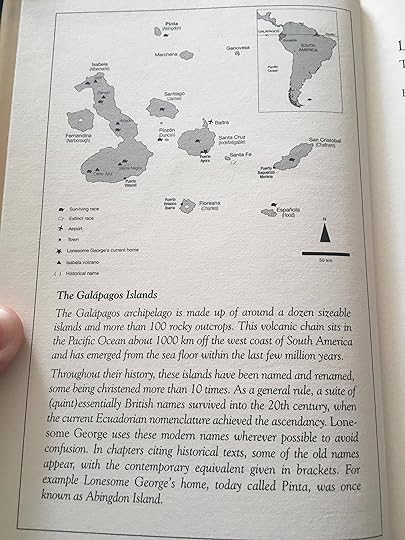
Lonesome George is a 5ft long, 200lb tortoise aged between 60 and 200. In 1971 he was discovered on the remote Galapagos island of Pinta, from which tortoises had supposedly been exterminated by greedy whalers and seal hunters. He has been at the Charles Darwin Research Station on Santa Cruz island ever since, on the off-chance that scientific ingenuity will conjure up a way of reproducing him and resurrecting his species. Meanwhile a million tourists and dozens of baffled scientists have looked on as the celebrity reptile shows not a jot of interest in the female company provided. Today, Lonesome George has come to embody the mystery, complexity and fragility of the unique Galapagos archipelago. His story echoes the challenges of conservation worldwide; it is a story of Darwin, sexual dysfunction, adventure on the high seas, cloning, DNA fingerprinting and eco-tourism.
Henry is a journalist, author and broadcaster, specialising in evolutionary biology, conservation and history of science. His first book Lonesome George: The Life and Loves of a Conservation Icon was about the Galapagos Archipelago and global conservation. He is also the author of The Way of the Panda: The Curious History of China's Political Animal, which charts the intertwined fortunes of giant pandas and China over the last 140 years. His third book, released in early 2014, is The Galapagos: A Natural History.
Lonesome George is a poster boy for conservation in the Galápagos and beyond. He is what conservation experts call a "flagship". Flagship species are charismatic animals or occasionally plants that stimulate conservation awareness and action. A successful flagship need only operate in the world of marketing and public relations. It need not even be endangered if it achieves something for conservation. [...] What makes a good flagship? Top of the hit parade are mammals; birds occasionally get a look in, reptiles rarely, fish hardly and invertebrates can forget it. The spineless just don't have one of the most important qualities of a good flagship - public appeal. [...] Perhaps the greatest flagship individual was Chi-Chi, a panda that arrived at London Zoo in 1958. She had been destined for an American zoo but this was before Nixon's pandas thawed the diplomatic tensions between China and the US, and as a symbol of communism she was refused entry. London Zoo decided to give Chi-Chi asylum and she was an instant hit with the public. So much so that she was the inspiration for the World Wildlife Fund's striking panda logo.
Why quote at such length from this book? Because it showcases the kind of work the author has put into this book (for good and ill).
First, we have the flagship for Galápagos conservation: Lonesome George. Then we get a bit of explanation, followed by a history lesson. This is how the entire book is structured. I, personally, love the deep exploration of the entire topic, even with the frequent side steps. However, it is quite meandering and not exactly what the reader was promised by the title. You see, George is just one example showcasing a whole world of endangered species and what can or even has been done to help them after humans have caused their plight. Thus, we get chapter after chapter detailing different approaches and scientific methods, but also historic accounts.
The author details what happened to the giant tortoises, what their probable origin is, how many different sub-species there are (officially), how people have been and are still trying to find a balance between necessary tourism (funds) and strict protection. The different scientific theories and approaches are explained and either dismissed or recommended by giving examples where it worked or didn't. Thus, the author talked about the introduction of a nowadays pretty famous poisonous toad to Australia in order to save crops and how that caused the very same toad to be a pest of its own (because the people coming up with the idea didn't think it through). He also gives successful examples of cross-breeding and even artificial insemination as a way of saving a species.
What I didn't know was that George was actually named after a US comedian. However, neither the name nor the tortoise's fate are funny. The Pinta tortoise has been officially declared extinct (not just in the wild). One problem was that, apparently, most of the population was male (reptiles' genders are determined by the temperature in which the eggs develop and hedge). Moreover, according to findings of different teams of researchers, many animals got caught in ravines or between rocks and thus starved to death. It is therefore pretty save to say that they had always had it tougher than other Galápagos tortoises and didn't really stand a chance. However, the fact that buccaneers and whalers frequently collected large numbers of tortoises from all the islands didn't really help.
What struck me was that many of the scientists charged with George's care had the right idea but simply didn't follow it through. For example: there was a young female student from Sweden who became famous as "George's girlfriend" because she tried to milk him (extract semen by giving him a handjob). This is a very well-known technique for many zoologists. True, especially back in the 70s it was not often admitted because many people are just childish and make fun of such techniques. However, the problem often is that animals like George, who haven't had many other specimen living around them, simply don't know HOW to reproduce or that they can! It is by now an accepted theory that even reptiles learn most of their behaviorisms from social interaction. Nevertheless, stimuli work on them (such as handjobs). Sadly, after a few months the student had to leave and instead of the research institute funding her for a while longer so semen samples could be taken and a female tortoise from another sub-species impregnated, they just let her go (she didn't have the money to stay and had to complete her studies)! It didn't even occur to them that that might have been their only chance! After the "girlfriend" had left, George became as erratic in his behaviour as he had been before and no offspring was ever produced.
Another chapter that deeply moved me was the one about the sea-cucumber fishermen in 1995. I understand that some people live in places where making a living is difficult. Add to that that they have never known any better and been fishermen (same goes for those culling sharks) all their lives and all the lives of their parents and grandparents and so on. However, these fine upstanding people not only blocked the way to all research buildings when protesting a ban on fishing in the Galápagos, they (indirectly but still) caused the death of a researcher, set fire to some parts of the national park around the buildings, drank themselves silly every night (and getting more aggressive in the process), threatened to at least kill the iguanas and tortoises, didn't let food get delivered to the researches trapped/held in the buildings (except for one time when the cameras were rolling), and made makeshift Molotov cocktails!!! If it hadn't been for the death of one of the scientists, they probably would have ended up escalating, butchering all the animals, and setting fire to all buildings (and who knows how many scientists would have died when trying to save the animals)! All that because of their dispute with the Ecuadorian government over fishing rights. Sorry, but I cannot defend such actions.
As you can see from the above examples, the book goes into detail about all manner of topics directly related to conservation and this one flagship animal in particular. Sadly, we now know how the tale ends so the last words of the author (him wanting his son to visit George one day) are quite haunting.
I liked the accurate details not only about historical events or politics that influenced the work of the scientists, but also about DNA-research at the time (cloning, creating chimeras, gene-splicing etc) and the amount of research the author must have done for this book. The writing style is also light and engaging and the author placed the different topics surrounding George and conservation efforts in a way that the reading never got boring.
Revisited after the sad news of Lonesome George's death:
Pinta Island in the Galapagos has a particularly famous inhabitant – the giant tortoise, Lonesome George, the only known survivor of the Pinta variant of that species. (Technically he isn’t an inhabitant, as he has been moved to a sanctuary on another part of the archipelago, but Pinta is where he came from.) George inevitably features regularly in the press, thanks to the combination of being a striking animal, a Darwinian icon and a very isolated creature, but does he warrant a whole book?
In a word, yes. Henry Nicholls cleverly makes George a central focus that he keeps returning to, but is able to use the tortoise as a springboard to examine everything from Darwin’s voyages to threats to the Galapagos from incoming, non-native wildlife, eco-tourists and the action of illegal sea cucumber fishers (who have threatened to kidnap George, or worse, in the past).
Some might find the description of the attempt to get George interested in the opposite sex from nearby islands (a lack of interest that seems largely due to lack of practice) a little too detailed, but it too is entertainingly told, bringing in some of the human characters involved along the way. It’s not all about George’s inclinations, though. As well as giving serious consideration to cloning, Nicholls looks at the possibility there might be another Pinta variant out there in the collections of giant tortoises around the world (these are long-lived beasts, and one may have been taken before their scarcity was noted), at various attempts to track down another tortoise on Pinta itself (it’s difficult to be absolutely sure something isn’t there), and at the state of the other sub-species of Galapagos giant tortoise.
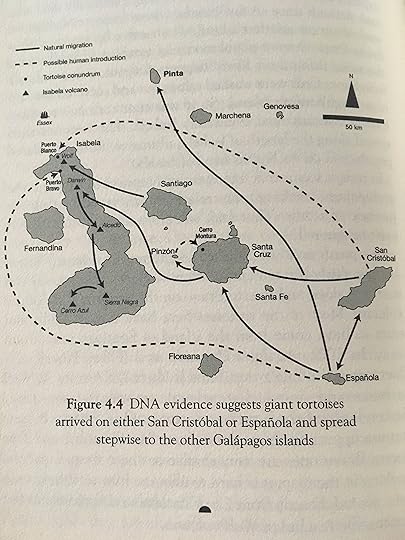
There is one aspect of the story that seems underplayed in the book. The only reason George is a celebrity is that he is a one-off – the only representative of the Pinta version of the Galapagos tortoise. But he is quite similar to the tortoises on one of the other islands, and it is known that tortoises have travelled between islands in the past. Could George just be a reptilian island hopper, and not a true Pinta tortoise at all? If this were the case he would just be one of many – no more special than any of the other Galapagos tortoises, rather than the tourist attraction he is today.
There have been two tests, comparing George’s DNA with the skin samples of three tortoises killed on Pinta in 1906. One test found that George didn’t match, one found George did. Nicholls’ conclusion “On balance it looks like Lonesome George fully deserves his hard-earned celebrity status,” sounds more like wishful thinking than a scientific conclusion. When two tests come up with opposite results, you don’t pick the result you want, you do a whole series of tests, reproduced in different labs – this hasn’t been done, so George’s status has to remain in doubt. This doesn’t stop him making a good story, though.
Nicholls gives us a good balance of George himself, the natural and political history of the Galapagos and the inevitable Darwinian connections. It’s a warmly enjoyable book – a pleasure to read.
I seem to be one of the only people who did not pick this up on vacation to the Galapagos Islands, which is odd since I actually don't remember how I came upon this book. I bought it a while back and have been wanting to read it for a while. It is a thorough and easy-to-read discussion on George, the islands themselves, and conservation and endangered species issues and efforts worldwide. It is interesting throughout, though I would have enjoyed more about George's life as the title suggests. Instead the book covers a wide variety of topics from sea currents to goat culling to the plight of the sea cucumber. I will also add the book contains more vivid detail on reptile genitalia, semen, and excrement than you probably ever wanted to know. That said, it is a well-written and interesting discussion of efforts to conserve and revive endangered species and will probably make you more angry at humans than anything else. At least if you're like me. George sounds wonderful and I would've like to have met him. More than anything, I'm sorry that he's gone and I thank Mr. Nicholls for capturing his story for the world.
This book got off to a slow start for me - it read a bit like a book report and I couldn't help but think that a talented science writer could have accomplished the same thing and reached a much wider audience in 10 pages of The New Yorker. That said, I finished the book in a week (a feat of epic proportions considering my complete lack of leisure time) and would recommend it to anyone with an even passing interest in conservation science. Certainly, it should be required reading for the 150,000 tourists who visit the Galapagos each year.
In particular, the last two chapters really bring out Nicholls' sense of humor (after all, what isn't funny about electroejaculation?) and his casual, informed style reminds me of Neil Shubin's Your Inner Fish. Like any good scientist, his discussion of George's lonesome conundrum is peppered with the successes and failures of other similarly endangered species. It's a fun read.
이 책은 동물보호의 아이콘이었던 론섬 조지가 죽기 6년 전에, 아직 희망이 있었을 때 출간된 책이다. 그가 죽은 후에 이 책을 읽고 있자니 가슴에 돌덩이가 얹힌듯 답답하다. electroejaculation이나 키메라를 만드는 등의 다소 끔찍한 시도들이 언급되는 것을 보면 론섬 조지는 그냥 존엄하게 멸종하고 싶었을 것 같기도. 이 책이 나온 2006년에 비해 생물학에도 엄청난 발전이 있었을텐데, 파충류의 인공수정이나 clone을 반드는 기술은 어떻게 발전했는지 궁금하다.
론섬 조지가 이 책에서 차지하는 비중은 의외로 적고, 갈라파고스의 자연사, 생태계, conservation biology 등 다양한 내용이 소개되고 있었다. 자연의 이용하려는 지역 주민들과 자연을 보호하려는 conservationist들의 충돌은, 해삼을 잡으려는 어부들과 찰스 다윈 연구소의 과학자들의 충돌로 반복되고 있었다. 이 대목을 읽다보니 진보와 보수의 세계관의 차이를 조금 더 알게되는 뜻밖의 수확이 있었���.
코로나 사태로 집에 처박혀 있으면서 읽기에는 정신 건강을 위해서는 부적절한 책이다. 그러나 론섬 조지와 공감하기에는 최적의 시기에 (정신 건강을 희생하며) 이 책을 읽은 것 같다. 에콰도르는 코로나 사태로 가장 고통받는 나라 중 하나라는데, 빨리 이 사태가 끝나야 할텐데...
Excellent book on the conservation efforts to restore species on the brink of extinction, specifically Lonesome George, the last known tortoise of a subspecies from Pinta Island in the Galapagos. It covers so much information from the history and geology of the Galapagos, theories of how tortoises arrived there and evolved into the different subspecies, human impact on that environment, efforts to breed several different species that are on the brink of extinction, and of course, George’s life story. Found the science easy to understand and intriguing. I’m sure it’s somewhat dated being written nearly 20 years ago, especially concerning the tourism boom recently in the Galapagos.
Nichols has an engaging writing style that enables him to simplify complex scientific ideas so that a layman like me understands what he’s talking about! His obvious concern and affection for Lonesome George’s plight as the last of his species shines throughout the book and he cleverly (in my opinion) uses this the discuss the wider issues in conservation.
I highly recommend this to anyone with an interest in the subject.
I teach about Lonesome George every year to my AP Biology students, even though it has been nearly 14 years since his death. This tortoise biography nicely frames the conservation challenges that the Galápagos Islands have faced over the last 50+ years. I hope I get to visit it one day before the tortoises are all gone!
I read this book maybe 10. 12 years ago, and I still keep on looking for anything similar. It is a perfect ecology non-fiction, with a great, metaphoric story, knowledge and good humor. I cannot praise this book enough, and would like to start a shelf with similar books. Hope it is not one of its kind.
A great short little analysis of conservation, the Galapagos Islands, and the quandaries we face and create when humans get involved with the natural world in pretty much any way at all. I liked this book's light handling of the material, which could otherwise be really depressing, as Lonesome George is the very last tortoise of his kind. When he's gone, well, we will have witnessed the bitter end of yet another species, and this time, it's going to be slow and excruciating, because tortoises can live for quite a while.
I also liked its brevity. It's a popular science book, dealing with something as conceptually massive as "what do we do when there's no one to mate him with and he most likely wouldn't mate if there was?" Considering the depths of possible solutions this book covers, as well as its discussion of the history that got us to this point, the book doesn't get bogged down in trying to cover every possible aspect of conservation and isn't trying to be definitive. It's a story about a lonely tortoise. A sad story and a confusing one. People behave strangely sometimes, especially people who are not living in our times.
In terms of the writing, it has some of the standard academic paper pitfalls that none of us want to see in a well-written, well-edited popular book. There are a lot of topic sentences and closing sentences. It can sound a bit grade-school.
But, it's short. So if you get your hands on this, pick it up and enjoy it. Won't take much time, and you'll learn some very interesting things about tortoise sex. Cheers!
Nicholls uses the story of the last tortoise found on the island of Pinta in the Galapagos as a vehicle to tell about many lesser known issues in environmental degradation and extinction. Some of the stories are expected, such as the problems with invasive non-native species on the Galapagos. Other issues are more complex. I was torn by the problems of ecotourism and displacement of local industries such as collecting sea cucumbers. I was most interested in the discussions of attempts at cloning and assisted reproduction. It appears that each species has a unique approach to reproduction and we are not very good at figuring out the whole picture. There was some discussion of what makes a species unique and how can we really tell if George was the last of his species. I would be interested in exploring this topic further.
Dr Henry Nicholls has done a remarkable job writing this book in way that lonesome George is portrayed as a true conservation icon that he truly was, Lonesome George is used effectively as a spring board to address and bring forth the several issues that conservation biologists and ecologists face. The book in general is a simple read, and as mark of a true Scientist , Dr Nicholls has done immense research while writing this book. For instance he talks about the Panda "Chi Chi" and how she became a the face of the worlds largest international NGO working on the issues of conservation and environment restoration. I never knew there was a story behind that logo and Dr Henry has written a book on the same " The way of the Panda". I would definitely recommend "lonesome George" to any nature enthusiast!
I've struggled for a few days to articulate why I enjoyed this book so much. I picked it up on a whim, vaguely curious about the Galapagos, and encouraged by the Goodreads reviews I had read, and found myself completely caught up in it, savouring every page. It was about far more than just Lonesome George, and the author's smooth writing style and knack for weaving a number of relevant examples and stories into the central narrative made for an engaging and compelling read.
An excellent book about the giant tortoises of the Galapagos--studies that have been carried out over the years and what we know about them from an evolutionary perspective (how did they get there? how come the tortoises of each island are distinct? & will they ever find a partner for Lonesome George to get it together with?)
The author does a nice job of weaving the story of discovering, caring for, and trying to mate "Lonesome George" with the human and natural history of the Galapagos Islands. Also does a great job of communicating rather complex scientific concepts related to biodiversity and genetics to a non-scientist reader.
I need another book to read like I need a proverbial hole in the head, but, I just read an article at nature.com written by Henry Nicholls exploring the possibilities of cloning a - yes - a wooly mammoth, and so enjoyed his writing. This looks good too. Stay tuned, I might actually bump this up to the top of my list.
A very bittersweet story now, after we have lost Lonesome George and the Pinta tortoise forever. I really liked the way it brought together the story of George with general threads in conservation biology and the Galapagos in particular. The author has a very readable style, with the facts never coming across as dry. Recommended for anyone interested in animals or conservation.
Fascinating look at the iconic Lonesome George, my favorite tortoise (not to be confused with my favorite turtle, Myrna). His story is embedded in the broader context of the conservation movement in the Galapagos and throughout the world. Highly recommended!
I loved this book! It was a fast, easy, enjoyable read and was really well-written. I think everyone should read it before they visit the Galapagos Islands or even after a trip. It´s a great introduction to the history, geology, and current conservation issues and conflicts of the Galapagos.
A very readable (and sometimes) introduction to the Galapagos and their history that uses the life of the eponymous sole surviving Pinta Island tortoise as a general thread. I recommend it to anyone considering a visit to the Galapagos - I happily read it while I was there.
I started reading...got lost in other fiction while in Equador...hope to get back to it as it is about more that George - a humongous tortoise of a species that will become extinct when wh dies- it deals with the discovery, developement and preservation of these beautiful islands.