

What do you think?

Mr Beethoven
What if Beethoven had travelled to the United States in their infancy, taking up his commission to write a Biblical oratorio for Boston's Handel and Haydn Society?
As Beethoven wrestles with his muse, and his librettist, he comes to rely on two women. Thankful, who conducts his conversations using Martha's Vineyard sign language, and a kindred spirit: the widow, Mrs. Hill. Meanwhile all Boston waits in anxious expectation of a first performance the composer will never hear.
Variously admonishing the amateur music society and laughing in the company of his hosts' children, the immortal composer is brought back to the fullness of life.
Griffiths invents only what is strictly possible. His historiography weaves through the text in counterpoint, making this also a story about the fragility of the past and the remaining traces of the man: Mr. Beethoven.
'In Griffiths' latest novel... the composer brings his time, his temperament and his sense of democracy to us. But he can’t possibly fit in. The challenge of Beethoven 250 will be to retain a Beethoven who is among us but refuses to fit in.'
- Mark Swed, Los Angeles Times
As Beethoven wrestles with his muse, and his librettist, he comes to rely on two women. Thankful, who conducts his conversations using Martha's Vineyard sign language, and a kindred spirit: the widow, Mrs. Hill. Meanwhile all Boston waits in anxious expectation of a first performance the composer will never hear.
Variously admonishing the amateur music society and laughing in the company of his hosts' children, the immortal composer is brought back to the fullness of life.
Griffiths invents only what is strictly possible. His historiography weaves through the text in counterpoint, making this also a story about the fragility of the past and the remaining traces of the man: Mr. Beethoven.
'In Griffiths' latest novel... the composer brings his time, his temperament and his sense of democracy to us. But he can’t possibly fit in. The challenge of Beethoven 250 will be to retain a Beethoven who is among us but refuses to fit in.'
- Mark Swed, Los Angeles Times
312 pages, Kindle Edition
First published May 1, 2020
About the author
Paul Griffiths
112 books37 followersPaul Anthony Griffiths, OBE, is a British music critic, novelist and librettist. He is particularly noted for his writings on modern classical music and for having written the libretti for two 20th century operas, Tan Dun's Marco Polo and Elliott Carter's What Next? [https://en.wikipedia.org/wiki/Paul_Gr...]
Ratings & Reviews
Friends & Following
Create a free account to discover what your friends think of this book!
Community Reviews
Displaying 1 - 30 of 42 reviews

March 22, 2021
Longlisted for The Republic of Consciousness Prize for Small Presses, Shortlisted for Goldsmith prize 2020 and longlisted for the 2021 Walter Scott Historical Fiction
Book 6/10
A beautiful and intelligently constructed novel which invites us to imagine what would have happened if Ludwig van Beethoven hadn’t died in 1827 and instead would have taken a trip to Boston to write an Oratorio.
This book came on my radar long before it was nominated for ROFC prize. Some of the Mookse and the Gripes members were raving about it and it was enough to spark my interest. Its nomination to the prize I am following this year was the final push I needed to order the book.
I cannot continue discussing the book without fan-girling over the cover. It is probably the most beautiful cover I own, its texture and graphic makes me want to caress it continuously. I brought the novel with me for a short vacation with some friends and they also fell in love.
Let’s get to the content. In 1823, Beethoven received a commission to write a Biblical oratorio for Boston's Handel and Haydn Society. Unfortunately, he died before accepting the proposal. The author changes the history in this novel by postponing the composer’s death and by taking him to Boston to write that oratorio.
Paul Griffiths is part of the Oulipo movement, which is a gathering of authors who “seek to create works using constrained writing techniques”. For example, its founder, Raymond Queneau, wrote Exercises in Style where the same mundane event is retold 99 times in a different way. Other constrains consist in the elimination of one or more letters, moving around different elements in text after certain rules etc. Usually, the resulting works are a struggle to read but it is not the case here. From what I read on the back cover, Griffith’s constraint is to " invent only what is strictly possible”. He used mostly real historical figures and Beethoven’s words are taken directly from his letters. Griffiths’s knowledge about the composer and the extensive research he undertook to write this novel is obvious from the beginning.
What I liked the most about this novel is the way the author involved the reader in the story by addressing her/him directly and explaining the research he made and how all the creative decisions were taken. The author explores other creative forms of writing, some which worked for me, some which didn’t, but they all made for a very interesting reading experience. I believe this is a novel to be relished slowly, with attention, in a nice environment.
An admirer of Mr. Beethoven’s work would probably get more from this novel but it was a very pleasant experience even for an ignorant like me. If you are looking for something different, I highly recommend Mr. Beethoven. It deserves to be enjoyed by a wider audience.
About the Small Press (from the website): Henningham Family Press is the collaborative art and writing of David and Ping Henningham. We are both Artists and Authors, and we are curious about every aspect of writing, printing and publishing. We complete and represent our writing through fine art printmaking, bookbinding and performance.
Book 6/10
A beautiful and intelligently constructed novel which invites us to imagine what would have happened if Ludwig van Beethoven hadn’t died in 1827 and instead would have taken a trip to Boston to write an Oratorio.
This book came on my radar long before it was nominated for ROFC prize. Some of the Mookse and the Gripes members were raving about it and it was enough to spark my interest. Its nomination to the prize I am following this year was the final push I needed to order the book.
I cannot continue discussing the book without fan-girling over the cover. It is probably the most beautiful cover I own, its texture and graphic makes me want to caress it continuously. I brought the novel with me for a short vacation with some friends and they also fell in love.
Let’s get to the content. In 1823, Beethoven received a commission to write a Biblical oratorio for Boston's Handel and Haydn Society. Unfortunately, he died before accepting the proposal. The author changes the history in this novel by postponing the composer’s death and by taking him to Boston to write that oratorio.
Paul Griffiths is part of the Oulipo movement, which is a gathering of authors who “seek to create works using constrained writing techniques”. For example, its founder, Raymond Queneau, wrote Exercises in Style where the same mundane event is retold 99 times in a different way. Other constrains consist in the elimination of one or more letters, moving around different elements in text after certain rules etc. Usually, the resulting works are a struggle to read but it is not the case here. From what I read on the back cover, Griffith’s constraint is to " invent only what is strictly possible”. He used mostly real historical figures and Beethoven’s words are taken directly from his letters. Griffiths’s knowledge about the composer and the extensive research he undertook to write this novel is obvious from the beginning.
What I liked the most about this novel is the way the author involved the reader in the story by addressing her/him directly and explaining the research he made and how all the creative decisions were taken. The author explores other creative forms of writing, some which worked for me, some which didn’t, but they all made for a very interesting reading experience. I believe this is a novel to be relished slowly, with attention, in a nice environment.
An admirer of Mr. Beethoven’s work would probably get more from this novel but it was a very pleasant experience even for an ignorant like me. If you are looking for something different, I highly recommend Mr. Beethoven. It deserves to be enjoyed by a wider audience.
About the Small Press (from the website): Henningham Family Press is the collaborative art and writing of David and Ping Henningham. We are both Artists and Authors, and we are curious about every aspect of writing, printing and publishing. We complete and represent our writing through fine art printmaking, bookbinding and performance.

October 30, 2020
Now longlisted for the 2021 Walter Scott Historical Fiction and Republic of Consciousness Prizes.
I read this book due to its shortlisting for the 2020 Goldsmith Prize and it is an excellent choice from the judges and my favourite on the shortlist – both innovative and fun but also of excellent literary quality.
The author is an internationally renowned writer on music, a librettist and an Oulipian author – and this book rather neatly manages to combine all three aspects.
The books set up is that Beethoven rather than dying in 1827, survived long enough to accept an 1823 commission to write a biblical oratia – and the book is a record (or perhaps better described as an imagining) of his time in Boston from his ship voyage through the first public performance of the piece – which is based around the story of Job.
And the first constrain that the author imposes on himself is that, as far as possible given the lack of truth of the book’s central premise, everything has to be based around actual historical people, locations, events and possibilities. But the way he does this is very enjoyable – by directly addressing the reader to explain both the research he has undertaken and the resulting editorial and narrative decisions he has taken, or in some cases retaken as further research means either altering elements of the story to date or a certain amount of explicit hand waving over inconsistencies that are not worth resolving. I also found it an excellent piece of commentary on the role and importance of fidelity in literary historical fiction: in this case going to (and detailing) lengths to maintain complete fidelity but surrounding a central core which fails fidelity in the most basic manner (the central subject visiting a continent on which he never set foot, not to mention the small manner of being long dead at the time the novel is set).
The second and more Oulipian is to only attribute words to Beethoven which are taken directly from his letter – mainly as complete sentences, sometimes as complete clauses. All sources explained in the notes at the back of the book.
First of all I found this a fascinating approach.
More conventional historical novels (ones which bide by the convention of actually telling a true story) for all their fidelity can often be accused still of putting words in their subjects mouth. In this case the words are the subject’s own. And as a result, even if the comments are taken out of context, we actually get a fascinating insight into Beethoven’s character which despite its not just fictional but falsifiably so central story, relies in one side of the dialogue entirely on primary factual sources.
And secondly it is, again, tremendous fun. One of the issues with Oulipian writing is that while it can be fascinating and clever for a short period of time, I find the reader’s interest normally pales fairly quickly and one can be left wishing you could have contacted the author and told them their efforts were understood, their point made and that there is no need to carry on. Here though the author, while respecting his self-imposed constraints plays with variations. We have: a chapter entirely of dialogue marked up with musical notation; dialogue to accompany a game of draughts; a letter; an interview with a youngster which is pretty well entirely drawn up to imply via one odd line that Beethoven perhaps inspired Moby Dick; a monologue address to the chorus; and best of all and early on a chapter where Beethoven’s identical words are used in two completely differently developing dialogues (a mishearing of a German word driving the two courses). Even if some of these don’t work for a particular reader it is of little consequence as each chapter is short and a new approach sure to follow shortly.
The third aspect of the novel is the oratorio itself – reproduced in the book in detail, together with descriptions of the music. The writer of the text is itself part of the plot of the book (a Unitarian minister with rather plodding prose being secretly superseded by a widow who Beethoven takes as a confidant) – and again the author plays with this: remarking that everyone who heard it felt that the composer has managed to find a poet who is his equal (that poet of course being the author).
And there is even more to the novel than this – lots of ideas many of which are only explored for a brief period, before taking their leave before any risk they become irksome to be replaced by something new.
We have for example a brief 21st Century editorial intervention (possibly a nod to the intervention by Elihu in Job’s story?) urging the author to move the story on. We also have a brief visit to the area of the kind of historical research that takes up the time of factual writers with a brief foray into a story about a distinctive green ink and what it might prove or unprove. We even have a theological dispute between Unitarian and and Trinitairan laced with tit for tat bible verse quoting and with theology sourced from a real character’s sermons.
Inevitably any reader may find a false note among all the perfect ones (and maybe even here the author signs that by first of all having a dispute over who was the source of some incorrect annotations in the first printing of the score, and secondly by having a number of musicians and singers whose limitations, particularly when faced with the complexity of the composer’s work, quite literally leads to false notes).
For me the one false note was a visit by some Indian Chiefs to a rehearsal – the behaviour and dialogue of the native Americans seemed a little sterotyped to me, and while based on a real occurrence I noted that the occurrence was from a contemporary white American account.
However overall this is an excellent novel – not just full of ideas but also a very well written story which seemed to have a new delight at each chapter.
I read this book due to its shortlisting for the 2020 Goldsmith Prize and it is an excellent choice from the judges and my favourite on the shortlist – both innovative and fun but also of excellent literary quality.
The author is an internationally renowned writer on music, a librettist and an Oulipian author – and this book rather neatly manages to combine all three aspects.
The books set up is that Beethoven rather than dying in 1827, survived long enough to accept an 1823 commission to write a biblical oratia – and the book is a record (or perhaps better described as an imagining) of his time in Boston from his ship voyage through the first public performance of the piece – which is based around the story of Job.
And the first constrain that the author imposes on himself is that, as far as possible given the lack of truth of the book’s central premise, everything has to be based around actual historical people, locations, events and possibilities. But the way he does this is very enjoyable – by directly addressing the reader to explain both the research he has undertaken and the resulting editorial and narrative decisions he has taken, or in some cases retaken as further research means either altering elements of the story to date or a certain amount of explicit hand waving over inconsistencies that are not worth resolving. I also found it an excellent piece of commentary on the role and importance of fidelity in literary historical fiction: in this case going to (and detailing) lengths to maintain complete fidelity but surrounding a central core which fails fidelity in the most basic manner (the central subject visiting a continent on which he never set foot, not to mention the small manner of being long dead at the time the novel is set).
The second and more Oulipian is to only attribute words to Beethoven which are taken directly from his letter – mainly as complete sentences, sometimes as complete clauses. All sources explained in the notes at the back of the book.
First of all I found this a fascinating approach.
More conventional historical novels (ones which bide by the convention of actually telling a true story) for all their fidelity can often be accused still of putting words in their subjects mouth. In this case the words are the subject’s own. And as a result, even if the comments are taken out of context, we actually get a fascinating insight into Beethoven’s character which despite its not just fictional but falsifiably so central story, relies in one side of the dialogue entirely on primary factual sources.
And secondly it is, again, tremendous fun. One of the issues with Oulipian writing is that while it can be fascinating and clever for a short period of time, I find the reader’s interest normally pales fairly quickly and one can be left wishing you could have contacted the author and told them their efforts were understood, their point made and that there is no need to carry on. Here though the author, while respecting his self-imposed constraints plays with variations. We have: a chapter entirely of dialogue marked up with musical notation; dialogue to accompany a game of draughts; a letter; an interview with a youngster which is pretty well entirely drawn up to imply via one odd line that Beethoven perhaps inspired Moby Dick; a monologue address to the chorus; and best of all and early on a chapter where Beethoven’s identical words are used in two completely differently developing dialogues (a mishearing of a German word driving the two courses). Even if some of these don’t work for a particular reader it is of little consequence as each chapter is short and a new approach sure to follow shortly.
The third aspect of the novel is the oratorio itself – reproduced in the book in detail, together with descriptions of the music. The writer of the text is itself part of the plot of the book (a Unitarian minister with rather plodding prose being secretly superseded by a widow who Beethoven takes as a confidant) – and again the author plays with this: remarking that everyone who heard it felt that the composer has managed to find a poet who is his equal (that poet of course being the author).
And there is even more to the novel than this – lots of ideas many of which are only explored for a brief period, before taking their leave before any risk they become irksome to be replaced by something new.
We have for example a brief 21st Century editorial intervention (possibly a nod to the intervention by Elihu in Job’s story?) urging the author to move the story on. We also have a brief visit to the area of the kind of historical research that takes up the time of factual writers with a brief foray into a story about a distinctive green ink and what it might prove or unprove. We even have a theological dispute between Unitarian and and Trinitairan laced with tit for tat bible verse quoting and with theology sourced from a real character’s sermons.
Inevitably any reader may find a false note among all the perfect ones (and maybe even here the author signs that by first of all having a dispute over who was the source of some incorrect annotations in the first printing of the score, and secondly by having a number of musicians and singers whose limitations, particularly when faced with the complexity of the composer’s work, quite literally leads to false notes).
For me the one false note was a visit by some Indian Chiefs to a rehearsal – the behaviour and dialogue of the native Americans seemed a little sterotyped to me, and while based on a real occurrence I noted that the occurrence was from a contemporary white American account.
However overall this is an excellent novel – not just full of ideas but also a very well written story which seemed to have a new delight at each chapter.

October 27, 2020
Shortlisted for the Goldsmiths Prize 2020
Longlisted for the Republic of Consciousness Prize 2021
For me, the most disappointing omission from the shortlist
This is my second book from the Goldsmiths list, and looks like a potential winner to me. Griffiths is a distinguished music critic, and his central premise, a counterfactual portrait of a Beethoven that lived a few more years after the real composer's death in 1827, and visited Boston in 1833 for the first performance of a new oratorio, is an interesting one.
What makes it potential Goldsmiths material are the self-imposed Oulipo constraints Griffiths imposed on himself, inventing as little as possible and taking all of the dialogue attributed to Beethoven from his letters. This is very cleverly done, but does lead to some entertaining near non-sequiturs.
Griffiths' command of the musical elements is impressive, and he even wrote a libretto for the imaginary oratorio. His portrait of the still young independent America is lively, and he slips in a couple of encounters with real people, including the poet Longfellow and a young Herman Melville, here cast as an aspiring interviewer, and their interview is also reproduced, again using Beethoven's own words.
A clever and very enjoyable book, which deserves a wider audience.
Longlisted for the Republic of Consciousness Prize 2021
For me, the most disappointing omission from the shortlist
This is my second book from the Goldsmiths list, and looks like a potential winner to me. Griffiths is a distinguished music critic, and his central premise, a counterfactual portrait of a Beethoven that lived a few more years after the real composer's death in 1827, and visited Boston in 1833 for the first performance of a new oratorio, is an interesting one.
What makes it potential Goldsmiths material are the self-imposed Oulipo constraints Griffiths imposed on himself, inventing as little as possible and taking all of the dialogue attributed to Beethoven from his letters. This is very cleverly done, but does lead to some entertaining near non-sequiturs.
Griffiths' command of the musical elements is impressive, and he even wrote a libretto for the imaginary oratorio. His portrait of the still young independent America is lively, and he slips in a couple of encounters with real people, including the poet Longfellow and a young Herman Melville, here cast as an aspiring interviewer, and their interview is also reproduced, again using Beethoven's own words.
A clever and very enjoyable book, which deserves a wider audience.

June 3, 2020
Now shortlisted for the Goldsmiths Prize
The latest book from the excellent Republic of Consciousness Book of the Month Club https://www.republicofconsciousness.c...
Mr Beethoven Paul Griffiths is amongst other things, a music critic, a writer on contemporary and classical music, a librettist and a innovative novelist. He brings these elements together with this book, Mr Beethoven. The novel was funded by an Unbound campaign (https://unbound.com/books/mr-beethoven/ ) and published by Henningham Family Press, whose physical books are a work of performance art in themselves.
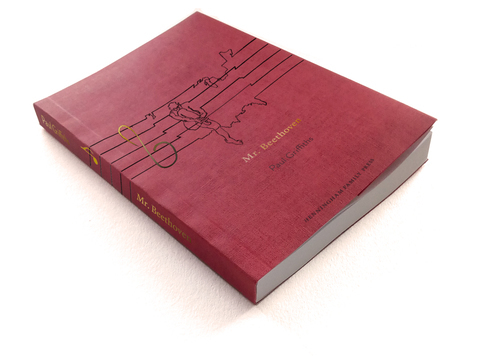
This particular volume is litho printed in lilac-grey. French-fold red Takeo cover, debossed with a gloss black and gold design.
Griffiths's previous novel 'let me tell you' was subject to an unusual Oulipan constraint - the expanded story of Ophelia from Hamlet but told using only the 483 words that the character speaks in the play. See here for a fascinating discussion of the construction of the book: https://lithub.com/writing-a-novel-li...
Published in the 250th anniversary year of Beethoven's birth, Mr Beethoven imagines that the composer undertook a commission that was reported in a newspaper in 1823, to produced a Biblical oratorio, received from the Handel and Haydn Society in Boston.
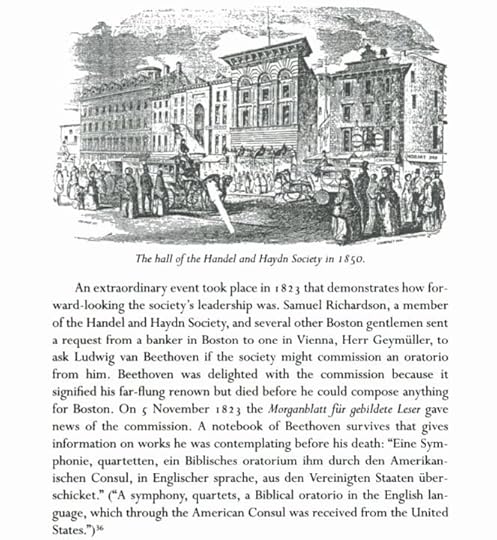
(From From Psalm to Symphony: A History of Music in New England By Nicholas E. Tawa)
In practice, Beethoven died in 1827 before he could respond to the Commission but in Griffiths reimagining he actually travels to the United States in 1833 to undertake the work. But Griffiths self-imposed constraint is to " invent only what is strictly possible " (in the words of the book's blurb).
For example, he searches historic records to discover a plausible vessel on which Beethoven may have travelled across the Atlantic. And his research and his deliberations on what might be possible are exposed in the story itself - at one point the reader even interrupts the narrative to berate the author for his techniques.
Another key constraint is that all words attributed to Beethoven in the text are sourced, either as complete clauses or often complete sentences, from translations of his letters, all carefully sourced in an appendix to the novel. Neil's review ( https://www.goodreads.com/review/show... ) explains how this all fits together better than I can.
A sample passage, from the Unbound website (the final version in the novel may I think differ slightly), illustrating both elements:
“Now, however, several passages” – he picked up the little book and shook it – “indeed I may say a great many passages” – he put it down again and snarled the next words – “in B.’s oratorio” – he returned to a calmer demeanor – “will have to be altered.”
The pause went on, and Mrs. Hill vigorously nodded, which suited as a prompt to the composer to return to his theme.
“I have in fact marked a few of them and shall soon finish marking the rest. For although the subject is very well thought out” (as, Mrs. Hill considered, I would expect of Mr. Ballou) “and the poetry has some merit” (not so sure) “yet it just cannot remain as it is at present.”
The composer turned his head toward the window. A bird was calling out, but of course that cannot have been what drew his attention. Mrs. Hill felt she must now say something in support, and, forgetting for an instant that Thankful was not there to translate for her, she opened her mouth to do so. However, neither she nor anyone else could know how she was going to proceed, because at this the composer immediately directed himself once more to her and to what was on his mind.
“Well,” he said, “we need not enquire into the value of poems of this kind.”
Mrs. Hill again gave a firm nod.
“But so far as I am concerned, I prefer to set to music the works of poets like Homer, Klopstock, and Schiller.”
Mrs. Hill would have been able to smile knowledgeably at the mention of these names, which she may even have revered as much as the composer did, for the most celebrated work of Friedrich Gottlieb Klopstock (1724-1803), and almost certainly the one of which the composer would have been thinking, Der Messias, had been translated into English by Mary and John Collyer, and their version, published first in London in 1763 (when the immense epic was only half-finished), had been brought out five years later in Elizabethtown, New Jersey, by the newspaper editor Shepard Kollock. Of course, given that Mrs. Hill would have to have been conversant with German for these scenes to be taking place, she could have read Klopstock and Schiller in the original. Cousin Josiah was not a massive supporter of female education; five years before all this, as Mayor of Boston, he had been instrumental in closing the city’s high school for girls. Since that school – the first such establishment in the United States – had been open for only two years, very few could have benefitted from it, and certainly not Mrs. Hill, who was of a class that at the time of her childhood would have educated its offspring, and certainly its female offspring, at home. Her father was Samuel Quincy, elder brother of their host’s father, another Josiah. In parallel fashion, she received her mother’s first name, and eventually, on her marriage, her mother’s last name, too, for the latter had been born Hannah Hill.
Oulipan texts are often intellectually but not emotionally satisfying - the constraint tends to dominate the story. But Griffiths' novel does not fall into that trap, presenting human account of Beethoven in his (imagined) later life, particularly the constraints of his profound deafness, which the author ingeniously solves within his strictly-possible constraint in terms of dialogue by recalling the existence of the local Martha's Vineyard Sign Language (https://en.wikipedia.org/wiki/Martha%...).
I suspect Beethoven fans and musicologists would gain even more from this novel - the author's own introduction to the composer's music can be found here: https://www.republicofconsciousness.c.... But even for someone relatively ignorant of the composer and his works, this was a fascinating and ingenious novel.
The latest book from the excellent Republic of Consciousness Book of the Month Club https://www.republicofconsciousness.c...
Mr Beethoven Paul Griffiths is amongst other things, a music critic, a writer on contemporary and classical music, a librettist and a innovative novelist. He brings these elements together with this book, Mr Beethoven. The novel was funded by an Unbound campaign (https://unbound.com/books/mr-beethoven/ ) and published by Henningham Family Press, whose physical books are a work of performance art in themselves.
This particular volume is litho printed in lilac-grey. French-fold red Takeo cover, debossed with a gloss black and gold design.
Griffiths's previous novel 'let me tell you' was subject to an unusual Oulipan constraint - the expanded story of Ophelia from Hamlet but told using only the 483 words that the character speaks in the play. See here for a fascinating discussion of the construction of the book: https://lithub.com/writing-a-novel-li...
Published in the 250th anniversary year of Beethoven's birth, Mr Beethoven imagines that the composer undertook a commission that was reported in a newspaper in 1823, to produced a Biblical oratorio, received from the Handel and Haydn Society in Boston.
(From From Psalm to Symphony: A History of Music in New England By Nicholas E. Tawa)
In practice, Beethoven died in 1827 before he could respond to the Commission but in Griffiths reimagining he actually travels to the United States in 1833 to undertake the work. But Griffiths self-imposed constraint is to " invent only what is strictly possible " (in the words of the book's blurb).
For example, he searches historic records to discover a plausible vessel on which Beethoven may have travelled across the Atlantic. And his research and his deliberations on what might be possible are exposed in the story itself - at one point the reader even interrupts the narrative to berate the author for his techniques.
Another key constraint is that all words attributed to Beethoven in the text are sourced, either as complete clauses or often complete sentences, from translations of his letters, all carefully sourced in an appendix to the novel. Neil's review ( https://www.goodreads.com/review/show... ) explains how this all fits together better than I can.
A sample passage, from the Unbound website (the final version in the novel may I think differ slightly), illustrating both elements:
“Now, however, several passages” – he picked up the little book and shook it – “indeed I may say a great many passages” – he put it down again and snarled the next words – “in B.’s oratorio” – he returned to a calmer demeanor – “will have to be altered.”
The pause went on, and Mrs. Hill vigorously nodded, which suited as a prompt to the composer to return to his theme.
“I have in fact marked a few of them and shall soon finish marking the rest. For although the subject is very well thought out” (as, Mrs. Hill considered, I would expect of Mr. Ballou) “and the poetry has some merit” (not so sure) “yet it just cannot remain as it is at present.”
The composer turned his head toward the window. A bird was calling out, but of course that cannot have been what drew his attention. Mrs. Hill felt she must now say something in support, and, forgetting for an instant that Thankful was not there to translate for her, she opened her mouth to do so. However, neither she nor anyone else could know how she was going to proceed, because at this the composer immediately directed himself once more to her and to what was on his mind.
“Well,” he said, “we need not enquire into the value of poems of this kind.”
Mrs. Hill again gave a firm nod.
“But so far as I am concerned, I prefer to set to music the works of poets like Homer, Klopstock, and Schiller.”
Mrs. Hill would have been able to smile knowledgeably at the mention of these names, which she may even have revered as much as the composer did, for the most celebrated work of Friedrich Gottlieb Klopstock (1724-1803), and almost certainly the one of which the composer would have been thinking, Der Messias, had been translated into English by Mary and John Collyer, and their version, published first in London in 1763 (when the immense epic was only half-finished), had been brought out five years later in Elizabethtown, New Jersey, by the newspaper editor Shepard Kollock. Of course, given that Mrs. Hill would have to have been conversant with German for these scenes to be taking place, she could have read Klopstock and Schiller in the original. Cousin Josiah was not a massive supporter of female education; five years before all this, as Mayor of Boston, he had been instrumental in closing the city’s high school for girls. Since that school – the first such establishment in the United States – had been open for only two years, very few could have benefitted from it, and certainly not Mrs. Hill, who was of a class that at the time of her childhood would have educated its offspring, and certainly its female offspring, at home. Her father was Samuel Quincy, elder brother of their host’s father, another Josiah. In parallel fashion, she received her mother’s first name, and eventually, on her marriage, her mother’s last name, too, for the latter had been born Hannah Hill.
Oulipan texts are often intellectually but not emotionally satisfying - the constraint tends to dominate the story. But Griffiths' novel does not fall into that trap, presenting human account of Beethoven in his (imagined) later life, particularly the constraints of his profound deafness, which the author ingeniously solves within his strictly-possible constraint in terms of dialogue by recalling the existence of the local Martha's Vineyard Sign Language (https://en.wikipedia.org/wiki/Martha%...).
I suspect Beethoven fans and musicologists would gain even more from this novel - the author's own introduction to the composer's music can be found here: https://www.republicofconsciousness.c.... But even for someone relatively ignorant of the composer and his works, this was a fascinating and ingenious novel.

November 13, 2021
Continuing with my counterfactual reading journey, and having already experienced the Incas discovering the Old World, I've reversed the historical ship. Here, Beethoven, after the Ninth and the Late Quartets and Missa Solemnis, sails to the New World, Boston and thereabouts, for a commission to compose an oratorio for the Handel and Haydn Society. There was such a proposal, but of course it never happened. So, what if?
Last year I read quite a bit about Beethoven and feel as if I have a handle on the man. Paul Griffiths has softened the image. Nowhere are the uncontrollable fits, the jealousies, rudeness, slovenliness. This Beethoven does not fret over money, nor does he have real fear of imminent death. There is no Fury. And you can't be Beethoven without the Fury.
But this is a make-believe story, so paint Beethoven as he fits in. And you know what: it works. For this is glorious.
You know how you can be reading a book and enjoying it well enough, but then you get to a sentence, a passage, a chapter that's so wonderful, maybe so perfect, that you have to stop, read it again, maybe again. You might even read it aloud to someone nearby who is not normally impressed when you do this, but is impressed now. And you can't continue reading; you have to stop right there. Sleep on it.
That happened twice to me while reading this book.
The first is when Beethoven is introduced to Thankful, a girl in her mid-teens from Martha's Vineyard. (Griffiths does female characters brilliantly). See, Griffiths does away with all the contraptions Beethoven used as hearing aids. Instead he relies on a little-known historical fact, that Martha's Vineyard, perhaps because of inbreeding, had a high incidence of deafness and had developed, very early, a system of sign language. Thankful, not otherwise engaged, is therefore procured to become a kind of aural amanuensis.
When they met, Beethoven thrusts out his hand, having learned that Americans shake. Thankful takes his hand . . . but she doesn't let go. Beethoven will let out a roar, but will slowly be soothed. And learn. An artistic convenience by the author, yes, but we will fall in love with Thankful. The author writes a portrait of her, the one that first stopped me. I won't and can't copy the whole thing here. But in his portrait, he gives her four books - Four books, then, let her have - books that she keeps covered in a basket she carries. It is her secret, because she has so little: It is almost as if they are warm, that they warm her, lying there at the bottom of her basket, that they warm her partly by their status as possessions - or rather, that they stay warm, like precious eggs, kept warm by the clothes she has placed on top of them . . .
Later, when she is "translating" from some officious imposer, Thankful and Beethoven will share a private signed joke. This Beethoven is irreverently boyish, even a twinkle in his eye.
There is another woman, Hannah Hill. There is always another woman with Beethoven; it was his curse. The author's telling is restrained here, and it takes some reading into things. But clearly Ludwig has fallen for her, and just as clearly he will not have her.
Hannah Hill is a widow - I search for a place to start, and it comes to me to begin with my husband, Dr. Hill. My Aaron, my Aaron, a man of such calm and gentleness. But the author makes her no mere appendage. It is her musical sense that Beethoven trusts, with good reason. A careless reader might think that her only purpose, but there is smoldering for certain.
The second time I stopped in my reading, re-read and slept on it, was when Hannah Hill gives a monologue, really a widow's lament. Again, I can't, and shouldn't, write it all here. But a taste, yes:
A widow speaks. Is there more to it than that? A poor widow, her husband of close on half a century not three years departed. Be kind to her. Treat her gently. . . . Now I am tightened within this little body of mine. Not so little, I should say. The moon rises out of the evening mist, and it is not mine. Nothing of it is mine. More than this: I myself am not mine. I do not recognize myself. How will I respond to that person who has just asked me a question, how will I raise my arm, how will I reach my hands behind my neck to fasten a chain - things I have done since I was a girl, things I have been doing for sixty years and more - are now strange to me. I do them, but they are not mine.
So, I fell in love again.
There is another scene, where a pipe-smoking, octogenarian, Massachusett woman (I may have mentioned the author does female characters very well) comes to a rehearsal. A wonderful vignette, and not entirely humorous.
There are plenty of non-invented characters portrayed, if in invented scenes. A fourteen year-old Herman Melville, for example, does a memorable cameo.
The book ends with the oratorio being performed. The author, a librettist in real life, breathes life into it. It is the story of Job, so apt. One can almost hear it:
Let the Day cease to exist
That saw me born.
May Time now wrinkle and crease
And seal it down.
What may I do
If not die?
Last year I read quite a bit about Beethoven and feel as if I have a handle on the man. Paul Griffiths has softened the image. Nowhere are the uncontrollable fits, the jealousies, rudeness, slovenliness. This Beethoven does not fret over money, nor does he have real fear of imminent death. There is no Fury. And you can't be Beethoven without the Fury.
But this is a make-believe story, so paint Beethoven as he fits in. And you know what: it works. For this is glorious.
You know how you can be reading a book and enjoying it well enough, but then you get to a sentence, a passage, a chapter that's so wonderful, maybe so perfect, that you have to stop, read it again, maybe again. You might even read it aloud to someone nearby who is not normally impressed when you do this, but is impressed now. And you can't continue reading; you have to stop right there. Sleep on it.
That happened twice to me while reading this book.
The first is when Beethoven is introduced to Thankful, a girl in her mid-teens from Martha's Vineyard. (Griffiths does female characters brilliantly). See, Griffiths does away with all the contraptions Beethoven used as hearing aids. Instead he relies on a little-known historical fact, that Martha's Vineyard, perhaps because of inbreeding, had a high incidence of deafness and had developed, very early, a system of sign language. Thankful, not otherwise engaged, is therefore procured to become a kind of aural amanuensis.
When they met, Beethoven thrusts out his hand, having learned that Americans shake. Thankful takes his hand . . . but she doesn't let go. Beethoven will let out a roar, but will slowly be soothed. And learn. An artistic convenience by the author, yes, but we will fall in love with Thankful. The author writes a portrait of her, the one that first stopped me. I won't and can't copy the whole thing here. But in his portrait, he gives her four books - Four books, then, let her have - books that she keeps covered in a basket she carries. It is her secret, because she has so little: It is almost as if they are warm, that they warm her, lying there at the bottom of her basket, that they warm her partly by their status as possessions - or rather, that they stay warm, like precious eggs, kept warm by the clothes she has placed on top of them . . .
Later, when she is "translating" from some officious imposer, Thankful and Beethoven will share a private signed joke. This Beethoven is irreverently boyish, even a twinkle in his eye.
There is another woman, Hannah Hill. There is always another woman with Beethoven; it was his curse. The author's telling is restrained here, and it takes some reading into things. But clearly Ludwig has fallen for her, and just as clearly he will not have her.
Hannah Hill is a widow - I search for a place to start, and it comes to me to begin with my husband, Dr. Hill. My Aaron, my Aaron, a man of such calm and gentleness. But the author makes her no mere appendage. It is her musical sense that Beethoven trusts, with good reason. A careless reader might think that her only purpose, but there is smoldering for certain.
The second time I stopped in my reading, re-read and slept on it, was when Hannah Hill gives a monologue, really a widow's lament. Again, I can't, and shouldn't, write it all here. But a taste, yes:
A widow speaks. Is there more to it than that? A poor widow, her husband of close on half a century not three years departed. Be kind to her. Treat her gently. . . . Now I am tightened within this little body of mine. Not so little, I should say. The moon rises out of the evening mist, and it is not mine. Nothing of it is mine. More than this: I myself am not mine. I do not recognize myself. How will I respond to that person who has just asked me a question, how will I raise my arm, how will I reach my hands behind my neck to fasten a chain - things I have done since I was a girl, things I have been doing for sixty years and more - are now strange to me. I do them, but they are not mine.
So, I fell in love again.
There is another scene, where a pipe-smoking, octogenarian, Massachusett woman (I may have mentioned the author does female characters very well) comes to a rehearsal. A wonderful vignette, and not entirely humorous.
There are plenty of non-invented characters portrayed, if in invented scenes. A fourteen year-old Herman Melville, for example, does a memorable cameo.
The book ends with the oratorio being performed. The author, a librettist in real life, breathes life into it. It is the story of Job, so apt. One can almost hear it:
Let the Day cease to exist
That saw me born.
May Time now wrinkle and crease
And seal it down.
What may I do
If not die?

February 23, 2023
Combination of alternate history and metafiction, this novel tells the story of what could or might have happened if Beethoven had not died in 1827 (as he actually did), and instead, traveled to America in 1833 at the request of the Handel and Haydn Society, who has requested Beethoven to write the music for an oratorio. At this point, Beethoven was deaf, and the storyline provides an interpreter, named Thankful, who teaches him a form of sign language. She forms a conduit between Beethoven and a local woman, who is rewriting lyrics previously provided by a rather incompetent Unitarian minister.
The metafictional element involves the author providing comments on events of the novel to relate how he assembled these scenes, what history tells us Beethoven actually said, or disclaim that he cannot tell the reader for sure what would have happened (because obviously it never did). Themes include the process of creating and interpreting as they apply to speaking, writing, and musical scoring. The sections on musical notation get to be a bit much, but overall, I found it a fun and clever read.
The metafictional element involves the author providing comments on events of the novel to relate how he assembled these scenes, what history tells us Beethoven actually said, or disclaim that he cannot tell the reader for sure what would have happened (because obviously it never did). Themes include the process of creating and interpreting as they apply to speaking, writing, and musical scoring. The sections on musical notation get to be a bit much, but overall, I found it a fun and clever read.

April 23, 2021
This is a strange, somewhat bewildering experimental novel that does bizarre and interesting things with historical - but I rather liked it. There's something charming about its use of music and music terminology especially, and its exploration of history, truth and speculation is nicely done.

June 15, 2020
Update December 22, 2021 There will be a Mr. Beethoven webinar hosted by the Handel & Haydn Society on January 20, 2022 which will include author Paul Griffiths. Registration at https://handelandhaydn.org/mr-beethoven/
Beethoven Lives Again!
Review of the Henningham Family Press paperback edition (May 2020)
Ludwig van Beethoven (1770-1827) died at the age of 56 after being bed-ridden in his last days while suffering hearing loss and the combined pains of organ failure through possible lead poisoning and the poor medical treatments of the time. In apocryphal stories, he was reported to have died saying “Plaudite, amici, comedia finita est!" (Applaud, my friends, the comedy is over!) and/or after shaking his fist towards the heavens in a final gesture of defiance. But... no more of these sounds.
Paul Griffiths’ Mr. Beethoven performs a wonderful act of speculative fiction by restoring Beethoven to life and giving him several more years of intensive composing activity that extends well into the 1830s. One of these projects is to realize a Biblical Oratorio commission for the Handel & Haydn Society in Boston, Massachusetts, USA. For this purpose, Beethoven actually travels to America to finish his composition on site and to participate in the selection of vocal soloists.
All does not necessarily proceed smoothly, as Beethoven is reluctant to share his progress to date with the officers of the Society, who are understandably concerned whether their commission will be realized. Author Griffiths keeps both them and the reader in suspense as to whether the spark of genius is still there or whether perhaps there is some writer’s block or poor health that is troubling the composer.
Gradually though, things begin to turn around as Beethoven (who is still deaf in this extended life) is partnered with a determined young woman who teaches him a local sign language to facilitate his communication with others. A secret ally comes to his aid when the libretto that he is provided seems to be lacking the right words of inspiration. It would be a spoiler to reveal very much more than that, as there are several unexpected cameo appearances that provide further delight along the way to the uplifting conclusion.
Paul Griffiths’ meticulous research combines all of the realistic possibilities based on existing documented evidence (detailed in the book’s Notes) to provide the basis for this fiction. Even Beethoven’s own words are not invented but are rather based on excerpting the appropriate texts from his own existing correspondence. The people he meets and places he goes were in fact there at the time and it all could have happened in real life. Most of all, Mr. Beethoven is so well constructed that it will make you wish that not only could it have happened, it will make you believe that it actually did.
I especially recommend my Goodread friend Paul Fulcher’s review for an excellent overview of the historical basis of this book and for the background on Griffiths’ writing in Oulipean constraints.
I read Mr. Beethoven as the May 2020 book perk from my support of The Republic of Consciousness Prize for small independent publishers.
Trivia and Links
Mr. Beethoven was published through a successful crowdfunding campaign on the website Unbound. It is the first book in the Historiographic Fictions series by the Henningham Family Press; novels set in the past that treat history with originality and flair.
The second book in the Historiographic Fictions series is The Blackbird (expected late June 2020) by Claire Allen, which is currently crowdfunding on Unbound here.
Beethoven Lives Again!
Review of the Henningham Family Press paperback edition (May 2020)
O Freunde, nicht diese Töne! Sondern laßt uns angenehmere anstimmen, und freudenvollere. (Oh friends, not these sounds! Let us instead strike up more pleasing and more joyful ones!) - Opening lyrics to the 4th movement Choral Finale in Beethoven’s Symphony No. 9
Ludwig van Beethoven (1770-1827) died at the age of 56 after being bed-ridden in his last days while suffering hearing loss and the combined pains of organ failure through possible lead poisoning and the poor medical treatments of the time. In apocryphal stories, he was reported to have died saying “Plaudite, amici, comedia finita est!" (Applaud, my friends, the comedy is over!) and/or after shaking his fist towards the heavens in a final gesture of defiance. But... no more of these sounds.
Paul Griffiths’ Mr. Beethoven performs a wonderful act of speculative fiction by restoring Beethoven to life and giving him several more years of intensive composing activity that extends well into the 1830s. One of these projects is to realize a Biblical Oratorio commission for the Handel & Haydn Society in Boston, Massachusetts, USA. For this purpose, Beethoven actually travels to America to finish his composition on site and to participate in the selection of vocal soloists.
All does not necessarily proceed smoothly, as Beethoven is reluctant to share his progress to date with the officers of the Society, who are understandably concerned whether their commission will be realized. Author Griffiths keeps both them and the reader in suspense as to whether the spark of genius is still there or whether perhaps there is some writer’s block or poor health that is troubling the composer.
Gradually though, things begin to turn around as Beethoven (who is still deaf in this extended life) is partnered with a determined young woman who teaches him a local sign language to facilitate his communication with others. A secret ally comes to his aid when the libretto that he is provided seems to be lacking the right words of inspiration. It would be a spoiler to reveal very much more than that, as there are several unexpected cameo appearances that provide further delight along the way to the uplifting conclusion.
Paul Griffiths’ meticulous research combines all of the realistic possibilities based on existing documented evidence (detailed in the book’s Notes) to provide the basis for this fiction. Even Beethoven’s own words are not invented but are rather based on excerpting the appropriate texts from his own existing correspondence. The people he meets and places he goes were in fact there at the time and it all could have happened in real life. Most of all, Mr. Beethoven is so well constructed that it will make you wish that not only could it have happened, it will make you believe that it actually did.
I especially recommend my Goodread friend Paul Fulcher’s review for an excellent overview of the historical basis of this book and for the background on Griffiths’ writing in Oulipean constraints.
I read Mr. Beethoven as the May 2020 book perk from my support of The Republic of Consciousness Prize for small independent publishers.
Trivia and Links
Mr. Beethoven was published through a successful crowdfunding campaign on the website Unbound. It is the first book in the Historiographic Fictions series by the Henningham Family Press; novels set in the past that treat history with originality and flair.
The second book in the Historiographic Fictions series is The Blackbird (expected late June 2020) by Claire Allen, which is currently crowdfunding on Unbound here.

November 1, 2020
I adore this book. Chapter 33 with its musical notation to describe a conversation is a highlight in a book full of delightful moments. I always buy my son the Goldsmiths winner for Christmas. He's getting this one regardless whether it wins or not (and I hope it does.)

June 28, 2026
In 1823 Beethoven was asked by the Handel and Haydn Society of Boston to write an oratorio, but he died in 1827 without finishing it. In this book of speculative historical fiction, Griffiths imagines that in 1833 Beethoven went to the US to finish the work and see it performed. Unlike most other books in this subgenre, he sets himself two constraints: every person, object and event must have either existed in 1833 Boston or been historically possible, and Beethoven's spoken words must literally be his own, drawn from his letters, journals, etc. Griffiths is the narrator and accompanies us through the story, conversationally explaining how he handles particularly sticky bits in the historical record and sometimes conjecturing alternative scenarios. I didn't find this a jarring intrusion into the story though, thanks to narrator Griffith's thoughtful, quiet voice. Reading it often felt like watching a play - it starts off feeling artificial, but in a few minutes you're immersed.
The very first page of the book shows how beautifully Griffiths creates a fictional scene while letting us know that it is a recreation. We are in Beethoven's small cabin on board the ship taking him to the US. He's asleep in his bunk and a worried cabin boy is at the door, unsuccessfully calling his name to wake him up for dinner
When it comes to the women in the story, Griffiths has to turn to what is historically possible, since there's so little historical record of them. For example, Abigail Mason, wife of the musician Lowell Mason, is hosting Beethoven in her home in Boston. Griffiths imagines her daily activities and the preparations she's made to receive him, then goes on to say:
My favorite character is the completely fictional Thankful, who Griffiths created to deal with the problem of how the Americans would have dealt with Beethoven's deafness.
Thankful is a sign language interpreter, and a fiction supported by historical fact. In 1833, many people on Martha's Vineyard knew sign language because hereditary deafness was common. One of the loveliest parts of the book is the warm relationship that develops between Thankful and Beethoven.
Almost halfway through the book Griffiths seems to feel a little worried that his intrusions are annoying readers. In a very short chapter titled "An Intervention" an apparent spokesperson for the reader reprimands Griffiths:
That chapter came along just when my enthusiasm for his experiment in historical fiction was starting to wear out. I can't say the pace picked up after this 'come to Jesus' chapter, but Beethoven lovers might appreciate the performance of the oratorio, which Griffiths, a music historian and librettist, wrote himself. This is one of those books that I appreciated more after, rather than while, I read it.
The very first page of the book shows how beautifully Griffiths creates a fictional scene while letting us know that it is a recreation. We are in Beethoven's small cabin on board the ship taking him to the US. He's asleep in his bunk and a worried cabin boy is at the door, unsuccessfully calling his name to wake him up for dinner
Somebody had informed the boy the previous day, but he had forgotten, that the recumbent body before him never would be made to stir this way, not if he were to yell at the top of his voice, not if he were to sing out lustily in his emerging tenor the master's "Ode to Joy," a tune of which, of course, this boy would have had no inkling."
When it comes to the women in the story, Griffiths has to turn to what is historically possible, since there's so little historical record of them. For example, Abigail Mason, wife of the musician Lowell Mason, is hosting Beethoven in her home in Boston. Griffiths imagines her daily activities and the preparations she's made to receive him, then goes on to say:
Overseeing [her household] will be part of Abigail Mason's existence. What else? Is she, too, a musician? A singer, perhaps. Charitable work. Reading and writing letters - to an aunt, a sister. A lot of thinking, unspoken and unrecorded. For a lack of information she dwindles into a stereotype. There must have been more. It has gone. She has disappeared behind a curtain.
My favorite character is the completely fictional Thankful, who Griffiths created to deal with the problem of how the Americans would have dealt with Beethoven's deafness.
We need a way through, and ahead. How about this? Boston provides the composer with a means of communication not available to him in Vienna. Here she is now, standing in his room. Abigail Mason is introducing her, one hand placed against the small of the girl's back to offer support, in a gesture the girl appreciates but does not really need....
Thankful is a sign language interpreter, and a fiction supported by historical fact. In 1833, many people on Martha's Vineyard knew sign language because hereditary deafness was common. One of the loveliest parts of the book is the warm relationship that develops between Thankful and Beethoven.
Almost halfway through the book Griffiths seems to feel a little worried that his intrusions are annoying readers. In a very short chapter titled "An Intervention" an apparent spokesperson for the reader reprimands Griffiths:
Sorry, but we have to stop you there....what exactly are the purposes of your story? Do you want to tell us that? Or is that not part of your plan. If there is a plan.... You fill this book with information. As if to taunt us, you tell us all kinds of things we do not need to know, such as the names and ages and trades of the other passengers (the shipboard septet - oh, please) on the vessel that could have conveyed the "great composer" to Boston. Remember that one? And we know where you find all these annoyingly irrelevant details. You even admit as much: on the Internet. So what?.... We have come this far largely in silence. We have played the game. We have done our part. But we cannot go on keeping quiet when you continue to withhold what we most want to know, which is not the facts of the matter but the fiction..... We have been patient long enough. Over to you. Get on with it."
That chapter came along just when my enthusiasm for his experiment in historical fiction was starting to wear out. I can't say the pace picked up after this 'come to Jesus' chapter, but Beethoven lovers might appreciate the performance of the oratorio, which Griffiths, a music historian and librettist, wrote himself. This is one of those books that I appreciated more after, rather than while, I read it.

October 25, 2020
Perhaps the only touch of genius which I possess is that my things are not always in very good order…
As a number of other reviewers here have pointed out, Ludwig van Beethoven died in 1827, at the age of 56, however Paul Griffiths’ speculates that Beethoven lives into the 1830’s taking up a commission, made by the Boston Handel & Haydn Society, to compose a Biblical Oratorio based on the Book of Job. Not only does Paul Griiffiths’ speculative work imagine that Beethoven lives longer, and he continues to compose more, the novel imagines the composer travelling to the US to fulfil these obligations. Due to his profound deafness he tees up with a resident of Martha’s Vineyard, a young girl named Thankful, who teaches him how to use sign language and who acts as his interpreter.
This is the basic premise of Paul Griffiths’ novel; however it is not only in the speculative tale that the riches prevail here. Griffiths is a former music critic of ‘The New Yorker’ and ‘The New York Times’ and, author of ‘Let Me Tell You’ a first-person narration using only the 481-word vocabulary that Shakespeare gives to Ophelia in Hamlet. He also contributed to the 2019 collection ‘The Penguin Book of Oulipo’, the literary constraints applied in this book are rich and varied, it is through the Oulipean constraints and musical knowledge where Griffiths’ book excels.
The novel opens with a past tense chapter, Beethoven is aboard a vessel travelling to the USA, we then move to research of possible vessels, “one sailing for Boston in 1833 from continental Europe, and from a port that would have been accessible at the time from Vienna without quite some difficulty.” Griffith lands on the brig Florida and using the “Familysearch website” comes up with a list of fellow passengers.
Throughout the novel there are signs of meticulous research, I assume it is all correct as I am not going to check it, Beethoven moving to a country estate owned by the Quincy’s to continue his work allows for rich research of the homestead, the extended family and more and when this research is mixed with playful constraints the book becomes an entertaining and unexpected read.
As advised in the ‘Notes’, “Words attributed to Beethoven, throughout; are taken as complete clauses – and, in most cases, complete sentences – from his (translated) letters”. We have chapters, longer than usual, that are a single sentence (Chapter 38) and we even have the readers interrupting the author;
For my full review go to https://messybooker.wordpress.com/202...
As a number of other reviewers here have pointed out, Ludwig van Beethoven died in 1827, at the age of 56, however Paul Griffiths’ speculates that Beethoven lives into the 1830’s taking up a commission, made by the Boston Handel & Haydn Society, to compose a Biblical Oratorio based on the Book of Job. Not only does Paul Griiffiths’ speculative work imagine that Beethoven lives longer, and he continues to compose more, the novel imagines the composer travelling to the US to fulfil these obligations. Due to his profound deafness he tees up with a resident of Martha’s Vineyard, a young girl named Thankful, who teaches him how to use sign language and who acts as his interpreter.
This is the basic premise of Paul Griffiths’ novel; however it is not only in the speculative tale that the riches prevail here. Griffiths is a former music critic of ‘The New Yorker’ and ‘The New York Times’ and, author of ‘Let Me Tell You’ a first-person narration using only the 481-word vocabulary that Shakespeare gives to Ophelia in Hamlet. He also contributed to the 2019 collection ‘The Penguin Book of Oulipo’, the literary constraints applied in this book are rich and varied, it is through the Oulipean constraints and musical knowledge where Griffiths’ book excels.
The novel opens with a past tense chapter, Beethoven is aboard a vessel travelling to the USA, we then move to research of possible vessels, “one sailing for Boston in 1833 from continental Europe, and from a port that would have been accessible at the time from Vienna without quite some difficulty.” Griffith lands on the brig Florida and using the “Familysearch website” comes up with a list of fellow passengers.
Throughout the novel there are signs of meticulous research, I assume it is all correct as I am not going to check it, Beethoven moving to a country estate owned by the Quincy’s to continue his work allows for rich research of the homestead, the extended family and more and when this research is mixed with playful constraints the book becomes an entertaining and unexpected read.
As advised in the ‘Notes’, “Words attributed to Beethoven, throughout; are taken as complete clauses – and, in most cases, complete sentences – from his (translated) letters”. We have chapters, longer than usual, that are a single sentence (Chapter 38) and we even have the readers interrupting the author;
For my full review go to https://messybooker.wordpress.com/202...

May 2, 2020
Imagine if Ludwig van Beethoven visited the U.S, namely Boston’s Handel and Hadyn society ? (at the time he had a huge following) imagine if it was for an surprise oratorio based on the book of Job. Now imagine that everyone who is connected is nervous because they have no idea about this work.
This is the main plot of Paul Griffiths’ Mr. Beethoven but there’s a lot more. This is not just a re-imagined tale about a composer going from state to state. Instead this is a twisty story filled with numerous digressions,mostly from the people hosting Beethoven and the members of the choir and orchestra, lots of trivia, and mixed media. Yet there’s some form of a linear timeline for the book starts off with Beethoven on a ship to the U.S. and ends with the performance of the oratorio.
Mr. Beethoven is not an easy book to describe due to the sheer variety of it’s contents. In a way it is not dissimilar to Sebald’s Austerlitz as that book also has informative digressions and forms of mixed media in the text. In a way it’s also like Rachel Cusk’s Outline which is a book stemmed from a series of conversations. At one point in Mr. Beethoven there’s an interlude of sorts which reveal that the book is just a chat of sorts between two friends. This is hinted at in some early chapters as some of the digressions mention the 21st century.
What struck me about the book is the use of details. We all know that Beethoven was deaf (in fact he couldn’t participate in his concerts, just organise them), a child prodigy and was easily irritated. This is all brought out, mostly to comedic effect. There are allusions that Beethoven is like the Job of his oratorio, a person who is being tested for his faith – The Satan also makes a symbolic appearance.
Despite all the experimentation Mr. Beethoven is a playful novel. I was reminded of some type of ride that compels you to join from the get go. It’s innovative, clever and has surprises at every chapter. This is a ‘what if’ tale like no other.
This is the main plot of Paul Griffiths’ Mr. Beethoven but there’s a lot more. This is not just a re-imagined tale about a composer going from state to state. Instead this is a twisty story filled with numerous digressions,mostly from the people hosting Beethoven and the members of the choir and orchestra, lots of trivia, and mixed media. Yet there’s some form of a linear timeline for the book starts off with Beethoven on a ship to the U.S. and ends with the performance of the oratorio.
Mr. Beethoven is not an easy book to describe due to the sheer variety of it’s contents. In a way it is not dissimilar to Sebald’s Austerlitz as that book also has informative digressions and forms of mixed media in the text. In a way it’s also like Rachel Cusk’s Outline which is a book stemmed from a series of conversations. At one point in Mr. Beethoven there’s an interlude of sorts which reveal that the book is just a chat of sorts between two friends. This is hinted at in some early chapters as some of the digressions mention the 21st century.
What struck me about the book is the use of details. We all know that Beethoven was deaf (in fact he couldn’t participate in his concerts, just organise them), a child prodigy and was easily irritated. This is all brought out, mostly to comedic effect. There are allusions that Beethoven is like the Job of his oratorio, a person who is being tested for his faith – The Satan also makes a symbolic appearance.
Despite all the experimentation Mr. Beethoven is a playful novel. I was reminded of some type of ride that compels you to join from the get go. It’s innovative, clever and has surprises at every chapter. This is a ‘what if’ tale like no other.

July 21, 2021
Longlisted The Republic of Consciousness Prize
Shortlisted Goldsmith Prize 2020
This book's narrative is something of an alternate history in which Beethoven accepts an 1823 commission to compose a biblical oratia for a Boston based musical society. It is an account of his travel to and time in Boston (1833) and surrounds as he completes the piece through to its first performance. So it occurs after the historical composer's death in 1827.
So what makes this book a 4 to 4.5 star read. For me it's for how the work delightfully and imaginatively plays with the conventions of historical fiction. Constantly reminding the reader that this is all a fabulously imagined conceit and in doing so telling us that all historical fiction and perhaps historicity and historical memory more generally is also so. At the same time though the sense of people, setting and events has a rich realism that sits in tension with these reminders that it's all constructed around an alternate history.
But this book is more than just a meta historical fiction conceit. It quietly builds a sense of place and time and character that's beautifully restrained and well written. There are cleaver ideas at play in this one about music, composition (of music and fiction and history), influence, friendship. A fascinating read that I very much enjoyed.
Shortlisted Goldsmith Prize 2020
This book's narrative is something of an alternate history in which Beethoven accepts an 1823 commission to compose a biblical oratia for a Boston based musical society. It is an account of his travel to and time in Boston (1833) and surrounds as he completes the piece through to its first performance. So it occurs after the historical composer's death in 1827.
So what makes this book a 4 to 4.5 star read. For me it's for how the work delightfully and imaginatively plays with the conventions of historical fiction. Constantly reminding the reader that this is all a fabulously imagined conceit and in doing so telling us that all historical fiction and perhaps historicity and historical memory more generally is also so. At the same time though the sense of people, setting and events has a rich realism that sits in tension with these reminders that it's all constructed around an alternate history.
But this book is more than just a meta historical fiction conceit. It quietly builds a sense of place and time and character that's beautifully restrained and well written. There are cleaver ideas at play in this one about music, composition (of music and fiction and history), influence, friendship. A fascinating read that I very much enjoyed.

October 10, 2021
All through last year, 250 years after his birth, Beethoven was remembered in as many ways as the year allowed, though not often with the imaginative insight Paul Griffiths' displays in 'Mr Beethoven', a novel in which he permits the great composer to live for "several years more, enough to travel to Boston in 1833". In this reconfigured life, he has been commissioned by The Handel and Haydn Society to write an oratorio, the circumstances of which will bring him into contact with a range of people from within the multiplicity that constituted American society at that time.
Review continues at: https://dodmill.wixsite.com/theunfort...
Review continues at: https://dodmill.wixsite.com/theunfort...

February 12, 2024
delightful and fun! wish it were a little longer

June 2, 2021
 I was always going to love this book. I was in love with Beethoven when I was a teenager: I was completely obsessed. I listened to his music over and over again, I played as many of his piano works as I could manage, and I read everything about him that I could get my hands on. (I have not entirely grown out of this obsession, as The Spouse can attest as I repeatedly work my way through my collection of Beethoven recordings.)
So Mr Beethoven, a novel in which he lives a little longer and writes another magnificent late work, kept me utterly absorbed.
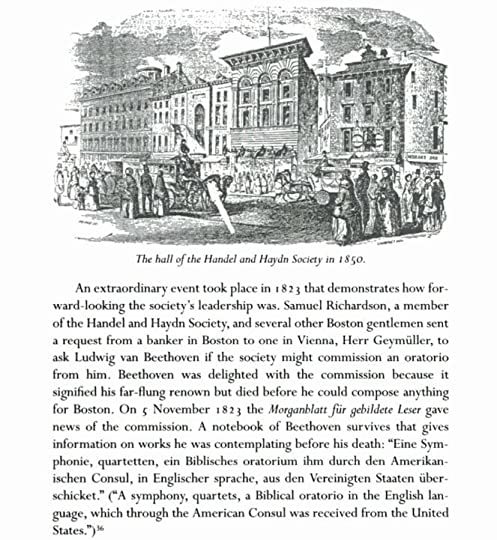
Shortlisted for the 2020 Goldsmith's Prize and the 2021 Republic of Consciousness Prize, and longlisted for the 2021 Walter Scott Prize for Historical Fiction, Mr Beethoven is playful fiction, which subverts the genre. Its central—preposterous—premise is that Beethoven did not die in 1827, but lived long enough to travel to Boston in 1833 to produce a Biblical oratorio commissioned by the (amateur) Handel and Haydn Society. This graphic via a review by Paul Fulcher at Goodreads reproduces a newspaper clipping that confirms the existence of the commission.
Beethoven's hearing loss was severe by then, (and he was suffering from excruciating tinnitus too though this is not mentioned in the novel) but his task in the novel is eased by the presence of a young woman called Thankful, fluent in the sign language used extensively in Martha's Vineyard. (This was apparently because there was a high incidence of congenital deafness in Martha'a Vineyard at that time, because of intermarriage amongst people with a recessive genetic mutation. Like other aspects of this playful story, this is derived from historical fact.) In no time Beethoven masters this sign language and communication is established. (Well, it is fiction.) This enables him to tell the indignant librettist Ballou that his work is unusable, to fob off enquiries about how he's getting on, and to indulge in mild intrigues with Thankful who doesn't always translate exactly what is said to her. 'It's more of the same', she says, presumably keeping a straight face as she does so.
There are constant playful reminders that this is not your usual historical novel.
To read the rest of my review please visit https://anzlitlovers.com/2021/06/02/m...

March 20, 2022
Historical fiction novel set around the idea that Beethoven accepted an invitation from the Haydn and Handel society of Boston to write an oratario, and he makes the visit in 1833.
Beethoven died in 1827, so the novel is an exercise in "what-might-have-been" from several angels. The author, a music critic and librettist in his own right, enjoys writing the hypothetical, but also knows only too well the limits of what he is doing. Every so often, he asks if we could have known this or that, or what buildings may or may not have existed. But then he has fun with the concept, dropping in historical figures.
In addition to that, he toys around with style. One chapter is taken from letters, another chapter has the dynamics marks (f, fff, ppp), written as guides for conversation.
As for Beethoven himself, he is a cypher. The author is tempted to suggest that if he had lived to 1833, there might have been a "fourth period", drawing from the early Renaissance. We can know a little more about the Boston of the time, although Griffiths really does cram in any other historical figure that could possibly be there at the time.
But the thing I appreciated the most is the difficulty or the fragility of the creative process - if history had gone just another way, art may have gone in another trend. If Beethoven had lived to write a 10th symphony or more string quartets, or an oratorio on the Book of Job, as seen in this novel. When the piece is performed, the last question is asked, "Did it all really happen?”
Beethoven died in 1827, so the novel is an exercise in "what-might-have-been" from several angels. The author, a music critic and librettist in his own right, enjoys writing the hypothetical, but also knows only too well the limits of what he is doing. Every so often, he asks if we could have known this or that, or what buildings may or may not have existed. But then he has fun with the concept, dropping in historical figures.
In addition to that, he toys around with style. One chapter is taken from letters, another chapter has the dynamics marks (f, fff, ppp), written as guides for conversation.
As for Beethoven himself, he is a cypher. The author is tempted to suggest that if he had lived to 1833, there might have been a "fourth period", drawing from the early Renaissance. We can know a little more about the Boston of the time, although Griffiths really does cram in any other historical figure that could possibly be there at the time.
But the thing I appreciated the most is the difficulty or the fragility of the creative process - if history had gone just another way, art may have gone in another trend. If Beethoven had lived to write a 10th symphony or more string quartets, or an oratorio on the Book of Job, as seen in this novel. When the piece is performed, the last question is asked, "Did it all really happen?”

January 18, 2022
This fiction was a joy to read. Beethoven in America! Every word he speaks is truly his own - taken from letters - and made to fit the conversations - sometimes a bit strange. Mr. Griffiths is a musical expert and it shows but not too erudite. He creates small wonderful portraits of the Bostonians and guest appearances are made by the likes of Melville and a very subtle one, I think!, by Emily Dickinson.

December 25, 2023
An absolutely interesting novel - I love the ideas presented here and the characterization of Beethoven and Thankful- one of the best relationships in novels I’ve read in a while; truly human.
The fourth wall doesn’t exist constantly addressing that this is a fictional creation but so filled with factual possibilities. Really interesting
The fourth wall doesn’t exist constantly addressing that this is a fictional creation but so filled with factual possibilities. Really interesting

November 1, 2020
A postmodern study of Beethoven, told through the artifice of extending his life a few more years, and visiting Boston to write an oratorio on the subject of Job, reimagining the genre as he does so. Beautifully structured and written.

January 15, 2022
i love. some funky historical fiction. that acknowledges its own research

November 30, 2025
Really great, interesting read. Sometimes I wanted the metafictional stuff to get out of the way, and one of the cameos was a little cute, maybe, but who knows.

November 6, 2021
Yet another book charms me by playing with history in a vibrant way. The first 3/4 is tremendous, weaving in wonderful (albeit, wholly imagined) anecdotes of Beethoven’s time in America. Breaking the fourth wall in a similar vein to HHhH by Binet, the story is quite enjoyable. The latter 1/4 gets a little choppier, relying more on long passages lifted from Job and a very in depth summary of the imagined oratorio itself. Griffith brings a scholar’s ear/hand to this section going deep into minutiae but this is not why I was here.

August 23, 2021
In 1823, Beethoven was commissioned to compose a biblical oratorio in the United States of America. He didn’t live to take up the commission… but what if he had? That’s the question posed by music critic Paul Griffiths in this novel.
I like it when historical fiction acknowledges the constructed nature of history. Mr. Beethoven goes much further than that. We begin with Beethoven on a ship headed for Boston – yet Griffiths emphasises that this is not how things were, but a plausible alternative:
It would be possible to work out which vessel this might have been, in whose dining salon these people were delving into their cabbage soup with greater or lesser pleasure. Suppose the year was 1833, as could well have been the case...
In this way, Griffiths is able to take his novel apart and rebuild it as he goes. The sense that this all provisional, contingent, raises the hairs on the back of one’s neck. There’s a brilliant chapter which rehearses a conversation between Beethoven and his librettist, Reverend Ballou, three times. In the first two versions, the composer says the same things but Ballou’s dialogue changes, giving the scene a completely different tone. In the third version, Beethoven doesn’t understand Ballou at all. Which is the ‘correct’ conversation? Take your pick.
Communication is one of the first problems that Beethoven encounters. Griffiths imagines a girl named Thankful, who uses Martha’s Vineyard sign language to interpret for him. But there’s still inevitably a distance between the composer and the world around him. All of Beethoven’s dialogue in the novel has been taken directly from his letters. Of course, it’s then out of context, which has the effect of making Beethoven seem to be at a slight remove from reality. It’s subtle but unnerving.
The subject of Beethoven’s oratorio is Job. As Thankful listens to the performance, she reflects on its meaning: “It is about this universe in which God is omnipotent. And it is about a larger universe in which God is powerless, helpless.” I’m struck that Mr. Beethoven puts its author in a similar position: totally in control over what’s between the covers in one sense, but at the mercy of history in another. If the author is like God, then – as Robert says in his review – Beethoven in this novel is like Job, undergoing his own trial of faith (in himself as much as anything).
Mr. Beethoven is a novel that twists language and history to explore what might have been, but also to expose the inherent fragility of any fictional account. I must mention as well that this is a beautifully made volume from Henningham Family Press. I was pleased to discover it through last year's Goldsmiths Prize.
I like it when historical fiction acknowledges the constructed nature of history. Mr. Beethoven goes much further than that. We begin with Beethoven on a ship headed for Boston – yet Griffiths emphasises that this is not how things were, but a plausible alternative:
It would be possible to work out which vessel this might have been, in whose dining salon these people were delving into their cabbage soup with greater or lesser pleasure. Suppose the year was 1833, as could well have been the case...
In this way, Griffiths is able to take his novel apart and rebuild it as he goes. The sense that this all provisional, contingent, raises the hairs on the back of one’s neck. There’s a brilliant chapter which rehearses a conversation between Beethoven and his librettist, Reverend Ballou, three times. In the first two versions, the composer says the same things but Ballou’s dialogue changes, giving the scene a completely different tone. In the third version, Beethoven doesn’t understand Ballou at all. Which is the ‘correct’ conversation? Take your pick.
Communication is one of the first problems that Beethoven encounters. Griffiths imagines a girl named Thankful, who uses Martha’s Vineyard sign language to interpret for him. But there’s still inevitably a distance between the composer and the world around him. All of Beethoven’s dialogue in the novel has been taken directly from his letters. Of course, it’s then out of context, which has the effect of making Beethoven seem to be at a slight remove from reality. It’s subtle but unnerving.
The subject of Beethoven’s oratorio is Job. As Thankful listens to the performance, she reflects on its meaning: “It is about this universe in which God is omnipotent. And it is about a larger universe in which God is powerless, helpless.” I’m struck that Mr. Beethoven puts its author in a similar position: totally in control over what’s between the covers in one sense, but at the mercy of history in another. If the author is like God, then – as Robert says in his review – Beethoven in this novel is like Job, undergoing his own trial of faith (in himself as much as anything).
Mr. Beethoven is a novel that twists language and history to explore what might have been, but also to expose the inherent fragility of any fictional account. I must mention as well that this is a beautifully made volume from Henningham Family Press. I was pleased to discover it through last year's Goldsmiths Prize.
November 4, 2021
Griffiths starts with a great premise.
In 1823 Beethoven gets a commission to write a oratorio on a biblical theme for the Boston Handel and Hayden Society. In this book, instead of dying in 1827 without ever completing the work, Beethoven travels to Boston in 1833 to complete the work and see its premier in Boston.
Beethoven is greeted as the great composer and Boston high and respectable society is excited to have him. Beethoven's deafness adds a strangeness to his presence in a foreign land. Griffiths introduces a young woman, thankful, who grew up in the deaf community on Martha's Vineyard. She teaches Beethoven the unique Martha's Vineyard sign language.
The story is filled with historic characters from 1833 Boston. Beethoven spends several weeks in the Quincy estate in Quincy Massachusetts.
Griffiths adds to the great premise a fascinating approach to writing an historical novel. He swings wildly back and forth between writing the novel and writing about how he would write this novel if he were writing it. At other times he tells us which part of the story he had to make up because there is no evidence on a particular point. At other times he lies about things, like the fact that Beethoven was alive in 1833. Sometimes he describes in detail the research he did to come up with accurate details. At other times he tells very moving stories. For example, we get a touching quasi-unacknowledged love story that captures the emotions buried in proper Boston.
Griffith also plays constantly with point of view. Sometimes we are in a classic society novel told in a witty third person voice. At times a scholarly speaker discusses the historical issues involved in recreating a scene. Sometimes the author is telling us what he thinks about what is going on. At one point we get the voice of a dissatisfied reader.
Griffith pulls off this stunt. The story is gripping. Beethoven is mysterious but basically decent. Thankful, the sign language translator, is also a mysterious self contained person. The Boston bigwigs who sponsored Beethoven's trip are in part small town boosters and in part real fans of great music.
Underneath the fun pyrotechnics of style, this is a subtle and well drawn story of basically decent people mystified about what to do with a deaf genius.
In 1823 Beethoven gets a commission to write a oratorio on a biblical theme for the Boston Handel and Hayden Society. In this book, instead of dying in 1827 without ever completing the work, Beethoven travels to Boston in 1833 to complete the work and see its premier in Boston.
Beethoven is greeted as the great composer and Boston high and respectable society is excited to have him. Beethoven's deafness adds a strangeness to his presence in a foreign land. Griffiths introduces a young woman, thankful, who grew up in the deaf community on Martha's Vineyard. She teaches Beethoven the unique Martha's Vineyard sign language.
The story is filled with historic characters from 1833 Boston. Beethoven spends several weeks in the Quincy estate in Quincy Massachusetts.
Griffiths adds to the great premise a fascinating approach to writing an historical novel. He swings wildly back and forth between writing the novel and writing about how he would write this novel if he were writing it. At other times he tells us which part of the story he had to make up because there is no evidence on a particular point. At other times he lies about things, like the fact that Beethoven was alive in 1833. Sometimes he describes in detail the research he did to come up with accurate details. At other times he tells very moving stories. For example, we get a touching quasi-unacknowledged love story that captures the emotions buried in proper Boston.
Griffith also plays constantly with point of view. Sometimes we are in a classic society novel told in a witty third person voice. At times a scholarly speaker discusses the historical issues involved in recreating a scene. Sometimes the author is telling us what he thinks about what is going on. At one point we get the voice of a dissatisfied reader.
Griffith pulls off this stunt. The story is gripping. Beethoven is mysterious but basically decent. Thankful, the sign language translator, is also a mysterious self contained person. The Boston bigwigs who sponsored Beethoven's trip are in part small town boosters and in part real fans of great music.
Underneath the fun pyrotechnics of style, this is a subtle and well drawn story of basically decent people mystified about what to do with a deaf genius.

January 2, 2021
The last book I finished in 2020. I chose to finish it last, putting it aside in early December with 25 pages to go. Why? Because the book itself is the most beautiful I've read this year and I wanted to see its cover on my GR 2020 in books compilation.

It's also a very cool book, imaging that Beethoven lived a few more years and came to Boston to create and produce a musical production, based on the Biblical story of Job, for the Handel and Haydn Society. In the text of the story, the author tells us how his research led him to choose the ship in which Beethoven crossed the Atlantic, to provide a translator (a young woman from Nantucket who knew sign language), to pick the soloists, to pick a poet to rewrite the text of the songs, and other things, all within the realm of possibility. The author also uses actual sentences and phrases that Beethoven wrote in his letters for all of Beethoven's dialogue. The book was slow at the beginning as it moved from story to the author explaining his choices, but eventually I settled in and it flowed, especially at the end as the rehearsals took place. We were treated to both the verses of the songs and music (helps that the author knows his music!).
I was even more impressed by this book when I read the reviews of GR friends and learned the Paul Griffiths was an Oulipian author. I had no idea what that meant so had to engage in a bit of research to learn about the restrictions an Oulipian author chooses to use -- fascinating!
Thank you Paul Griffiths for this present for Beethoven's 250th birthday!!
It's also a very cool book, imaging that Beethoven lived a few more years and came to Boston to create and produce a musical production, based on the Biblical story of Job, for the Handel and Haydn Society. In the text of the story, the author tells us how his research led him to choose the ship in which Beethoven crossed the Atlantic, to provide a translator (a young woman from Nantucket who knew sign language), to pick the soloists, to pick a poet to rewrite the text of the songs, and other things, all within the realm of possibility. The author also uses actual sentences and phrases that Beethoven wrote in his letters for all of Beethoven's dialogue. The book was slow at the beginning as it moved from story to the author explaining his choices, but eventually I settled in and it flowed, especially at the end as the rehearsals took place. We were treated to both the verses of the songs and music (helps that the author knows his music!).
I was even more impressed by this book when I read the reviews of GR friends and learned the Paul Griffiths was an Oulipian author. I had no idea what that meant so had to engage in a bit of research to learn about the restrictions an Oulipian author chooses to use -- fascinating!
Thank you Paul Griffiths for this present for Beethoven's 250th birthday!!

June 25, 2022
This is a really unique novel. Is it possible to appreciate and enjoy a novel when you don't really know what the author's trying to do? I think so. (I often did when reading Tom Robbins, for example, though I don't mean to compare this to his wacky novels.) It's hard to describe this. It seems to be cast as a historian describing a visit Beethoven supposedly made to Boston in 1834 to complete a commission by Boston's Handel & Haydn Society for a biblical oratorio on the book of Job, though the author also occasionally explicitly acknowledges that it's a fictional account. (Of course, Beethoven was actually dead by that time.) It frequently includes actual people and documents from the time. But it's all pretty whimsical, even as it, perhaps paradoxically, feels plausible and authentic because of the author's evident depth of musical knowledge as well as his mastery of the social and musical knowledge of Boston at the time. I think it's in part a spoof of historians' accounts of events for which there is actually very little documentation, thus necessitating frequent speculation. (I'm reading one at the same time, ironically: All That She Carried by Tiya Miles.) [I could be wrong about this; professional reviewers don't seem to think so.] The novel is full of gimmicks, e.g. the 5-page chapter (39) that is all one run-on sentence. And there are lots of (often explicitly admitted) digressions, e.g., the description of an art sale (ch. 15), that contribute little if anything to the general narrative. Despite everything, I really enjoyed this, but it definitely won't appeal to all readers.

October 19, 2023
Set five years after Beethoven's death, this meticulously researched and historically populated story of a journey Beethoven might have made to Boston to write an oratorio is therefore historical and fiction, but decidedly not historical fiction. Speculative historical metafiction? It doesn't really need a genre if you like literature, because its a great read. One of my favorite aspects was the sensation of reading an orchestral piece. The first chapter, a simple melodic storyline in the flute say of a cabin boy rousing the deaf composer for a meal. Then joined by strings, with the layered perspectives in the author's voice of a trip to the archives, what boats are coming to Boston, from where and who is on them which might carry him if he had been alive to make the trip? The wind section joins in building from the stroll through the gallery to gaze at contemporary paintings of the harbor to the full throated back to omniscient perspective windblown arrival standing on deck. Pause and rest with movement 2, the reception being prepared in Boston. Reading, you can carry both the narrative of the story and the researching author, chosen details and the process of choosing. And then of course, the surface story is also about choosing - a text, the words from the text, the notes, the singers - to create art from an idea, and how that turns into communication from one soul to another. The genius is the choosing. This is a book written with and about the joy of artistic creation, and it was a joy to read.

April 3, 2022
Ludwig van Beethoven accepts an invitation from the Handel and Haydn Society of Boston to travel to America to compose an oratorio to be presented by said society.
Upon arrival, Beethoven, deaf by this point in his life, is assigned a 17-year-old girl named Truthful as his interpreter. She is from Martha's Vineyard, which has a cluster of deaf people and has developed an early form of sign language. Truthful teaches this to the great composer and serves as his bridge to the eager Bostonians.
None of this happened in real life. Beethoven never traveled to America; in fact, the novel is set a few years after his death. But it's an intriguing idea for a novel.
However, Paul Griffiths writes in what I'll call an experimental style, and the experiment mostly doesn't work for me.
Nonetheless, there are some charming scenes, such as when Beethoven becomes engaged in a game of checkers with the 10-year-old son of his hosts. Also when Truthful engages in a theological debate with Beethoven's librettist, who assumes he is debating Beethoven himself. (Beethoven has given God three voices in his oratorio, and the librettist doesn't believe in the Trinity.)
To me Griffiths' writing conventions, such as writing much of the novel in the conditional ("Beethoven would have ...") detracted from what was otherwise a good story.
Upon arrival, Beethoven, deaf by this point in his life, is assigned a 17-year-old girl named Truthful as his interpreter. She is from Martha's Vineyard, which has a cluster of deaf people and has developed an early form of sign language. Truthful teaches this to the great composer and serves as his bridge to the eager Bostonians.
None of this happened in real life. Beethoven never traveled to America; in fact, the novel is set a few years after his death. But it's an intriguing idea for a novel.
However, Paul Griffiths writes in what I'll call an experimental style, and the experiment mostly doesn't work for me.
Nonetheless, there are some charming scenes, such as when Beethoven becomes engaged in a game of checkers with the 10-year-old son of his hosts. Also when Truthful engages in a theological debate with Beethoven's librettist, who assumes he is debating Beethoven himself. (Beethoven has given God three voices in his oratorio, and the librettist doesn't believe in the Trinity.)
To me Griffiths' writing conventions, such as writing much of the novel in the conditional ("Beethoven would have ...") detracted from what was otherwise a good story.

Read
May 10, 20222022 reads, #25. DID NOT FINISH. This alt-history novel has an irresistible premise, which is why I picked it up -- what if, near the end of his life, Beethoven had had an opportunity to travel to America in the 1830s, to attend the premiere of a new piece specifically commissioned by a chamber music group in Boston? But alas, author Paul Griffiths (who's actually more well-known as a music critic than a novelist) writes the whole thing in a deliberately artsy, deliberately pretentious prose style, one specifically meant to hold the audience at arm's length from the actual story taking place, so not only like we're reading a Wikipedia entry on the subject but like we're listening to some hoary old professor actually read that Wikipedia entry out loud, inserting his own snotty little comments at the end of each paragraph and sorta wandering off Alzheimer's-style into a whole series of digressions that have nothing to do with the story itself. I stuck in there for 50 pages, but even at that point I felt like I was floating on top of the story and looking in, instead of actually being fully immersed within the events taking place; so at that point I officially gave up and turned it back in at the library. Your own results may vary, but caution and low expectations are recommended nonetheless.
Displaying 1 - 30 of 42 reviews