Jump to ratings and reviews
Rate this book

The Infinite Retina: Spatial Computing, Augmented Reality, and how a collision of new technologies are bringing about the next tech revolution

Rate this book
A compelling and insightful look at the future of Spatial Computing, and how this cutting-edge technology is changing the way we do business across seven primary industries, and what it means for humanity as a whole. What is Spatial Computing and why is everyone from Tesla, Apple, and Facebook investing heavily in it? In The Infinite Retina, authors Irena Cronin and Robert Scoble attempt to answer that question by helping you understand where Spatial Computing-an augmented reality where humans and machines can interact in a physical space-came from, where it's going, and why it's so fundamentally different from the computers or mobile phones that came before. They present seven visions of the future and the industry verticals in which Spatial Computing has the most influence-Transportation; Technology, Media, and Telecommunications; Manufacturing; Retail; Healthcare; Finance; and Education. The book also shares insights about the past, present, and future from leading experts an other industry veterans and innovators, including Sebastian Thrun, Ken Bretschneider, and Hugo Swart. They dive into what they think will happen in Spatial Computing in the near and medium term, and also explore what it could mean for humanity in the long term. The Infinite Retina then leaves it up to you to decide whether Spatial Computing is truly where the future of technology is heading or whether it's just an exciting, but passing, phase. The Infinite Retina is for anyone interested in the future of technology and how Augmented Reality and Spatial Computing (among other developments) will affect both businesses and the individual. Part Why Spatial Computing and Why Now? Part The Seven Visions Part The Spatial Business

402 pages, Hardcover

Published May 8, 2020

86 people are currently reading
329 people want to read

About the author

Irena Cronin

12 books7 followers
Irena Cronin is SVP of Product for DADOS Technology which is creating a data analytics and visualization platform for the Apple Vision Pro. She is also the CEO of Infinite Retina which provides research to help companies develop and implement AI, AR and other new technologies for their businesses. Previous to this, she worked for several years as an equity research analyst and gained extensive experience in evaluating both public and private companies.

Cronin has a Joint MBA/MA from the University of Southern California and an MS in Management and Systems from New York University. She graduated with a BA from the University of Pennsylvania with a major in Economics (summa cum laude). She has near-fluent proficiency in Mandarin, intermediate in Japanese and beginning in Korean.

Ratings & Reviews

What do you think?
Rate this book

Friends & Following

Create a free account to discover what your friends think of this book!

Community Reviews

5 stars
9 (18%)
4 stars
24 (50%)
3 stars
12 (25%)
2 stars
2 (4%)
1 star
1 (2%)
Displaying 1 - 11 of 11 reviews
Profile Image for Brian Clegg.
Author 161 books3,173 followers
August 9, 2020
I really wanted to like this book - spatial computing and augmented/virtual reality are topics that are fascinating and will definitely influence our lives. There is a lot on them in this chunky tome, but a considerable amount of the content is repetitive, and it suffers strongly from geek-enthusiasm, making wildly optimistic predictions of how we'll all be wearing augmented/virtual reality glasses by 2023-2025, and of the transformative dominance of autonomous vehicles (self-driving cars if you prefer fewer syllables).

The approach to each of these areas was, for me, full of issues. If I think about what I currently use a smartphone for and it's a very wide range of applications - maybe 40 different roles - but I can only think of one, following directions using mapping software, that would be enhanced by augmented or virtual reality. Similar, my main computer I do maybe 20 different things more intensively. Here, for example while working with text documents or spreadsheets, I can't see any point whatsoever.

Similarly, the self-driving cars section seemed dominated by enthusiasm for the concept and Tesla-love. (Tesla gets an awful lot of mentions.) But it didn't address the problem of what will happen when autonomous vehicles kill hundreds of people. Yes, they will be saving thousands of lives - but those are virtual lives, not real people. The families of those killed by robots or faceless corporations will be very real people. Such is the authors' enthusiasm for self-driving cars, at one point they comment 'Electric vehicles are cheaper. Autonomous vehicles are too...' At the moment you pay at least £15,000 extra for an electric car over the equivalent petrol vehicle. Autonomous will have a significantly bigger markup still. Yes, you save on fuel costs - but it's going to take a good number of years to pay off that strange version of 'cheaper' that involves paying a whole lot more.

The trouble with looking at this sort of technology through geeky eyes is the assumption that everyone else is like you and cares all that much about the latest hot tech - but most of us don't really care as long as what we have does the job. What the authors seem to miss when they predict an explosion of AR/VR headsets is that (as they tell us) this technology has existed in the military since the 1960s and commercially since 1990s. But it is still only bought by a tiny fraction of a percent of computer/smartphone users, in part because people don't like to wear stuff on their face. (Remember 3D TV anyone?) Yes, the technology has come on in leaps and bounds, but Cronin and Scoble really don’t explain how we can possibly get from where we are now in 2020 to AR/VR glasses being mass market affordable products in 3 to 5 years time as they suggest.

Occasionally, the book does acknowledge some of the problems, and here it's at its most effective. In a section on why Google Glass failed so spectacularly, for example, it notes that one big problem was the over-hyping of the product (even though that's exactly what's being done in this book for the next generation). Similarly, there's a really well-thought out section on the difficulties that are going to be faced over privacy and data sharing if we're using systems that track our every movement, down to where we're looking all the time. One scary revelation, for example, is that already a Tesla is constantly capturing and photographing everything it passes and sharing the information. I'd love to be able to afford an electric car, but what I've read here has certainly persuaded me it shouldn't be a Tesla.

I genuinely did appreciate reading the book for those occasions when it got real. (There was also a lot of interesting material on the use of spatial computing technology in, for example, warehousing and retail.) But what perhaps should have been the most interesting but balanced bits - on the personal environment, including what we currently use smartphones for, and cars - felt like wading through fanboi treacle.

P.S. spot the grammatical error in the subtitle 'Spatial Computing, Augmented Reality, and how a collision of new technologies are bringing about the next tech revolution.'
Profile Image for Arthur.
97 reviews6 followers
June 8, 2020
I was as amazed as thrilled reading about the past and the future of the computing, robotic and artificial intelligence technologies in retrospect to its mass use. So much to find out, so much to come!
I must say this not a typical technical book as you would expect from a seemingly technical publisher, it is a prophesy on the near future computing and networking with facts. Most importantly, how it will impact our lives. Today, tomorrow, or very soon. Some facts and events covered in the book are very recent e.g. the impact assessment of the COVID-19 virus and what shifts it made on the technology, and some facts are from a lesser known not so distant past.
I think the book ties it all well together even explaining the rationale behind the recent advancements and where we go.
Much enjoyed, highly recommend.
Profile Image for Mojtaba Tabatabaie.
17 reviews10 followers
May 22, 2020
Robert Scoble and Irena Cronin have done a great job of analyzing the current trends of AR/VR and spatial computing in this book. If you are active in the field of AR, VR, AI, Autonomous cars or want to have a better understanding of how the next decade will look like, Don't miss this book. It's a must-read!
Profile Image for Walter Ullon.
332 reviews164 followers
June 8, 2020
I'll be honest and confess that I never heard of the term "Spatial Computing" until I picked this book up, which the authors define as:

...all software and hardware technologies that enable humans, virtual beings, or robots to move through real or virtual worlds, and includes Artificial Intelligence, Computer Vision, Augmented Reality (AR), VR, Sensor Technology, and Automated Vehicles.
I guess I always saw these technologies as belonging to separate classes, and never under the umbrella of a single taxonomy. The authors did a great job showing the way in which these tools build on each other, spurring symbiotic advances that disrupt the old ways of working, learning, and doing business.

It's a fascinating and prescient book in many ways: part history book, part current tech trends reporting, and part sci-fi, as the authors have given themselves license to playfully (but tactfully) extrapolate the effects these technologies will have on Transportation, Technology, Media, Telecommunications, Manufacturing, Retail, Healthcare, Finance, and Education, in the coming decades. Turns out there's a ton more to learn about advances in these areas that I ever imagined.

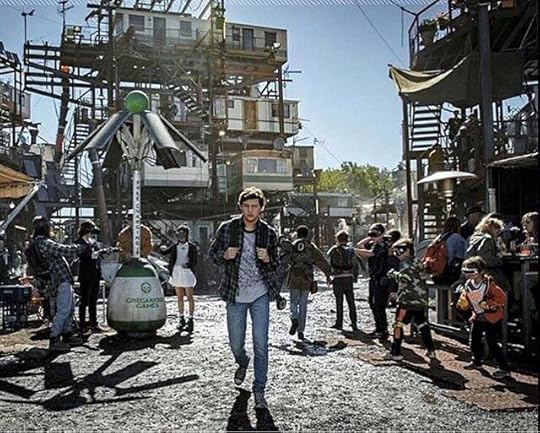
Here's where the book awoke some dystopian fears in me though, If you have read "Ready Player One" then you know where I am going with this.

description

description

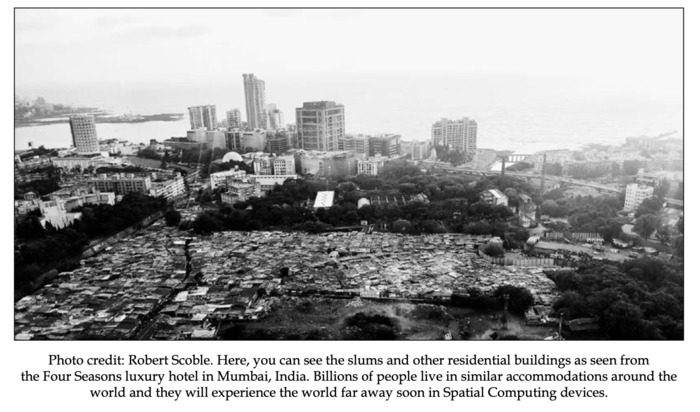
There's a section of the book where the authors sing the praises of VR as escapism for those living in slums and other poor areas: "...they will experience the world far away soon in spatial computing devices". I suppose this is better than nothing but I can't resist thinking some will see this type of arrangement as a "cash cow", i.e. keeping the poor masses entertained and ready to connect (for a fee). Technology as a full-time distraction, as a drug, is pernicious. Technology as a tool for social and economic mobility is what we should strive for; no VR connected slums. The people living in these places struggle daily to put food on the table, clothe themselves, and source other basic necessities (like clean running water, sewage, and internet), thus I find the authors out of touch for thinking that they will be able to afford expensive VR headsets and plug in for a bit of 1st world fun!

The authors recognize some of these issues and tell us that...

"It does not escape us that in the process of creating and using technologies to aid and entertain, human beings can become slaves to those very technologies, which have the effect of dehumanizing them. Another passage to dehumanization is the effort to reduce too easily to data the characteristics of human individuals and human life for the sole purpose of commerce, rendering humans down to basic tools of utility. When human beings overly view themselves and others as consumption machines and the content of their lives as data points, they become estranged from themselves. An inherent contradiction is that this kind of rationalization is in itself very human. The key to avoid estrangement is to be balanced between our actual human needs and human wants."


However, as good as the book is, I believe it is still incomplete and a bit too cheerful and one-sided in its reporting, which is why I decided to subtract one star. The authors give the issues of privacy, security, identity, and ownership, a solid and thorough treatment but gloss over the effect Spatial Computing will have (and is already having) on the economy as automation gives rise to unemployment; it's like reading the benefits of the pill without telling you the side effects. Thus I found it imperfect.

Overall, this is an excellent and authoritative account of Spatial Computing that is a must-read for anyone looking to understand how the current and future world is being shaped by these amazing technologies.

Highly recommended!
Profile Image for Toshihisa Kawamata.
1 review
February 25, 2024

This is a marvelous book. Apparently released in 2020, I am reading it in 2024, after the launch of the Apple Vision Pro. The book's title, "Infinite Retina," might suggest boundless vision, but its subtitle, "Spatial Computing, Augmented Reality, and how a collision of new technologies are bringing about the next tech revolution," truly encapsulates its content. It feels like spatial computing could well be synonymous with VR.

It's an incredibly timely read for those of us developing an interest in VR. Although it's a bit challenging to grasp the concept of past technologies, the abundance of photographs in the book significantly aids in understanding.

Chapter 1, titled "Why Spatial Computing and Why Now," provides a broad overview of VR up to 2020. There was a lot I didn’t know, and I appreciate the comprehensive perspective provided.

Section 2, "Four Paradigms and Six Technologies," categorizes the evolution of VR into four segments and introduces six technologies that have enabled current VR experiences.

It traces the evolution of personal computing from the Apple II, presenting key technological developments. Looking back from 2024, there are elements that prompt a reaction of "Ah, so that was the state of things," though some aspects, especially regarding 5G, are slightly disappointing. Nonetheless, I view this as an incredibly useful snapshot.

Chapter 2, "The Seven Visions," discusses spatial computing across various industries, covering seven sectors in a unique classification that includes automotive, virtual spaces and the devices to access them, manufacturing, healthcare, education, and finance, among others. This section is rich with real-world examples and discussions of failures, including technology that was too cumbersome or didn't perform as well as expected, offering plenty of insightful observations.

Chapter 3, "The Spatial Business," builds on the previous chapter with future outlooks and interviews. The discussions on what hasn’t been realized offer a good opportunity for reflection on the reasons behind these shortcomings, which I find valuable.

I am looking forward to a revised edition potentially coming out by the end of this year. Let’s keep our expectations high after reading this book.
Profile Image for John.
Author 3 books8 followers
December 5, 2020
The author take forever to get anywhere, and when they get there, the pay-off is lacking.

It's a hype book by people who seem to lack depth in the field (to be fair, I didn't go back and check their credentials, so either they lacked the background, or they targeted the book to a too-basic audience which undermined the book).

For example, an immediate early trigger was their discussion of the impact of 5G on distributed simulation (telepresence or games or whatever), and basically declare the problems of netcode and the like solved, which isn't the reality at all -- it's just that delays are lessened. There is still a partial ordering of events, just with a tighter window, and still issues of dealing with severed connections and reconciliation. Now it's true that with telepresence and telerobotics, the situations are a bit more one-to-one and simplified (ignoring SLAM and only speaking to the issue of the delay, feel, "acceptable" mutual truth for participants), but in any social multi-agent environment, that's still a problem (still very true of games). That colored my view from the beginning, but the book had a lot of that.

It's like reading one of the latest breathless discussions of machine learning, which fail to reflect the actuality of problems underlying it all. Lots of wowee discussion, think how crazy the future will be.

Now I didn't read all of it, quit in the middle. It's possible were I to go back sometime I'd have a kinder assessment. It's just not what I expected in picking up a book like this. I want to read something that doesn't trigger constant skepticism. Perhaps the book needed more comments from other experts in the field to draw the author down from the clouds, get to the point faster, and cover the areas where they lack expertise.
Profile Image for Nick.
Author 5 books10 followers
January 9, 2025
Like Robert Scoble's persona, this book is full of fantastical ideas of the future set in a world where computers are smarter than humans but also benevolent. In particular this book focuses on spatial computing, the confluence of 3D rendering alongside new user interface paradigms.

It's quite interesting to read it today, five years after publication, as the authors do make a handful of predictions about what will happen now and others that will happen by the end of the decade. Many of the predictions are in the right direction but overly ambitious. They were right about Apple producing a headset, albeit earlier than they actually did. However, they were too eager for its success and their ability to quickly pivot into producing glasses.

They really do gloss over the privacy issues, only briefly mentioning China's surveillance apparatus at the end, and seem confident that there's no need to create trade-offs or that it just won't be a problem at all.

Overall, I think the book deserves 3 stars. It's a nice overview of technology in multiple industries, but it's not really looking deep into anything of them to suss out what's actually useful and what's icing on the cake.
Profile Image for Anthony O'Connor.
Author 5 books34 followers
December 4, 2020
Can’t wait.

I can’t wait for high fidelity fully immersive AR and VR. This book is a rollick through the possibilities. Hopefully the near future. A bit light weight, and at times more glossy brochure than a serious study, but nonetheless full of interesting and useful material.
Many of the applications described are distressingly trivial but then aren’t we all, for the most part. Gaming applications will be awesome. Education and research applications will rapidly change everything. What I found particularly useful was the obviously knowledgeable descriptions of who’s doing what, right now. Towards a future so bright we’ll all need to wear shades.
13 reviews2 followers
October 25, 2020
good primer on where AR/VR are at now and good predictions of important future tech and implications, just a little repetitive as stories are mentioned multiple times. could have been better edited but still a good read
Profile Image for Kevin.
266 reviews
October 26, 2021
I'm very much an AR/VR "True Believer," but this book was mostly just dull.
Profile Image for Kelly.
597 reviews3 followers
April 21, 2023
Only 3 years old and feels incredibly out of date already...
Displaying 1 - 11 of 11 reviews

Can't find what you're looking for?

Get help and learn more about the design.